Type of the Paper (Article)
How does N mineral fertilizer influence the crop residue N credit?
Risely Ferraz-Almeida1*, Natália Lopes da Silva2, Beno Wendling2
1 Universidade de São Paulo, Escola Superior “Luiz de Queiroz”. Departamento de Ciência do Solo, Piracicaba, São Paulo, Brazil; E-mail: [email protected]
2 Universidade Federal de Uberlândia. Instituto de Ciências Agrárias, Uberlândia, Minas Gerais, Brazil; E-mail: [email protected]; [email protected]
* Correspondence author (+55 1934294100)
Abstract: In no-tillage systems, there is an accumulation of crop residues (CR) which plays an important role in available of soil-N. A study was set up to provide information regarding the CR N credit, and the influence of N mineral fertilizer. An incubation was run in a loam soil with addition of a similar rate of residue (10 Mg ha-1; sugarcane, soybean, and brachiaria) and N mineral fertilizer (urea; 120 kg N ha-1). After the stabilization of biological activity, soil and remaining residues were collected, and N monitored. Results showed that the N credit was positive with application of soybean, sugarcane, and brachiaria. There was an expressive performance of soybean N credit represented by a positive balance, and a reduction from 2.49 to 0.9 g kg-1 of N in residue, with direct increase of 90% of soil-N. There is no need of N fertilizer to potentialize the soybean N credit, but it is requested to potentialize N credit of brachiaria and sugarcane. The urea demonstrated be a good enhancer of brachiaria N credit, but it was not adequate to sugarcane residues. Based in our result, the accumulation and incorporation of CR can be considered as a N credit with positive contribution in soil-N.
Keywords: sugarcane; soybean; trash; soil n; waste management
1. Introduction
In no-tillage systems, there is an accumulation of crop residues which drives the decomposition kinetics and impacts the dynamic of nutrients in soil with the mineralization and/or immobilization
of nutrients. The accumulation of crop residues also increases the soil quality, impacting positively the aggregation, water retention and cation exchange capacity in soil with a direct effect on crop
production and the diversity of fauna and flora 1–3. In Mediterranean climate, 4showed an increasing of soil quality in a no-tillage system during 15 years, represented by a higher content of organic matter
and the abundance and diversity of micro-arthropods. In tropical climate, also is commonly the increase of residues in soil in no-tillage systems, but with a rapid decomposition due to the adequate
conditions of temperature and moisture to biological activities 2,5.
The dynamic of N is affected by accumulation of residues in soil, and the main soil N reserves
are found as organic N 6,7. In the soil surface, about 90% of the N is organically combined 6. 8 showed that organic N in soil can be classified according to availability (labile pool, and stable pool) and
chemical components (i.e., hydrolysable and non-hydrolysable, ammonia, amino acid, and amino sugar); the amino acid represents the highest N organic content in soil, followed by non-hydrolysable, ammonia, and amino sugar. The N in residue, when is mineralized by soil microorganisms, is
converted into mineral fractions (nitrate, NO3-; and ammonium, NH4+)9. The NO3- presents a high mobility in the soil surface due to the low interaction and predominance of negative charge in tropical
soil. While, the NH4+ presents a higher efficiency due to low mobility in the soil surface. In the N net in soil, there are N losses by nitrate leaching 10, nitrous oxide emissions 11,12, and ammonia
volatilization 13.
The uses of legume cover crops have been presented as alternatives to enrich soil N by
accumulation and decomposition of remaining residue. The term “N credit” has been associated to soil N derived from cultivation of soybean (Glycine max L.) in succession systems of soybean and corn (Zea mays L). The efficiency of N credit is variable due to the direct influence of biological activity in N mineralization. Studies of 2,14,15 showed that the rate of residue mineralization in soil depends of temperature, soil moisture, and management (i.e. rate, quality/source, and incorporation) of crop
residues. 16 showed that in a sandy soil, soybean remaining residue provided little N to subsequent crops due to N losses by leaching; but there was an increase of corn yield and N uptake in subsequent
crop in a silt loam soil. 17 noticed that the use of sunn hemp (Crotalaria spectabilis) as cover crop promoted sugarcane (Saccharum officinarum) yield in subsequent years, but there was no effect in content of soil N. Possible, the plays role of N credit of legumes (i.e. soybean; sunnhemp; bean, Phaseolus vulgaris; and lentil, Lens culinaris), not only soybean, also is associated to the quality/quantify of N mineral fertilizer in subsequent years. 4 showed that the application of Vicia villosa (legume), known as the hairy vetch in Europe/Western Asia, can be considered as a N organic source and its effect is enhanced when associated with a moderate N rate.
Even with positive benefices of crop residues in N dynamic, the application of mineral fertilizer is commonly performed in tropical condition after legumes planting without counting the N credit.
Possibly, studies that demonstrate the legume N credit and influence in N soil and crop subsequent yield can contribute to decrease the use of mineral N and improve N credit supplied by legumes in
crop sequences. It seems reasonable the reducing of conventional N fertilizers by organic N source derived by legume residues. If success the association of N sources (organic and mineral), isolated or associated, will achieve the principles of a circular economy with an adequate balance of society,
economy, and environment 18,19.
This study was set up to provide information regarding the potential of crops residues N credit,
as a complementary N source associated with N mineral fertilizer. We hypothesized that the addition of crop residues (soybean, brachiaria and sugarcane) can be an alternative to increase the N content
in soil. The goal here was to monitor the inputs of N in soil by the application of crop residues and N mineral fertilizers, and theirs impact in content of soil N and remaining residues N after the stabilization of biological activity in soil.
2. Materials and Methods
2.1 Experimental characterization
A study of incubation was run with additions of residues (soybean, brachiaria and sugarcane), and N mineral fertilizer in soil, isolated or associated, using three replications in a completely
randomized block design. Soil without inputs of residues or N mineral fertilizer was monitored as a control.
Prior the incubation, soil and residues were collected from areas cultivated with soybean, brachiaria, and sugarcane, located in the region of Uberlândia and Uberaba (latitude 19°13′00.22″S
and longitude 48°08′24.80″ W; 900 m), with a climate classified as Cwa (tropical cliamte), according to the Köppen classification. Soil was collected in the 0.0–0.2 m layer, and residues removed from soil
phosphorus (2.47 mg dm−3; Mehlich I), potassium (230.00 cmolc dm−3) calcium (2.20 cmolc dm−3), and magnesium (0.56 cmolc dm−3), with a soil texture classified as loam, and respective content of clay, silt and sand: 230, 140 and 630 g kg−1 (hydrometer method 21). Soil was classified as a Latossolo Amarelo22, correspondent to an Oxisol 23. The total carbon (C) and N in soil and residues were 120.00 and 1.44 g kg−1 (sugarcane); 122.40 and 1.68 g kg−1 (Brachiaria); and 142.12 and 2.49 g kg−1 (soybean),
respectively. The soil C and N were monitored by the acidified dichromate method 24 and the Kjeldahl method 20, respectively.
2.2 Soil and residues incubation
A soil sample of 700 g (size < 2 mm) was added in a column (volume: 1298.8 cm3; height: 13 cm; diameter: 10.5 cm) and moistened at 60 % of field capacity. An equivalent average rate of 10 Mg ha-1 (17 g of residue pot-1) of residue of soybean, sugarcane and brachiaria were incorporated and homogenized in soil surface (at the first 5 cm) to promote the contact of soil and residue. We used this similar residue rate to understand the effect of residue quality in N content in soil. In field, the residue accumulation average of sugarcane, soybean, and brachiaria, respectively, ranging from 15
to 20 25, 2 to 4 26, and 5 to 12 Mg ha-127. A rate of 120 kg ha-1 of N mineral fertilizer (urea: 45% N) was incorporated and homogenized also in soil surface (at the first 5 cm). The N rate was based in an
average of current N recommendation for crop productions in tropical conditions.
Column was fixed on a tyrofoam base properly insolated to prevent soil water loss and keeping
at 60 % of field capacity, which was constantly weighted with water addition when requested. This study was developed in incubation due to the controlled experimental conditions as demonstrated by 15,28. The setup was left in an open laboratory environment at a controlled temperature (25 °C), during 73 days of incubation. The time of incubation was based in previous studies with goals to monitor the N in soil and remaining residues after stabilization of biological activity in soil 14,15,29.
2.3 Measurements and statistical analysis
After the stabilization of biological activity with 73 days of incubation, soil and remaining
residues were collected and sieved (2 mm mesh). Soil and remaining residues were physically separated and content of total N, in each part, monitored using the Kjeldahl method 20. The balance of N in soil and residues were calculated according to the difference of N contents in 73-day and initial N content (without N addition in soil).
The variability of the variables was studied using descriptive statistics (average, standard
deviation, minimum, maximum and median values). Assumptions of residues normality and variances homogeneity were tested using the Shapiro-Wilk test, and the Bartlett test, respectively (P
≤ 0.05). Data were submitted to the t test to compare two averages (average of treatments and control; P ≤ 0.05), and the LSD test to compare more than two averages (average of residues, N, residues and
N; P ≤ 0.05).
A graphical algorithmic representation was adapted to demonstrate the inputs (crop residues
analysis was performed using R Statistical Software (version 4.0.0; R Foundation for Statistical Computing).
3. Results
3.1 Total soil N
With the general average, the application of crop residues increased 85% of N in soil followed by an increasing of 60% with the addition of N mineral fertilizer. The associated applications of both
(crop residues and N mineral fertilizer) promoted a higher N inputs in soil with an increasing of 90% (P<0.05), and, therefore, indicating an accumulated and positive effect of both N sources in soil N
content (Figure 1A).
Figure 1. Total soil N after the incubation of crop residues (R; soybean, sugarcane and brachiaria) and nitrogen mineral fertilizer (N). C represents control treatment. The soil N in control was similar in all
treatments (0.12 g kg-1). Mean of N, R, and R+N were compared by the LSD test (P ≤ 0.05), and the general mean of treatments (N, R and R+N) and control were compared by the LSD test (P ≤ 0.05),
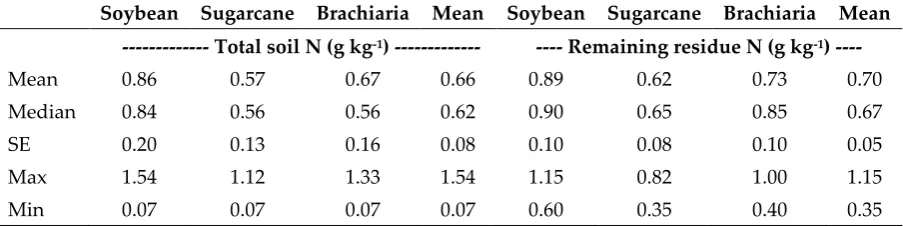
Focusing in each crop residue, the highest soil N accumulation was found with application of soybean residue with a general average of 0.86 g kg-1, followed by residue of brachiaria and sugarcane with respective general averages of 0.67 and 0.57 g kg-1 (Table 1). The associations of N mineral fertilizer and residues of soybean presented the highest soil N inputs with an average of 1.3 g kg-1 , without difference to application of soybean residue isolated (average: 1.1 g kg-1), Figure 1B. Also, there was not a significant difference in application of sugarcane residue with a general average of 0.8 g kg-1, and a small difference of 0.2 g kg-1 between the average of residue and residue + N (Figure 1C). These results showed an N input efficiency from soybean residue, and a possible N loss in systems with application of N mineral fertilizer mainly associated with sugarcane residue. On the
other hand, there was a significant effect of brachiaria residues and N mineral fertilizer which represented an increase of 42 % compared to application of residue isolated (P<0.05), Figure 1D.
Table 1. Descriptive statistics (mean, media, standard error - SE, minimum and maximum values) of N in soil and remaining residue after the incubation of crop residues (soybean, sugarcane and brachiaria) and nitrogen mineral fertilizer.
Soybean Sugarcane Brachiaria Mean Soybean Sugarcane Brachiaria Mean --- Total soil N (g kg-1) --- ---- Remaining residue N (g kg-1) ----
Mean 0.86 0.57 0.67 0.66 0.89 0.62 0.73 0.70
Median 0.84 0.56 0.56 0.62 0.90 0.65 0.85 0.67
SE 0.20 0.13 0.16 0.08 0.10 0.08 0.10 0.05
Max 1.54 1.12 1.33 1.54 1.15 0.82 1.00 1.15
Min 0.07 0.07 0.07 0.07 0.60 0.35 0.40 0.35
N = 3 and 12 observations to each residue and general mean, respectively. The treatments with application of N mineral fertilizer are included in mean of residues.
The balance of soil N revealed that the associations of crop residue and N mineral fertilizer
increased the N content in soil with an average ranging from 84 to 90%, considered 5% higher than residue application isolated (Table 2). The highest positive balance of soil N was obtained with
application of soybean residue with a sequence: soybean>sugarcane=brachiaria (residue), and soybean>brachiaria>sugarcane (residue + N mineral fertilizer). These results demonstrated that the soybean residue is a great N credit to increase soil N, and there was need of association with N
mineral fertilizer represented by a positive balance.
3.2 Remaining residue total N
With general average, there was a decrease of 62% and 50% of N in remaining residue after the incubation, respectively with application of residue and residue + N. This result indicated that the
association of residue + N promoted a higher N accumulation in residue (up to 0.2 g kg-1), if compared with incubation of residue alone (Figure 2A).
Focusing in each crop residue, the highest N accumulation in remaining residue was found by soybean with a general average of 0.89 g kg-1, following brachiaria and sugarcane with respective average of 0.73; and 0.20 g kg-1 (Table 1). In all residues, there was a reduction of N in residue compared initial N after the incubation-time with negative balance ranging from -46 to -68 % (Table
Table 2. Balance of total N in soil and remaining residue after the incubation of crop residues (R; soybean, sugarcane and brachiaria) and nitrogen mineral fertilizer (N).
Soybean Sugarcane Brachiaria
Soil N (g kg-1)
R +1.11±0.2(+90%) +0.75±0.2(+84%) +0.72±0.2(+84%)
R+N +1.31±0.1(+91%) +0.86±0.1(+86%) +1.19±0.1(+90%)
Initial N 0.12 0.12 0.12
Remaining residue N (g kg-1)
R -1.69±0.2(-68%) -0.86±0.1(-59%) -1.11±0.1(-66%)
R+N -1.51±0.1(-61%) -0.77±0.1(-54%) -0.78±0.1(-46%)
Initial N 2.49 1.44 1.68
In “initial soil N”, there was no addition of residue and N mineral fertilizer. The N balance is the
difference between N content in initial soil/residue and the 73-day of incubation; result are represented in real values (outside the parenthesis) and percentage (%; balance positive, +; and
negative, -).
As expected, the N reduction in remaining residue was more expressive in incubation of soybean with a decrease of -61% (residue + N) and -68 % (residue), respectively representing a reduction from 2.49 g kg-1 of
N in initial residue to 1.0 and 0.8 g kg-1 of N after the incubation time (Table 2; and Figure 2B). There was no
difference of N in remaining residue with application of soybean and sugarcane residue, isolated or associated with N, represented by a general average of 0.9 and 0.6 g kg-1 of N after the incubation time, respectively
(Figures 2B and 2C). In contrast, the incubation of brachiaria, and brachiaria + N decreased -66 and -46% of N in remaining residue with an average from 1.7 g kg-1 of N in initial residue to 0.6 to 0.9 g kg-1, respectively
(Figure 2 D). Therefore, these results indicated that there was N mineralization in soil, and a low N immobilization when associated to N mineral fertilizer. We also expected to find this result with application of sugarcane residue, but there was no a clear evidence of N immobilization with a general average ranging from 0.6 to 0.7 g kg-1 of N in remaining residue (Figure 2).
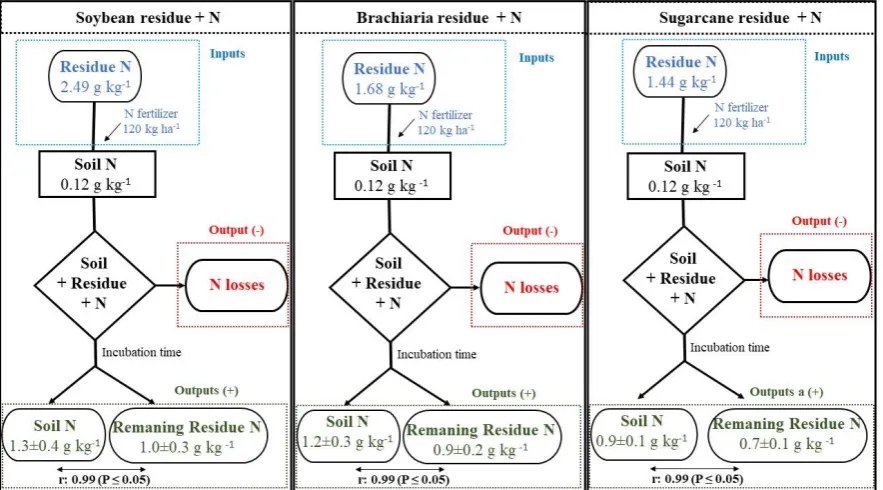
With the general mean of treatments, we observed that there was a positive correlation between the soil N and remaining residue N with a r of 0.99 with incubation of all residues (P ≤ 0.05). The inputs in systems of represented by additions of crop residues and N mineral fertilizer, while the outputs were separated into positive (N soil, and N in residue remaining) and negative (N losses). In our study, we monitored the positives outputs with general averages of 1.3±0.4; 1.0±0.3; 0.9±0.1 g kg-1 (soil N) and 1.0±0.3; 0.9±0.2; 0.7±0.1 g kg-1 (soil N),
respectively (Figure 3).
4. Discussion
Positive effect of soil N inputs with application of crop residues also is showed in literature 30,31, as well the positive effect of N mineral fertilizer 32–34. In our study, the application of crop residues increased 87% of total N in soil, while N mineral fertilize increased 61% of total N in soil, and
association of crop residue and N mineral fertilizer contributed in 90%. The positive effect of application of crop residues was expected because N organic sources played an important role in soil N cycling with additional benefices in soil quality, i.e. increase of organic matter, enzymatic activity,
Figure 2. Total N in soil remaining residue after the incubation of crop residues (R; soybean, sugarcane and brachiaria) and nitrogen mineral fertilizer (N). C represents control treatment. Mean of R and R+N, and the mean of treatments (R and R+N) and control were compared by the t test (P ≤ 0.05), significant result represented by uppercase letter and *, respectively.
The soybean residue promoted the highest soil N accumulation indicating that the total N content in residue was mineralized by soil microorganisms. In our study, there was not crop planting
to check if the plants absorbed the N in soil. In field,39–41 showed that corn yield was positively impacted by the use of cover crops using legumins (soybean or sunnhemp), explained by the increase
result from reduction of N in remaining residue in -68% and -56%, respectively when applied residue isolated or associated with N mineral fertilizer. Increasing of soil N with mineralization of soybean
residues was presented by14,15,42. 30showed that compost application of beans and soybean residues and manure increased 44 and 27% of total organic nitrogen in soil layer 0.0-0.1 and 0.1-0.2 m, respectively compared to soil without N application. In our study, the highest decrease of N in
remaining residue corroborated the N addition in soil by mineralization of soybean with a correlation of 99% (Pearson correlation). The soybean residue presented a low C:N rate and high N available
(2.49 g kg−1) to activity of microorganism in soil and N mineralization. Study of 43 with application of residues (rice straw, rice root, cowdung, and poultry manure) noticed that the high amount of N and
low C:N ratio contributed to rapid microbial decomposition and increase of N in soil. Therefore, our results and results from literature 14,15,42, indicated that the soybean residue can plays as a N source due to high N credit in soil. The application of N did not potentialize N credit of soybean residues with a small difference of 0.2 g kg-1 between residue and residue + N. In field, Blackmer (1996) showed that the N credit of soybean residues is impacted by the time of residue decomposition, N content in residue, and rate of residue accumulation. Blumenthal et al. (1988) also showed the decisions made in soybean panting influenced the quantify of accumulated residue in soil (i.e. population density
and root development). Possibly, in field, studies using model with different inputs of residues and climate conditions can help the decision of N application in successive crop, turning the N credit of
soybean as part of plant N request.
Figure 3. Graph algorithm with the inputs (crop residues and N mineral fertilizer) and outputs (Total N soil, N losses, and N in residue remaining) in the incubation system. The positive outputs were correlated using Pearson correlation (P ≤ 0.05).
with a modest contribution of N from sugarcane residue. These results are explained by a high C:N ration and low N content (1.44 g kg−1) in residue that possibly promoted a immobilization of N in
residue. 47,48 demonstrated that the high C:N in residues is associated with content of cellulose, hemicellulose, and lignin. The residues with high C concentrations, as sugarcane, the microorganisms request several cycles and an extra time to decompose it 43. 46,49 described that the immobilization of N in sugarcane residue plays as a reserve of N turning a slow release source in long-term. Interest, we expected that application of N would promote the increase of mineralization and content of N in
soil. However, in our study we did not notice this result with a small difference of 0.2 g kg-1 between residue and residue + N. Possibly this result can be associated with the low rate of residues tested,
which was 50% lower than in the field (green harvest), and application of N as a source of urea; which is characterized by high losses of N through ammonia volatilization, mainly when surface-applied to
soils 50–53. 54 showed that N lost by application of N as urea can achieve 35% of N applied when associated with sugarcane residue. Another perspective can be the physical separation of residue and
soil in the collecting after the incubation, probably for next studies will be request the physical separation of residue and soil, and a washing of residue to avoid residue contamination with soil.
The addition of brachiaria residues played as an intermediate N credit if compared with the
result of soybean and sugarcane residue. The intermediate brachiaria N credit was expected because the C:N ration and N content (1.68 g kg−1) in residue was intermediate if compared to soybean and
sugarcane residue. The application of N in brachiaria residue enhanced the N credit of brachiaria residues causing an increase of 42% of soil N as a response to reducing of 60% of N in remaining
residue. However, even with increase of soil N there was a low immobilization of N in remaining residue with N application, which reinforces our idea of residue contamination with soil. The significant contributions of brachiaria residues in soil N also is showed in literature 2,55. 29 showed an increase of soil N with addition of brachiaria residues, considered a contribution higher than residues of sorghum (84 kg ha-1; sorghum bicolor), sunn hemp (118 kg ha-1; Crotalaria juncea, black oat (29 kg ha
-1; Avena strigosa Schreb), and pigeon pea (51 kg ha-1; Cajanus cajan (L.) Mill sp), but with a lower N contributions compared to millet (165 kg ha-1; Pennisetum glaucum). The influence of brachiaria residue is associated with quantify of residues added in soil 15. The results of 29 were explained by high residue rates. 2 also showed that N addition is a great strategy to increase the N stocks in soil and avoid the soil depletion.
5. Conclusions
The N credit of incorporated crop residues was positive with application of soybean, sugarcane and brachiaria residue. There is an expressive performance of soybean residues in N credit
represented by a positive balance with a reduction from 2.49 g kg-1 of N in initial residue to an average of 0.9 g kg-1 of N in remaining residue after the incubation time, representing an increase of 90% of soil N. There is no need of N mineral fertilizer to potentialize the N credit with incorporation of soybean residues, but it requested with accumulation and incorporation of brachiaria and sugarcane
residues in soil. The urea demonstrated be a great enhancer of N credit in brachiaria residue, but it is not adequate to sugarcane residues due N losses by volatilization that is well-demonstrated in
Author Contributions: All authors conceived and ran the experiments, and contributed to the interpretation of the results, provided critical feedback, and helped shape the research, analysis and manuscript.
Funding: This research was funded by the Coordenação de Aperfeiçoamento de Pessoal de Nível Superior (CAPES; grant number, 88882.317567/2019-01).
Acknowledgments: Thanks to the Coordenação de Aperfeiçoamento de Pessoal de Nível Superior (CAPES), and the Universidade de Uberlândia, campus Uberândia.
Conflicts of Interest: The authors declare no conflict of interest.
References
1. Wendling, B., Jucksch, I., De Sá Mendonça, E., De Almeida, R. F. & Alvarenga, R. C. Simulação
dos estoques de Carbono e Nitrogênio pelo Modelo Century em Latossolos, no Cerrado Brasileiro. Revista Ciencia Agronomica45, 238–248 (2014).
2. Mikhael, J. E. R., Almeida, R. F., Franco, F. de O., Camargo, R. O. & Wendling, B. Recalcitrant carbon and nitrogen in agriculture soils with residue accumulation and fertilization under
tropical conditions. Bioscience Journal35, 732–740 (2019).
3. Almeida, R. F., Mikhael, J. E. R., Franco, F. O., Santana, L. M. F. & Wendling, B. Measuring the
labile and recalcitrant pools of carbon and nitrogen in forested and agricultural soils: A study under tropical conditions. Forests10, (2019).
4. Sapkota, T. B., Mazzoncini, M., Bàrberi, P., Antichi, D. & Silvestri, N. Fifteen years of no till
increase soil organic matter, microbial biomass and arthropod diversity in cover crop-based arable cropping systems. Agronomy for Sustainable Development32, 853–863 (2012).
5. Santos, I. L. dos et al. Cover plants and mineral nitrogen: effects on organic matter fractions in an oxisol under no-tillage in the cerrado. Revista Brasileira de Ciência do Solo38, 1874–1881 (2014).
6. Stevenson, F. J. Organic Forms of Soil Nitrogen. in 67–122 (John Wiley & Sons, Ltd, 1982).
doi:10.2134/agronmonogr22.c3.
7. Bremner, J. M. Organic Nitrogen in Soils. in Agronomy Monographs (eds. Bartholomew, W. V. & Clark, F. E.) 93–149 (John Wiley & Sons, Ltd, 1965). doi:10.2134/agronmonogr10.c3.
8. Li, S. xiu, Wang, Z. hui, Miao, Y. fang & Li, S. qing. Soil Organic Nitrogen and Its Contribution to Crop Production. Journal of Integrative Agriculture vol. 13 2061–2080 (2014).
9. Barth, G. et al. Performance of nitrification inhibitors with different nitrogen fertilizers and soil textures. Journal of Plant Nutrition and Soil Science182, (2019).
10. Ghiberto, P. J., Libardi, P. L. & Trivelin, P. C. O. Nutrient leaching in an Ultisol cultivated with sugarcane. Agricultural Water Management148, 141–149 (2015).
11. Carmo, J. B. do et al. Infield greenhouse gas emissions from sugarcane soils in brazil: Effects from synthetic and organic fertilizer application and crop trash accumulation. GCB Bioenergy 5, 267–280 (2013).
12. Almeida, R. F., Naves, E. R., Silveira, C. H. & Wendling, B. Emissão de óxido nitroso em solos
13. Gallucci, A. D. et al. Nitrogen-Enriched Vinasse as a Means of Supplying Nitrogen to Sugarcane Fields: Testing the Effectiveness of N Source and Application Rate. Sugar Tech21, 20–28 (2019).
14. Ferraz-Almeida, R. et al. CO2 emissions from soil incubated with sugarcane straw and nitrogen fertilizer. African Journal of Biotechnology13, 3376–3384 (2014).
15. De Almeida, R. F. et al. For how long does the quality and quantity of residues in the soil affect the carbon compartments and CO2-C emissions? Journal of Soils and Sediments16, 2354–2364 (2016).
16. Bundy, L. G., Andraski, T. W. & Wolkowski, R. P. Nitrogen Credits in Soybean-Corn Crop
Sequences on Three Soils. Agronomy Journal85, 1061–1067 (1993).
17. Tenelli, S. et al. Legume nitrogen credits for sugarcane production: implications for soil N availability and ratoon yield. Nutrient Cycling in Agroecosystems113, 307–322 (2019).
18. Ghisellini, P., Cialani, C. & Ulgiati, S. A review on circular economy: The expected transition
to a balanced interplay of environmental and economic systems. Journal of Cleaner Production 114, 11–32 (2016).
19. Yong, R. The circular economy in China. Journal of Material Cycles and Waste Management9, 121–129 (2007).
20. EMBRAPA, E. B. de P. A. Manual de métodos de análise de solo. (1997).
21. Gee, G. W. & Orr, D. Particle-size analysis. in Methods of soil analysis (eds. Dane, J. & Topp, G.) 255–293 (2002).
22. Embrapa. Sistema Brasileiro de Classificação de Solos. (Embrapa, 2018).
23. Soil Survey Staff. Soil Survey | NRCS Soils.
https://www.nrcs.usda.gov/wps/portal/nrcs/main/soils/survey/ (2014).
24. Yeomans, J. C. & Bremner, J. M. A rapid and precise method for routine determination of organic carbon in soil1. Communications in Soil Science and Plant Analysis19, 1467–1476 (1988). 25. Urquiaga, S., Boddey, R. M., Deoliveira, O. C., Lima, E. & Guimarães, D. H. V. A importância
de não queimar a palha na cultura da cana de açúcar. (1991).
26. Kurihara, C. H., Venegas, V. H. A., Neves, J. C. L. & Novais, R. F. de. Acúmulo de matéria seca e nutrientes em soja, como variável do potencial produtivo. Revista Ceres 60, 690–698 (2013).
27. Nunes, U. R. et al. Produção de palhada de plantas de cobertura e rendimento do feijão em plantio direto. Pesquisa Agropecuaria Brasileira41, 943–948 (2006).
28. Guo, L., Nishimura, T., Imoto, H. & Sun, Z. Applicability of soil column incubation experiments to measure CO 2 efflux**. Int. Agrophys29, 413–421 (2015).
29. Torres, J. L. R., Pereira, M. G., Andrioli, I., Polidoro, J. C. & Fabian, A. J. Decomposição e liberação de nitrogênio de resíduos culturms de plantas de cobertura em um solo de cerrado.
Revista Brasileira de Ciencia do Solo29, 609–618 (2005).
30. Maia, C. E. & Cantarutti, R. B. Acumulação de nitrogênio e carbono no solo pela adubação
orgânica e mineral contínua na cultura do milho. Revista Brasileira de Engenharia Agrícola e Ambiental8, 39–44 (2004).
32. Franco, H. C. J. et al. Nitrogen in sugarcane derived from fertilizer under Brazilian field conditions. Field Crops Research121, 29–41 (2011).
33. Altarugio, L. M. et al. Optimal Management Practices for Nitrogen Application in Corn Cultivated During Summer and Fall in the Tropics. Communications in Soil Science and Plant Analysis50, 662–672 (2019).
34. De Faria, I. K. P. et al. Optimal plant density and nitrogen rates for improving off-season corn yields in Brazil. Scientia Agricola76, 344–352 (2019).
35. Teixeira, alves W. et al. Hydro-physical properties and organic carbon of a yellow oxysol under different uses. African Journal of Agricultural Research11, 2547–2554 (2016).
36. Arruda, E. et al. Soil porosity and density in sugarcane cultivation under different tillage systems. African Journal of Agricultural Research11, 2689–2696 (2016).
37. Almeida, R. F. & Sanches, B. C. Disponibilidade de carbono orgânico nos solos do cerrado brasileiro. Scientia Agraria Paranaensis13, 259–264 (2014).
38. Almeida, R. F., NAVE, E. R. & MOTA, R. P. . Soil quality: Enzymatic activity of soil β-glucosidase. Global Science Research Journals3, 146–150 (2015).
39. Chioderoli, C. A. et al. Physycal properties of soil and yield of soybeans in corn braquiaria consortium. Revista Brasileira de Engenharia Agricola e Ambiental16, 37–43 (2012).
40. De Carvalho, M. A. C., Soratto, R. P., Athayde, M. L. F., Arf, O. & De Sá, M. E. Produtividade
do milho em sucessão a adubos verdes no sistema de plantio direto e convencional. Pesquisa Agropecuaria Brasileira39, 47–53 (2004).
41. Torres, J. L. R. & Pereira, M. G. Production and decomposition residue culture preceding corn and soybeans in the savannah oxisol miner. Comunicata Scientiae5, 419–426 (2014).
42. Uchida, Y. & Akiyama, H. Soil Science and Plant Nutrition Mitigation of postharvest nitrous
oxide emissions from soybean ecosystems: a review Mitigation of postharvest nitrous oxide emissions from soybean ecosystems: a review. (2013) doi:10.1080/00380768.2013.805433.
43. Rahman, M. M. Carbon Dioxide Emission from Soil. Agricultural Research2, 132–139 (2013). 44. Blackmer, A. M. How Much Nitrogen Do Soybeans Leave for Corn? in Proceedings of the
Integrated Crop Management Conference (1996).
45. Blumenthal, M. J., Quach, V. P. & Searle, P. G. E. Effect of soybean population density on
soybean yield, nitrogen accumulation and residual nitrogen. Australian Journal of Experimental Agriculture28, 99–106 (1988).
46. Fortes, C. et al. Contribution of nitrogen from sugarcane harvest residues and urea for crop nutrition. Scientia Agricola70, 313–320 (2013).
47. Wang, W. J., Baldock, J. A., Dalal, R. C. & Moody, P. W. Decomposition dynamics of plant
materials in relation to nitrogen availability and biochemistry determined by NMR and wet-chemical analysis. Soil Biology and Biochemistry36, 2045–2058 (2004).
48. Gunnarsson, S., Marstorp, H., Dahlin, A. S. & Witter, E. Influence of non-cellulose structural carbohydrate composition on plant material decomposition in soil. Biology and Fertility of Soils 45, 27–36 (2008).
49. Ferreira, D. A. et al. Contribution of N from green harvest residues for sugarcane nutrition in Brazil. GCB Bioenergy8, 859–866 (2016).
51. Prasertsak, P. et al. Effect of fertilizer placement on nitrogen loss from sugarcane in tropical Queensland. Nutrient Cycling in Agroecosystems62, 229–239 (2002).
52. Otto, R., Zavaschi, E., de Souza Netto, G. J. M., Machado, B. de A. & de Mira, A. B. Ammonia volatilization from nitrogen fertilizers applied to sugarcane straw. Revista Ciencia Agronomica 48, 413–418 (2017).
53. Cantarella, H. et al. Ammonia volatilisation from urease inhibitor-treated urea applied to sugarcane trash blankets. Scientia Agricola65, 397–401 (2008).
54. Costa, M. C. G., Vitti, G. C. & Cantarella, H. Volatilização de N-NH3 de fontes nitrogenadas em cana-de-açúcar colhida sem despalha a fogo. Revista Brasileira de Ciência do Solo27, 631–637 (2003).