CONSTRUCTION DEMAND MODELLING :
A SYSTEMATIC APPROACH TO USING ECONOMIC INDICATORS AND A COMPARATIVE STUDY OF ALTERNATIVE FORECASTING
APPROACHES
by
GOH BEE HUA
A thesis submitted in fulfilment of the requirements for the award of the degree of
Doctor of Philosophy
The Bartlett School of Architecture, Building, Environmental Design and Planning UNIVERSITY COLLEGE LONDON
ProQuest Number: 10017371
All rights reserved
INFO RM A TIO N TO ALL U SER S
The quality of this reproduction is dependent upon the quality of the copy submitted.
In the unlikely event that the author did not send a complete manuscript
and there are missing pages, these will be noted. Also, if material had to be removed, a note will indicate the deletion.
uest.
ProQuest 10017371
Published by ProQuest LLC(2016). Copyright of the Dissertation is held by the Author.
All rights reserved.
This work is protected against unauthorized copying under Title 17, United States Code. Microform Edition © ProQuest LLC.
ProQuest LLC
789 East Eisenhower Parkway P.O. Box 1346
Acknowledgements
I would like to take this opportunity to express my heartfelt gratitude to several organisations and people who have contributed in many ways to the successful completion o f this research.
Professor John Andrews, my research supervisor, who has been most encouraging and supportive throughout the period of my candidature. Without his unceasing help and advice, none o f this could have been possible. I will always bear in mind his research teachings for which I will strive to uphold in my future academic career.
The National University o f Singapore, for the award o f the Overseas Graduate Scholarship to undertake my doctoral study.
The Construction Management and Economics Journal, for the publication o f my paper which has greatly boosted my confidence in this research.
Professor Victor Torrance, Mr Graham Ive and Professor Philip Treleaven, for their many useful suggestions and recommendations.
Ms Wong Keng Lee o f the Urban Redevelopment Authority and Dr Francis Wong o f NIBS Inc., for the supply o f invaluable information during the course o f my research.
Several of my colleagues at the School of Building and Estate Management, National University of Singapore, namely, Lim Lan Yuan. Low Sui Pheng, George Ofori, Yu Lai Boon and Zhong Qi, for their help and concern.
My family - Mum, for coping with my absence which I know is very difficult; my sisters, especially Bee Eng, for sharing out my responsibilities in caring for my mother; and my late father, who had given me the constant will to fight.
Abstract
The published literature abounds with evidence o f a close relationship between the construction
industry and the national economy. This study reinforces the strength o f this relationship by
proposing the use of economic indicators to model demand for construction. Alternative forecasting
approaches are applied, comprising both traditional and state-of-the-art techniques. The aim is to
establish the most theoretically significant and statistically adequate indicators, and the most
accurate forecasting technique for modelling and predicting construction demand.
A systematic approach is proposed to identify and select economic indicators that relate to demand
for construction. It involves four distinct stages and they are: (1) theoretical identification; (2) data
collection and pre-processing; (3) statistical selection; and (4) usage. This stage-by-stage process
is illustrated on residential, industrial and commercial-type construction in Singapore. The findings
confirm that demand in the construction industry is significantly related to a wide range o f economic
measures.
A comparative stufy of regression and non-regression approaches o f forecasting is carried out using
Singapore's residential sector as a case-study. The techniques include the Multiple Linear
Regression, the Multiple Log-linear Regression, the Autoregressive Non-linear Regression
Algorithm and the Artificial Neural Network (ANN). Seven economic indicators have been selected
to build the demand models, and they are: Building tender price index; Bank lending for housing;
Population size; Housing stock (additions); National savings; Gross fixed capital formation for
residential buildings; and Unemployment rate. Quarterly time-series data over the period 1975 -
1994 are used. Several conclusions are drawn. Firstly, non-linear methods produce more accurate
forecasts. Secondly, the Multiple Log-linear is the most accurate regression technique. Thirdly, the
ANN technique, a non-regression approach, performs outstandingly better than the regression
approach.
Table of Contents
Page
A c k n o w le d g e m e n ts 2
A b stra c t 3
T ab le o f c o n te n ts 4
List of ta b le s 11
List of fig u re s 13
List of A p p e n d ic e s 14
1. INTRODUCTION
1.1 B ackground 15
1.2 P u rp o se of research 17
1.3 Terminology 18
1.4 S ta tem en ts of the problem s 20
1.5 Objectives of the research 21
1.6 R esea rch hypotheses 22
1.7 R esea rch m ethodology 22
1.8 S co p e of the research 24
1.9 S tructure of the thesis 25
A REVIEW OF THE RELATIONSHIP BETWEEN THE CONSTRUCTION INDUSTRY AND THE NATIONAL ECONOMY
2.1 Introduction 29
2.2 Definitions 30
2.3 T he relationship betw een building cycles and b usiness or econom ic cycles 34
2.3.1 Nature of building cycles 34
2.3.2 Interaction of building and business cycles 35 2.4 T he construction industry in the national econom ic system 37 2.4.1 Construction and m acroeconom ic theory of th e econom y 37 2.4.1.1 Construction and national output 37 2.4.1.2 Construction in relation to national consum ption and
production 38
2.4.2 T he context of the construction industry in th e national econom y 38 2.4.3 Construction and other secto rs of the econom y 40 2.5 T he role of the construction industry in econom ic policy 42 2.5.1 G overnm ent a s a public client 42 2.5.2 Econom ic policy and the construction industry 44 2.5.3 C h a n g e s in econom ic policy and their im pact on the construction
2.5.3.1 Fiscal policy 45
2.5.5.2 Monetary policy 47
2.5 3.3 Income or w age-price policy 48 2.5 3.4 B alance of paym ents policy 49 2.5.4 Shortcom ings of using the construction industry a s an econom ic
regulator 50
2.6 T he role of the construction industry in econom ic developm ent and growth 51 2.6.1 Construction and socio-econom ic developm ent 51 2.6.2 Construction and long-term econom ic growth 52 2.7 A review of the relationship betw een the construction industry and the national
econom y of Singapore 55
2.8 C hapter sum m ary 58
3. THEORY OF CONSTRUCTION DEMAND
3.1 Introduction 61
3.2 Definition 61
3.3 N ature of construction d em an d 63
3.4 Classification of construction 64
3.5 M easures of construction output and dem an d 66 3.5.1 The need for m easu rem en t 66 3.5.2 Basic m ethods of m easu rem en t 66
3.5.3 M easures of output 69
3.5.3.1 G ross output 69
3.5 3.2 Fixed capital formation 71
3.5.3.3 Value added 72
3.5.4 M easures of dem an d 73
3.5.4.1 Contractor's new orders (or value of contracts aw arded) 73 3.5.4.2 D evelopm ents granted planning approval or co m m enced 75 3.5.4 3 Investm ent intentions surveys 75 3.5.4 4 Private architect's design work 76
3.5.4 5 Output forecasts 77
3.6 C h ap ter sum m ary 77
4. THEORY OF ECONOMIC INDICATORS
4.1 Introduction 79
4.2 Definitions 79
4.3 T he p urpose and u se of econom ic indicators 81 4.4 Basic m eth o d s of interpretation 83
4.5.1 National output and growth 85 4.5.1.1 Nominal and real GDP 86
4.5.1.2 GDP per head 86
4.5.1.3 Productivity 86
4.5.1.4 Cyclical or leading indicators 87 4.5.2 Population and em ploym ent 87
4.5.2.1 Population 88
4.5.2 2 Labour or work force 88
4 5.2.3 Em ploym ent or payrolls and hours worked 88
4.5 2.4 Unem ploym ent 89
4.5.3 Fiscal indicators 89
4.5.3.1 Public expenditure 89
4.5.3.2 G overnm ent revenues 90
4.5.3.3 National debt, governm ent or public d eb t 90
4.5.4 C onsum ers 91
4.5.4.1 Personal incom e, disposable incom e 91 4.5.4.2 C onsum er and personal expenditure, private consum ption 91
4.5.5 Investm ent and savings 92
4.5.5.1 Fixed investm ent and GDFCF 92 4.5 5.2 National savings, savings ratio 93
4.5.6 Industry and com m erce 93
4.5.6.1 B usiness conditions 93
4.5.6 2 Industrial and m anufacturing production 94 4.5 6.3 Manufacturing orders 94 4.5.6 4 Construction orders and output 95 4.5.6.5 Housing starts, com pletions and s a le s 95 4.5.6 6 W holesale sa le s or turnover, orders and stocks 96 4.5.6.7 Retail s a le s or turnover, orders and stocks 96
4.5.7 T rade and exchange rates 97
4.5.7.1 Imports of goods and services 97 4.5.7.2 Exports of goods and services 98 4.5.7.3 T rade balance, m erchandise trad e b alan ce 98 4.5.7.4 Nominal exchange rates 99
4.5.8 Money and finance 99
4.5.8.1 Money supply, m oney stock, Ml ...M3, liquidity 99 4.5.8 2 Bank lending, advances, credit, co n su m er credit 100 4.5.8.3 Interest rates, short-term and m oney-m arket ra te s 101 4.5.8.4 Stock and sh are prices 101
4.5.9.1 Export and import price index 102
4.5.9.2 Property price index 103
4.5.9.5 Building material price index 103 4.5.9 4 C onsum er or retail price index 104
4.5.9.5 GDP deflators 104
4.5.9.6 Unit labour costs 104
4.6 C hap ter sum m ary 105
THEORETICAL IDENTIFICATION OF ECONOMIC INDICATORS FOR MODELLING DEMAND FOR DIFFERENT TYPES OF BUILDING CONSTRUCTION
5.1 Introduction 107
5.2 Classification of building construction 107 5.2.1 Classification adopted for this study 108
5.2.2 Justifications for choice 108
5.3 D em and for residential buildings 109 5.3.1 C haracteristics and determ inants of d em an d 109 5.3.2 A review of associated econom ic and social factors 110 5.3.3 Identification of econom ic indicators 113 5.4 D em and for industrial buildings 114 5.4.1 C haracteristics and determ inants of d em an d 114 5.4.2 A review of associated econom ic and social factors 114 5.4.3 Identification of econom ic indicators 116 5.5 D em and for com m ercial buildings 117 5.5.1 C haracteristics and determ inants of d em an d 117 5.5.2 A review of associated econom ic and social factors 118 5.5.3 Identification of econom ic indicators 120 5.6 S um m ary of theoretical identification results 121
5.7 C hap ter sum m ary 123
STATISTICAL SELECTION OF ECONOMIC INDICATORS FOR MODELLING DEMAND FOR DIFFERENT TYPES OF BUILDING CONSTRUCTION: THE CASE OF SINGAPORE
6.1 Introduction 125
6.2 D ata collection 126
6.2.1 S ource of data 126
6.2.1.1 The statistical system of Singapore 127 6.2.1.2 Major statistical activities in the public secto r 129 6.2.2 S am p le size and frequency 131 6.3 M ethodology adopted for statistical selection 131
6.3.2 The u se of variable selection p rocedures 134 6.4 Theoretical and statistical classification of econom ic indicators 136 6.4.1 D em and for residential building construction 136 6.4.2 D em and for industrial building construction 137 6.4.3 D em and for com m ercial building construction 139 6.5 Statistical selection of econom ic indicators 140 6.5.1 D em and for residential building construction 140 6.5.2 D em and for industrial building construction 141 6.5.3 D em and for com m ercial building construction 143 6.6 S um m ary of statistical selection results 143
6.7 Discussion of findings 146
6.7.1 Justifications for disparity betw een theoretical identification and
statistical selection 146
6.7.2 Choice of modelling variables for residential construction d em an d 148
6.8 C hap ter sum m ary 150
A PROPOSED SYSTEMATIC APPROACH TO IDENTIFYING AND SELECTING ECONOMIC INDICATORS FOR CONSTRUCTION DEMAND MODELLING
7.1 Introduction 153
7.2 T he sta g e of theoretical identification of econom ic indicators 153 7.3 T he sta g e of statistical selection of econom ic indicators 155 7.4 A proposed stage-by-stage approach 156
7.4.1 Introduction 156
7.4.2 A schem atic representation 157
7.5 Discussion of proposed approach 158
7.5.1 Implications for construction dem and modelling 158
7.5.2 P roblem s anticipated 162
7.6 C hap ter sum m ary 163
THE REGRESSION APPROACH TO FORECASTING: THEORY AND APPLICATIONS
8.1 Introduction 165
8.2 T he g eneral n eed to forecast 165
8.3 Theory of quantitative forecasting m ethods 166
8.4 T he R egression Approach 169
8.4.1 T he classical linear regression 169 8.4.2 R egression applying linearizing transform ations 170 8.4.3 Non-linear regression algorithm s 171 8.5 Construction d em an d modelling and forecasting applications 172 8.5.1 Investigation of leading indicators for the prediction of UK contractors'
8.5.2 Thai construction industry: d em an d and projection 174 8.5.3 Preliminary investigation into formulating d em an d forecasting model
for industrial construction 175
8.5.4 M odels of UK private secto r quarterly construction d em an d 176 8.6 A critique of the prevailing forecasting m ethods used for construction dem and
modelling and prediction 177
8.7 C hap ter sum m ary 179
9. ARTIFICIAL NEURAL NETWORKS: THEORY AND APPLICATIONS
9.1 Introduction 182
9.2 Definitions 183
9.3 C haracteristics of ANNs 184
9.4 T heoretical foundations of ANNs 185
9.4.1 Real and artificial neural system s 185
9.4.2 P rocessing elem ents 186
9.4.3 Threshold functions 188
9.4.4 Topology characteristics 188
9.4.5 Memory and recall 191
9.4.6 Learning or training m ethod 192 9.4.6.1 Error-correction Learning 192 9.4.6 2 R einforcem ent Learning 193
9.4.6 3 Hebbian Learning 193
9.4.6 4 Competitive and Cooperative Learning 194
9.4.7 Stability and convergence 195
9.5 S o m e m ajor ANN paradigm s and their g eneral applications 196
9.5.1 P erceptron 196
9.5.2 ADALINE/MADALINE 198
9.5.3 B%ckpropagation 199
9.6 Application of Backpropagation ANNs to forecasting 205 9.6.1 Econom ic and financial forecasting 205 9.6.2 C onstruction-related forecasting 207
9.7 C hap ter sum m ary 208
10. CONSTRUCTION DEMAND MODELLING USING ALTERNATIVE FORECASTING APPROACHES:
THE CASE OF RESIDENTIAL CONSTRUCTION IN SINGAPORE
10.1 Introduction 210
10.2.3 Data and m ethodology 213 10.3 A review of the factors influencing residential construction d em an d 214 10.4 Construction d em an d modelling and forecasting using regression m ethods 217 10.4.1 Application of the Multiple Linear R egression T echnique 217 10.4.2 Application of the Multiple Log-linear R egression Ie c h n iq u e 220 10.4.3 Application of the A utoregressive Non-linear R egression Algorithm 222 10.5 Construction d e m an d modelling and forecasting using Artificial Neural
Networks 229
10.5.1 Application of the B ackpropagation learning algorithm 229
10.6 Forecasting results 234
10.7 S um m ary and discussion of findings 238
10.8 G eneral discussion 240
10.9 C hapter sum m ary 241
11. CONCLUSIONS AND RECOMMENDATIONS
11.1 Introduction 244
11.2 A review of the researc h prem ises and hypotheses 244 11.3 S um m ary of re se a rc h findings 246 11.4 Validation of re se a rc h hypotheses 253
11.5 C onclusions an d discussion 254
11.6 Limitations of th e study 256
11.7 R ecom m endations for further study 257
REFERENCES 260
BIBLIOGRAPHY 272
APPENDICES 275
List of Tables
Table 1.1
Table 2.1 Table 2.2 Table 5.1 Table 5.2 Table 5.3 Table 5.4 Table 6.1 Table 6.2 Table 6.3 Table 6.4 Table 6.5 Table 6.6 Table 6.7
Table 10.1
Table 10.2
Table 10.3
Table 10.4
The main phases and intervening processes o f quantitative research
Objectives and instruments o f macroeconomics
Singapore's National Economy and Construction Industry between 1965 and the early 1990s
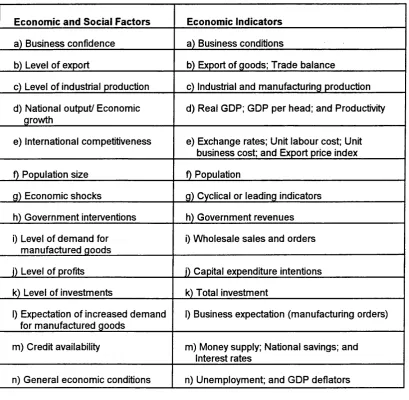
Factors and their corresponding economic indicators identified for residential construction demand
Factors and their corresponding economic indicators identified for industrial construction demand
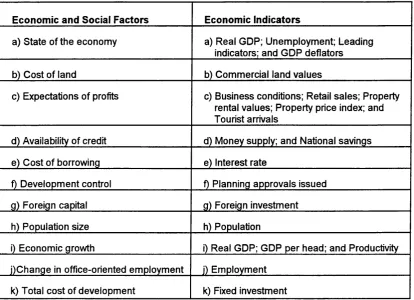
Factors and their corresponding economic indicators identified for commercial construction demand
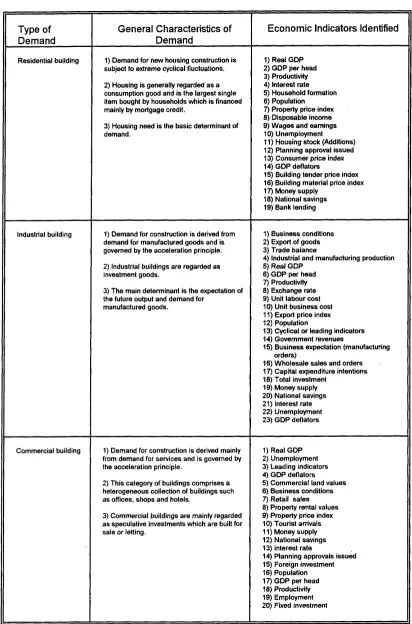
A summary o f the theoretical identification results
Levels o f significance to be used for the Forward Selection and the Stepwise Selection
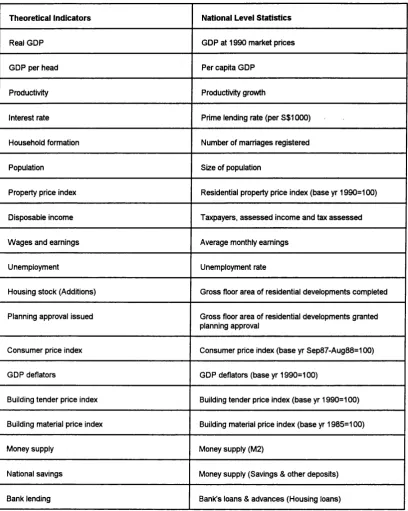
National level statistical series for indicators o f residential construction demand
National level statistical series for indicators o f industrial construction demand
National level statistical series for indicators o f commercial construction demand
Results o f statistical selection for residential construction demand
Results o f statistical selection for industrial construction demand
Results o f statistical selection for commercial construction demand
Value o f contracts awarded per year (in Sing$ million)
Estimated demand function for residential construction using Multiple Linear Regression
Estimated demand function for residential construction using Multiple Log-linear Regression
Estimated demand function for residential construction using a first-order autoregressive transformation
Table 10.5 Estimated demand fimction for residential construction using a second-order autoregressive transformation
Table 10.6 Result o f the forecasts generated by the Multiple Linear
Regression model
Table 10.7 Result of the forecasts generated by the Multiple Log-linear
Regression model
Table 10.8 Result o f the forecasts generated by the Autoregressive
Non-linear Regression Algorithm model
Table 10.9 Result o f the forecasts generated by the ANN model
Table 10.10 Relative measures o f accuracy o f different forecasting techniques
Table 11.1 Economic indicators theoretically identified for different types
o f construction demand
Table 11.2 Economic indicators statistically selected for different types o f construction demand by general groups o f economic measures
Table 11.3 A summary o f the results o f the comparative study o f different forecasting techniques
227
235
235
236
236
237
248
249
List of Figures
Page
Figure 1.1 Chapter layout and structure o f thesis 28
Figure 2.1 Relations between consumption, production and construction 39
Figure 2.2 The context o f the Construction Industry in the National
Economy 41
Figure 7.1 Flowchart showing stages o f identification, pre-processing,
selection and usage 159
Figure 8.1 Time-series relationship 168
Figure 8.2 Explanatory or causal relationship 168
Figure 9.1 A processing element as a simple threshold unit 187
Figure 9.2 A generic processing element illustrating the threshold fimction 187
Figure 9.3 An illustration o f the difference between feedforward and feedback
recall 190
Figure 9.4 Topology o f an elementary three-layer Backpropagation Artificial
Neural Network 204
Figure 10.1 Autocorrelations of the residuals o f the Multiple Linear Regression
model 224
Figure 10.2 Autocorrelations of the residuals o f the first-order Autoregressive
Non-linear Regression model 226
Figure 10.3 Autocorrelations of the residuals o f the second-order Autoregressive
Non-linear Regression model 228
Figure 10.4 The Genetic Algorithm evolutionary process 232
Figure 10.5 Components of the Artificial Neural Network model architecture 233
Figure 10.6 Scatterplot matrices showing the relationship between demand and
List of Appendices
Page
Appendix 1 Dataset used for modelling residential construction demand 275
CHAPTER 1
INTRODUCTION
1.1 Background
A country's economic performance has always been closely related to its construction industry.
The importance o f the construction industry's role in the economy is reflected by its significant
contribution to the Gross Domestic Product (GDP) and investment, measured by value added in
construction and gross fixed capital formation, respectively. On the other hand, the state of
activities in the construction industry is also highly dependent on the well-being o f the economy
as a whole. Construction is regarded as an investment good, and demand for most buildings is
"derived demand", that is, it depends on the demand for goods and services that can be produced
from the building or for the utility offered by the building (Hillebrandt, 1974). Generally, firms
are more likely to invest in physical assets if they expect demand to remain high and long-term
economic conditions to be good. If the general economic outlook is unfavourable, businesses are
m ost likely to cut back on fixed investments owing to their high cost. Hence, activity in the
construction industry is very sensitive to the general economic environment, creating uncertainty
in the future levels o f construction workloads.
According to Kindle (1993a), the short-term business cycle has a direct influence on construction
demand which inevitably causes substantial fluctuations. It is also widely believed that
construction is more volatile than other sectors in this respect (National Economic Development
Office, 1978; Hillebrandt, 1984; and Newcombe et a i, 1990). Hence, the construction industry is subject to the detrimental effects o f demand fluctuations. For construction firms, adverse
effects o f cyclical construction demand on their performance and operation were found to exist,
having a distinct impact on firms' production efficiency (Wong, 1985). On a broader basis.
Kindle (1993b) examined the general effects of demand fluctuations on the construction industry
in different stages o f the construction cycle. He cited competition for construction work and
resources as the primary effect, while secondary effects included profitability, production
volume, quality standards, investment in training, construction delays, investment in research and
unity in the industry.
reasons. From a prospective developer's point of view, the levels o f demand for various types of
buildings would indicate the possibility o f a timely and profitable disposal o f new developments.
The industry should also be aware o f the probable levels and nature in order to plan its future
workload. At the enterprise level, knowledge o f total construction demand enables construction
firms to forecast their future workload and to anticipate any significant changes in their share of
sectoral demands. It also helps them to operate more efficiently through better planning and
control o f their activities. At the project level, tenderers who have knowledge o f fiiture demand
can price their tenders more realistically and strategically, thereby increasing their chances of
success, and consequently realising the expected level o f profit for the building project.
Despite considerable need to estimate construction demand, it involves a very complex process;
and such attempts are fraught with difficulties because of the many differing factors that
influence demand for different types o f construction. However, upon examination o f these
factors, Hillebrandt (1984) noted that the general economic situation is a common factor that
affects demand for all types o f construction. Subsequent studies o f construction demand
(Oshobajo and Fellows, 1989; Tang et a l, 1990; Hutcheson, 1990; Killingsworth, 1990; Akintoye and Skitmore, 1994) have also typically incorporated macroeconomic measures in the
modelling process to take account of economic influences.
The need to incorporate a multitude of influencing factors when modelling demand for
construction has led to the predominant use o f multivariate forecasting methods. In particular,
there is an extensive use o f the multiple regression approach owing to its relative simplicity in
concept and application. Within the domain of this approach, the focus is always on building
linear models. Models based on non-linear forms are generally lacking. This is because non
linear regression techniques involve the manual task o f specifying functional forms to fit the
data, and such judgemental interventions would require the modeller to have an intimate
knowledge o f past trends o f the modelling variables in order to be precise in their specification.
In a few studies (Tang et a l, 1990; and Akintoye and Skitmore, 1994), non-linearity was considered with the use o f the log-linear form. However, the incremental improvement, if any, of
going from the traditional linear form to the log-linear form had not been investigated. In any
case, there have been recent contentions (Oshobajo and Fellows. 1989; and Goh, 1996) that the
incorporation o f "expert" judgement or the manual specification o f non-linear terms in regression
models may introduce an element of biasness and intuition, undermining the objectivity o f the
The inter-disciplinary field o f non-linear modelling and forecasting has grown rapidly over the
last decade. This is largely due to the increasing availability o f computer resources, which both
allows for the collection o f increasingly large datasets, and the analysis o f the datasets with
numerically intensive algorithms. Casdagli and Eubank (1991) attributed the growth in the field
to the increasing recognition o f the ubiquity and importance o f the effects o f non-linear dynamics
in the natural and social sciences. Among a wide range o f disciplines working on different
aspects o f non-linear modelling, advancement in Artificial Intelligence (AI) techniques has been
one o f the greatest. The use o f Artificial Neural Networks (ANNs) to construct non-linear
models from time-series data is the most prevalent. In recent years, ANNs have gained
popularity as powerfiil pattern recognition devices that have the ability to perform non-linear
modelling and adaptation automatically, without having to make any functional assumptions.
They provide a relatively simple way to model and forecast complex non-linear systems.
When several plausible forecasting methods are available, there is a need to choose one which
best suits the nature o f the variable to be predicted. Demand for construction is generally known
to have a volatile trend, amplifying the need for accurate short-term forecasts. Hence, in the
evaluation and comparison o f different forecasting techniques, accuracy can be used as an
effective measure. In general, accuracy is regarded as a vital attribute o f all quantitative
predictive models and plays an important part in the selection and testing o f forecasting
techniques (Lawrence, 1983; and Mahmoud, 1984). This justifies the claim by Makridakis et
o/.(1982) that accuracy is a major factor that has been dealt with in the forecasting literature by
empirical or experimental studies. In fact, forecasting techniques ranging from purely intuitive or
judgemental approaches to highly structured and complex quantitative methods have been
compared solely on their accuracy performance.
1.2 Purpose o f research
The published literature abounds with evidence of a need to relate the construction industry with
the general economic environment. The effect o f economic fluctuations has a major impact on
the performance o f this sector of the economy. Economic indicators, which are measures of
performance o f the national economy, may sen e as viable input variables to model construction
demand. Traditionally, in macroeconomic modelling studies, independent variables are selected
However, this has not been the case in construction demand modelling studies. There has yet to
be a systematic approach proposed for variable selection as part o f the whole modelling process.
In relation to modelling demand for construction, mainly regression methods have been used in
the past, and the focus has been on developing linear models. Therefore, there is a need to
examine non-linear regression techniques, using the traditional linear method as a benchmark for
comparison. In addition, the apphcation o f non-regression methods also needs to be explored,
and any improvements tested. Essentially, this would extend the boundary o f traditional
practices by seeking better alternative techniques for construction demand modelling.
The key to evaluating the performance o f different demand modelling techniques is to measure
the predictive ability o f the derived models. As mentioned earlier, accuracy is the most
significant way o f assessing forecasting techniques, at least quantitatively. Using relative
measures o f accuracy, alternative forecasting approaches can be compared.
This study is concerned, inter alia, with the use o f economic indicators and alternative forecasting approaches to model and predict demand for construction. More specifically, the
purpose o f this research is to:
1) Propose a systematic approach to the theoretical identification and statistical selection o f
economic indicators for construction demand modelling;
2) Critically appraise linear and non-linear regression methods, and a non-regression method
o f modelling and forecasting demand for construction; and
3) Evaluate and compare the forecasting accuracy o f construction demand models that are
built using linear and non-linear regression methods, and a non-regression method.
1.3 Terminology
In the process o f writing this thesis, a few terminological issues arise. In resolving them,
definitions, as well as. distinctions are given for these terms. This is to ensure that the terms used
in this thesis tailor more specifically to the scope and objectives o f the study.
have been used interchangeably to refer to the period between two successive peaks or troughs in
the total volume o f construction. However a distinction can be made between the terms building'
and 'construction'. The latter includes, besides the body o f knowledge traditionally covered by
building', considerations o f infrastructure and utilities such as roads, harbours and bridges.
From this, it can be gathered that building cycles would refer more to construction activities
involving buildings only. Writers who have based their works mainly on building cycles are
M itchell (1927), Newman (1935), Hansen (1941), Lewis (1965), Kafandaris (1980) and Bon
(1989). This is evident that a clear distinction can be made between the two types o f cycles and
the common use o f the term building' rather than construction' reflects the fact that cycle
theorists have basically concentrated on that particular sector o f the industry, especially
housebuilding. Kafandaris (1980:298) noted that "almost invariably, cycles were invoked in
relation to housing and not to civil engineering works". Building cycles have generally been
studied in the context o f the whole economy; and a major objective has been to develop
appropriate propositions to aid the formulation o f policy to stabilise construction activity, mainly
through public works. Over the issue o f building cycles' and construction cycles', the former is
considered more appropriate as it reflects more accurately the scope o f this research.
However, in the context o f demand, a distinction between building' and construction' has not
been so clear. The terms construction demand' and demand for construction' are used, in
general, to refer to demand for any type of construction activities, that is, buildings,
infrastructure, or both. In view o f this, it should be highlighted that where such terms are
adopted in this thesis, they refer to demand for construction involving buildings alone, since only
such works are examined here.
Economic indicators have been broadly defined as "descriptive and anticipatory data used as
tools for business conditions analysis and forecasting" by Zamowitz (1992:283). He elaborated
that "there are potentially as many subsets of indicators in this sense as there are different targets
which they can be directed". Similarly, the Economist (1994) also distinguished a wide range of
different groups o f major economic indicators which cover economic growth, population and
employment, government fiscal policies, consumers, investment and savings, industry and
commerce, external flows, exchange rates, money and interest rates, and prices and wages.
Although economic indicators may be taken in a narrower sense to cover only measures of
economic activities, the wider definition is preferred by the writer. Therefore, for the purpose of
and demographic measures as well.
It is also necessary to define the term 'traditional', used in the context o f the linear regression
method. Traditional forecasting methods refer to those which have been practised from the past
to the present. In contrast, non-traditional, or state-of-the-art, methods are those that have only
recently evolved and are still being explored to determine their viability as practical forecasting
tools.
The terms approach' and 'method' used in the context o f this thesis are different with respect to
their scope. A forecasting approach is regarded as having a broader scope and may comprise
more than one forecasting method or technique. A method is, therefore, to be considered as a
subset o f an approach.
Finally, it is apt to mention that discussion o f these issues is limited to that required to justify the
terms used in this thesis. It is by no means an attempt to redefine them but only to illustrate
either the specificity or the diversity o f the terms adopted.
1.4 Statements of the problems
Having outlined the limitations and difficulties faced by past construction demand modelling
studies, the three problem areas to be addressed in this thesis may be stated as:
The first premise upon which this research is based is that there has been insufficient
examination o f all possible economic indicators for use in modelling demand for different types
o f building construction. This may be attributed to the absence o f a systematic approach to the
identification and selection o f economic indicators which satisfy the economic significance and
statistical adequacy criteria.
The second premise is that the scope o f the forecasting methods used in the past for construction
demand modelling has generally been limited to building linear regression models, that is,
linearity is assumed at the outset for the relationship between the modelling variables. In cases
where non-linearity was considered, only log-linear forms were used. Their improvements, if
The third premise is that the scope o f non-linear forecasting methods used for construction
demand modelling has also generally been restricted to the regression approach. Considering the
need of having to manually specify non-linear functional forms to fit the data, there may exist a
risk of such methods not modelling the true relationship between the variables, but only the form
which the model should take, as subjectively judged by the modeller. The inability o f such
models to generate good forecasts may be the result o f a common failure to explore a non
regression approach such as the ANN technique, which is specially designed to cope with
complex non-linear systems.
The final premise is that there has been little or no comparative study o f different forecasting
methods used to model demand for construction. This has resulted in the adoption o f forecasting
methods without having an objective view o f their strengths and weaknesses, particularly their
predictive abilities. This may eventually lead to forecasters o f construction demand being
without adequate assurance as to the fidelity o f their forecasts.
1.5 Objectives of the research
The detailed objectives o f this study, therefore, are to:
1) Examine, in theory, the relationship between the construction industry and the national
economy;
2) Theoretically identify economic indicators that relate to demand for different types of
building construction so that economic significance is achieved;
3) Statistically select economic indicators that relate to demand for different types of building
construction so that statistical adequacy is achieved:
4) Propose a systematic approach to the identification and selection of economic indicators
for construction demand modelling;
5) Review the theory^ and applications of linear and non-linear regression methods;
6) Review the theory and applications o f the ANN technique;
7) Apply linear and non-linear regression methods, and the ANN technique in a case-study
8) Evaluate and compare the predictive ability o f the derived demand models in terms o f their
accuracv.
1.6 Research hypotheses
In addition to fulfilling the objectives set out for this study, three research hypotheses are
developed to verify some specific issues arising fi"om this research. They are:
1) Demand in the construction industry is significantly related to a wide range o f economic
measures such as national output, population and employment, government fiscal
policies, national consumption, investment and savings, industry and commerce, balance
o f payments, money and interest rates, and prices and wages.
2) A non-linear model can forecast demand for construction more accurately than a
linear model.
3) The ANN technique, a non-regression approach, can outperform the regression approach
in predicting demand for construction.
1.7 Research methodology
Research is the method by which rational inquiiy is used to generate new knowledge. It is
reserved for activities designed to discover facts and relationships that will make knowledge
more effective. According to Skitmore (1988), the basic approach used in academic research is
the scientific approach. He cites objectivity and the ability to divide the subject matter in
question into smaller parts fi'om analysis as reasons to this standpoint. Earlier, Kerlinger (1973)
highlighted that a critical feature of the scientific approach is the notion o f problem, hypothesis,
reasoning, observation-test-experiment, and conclusions by which the hypothesis is accepted or
rejected. Newton (1983) subsequently classified this as the 'top-down' approach and the main
phases that describe this approach, as depicted by Bryman (1988), is shown in Table 1.1. On the
contrary, the adoption o f a bottom-up' approach has been advocated by Watkins (1970). This
resulting in the use o f inductive reasoning. A clear distinction from the top-down' approach is
its departure from the need to formulate and prove a hypothesis. Precedents for the bottom-up'
approach has been set by Atkin (1988) and Bowen (1993).
Table 1.1. The main phases and intervening processes of quantitative research
M ain Phases Intervening Processes
Theoiy Deduction
Hypothesis Operationalization
Observation/ Data collection Data processing
Data analysis Interpretation
Findings Induction
Relating to research methods, Buckley et al. (1975) classified them into four main types: archival; analytical; opinion; and empirical. Osuala (1982) also established four distinct research
methods and they are: historical; descriptive; experimental: and survey. These categories have
been similarly adopted by Leedy (1985) and Dane (1990). A different classification was
suggested by Kidd and Judd (1986). However, upon close examination, their classification of
research methods comprised a combination o f the ones identified by Buckley et al. (1975) and Osuala (1982).
For this research, the objectives of the study dictates the adoption o f the 'top-down' approach
where the conventional hypothesis' required by the scientific approach is developed and proven.
The research methods employed are the archival and analytical methods as proposed by Buckley
et al. (1975). The archival method is required because it concerns the examination o f recorded facts. The main advantage o f this method is its ability to access and manipulate a vast quantity
o f hard, and often factual, information. It is most suitable for the analysis o f historical data in an
attem pt to identify data patterns and extrapolate these patterns into the future to make forecasts.
The analytical method is also useful as it involves breaking down the problem into its component
parts so that its true nature and the causal relationships of the variables o f interest may be
Consequently, the research methodology employed in this study can be detailed as follows:
1) A comprehensive literature review o f the topics involved in this research;
2) An archival approach to the collection of vast quantities o f data relating to national level
statistics;
3) An analytical approach to the theoretical and statistical selection o f economic indicators
that are significantly related to demand for different types o f building construction; and
4) A combination o f archival and analytical approaches for the application, comparison and
evaluation of the various forecasting methods used to model and predict demand for
construction.
1.8 Scope of the research
The scope o f this research can be divided into three main parts.
The first part o f the study aims to develop a systematic approach for the identification and
selection o f economic indicators for construction demand modelling. First, it involves a
comprehensive literature review of the relationship between the construction industry and the
national economy. Second, theoretical issues of construction demand and economic indicators
are discussed, serving as introductory chapters to the empirical study. Third, the process of
theoretical identification is carried out based on a literature review o f all possible economic
indicators that are associated with demand for different types o f building construction namely,
residential, commercial and industrial. Civil engineering works involving the construction of
infrastructure and utilities are excluded. Finally, for the statistical selection process, Singapore
data is utilised and the statistical technique known as the Step-wise procedure is applied.
The second part involves the application of linear and non-linear regression methods, and the
ANN technique, a non-regression approach, to model and predict demand for residential
construction in Singapore. Economic indicators selected in the first part o f the study are used as
m odelling variables. The regression methods are namely, the Multiple Linear Regression, the
M ultiple Log-linear Regression and the Autoregressive Non-linear Regression Algorithm. The
is subsequently used to generate forecasts o f residential construction demand in Singapore.
The third and final part consists o f a comparative study o f these forecasting techniques. With
accuracy chosen as the quantitative criterion o f evaluating and comparing the different
techniques, relative measures based on percentage errors are employed to establish the most
accurate predictive model o f residential construction demand in Singapore.
Although only Singapore data is utilised in the quantitative study, it should not be considered as
a limitation. The scope of this research requires an in-depth study into a wide range o f economic
indicators and forecasting techniques. The case study o f Singapore alone entails the collection
and analysis o f a massive amount of data. Therefore, owing to time constraints, it is only
possible to carry out quantitative analyses o f one country's data. However, the general approach
o f this study can be treated as a methodological framework which may be applied in the context
o f other countries.
1.9 Structure of the thesis
This thesis comprises a total o f 11 chapters and the content o f each chapter is briefly outlined
below.
Chapter 2 sets out to establish an economic relationship between the construction industry and
the national economy. General issues such as the following are discussed:
a) the nature o f building cycles and their relationship with business or economic cycles:
b) the construction industry in the context o f the national economy;
c) the impact o f a change in government policies (i.e. fiscal, monetary, balance o f payments)
on the level o f demand for construction;
d) the role o f government in the construction industry; and
e) the role o f the construction industry in socio-economic development and long-term
economic growth.
Specifically, the role of Singapore's construction industry in the national economy is examined
Chapter 3 is a general discussion of the need to forecast demand for construction, the nature of
demand cycles, and the measures, or forward indicators, o f demand.
The level o f performance o f a national economy can be monitored via economic indicators. Some
o f these include the GDP, the Consumer Price Index, prime-lending rate, industrial production,
unemployment rate, housing starts, etc. Basic information on the scope, significance and
interpretation o f some key indicators are provided in Chapter 4.
The objective o f Chapters 5 and 6 is to identify and select economic indicators that relate to
demand for different types o f building construction. There are two selection criteria adopted
namely, economic significance and statistical adequacy. Chapter 5 deals with the process of
theoretical identification, while Chapter 6 undertakes the statistical selection o f indicators based
on a case-study o f Singapore.
Following the steps adopted in Chapters 5 and 6, a systematic approach is proposed and
described in Chapter 7 for the identification and selection o f economic indicators for modelling
construction demand. A schematic representation o f the approach is also given.
The next two chapters review the regression and non-regression approaches to modelling and
forecasting construction demand. Chapter 8 comprises a comprehensive literature review o f past
works on construction demand modelling and forecasting. The emphasis is on describing the
traditional regression methods that have been adopted. The ANN technique, a non-regression
approach, is introduced in Chapter 9. Aspects of theory and application are discussed.
The scope o f Chapter 10 is a case study o f the residential construction sector in Singapore. It
involves the application of linear and non-linear regression methods, and the ANN technique to
model and predict demand for residential construction in Singapore. The economic indicators
selected in the earlier stages serve as input variables for these models. The predictive ability of
these models is assessed and compared by adopting some relative measures o f forecasting
accuracy. The strengths and weaknesses o f each approach are generally discussed.
Chapter 11 reviews and summarises the findings o f the research. Recommendations for future
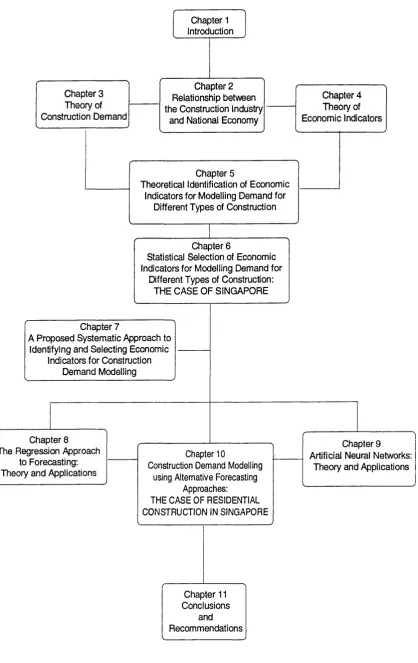
Figure 1.1 shows the layout o f the 11 chapters described above. It provides an overview o f the
Chapter 1 Introduction Chapter 4 Theory of Economic Indicators Chapter 3 Theory of Construction Demand Chapter 11 Conclusions and Recommendations Chapter 2 Relationship between the Construction Industry
and National Economy
Chapter 9 Artificial Neural Networks:
Theory and Applications Chapter 8
The Regression Approach to Forecasting: Theory and Applications
Chapter 7
A Proposed Systematic Approach to Identifying and Selecting Economic
Indicators for Construction Demand Modelling
Chapter 6
Statistical Selection of Economic Indicators for Modelling Demand for
Different Types of Construction: THE CASE OF SINGAPORE
Chapter 5
Theoretical Identification of Economic Indicators for Modelling Demand for
Different Types of Construction
Chapter 10
Construction Demand Modelling using Alternative Forecasting
Approaches:
THE CASE OF RESIDENTIAL CONSTRUCTION IN SINGAPORE
CHAPTER 2
A REVIEW OF THE RELATIONSHIP BETWEEN THE CONSTRUCTION INDUSTRY AND THE NATIONAL ECONOMY
2.1 Introduction
Chapter 2 is a theoretical review o f the link between the construction industry and the national
economy. In essence, the construction industry is studied in relation to its role in the national
economic system, macroeconomic policies, and economic development and growth.
The chapter begins by looking at different definitions o f the construction industry. Some
definitions are also provided for the national economy to explain key concepts relating to output,
growth, inflation, employment, and import and export. All these are covered in Section 2.2.
Section 2.3 examines the relationship between building and business or economic cycles. First,
the nature o f building cycles is discussed in relation to changing levels o f demand for
construction. As demand for construction is influenced by the level of economic activity, the
interaction between building and business cycles is drawn upon next.
The importance o f the construction industry in the national economy is discussed within the
scope o f macroeconomic theory in Section 2.4. The contributions o f the construction industry to
national aggregates such as output, consumption and production are highlighted. The relations
between construction and other sectors o f the economy are also examined.
Owing to the significant role played by the construction industry in the national economy, any
change in one will have a strong impact on the other. Most often, changes are activated through
government's adoption o f different sets o f economic policies. The relations between construction
and various economic policies are explored in Section 2.5.
The role o f the construction industry in socio-economic development and long-term growth o f an
economy is considered in Section 2.6. Specifically, the role of construction in both developing
and developed countries is discussed. Factors and conditions of long-term growth in an economy
The chapter concludes with Section 2.7 which, in essence, aims to bring together the various
issues discussed in the preceding sections. It involves a review o f the relationship between the
construction industry and the national economy o f Singapore, focusing particularly on the vital
role o f construction in Singapore's socio-economic development over the past few decades.
2.2 Definitions
M any definitions have been given for the construction industry, varying in terminology and
scope. Some writers attempt to define it based on the nature o f the construction process and
features o f the industry's products, which merely indicates what the construction industry
includes or does not include. Construction has been described by Colean and Newcomb (1952),
and Lange and Mills (1979) as an aggregation o f businesses engaged in closely related activities.
Nam and Tatum (1989) refers construction to all types o f activities associated with the erection
o f and repair o f immobile structures and facilities. Other writers extend their definitions to
include the services provided by participants in the construction process. Cassimatis (1969:10)
defines separately "construction" and "contract construction" to distinguish the difference
between the activities involved in construction and the provision o f construction services.
Together, they constitute the "contract construction industry". His definitions are as follows:
"construction refers to all types o f construction activity usually associated with the erection and repairs o f immobile structures and facilities, such as, buildings o f all types, highways and streets, ports and airports, dams and conservation projects, railroad lines and canals, and other similar types o f work"; and
"contract construction refers to an industry consisting o f a large number offirm s that perform construction work fo r others. "
Hillebrandt (1984) defines construction as covering the parties involved in the construction
process and, to some extent, the suppliers o f the industiy's inputs. She also distinguishes the
contracting part o f the industry as one which:
contracting industry is providing is basically the service o f moving earth and material o f assembling and managing the whole process" (Hillebrandt, 1985:24).
In view o f all existing definitions, Ofori (1990:23) proposed a broad outline o f construction
which defines the industry as:
"that sector o f the economy which plans, designs, constructs, alters, maintains, repairs and eventually demolishes buildings o f all kinds, civil engineering works, mechanical and electrical engineering structures and other similar works. Thus, the industry includes: persons, enterprises and agencies, both public and private, involved in physical construction..., and those providing all kinds o f planning, design, supervisory and managerial
services relating to construction. "
It is only in this latter definition that the construction industry has been viewed and described as a
sector of the general economy. A broader definition needs to be established in order to reflect the
importance o f the construction industry in relation to the national economy. It may serve as a
supplement to the earlier definitions which mostly describe the construction industry too
narrowly and in isolation. For the purpose o f the study, a macroeconomic definition is proposed
which describes the construction industry as:
"that sector o f the economy which contributes significantly to the country's socio-economic development, employment, fixed capital formation, capital investments, and balance o f paym ents in terms o f import and export o f construction services and inputs. Its
interdependence with other sectors o f the economy is reflected by its need fo r inputs from the
other sectors and its largely derived demand. Owing to this, the satisfactory performance o f the construction industry is vital fo r the well-being o f several other parts o f the economy, and vice versa. It may also serve as a regulator o f the economy, due to its size and importance, and its p rospects have a major effect on the general economic condition o f the whole economy. "
W ith regard to the national economy, there are a few key concepts that are central to evaluating
macroeconomic performance. They are mainly related to output, growth, inflation,
1) Gross national output
Gross National Product (GNP) is defined as the value o f all final goods and services produced by
domestically-owned factors o f production within a given time period. It is the basic measure of
economic activity. In relation to GNP, three important distinctions have to be made and they are:
a) GNP and GDP
GDP is defined as the value o f final goods and services produced within the country within a
given time period. This implies that part o f GNP is earned abroad. For example, when GNP
exceeds GDP, residents o f a given country are earning more abroad than foreigners are earning in
that country. GDP is often viewed as a better measure than GNP and is generally accepted by all
major industrialised countries (The Economist, 1994). The difference between GNP and GDP is
usually relatively small, perhaps 1 per cent o f GDP, but there are a few exceptions, for example,
in 1989 Kuwait's GNP was 35 per cent larger than its GDP, due to the country's vast income
fi-om foreign assets.
b) Nominal and Real GNP
Nominal GNP measures the value o f output at the prices prevailing in the period during which
the output is produced, while real GNP measures the output produced in any one period at the
prices o f some base year. Real GNP, which values the output produced in different years at the
same prices, implies an estimate o f the real or physical change in production or output between
any specified years. When there is a difference between the growth rates o f nominal and real
GNP, it is often attributed to the rising o f prices o f goods or inflation. The rate o f inflation is
defined as the percentage rate of increase o f the level o f prices during a given period o f time. The
most common way to measure the overall price level is the consumer price index (CPI). The CPI
measures the cost o f a fixed basket o f goods bought by the typical urban consumer. Generally,
the growth rate o f the economy is determined by the rate at which real GNP is increasing.
c) GNP and GNP per capita
Another measure o f real GNP is established by looking at national output per person. GNP per
measure is used as an indicator o f overall economic welfare. The growth rate o f real GNP per
capita is the most important o f all the macroeconomic indicators by which to judge the economy's
long-run performance.
2) Employment and unemployment
One major objective of macroeconomic policy is high employment, which also requires low
unemployment. The unemployment rate is defined as the fi-action o f the labour force that is out
o f work but is ready and able to work. It serves as an indicator o f spare labour capacity or
wasted resources in an economy.
High unemployment rates are a major social problem. The unemployed suffer a loss in their
income, standard o f living and career opportunities. Besides being one o f the most important
social and political issues, high levels o f unemployment also impose great costs on society.
3) Foreign economic policy
This policy deals mainly with the import and export o f goods and services, and the borrowing
and lending o f money to foreigners. Net exports is defined as the difference between the dollar
value o f exports and the dollar value o f imports. It can also be regarded as the trade balance,
which is defined as the net balance between exports and imports o f goods.
Since trading is involved between countries, the price of one country's currency in terms of
another has to be monitored. The foreign exchange rate o f a given country represents the price of
its own currency in terms o f the currencies of other countries. When a country's exchange rate
rises, its export becomes more expensive and. therefore, is less competitive in world markets,
causing exports to shrink relative to imports. By contrast, when a country's exchange rate falls,
import prices rise and the inflation rate also tends to increase. These impacts on the economy
make the exchange rate increasingly important for all countries.
In general, when net exports turn to deficit or surplus, or when the foreign exchange rate rises or
falls sharply, countries move to correct the imbalance in their foreign economic relations.
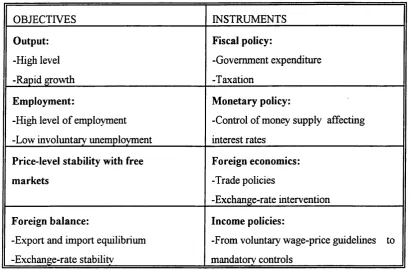
T able 2.1: O bjectives and instrum ents of macroeconomics
OBJECTIVES INSTRUMENTS
O utput: Fiscal policy:
-High level -Government expenditure
-Rapid growth -Taxation
Em ploym ent: M onetary policy:
-High level o f employment -Control o f money supply affecting
-Low involuntary unemployment interest rates
Price-level stability with free Foreign economics:
m arkets -Trade policies
-Exchange-rate intervention
Foreign balance: Incom e policies:
-Export and import equilibrium -From voluntary wage-price guidelines to
-Exchange-rate stability mandatorv controls
Source: Samuelson P.A. and W.D. Nordhaus, Economies, 1989.
2.3 The relationship between building cycles and business o r economic cycles
2.3.1 N ature of building cycles
The pattern o f construction activities is typified by cyclical fluctuations, which are mainly caused
by changing levels o f demand. Since demand for construction is essentially 'derived demand', an
increase or decrease in economic activity, would result in a change in demand for goods and
services, thus affecting the level o f construction activity. Hence, it is possible to outline the
nature o f a building cycle o f a typical construction industry when reference is made to the general
economic environment.
In a period o f economic expansion, increased economic activity causes an upsurge in demand for
goods and services as incomes rise. Throughout the early stages o f expansion, all the economic
agents involved experience increasing pressure to expand their own facilities. Firms either
purchase dwellings, while real estate developers may start considering new investment projects.
With a general trend o f rising standard o f living, government may have to spend more on public
building works such as housing, hospitals and schools. These will lead to an overall increase in
the demand for construction. If the industry is operating below capacity, the unused resources
will be utilised. Construction firms will take measures to increase productivity and secure more
work. With increasing demand on building resources, prices o f materials and wages will
generally rise. Meanwhile, new construction firms will emerge as a result o f better perceived
profits. However, at some point in time, difficulties will be experienced by those involved in the
evermore intensive construction activity. Productivity and efficiency in the industry will start to
fall, while wages are still steadily increasing. If demand continues to rise, the industry will reach
its capacity. Resources will have been spread fairly thin by the expansion and becoming scarce,
projects will be delayed and costs become abnormally high.
Government may intervene to control the inflationary spiral by increasing interest rates. High
interest rates will usually mark the end o f the economic expansion. With credit restriction,
general investments become less attractive. Demand for construction items will fall as they are
regarded as expensive capital goods. By then, construction may be priced out o f reach of most
people. In the construction industry, the combination o f rising interest rates and spreading cost
increases will create cash-flow problems for some construction firms. Nevertheless, construction
projects will still proceed at the expense o f anticipated profits. With prospects o f the economy
looking less bright, demand for construction continues to fall. With fewer projects available for
tender in the industry, competition is keener and tender prices become lower. Construction firms
will have to reduce their costs by shedding excess capacity and increasing productivity.
Investments in the training o f personnel and in plant and machinery will be reduced. Less
efficient firms will be forced out o f business while others continue to survive. In a period of
excess capacity in the construction industry, the prices of materials, labour, and plant and
machinery' will start to fall. When prices have fallen to a level which makes investments in
construction become viable again, it may signal the upturn of another building cycle.
2.3.2 In te rac tio n of building and business cycles
Past studies o f building cycles have repeatedly drawn upon the interaction between business and
building cycles. Although early studies have focused mainly on either building cycles or business