Copyright to IJIRSET www.ijirset.com 124
A Comparative Study on Performance and
Emission Characteristics of Compression Ignition
Engine using Biodiesel Derived from Castor oil
Pradip Lingfa
Associate professor, Department of Mechanical Engineering, North Eastern Regional Institute of Science &
Technology, Itanagar Arunachal Pradesh:791109 (India)
Abstract:
With the limited reserves of fossil fuels coupled with global environmental pollution have stimulated the search for alternate fuel for diesel engine. In present study, non-edible vegetable oil such as Castor methyl ester were produced and blended with diesel fuel in different proportions. An experimental investigation was carried out to analyze the performance and emission characteristics of a compression ignition engine fuelled with blends of Castor biodiesel and diesel fuel. Engine performance and emission analysis were performed using biodiesel blends (2%, 5% and 10%) in 4.4 kW single cylinder air cooled four stroke compression ignition engine at different loads. It was observed that performance characteristics like brake thermal efficiency (BTE), brake specific fuel consumptions (BSFC) with 10% Castor methyl ester was closed to diesel fuel. The emission characteristics like CO, HC and smoke were lower compared to diesel fuel. However NOx emission was observed to be higher for Castor biodiesel blends.Keywords: Non-edible vegetable oils, Castor methyl ester, biodiesel blends, performance, emission
I. INTRODUCTION
Petroleum is the largest source of energy consumed by world’s population exceeding coal, natural gas, nuclear, hydro and renewable. The crude oil price has been fluctuating in the world market and has increased significantly in recent past, reaching a level of more than $ 140 per barrel. Such unforeseen escalation of crude oil prices is severely straining various economies of the world over, particularly those of developing countries. Petro-based oil meets about 95% of the requirement for transportation fuels, and the demand has been steadily rising [1]. The concept of producing liquid fuel from vegetable oil is not a new. When Rudolf Diesel first invented the diesel engine, about century ago, he demonstrated the principle by employing Peanut oil and hinted that vegetable oil would be future fuel for diesel engine. However with
Copyright to IJIRSET www.ijirset.com 125
serious engine fouling. It has been reported that when direction injection engines are run with neat vegetable oil as fuel, injectors get choked up after few hours and lead to poor fuel atomization, less efficient
combustion and dilution of lubricating oil by partially burnt vegetable oil [4].
In the present experimental investigation, non-edible vegetable oil from Castor oil have been selected for its utiliation in diesel engine. From the literaure, it was observed that the performance and emisions studies in diesel engine using Castor oil and its methyl ester specially at lower blends of biodiesel with high speed diesel has scantly been reported.
Castor (Ricinus communis) is a species that belongs to the Euphorbiaceae family and it is commonly known as Castor oil plant. This plant originates in Africa but it is found in both wild and cultivated states in all the tropical and subtropical countries of the world. In wild conditions this plant is well-adapted to arid conditions and is able to stand long periods of drought. The plant starts flowering about 45 days after sowing. Seeds are approximately 46% oil. This oil is highly viscous, its coloration ranges from a pale yellow to colourless. It has a soft and faint odour and a highly unpleasant taste. The present studies was carried out with aim to understand the effect of various biodiesel bends of obtained from Castor oil. The performance and emissions part were analyzed to ensure minimum power drop and emission remained within the limits. The oxygenated nature of biodiesel tends to improve the combustion efficiency at the same time it is also a factor contributing to increase of NOx. The experiments helped in determining the optimum biodiesel blend suitable for operation in an unmodified stationary diesel engine.
II.BIODIESEL PRODUCTION
Production of Castor Methyl Esters
The Castor biodiesel was prepared using both acid and based transesterification process which render the properties similar to that of diesel, significantly lowering the viscosity to prescribed limit for usage in engines.
Methyl esters (biodiesel) from Castor oil was produced in 1 litre capacity biodiesel reactor as shown in Figure 1. The major components of biodiesel reactor are mechanical stirrer, condenser and inlet for reactant as well as for placing thermocouple to observe the reaction temperature. The flask has a stopcock at
bottom for collection of the final product. Initially the required amount of raw oils, alcohol and catalyst were added to the reactor. The mixtures were heated to about 2-3 hours at a constant temperature of 65°C. It was then stirred using electric stirrer at the speed of 350-400 rpm. After the completion of reaction, the mixture mainly consisted of two products, namely, biodiesel and glycerol. The light layer on the top is the biodiesel while the darker layer is glycerol. After removing the glycerol layer using separating funnel, the methyl ester was mixed with hot distilled water, shakes gently and allowed to settle for 10-15 minutes. The procedure was repeated for 3 to 4 times till the water appears clear. After water washing the methyl esters was heated in oven for about temperature of 100-105°c to remove traces of water. The final product obtained was the methyl esters (biodiesel).
Engine selection and test procedure
Copyright to IJIRSET www.ijirset.com 126 Figure 1. Schematic Diagram of Transesterification Reactor
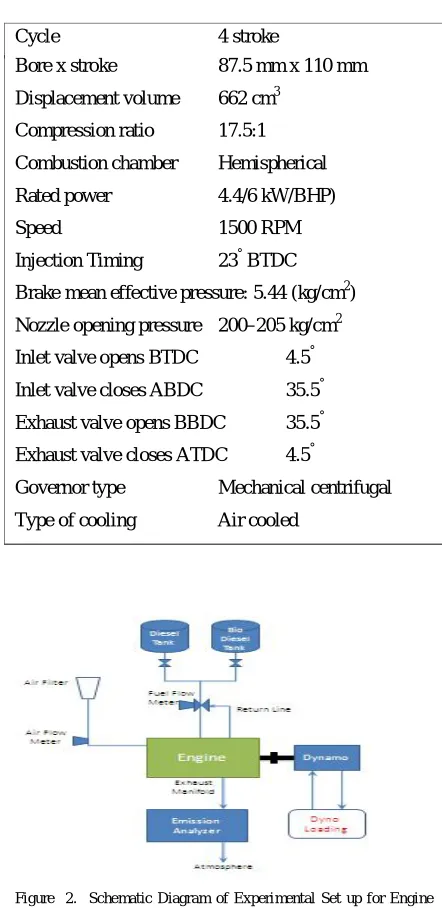
The emission characteristics were measured using AVL 5 gas analyzer and AVL 437 Smoke meter. The experimental setup is as shown in Figure 2. Initially the base line data of diesel fuel were generated. Subsequently the biodiesel and its blends were tested in engine and recorded. The engine performance and emissiondata were conducted tripletfor each blend of biodiesel in the test engine.
III.RESULTS AND DISCUSSION
Production of Castor Methyl Ester
The methyl ester of Castor was produced using acid and based catalyst transesterification process. The kinematic viscosity of oil drastically reduced after transesterification process. It was observed that the reaction parameters such as catalyst concentration, alcohol/oil (molar ratio), reaction time, temperature and stirring speed play important role during conversion process.
Table 1. Technical Specifications of Test Engine
Engine
Make Kirlosker oil Engine Ltd
Model TAF1
No. of cylinder 1
Cycle 4 stroke
Bore x stroke 87.5 mm x 110 mm
Displacement volume 662 cm3
Compression ratio 17.5:1
Combustion chamber Hemispherical
Rated power 4.4/6 kW/BHP)
Speed 1500 RPM
Injection Timing 23° BTDC
Brake mean effective pressure: 5.44 (kg/cm2)
Nozzle opening pressure 200–205 kg/cm2
Inlet valve opens BTDC 4.5°
Inlet valve closes ABDC 35.5°
Exhaust valve opens BBDC 35.5°
Exhaust valve closes ATDC 4.5°
Governor type Mechanical centrifugal
Type of cooling Air cooled
Figure 2. Schematic Diagram of Experimental Set up for Engine
Test Rig.
Performance and Emission Studies of Castor Methyl ester
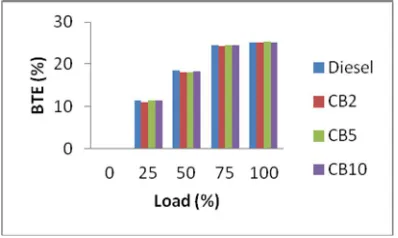
Figure 3 shows the variation of brake thermal efficiency of Castor methyl ester and its blends with
Copyright to IJIRSET www.ijirset.com 127
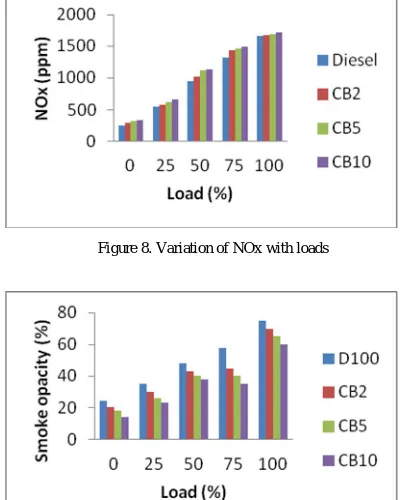
efficiency was observed for biodiesel blend CB10 (10% Castor biodiesel and 90% diesel). The variation of brake specific fuel consumption (BSFC) with respect to loads is shown in Figure 4. It is observed that the brake specific fuel consumption decreases with increased in load . At lower load as brake power developed is less, so BSFC is more on that load for all the test fuels. However with [6] increased in biodiesel percentage in the blends, the calorific value of fuel decreases and hence BSFC increases (Table 2). Figure 5 shows the variation of CO with respect to loads. It is observed that CO emission increases with increasing loads for all test fuels. This may be due to fact that air fuel mixing ratio was affected by difficulty in atomization of heavy compounds. The resulting locally rich mixture results in incomplete combustion cause more CO to be produced during combustion due to lack of oxygen. Figure 6 shows the comparison of unburned hydrocarbon (UBHC) at higher load for diesel, biodiesel and its blends. The UBHC of all the test fuels increases at higher load. This may be due to the fact fuel quantity injected is increased hereby contributing to increases in HC emissions. The minimum UBHC was observed for CB10 biodiesel due to more oxygen content owing to better combustion. NOx emission for Castor methyl ester is higher in comparison diesel fuel as shown in Figure 7. This may be due to higher combustion chamber temperature as with increased in combustion chamber temperature, NOx emission increases. Figure 8, shows the comparison of smoke for different test blends at different loads. The smoke levels of Castor methyl ester and their blends is significantly lower than that of diesel fuel.
Figure 3. Variation of BTE with loads
Figure 4. Variation of BSFC with loads
Figure 5. Variation of CO with loads
Copyright to IJIRSET www.ijirset.com 128 Figure 8. Variation of NOx with loads
Figure 7. Variation of smoke with loads
Table 2. Properties of Biodiesel Blends of Castor oil (ASTMD6751 standard)
Fuel
Name
Properties
Visco
sity
@
40°C
(Cst)
Density
(g/ml)
Heating
Value
(MJ/kg) Clou
d
Point
(°C) Flash
Point
(°C) Pour
Point
(°C)
Diesel 2.87 0.845 44 6.5 76 3.1
CB10 3.40 0.848 42.6 -1.2 72 -6.2
CB5 2.98 0.847 42.8 -1 64 -6.0
CB2 2.70 0.845 43.0 -1 61 -5.9
Note: CB Castor biodiesel
IV.CONCLUSIONS
In the present study Castor oil was converted to mono-esters using acid and based catalyst transesterification process. The kinematic viscosity of Castor oil reduced significantly after transesterification process.
The BSFC Castor biodiesel blends decreases at increasing loads but further increased of concentration of biodiesel blends increased the fuel consumptions due to lower calorific value and higher viscosity.
The biodiesel blends of Castor methyl ester shows higher NOx compared to diesel fuel during entire range of operation.
In general the emission characteristics like CO, HC and smoke were lower at all engine load conditions compared to diesel fuel.
Among the various blends studied it was found that 10% blend of Castor biodiesel yields the best result in terms of performance and emission.
ACKNOWLEDGEMENTS
The authors acknowledge the Department of Science and Technology (India) for financial supports.
REFERENCES
[1] Sharma, A., “Biodiesel: An Eco-friendly Fuel”. Asian Sci. Vol 1-2, , p. 1- 3, 2008.
[2] Panday, K.C., Panday, K.P. and Ghosh, B.B., “Critical Review on Vegetable Oils as Substitute’s Fuel for Diesel Engine”. Proceedings of National Conference on I.C Engines and Combustion. (16): 95 – 104, 2007.
[3] Reports on the Committee on Development at Bio-fuels, Planning Commission of India 2003.
[4] Baiju, B., "A Comparative Evaluation of Compression Ignition Engine Characteristics Using Methyl and Ethyl Esters of Karanja Oil". Renewable Energy Vol. 34,pp 1616-1621.
[5] N.L. Panwar, Y. Hemant, Performance evaluation of a diesel engine fuelled with methyl ester of Castor oil, Applied Thermal Engineering, (30) (2010) 245-249.