BER Performance of NLMS Adaptive
Channel Estimation Technique for
MIMO-OFDM Systems
Bipin Kumar1, Prof. Sandeep Shrivastava2
M. Tech. Scholar, Department of Electronics and Communication, SIRT, Bhopal, India1
Assistant Professor, Department of Electronics and Communication, SIRT, Bhopal, India 2
ABSTRACT: An adaptive, blind multiuser detector with integrated channel estimation for digital wireless networks in
binary phase shift key (BPSK) with normalized least mean square (NLMS) is developed and analyzed. The detector is formed iteratively from the received signals using the minimum output energy criterion. The more accuracy of the technique more will be the accurate performance of the system. On this paper an stronger adaptive channel estimation using normalized least suggest rectangular (NLMS) method has been proposed. This approach offers higher overall performance which can be judged by the BER performance as compared than the existing algorithm i.e. least mean square (LMS) and recursive least square (RLS).
KEYWORDS: Least Mean Square (LMS), Adaptive Channel Estimation, Convergence Speed
I. INTRODUCTION
In the present scenario of communication systems, wireless devices like smart phones, laptops and tablets have become ubiquitous. These devices are used for applications that require large bandwidth, like High Definition (HD) video streaming. An obvious way to increase bandwidth would be to decrease the symbol rate. But this leads to Inter Symbol Interference (ISI) [1]. Multichannel modulation technique like Orthogonal Frequency Division Multiplexing (OFDM) [1] could be used to counter ISI. An introduction to OFDM is given in Appendix-A. The advantage of OFDM is that, by using Fast Fourier Transform (FFT) algorithm it can be implemented with low complexity. OFDM is the preferred modulation technique for the downlink of a Long Term Evolution (LTE) system [2]. Some of the latest research in wireless communication is in the field of relay based systems. Relay based communication finds wide scale use in LTE systems [3]. Relay based communication is also known as cooperative communication [4]. It is not possible the direct communication between source to destination in wireless communication and very shadowing, wall effect to the destination time. If a third party device or a dedicated relay is present between source and destination that has low shadowing effect, then this device can help in forwarding the data to destination [5]. In a wireless device like mobile phone the presence of multiple antennas is not feasible due to space constraint. Cooperative communication can be used to form diversity between the communicating nodes. This is known as virtual MIMO. Another important use of relaying is to conserve the power in the communicating devices by helping to forward the data to the destination. Within the present situation of wireless communiqué, OFDM is a distinguished modulation method due to its potential to provide high records charge, robustness to Inter symbol Interference (ISI) and simplicity of implementation [6]. For coherent detection of records, the channel facts are needed at the receiver [1]. There is considerable studies material to be had on the subject of OFDM channel estimation. In channel estimation based on time domain channel records had been brought.
requirement and bandwidth expansion. The major issues across MIMO-OFDM system are encoders’ complexity, high peak-to-average power ratio (PAPR), antennas design, equalization, channel estimation and so on. MIMO-OFDM signals with a high envelope fluctuation require highly linear power amplifiers to evade excessive inter-modulation distortion. Equalization of MIMO-OFDM signal is also important to mitigate the impact of ISI brought on because of channel delay spread.
II. SYSTEM MODEL
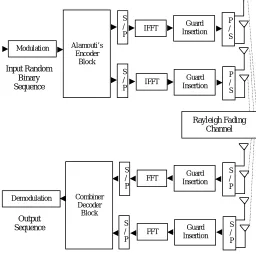
System model of the MIMO-OFDM system are shows in figure 1. In this figure, the transmit antenna are denoted by NTx and the receiver antenna are denoted by NRx of the MIMO-OFDM system model. The input random binary
sequence is applied to the modulation block; this block is change the input sequence to binary block. After than the output of the modulation is applied to the encoder block, this block is all binary information divided into the block and each block are add some parity check bit.
Figure 1: System Model of MIMO-OFDM system
So basically eight by eight blocks are made and going to 8-point inverse fast fourier transform (FFT) with the help of serial to parallel converter. A scientific block diagram of (NTx × NRx) MIMO-OFDM device is proven in discern 1, in
which NTx and NRx are range of transmit and get hold of antennas, respectively.
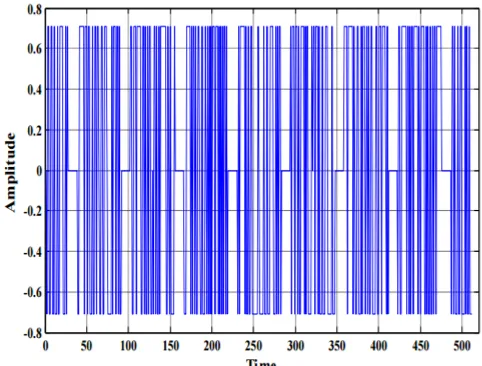
The enter bit stream Nc sub-vendors is modulated into facts symbols via quadrature segment shift keying (QPSK) modulation technique. The transmitted QPSK image is proven in Figure 2. The modulated QPSK symbols are encoded through an Alamouti’s encoder and fed into an OFDM modulator. The output of the encoder is a code phrase matrix M with measurement of NTx × T, where T is the quantity of symbols for each OFDM blocks such as Nc sub-channels.
The received signal at jth antenna can be expressed as
Rayleigh Fading Channel
Modulation Alamouti’s Encoder Block IFFT S / P S / P IFFT Guard Insertion P / S Guard Insertion P / S Input Random Binary Sequence Output Sequence
In which H is the channel matrix, X is the input signal and W is noise with 0 suggest and variance. Also bi[n,k] represents the facts block ith transmit antenna, nth time slot and kth sub channel index of OFDM. Here i and j denoted the transmitting antennas index and receiving antenna index respectively.
The equation of the MIMO-OFDM system model with number of transmit antenna NTx and number of receiver antenna
can be given by as:
(2)
Equation (2) shows the output data vector is represented by Z, the channel matrix is represented by H, A and M represented by input data vector and noise vector respectively. The wireless channel used is AWGN channel. The OFDM transmitter perform Nc-points inverse fast fourier transform (IFFT) to every column of matrix M. Interference
between the OFDM symbols are removed by cyclic prefix (CP) addition to each OFDM symbol, but it causes distortion in spectral efficiency.
Figure 2: Transmitted QPSK symbol of MIMO-OFDM (NTx × NRx) system.
III. ADAPTIVE CHANNEL ESTINATION
it'll growth an excessive amount of then there may be a threat that device can also turn out to be risky. If the case of recursive algorithms is visible we see that they will be now not depending at the step duration parameter, as a cease end result making them specific and fast estimators. However there can be a con in them i.e. they'll be very complex. Their complicated shape calls for extra hardware charge also. Even though they may be quicker than stochastic gradient set of hints however complexity marks them as unusable but now the situation is converting with the improved hardware structures in use.
Least mean squares (LMS) algorithms are magnificence of adaptive clean out used to mimic a preferred filter out via locating the clear out coefficients that relate to generating the least suggest squares of the error sign (distinction among the favored and the real sign). Its miles a stochastic gradient descent approach in that the clean out is simplest adapted based on the mistake at the modern-day time. The simple concept at the back of LMS clean out is to method the most reliable clean out weights (R-1 P), via updating the clean out weights in a way to converge to the top of the line filter weight [12]. The set of rules starts off evolved off evolved through assuming a small weights (zero in most instances), and at each step, via locating the gradient of the propose rectangular errors, the weights are updated. That is, if the MSE-gradient is wonderful, it implies, the mistake would possibly keep developing certainly, if the identical weight is used for further iterations, because of this we want to lessen the weights.
Structure and Operation of NLMS:-
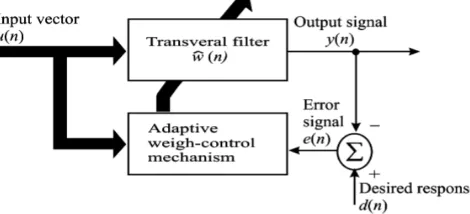
In the form of constructional view, the normalized LMS filter is exactly the same as the standard LMS filter, as shown in the Figure 3. Fundamental concept of both the filter is transversal filter.
Figure 3: Block diagram of adaptive transversal filter
The normalized LMS filter gives minimal disturbance and may be stated as follows: gradually by different iterations weight vector will change in straight weight will change step by step, it is controlled by updated filter output and its proposed values.
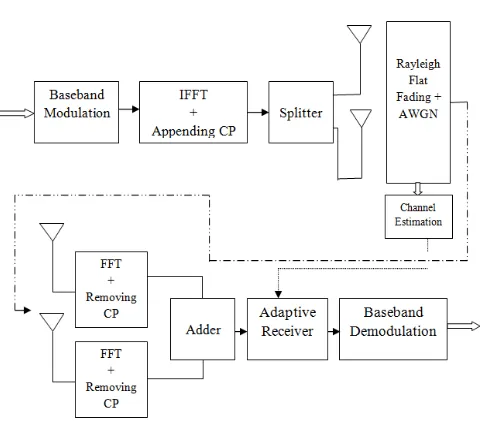
IV. FLOW OF ALGORITHM
Figure 4: 2x 2 MIMO-OFDM System Models with Adaptive Filter
V. SIMULATION RESULT
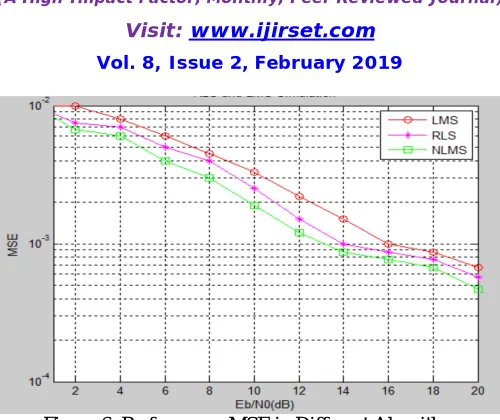
In simulations it is assumed that the system is perfectly synchronized. Different values of SNR are taken and the performance is checked.
Figure 5: Performance BER in Different Algorithm
Figure 6: Performance MSE in Different Algorithm
In addition the MIMO OFDM machine is checked for channel estimation the usage of the 3 algorithms i.e. LMS, RLS and NLMS respectively. Figure 7 display that the modulation used is QPSK. As the fee of M increases in M-PSK the BER performance decreases and the capacity increases. The BER overall performance is reduced than the formerly used for BPSK modulation. But the NLMS set of rules right here again shows higher performance than RLMS set of rules.
Figure 7: Performance BER versus SNR in Different Adaptive Algorithm
VI. CONCLUSION
REEFRENCES
[1] Samira Boualleg, Khalida Ghanem, Brahim Haraoubia, and Mourad Nedil, On the Performance Enhancement when combining STBC and Channel Estimation Techniques in Underground MIMO Channels”, IEEE Communication Letters, Vol. 15, No. 07, 2016
[2] Mel Li, Xiang Wang and Kun Zhang, “Comparative Study of Adaptive Filter Channel Estimation Technique in MIMO-OFDM System Based on STBC”, Proceedings of the 2014 International Conference on Machine Learning and Cybernetics, Lanzhou, 13-16 July, 2014. [3] Biswajit Sahoo, Ravi Ranjan Prasad, and P. Samundiswary, “BER Analysis of Mobile WiMAX System using LDPC Coding and MIMO
System under Rayleigh Channel”, International conference on Communication and Signal Processing, April 3-5, 2013, India.
[4] Mukesh Patidar, Rupeshdubey, Nitinkumar Jain and Saritakulpariya, ”Performance Analysis of WiMAX 802.16e Physical Layer Model”, 978-1-4673-1989-8/12/$31.00 ©2012 IEEE [2].
[5] B. Sklar, “Digital Communications Fundamentals and Applications,” Prentice Hall, Upper Saddle River, NJ, 2000.
[6] Wei Jiang and Daoben Li, “Convolutional Multi-code Multiplexing for OFDM Systems”, Beijing University of Posts and Telecommunications Beijing 100876, China (2007).
[7] Ke Chen and Xiaojing Huang, “A Novel Approach for Interference Suppression in Multi-Subband Convolutional Coded OFDM System”, School of Electrical, Computer & Telecommunications University of Wollongong, Australia (2010).
[8] Chin-Liang Wang and Shun-Sheng Wang† and Hsiao-Ling Chang, “A Low-Complexity SLM Based PAPR Reduction Scheme for SFBC MIMO-OFDM Systems”, 978-1-61284-254-7/11/$26.00 ©2011 IEEE.
[9] Sen-Hung Wang, Student Member, IEEE, and Chih-Peng Li, Member, IEEE, “A Low-Complexity PAPR Reduction Scheme for SFBC MIMO-OFDM Systems”, IEEE SIGNAL PROCESSING LETTERS, VOL. 16, NO. 11, NOVEMBER 2009.
[10] Yang Zhou and Tao Jiang, “A Novel Multi-Points Square Mapping Combined With PTS to ReducePAPR of OFDM Signals Without Side Information”, IEEE TRANSACTIONS ON BROADCASTING, VOL. 55, NO. 4, DECEMBER 2009.