Construction Supervision of Structures-An
Effective and Efficient Approach
Ashok Kumar Sharma, M. Tech(Structures)1, Kamlesh Kumar Ahirwar, B. Tech(Civil)2
General Manager (Structure), Lion Engineering Consultants, Bhopal, M.P, India1
Asst. Manager (Tech.), Lion Engineering Consultants, Bhopal, M.P, India2
ABSTRACT: Structures are designed for considering the life span for 100years and more, considering the construction
supervision of structures as per drawing, design and technical specification. Normally the supervision is beyond the control of designers, and the supervisory staff is also not equipped, skilled and trained to do the job effectively and efficiently. Consequently, project gets delayed due to interlinking and interdependency nature of activities. Further, due to lack of adequate technical supervision, age of structure, functional performance, weak structural performance and early deterioration of structures leads to frequent repair and maintenance.This paper emphasizes on the need of skill up gradation and training of supervisors with general and specific methods for a particular project. Enabling them to track the time lines for achieving improved technical supervision by using modern monitoring tools& techniques. Construction supervision ensures that projects are built according to design and specification takes care of the quality of construction, oversees on the safety of the works.
KEYWORDS: Construction supervision of structures, quality management supervision, type of foundation,
monitoring tools, inspection, PERT, CPM, PDCA cycle, SWOT analysis.
I. INTRODUCTION
Construction supervision critical element for a structure to be performed the indented purposes during design service life.Construction supervision ensures that projects are built according to design and specification takes care of the quality of construction, oversees on the safety of the works. It deals with- (i) Generaloverviewandproject organization (ii) Estimationofproject cost, (iii) Construction Economics, (iv) Planning andscheduling (v) Qualitymanagement (vi)Safety Management, (vii) Legalaspectsofa constructionproject
Normally the supervision is beyond the control of designers, and the supervisory staff is also not equipped, skilled and trained to do the job effectively and efficiently. Consequently, project gets delayed due to interlinking and interdependency nature of activities. In long termdue to lack of adequate technical supervision, the age of structure, functional performance, structural performancegets reduced or the structure will fail to perform the intended functionin service life and early deterioration of structures leads to frequent repair and maintenance activities.This paper emphasizes on the need of skill up gradation and training of supervisors with general and specific methods for a particular project. Enabling them to tracking the time lines with the use of modern tools.It will ensure that projects are built according to design and specification takes care of the quality of construction, oversees on the safety of the works.
II. GENERAL ASPECTSOFSUPERVISION OFSTRUCTURES
The general aspects of supervision are -
Documentation: (i) Sanction letter and technical note, if any (ii) Bill of quantities (iii) Copy of contract document along with any special conditions thereof. (iv) Copy of approved set of plans and detailed working drawings. (v) Standards, specifications, guidelines, codes of practices etc., according to which the work must be executed as per contract (vi) Survey, investigation and sub-soil test reports.
Preparatory Works/Mobilisation:location of site office, storage sheds, batching plant, casting yard, labour
camp etc.
Resources:materials like water, sand, coarse aggregate and boulders,cement andsteel etc.
Detailed Construction Schedules – CPM, PERT.
Major Mile stone: important dates for reviewing the progress of work.
Setting out of site: transfer the alignment of the structure and ground, Fix up permanent bench marks, reference pillars. Using Auto levels and total Station.
Commencement of Construction activities:for various component of structures along with Protective and safety works.
For effective supervision project engineer should have following qualities -
Excellent Communication: A Project Engineer should possess excellent communication skills.
Ability to Delegate Tasks: A Project Engineer should be able to assign tasks to support/subordinate staff based on their specific capabilities and specialized skills.
Ability to Prioritize Activities: Construction projects are multi-faceted and complex, A Project Engineer lay out the most optimal work schedule and execute the plan to the best of their abilities.
Value Teamwork: teamwork as an integral part of the construction process. a more positive atmosphere
will be achieved, which boosts team morale and increases productivity among all workers.
Possess Problem Solving Skills: A Project Engineer is able to devise strategies that are specific to a particular project and tailored to a unique group of individuals.
III. SUPERVISION OF SUBSTRUCTURES
The supervision of substructures deals with - Foundation, pier, pier cap.
1. Formwork and Staging- The objective is to design and construct safe and economical formwork and
scaffolding system that will support all loads imposed and provide the necessary rigidity to achieve the lines, grades and shapes shown in the working drawings. The basic parameters to be considered as under (i) Quality, (ii) Safety, (iii) Efficiency (iv) Economy.
2. Placing of Reinforcement:following key points are of prime concern of supervision of substructure
Reinforcing steel shall conform to the dimensions and shapes given in the approved Bar Bending Schedules.
Reinforcement bars shall be placed and tied accurately in position as shown on the drawings. The diameter of binding wire shall not be less than 1 mm/ 1.3mm for surface and buried structures.
Layers of reinforcement shall be separated by spacer bars at approximately one meter intervals. No person shall be allowed to walk directly over the reinforcement placed in position.
Necessary stays, concrete/polymer cover blocks, metal chairs, metal hangers, supporting wires etc. to fix the reinforcement firmly in its correct position.
3. Open Foundation
The most suitable type of foundation should be selected as per subsurface investigation report. Isolated open foundations are feasible where an SBC of about15 t/m2 or more is available at shallow depths 3-4m.In case of open foundation, the excavation should be done in required line grade, depth, and level as shown in drawings and removal/disposal should be done as directed by the engineer in charge. If groundwater encountered during excavation the necessary dewatering arrangement should be done.
Fig.1: Typical Diagram of Open, Pile, & Well, foundation
4. Well Foundation - Well sinking: Sinking of well can be accomplished by the following methods: -
a) Open grabbing with / without Kent ledge
b) Jack down methods
c) Pneumatic sinking of wells
d) Blasting: may be employed with prior approval of authority to help sinking of well for breaking obstacles such as boulders or for levelling the rock layers for square setting of wells. Blasting may be resorted to only when other methods are found ineffective.
5. Pile Foundation
Subsurface investigation –the depth of boring shall not be less than the following as to ascertain the nature of strata around the pile shaft –
a) 1.5times estimated length of pile in soil or 15m below the proposed foundation level
c) 4 times diameter of pile in hard rock but minimum 3m in such rock.
5.1 Construction stages of pile: (i)Control of Piling Installation, (ii)Control of Alignment, (iii)Use of Drilling Mud (iv) Cleaning of Borehole (v) lowering of reinforcement cag (vi)Tremie (bucket) Concreting, (vii)Testing of pile, (viii) Defective Pile
6. Substructure-Piers and abutments
6.1 Piers cap and abutments cap: The surface of cap shall be finished smooth and shall have a slope for draining of water. For short span slab bridges with continuous support on pier caps the surface shall be cast horizontal. The top surface of the pedestal on which bearing are to be placed shall also be cast horizontally.
6.2 The surface on which elastomeric bearings are to be placed shall be wood float finished to a level plane which shall not vary more than 1.5 mm from straight edge placed in any direction across the area. The surface on which other bearings (steel bearings, pot bearings) are to be placed shall be cast about 25 mm below the bottom level of bearings.
6.3 Dirt/ballast wall, return wall and wing wall: In case of cantilever walls, no construction joint shall be permitted. Wherever, feasible, the concreting in cantilever walls shall be carried out in continuation of the ballast wall.
IV. SUPERVISION OF SUPERSTRUCTURES
The critical element of supervision of superstructures– girder, deck slab, bearing, expansion joints, crash barriers. The major activities in constructions are concreting, pre-stressing, grouting, Fixing of bearing, installation of expansion joints etc. This section highlight important
1. Concreting:Concreting should be done as per approved specified mix.
2. Pre Stressing:
a) Before commencement of the pre-stressing, it shall be ensured that all the tendons are free to move between the jacking points.
b) The tendons shall be stressed at a gradual and steady rate and the extension recorded at each increment of jack pressure.
c) The extension of the tendons at the agreed pre-specified total force shall be within 5 per cent of the agreed calculatedextension.
d) Any appreciable variation between the calculated extension and actual extension should be notified and settled in consultation with the Engineer-in-charge before proceeding with further tensioning.
e) Stressing shall be done from both ends unless one end pre-stressing is specified in the drawings.
f) Pre-stressing record of all the cables shall be maintained in the format given in Appendix 1800/II of Ministry’s Specifications for roads & bridge works (third revision).
g) Efficiency of pre-stressing jack should be found beforehand and catered for in the extension of cables.
3. Grouting:
a) Grouting shall be carried out as early as possible as but not later than 2 weeks of stressing in tendon.
b) Before grouting, ducts shall be flushed with water for cleaning as well as for wetting the surfaces of the ducts walls. Water used for flushing should be of samequality asused for grouting
c) Water/cement ratio of grout mix should be as low as possible, consistent with workability. This ratio should not normally exceed 0.45.
d) Mixing time depends upon the type of the mixer, but will normally be between 2 and 3 minutes. However, mixing should be for such duration as to obtain uniform and thoroughly blended grout.
f) The pump should be a positive displacement type and should be capable of ejecting the grout in a continuous operation and not by way of pulses.
4. Bearing
a) Bearings: Bridge flexibility is primarily achieved by a component called, elastomeric bearing pad. This is typically made of a strong and pliable material such as neoprene, - a type of heavy-duty industrial rubber. b) Installation- Polytetrafluoroethylene (PTFE) is a synthetic fluoropolymer of tetrafluoroethylene that has
numerous applications. The best known brand name of PTFE-based formulas is Teflon by
Chemours.Correct installation of all types of structural bearings is critical to their performance. The most important aspects of installation are:
c) Ensuring intimate surface contact with the structure- absolutely no voids above or belowthe bearings. Cementitious or epoxy grout must be properly mixed and must be of adequate strength.
d) Bearing orientation and pre-sets must be carefully checked and adjusted where necessary. Horizontal and vertical alignment. Where applicable, anchor bars must be substantially encased within the steel reinforcement of concrete members.
e) Prevention of contamination, especially slurry, of the exposed stainless steel sliding surfaces. Preventing mechanical damage to the corrosion protection system.
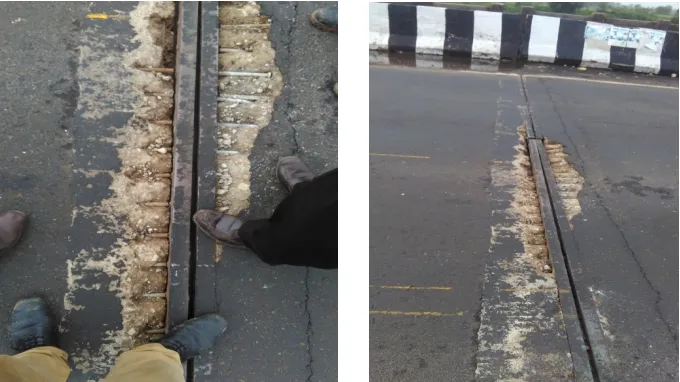
f) Expansion Joints: designed to allow for continuous traffic between structures while
accommodating movement, shrinkage, and temperature variations on reinforced and pre-stressed concrete, composite, and steel structures.
Fig.3: Correct Installation of Expansion Joints
V. QUALITY MANAGEMENT SYSTEMS
To ensure building of safe, serviceable, durable and economically viable structures, it is necessary to have a strategy for management of human skills by way of quality system defining quality policy, quality assurance and quality audit. Approved project quality assurance plan for given project should ensure the quality management system. It is found that mobile labs are quite useful and time saving for large project; the same system for QMS should be followed wherever applicable.
Codal(IRC/IS/MORTH) provision & guidelines cover quality system for activities of bridge and structures using concrete elements and include project preparation, design and drawing, construction and supervision, contract management, quality of materials, test/standard of acceptance criteria and equipment's used in construction and workmanship.
VI. PROJECT PLANNING,SCHEDULING AND MONITORING OF WORKS
1. Planning & Scheduling:
1.1 Construction planning is a fundamental and
challenging activity in the management and execution of construction projects. It involves the choice of technology, the definition of work tasks, the estimation of the required resources and durations for individual tasks, and the identification of any interactions among the different work tasks.
1.2 Scheduling basically means determining the inter-relationship of various activities of a project.
Fig.5: Construction Planning
2. Monitoring
To monitor the progress of the work at various stages, necessary data must be maintained at site showing the position of each activity, targets to be achieved, bottlenecks, if any, expenditure and position of funds, etc.
Monthly/quarterly progress reports may be prepared in the approved Performa and submitted regularly to the concerned authority for their information and for keeping a close watch on the progress of the work and the problems encountered in the field with a view to sort them out.
It is necessary to ensure simultaneous completion of a structures and its approaches. Accordingly, progress made on the approaches may also be indicated. Mainly three monitoring discussed in this study – (i) PDCA Cycle, (ii)SWOT analysis, (iii)PERT and CPM.
2.1 When to Use Plan–Do–Check–Act cycle:
As a model for continuous improvement.
When starting a new improvement project.
When developing a new or improved design of a process, product or service.
When defining a repetitive work process.
When planning data collection and analysis in order to verify and prioritize problems or root causes.
Plan–Do–Check–Act cycle Procedure
Plan: Recognize an opportunity and plan
a change.
Do: Test the change. Carry out a small-scale study.
Check: Review the test, analyse the
results and identify what you’ve learned.
Act: Take action based on what you
learned in the study step: If the change did not work, go through the cycle again with a different plan. If you were successful, incorporate what you learned from the test into wider changes. Use
what you learned to plan new
improvements, beginning the cycle again.
Fig.6: PDCA Cycle
2.2 SWOT
SWOT is a strategic planning technique used to help a person or organization identify strengths, weaknesses, opportunities, and threats related to business competition or project planning.Strengths and weakness are frequently internally-related, while opportunities and threats commonly focus on the external environment. The name is an acronym for the four parameters the technique examines:
Strengths: characteristics of the business or project that give it an advantage over others.
Weaknesses: characteristics of the business that place the business or project at a disadvantage relative to others.
Opportunities: elements in the environment that the
business or project could exploit to its advantage.
Threats: elements in the environment that could cause trouble for the business or project.
2.3 PERT and CPM
BASIS FOR COMPARISON
PERT CPM
Meaning PERT is a project management technique, used to
manage uncertain activities of a project.
CPM is a statistical technique of project management that manages well defined activities of a project.
What is it? A technique of planning and control of time. A method to control cost and time.
Orientation Event-oriented Activity-oriented
Evolution Evolved as Research & Development project Evolved as Construction project
Model Probabilistic Model Deterministic Model
Focuses on Time Time-cost trade-off
Estimates Three time estimates One time estimate
Appropriate for High precision time estimate Reasonable time estimate
Management of Unpredictable Activities Predictable activities
Nature of jobs Non-repetitive nature Repetitive nature
Critical and Non-critical activities
No differentiation Differentiated
Suitable for Research and Development Project Non-research projects like civil
construction, ship building etc.
Crashing concept Not Applicable Applicable
VII. CONCLUSIONSANDRECOMMENDATIONS
The important conclusions of this study may be summarized as follows-
With the growing application of EDMS and WPMS (Electronic data management system/Web based
project management system), level and standard of supervision is to be improved.
If these systems are followed, then life cycle document management system for project construction management, becomes a referral/model document for coming projects
Necessary training calendar should be ready for every fiscal year with innovation incorporated and updated trends in construction
In any company/any project the end objective is to achieve project goal as defined by the scope, time, cost. Quality and client satisfaction. The overall scenario is to harmonize the function of supervision to meet the project objectives.
The use of modern monitoring and supervising tools should be encouraged for optimum utilization of project team available at site
REFERENCES
[1] MORTH 2013, “Specifications for Road and Bridge Works, 2013 (Fifth Revision)”.
[2] IRC:5-1998, Standard Specifications and Code of Practice for Road Bridges, Section I – General Features of Design (Eighth Revision). 2015 [3] IRC:6-2000, Standard Specifications and Code of Practice for Road Bridges, Section-II Loads and Load Combinations (Seventh Revision) [4] IRC:18-2000, Design Criteria for Pre-stressed Concrete Road Bridges (Post-Tensioned Concrete) (Third Revision)
[5] IRC:21-2000, Standard Specifications and Code of Practice for Road Bridges, Section III – Cement Concrete (Plain and Reinforced) (Third Revision
[6] IRC:22-2008, Standard Specifications and Code of Practice for Road Bridges, Section VI – Composite Construction (Limit States Design) (Third Revision)
[7] IRC: 24-2010, Standard Specifications and Code of Practice for Road Bridges, Steel Road Bridges (Limit State Method) Third Revision) . [8] IRC:38-1988 , Guidelines for Design of Horizontal Curves for Highways and Design Tables (First Revision)
[9] IRC:45-1972 Recommendations for Estimating the Resistance of Soil Below the Maximum Scour Level in the Design of Well Foundations of Bridges
[10] IRC:78-2000 , Standard Specifications and Code of Practice for Road Bridges, Section VII- Foundations and Substructures (Revised Edition) [11] IRC:83-1999 (Part I), Standard Specifications and Code of Practice for Road Bridges, Section IX Bearings, Part I : Roller & Rocker Bearings
(Second Revision
[12] IRC:83-1987 (Part II)Standard Specifications and Code of Practice for Road Bridges, Section IX – Bearings (Elastomeric Bearings), Part II (First Revision)
[13] IRC:83-2002 (Part III)Standard Specifications and Code of Practice for Road Bridges, Section IX – Bearings, Part III: POT, POT-CUM-PTFE, PIN and Metallic Guide Bearings.