ISSN(Online): 2319-8753 ISSN (Print): 2347-6710
I
nternational
J
ournal of
I
nnovative
R
esearch in
S
cience,
E
ngineering and
T
echnology
(A High Impact Factor, Monthly, Peer Reviewed Journal)
Visit: www.ijirset.com
Vol. 7, Issue 5, May 2018
The Factor Analysis of Implementing Precast
Construction Method on Improving Time
Performance in Multi-Storey Building
Construction Projects in the South Tangerang
City ( Case Study : Pt. X, Project Abc)
Manlian Ronald. A . Simanjuntak1, Agung Sakti2
Professor of Construction Management, Universitas Pelita Harapan, Jakarta, Indonesia1 Student of Magister of Civil Engineering, Universitas Pelita Harapan, Jakarta, Indonesia 2
ABSTRACT: The time factor of a project implementation is very significant to be considered in the construction process. Thus a research that identifies factors of precast construction method execution on multi storey buildingconstruction projects in the city of South Tangerang is necessary to conduct, as well as how these factors are implemented in order to optimize project implementation time to prevent delays.
The research problem as a whole is to identify factors and variables of precast construction method execution on multi storey building construction projects in the city of South Tangerang, to analyze the effect of precast construction method execution on improving time performance in multi storey building construction projects in the South Tangerang city, to provide recommendations for improvements to the analysis undertaken.
Literature review of this research provides information about construction process, construction methods, precast construction method, portrait of multi storey building construction in the South Tangerang city, project performance, and various relevant research results over the past ten years.
Identification of research problem is carried out in the early stage of research methodology followed by research analysis, study of research findings, determine recommendations to produce the necessary improvements. Furthermore quantitative method by using analysis of survey results is used in this research.
It is expected that this research will increase both knowledge and understanding on how precast construction method effects project time performance especially in multi storey building constrcution. Besides the result of this research is expected to determine recommendations to produce the necessary improvements for contractor to optimize the execution of construction process with the chosen construction method.
KEYWORDS :Constrcution process, constrcution method, precast, time performance, construction, multi storey building.
I. INTRODUCTION
ISSN(Online): 2319-8753 ISSN (Print): 2347-6710
I
nternational
J
ournal of
I
nnovative
R
esearch in
S
cience,
E
ngineering and
T
echnology
(A High Impact Factor, Monthly, Peer Reviewed Journal)
Visit: www.ijirset.com
Vol. 7, Issue 5, May 2018
even eliminated. One of the most widely used precast concrete systems today is the light-weight facade. Nowadays development of Indonesia’s constrcution industry is increasingly encouraging the development of various construction method in the field of civil engineering. In the effort to meet those reuirements, the demand for construction work quickly and efficiently increase, one of them is precast method as one of the appropriate alternative construction methods due to its advantages in terms of speed, quality control, and ease of implementation.
In practice, precast systems are more precise and efficient when applied to several things including on buildings located in areas with relatively low seismic zones (Zone I and II) and in buildings of ‘typical’ type. Low seismic zone has a frequency of earthquakes that are not very often with a not very large intensity. Therefore precast method is very precise to apply due to bonding occured is not too rigid.
The development of Jakarta as a metropolitan city poised to give effect to the surrounding areas. Located around Jakarta, South Tangerang city felt the impact of development of Jakarta city as one of Jakarta's buffer areas experiencing rapid development and population growth. South Tangerang is a newly established city after its expansion from Tangerang Regency on October 29, 2008, where the establishment of this city is regulated in the Law of the Republic of Indonesia Number 51 of 2008. This expansion is indirectly related to the presence of many multi storey buildings as one of the physical characteristics of urban areas in the South Tangerang city. The time factor of the project implementation is very significant to be considered in the construction process. Thus a research that identifies factors of precast construction method execution on multi storey building construction projects in the city of South Tangerang is necessary to conduct, as well as how these factors are implemented in order to optimize project implementation time to prevent delays.
Therefore this research is conducted to examine the significant factors and variables in the process of implementation of precast construction method in the construction of multi-storey buildings in South Tangerang City, to analyze the effect of the implementation process of the precast construction method in improving the performance of the time, as well as to review the recommendations for improvement in the process of implementation of the precast construction method.
II. RESEARCHGAP
The use of precast concrete as the main material for infrastructure development and construction increasingly in demand where every year its capacity increases rapidly. In 2017 it was recorded 34 million tons or up about 20 percent compared to last year, said Chairman of Prasy and Prestressed Companies Association (AP3I) Wilfred Singkali. Both precast and conventional is a working method, which distinguishes the technology contained in it. Both are still needed, said Wilfred. Currently the constraints on precast systems are long-term investments that require market certainty. However, when compared to developed countries, the share of the use of precast system could reach 70-80 percent so that is promising. As a producer, both private and State-Owned Enterprises (SOEs), has the same magnitude in terms of producing precast concrete. The production capacity of the SOE group is about 46 percent of the national capacity, said Wilfred.
Indonesia is still lacking the application of its precast concrete, we must be able to prove that we can carry out by ourselves and not lose competitiveness. Said Wilfred Saps (Chairman of Prasy and Prestressed Companies Association of Indonesia, 2017). Many studies has been done to exploit the potential of local raw materials, production waste, or recycled material, including what has been done by the Research and Development Department of the Ministry PUPR. Researches continue to be encouraged by the government to support the implementation of more lean and sustainable cement construction. Precast concrete can be a response to the challenges of Indonesia development. The government's expectation is in 2020 precast must hold 30 percent of the current development in Indonesia, says Wilfred Singkali.
III.RESEARCHPROBLEMS
1. What are the important factors and variables in the process of implementation of precast facade construction method in multi storey building construction in South Tangerang city?
ISSN(Online): 2319-8753 ISSN (Print): 2347-6710
I
nternational
J
ournal of
I
nnovative
R
esearch in
S
cience,
E
ngineering and
T
echnology
(A High Impact Factor, Monthly, Peer Reviewed Journal)
Visit: www.ijirset.com
Vol. 7, Issue 5, May 2018
IV.LITERATUREREVIEW
Construction Management There are several stages in the implementation of a development plan, where the stages of project construction are prepared before the implementation to make sure that project run as planned and on schedule. Construction project work begins with planning and design afterwards proceed with construction phase in which it is a phase of physical development implementation, furthermore phase of operational and maintenance. According to Wulfram I. Ervianto in Construction Project Management, there are three parties involved in the construction project since the initial phase (preliminary, structural work, and design) up to the construction period which are 1) Owner , 2) Designer, and 3) Contractor. Time performance management on construction projects is a control and timing or schedule of the project. Time performance standard is determined by referring to all stages of the project along with duration and resource usage. All the data and information that has been obtained is used to make the scheduling so that the time progress indicator can be obtained. Performance refers to the level of success in performing the task and ability to achieve the goals set. Performance is considered good and successful if the desired goal can be achieved properly (Carr R.I 1993).
According Dipohusodo (1996), the performance control process in the implementation of construction projects generally consists of three main steps, namely: Establish performance standards where this standard can be budgeted costs and schedules, measure performance against standards by comparing actual performance with performance standards. Results of work and expenditures that have occurred compared to the schedule and the cost that has been planned, the last is taking corrective action in case of deviation against predefined standard. Time performance will have implications on cost performance, as well as overall performance. Consequently affecting variables should also be monitored, such as quality, safety, availability of equipment and materials, as well as project stakeholders involved. In practice there are problems that can impede time performance, such as ineffective allocation of resources, limited personnel, insufficient equipment, poor weather conditions, and faulty working methods. So it is necessary a good and reliable management to prevent and mitigate the problems that can occur (Husen, 2010).
Development of Precast Concrete in Indonesia Actually the application of precast concrete system in Indonesia is not something new. Precast concrete systems has been implemented In the 70s, for example with the construction of a house in Sarijadi Bandung. Later precast concrete systems which has been regularly applied is imported from overseas such as Mivan and Utinord systems. Around 1995s, the construction of layered houses was carried out using waffle-crete system, for example in Cilincing, Cengkareng and Batam projects. Then Association of Precast and Prestressed Indonesia (IAPPI) as an association that embodies both company and individuals who take part in the work and research of precast concrete system was established in 1999. In the early years, there were some precast concrete systems found by Indonesians and had been applied to rumah susun projects. Now there are about 40 precast concrete systems that have been implemented, especially in support of 1000 tower program that has been launched by government. The precast system is evolving which is characterized by the emergence of various innovations such as Column Slab System (1996), L-Shape Wall System (1996), All Load Bearing Wall System (1997), Beam Column Slab System (1998), Jasubakim System (1999) The Bresphaka system (1999) and the T-Cap system (2000).
Portrait of Multi-Storey Building in South Tangerang City The development of DKI Jakarta as a Metropolitan City also gives impact to the surrounding areas. South Tangerang City, as one of the areas around Jakarta also impacted as one of buffer areas of Jakarta City which experienced urban development and population growth. South Tangerang is a newly established city after its expansion from Tangerang regency on October 29, 2008, where the establishment of this city is regulated in the Law of the Republic of Indonesia Number 51, 2008. This expansion is indirectly related to the existence of multi storey buildings (as one of urban physical characteristics) located in South Tangerang city.
ISSN(Online): 2319-8753 ISSN (Print): 2347-6710
I
nternational
J
ournal of
I
nnovative
R
esearch in
S
cience,
E
ngineering and
T
echnology
(A High Impact Factor, Monthly, Peer Reviewed Journal)
Visit: www.ijirset.com
Vol. 7, Issue 5, May 2018
South Tangerang city improvement also occurred in various sectors, such as the economic sector, services, trade, etc. This will attract people around Tangerang city to live, work and do business in South Tangerang city. As a result there was an increase in population and multi storey buildings in South Tangerang city. The high demand for business premises, as well as dwellings resulted in the transition of land use, from agricultural use to wake-up areas in South Tangerang City.
V. RESEARCHMETHODOLOGY
1. Research Process
Based on background and research problems, the framework of this research process is from the initial stage, literature study, analysis and discussion. Initial stages of this research is to obtain information and prepare the necessary tools. such as observing issues or research topics, formulating problems and determining the goals to be achieved. The literature study is derived from construction management guidebooks as well as relevant journals in the last ten years with the aim of identifying the factors/scope of implementation of precast construction methods at the project implementation stage. At this stage, It will be analyzed data used in evaluating and giving recommendation about effects of the implementation of precast construction method to the escalation of time performance in the multi-storey building project in South Tangerang City (Case Study: PT X, ABC Project).
2.Survey Respondents
The respondents chosen in this research were homogeneous respondents who has these criteria: having minimum education of Diploma, having at least three years experiences in construction with a good reputation, as well as having minimum age of 25 years. These requirements are given to ensure that respondent understands the research topic so that the answers given are in accordance with the assumptions specified. It was determined that at least 50 respondents participated ini this research. Research instruments is a tool used to measure either natural or social phenomena observed. Thus use of research instruments is to gather a complete information regarding a problem, natural or social phenomena (Sugiyono, 2014).
VI.ANALYSISANDDISCUSSION
1. Discussion Of Research Process
At this stage the data questionnaire results in the first validation by experts, and then answered by the respondents, collected and then the data respondents will be sorted. After that the answers from the questionnaires that have been filled respondents will be processed by using the help of SPSS (Statistical Package For The Social Sciences) program.
a. Primary Data Collection
This study uses primary data obtained from the results of filling questionnaires by as many as 50 respondents who are all respondents who are the owner of various companies. Primary data obtained will be analyzed to examine factors (7 Factors) and (39 Variables) of important variables in the process of implementation of precast facade construction method in building construction in South Tangerang City. To analyze the influence of the process of execution of precast facade construction method in improving the time performance in the process of building of multi-storey building in South Tangerang City. To review the improvement recommendations in the process of implementing the construction method of precast façade Based on the results of filling the questionnaire. The following are characteristics of respondents who viewed in terms of gender, age, education, position and tenure in the owner.
b. Secondary Data Collection
ISSN(Online): 2319-8753 ISSN (Print): 2347-6710
I
nternational
J
ournal of
I
nnovative
R
esearch in
S
cience,
E
ngineering and
T
echnology
(A High Impact Factor, Monthly, Peer Reviewed Journal)
Visit: www.ijirset.com
Vol. 7, Issue 5, May 2018
c. Data Analysis of Research Results 1) Realibility Test
Reliability test is an advanced stage in the factor analysis after the validity of variable test compilation of the factors that formed. In the analysis of early stage factors have been obtained two component factors formed by each variable forming. Both components of these factors then tested its reliability by looking at the value of crombach alpha obtained from the results of reliability test. Now (2006) states that a research instrument indicates adequate reliability if the coefficient of alpha crombach is greater or equal to 0.70. However, in some cases, a factor with a component of less than 3 can have crombach alpha <0.7, for that case Guilford reliability is used in Sugiyono (2007: 183) which divides the level of reliability in the following 5 criteria:
Tabel 1 Reliabel Rate
Based on table 1 above, the adequacy of factor components is not reliable if it has coefficient crombach's alpha below 0.2, the coefficient of crombach's alpha between 0.2 to 0.4 declared less reliable and on the coefficient of crombach's alpha between 0.4 to 0, 7 has been declared quite reliable. Using SPSS program support, the following Table 4.6 is the result of the reliability test of the two component factors formed:
Tabel 2 Reliability Component Factor
Based on table 2 above, the value of alpha crombachs reliability factor test component factor is 0.931, which means that the factor component is considered very reliable.
2) Correlation Test
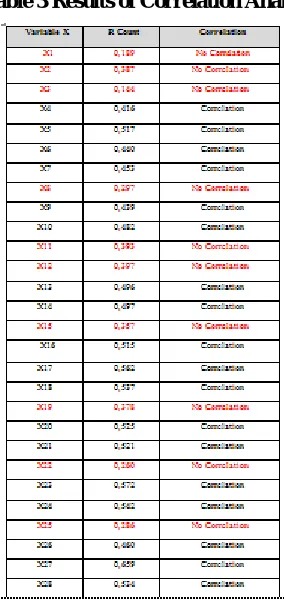
In this research, the correlation test is conducted to measure the relationship between all independent variables which are important factors that are in the process stages of the construction of precast facade method to the time performance of the building project in South Tangerang. Correlation analysis done in research using SPSS version 20 program aid and because the data used in this study is numerical then correlation analysis used is product moment correlation analysis. The independent variable with correlation value of r ≥ 0,4 is considered to have a close relationship with the
ISSN(Online): 2319-8753 ISSN (Print): 2347-6710
I
nternational
J
ournal of
I
nnovative
R
esearch in
S
cience,
E
ngineering and
T
echnology
(A High Impact Factor, Monthly, Peer Reviewed Journal)
Visit: www.ijirset.com
Vol. 7, Issue 5, May 2018
r ≥ 0,4 to variable of process performance of precast facade construction method) and will be analyzed further by
intercorrelation analysis:
Table 3 Results of Correlation Analysis
ISSN(Online): 2319-8753 ISSN (Print): 2347-6710
I
nternational
J
ournal of
I
nnovative
R
esearch in
S
cience,
E
ngineering and
T
echnology
(A High Impact Factor, Monthly, Peer Reviewed Journal)
Visit: www.ijirset.com
Vol. 7, Issue 5, May 2018
Based on table 4 above, it can be seen that of 38 variables analyzed, there are only 23 variables that have correlation to time performance variables in building projects in South Tangerang City, these variables are further analyzed by intercorrelation analysis.
3) Intercorrelation Test
Intercorrelation test conducted to determine the magnitude of the relationship between independent variables of the other free variables selected from the correlation test results. In the intercorrelation analysis, independent variables that cause high correlation to other independent variables (correlation value r ≥ 0.4) will be removed from the model until
the model obtained without independent variables that are mutually correlated high. Based on the results of intercorrelation analysis, it can be seen from 23 independent variables analyzed, only the remaining 15 independent variables passed in intercorrelation test (have correlation value r ≤ 0,4 to other independent variable), so at the next
analysis stage, there are only 15 independent variables which will be analyzed, ie variables X1, X2, X3, X8, X11, X12, X15, X19, X22, X25, X34, X35, X36, X38, and X39.
4) Factors Analysis Test
Factor analysis test is performed to form several groups of selected independent variables from the correlation and intercorrelation test results that are considered valid to explain the important factors in the process of implementation of precast facade construction method in high rise building project in South Tangerang City. In the analysis of this factor also, will be tested whether the determinant variable is still consistent in the factor or not.
a. KMO And Bartlet
Bartlett of Sphericity and Keizer Meyer Olkin test Mearuse of Sampling Adequacy (KMO) is a test instrument used to measure intercorrelation between variables and whether factor analysis can be done. Criteria data that can be analyzed factors are data showing KMO> 0.5 and Bartlet's test of Sphericity at significant <0.05 (Ghozalli, 2006). The following is a table 4.10 KMO-MSA result of factor analysis:
Table 5 KMO and Bartlet Factor Analysis Results KMO and Bartlett's Test
Kaiser-Meyer-Olkin Measure of Sampling Adequacy. ,821
Bartlett's Test of Sphericity
Approx. Chi-Square 709,367
Df 253
Sig. ,000
Based on table 5 above, the value of KMO result of factor analysis is 0.821, KMO value obtained more than 0.5, this means factor analysis can be done. Furthermore, the significant value obtained from the Bartlett test is 0,000 and this value is smaller than 0.05 which means there is a significant relationship between independent variables inside and outside factors.
b. Matriks Anti Image
ISSN(Online): 2319-8753 ISSN (Print): 2347-6710
I
nternational
J
ournal of
I
nnovative
R
esearch in
S
cience,
E
ngineering and
T
echnology
(A High Impact Factor, Monthly, Peer Reviewed Journal)
Visit: www.ijirset.com
Vol. 7, Issue 5, May 2018
Table 6 Matrix of Anti Image Result Factor Analysis
Based on the anti Image matrix in table 6 above, the diagonal values of all variables> 0,500, meaning all variables match the structure of other variables in the factor, so no independent variables are eliminated from the model. 23 independent variables selected intercorrelation test results can be further analyzed by regression analysis.
c. Total Variance Explained
The total variance explained table describes the number of component factors that can be formed from the 23 independent variables analyzed. The following is a table of total variance explained results from the analysis of these factors:
Table 7 Total Variance Explained Factor Analysis Results
X4 X5 X6 X7 X9 X1 0 X13 X1 4 X16 X1 7 X18 X2 0 X21 X23 X24 X26 X2 7 X28 X2 9 X30 X3 1 X32 X3 3
X4 ,3 45 -,119 -,0 27 ,063 -,0 87 -,001 ,0 70 ,017 -,02 5 -,075 ,05 4 -,0 72 -,01 4 ,1 38 ,05 9 -,0 44 -,05 6 ,0 86 -,03 9 ,0 06 -,00 3 -,0 57 -,07 9 X5 -,1 19 ,292 ,0 36 -,051 ,0 52 ,010 -,0 54 -,039 -,07 2 ,000 ,04 4 ,0 99 ,00 4 -,1 02 -,00 4 -,0 46 -,00 1 -,0 11 ,03 5 ,0 18 -,01 9 ,0 01 -,03 5 X6 -,0 27 ,036 ,2 86 -,111 ,0 14 ,008 -,0 40 ,000 ,03 5 -,057 ,04 4 ,0 42 ,00 8 -,0 45 -,04 3 ,0 59 -,02 9 -,0 02 -,09 6 ,0 66 -,03 9 ,0 06 ,03 8 X7 ,0 63 -,051 -,1 11 ,229 -,1 44 ,062 -,0 24 ,037 -,08 4 ,009 -,00 5 -,0 65 ,01 8 ,0 59 ,04 3 ,0 10 -,03 7 ,0 54 ,00 4 -,0 29 ,03 8 -,0 16 -,08 4 X9 -,0 87 ,052 ,0 14 -,144 ,3 13 -,061 -,0 35 -,058 ,05 9 ,044 ,00 6 ,0 30 -,02 7 -,0 91 -,01 6 -,0 30 ,03 6 -,0 67 ,05 7 ,0 34 -,06 1 ,0 42 ,01 4 X10 -,0 01 ,010 ,0 08 ,062 -,0 61 ,214 -,0 97 ,085 -,04 5 -,014 ,08 4 -,0 09 -,02 3 ,0 19 ,03 7 -,0 37 -,09 8 ,0 60 ,00 1 ,0 18 -,10 9 ,0 91 -,08 3 X13 ,0 70 -,054 -,0 40 -,024 -,0 35 -,097 ,1 82 -,089 ,03 3 -,026 -,07 2 -,0 10 ,04 7 ,0 36 -,05 6 -,0 30 ,02 2 ,0 05 -,02 0 -,0 11 ,10 3 -,0 82 ,07 5 X14 ,0 17 -,039 ,0 00 ,037 -,0 58 ,085 -,0 89 ,335 -,00 3 -,023 ,01 0 -,0 43 -,01 9 -,0 28 ,05 2 -,0 77 -,03 8 ,0 24 ,03 0 ,0 59 -,10 1 ,0 76 -,06 7 X16 -,0 25 -,072 ,0 35 -,084 ,0 59 -,045 ,0 33 -,003 ,26 6 -,084 -,07 3 -,0 50 ,03 4 -,0 15 -,09 5 ,0 28 ,02 5 -,0 27 -,05 5 ,0 55 ,00 0 -,0 15 ,12 6 X17 -,0 75 ,000 -,0 57 ,009 ,0 44 -,014 -,0 26 -,023 -,08 4 ,206 -,07 9 -,0 06 -,00 4 -,0 35 ,04 1 -,0 18 ,04 1 -,0 85 ,08 5 -,0 59 ,01 8 ,0 17 -,07 6 X18 ,0 54 ,044 ,0 44 -,005 ,0 06 ,084 -,0 72 ,010 -,07 3 -,079 ,38 4 ,0 57 -,06 8 -,0 05 -,00 6 -,0 15 -,05 5 ,0 57 -,02 6 -,0 11 -,05 8 ,0 23 -,07 1 X20 -,0 72 ,099 ,0 42 -,065 ,0 30 -,009 -,0 10 -,043 -,05 0 -,006 ,05 7 ,3 56 ,04 1 -,0 85 ,01 8 -,0 72 -,05 7 ,0 54 ,02 9 -,0 75 ,01 4 -,0 09 -,03 0 X21 -,0 14 ,004 ,0 08 ,018 -,0 27 -,023 ,0 47 -,019 ,03 4 -,004 -,06 8 ,0 41 ,41 5 -,0 70 -,14 8 -,0 49 -,03 3 ,0 52 ,01 5 -,1 07 ,02 4 ,0 46 -,01 6 X23 ,1 38 -,102 -,0 45 ,059 -,0 91 ,019 ,0 36 -,028 -,01 5 -,035 -,00 5 -,0 85 -,07 0 ,3 17 ,03 9 ,0 03 -,03 0 ,0 36 -,04 8 -,0 65 ,03 1 -,0 38 -,02 8 X24 ,0 59 -,004 -,0 43 ,043 -,0 16 ,037 -,0 56 ,052 -,09 5 ,041 -,00 6 ,0 18 -,14 8 ,0 39 ,40 0 -,0 52 -,03 9 ,0 05 ,04 3 -,0 61 -,01 2 -,0 18 -,08 9 X26 -,0 44 -,046 ,0 59 ,010 -,0 30 -,037 -,0 30 -,077 ,02 8 -,018 -,01 5 -,0 72 -,04 9 ,0 03 -,05 2 ,2 54 ,06 7 -,0 56 -,08 5 ,0 37 ,01 9 -,0 70 ,06 8 X27 -,0 56 -,001 -,0 29 -,037 ,0 36 -,098 ,0 22 -,038 ,02 5 ,041 -,05 5 -,0 57 -,03 3 -,0 30 -,03 9 ,0 67 ,13 5 -,1 07 -,01 3 ,0 02 ,01 8 -,0 32 ,06 5 X28 ,0 86 -,011 -,0 02 ,054 -,0 67 ,060 ,0 05 ,024 -,02 7 -,085 ,05 7 ,0 54 ,05 2 ,0 36 ,00 5 -,0 56 -,10 7 ,2 22 -,07 1 -,0 06 -,01 0 ,0 12 -,05 4 X29 -,0 39 ,035 -,0 96 ,004 ,0 57 ,001 -,0 20 ,030 -,05 5 ,085 -,02 6 ,0 29 ,01 5 -,0 48 ,04 3 -,0 85 -,01 3 -,0 71 ,25 6 -,0 93 -,00 8 ,0 67 -,08 4 X30 ,0 06 ,018 ,0 66 -,029 ,0 34 ,018 -,0 11 ,059 ,05 5 -,059 -,01 1 -,0 75 -,10 7 -,0 65 -,06 1 ,0 37 ,00 2 -,0 06 -,09 3 ,3 49 -,07 8 -,0 35 ,02 1 X31 -,0 03 -,019 -,0 39 ,038 -,0 61 -,109 ,1 03 -,101 ,00 0 ,018 -,05 8 ,0 14 ,02 4 ,0 31 -,01 2 ,0 19 ,01 8 -,0 10 -,00 8 -,0 78 ,37 8 -,2 22 ,05 6 X32 -,0 57 ,001 ,0 06 -,016 ,0 42 ,091 -,0 82 ,076 -,01 5 ,017 ,02 3 -,0 09 ,04 6 -,0 38 -,01 8 -,0 70 -,03 2 ,0 12 ,06 7 -,0 35 -,22 2 ,3 85 -,06 3 X33 -,0 79 -,035 ,0 38 -,084 ,0 14 -,083 ,0 75 -,067 ,12 6 -,076 -,07 1 -,0 30 -,01 6 -,0 28 -,08 9 ,0 68 ,06 5 -,0 54 -,08 4 ,0 21 ,05 6 -,0 63 ,40 1 X4 ,71 1a -,377 -,0 85 ,225 -,2 64 -,003 ,2 78 ,050 -,08 3 -,280 ,14 9 -,2 05 -,03 8 ,4 17 ,16 0 -,1 49 -,26 1 ,3 10 -,13 0 ,0 17 -,00 9 -,1 56 -,21 2 X5 -,3 77 ,8 74a ,1 24 -,197 ,1 70 ,042 -,2 35 -,125 -,26 0 ,002 ,13 3 ,3 06 ,01 0 -,3 34 -,01 1 -,1 69 -,00 7 -,0 41 ,12 8 ,0 56 -,05 7 ,0 03 -,10 3 X6 -,0 85 ,124 ,85 8a -,435 ,0 48 ,032 -,1 75 ,001 ,12 9 -,236 ,13 2 ,1 31 ,02 2 -,1 48 -,12 8 ,2 20 -,14 9 -,0 06 -,35 6 ,2 08 -,11 8 ,0 19 ,11 2 X7 ,2 25 -,197 -,4 35 ,7 80a -,5 36 ,280 -,1 17 ,132 -,33 9 ,043 -,01 6 -,2 27 ,05 9 ,2 18 ,14 4 ,0 41 -,21 3 ,2 40 ,01 6 -,1 02 ,12 7 -,0 53 -,27 8 X9 -,2 64 ,170 ,0 48 -,536 ,79 2a -,237 -,1 48 -,178 ,20 5 ,174 ,01 6 ,0 91 -,07 6 -,2 88 -,04 4 -,1 07 ,17 6 -,2 55 ,20 2 ,1 02 -,17 6 ,1 21 ,03 9 X10 -,0 03 ,042 ,0 32 ,280 -,2 37 ,7 45a -,4 91 ,319 -,18 9 -,068 ,29 4 -,0 34 -,07 7 ,0 72 ,12 6 -,1 56 -,57 5 ,2 74 ,00 6 ,0 66 -,38 4 ,3 17 -,28 3 X13 ,2 78 -,235 -,1 75 -,117 -,1 48 -,491 ,81 0a -,360 ,14 9 -,137 -,27 1 -,0 41 ,17 0 ,1 51 -,20 7 -,1 41 ,14 3 ,0 23 -,09 1 -,0 42 ,39 2 -,3 10 ,27 7 X14 ,0 50 -,125 ,0 01 ,132 -,1 78 ,319 -,3 60 ,8 50a -,00 9 -,089 ,02 6 -,1 25 -,05 2 -,0 86 ,14 3 -,2 64 -,17 6 ,0 87 ,10 2 ,1 73 -,28 4 ,2 12 -,18 3 X16 -,0 83 -,260 ,1 29 -,339 ,2 05 -,189 ,1 49 -,009 ,840a -,358 -,22 8 -,1 62 ,10 3 -,0 51 -,29 2 ,1 06 ,13 0 -,1 10 -,21 3 ,1 81 ,00 1 -,0 46 ,38 7 X17 -,2 80 ,002 -,2 36 ,043 ,1 74 -,068 -,1 37 -,089 -,35 8 ,8 49a -,28 1 -,0 23 -,01 4 -,1 37 ,14 1 -,0 77 ,24 6 -,3 99 ,37 1 -,2 22 ,06 5 ,0 62 -,26 5 X18 ,1 49 ,133 ,1 32 -,016 ,0 16 ,294 -,2 71 ,026 -,22 8 -,281 ,867a ,1 53 -,17 1 -,0 16 -,01 5 -,0 49 -,24 3 ,1 95 -,08 4 -,0 29 -,15 1 ,0 61 -,18 2 X20 -,2 05 ,306 ,1 31 -,227 ,0 91 -,034 -,0 41 -,125 -,16 2 -,023 ,15 3 ,8 78a ,10 6 -,2 52 ,04 8 -,2 39 -,26 0 ,1 93 ,09 6 -,2 12 ,03 7 -,0 23 -,08 0 X21 -,0 38 ,010 ,0 22 ,059 -,0 76 -,077 ,1 70 -,052 ,10 3 -,014 -,17 1 ,1 06 ,858a -,1 94 -,36 3 -,1 52 -,13 9 ,1 70 ,04 6 -,2 80 ,06 0 ,1 15 -,04 0 X23 ,4 17 -,334 -,1 48 ,218 -,2 88 ,072 ,1 51 -,086 -,05 1 -,137 -,01 6 -,2 52 -,19 4 ,86 5a ,11 1 ,0 10 -,14 3 ,1 37 -,16 7 -,1 95 ,09 1 -,1 09 -,07 9 X24 ,1 60 -,011 -,1 28 ,144 -,0 44 ,126 -,2 07 ,143 -,29 2 ,141 -,01 5 ,0 48 -,36 3 ,1 11 ,874a -,1 64 -,16 7 ,0 16 ,13 4 -,1 63 -,03 0 -,0 45 -,22 1 X26 -,1 49 -,169 ,2 20 ,041 -,1 07 -,156 -,1 41 -,264 ,10 6 -,077 -,04 9 -,2 39 -,15 2 ,0 10 -,16 4 ,85 5a ,36 3 -,2 34 -,33 5 ,1 26 ,06 0 -,2 22 ,21 4 X27 -,2 61 -,007 -,1 49 -,213 ,1 76 -,575 ,1 43 -,176 ,13 0 ,246 -,24 3 -,2 60 -,13 9 -,1 43 -,16 7 ,3 63 ,7 83a -,6 16 -,07 1 ,0 11 ,08 0 -,1 39 ,28 1 X28 ,3 10 -,041 -,0 06 ,240 -,2 55 ,274 ,0 23 ,087 -,11 0 -,399 ,19 5 ,1 93 ,17 0 ,1 37 ,01 6 -,2 34 -,61 6 ,79 2a -,29 9 -,0 22 -,03 4 ,0 41 -,18 0 X29 -,1 30 ,128 -,3 56 ,016 ,2 02 ,006 -,0 91 ,102 -,21 3 ,371 -,08 4 ,0 96 ,04 6 -,1 67 ,13 4 -,3 35 -,07 1 -,2 99 ,8 31a -,3 11 -,02 5 ,2 13 -,26 3 X30 ,0 17 ,056 ,2 08 -,102 ,1 02 ,066 -,0 42 ,173 ,18 1 -,222 -,02 9 -,2 12 -,28 0 -,1 95 -,16 3 ,1 26 ,01 1 -,0 22 -,31 1 ,86 1a -,21 4 -,0 96 ,05 6 X31 -,0 09 -,057 -,1 18 ,127 -,1 76 -,384 ,3 92 -,284 ,00 1 ,065 -,15 1 ,0 37 ,06 0 ,0 91 -,03 0 ,0 60 ,08 0 -,0 34 -,02 5 -,2 14 ,6 97a -,5 82 ,14 5 X32 -,1 56 ,003 ,0 19 -,053 ,1 21 ,317 -,3 10 ,212 -,04 6 ,062 ,06 1 -,0 23 ,11 5 -,1 09 -,04 5 -,2 22 -,13 9 ,0 41 ,21 3 -,0 96 -,58 2 ,76 9a -,15 9 X33 -,2 12 -,103 ,1 12 -,278 ,0 39 -,283 ,2 77 -,183 ,38 7 -,265 -,18 2 -,0 80 -,04 0 -,0 79 -,22 1 ,2 14 ,28 1 -,1 80 -,26 3 ,0 56 ,14 5 -,1 59 ,7 82a
Anti-image Ma trice s
An ti-im ag e Co va rian ce
An ti-im ag e Co rre latio n
ISSN(Online): 2319-8753 ISSN (Print): 2347-6710
I
nternational
J
ournal of
I
nnovative
R
esearch in
S
cience,
E
ngineering and
T
echnology
(A High Impact Factor, Monthly, Peer Reviewed Journal)
Visit: www.ijirset.com
Vol. 7, Issue 5, May 2018
Based on table 7 above, it can be seen that the total variance explained result of factor analysis is 69,594% (> 60%). This means that the factor formed by 23 independent variables is good enough to explain the factors in the process of implementation of construction precast facade method in the construction project of multilevel building in South Tangerang City. The result of factor analysis is able to form 5 component factor.
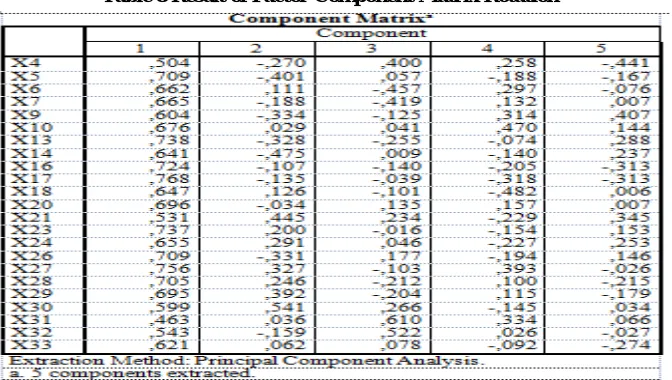
d. Component matriks
According to Hair Et. Al (1998), each variable in factor analysis must have a strong correlation with its component factor. Each question item (variable) must have factor loading over 0.40. The following is the factor loading factor of each variable in its factors.
Table 8 Result of Factor Component Matrix Rotation
Based on table 8 above, the value factor loading each independent variable to its component > 0.4 which means the four independent variables analyzed have a strong correlation to its components.
Based on the explanation of CHAPTER III at the beginning of the study, 38 independent variables were analyzed in 7 factors, but after a series of data analysis process including correlation test and factor analysis, only formed 5 factor components arranged in 23 independent variables selected correlation and intercorrelation test results. The component of factor I is composed by the variables X4, X5, X6, X7, X9, X10, X13, X20, X21, X23, X24, X26, X27, X28, X29, X30, X31, X32, X33. Component factor II is composed by variables X21 and X30. Component factor III is composed by variables X31 and X32. The component of factor IV is composed by the variable X10. The factor V component is composed by variable X9.
VII. CONCLUSION
Based on the results of analysis and discussion of research, the authors take the conclusion that is the answer of the questions on research problems are:
1. What are the important factors and variables in the process of implementing the precast facade construction method of building construction in South Tangerang?
ISSN(Online): 2319-8753 ISSN (Print): 2347-6710
I
nternational
J
ournal of
I
nnovative
R
esearch in
S
cience,
E
ngineering and
T
echnology
(A High Impact Factor, Monthly, Peer Reviewed Journal)
Visit: www.ijirset.com
Vol. 7, Issue 5, May 2018
Based on the Discussion of Results of Problem Analysis of Research I and II to the questions on research problems I and II, then it can be made The conclusion is the answer to the questions on research problems is:
1. What are the important factors and variables in the process of implementation of precast facade construction method in building construction in South Tangerang?
a). EQUIPMENT factors covering several important variables within which consist of identifying the type of equipment to be used, measuring the distance within the transport of the precasr facade material, identifying the volume of the precast facade to be installed.
b). THE HUMAN RESOUCES factor in which it covers the important variables that are formed, that is Workers who have good ethics towards peers while working in the field, Placing workers who have a soul of leadership / leadership at work, Having a worker with special skills or specialist skills in the construction process of precast facade construction, The selection of disciplined workforce will greatly affect the accuracy of the work plan in accordance with the schedule, Selection of workers who have education in accordance with the desired work standards.
c). TRANSPORTATION factor consists of Planning alternative roads if there are obstacles in the initial path that will be taken, Taking into account the control of the flow of good traffic so that the delivery of work material can be up to the destination in good condition and feasible to use diproyek, Determining the travel time required from manufacturing to project , Determining the appropriate transportation with the needs of transport or volume of precast facade, Delivery of precast fasade components using trucks equipped with retrofitting equipment therein,
Checking prior to access to truck material, especially for trucks material precast fasade regarding carrying capacity and maximum weight of truckload.
d). INSTALLATION factor consists of Improvement of the fascade precast to the floor location to be installed using the selected crane, Embedded installation for precast connection connected to the floor, Prefaced displacement of the cascade from selected cranes to suspended ties using a chain of blocks and lift on the lifting latche, precast fasade is set by using a tile and adjustable, the status is available setinggan the right panel, with embeded mounted on the slab surface and embedeb mounted on the panel welding done, When embeded welding is done, then also checks the vertikality and horinzontal on the panel, After the installation is complete, then the takel to hang the fasade is removed and move to the next location, Take into account the capacity of the crane and takel carrying capacity of the panel to be lifted, Special labor and expert in his field in melakuukan precast fasade installation.
2. What is the result of factor analysis from the study of this research model?
Based on table 4:10 above, the value of KMO result factor is 0.821, KMO value obtained more than 0.5, this allows the magnitude can be done. Furthermore, the significant value obtained from the Bartlett test is 0.000 and this rate is smaller than 0.05 which means there is a significant relationship between independent variables both within and outside factors.
Based on the anti Image matrix in table 4.10 above, the diagonal values of all variables> 0,500, meaning all variables match the structure of other variables in the factor, so no independent variables are eliminated from the model. 23 independent variables selected intercorrelation test results can be further analyzed by regression analysis.
Based on table 4.11 above, it can be seen that the total variance explained result of factor analysis is 69,594% (> 60%). This means that the factor formed by 23 independent variables is good enough to explain the factors in the process of implementation of construction precast facade method in the construction project of multilevel building in South Tangerang City. The result of factor analysis is able to form 5 component factor.
ISSN(Online): 2319-8753 ISSN (Print): 2347-6710
I
nternational
J
ournal of
I
nnovative
R
esearch in
S
cience,
E
ngineering and
T
echnology
(A High Impact Factor, Monthly, Peer Reviewed Journal)
Visit: www.ijirset.com
Vol. 7, Issue 5, May 2018
Based on the explanation of CHAPTER III at the beginning of the study, 38 independent variables were analyzed in 7 factors, but after a series of data analysis process including correlation test and factor analysis, only formed 5 factor components arranged in 23 independent variables selected correlation and intercorrelation test results. The component of factor I is composed by the variables X4, X5, X6, X7, X9, X10, X13, X20, X21, X23, X24, X26, X27, X28, X29, X30, X31, X32, X33. Component factor II is composed by variables X21 and X30. Component factor III is composed by variables X31 and X32. The component of factor IV is composed by the variable X10. The factor V component is composed by variable X9.
REFERENCES
1. Wulfram I. Ervianto, Ir. MT. "Implementation Study of Precast Concrete Technology for Building Building". Civil Engineering Department - Engineering Faculty of Atma Jaya University, Jogjakarta, 2007.
2. Ratih Sarwendah Komala Dewi, S.T. "Earthquake-resistant precast construction in low-rent rental apartment of muhammadiyah malang". Post Graduate Student of Civil Engineering Department - Bandung Institute of Technology, 2011.
3. Azis Mudzakir Adiasa, Dimas Kurniawan Prakosa, Teak Utomo Dwi Hatmoko, Tanto Djoko Santoso. "Evaluate the use of precast concrete in construction projects". Civil Engineering Department, Engineering Faculty of Diponegoro University, 2015.
4. Siti Aisyah Nurjannah. "The development of precast concrete structure system as an alternative to Indonesia's construction technology that supports energy efficiency as well as environmentally friendly". Proceeding of the 3rd Avoer seminar. Training Area VII Training Center of the Ministry of Public Works, Jl. K.S. Tubun No. 12, Hatta Field, Palembang, 2011.
5. Peter F. Kaming, Ferianto Rahardjo, and Yenry G. Situmorang. "Analysis of construction project performance". Civil Engineering Department, Engineering Faculty of Atma Jaya University, Yogyakarta, 2010.
6. Andree Surya Salim, Lukito Kaswara, Andi. "Case study of production work on wall installation of precast on apartment project". Civil Engineering Department, Engineering Faculty of Christian Petra University, Surabaya, 2013.
7. Nadya Safira Asmarantaka "The risk analysis that influences the project performance in the construction of hotel batiqa, Palembang". Civil Engineering Department, Engineering Faculty of Sriwijaya University, Palembang, 2014.
8. Zulvantino and Ir.syahrizal, M.T. "Analysis of risk factors that affect building project delays". Civil Engineering Department, North University, Medan, 2012.
9. Yulistianingsih. "Comparison of the implementation of precast wall with conventional wall in terms of time and cost". Civil Engineering Department, Engineering Faculty of Muhammadiyah University, Jakarta, 2014.
10. Zainul Khakim, M. Ruslin Anwar, M. Hamzah Hasyim "The study of the selection of concrete works between precast and conventional on the construction of buildings using the AHP method". Department of Civil Engineering, Faculty of Engineering, University, 2011.
11. Candy Happy Najoan and Jermias Tjakra, Pingkan A. K. Pratasis "Analysis of the method of plate plate precast with conventional plate in terms of time and cost (case study: Manado regional military command headquarters)". Vol.4 No.5 2016.