INVESTIGATION
Long-Term and Short-Term Evolutionary Impacts
of Transposable Elements on
Drosophila
Yuh Chwen G. Lee1and Charles H. Langley Center for Population Biology and Department of Evolution and Ecology, University of California, Davis, California 95616
ABSTRACT Transposable elements (TEs) are considered to be genomic parasites and their interactions with their hosts have been likened to the coevolution between host and other nongenomic, horizontally transferred pathogens. TE families, however, are vertically inherited as integral segments of the nuclear genome. This transmission strategy has been suggested to weaken the selective benefits of host alleles repressing the transposition of specific TE variants. On the other hand, the elevated rates of TE transposition and high incidences of deleterious mutations observed during the rare cases of horizontal transfers of TE families between species could create at least a transient process analogous to the influence of horizontally transmitted pathogens. Here, we formally address this analogy, using empirical and theoretical analysis to specify the mechanism of how host–TE interactions may drive the evolution of host genes. We found that host TE-interacting genes actually have more pervasive evidence of adaptive evolution than immunity genes that interact with nongenomic pathogens inDrosophila. Yet, both our theoretical modeling and empirical observations comparing Dro-sophila melanogasterpopulations before and after the horizontal transfer ofP elements, which invadedD. melanogasterearly last century, demonstrated that horizontally transferred TEs have only a limited influence on host TE-interacting genes. We propose that the more prevalent and constant interaction withmultiplevertically transmitted TE families may instead be the main force driving the fast evolution of TE-interacting genes, which is fundamentally different from the gene-for-gene interaction of host–pathogen coevolution.
H
OST–PATHOGEN interactions affect the population dy-namics and the evolutionary trajectories of both species. In particular, coevolutionary dynamics will affect the pattern of polymorphism and divergence of genes underlying host– parasite interactions either through an arms race (Van Valen 1973; Dawkins and Krebs 1979) or through balancing selec-tion (Haldane 1949; Hughes et al. 1990; Takahata et al. 1992; Hughes and Yeager 1998; Roseet al. 2004). In either case, accelerated rates of protein evolution and/or recurrent adaptive substitutions are expected in genes engaged in these interactions, which has been observed in both immunity genes (Schlenke and Begun 2003; Jiggins and Kim 2007; Sacktonet al.2007; Obbardet al.2009b) and antivirussiRNA genes (Obbardet al. 2006, 2009a,b, 2011) inDrosophila.Transposable elements (TEs) are ubiquitous genomic constituents that increase their copy number (the number of TEs in a host genome) by replicative transposition (copying to new genomic locations). LikeDrosophila, most host genomes are occupied by multiple TE families, which are defined by sequence similarity (homology) and by replication and trans-position mechanisms. Even though incidences of potentially adaptive individual TE insertions with high population fre-quencies have been reported (Dabornet al.2002; Aminetzach et al. 2005; Gonzálezet al.2008; Schmidt et al.2010), the mutagenic effects of TE insertions are typically deleterious because they disrupt gene structure and function (Finnegan 1992) and can lead to deleterious chromosomal rearrange-ment (Montgomery et al.1987, 1991; Langleyet al. 1988). Supporting this, TEs in natural populations of Drosophila are generally found in intergenic regions (Aquadro et al. 1986; Kaminkeret al.2002; Bergmanet al.2006) and present at low population frequencies (reviewed in Charlesworth and Langley 1989; Le Rouzic and Deceliere 2005; Lee and Langley 2010).Drosophila melanogasterstrains with a larger copy number of several TE families surveyed also have lower fitness (Mackay 1989; Pasyukovaet al.2004).
Copyright © 2012 by the Genetics Society of America doi: 10.1534/genetics.112.145714
Manuscript received May 6, 2012; accepted for publication September 12, 2012 Supporting information is available online athttp://www.genetics.org/lookup/suppl/ doi:10.1534/genetics.112.145714/-/DC1.
Sequences generated from this article have deposited with the EMBL/GenBank Data Libraries under accession nos. JX974565–JX974572 and KC115855–KC116217. 1Corresponding author: Department of Evolution and Ecology, One Shields Ave.,
Because of these deleterious fitness impacts of TEs on their hosts, the interaction between host and TEs has been suggested to be analogous to an arms race between host and other more familiar pathogens (Kidwell and Lisch 2001; Aravin et al.2007; Siomiet al.2008; Obbardet al.2009a; Blumenstiel 2011). Surprisingly, there has been no system-atic comparison of the evolution of host genes interacting with TEs and those interacting with pathogens to examine this analogy. Furthermore, no specific models for the evolu-tionary impact of antagonistic interactions between host and TEs on protein evolution have been analyzed.
Due to the horizontal transmission of pathogens, there can be strong associations between specific host alleles and the level of pathogen load, leading to large selective benefits for host alleles that can effectively suppress pathogen infections. On the contrary, TE families are inherited vertically as part of the host parental genome. Vertical inheritance of TE inser-tions, random mating, and recombination lead to weak as-sociations between selectively favored, TE-suppressive host variants and any net reduction in TE replication. Indeed, in organisms with random mating and weak linkage disequilib-rium (e.g.,Drosophila), a host variant suppressing a single TE family will enjoy only weak adaptive advantage (Charles-worth and Langley 1986). If the suppression of TE transpo-sition involves specific associations between host alleles and TE variants, this is unlikely to drive the fast evolution of host genes involved in TE suppression.
In rare cases, TEs are observed to have been horizontally transferred between host species (reviewed by Silva et al. 2004; Loreto et al. 2008; Schaack et al. 2010). In these cases, the evolutionary impacts of TEs on the host may be more analogous to those of nongenomic pathogens. During the spread of a newly invaded TE family, the transposition rate can be exceptionally high (Kidwell et al. 1988; Good et al. 1989; reviewed in Silva et al. 2004). This is usually associated with a high incidence of deleterious insertions and sterilities, imposing a strong selective pressure on the host. However, the spread of horizontal transfer of TE families to all genomes of the new host species is found to happen on a short timescale, generally within thousands of generations (Daniels et al.1990; Simmons 1992). After the initial hori-zontal transfer, copies of the new TE family appear to follow the typical TE mode of vertical transmission. A quantitative analysis of the hypothesis that horizontal transferred TE fam-ilies are able to impose strong enough selection to elicit spe-cific adaptive evolution in host genes remains unaddressed.
One of the best-studied examples of a TE horizontal transfer is the P element (reviewed in Engels 1997; Rio 2002), which invadedD. melanogasterfrom the distantly re-lated D. willistoni ,100 years ago (Brookfieldet al. 1984; Anxolabéhère et al. 1988; Daniels et al. 1990; Clark et al. 1994). While virtually all more recently surveyed D. mela-nogasterpopulations haveP elements,D. melanogasterstrains collected early last century, and maintained in the laboratory since that time, are still free ofP elements(Kidwellet al.1983; Anxolabéhèreet al.1988). Matings between females lacking
P elements(the M strains, said to haveM cytotype) and males withP elements(the P strains, said to haveP cytotype) result in progeny with“hybrid dysgenesis”syndrome, which consists of high rates of male recombination, sterility, mutation, and chromosomal rearrangement (Hiraizumi 1971; Kidwellet al. 1973, 1977; Engels 1979). These dysgenic effects are attrib-uted to the high rate of P-element transposition (Bingham et al.1982; Rubinet al.1982).P elementsofD. melanogaster thus provide a rare opportunity to investigate the evolutionary impacts of horizontally transferred TE families on the host genes interacting with them.
Our systematic comparisons demonstrate that the molecular evolution of TE-interacting genes exhibits comparable evidence of recurrent adaptivefixations to that of genes mediating the interactions between Drosophila and horizontally transferred pathogens. We took two approaches to investigate whether horizontally transferred TEs have discernable selective impacts and can contribute to the observed long-term adaptive evo-lution of TE-interacting genes. We developed and analyzed a model of TE invasion after horizontal transfer and we used the recently invaded P element as a system to empirically contrast the genetic differentiation of candidate host genes be-tweenD. melanogasterpopulations before and afterP-element invasions. Both our analytical modeling and empirical obser-vations suggest that the selective pressure imposed by hor-izontally transferred TE families is limited. We proposed a hypothesis other than the gene-for-gene host–TE coevolu-tionary model to explain our observations.
Materials and Methods
D. melanogaster variation of post–P-element invasion population and Drosophila divergence data
We used the release 1.0 assembly of 44 D. melanogaster genome sequences generated by the DrosophilaPopulation Genomic Project [DPGP, www.dpgp.org (Langley et al. 2012)]. The DPGP data consist of 7 strains from Malawi, Africa, and 37 strains from North Carolina, which were all collected afterP-elementinvasions and haveP elements. Cod-ing regions of each candidate gene were defined according to the D. melanogaster reference genome annotation (ver-sion 5.16) and parsed out from the above genomic sequen-ces, using Perl scripts. Bases with quality scores ,30 and regions that appeared as identical by descent (IBD) or exhibited residual heterozygosity (Langleyet al.2012) were treated as missing data. We also removed alleles when
.50% of the bases were missing data. To compare the evo-lution of candidate genes with immunity genes, we used 236 immunity genes included in Sacktonet al.(2007) and follow the categorization of the immunity genes of this previous study. Retrieval of coding sequences and population genetics analysis (see below) of these immunity genes were the same as those of candidate genes.
which includesD. melanogaster,D. simulans,D. yakuba, and D. erectagenomes (Langleyet al.2012). When aD. simulans allele was used as an outgroup in statistical inferences (see below), we chose the allele with the smallest proportion of missing data and alignment gaps (or highest base coverage) among the mosaic D. simulans genome (Clark et al.2007) and sixD. simulansgenomes (Begunet al.2007). ForAgo3, all D. simulans alleles from the above seven genomes had low coverage. We used D. melanogasterexon sequences of Ago3to blast against the trace reads generated from theD. simulans population genomics project (Begun et al. 2007) and assembled retrieved reads, using the codoncode aligner (http://www.codoncode.com/aligner/). We removed reads whose alignment outside exons was incongruent with the majority of other reads. Consensus sequence was called if there were at least three reads covering the region.
Population genetics and molecular evolution analysis of candidate genes
pwas estimated as average pairwise differences (Nei 1987). Lineage-specific divergences were estimated by maximum likelihood, using PAML version 4 (Yang 2007) on the branch leading toD. melanogasterandD. simulans, withD. yakuba as the outgroup. Genes with ,100 sites included in the PAML analysis or with a dSvalue,0.0001 were excluded. We used both D. melanogaster and D. simulans within-species polymorphism to carry out McDonald–Kreitman tests [two-species McDonald–Kreitman (MK) test (McDonald and Kreitman 1991)]. Codons having more than two states within species were removed. Codons that are both poly-morphic within species and divergent between species were counted as both polymorphism and divergence. We used the mutational path minimizing the number of nonsynonymous differences. P-values of MK tests were determined by Fish-er’s exact tests (FET). For genes withoutD. simulans varia-tion (Ago3andmael), we carried out one-species MK tests, using D. melanogaster polymorphism and the D. simulans allele with highest base coverage to count the number of fixations. For candidate genes with significant MK test results, we used Pfam (Finn et al. 2009) with an E-value cutoff of 1025to annotate known domains and perform a MK test on each annotated domain. We estimated averagea (the proportion of amino acid fixations driven by positive selection) for different classes of genes, using Welch (2006) with default parameters. We also used the likelihood-ratio test to investigate whether a single-a or a two-a model better fits the data when we included both candidate and immunity/all genes in the analysis, testing whether there are differences inabetween classes of genes.
When comparing population genetic estimates or statis-tics of candidate genes with genome-wide distribution, we used a conservative gene set used by DPGP (Langleyet al. 2012), which consists of genes whose D. melanogaster alleles of DPGP data and outgroup alleles all have the same gene model as the reference annotations (canonical initia-tion codon, splice juncinitia-tion, and terminainitia-tion codon).
D. melanogaster variation data before P-element invasions
Variation data from pre–P-element D. melanogaster popula-tions were collected by resequencing the coding regions of candidate genes from laboratory-maintained strains col-lected before the 1960s and previously identified as M strains (Kidwell et al.1983). PCR with primers amplifying the second exon ofP-elementtransposase (O’Hare and Rubin 1983; Clarket al.1998) was used to confirm the absence of P elements. To have comparable sampling locations to those of the DPGP data, we first used four African strains (CA1, KSA2, KSA3, and KSA4) and four North and South Carolina strains (Wild 10E, Wild 11A, Wild 11C, and Wild 11D) in the initial survey for unusual temporal differentiation. Five candidate genes (Irbp,squ,Spn-E,Krimp, andHen1) showed significant differentiation between alleles from the above eight strains and post–P-element alleles from DPGP data. Additional alleles were then collected on these five genes, using 4 Asian, 5 European, 1 South American, and 11 North American strains. Details ofD. melanogasterstrains used in this study can be found in supporting information,File S1,
Table S1. For control genes nearHen1, we sequenced only the 15 North American M strains.
Despite exhaustive efforts to locate M strains collected before P-element horizontal transfer, the available pre– P-elementstrains are far from ideal. Within North America, where there is the largest set of pre–P-element strains, spatial locations are disperse: strains were collected on the West and the East Coast as well as in the northern and southern latitudes. Latitudinal clines for various loci have been observed in D. melanogaster(reviewed in Schmidtet al.2005; Hoffmann and Weeks 2007). Unfortunately, this may increase the possibility of falsely concluding that there is temporal genetic differentiation while the actual difference would be a result of the geographic heterogeneity of between-time samples. Accordingly, we also examined other aspects of the data (heterozygosity and haplo-types) in addition to temporal differentiation and included con-trol genes near candidate genes showing strong temporal differentiation before drawing conclusions (see below).
DNA samples were prepared from 30flies from each D. melanogasterM strain. PCR and sequencing primers for cod-ing regions of candidate genes were designed uscod-ing the Primer3 program (Rozen and Skaletsky 2000) and the D. melanogasterreference genome. PCR products were purified and sequenced directly. Most of theD. melanogasterstrains used in this study have been maintained in the laboratory for .50 years and are highly inbred. For targeted regions with residual heterozygosity within lines, PCR products were cloned with TOPO-TA cloning (Invitrogen, Carlsbad, CA) and one clone of each PCR product was sequenced.
Analysis of temporal differentiation between pre-P and post–P-element populations
manual curation. We estimated Fst according to Weir and Cockerham (1984) and used permutations to determine the P-values (Hudson et al.1992). To further test for unusual haplotypic structures, we used methods based on the fre-quency of major haplotypes (Hudsonet al.1994), the num-ber of haplotypes, and the heterozygosity of haplotypes (Depaulis and Veuille 1998) and used coalescent simulation without recombination to determine theP-values (Hudson 2002). Although these three haplotype-based tests are re-lated conceptually, their power to detect deviations from the same null hypothesis varies with the alternatives and thus is not fully redundant (Depaulis and Veuille 1998). It is worth noting that the significance of haplotype tests was based on coalescent simulationswithoutrecombination, which is especially conservative, and our observation of strong evi-dence for a 20-kb haplotypic structure aroundHen1is highly unusual (seeResults).
For analysis of the upstream and downstream regions of Hen1, we used a sliding window of size 5 kb incremented every 100 bp to depict the divergence between D. mela-nogaster andD. simulans, the polymorphism withinD. sim-ulans, and the polymorphism ofD. melanogasterAfrican and North American populations separately.
Analytical model for the dynamics of host alleles that can reduce transposition during the spread of an invading transposable element such as the P element
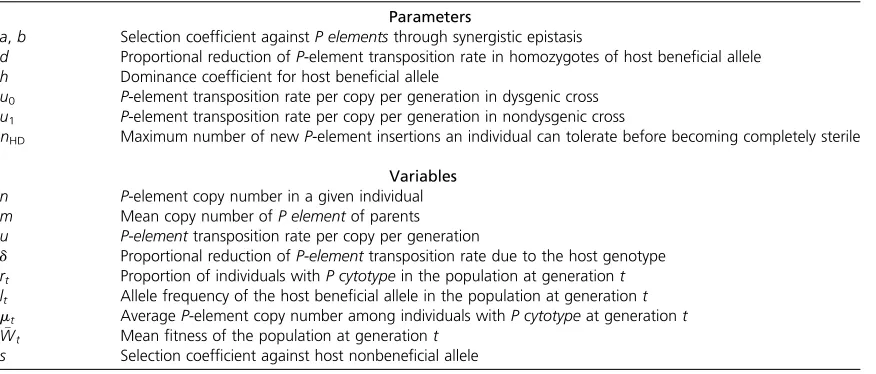
We considered a panmictic population of diploid hosts with infinite population size and initially devoid of the invading TE. After invasion of the TE, each host genome carries a number (n $0) of TEs and zero, one, or two suppressive alleles at the host locus of interest. We assumed that there is complete linkage equilibrium among the invading TEs, and the TEs and the host resistance locus. The low frequency of virtually all TE insertions in natural populations ofD. mela-nogaster (Aquadro et al. 1986; Montgomery et al. 1987; Charlesworth and Langley 1989; Lee and Langley 2010) coupled with the small scale of linkage disequilibrium be-tween SNPs with more intermediate frequency in D. mela-nogaster (Miyashita and Langley 1988; Long et al. 1998; Langley et al.2000, 2012) ensures that the magnitude of linkage disequilibrium among elements is small and our as-sumption is reasonable. The asas-sumption of no linkage dis-equilibrium and low TE frequencies motivates the further modeling of distribution of TE copy number as Poisson. The use of the Poisson distribution of TE copy number among individuals of a population has been developed as an approximation and successfully applied in theoretical analyses of TEs (Charlesworth and Charlesworth 1983; Langleyet al.1983). As mentioned above, it has an empir-ical basis in studies of specific TE families and surveys of genomic variation (reviewed in Charlesworth and Langley 1989). The transposition of TEs was also modeled following a Poisson process.
We considered two aspects of the deleterious effects of TEs on hostfitness with some details of the model based
on the specific biology ofP elements. According to previous theoretical analysis (Charlesworth and Charlesworth 1983), to have stable containment of transposable elements, the logarithm offitness must decline more rapidly than linearly with average copy number. We considered a synergistic epis-tasis for the deleterious effects of TE insertions described previously (Dolgin and Charlesworth 2006, 2008) and the fitness of an individual withncopies of aP elementis
wðnÞ ¼e2an2bn2=2:
a and b were chosen as 1025 and 1026, respectively (see Appendix). The other deleterious fitness effect is caused when the transposition of P elements generates more double-stranded breaks than the host recombination repair machinery can efficiently repair, leading to the reported re-duced fertility (reviewed in Rio 2002). TheP element trans-poses through a cut-and-paste mechanism and the process starts with a double-stranded break generated at the origi-nalP-elementinsertion (donor site). Approximately 85% of the double-stranded breaks at the donor sites are repaired using the sister chromatid as the template (Engels et al. 1990), resulting in regeneration of aP elementat the donor site and an increase in copy number by one. With the as-sumption that every P-elementtransposition leads to a net gain of one P-elementcopy, we used a truncation selection model: an offspring with more than nHD (the maximum number of new TE transpositions a host can tolerate before having hybrid dysgenic syndrome) newP-elementinsertions is sterile. The mean fitness of offspring of parents with an average of m P-elementcopies is
wðm;uÞ ¼X
N
n¼0
e2mmn n!
XnHD
i¼0
e2nuðnuÞi
i! e2aðnþiÞ2bðnþiÞ
2=2 !
:
u, the transposition rate per copy per generation, changes according to parental cytotypes, with theP-element transpo-sition rate in the M · P dysgenic cross (u0) being much higher than that in other crosses (u1). Individuals with P elements are set to have aP cytotypeand others without are set to have anM cytotype.
as an independent event from the type of cross. The mean fitness of offspring of a specific cross withmparentalP-element copies is
wcrossðm;u;lÞ ¼l2wðm;uð12dÞÞ
þ2lð12lÞwðm;uð12hdÞÞ þ ð12lÞ2wðm;uÞ:
Based on this formula, we derived equations forr,l, andm, which can be found in theAppendix. We calculatedr,l, and mfor 1000–10,000 generations. For most cases, we reported the result for 1000 generations, the approximate number ofD. melanogastergenerations since the M strains werefirst collected. At generation zero, we set r0 and l0 = 1023. Parameters without a significant impact on the dynamics of l are set as constant values (d = 0.5, h = 0.5, u1 = 1024, andm0= 10; seeAppendixfor results of all parame-ters tested).u0was tested for 1021and 1.nHDwas tested for 2, 3, 5, 7, and 10.
Results
Candidate genes
We took a candidate gene approach and focused on two groups of genes (Table 1). Thefirst group consists of genes known to be involved in thepiwi-RNA(piRNA) biogenesis [hereafter termed piRNA genes (reviewed in Klattenhoff and Theurkauf 2008)].piRNAis a class of small RNAs that has been implicated in TE transposition rate regulation. Generation of piRNAs is disrupted in piRNA gene mutants (Aravin et al. 2004; Lim and Kai 2007; Pane et al. 2007 Klattenhoff et al.2009; Liet al.2009), leading to elevated expression levels of .10 TE families (Aravin et al. 2004;
Vagin et al. 2004; Lim and Kai 2007; Pane et al. 2007; Klattenhoff et al.2009; Liet al.2009; Lu and Clark 2010). We also includedvasa(vas), whose mutant phenotypes also include piRNA generation disruptions and elevated tran-scription of several TE families (Vaginet al.2004; Lim and Kai 2007). piRNAs corresponding to P-element sequences have been observed in Pstrains but not in Mstrains, sug-gestingP elementsare a common target of the piRNA path-way (Brenneckeet al.2008).
The second group of candidates contains genes known to interact with P elements via other pathways. The double-stranded breaks left after P-element transpositions in the germline are repaired by host recombination–repair machin-ery of heterodimers formed by Irbp and Ku80 (Rio and Rubin 1988; Beallet al.1994). Double-stranded breaks gen-erated by other DNA-based TEs may be repaired using a sim-ilar mechanism. Splicing factor Psi is shown to specifically bind to the 59-splice site of the P-elementthird intron, sup-pressing the proper splicing of mRNAofP-element transpo-sase and thereby repressing the somatic transposition of P elements (Siebel and Rio 1990; Siebelet al.1992, 1994, 1995; Adamset al.1997).Hrb27Cis a nuclear protein that forms anmRNAsplicing complex withPsi(Siebelet al.1992, 1994).
Genes interacting with transposable elements show evidence of positive selection
Recurrent directional selection can lead to an accelerated rate of protein divergence relative to synonymous site divergence. We used maximum-likelihood methods (Yang 2007) to estimate the dN/dS ratios on both the D. mela-nogaster and the D. simulans branches with D. yakuba as an outgroup. We then rank dN/dS estimates of candidate
Table 1 Information of candidate genes
Category Flybase ID Symbol Gene name Chra CDs lengthb Gene functions
piRNAgenes FBgn0004872 piwi piwi 2L 2532 piRNAgeneration
FBgn0000146 aub aubergine 2L 2601 piRNAgeneration
FBgn0250816 AGO3 Argonaute 3 3L 2604 piRNAgeneration
FBgn0041164 armi armitage 3L 3825 RNAhelicase
FBgn0003483 spn-E spindle E 3R 4305 RNAhelicase
FBgn0002652 squ squash 2L 726 Nuclease
FBgn0261266 zuc zucchini 2L 762 Nuclease
FBgn0033686 Hen1 PIMET/DmHen1 2R 1176 piRNAmethyltransferase
FBgn0016034 mael maelstrom 3L 1389 Nuage component
FBgn0034098 krimp krimper 2R 2241 Nuage component
FBgn0262526 vas vasa 2L 661 Nuage component
FBgn0004400 rhi rhino 2R 1257 HP1 paralog, heterochromatin
binding
P-element–
specific genes
FBgn0014870 Psi P-elementsomatic inhibitor 2R 2394 P-elementsomatic inhibitor;
mRNAsplicing factor
FBgn0004838 Hrb27C Heterogeneous nuclear
ribonucleoprotein at 27C
2L 1266 mRNAsplicing factor
FBgn0011774 Irbp Inverted repeat-binding
protein
3R 1897 Recombination repair protein
FBgn0041627 Ku80 Ku80 2L 2100 Recombination repair protein
achromosome
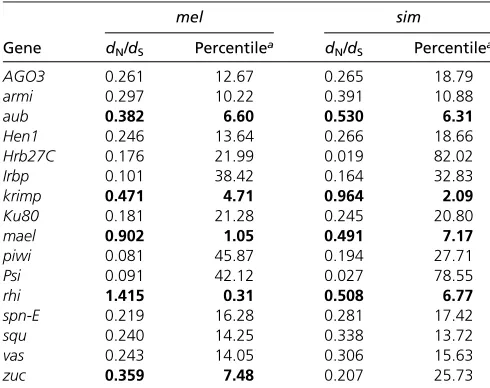
genes among other D. melanogaster annotated genes (see Table 2 for dN/dSratio and Table S2for separate dN and dSvalues). Consistent with a previous report (Vermaaket al. 2005), rhi has adN/dS ratio that is larger than one and is among the fastest-evolving genes inD. melanogaster(dN/dS =1.415, rank = 0.31% genome-wide). Two nuage compo-nent genes, krimpand mael, both rank in the top 5% ge-nome-wide whileaubandzucare among top 10%. Estimates of thedN/dSratios on theD. simulansbranch, except for that ofzuc, gave similar results. Our inferences are generally in agreement with previous reports that used a branch-site model to detect recurrent amino acid substitutions on the phylogeny of 12 Drosophila species (Heger and Ponting 2007; Kolaczkowski et al. 2011). Even though Spn-E was identified as the RNA interference gene showing the most extensive signal of recurrent adaptation on the phylogenetic tree (Heger and Ponting 2007; Kolaczkowski et al. 2011), the branch leading to D. melanogaster was not significant (Kolaczkowskiet al.2011). The differences between studies are not surprising given the fundamental differences in methodology (comparing relative rates of amino acid sub-stitutions of entire coding sequences among all genes vs. identification of a subset of sites or branches that recurrently substituted across the phylogeny).
We used the MK test (McDonald and Kreitman 1991) to detect genes whose evolution does not follow the neutral model of evolution. Rejection of the null hypothesis due to the presence of more than the expected number of amino acid fixations has been interpreted as evidence supporting adaptive protein evolution. To have greater statistical power, we considered polymorphisms from both D. melanogaster (Langley et al.2012) andD. simulans(Begunet al.2007). We identifiedaubandarmias significant whilespn-E,krimp, vas, and Ku80 were marginally significant (Table 3). All of these genes rejected the null hypothesis of neutral
evolu-tion in the direcevolu-tion of an excess of amino acid divergence (Table 3), consistent with a history of positive selection acting on these genes. To further localize protein domains showing signals of positive selection, we performed MK tests on Pfam-annotated domains. We found the PAZ domain of aub (P-value = 0.011) and the DEAD domain of vas (P-value = 0.0007) showed significant enrichment of amino acid substitutions. When considering only within D. mela-nogaster polymorphism, we did not find evidence of adap-tive evolution for spn-E,vas, and Ku80 (Table 3), perhaps due to a generally lower level of variation inD. melanogaster than inD. simulans(Aquadroet al.1988; Andolfatto 2001; Andolfattoet al.2011) and thus lower statistical power.
Genes interacting with transposable elements show more prevalent evidence of positive selection than immunity genes
The fundamental differences in the mechanism of trans-mission between TE families and other nongenomic patho-gens raised the question regarding the relative intensity of evolutionary impacts they imposed on hosts. To address this question, we compared the proportion of genes exhibiting evidence of positive selection between our candidate genes and immunity genes, using the same population genetic and molecular evolution analysis.
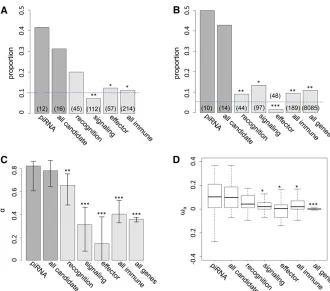
We found 5 of 12piRNAgenes (41.67%) have D. mela-nogaster dN/dSestimates among the top 10% genome-wide, which is significantly greater than that of immunity genes (24 of 214 genes, 11.21%, FET P = 0.01, Figure 1A and
Table S2). Studies have found that the rates of adaptive evolution vary with respect to the function of immunity genes (Sacktonet al.2007; Obbardet al.2009b; reviewed in Lazzaro 2008). We categorized immunity genes into “ rec-ognition,” “signaling,”and“effector”categories and still found
Table 2 Linage-specific relative rates of protein evolution
mel sim
Gene dN/dS Percentilea dN/dS Percentilea
AGO3 0.261 12.67 0.265 18.79
armi 0.297 10.22 0.391 10.88
aub 0.382 6.60 0.530 6.31
Hen1 0.246 13.64 0.266 18.66
Hrb27C 0.176 21.99 0.019 82.02
Irbp 0.101 38.42 0.164 32.83
krimp 0.471 4.71 0.964 2.09
Ku80 0.181 21.28 0.245 20.80
mael 0.902 1.05 0.491 7.17
piwi 0.081 45.87 0.194 27.71
Psi 0.091 42.12 0.027 78.55
rhi 1.415 0.31 0.508 6.77
spn-E 0.219 16.28 0.281 17.42
squ 0.240 14.25 0.338 13.72
vas 0.243 14.05 0.306 15.63
zuc 0.359 7.48 0.207 25.73
a
dN/dSfor each candidate gene was ranked among 9172 (D. melanogaster) and 9051 (D. simulans) genes that have PAML results. Candidate genes that ranked among the top 10% among all the genes with PAML results are in boldface type.
Table 3 McDonald–Kreitman test on candidate genes
Two-species MK testa melMK testb
Gene No. codons P-value No. codons P-value
AGO3 NA NAc 689 0.351
armi 1186 ,0.001 1231 ,0.001
aub 835 ,0.001 855 ,0.001
Hen1 389 0.837 391 1.000
Hrb27C 421 0.095 421 0.532
Irbp 628 0.189 628 0.069
krimp 712 0.020 690 0.001
Ku80 694 0.012 699 0.156
mael NA NA 459 0.390
piwi 837 0.732 843 0.267
Psi 796 0.189 797 1.000
rhi 413 0.396 413 0.535
spn-E 1427 0.021 1433 0.731
squ 130 0.493 233 1.000
vas 634 0.022 639 0.151
zuc 253 1.000 253 1.000
MK testswith significantp-valuesand positiveaare in bold type.
aMK tests using bothD. melanogasterandD. simulanspolymorphism (see
Materi-als and Methods).
piRNAgenes have a higher proportion of fast-evolving genes than all categories of immunity genes. However, we found statistical significance only when comparing piRNAgenes to either signaling or effector categories (Figure 1A). Compari-sons considering all candidate genes (bothpiRNA genes and genes known to interact withP elements; Figure 1A) or focus-ing on relative rates of amino acid evolution on theD. simulans lineage (data not shown) are consistent with ourfindings using piRNA pathway gene evolution along the D. melanogaster lineage.
We observed even more dramatic enrichment in the proportion of genes showing evidence of recurrent adaptive protein evolution (rejection of MK tests with overabundant amino acid fixation) ofpiRNAgenes (5 of 10 genes, 50%) than that of immunity genes (18 of 180 genes, 9.52%, FET P-values=0.002; Figure 1B) and the genome-wide propor-tion (888 of 8085 genes, 10.98%, FET P-values = 0.003). Signaling genes have the largest proportion of genes show-ing adaptive evolution among three immunity gene catego-ries (13 of 97 genes, 10.92%), which is still significantly lower than that ofpiRNAgenes or all candidate genes (FET P-values=0.012). We found a consistent pattern when in-cluding all candidate genes in the comparisons.
We used the maximum-likelihood method proposed by Welch (2006) to formally test whether averageda(the pro-portion of amino acid substitutionfixed by positive selection) is different between classes of genes. When comparing either
“piRNA vs.immunity genes”or“piRNA vs.all genes,”we found a two-amodel consistentlyfitted the data better [L= 446.46 (vs.immunity genes) and 613.82 (vs.all genes);P, 0.001
for both comparisons]. Comparisons between piRNA genes and a specific subset of immunity genes were also highly significant (P,0.001). Permutation analysis also found the maximum-likelihood estimatedaofpiRNAgenes (a= 0.82) is significantly higher than that of immunity genes (a= 0.40 for all immunity genes) and all genes (a= 0.36), except for recognition immunity genes (Figure 1C). Again, comparisons considering all candidate genes gave consistent results. An-other estimate of adaptive protein evolution va, the rate of adaptive substitution relative to the rate of neutral substitu-tions (Gossmann et al.2010), supports the same conclusion based ona(Figure 1D). EitherpiRNAgenes or all candidate genes have largervathan immunity genes except for recog-nition immunity genes (Mann–WhitneyU-test,P,0.05) and all genes (Mann–WhitneyU-test,P,0.001), suggesting that the largeraof TE-interacting genes is not due to differences in proportion of effectively neutral mutations.
Horizontal transfer of TE families does not impose enduringly strong selection on host beneficial variants
We used a deterministic model to analyze the dynamics of host alleles that can reduce the transposition rate of a newly horizontally transferred TE family by a fixed proportion (referred to as“beneficial allele”) during the spread of that TE family in a panmictic host population (seeMaterials and Methods and Appendix for model details). We specifically considered the well-documented horizontal transfer of P elements, which provided the biological context needed to specify details of the model. The model considered both epistatic selections against increases inP-elementcopy
Figure 1Proportion of candidate and immu-nity genes showing evidence of positive selec-tion. (A) Proportions of candidate and immunity genes having D. melanogaster dN/dS among
the top 10% genome-wide. (B) Proportions of candidate genes, immunity genes, and all genes having significant two-species MK tests (P-value,0.05) and positivea. Dashed lines are the expectations assuming uniformity. The Number of genes with MK test and PAML results in each category is shown in parenthe-ses. (C and D) Maximum-likelihood estimates of averageda(C) and boxplots (25th, 50th, and 75th percentiles) of estimatedva(D) for
differ-ent classes of genes. Error bars represdiffer-ent the 95% bootstrapping intervals around each esti-mate. Significant comparisons betweenpiRNA
genes and other classes of genes are denoted by*(P-value,0.05),**(P-value,0.01), and
***(P-value,0.001). Comparisons of propor-tions (A and B) were based on Fisher’s exact test, comparisons of maximum-likelihood esti-mateda(C) were based on permutations, and comparisons ofva(D) were based on a Mann–
number (Charlesworth and Charlesworth 1983; Dolgin and Charlesworth 2006, 2008) and host sterility caused by too many double-stranded chromosomal breaks generated throughP-elementtransposition. We set individuals with more than nHD new P-element transpositions (and thus double-stranded breaks) to be completely sterile. This sterility effect would most likely occur in theM(female)·P(male) hybrid dysgenic cross, as the transposition rate ofP elementsin the dysgenic cross (u0) is several orders of magnitude higher than in the nondysgenic cross (u1) (Eggleston et al.1988). The host beneficial allele will especially enjoy strongfitness advantages in the dysgenic crosses because hosts with this allele will be more likely to have fewer than nHD double-stranded breaks and therefore higher expected fertility. Of course, the degree of sterility elicited byP-element transpo-sition can be a continuous phenotype. The usage of the truncation selection model will maximize the selective ben-efit of a host allele that can reduce the transposition rate ofP element, making our overall conclusion conservative.
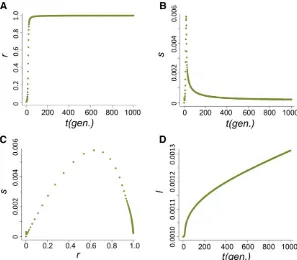
The increase in frequency of the host beneficial allele (l) is dependent on how fast P elements spread through the population and, during their spread, how likely hybrid dys-genesis is to occur. We found that the spread ofP elementsis fast in most cases (Figure 2A for u0= 1 andnHD= 5; see Appendixfor discussions of other cases tested), afinding that is consistent with several caged experiments introducing P elements into M strain populations (Kidwell et al. 1988; Goodet al.1989). This quick spread leads to the host ben-eficial allele having selective advantage only during a narrow period (Figure 2B). We found that the largest selective ad-vantage occurs when the proportion ofP cytotypeindividuals (r) is intermediate and the probability of a hybrid dysgenic
cross is high (Figure 2C). This is also reflected in the dynam-ics of l, which has a phase of rapid increase followed by a longer phase of slow increase (Figure 2D).
The combined effects ofu0andnHDhad the most notable influence on the dynamics of the host beneficial allele. With increasednHD, it takes fewer generations until theP element is found in nearly all genomes (r.0.99) in the population (t0.99) (Figure 3A) and host beneficial allele frequency at generation 1000 (l1000) because of the decreased duration during which the probability of hybrid dysgenesis is high (Figure 3B). Generally, P elementsspread faster whenu0is larger (except fornHD= 2, see below). Yet, the probability of hybrid dysgenesis is also higher, leading to larger l1000 (Figure 3, A and B). For all cases examined except one (see Appendixfor all parameters tested), the difference between l0andl1000(,2%) would hardly be detected with the reg-ular size of samples.
The only exception is whenu0= 1 and nHD=2 in which thetemporal Fstcan be as large as 0.15. However, it takes
.10,000 generations for the P element to become nearly fixed in the population due to the still high probability of hybrid dysgenesis even when the majority of the hosts have P cytotype. This is much longer than the timescale of actual P-element spread. Furthermore, the tolerance of nonprog-rammed double-stranded breaks in the germline can be much higher than this threshold (nHD= 2; Orsiet al.2010). It is worth noting that we modeled the distribution of P-elementcopy number as approximately Poisson. The der-ivation and previous application of the Poisson approxima-tion were focused on situaapproxima-tions where the TE populaapproxima-tion is near equilibrium and the mean copy number of TEs is much larger than one (Charlesworth and Charlesworth 1983;
Figure 2The dynamics of the host population during the spread ofP elements. (A–D) The change of proportion of
P-cytotype individuals, r (A); the selection coefficient
Langley et al. 1983). However, the critical aspect of our analytical modeling here is the initial phase of the invasion of a new TE family (theP element), which may lead to a copy number distribution different from Poisson. We thus used Monte Carlo simulations (see File S1 for details of simula-tions) to investigate how the distribution of TE copy number reaches a Poisson distribution. We found that soon after the P cytotypeis common in the population, the TE copy number distribution is close to Poisson (Figure S5 inFile S1). More importantly, these simulations show that the estimated change of host beneficial allele frequency from the analytical approximation is within 2% of the simulated results (Figure S3 and Figure S4 inFile S1), supporting our overall conclusions.
Recent horizontal transfer of the P element does not have widespread evolutionary impacts on
candidate genes
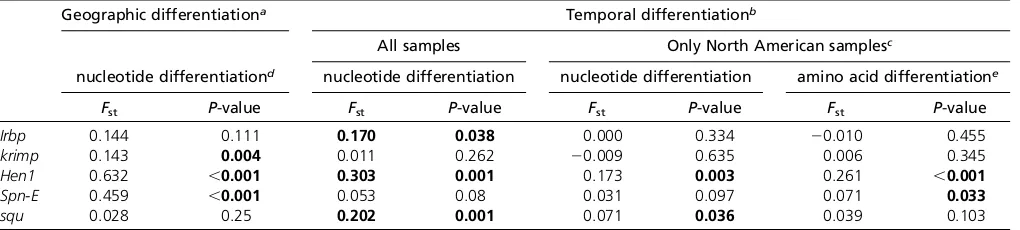
To empirically investigate the short-term evolutionary im-pacts of TE horizontal transfer on hosts, we compared the genetic differentiation between pre–P-element invasion (pre-P) and current (post-P) populations (temporal differen-tiation). For five candidate genes that showed strong tem-poral differentiation in our initial survey with a smaller number of M strains (Irbp, krimp, Hen1, spn-E, and squ; see Materials and Methods and Table S3), only Hen1 and
squ still showed highly significant temporal differentiation with increased size of pre–P-element samples (Table 4). However, we observed strong genetic differentiation be-tween North American and African contemporary post-P populations for our candidate genes (geographic differenti-ation, Table 4). If the geographic differentiation of the cur-rent population was also present in thepre-Ppopulation, the wide geographic distribution of M strains used may lead to false conclusions about the temporal differentiation (see Materials and MethodsandTable S1). We further restricted our analysis to the North American population, which has the largest number of alleles for bothpre-P(15) andpost-P (37) samples and still found strong temporal differentiation ofHen1(Fst= 0.173,P =0.003; Table 4). Such differenti-ation may reflect divergence in protein functions, asFst es-timated using amino acid sequences also showed significant temporal differentiation (Fst=0.261,P,0.001; Table 4).
The strong temporal differentiation of Hen1 is likely the result of genetic hitchhiking from a nearby, strongly selected gene
Given that the spread ofP elementsis fairly recent and fast, any associated directional selection on suppressive host variants is expected to result in reduced genomic polymor-phism around the selected SNPs and increased linkage
Figure 3 The influences ofu0andnHDon the
time for nearfixation ofP elementsand host beneficial allele frequency. (A) The generations until theP elementis nearlyfixed in the popu-lation (t0.99) for different u0 and nHD. Green
dots are whenu0= 1 and blue dots are when u0= 1021. The dashed line denotes generation
1000. (B) The allele frequencies of the host ben-eficial allele (l1000) at generation 1000 for
dif-ferent u0 and nHD. The dashed line denotes
0.001, which equalsl0.
Table 4 Temporal differentiation of a subset of candidate genes
Geographic differentiationa Temporal differentiationb
All samples Only North American samplesc
nucleotide differentiationd nucleotide differentiation nucleotide differentiation amino acid differentiatione
Fst P-value Fst P-value Fst P-value Fst P-value
Irbp 0.144 0.111 0.170 0.038 0.000 0.334 20.010 0.455
krimp 0.143 0.004 0.011 0.262 20.009 0.635 0.006 0.345
Hen1 0.632 ,0.001 0.303 0.001 0.173 0.003 0.261 ,0.001
Spn-E 0.459 ,0.001 0.053 0.08 0.031 0.097 0.071 0.033
squ 0.028 0.25 0.202 0.001 0.071 0.036 0.039 0.103
All the significant results are in boldface type.
aGenetic differentiation between current (post–P-element) African and North American populations. bGenetic differentiation between pre–P- andpost–P-elementinvasion populations.
cThe temporal differentiation was estimated considering only North American samples of both populations (before and afterP-elementinvasions). dGenetic differentiation estimated using nucleotide sequences.
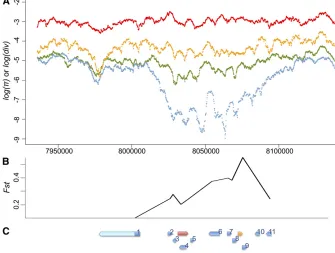
disequilibrium due to genetic hitchhiking (Maynard Smith and Haigh 1974; Kim and Nielsen 2004; Stephan et al. 2006). Consistent with the analysis of temporal differentia-tion, we observed marginally significant haplotypic struc-tures for the Hen1gene region for post-P North American populations [frequency of major haplotypes = 15,P= 0.042 (Hudsonet al.1994) and haplotype heterozygosity = 0.759, P =0.031 (Depaulis and Veuille 1998)]. This strong haplo-typic structure was extended at least 10 kb upstream and downstream ofHen1(frequency of major haplotypes = 10, P = 0.003 and haplotype heterozygosity = 0.290, P = 0.001). We also observed a dramatic reduction of post– P-element North American variation for an almost 100-kb genomic segment aroundHen1when compared with poly-morphism in post–P-element AfricanD. melanogaster, poly-morphism in closely related D. simulans, and divergence betweenD. melanogasterandD. simulans(Figure 4A).
However, the genomic region around Hen1is highly gene rich, with.20 genes, includingCyp6g1. Studies have identi-fied a recent selective sweep associated with theCyp6g1allele that has an Accord transposable element inserted upstream (Daborn et al.2002; Cataniaet al.2004; Chunget al.2007; Schmidtet al.2010). Functional analysis confirmed that this Accord insertion confers insecticide resistance (Daborn et al. 2002; Chunget al.2007), which is the most likely force driving the strong, recent selective sweep on Cyp6g1. The Accord inserted allele was found fixed in non-African populations, yet it was intermediate in African populations (Cataniaet al. 2004), which may also explain why the reduction of heterozy-gosity aroundHen1was most apparent in the North American populations while theP elementis virtuallyfixed worldwide.
To further investigate whether the strong temporal differentiation observed on Hen1 is the result of genetic
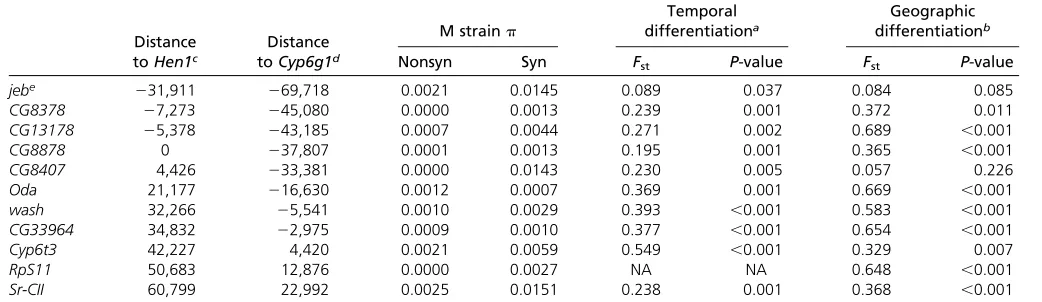
hitchhiking from strongly selected Cyp6g1 or any other genes in the nearby region, we estimated the temporal dif-ferentiation of coding regions for another 11 genes that are within 30 kb to eitherHen1orCyp6g1and have functions unrelated to either TE suppression or insecticide resistance (“control genes,”Table S4and Figure 4C). Compared with the observed strong temporal differentiation of these control genes,Hen1(Fst=0.173) is no longer exceptional (Table 5 and Figure 4B). We also found that the closer a gene is to Cyp6g1, the stronger the temporal differentiation was (Ta-ble 5 and Figure 4B). The geographic differentiation was also strong for these 11 genes (Table 5), which is consistent with the scenario that application of insecticide in the non-African regions is leading to strong genetic hitchhiking on genes aroundCyp6g1in the post-PNorth American popula-tion we studied.
Discussion
TEs are selfish genetic elements in the genome. Their inter-actions with their hosts are often analogized to the molecular arms race between hosts and other nongenomic pathogens, such as bacteria, viruses, fungi, and protozoa. This analogy deserves further mechanistic specification and analysis be-cause of the fundamental differences in transmission mode between TEs and horizontally transmitted pathogens.
To address this analogy, wefirst systematically compared the long-term evolution of host TE-interacting genes to that of immunity genes. We found the proportion of TE-interact-ing genes with evidence of positive selection is at least as large as, if not greater than, that of genes in pathways conferring immunity to pathogens. aub, which showed strong evidence of adaptive protein evolution, is a key
Figure 4Polymorphism, divergence, and tem-poral differentiation aroundHen1. (A)
Diver-gence between D. melanogaster and D.
simulans (red), polymorphism of D. simulans
(orange), polymorphism of the post–P-element
African D. melanogaster population (green), and polymorphism of the post–P-elementNorth AmericanD. melanogasterpopulation (blue) of 100 kb upstream and downstream of Hen1
(from 8,033,215 to 8,040,257) are shown on a log scale. There is a dramatic drop of poly-morphism in the North American D.
mela-nogasterpopulations aroundHen1. (B and C)
Temporal differentiation between pre–P- and
post–P-element North American populations
of control genes (B), and their relative position (C). Genes in (C) areHen1(red),Cyp6g1 (or-ange), jeb (1), CG8378 (2), CG13178 (3),
CG8878 (4), CG8407 (5), Oda (6), wash (7),
CG33964(8),Cyp6t3(9),RpS11(10), and
component in piRNA-mediated TE silencing (Brennecke et al.2007; Gunawardaneet al.2007) and its PAZ domain, known to mediate the binding of single-strand RNAs asso-ciated with Argonaute/Piwi proteins (Lingel et al. 2003; Song et al.2003; Yan et al.2003), also showed an excess of amino acidfixations. Both RNA helicases surveyed, armi andspn-E, showed evidence of adaptive evolution, although the detailed mechanism of their involvement inpiRNA bio-genesis and TE suppression is still not clear. Most interest-ingly, all three nuage component genes (mael, krimp, and vas) showed strong evidence of positive selection. The nuage, where many proteins encoded bypiRNAgenes local-ize (reviewed in Klattenhoff and Theurkauf 2008), is con-sidered the major battleground for the host–TE arms race (Blumenstiel 2011). In addition, vasis involved in the for-mation of pole plasm (the future germline) and is essential for the proper localization and translational control of ma-ternally depositedmRNAsat the rear of developing embryos (Lasko and Ashburner 1990; Styhleret al.1998; Johnstone and Lasko 2004). The RNA genome of TEs that can be pref-erentially incorporated into the pole plasm and have its RNA tertiary structure be detangled and translated will have large fitness benefits from increased transmission. The DEAD box of VAS, the key domain mediating the unwinding of RNAs with self-annealed structure (reviewed in Linder 2006; Arkov and Ramos 2010), had a strong enrichment of amino acid fixations under the McDonald–Kreitman framework.
Our analytical model found that host alleles suppress-ingP-elementtransposition enjoy strong selective benefits only during a limited time frame due to the fast spread ofP elements through strict vertical parent–offspring inheri-tance. This led to negligible host allele frequency differ-ences between pre–and post–P-elementpopulations with all biologically reasonable parameters tested. This theoretical
prediction may be extended to other known cases of horizon-tally transferred TEs in Drosophila, such as I-element, hobo, andmariner(reviewed in Silvaet al.2004). For DNA-based TE families that also transpose with the cut-and-paste mech-anism (hoboandmariner), our model should be readily ap-plicable. RNA-based TE families, such asI-element, transpose through a “copy-and-paste mechanism”(replicating through insertions of reversed transcribedcDNAinto another position in the genome). The hybrid dysgenic syndrome observed for I-elementis caused by the catastrophic meiosis of eggs, which includes failure to produce functional female pronucleus and developmental abnormalities after fertilization (Orsi et al. 2010). If such a meiotic defect is initiated with a higher than tolerable threshold ofI-elementstransposition activity and is also responsible for the hybrid dysgenic syndromes of other unobserved horizontal transfer of RNA-based TEs, our model could be a reasonable generalization for all TE families.
Consistent with our quantitative analysis, we found no strong evidence supporting recent selection imposed by P elementson host candidate genes. The significant temporal differentiation and haplotypic structures ofHen1, our only strong candidate, are likely the result of the strong genetic hitchhiking effects from the nearby insecticide-resistant gene, Cyp6g1. Certainly it is possible that other types of alleles or loci may have responded to the P-element inva-sion. We did notfind a strong reduction in polymorphism of the post–P-elementpopulation 10 kb upstream and down-stream of each candidate gene, providing no support for the alternative that selection has acted on polymorphisms of localcis-acting elements (data not shown). Yet, the possibil-ity of strong selection oncis-regulatory elements outside the surveyed region or oftrans-acting regulatory variation can-not be ruled out. The possibility that there was instead strong selection for aP-elementvariant that can reduce the deleterious impact on its host is not plausible because there
Table 5 Temporal and geographic differentiation of control genes
Distance toHen1c
Distance
toCyp6g1d
M strainp
Temporal differentiationa
Geographic differentiationb
Nonsyn Syn Fst P-value Fst P-value
jebe 231,911 269,718 0.0021 0.0145 0.089 0.037 0.084 0.085
CG8378 27,273 245,080 0.0000 0.0013 0.239 0.001 0.372 0.011
CG13178 25,378 243,185 0.0007 0.0044 0.271 0.002 0.689 ,0.001
CG8878 0 237,807 0.0001 0.0013 0.195 0.001 0.365 ,0.001
CG8407 4,426 233,381 0.0000 0.0143 0.230 0.005 0.057 0.226
Oda 21,177 216,630 0.0012 0.0007 0.369 0.001 0.669 ,0.001
wash 32,266 25,541 0.0010 0.0029 0.393 ,0.001 0.583 ,0.001
CG33964 34,832 22,975 0.0009 0.0010 0.377 ,0.001 0.654 ,0.001
Cyp6t3 42,227 4,420 0.0021 0.0059 0.549 ,0.001 0.329 0.007
RpS11 50,683 12,876 0.0000 0.0027 NA NA 0.648 ,0.001
Sr-CII 60,799 22,992 0.0025 0.0151 0.238 0.001 0.368 ,0.001
NA, not available due to no SNP differences between pre–P- and post–P-elementNorth American populations. The differentiations were estimated using nucleotide sequences.
aComparisons between pre–and post–P-elementinvasion populations with samples from North American populations only. bComparisons between North American and African post–P-elementinvasion populations.
cDistance in base pairs between the midpoints of the focused gene andHen1. CG8878has zero distance because it is nested withinHen1. dDistance in base pairs between the midpoints of the focused gene andCyp6g1.
is only a 1-base difference observed betweenD. willistoniand D. melanogaster canonicalP elements (Daniels et al. 1990). Still another alternative is that prevalentD. melanogaster var-iants of host genes segregating in the pre–P-element popula-tion were already similar to those of D. willistoni, which coevolved withP elementsand can thus effectively reduce P-element transposition and minimize their deleterious effects. We found that the amino acid sequence divergence between D. melanogasterandD. willistoniorthologs (Clarket al.2007) for most candidate genes is greater than the genome-wide median (Figure 5). The only two exceptions [Hrb27C (1.7%) andPsi(16.4%)] both have other essential host func-tions (Hammondet al.1997; Labourieret al.2002; Goodrich et al.2004; Huynhet al.2004; Yanoet al.2004; Blanchette et al. 2005) and their evolution is expected to be strongly constrained. These observations therefore do not support the scenario ofD. melanogasterpreadaptation toP elements.
The selection coefficient for a host allele that can reduce TE transposition rate in an outbred population with limited linkage disequilibrium is
sdunu 2H~
(Charlesworth and Langley 1986), which depends on the change in transposition rate du and the expected number of new TE copies (average copy numberntimes transposi-tion rate u).H~ is the approximated harmonic mean of re-combination frequency between pairs of TE insertions, which approaches1
2in species with free recombination. This theoretical prediction suggests that the selective benefit of a host allele increases with the number of TE copies whose transposition it can suppress. Given the TE transposition rate [10251024(Nuzhdin and Mackay 1995; Nuzhdinet al. 1997; Masideet al.2000, 2001; reviewed in Charlesworth and Langley 1989; Le Rouzic and Deceliere 2005)] and the number of active copies of individual TE families [generally ,100 (Kaminker et al. 2002; Quesneville et al. 2005; Bergman
et al. 2006)] in Drosophila, the selective benefits for a host allele targeting a specific TE family are small. However, Dro-sophilagenomes are occupied by.100 TE families (Kaminker et al.2002; Quesnevilleet al.2005; Bergmanet al.2006; Clark et al. 2007), and TE families can be further classified into clades or superfamilies according to encoded protein products and similarities in sequences [such as Ty1-copia-like or Ty3-gypsy like (reviewed in Wickeret al.2007)]. In this case, a host variant targeting attributes shared between multiple TE fami-lies can enjoy larger selective benefits than a variant targeting a single TE family and is likely to spread in the host population. For example, a host allele that can reduce half of the trans-position rate of a subset of TE families with a total of 1000 copies can have a selection coefficient as large as 1025, which would be strong enough to overcome the effect of genetic drift inD. melanogaster[Ne106(Langley et al.1982; Kreitman 1983)]. Accordingly, unlike the arms race between host and horizontally transferred pathogens, where strong selective ben-efit comes from the precise targeting of the host allele to a spe-cific pathogen variant, the antagonistic interaction between TEs and host variants that can target the aggregated influence of multiple vertically inherited TE families could be the main force driving the fast evolution of host TE-interacting genes
Acknowledgments
We thank the Bloomington Drosophila Stock Center and M. Itoh for providing M strains. We appreciate D. J. Begun and M. T. Levine for extensive discussion of the project and D. J. Begun, M. T. Levine, P. L. Ralph, M. Turelli, James A. Chandler, and E. I. Dietrich for critical reading of the manuscript. We also thank D. J. Obbard for helpful discus-sion and kindly sharing unpublished results regarding MK tests forpiRNAgenes. We thank C. M. Cardeno, P. Saelao, and T. Trejo-Cantwell for experimental assistance. Finally, we acknowledge the thoughtful, constructive, and patient criti-cism of two anonymous reviewers. This work was supported by National Science Foundation Doctoral Dissertation
Figure 5 Divergence betweenD. melanogaster
(D. mel) andD. willistoni(D. wil) of candidate
Improvement Grant, Daphne and Ted Pengelley Award in Evolutionary Biology, and Center for Population Biology of University of California, Davis, Research Award to Y.C.G.L.
Literature Cited
Adams, M. D., R. S. Tarng, and D. C. Rio, 1997 The alternative
splicing factor PSI regulates P-element third intron splicing
in vivo. Genes Dev. 11: 129–138.
Aminetzach, Y. T., J. M. Macpherson, and D. A. Petrov,
2005 Pesticide resistance via transposition-mediated adaptive
gene truncation in Drosophila. Science 309: 764–767.
Andolfatto, P., 2001 Contrasting patterns of X–linked and
auto-somal nucleotide variation in Drosophila melanogaster and
Dro-sophila simulans. Mol. Biol. Evol. 18: 279–290.
Andolfatto, P., K. M. Wong, and D. Bachtrog, 2011 Effective
popula-tion size and the efficacy of selection on the X chromosomes of two
closely related Drosophila species. Genome Biol. Evol. 3: 114–128.
Anxolabéhère, D., M. G. Kidwell, and G. Periquet, 1988 Molecular
characteristics of diverse populations are consistent with the hypothesis of a recent invasion of Drosophila melanogaster by
mobile P elements. Mol. Biol. Evol. 5: 252–269.
Aquadro, C. F., S. F. Desse, M. M. Bland, C. H. Langley, and C. C.
Laurie-Ahlberg, 1986 Molecular population genetics of the
al-cohol dehydrogenase gene region of Drosophila melanogaster.
Genetics 114: 1165–1190.
Aquadro, C. F., K. M. Lado, and W. A. Noon, 1988 The rosy region
ofDrosophila melanogasterandDrosophila simulans. I. Contrast-ing levels of naturally occurrContrast-ing DNA restriction map variation
and divergence. Genetics 119: 875–888.
Aravin, A. A., M. S. Klenov, V. V. Vagin, F. Bantignies, G. Cavalli
et al., 2004 Dissection of a natural RNA silencing process in the Drosophila melanogaster germ line. Mol. Cell. Biol. 24:
6742–6750.
Aravin, A. A., G. J. Hannon, and J. Brennecke, 2007 The
Piwi-piRNA pathway provides an adaptive defense in the transposon
arms race. Science 318: 761–764.
Arkov, A. L., and A. Ramos, 2010 Building RNA-protein granules:
insight from the germline. Trends Cell Biol. 20: 482–490.
Beall, E. L., A. Admon, and D. C. Rio, 1994 A Drosophila protein
homologous to the human p70 Ku autoimmune antigen inter-acts with the P transposable element inverted repeats. Proc.
Natl. Acad. Sci. USA 91: 12681–12685.
Begun, D. J., A. K. Holloway, K. Stevens, L. W. Hillier, Y.-P. Poh
et al., 2007 Population genomics: whole-genome analysis of polymorphism and divergence in Drosophila simulans. PLoS Biol. 5: e310.
Bergman, C. M., H. Quesneville, D. Anxolabéhère, and M. Ashburner,
2006 Recurrent insertion and duplication generate networks of
transposable element sequences in the Drosophila melanogaster genome. Genome Biol. 7: R112.
Bingham, P. M., M. G. Kidwell, and G. M. Rubin, 1982 The
mo-lecular basis of P-M hybrid dysgenesis: the role of the P element,
a P-strain-specific transposon family. Cell 29: 995–1004.
Blanchette, M., R. E. Green, S. E. Brenner, and D. C. Rio,
2005 Global analysis of positive and negative pre-mRNA
splic-ing regulators in Drosophila. Genes Dev. 19: 1306–1314.
Blumenstiel, J. P., 2011 Evolutionary dynamics of transposable
elements in a small RNA world. Trends Genet. 27: 23–31.
Brennecke, J., A. A. Aravin, A. Stark, M. Dus, M. Kellis et al.,
2007 Discrete small RNA-generating loci as master regulators
of transposon activity in Drosophila. Cell 128: 1089–1103.
Brennecke, J., C. D. Malone, A. A. Aravin, R. Sachidanandam, A.
Starket al., 2008 An epigenetic role for maternally inherited
piRNAs in transposon silencing. Science 322: 1387–1392.
Brookfield, J. F., E. Montgomery, and C. H. Langley, 1984
Ap-parent absence of transposable elements related to the P
ele-ments of D. melanogaster in other species of Drosophila.
Nature 310: 330–332.
Catania, F., M. O. Kauer, P. J. Daborn, J. L. Yen, R. H.
Ffrench-Constantet al., 2004 World-wide survey of an Accord
inser-tion and its associainser-tion with DDT resistance in Drosophila
mel-anogaster. Mol. Ecol. 13: 2491–2504.
Charlesworth, B., and D. Charlesworth, 1983 The population
dy-namics of transposable elements. Genet. Res. 42: 1–27.
Charlesworth, B., and C. H. Langley, 1986 The evolution of
self-regulated transposition of transposable elements. Genetics 112:
359–383.
Charlesworth, B., and C. H. Langley, 1989 The population
genet-ics of Drosophila transposable elements. Annu. Rev. Genet. 23:
251–287.
Chenna, R., H. Sugawara, T. Koike, R. Lopez, T. J. Gibson et al.,
2003 Multiple sequence alignment with the Clustal series of
programs. Nucleic Acids Res. 31: 3497–3500.
Chung, H., M. R. Bogwitz, C. McCart, A. Andrianopoulos, R. H.
Ffrench-Constant et al., 2007 cis-regulatory elements in the
Accord retrotransposon result in tissue-specific expression of
theDrosophila melanogasterinsecticide resistance gene Cyp6g1.
Genetics 175: 1071–1077.
Clark, A. G., M. B. Eisen, D. R. Smith, C. M. Bergman, B. Oliver
et al., 2007 Evolution of genes and genomes on the Drosophila
phylogeny. Nature 450: 203–218.
Clark, J. B., W. P. Maddison, and M. G. Kidwell, 1994
Phy-logenetic analysis supports horizontal transfer of P transposable
elements. Mol. Biol. Evol. 11: 40–50.
Clark, J. B., P. C. Kim, and M. G. Kidwell, 1998 Molecular
evolu-tion of P transposable elements in the genus Drosophila. III. The
melanogaster species group. Mol. Biol. Evol. 15: 746–755.
Daborn, P. J., J. L. Yen, M. R. Bogwitz, G. Le Goff, E. Feil et al.,
2002 A single P450 allele associated with insecticide
resis-tance in Drosophila. Science 297: 2253–2256.
Daniels, S. B., K. R. Peterson, L. D. Strausbaugh, M. G. Kidwell, and
A. Chovnick, 1990 Evidence for horizontal transmission of the
P transposable element between Drosophila species. Genetics
124: 339–355.
Dawkins, R., and J. R. Krebs, 1979 Arms races between and
within species. Proc. R. Soc. Lond., B, Biol. Sci. 205: 489–511.
Depaulis, F., and M. Veuille, 1998 Neutrality tests based on the
distribution of haplotypes under an infinite-site model. Mol.
Biol. Evol. 15: 1788–1790.
Dolgin, E. S., and B. Charlesworth, 2006 The fate of transposable
elements in asexual populations. Genetics 174: 817–827.
Dolgin, E. S., and B. Charlesworth, 2008 The effects of
recombi-nation rate on the distribution and abundance of transposable
elements. Genetics 178: 2169–2177.
Eggleston, W. B., D. M. Johnson-Schlitz, and W. R. Engels,
1988 P-M hybrid dysgenesis does not mobilize other
transpos-able element families in D. melanogaster. Nature 331: 368–370.
Engels, W. R., 1979 Germ line aberrations associated with a case
of hybrid dysgenesis in Drosophila melanogaster males. Genet.
Res. 33: 137–146.
Engels, W. R., 1997 Invasions of P elements. Genetics 145: 11–15.
Engels, W. R., D. M. Johnson-Schlitz, W. B. Eggleston, and J. Sved,
1990 High-frequency P element loss in Drosophila is homolog
dependent. Cell 62: 515–525.
Finn, R. D., J. Mistry, J. Tate, P. Coggill, A. Hegeret al., 2009 The
Pfam protein families database. Nucleic Acids Res. 38: D211–D222.
Finnegan, D. J., 1992 Transposable elements. Curr. Opin. Genet.
Dev. 2: 861–867.
González, J., K. Lenkov, M. Lipatov, J. M. Macpherson, and D. A.
Petrov, 2008 High rate of recent transposable element-induced
Good, A. G., G. A. Meister, H. W. Brock, T. A. Grigliatti, and D. A.
Hickey, 1989 Rapid spread of transposable P elements in
ex-perimental populations of Drosophila melanogaster. Genetics
122: 387–396.
Goodrich, J. S., K. N. Clouse, and T. Schüpbach, 2004 Hrb27C,
Sqd and Otu cooperatively regulate gurken RNA localization and mediate nurse cell chromosome dispersion in Drosophila
oogenesis. Development 131: 1949–1958.
Gossmann, T. I., B.-H. Song, A. J. Windsor, T. Mitchell-Olds, C. J.
Dixonet al., 2010 Genome wide analyses reveal little evidence
for adaptive evolution in many plant species. Mol. Biol. Evol. 27:
1822–1832.
Gunawardane, L. S., K. Saito, K. M. Nishida, K. Miyoshi, Y. Kawamura
et al., 2007 A slicer-mediated mechanism for repeat-associated
siRNA 59end formation in Drosophila. Science 315: 1587–1590.
Haldane, J. B., 1949 Disease and evolution. Ric. Sci. Suppl. A 19:
68–76.
Hammond, L. E., D. Z. Rudner, R. Kanaar, and D. C. Rio,
1997 Mutations in the hrp48 gene, which encodes a
Drosoph-ila heterogeneous nuclear ribonucleoprotein particle protein, cause lethality and developmental defects and affect P-element
third-intron splicing in vivo. Mol. Cell. Biol. 17: 7260–7267.
Heger, A., and C. P. Ponting, 2007 Evolutionary rate analyses of
orthologs and paralogs from 12 Drosophila genomes. Genome
Res. 17: 1837–1849.
Hiraizumi, Y., 1971 Spontaneous recombination in Drosophila
melanogaster males. Proc. Natl. Acad. Sci. USA 68: 268–270.
Hoffmann, A. A., and A. R. Weeks, 2007 Climatic selection on
genes and traits after a 100 year-old invasion: a critical look at the temperate-tropical clines in Drosophila melanogaster
from eastern Australia. Genetica 129: 133–147.
Hudson, R. R., 2002 Generating samples under a Wright-Fisher
neutral model of genetic variation. Bioinformatics 18: 337–338.
Hudson, R. R., D. D. Boos, and N. L. Kaplan, 1992 A statistical test
for detecting geographic subdivision. Mol. Biol. Evol. 9: 138–151.
Hudson, R. R., K. Bailey, D. Skarecky, J. Kwiatowski, and F. J. Ayala,
1994 Evidence for positive selection in the superoxide
dismu-tase (Sod) region of Drosophila melanogaster. Genetics 136:
1329–1340.
Hughes, A. L., and M. Yeager, 1998 Natural selection at major
histocompatibility complex loci of vertebrates. Annu. Rev.
Genet. 32: 415–435.
Hughes, A. L., T. Ota, and M. Nei, 1990 Positive Darwinian
selec-tion promotes charge profile diversity in the antigen-binding cleft
of class I major-histocompatibility-complex molecules. Mol. Biol.
Evol. 7: 515–524.
Huynh, J.-R., T. P. Munro, K. Smith-Litière, J.-A. Lepesant, and D.
St Johnston, 2004 The Drosophila hnRNPA/B homolog,
Hrp48, is specifically required for a distinct step in osk mRNA
localization. Dev. Cell 6: 625–635.
Jiggins, F. M., and K. W. Kim, 2007 A screen for immunity genes
evolving under positive selection in Drosophila. J. Evol. Biol. 20:
965–970.
Johnstone, O., and P. Lasko, 2004 Interaction with eIF5B is
es-sential for Vasa function during development. Development
131: 4167–4178.
Kaminker J. S., C. M. Bergman, B. Kronmiller, J. Carlson, R. Svirskas
et al., 2002 The transposable elements of the Drosophila mela-nogaster euchromatin: a genomics perspective. Genome Biol. 3: RESEARCH0084.
Kidwell, M. G., and D. R. Lisch, 2001 Perspective: transposable
ele-ments, parasitic DNA, and genome evolution. Evolution 55: 1–24.
Kidwell, M. G., J. F. Kidwell, and M. Nei, 1973 A case of high rate
of spontaneous mutation affecting viability in Drosophila
mela-nogaster. Genetics 75: 133–153.
Kidwell, M. G., J. F. Kidwell, and J. A. Sved, 1977 Hybrid
dysgen-esis in Drosophila melanogaster: a syndrome of aberrant traits
including mutation, sterility and male recombination. Genetics
86: 813–833.
Kidwell, M. G., T. Frydryk, and J. Novy, 1983 The hybrid dysgenesis
potential of Drosophila melanogaster strains of diverse temporal
and geographical natural origins. Drosoph. Inf. Serv. 59: 63–69.
Kidwell, M. G., K. Kimura, and D. M. Black, 1988 Evolution of
hybrid dysgenesis potential following P element contamination
in Drosophila melanogaster. Genetics 119: 815–828.
Kim, Y., and R. Nielsen, 2004 Linkage disequilibrium as a
signa-ture of selective sweeps. Genetics 167: 1513–1524.
Klattenhoff, C., and W. Theurkauf, 2008 Biogenesis and germline
functions of piRNAs. Development 135: 3–9.
Klattenhoff, C., H. Xi, C. Li, S. Lee, J. Xuet al., 2009 The Drosophila
HP1 homolog Rhino is required for transposon silencing and
piRNA production by dual-strand clusters. Cell 138: 1137–1149.
Kolaczkowski, B., D. N. Hupalo, and A. D. Kern, 2011 Recurrent
adaptation in RNA interference genes across the Drosophila
phylogeny. Mol. Biol. Evol. 28: 1033–1042.
Kreitman, M., 1983 Nucleotide polymorphism at the alcohol
dehy-drogenase locus of Drosophila melanogaster. Nature 304: 412–417.
Labourier, E., M. Blanchette, J. W. Feiger, M. D. Adams, and D. C.
Rio, 2002 The KH-type RNA-binding protein PSI is required
for Drosophila viability, male fertility, and cellular mRNA
pro-cessing. Genes Dev. 16: 72–84.
Langley, C. H., E. Montgomery, and W. F. Quattlebaum,
1982 Restriction map variation in the Adh region of
Drosoph-ila. Proc. Natl. Acad. Sci. USA 79: 5631–5635.
Langley, C. H., J. F. Brookfield, and N. Kaplan, 1983 Transposable
elements in Mendelian populations. I. A theory. Genetics 104:
457–471.
Langley, C. H., E. Montgomery, R. Hudson, N. Kaplan, and B.
Char-lesworth, 1988 On the role of unequal exchange in the
con-tainment of transposable element copy number. Genet. Res. 52:
223–235.
Langley, C. H., B. P. Lazzaro, W. Phillips, E. Heikkinen, and J. M.
Braverman, 2000 Linkage disequilibria and the site frequency
spectra in the su(s) and su(w(a)) regions of the Drosophila
melanogaster X chromosome. Genetics 156: 1837–1852.
Langley, C. H., K. Stevens, C. Cardeno, Y. C. G. Lee, D. R. Schrider
et al., 2012 Genomic variation in natural populations of Dro-sophila melanogaster. Genetics 192: 533–598.
Lasko, P. F., and M. Ashburner, 1990 Posterior localization of vasa
protein correlates with, but is not sufficient for, pole cell
devel-opment. Genes Dev. 4: 905–921.
Lazzaro, B. P., 2008 Natural selection on the Drosophila
antimi-crobial immune system. Curr. Opin. Microbiol. 11: 284–289.
Lee, Y. C. G., and C. H. Langley, 2010 Transposable elements in
natural populations of Drosophila melanogaster. Philos. Trans.
R. Soc. Lond. B Biol. Sci. 365: 1219–1228.
Le Rouzic, A., and G. Deceliere, 2005 Models of the population
genetics of transposable elements. Genet. Res. 85: 171–181.
Li, C., V. V. Vagin, S. Lee, J. Xu, S. Ma et al., 2009 Collapse of
germline piRNAs in the absence of Argonaute3 reveals somatic
piRNAs inflies. Cell 137: 509–521.
Lim, A. K., and T. Kai, 2007 Unique germ-line organelle, nuage,
functions to repress selfish genetic elements in Drosophila
mel-anogaster. Proc. Natl. Acad. Sci. USA 104: 6714–6719.
Linder, P., 2006 Dead-box proteins: a family affair—active and
passive players in RNP-remodeling. Nucleic Acids Res. 34:
4168–4180.
Lingel, A., B. Simon, E. Izaurralde, and M. Sattler, 2003 Structure
and nucleic-acid binding of the Drosophila Argonaute 2 PAZ
domain. Nature 426: 465–469.
Long, A. D., R. F. Lyman, C. H. Langley, and T. F. Mackay,
1998 Two sites in the Delta gene region contribute to
natu-rally occurring variation in bristle number in Drosophila