Building Large Scale Text Corpus for Tibetan Natural
Language Processing by Extracting Text from Web
Pages
Huidan LIU
1,2M inghua N UO
1,2J ian W U
1Yeping H E
1 (1) Institute of Software, Chinese Academy of Sciences, Beijing, China, 100190(2) University of Chinese Academy of Sciences, Beijing, China, 100190 {huidan,minghua,wujian,yeping}@iscas.ac.cn
Abstract
In this paper, we propose an approach to build a large scale text corpus for Tibetan natural language processing. We find the distribution of Tibetan web pages on the internet with a crawler which can identify whether or not a web page contains Tibetan text. Three biggest web sites are selected, and topic pages are selected with a rule based method by checking the url. The layout structures of selected pages are analysed, and topic related information are extracted based on web site specific rules. Consequently, we get a corpus including more than 65 thousands documents, nearly 1.59 million sentences or 35 million syllables in total.
Title and Abstract in Chinese
抽取网页文本为藏文自然语言处理构建大规模文本语料库
在本文中,我们提出了一种为藏文自然语言处理构建大规模文本语料库的方法。我们首先 使用网络爬虫技术,并结合藏文网页的编码识别技术判断一个网页中是否包含藏文文本, 并据此考察互联网上藏文网页的分布情况。然后,我们选择了三个最大的藏文网站,根据
网页的URL,利用预先定义的规则,判断网页是Hub页面还是Topic页面。之后,我
们分析了每个网站的Topic页面的布局结构特点,并利用正则表达式编制了相应的Topic
相关文本的抽取规则。采用上述方法,我们构建了一个包含6.5万文档,共计159万句、
3500万藏文音节字的文本语料库。
Keywords:
Tibetan, text corpus, web page, crawler, information extraction .1
Introduction
Text corpora are the basis of natural language processing. But text corpora for Tibetan are seldom reported. It’s an urgent task to build text corpora for Tibetan. As the web is a large data source, we have been seeking methods to get text from the web to build a large scale Tibetan text corpus. This paper reports the work.
The paper is organized as follows: In Section 2 we recall related work on Tibetan corpora and web as corpus for other language. In Section 3, we describe our research on the distribution of Tibetan web pages, then propose the strategy and methods to select web sites, get web pages and extract text from them. We introduce the corpus in Section 4 and then concludes the paper.
2
Related work
We review the work related to Tibetan corpora in this section. As we are reporting our work on getting corpus from the web, we also review the work on ”web as corpus”.
2.1
Reported Tibetan text corpora
Currently, the reported Tibetan corpora are all task-oriented, mainly for word segmentation and POS tagging. Chen et al. (2003a,b) built a corpus including 500 sentences (5890 words) as the test set. Caizhijie (2009a,b) also built a corpus including about 800 Kb text. Sun et al. (2009, 2010) used a corpus including 435 sentences (4067 words) as the test set in their research. These corpora are all for word segmentation. Norbu et al. (2010) described the initial effort in segmenting the Dzongkha (Tibetan) scripts. Their experiments are made on 8 corpora in different domains, which include only 714 words in total. Chungku et al. (2010) described the Dzongkha corpus for part-of-speech tagging and proposed a tag set containing 66 tags which is applied to annotate their corpus. The corpus contains 570247 tokens in 7 domains.
From the merely reports, we find that not only the number of corpora but also the scales of them are both very small, which shows that Tibetan text corpora are far from enough.
2.2
Web as corpus
In recent years, as the internet grows rapidly, it’s already an over large data source and has been increasingly used as a source of linguistic data (Kilgarriff and Grefenstette, 2003). Many researchers has begin to building corpora with web text. Boleda et al. (2006); Zuraw (2006); Guevara (2010); Dickinson et al. (2010) presented the monolingual corpora for Catalan, Tagalog, Norwegian and Korean respectively which are built by crawling the web. Resnik (1998, 1999) developed ”STRAND” while Chen and Nie (2000) also developed ”PTMiner” to mining parallel bilingual text from the web. We are inspired by those work to build a large scale text corpus for Tibetan natural language processing.
3
Distribution of Tibetan web pages on the internet
We use a crawler with a seed url list including a certain Tibetan web sites. Then, with a Tibetan web page examiner, the crawler checks each fetched web page whether or not there is some Tibetan text in it. If Tibetan text is found in the page, then urls of all pages it links to will be append to the fetching list. This procedure continues until the fetching list is empty, which means that there is no new Tibetan web pages are found. The procedure is also described in Figure 1.
Crawl a page URL
Fetching List
Examine the page
Page Tibetan? no Drop
Extract Links
yes URL URL
Next until fetching list is empty Internet
[image:3.420.110.328.155.208.2]Seed URLs
Figure 1: The procedure of finding Tibetan web pages.
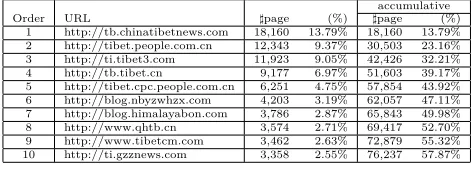
Implementing this method, we build a Tibetan web text mining system. It starts to run on January 12 in 2011, and keeps running until now. Data are collected on April 13 in 2012. It’s shown that the mining system find 150 Tibetan web sites and more than 130000 web pages after deduplication. Table 1 shows the web page numbers of the biggest 10 web sites.
accumulative
Order URL ♯page (%) ♯page (%)
1 http://tb.chinatibetnews.com 18,160 13.79% 18,160 13.79% 2 http://tibet.people.com.cn 12,343 9.37% 30,503 23.16%
3 http://ti.tibet3.com 11,923 9.05% 42,426 32.21%
4 http://tb.tibet.cn 9,177 6.97% 51,603 39.17%
5 http://tibet.cpc.people.com.cn 6,251 4.75% 57,854 43.92%
6 http://blog.nbyzwhzx.com 4,203 3.19% 62,057 47.11%
7 http://blog.himalayabon.com 3,786 2.87% 65,843 49.98%
8 http://www.qhtb.cn 3,574 2.71% 69,417 52.70%
9 http://www.tibetcm.com 3,462 2.63% 72,879 55.32%
10 http://ti.gzznews.com 3,358 2.55% 76,237 57.87%
Table 1: Page numbers of the 10 biggest Tibetan web sites.
From Table 1 we see that nearly half (49.98%) of the web pages are intensively distributed in the 7 web sites, which is a plus factor for us to extract Tibetan text from web pages, because we can focus on only some biggest web sites.
4
Get Tibetan text from the web
In this section, we report the methods to select web sites, web pages and to extract text from web pages.
4.1
Selection of web sites
[image:3.420.99.335.293.378.2]in-formation about them. As the sites are hold by newspaper offices, which have high quality standards for publishing, the quality of the corpus is guaranteed.
Order Host URL Site Name Holder
1 http://tb.chinatibetnews.com China Tibet News Tibet Daily 2 http://tibet.people.com.cn China Tibet Online People’s Daily 3 http://ti.tibet3.com Tibetan’s Web of China Qinghai Daily
Table 2: Information about the selected web sites.
4.2
Selection of web pages
Web pages can be classified into two kinds, namely ”topic” and ”hub”. A topic page contains long text in it while a hub page contains many links to the topic pages. As our target is to extract Tibetan text from the web pages. We only care about the topic pages rather than the hub pages. But in the URL list, which one is the URL of a topic page?
Site Example URLs
China http://tb.chinatibetnews.com/news/2012-02/16/content_884280.htm Tibet http://tb.chinatibetnews.com/xzmeishi/2011-12/05/content_831210.htm News http://tb.chinatibetnews.com/xzzongjiao/2011-10/21/content_798694.htm China http://tibet.people.com.cn/141101/15137028.html
Tibet http://tibet.people.com.cn/141101/15199715.html Online http://tibet.people.com.cn/15143391.html
Tibetan’s http://ti.tibet3.com/economy/2011-01/14/content_370366.htm Web of http://ti.tibet3.com/folkways/2008-12/10/content_3541.htm
China http://ti.tibet3.com/medicine/2009-10/27/content_99171.htm
Table 3: Example URLs of topic pages in the three sites.
Site Example URLs
China http://tb.chinatibetnews.com/xzpinglun/node_698.htm Tibet http://tb.chinatibetnews.com/shehuiminsheng/index.html News http://tb.chinatibetnews.com/xzcaijing/index.html China http://tibet.people.com.cn/140827/141059/index3.html Tibet http://tibet.people.com.cn/96372/125163/index.html Online http://tibet.people.com.cn/141101/index11.html Tibetan’s http://ti.tibet3.com/culture/index.htm
Web of http://ti.tibet3.com/tour/node_701.htm China http://ti.tibet3.com/economy/index.htm
Table 4: Example URLs of hub pages in the three sites.
Table 3 and Table 4 show some URLs of topic pages and hub pages of the three Tibetan web sites respectively. Comparing tens of thousands of URLs of the three web sites, we find the following rules:
• The topic URLs of ”China Tibet News” and ”Tibetan Web of China” have the pattern of ”{host}/{column}/{year}-{month}/{date}/content_{articleid}.htm”. Everyone of them contains the string ”content_”.
• The hub URLs of ”China Tibet News” and ”Tibetan Web of China” contain the string ”index” or ”node”.
• The topic URLs of ”China Tibet Online” have the pattern of
”{host}/{columnid}/{articleid}.html”. Characters between the host URL ”{host}” and the file suffix name ”html” are numbers or slash.
With these rules, we make text extraction only on the topic pages, while URL extraction are made on both the hub pages and the topic pages.
[image:5.420.226.374.122.199.2]4.3
Text extraction
Figure 2: Commented text in a web page from ”China Tibet News”.
Figure 3: Commented text in a web page from ”Tibetan’s Web of China”.
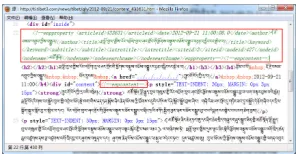
Then, we analyse each topic page to find whether there is a rule to extract topic related text. It’s a surprise that we find some commented text from the html file of topic pages of
”China Tibet News”. Figure 2 shows the commented text in a web page1from ”China Tibet
News”. The shadowed text in the figure shows many information about the page, including title, subtitle, publish date, author, and so on. Although some of the field values are kept empty, it provides us a simple method to extract those information. Unsurprisingly, the text following the shadowed text are the content of the topic, which is followed by another
segment of commented text: ”<!--/enpcontent--><!--/enpcontent-->”.
Then, we get the following rules.
• Tags and text between ’<!–enpproperty>’ and ’/enpproperty–>’ are useful informa-tion about the topic. which can be directly used as XML format text.
• HTML tags and text between the inner pair of ’<!--enpcontent-->’ and
’<!--/enpcontent-->’ are the content of the topic in HTML format.
What a big surprise! We find almost the same commented text in the topic pages from the
third web site ”Tibetan’s Web of China”. Figure 3 shows the HTML file of a web page2
from it. But is it a coincidence? We get the information that both of the two web sites are using the same computer management system of news gathering and editing, which is a product of Beijing Founder Electronics company, to manage their articles and web pages.
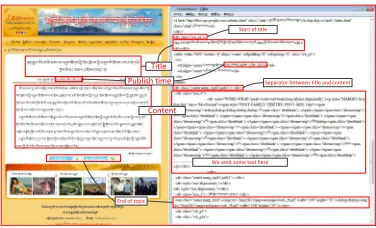
We have no luck in processing pages from ”China Tibet Online”. But we still get a clue after analysing the structure of some web pages from this site. Figure 4 shows the structure
of a web page3from this site. From the figure, we see that there are some HTML tags
giving the boundaries of different text blocks, including:
• String ’<div class=”wb_p1”>’ indicates the start of the title, and the title is sur-rounded by HTML tags ”<h1>” and ”</h1>”. The text between the following ”<h2>” and ”</h2>” may be the subtitle.
Title
Content Publish time
End of topic
We omit some text here Start of title
[image:6.420.109.297.69.183.2]Separator between title and content
Figure 4: The structure of a web page from ”China Tibet Online”.
Figure 5: The text extracted from a page from ”China Tibet news”.
Figure 6: The text extracted from a page from ”China Tibet Online”.
• String ’<div class=”center marg_top10 pic01”> </div>’ is the separator between the title block and the content block.
• String ’<div class=”text_4”>’ indicates the start of the content block.
• String ’<em class=”center marg_bt10”>...</em>’ indicates the end of the content block.
Taking advantage of the HTML tag information, we also can extract the topic related information from the web pages in the web site ”China Tibet Online”.
Then, we use another crawler, which is deployed with a larger link depth than the former crawler, to download web pages from the three web sites, and implement the rules men-tioned above by regular expressions. Topic related text are extracted from the web pages. we filtered out most HTML tags, and convert them into XML format. Figure 5 and Figure 6 show the results.
5
The corpus
In this section, we have to introduce the counting units because Tibetan is different from many other languages. The corpus is introduced after that.
5.1
About the counting units
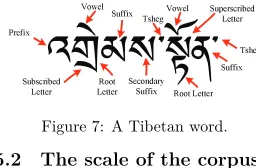
and meanwhile it’s larger than or equal to a character, just like a ”hanzi” in Chinese. Figure 7 shows the structure of a Tibetan word which is made up of two syllables and means “show” or “exhibition”. Another delimiter known as “shed” indicates the sentence boundary, which looks like a vertical pipe. Figure 8 shows a Tibetan sentence. In this paper, we use ”sentence” and ”syllable” as the units to give a more sensitive description of the scale of the corpus.
འགྲེམས་སྟོན་
Prefix
Root Letter Tsheg
Subscribed Letter
Vowel Superscribed Letter Suffix
Secondary Suffix Root Letter Vowel
[image:7.420.64.192.137.221.2]Suffix Tsheg
Figure 7: A Tibetan word.
!"!#!$%!&!'()! *!+!,*!-.!&!/%!%0%"!1*!2
!"! #! $%!&! '()! *!+ ,*!-.!&! /%! %0%"! 1*! 2
Yesterday man rich this house expensive an bought did .
[image:7.420.211.367.139.185.2]Yesterday this rich man bought an expensive house.
Figure 8: A Tibetan sentence.
5.2
The scale of the corpus
We get more than 65 thousands documents from the three web sites, including nearly 1.59 million sentences or 35 million syllables in total. Table 5 shows the data about the corpus. The corpus may be used to make many kinds of statistics, such as character frequencies, syllable frequencies, to train the language models. It can also be used as a basis to build corpus for other natural language processing tasks.
Order Site Name ♯document (%) ♯sentence ♯syllable
1 China Tibet News 31,304 47.88% 815,000 20,264,896
2 China Tibet Online 18,558 28.39% 339,096 7,595,860
3 Tibetan’s Web of China 15,515 23.73% 435,623 7,182,505
Total 65,377 100.00% 1,589,719 35,043,261
Table 5: The scale of the corpus.
Note that the document numbers in Table 5 are great than those in Table 1. It results from two factors:(1) New pages are created after the data in Table 1 are collected. (2) The crawler used to extract Tibetan text corpus is deployed with a bigger link depth than the one in section 3.
5.3
Domains in the corpus
Table 3 shows some URLs from the three web sites. We find that the URL of a page from ”China Tibet News” or ”Tibetan’s Web of China” gives the evidence that which column or sub column, and consequently which domain it belongs to. The following examples shows it.
• The url ”http://tb.chinatibetnews.com/xzmeishi/2011-12/05/content_831210.htm” shows it belongs to a column called ”xzmeishi”. so it must be a topic page about Tibetan foods, because ”xz” is the abbreviated form of Chinese word ”xizang” written
in Pinyin4, which means the Tibetan Autonomous Region, while ”meishi” means
”delicious food”.
• Another url ”http://ti.tibet3.com/medicine/2009-10/27/content_99171.htm” from ”Tibetan’s web of China” shows it belongs to ”Tibetan Medicine” domain.
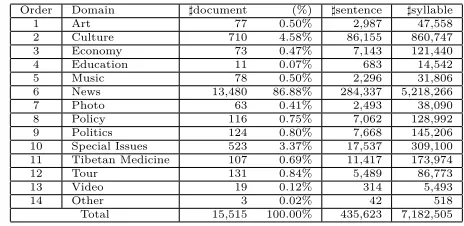
[image:7.420.92.340.280.332.2]With this method, we classify the documents into different domains. Table 6 and Table 7 show the numbers of documents from the two web sites , in different domains. Comparing the two tables, we find that ”News” shares a large part of the documents, especially for those from ”Tibetan’s web of China”, which is up to 86.88%. Documents from ”China Tibet News” are more balanced. These parts of corpus can be used for text classification.
Order Domain ♯document (%) ♯sentence ♯syllable
1 Art 1,277 4.08% 49,250 614,269
2 Finance & Economy 503 1.61% 9,785 268,098
3 History & Geometry 443 1.42% 8,546 151,663
4 News 10,395 33.21% 272,745 7,446,822
5 Picture 2,548 8.14% 16,935 346,175
6 Politics & Law 5,329 17.02% 181,545 4,659,379
7 Rural Life 1,238 3.95% 23,891 646,246
8 Social Life 473 1.51% 6,385 173,766
9 Special Issues 6,100 19.49% 175,173 4,561,724
10 Technology & Education 943 3.01% 24,716 600,806
11 Tibetan Buddhism 792 2.53% 22,318 352,642
12 Tibetan Food 92 0.29% 1,682 16,640
13 Tibetan Medicine 508 1.62% 10,436 155,372
14 Tour 663 2.12% 11,593 271,294
Total 31,304 100.00% 815,000 20,264,896
Table 6: Domains in the documents from ”China Tibet News”.
Order Domain ♯document (%) ♯sentence ♯syllable
1 Art 77 0.50% 2,987 47,558
2 Culture 710 4.58% 86,155 860,747
3 Economy 73 0.47% 7,143 121,440
4 Education 11 0.07% 683 14,542
5 Music 78 0.50% 2,296 31,806
6 News 13,480 86.88% 284,337 5,218,266
7 Photo 63 0.41% 2,493 38,090
8 Policy 116 0.75% 7,062 128,992
9 Politics 124 0.80% 7,668 145,206
10 Special Issues 523 3.37% 17,537 309,100
11 Tibetan Medicine 107 0.69% 11,417 173,974
12 Tour 131 0.84% 5,489 86,773
13 Video 19 0.12% 314 5,493
14 Other 3 0.02% 42 518
Total 15,515 100.00% 435,623 7,182,505
Table 7: Domains in the documents from ”Tibetan’s web of China”.
Conclusion and perspectives
In this paper, we proposed an approach to build a large scale text corpus for Tibetan natural language processing by extracting text from three biggest web sites. Consequently, we get a corpus including more than 65 thousands documents, nearly 1.59 million sentences or 35 million syllables in total. Parts of the corpus are classified into different domains. In the following work, we will build corpora for other tasks based on the present corpus.
Acknowledgements
[image:8.420.79.330.126.237.2] [image:8.420.85.317.262.375.2]References
Boleda, G., Bott, S., Meza, R., Castillo, C., Badia, T., and López, V. (2006). Cucweb: a
catalan corpus built from the web. InProceedings of the 2nd International Workshop on
Web as Corpus, pages 19–26. Association for Computational Linguistics.
Cai, D., Yu, S., Wen, J., and Ma, W. (2003). Vips: a visionbased page segmentation algorithm. Technical report, Microsoft Technical Report, MSR-TR-2003-79.
Caizhijie (2009a). The design of banzhida tibetan word segmentation system. Inthe 12th
Symposium on Chinese Minority Information Processing.
Caizhijie (2009b). Identification of abbreviated word in tibetan word segmentation.
Jour-nal of Chinese Information Processing, 23(01):35–37.
Chen, J. and Nie, J.-Y. (2000). Automatic construction of parallel english-chinese corpus
for cross-language information retrieval. InProceedings of the sixth conference on Applied
natural language processing, ANLC ’00, pages 21–28, Stroudsburg, PA, USA. Association for Computational Linguistics.
Chen, Y., Li, B., and Yu, S. (2003a). The design and implementation of a tibetan word
segmentation system.Journal of Chinese Information Processing, 17(3):15–20.
Chen, Y., Li, B., Yu, S., and Lancuoji (2003b). An automatic tibetan segmentation
scheme based on case auxiliary words and continuous features. Applied Linguistics,
2003(01):75–82.
Chungku, C., Rabgay, J., and Faaß, G. (2010). Building nlp resources for dzongkha: A
tagset and a tagged corpus. InProceedings of the Eighth Workshop on Asian Language
Resouces, pages 103–110, Beijing, China. Coling 2010 Organizing Committee.
Dickinson, M., Israel, R., and Lee, S.-H. (2010). Building a korean web corpus for
ana-lyzing learner language. InProceedings of the NAACL HLT 2010 Sixth Web as Corpus
Workshop, pages 8–16, NAACL-HLT, Los Angeles. Association for Computational Lin-guistics.
Guevara, E. R. (2010). Nowac: a large web-based corpus for norwegian. InProceedings
of the NAACL HLT 2010 Sixth Web as Corpus Workshop, pages 1–7, NAACL-HLT, Los Angeles. Association for Computational Linguistics.
Kilgarriff, A. and Grefenstette, G. (2003). Introduction to the special issue on the web as
corpus.Computational linguistics, 29(3):333–347.
Norbu, S., Choejey, P., Dendup, T., Hussain, S., and Muaz, A. (2010). Dzongkha word
segmentation. InProceedings of the Eighth Workshop on Asian Language Resouces, pages
95–102, Beijing, China. Coling 2010 Organizing Committee.
Resnik, P. (1998). Parallel strands: A preliminary investigation into mining the web for
bilingual text.Machine Translation and the Information Soup, pages 72–82.
Resnik, P. (1999). Mining the web for bilingual text. InProceedings of the 37th annual
Resnik, P. and Smith, N. A. (2003). The web as a parallel corpus. Comput. Linguist., 29(3):349–380.
Sun, Y., Luosangqiangba, Yang, R., and Zhao, X. (2009). Design of a tibetan
auto-matic segmentation scheme. Inthe 12th Symposium on Chinese Minority Information
Processing.
Sun, Y., Yan, X., Zhao, X., and Yang, G. (2010). A resolution of overlapping ambiguity
in tibetan word segmentation. In Proceedings of the 3rd International Conference on
Computer Science and Information Technology, pages 222–225.
Zuraw, K. (2006). Using the web as a phonological corpus: a case study from
taga-log. InProceedings of the 2nd International Workshop on Web as Corpus, pages 59–66.