Digitalization of Production Area Based on
Raw Material Industries
Prof.Mr.M.G.Panjawani, Snigdha Dakwale, Harshala Gupta, Astha Singh, Aditya Chandak, Kajal Ingole
Dept. of Computer Technology, Priyadarshini College of Engineering, Nagpur, India
ABSTRACT: Digitalization is the process of converting any kind of information into digital form. We can use different ways to store any particular information, but digitalization provides the most effective and easiest way. This is an era in which digitalization is at its peak. Now a day almost every work is preferred to be done by various digital means using the computing technology. Digitalization has its hands in every field including various industries. In spite of this we find different raw industries lagging behind in this case. Raw industries are those industries which involves the primary production and distribution of various raw materials to be used by other manufacturing industries. Our project deals with digitalization of such industries. The raw industries have the main function to produce raw materials, and then come its distribution. They need to keep records for their every production and distribution for which they use a lot of paper work which has a greater chance of being lost and the data can be easily manipulated. Moreover, it requires a lot of papers for it while eventually leads to cutting down of a number of trees. And because of this system of distribution the customer needs to go to the factory very often for buying the materials which may prove to be hectic for them. Thus, by keeping all these in mind we present a system in which all the information and data are to be stored digitally in database, through which every data is easily stored and accessed and the data can be kept and maintained for longer time. The use of paper would also be minimized and it would be easy for both the distributor and the dealer to deal, both of them could have the data preserved with them and can be referred by both of them anytime. In this case the data would be only accessible to few particulars thus maintaining its privacy. Hence this system for the digitalization of raw industry is very effective, safe and easy way to store and preserve the information regarding production and distribution of raw materials.
KEYWORDS: Digitalization, Raw Industries, Non-ambient, database, business.
I. INTRODUCTION
Impact of Digitalization in Rural Areas: -
India’s population now exceeds 1.21 billion with 69% of the population located in rural areas. Internet penetration is increasing with Mobile playing the major catalyst. Studies conducted by IAMAI reflect some interesting patterns. 90% of those accessing the internet were using it for entertainment, 80% were using it for communications, 67% for online services, 65% for e-commerce and 60% for social networking. The number of Internet users in rural India is estimated to cross 85 million by June 2014 making India the world’s second largest market for Internet users. All these put together is now changing attitudes, awareness and lifestyles in rural India. A decade ago, the awareness, information and knowledge gap between the rural youth and his urban counterpart were significant. This has now rapidly narrowed and the gap is closing.
Digitalization: Is the use of digital technologies to change a business model and provide new revenue and value-producing opportunities; it is the process of moving to a digital business.
A particular INDUSTRY consists of all the people and activities involved in making a particular product or providing a particular service.
List of Raw Material Industries
Steel: The Indian Steel industry is one of the oldest industries in the Indian economy. It has been a force to reckon with, both in terms of innovation and driving economic development.
Plywood: The Indian plywood and laminates industry manufacture various engineered woods like plywood, laminates, MDF and veneers. Plywood is the most demanded product of this industry followed by laminates. MDF on the other hand is a small segment of the Indian industry.
Textile: The Indian textile is one of the oldest fabrication industries in raw industries. It is boon industry in India up till date.
Yarn: Indian Yarn & Fabric industry Optimistic about future growth. The textile industry is the largest industry of modern India. The industry accounts for 14 per cent of the total industrial production, contributes to nearly 30 per cent of the total exports and is the second largest employment.
Problems in Raw Material Industry
Loss of data collection.
Difficulty in finding of particular data. Loss in maintaining the stock.
1. Inventory Control and Its Management: - The term inventory means the value or amount of materials or resource on hand. It includes raw material work in process, finished goods, spares and stores.it is a constant requirement of doing business successfully.it prevents from losing urn stock management as it is maintained in systematic manner in database.
2. Business Processes Are Becoming More Customer Centric: - As each and every product is verified during its inventory process by keeping in mind the assets of the customer according their demand.
3. Business Models are Becoming More Flexible: - As the user can view their required product easily including its overall details easily from anywhere and anytime so it saves their time of purchasing the product. It gives growth to the network of e-commerce.
4. Periodic Check: - The entry of each and every product is maintained in database.it is managed by inventories so the 5. Availability of product and purchasing is also checked periodically the products left in stock.
6. Loss of Data: - With the help of e-commerce each and every data is maintained in well manner. The data is recorded
in an efficient manner in database by providing locks concept to it so that data remained secure and sustainable to user.
II. LITERATURE REVIEW
The scenario of Indian industries has incalculably distributed in the digital world. The number of Indian raw industryis has increased at a very striking rate which is textile industry. It has been observed that more and more such industries are willing to have their place of business in digital India. With more liberalized norms and rules by the Government, more and more companies saw the business scenario getting better.
This project consists of software where we are digitalizing raw industry. Our main moto is to empower the industry which is lagging behind. As we found 64% of today’s population uses internet where they are unaware of raw industries which lags behind our nation. So, we made a project where we can digitalize our raw industry which has too much scope for future employment, which will automatically increase our gdp.
the global markets. The Wood, Plywood & Allied Products Industry is one of the major sectors having enormous potential for gaining from these developments as India is one of the major wood-users in the Asia pacific region.
FACTS & FIGURES:
Asia Pacific region has over 4500 varieties of wood-yielding species & has some of the best known and most highly prized tropical hardwoods. Indian plywood industry is as big as Rs.5, 000 crore equivalent to USD 1 billion. The industry is growing at rapid pace of 10-20% per annum. Approximately 600 units are currently functioning all over the country. There is tremendous growth potential as the players are yet to invade majority of the international market. Panel and plywood products are the main wood products in India. Product categories include veneer sheets, particle board (composite wood core with plastic laminate finish), panel products (fibre board), plywood made from both hard and softwood (veneered panels and laminated woods), and medium density fibre board. Indian particle board and plywood industry accounts for 15% of the total production, producing, and some 30 million sqm of plywood and block boards. At present, the Indian wood & furniture sector is predominantly in the hands of unorganized small units. The branded (higher quality) wooden furniture industry is growing at 15% annually.
Table -1:
PRODUCTS VALUE IN 2010 (US$ MILLION) % SHARE
Furniture and parts 63648 41
Sawn Wood 29761 19
Plywood 11343 7
Joinery & Carpentry of Wood 11140 7
Fibre board 8183 5
Others 33899 21
TOTAL 157973
Source: ITC Trade Map
Hence, the era of digitalization demands development. The raw industries are required to maintain complete records, to fulfil all the formalities as well as to ensure full chain relationship from forest to final delivery of finished products to overseas dealers. Therefore, this system shall overcome the challenges faced by the wood industries.
III. METHODOLOGY
ASP .Net is the way to make your site dynamic. The real beauty of ASP .Net, SQL Server, JavaScript, and CSS is the wonderful way in which they all work together to produce dynamic web content: ASP .Net handles all the main work on the web server, SQL Server manages all the data, and the combination of CSS and JavaScript looks after web page presentation. JavaScript can also talk with your ASP .Net code on the web server whenever it needs to update something (either on the server or on the web page). ASP .Net is a robust, Server-side, Semi open source scripting language that is extremely flexible and actually fun to learn. SQL Server is the standard query language for interacting with databases. SQL Server is a Semi open source, SQL database server that is more or less free and extremely fast. SQL Server is also cross platform [6].
application virtual machine that provides the services such as the security system, management of memory, and handling the exception.
Atul Mishra [2] proposed the system for Critical Comparison of PHP and ASP.NET for Web Development. An importance of ASP.NET for development of web application (WA) which was developed as a part of a module’s assessment. These languages have been evaluated for development of WA functional requirements and features.
Priya Patil [3] proposed the system for conversation of paper based system to paperless work using the front oriented module. Managing access control and task completion using the type role hierarchy based access control model implementation of services like notification, performance evolution. Wiwin Susanty, TaqwanTamrin, Ahmad Cucus [4] proposed the system for Document management System Based on Paperless. Which were effectively and useful in an office to streamline in the process documentation. The main benefit was that user can find needed information quickly, so it can help to process faster, better, cheaper and reduce environmental impacts.
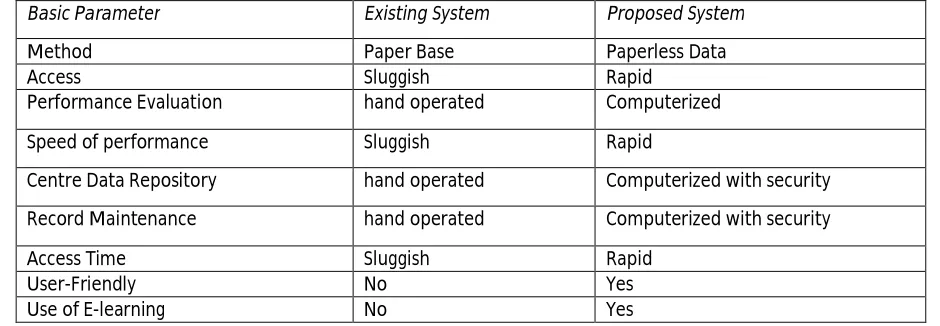
Table -2:
Basic Parameter Existing System Proposed System
Method Paper Base Paperless Data
Access Sluggish Rapid
Performance Evaluation hand operated Computerized
Speed of performance Sluggish Rapid
Centre Data Repository hand operated Computerized with security
Record Maintenance hand operated Computerized with security
Access Time Sluggish Rapid
User-Friendly No Yes
Use of E-learning No Yes
Advantages of using C# in the ASP.NET in our project:-
The best part about ASP.NET is that it uses a model view controller (MVC) architecture. This greatly dissociate your site code into three distinct cask; the model (database - what the user requests and often edits), the view (what the user sees on the web page), and the controller (the code that changes/edits the model/databases). Separating this code makes it easier for large teams to collaborate. One developer team can concentrate on the user experience (UX) and the user interface (UI) while other teams can add and develop the database and likewise the functions to serve up and to edit that data.
While many programming languages can be integrated into an ASP.NET application, C# has become widely popular because it is much easier than some of the other programming languages and can allow you to create functions in minimal code than other languages such as Java. In a textbook definition, C# is a type-safe, managed and object oriented language, which is compiled by .Net framework for generating intermediate language (IL). Being an object oriented language C# embraces the 3 pillars of object oriented programming; C# supports the concepts of encapsulation, inheritance, and polymorphism.
There are now limitless options for building a website. A newer idea is something called a "Headless CMS". That's another discussion entirely. I'm currently working on my recommendations and explanation of this technology so stay tuned to my organic channel for more clarity and understanding.
IV. OBJECTIVE
1. To provide a Login to each and every dealer to maintain security. 2. To provide online upload and download from anywhere any time.
3. To provide the online reach to dealer and factories to modify and provide data. 4. To increase the information to dealer at one click on website as well as mobile browser. 5. To decrease the time spends on non-value added task such as old data and bills. 6. E-Learning module is cost effective and saves time.
7. Business 24/7, anywhere.
8. Get every notification on one place in digital format.
V. CONCLUSION
This system proposed a protocol for raw industries for secure and effective storage of information and various data regarding the production and distribution of raw materials. It provides a secure platform through which the raw industries can easily deal with the other industries for the supply of its production through digitalization. It would be very helpful in maintaining the record of all the materials produced and distributed which could be secured for a very long time and there would not be any chance of loosing the document. Moreover it would lessen the burden of keeping the records on a paper and this approach is also eco-friendly. Thus we conclude that this system can be used for the development of the raw industries.
REFERENCES
[1] Pulakesh Roy “Development of Online Shopping System using ASP.NET Technology and Microsoft SQL “International Journal of Advance Research in Computer Science and Management Studies. Volume 4, Issue 4, April 2016.
[2] Atul Mishra” Critical Comparison of PHP and ASP.NET For Web Development “volume 3, Issue 7, July 2014.
[3] PritaPatil, KavitaShirsat “An Integrated Automated Paperless Academic Module for Education Institutes” Computer Engineering Department, Mumbai University, Vidyalankar Institute of Technology, Mumbai Vol. I Issue IX March 2015.
[4] Chilla.Santhi, A. SatyaMallesh “Intrusion Detection in Web applications Using Double Guard” Dept. of CSE, BonamVenkataChalamayya Engineering College Odalarevu- AmalapuramE.G.dt,AP, India. International Journal of Research in Computer and Communication Technology, Vol 2, Issue 12, December- 2013.
[5] SPEECH ON “EXPORT MARKET CHALLENGES FOR INDIAN TIMBER PRODUCTS” BY MR. B. H. PATEL, CHAIRMAN – PLYWOOD & ALLIED PRODUCTS PANEL, CAPEXIL