Energy Conserving Delay Conscious Lifetime
Enhancing Data Aggregation Protocol for
Heterogeneous Wireless Networks
Satyanarayan Padaganur 1, Dr. Jayashree Mallapur 2
Asst. Professor, Department of E & C, BLDEA Engineering College, Vijayapur, India1
Professor, Department of E & C, Basaveshwar Engineering College, Bagalkot, India 2
ABSTRACT: In this work, we aim at implementing a data collection protocol for heterogeneous wireless networks which improves energy efficiency, delay and network lifetime. Thus Energy conserving Delay Conscious Lifetime enhancing (EDCL) data aggregation protocol is implemented. Centralized heuristic EDCL (C-EDCL) and Distributed heuristic EDCL (D-EDCL) are two approaches used to achieve the goal. Performance of C-EDCL and D-EDCL is tested on certain parameters like energy consumption by nodes, end-to-end delay, number of hops, number of dead nodes and alive nodes. Results of both the approaches are compared.
KEYWORDS: Heterogeneous wireless networks, Data aggregation protocol, Centralized EDCL and Distributed EDCL.
I. INTRODUCTION
Heterogeneous network is defined as a network connecting computers and other devices with various operating systems and/or protocols. While in our context heterogeneous network means a network that allows use of different access technologies. The heterogeneous network that has been used in this project is a combination of wireless sensor network and a cellular network. Here we form a network of four clusters and communication between the clusters is either centralized or distributed.
Wireless sensor network (WSN) is a collection of minute sensor devices that can be used as a means to collect data in required environments. Each of the sensor nodes sends the aggregated data to the Base Station (BS) which finally relays the data to the end user. Clustering is the best way to provide data aggregation and scalability for wireless sensor networks. In this project work we have introduced a data aggregation protocol called Energy conserving Delay Conscious Lifetime enhancing (EDCL) data aggregation protocol for heterogeneous wireless sensor networks. Clusters are formed based on their geographical location.
Wireless sensor networks (WSNs) are most widely used for random and rapid deployment of nodes, which is used in many applications such as temporary networking tactical communications, health care and disaster relief operations. WSNs are comprised of nodes that wirelessly communicate with each other. If a node is not within the transmission range of another node that is willing to communicate with that node, then an intermediate node that is within the transmission range of the sending node would relay the data to the receiver node. This eventually establishes communication among the deployed nodes. However, WSN poses various security problems which are to be dealt with. Multi-hop routing is used in WSN. In WSN routing typically begins with finding the neighbours. Nodes keep sending packets and build local neighbour tables. These tables include each neighbour’s ID and location. Consequently, the nodes must know their geographic location before their neighbour discovery. Typical additional information in these tables includes node’s remaining energy, delay through that node and an estimate of link quality. Once the tables are formed, in most of the WSNs, routing algorithm messages are directed from a source location to a destination location based on geographic coordinates and not based on node IDs for ex: - Geographic Forwarding.
prevent interference thereby providing assured bandwidth in each cell. This network provides a number of most desirable features like: high capacity as same frequency will be allowed to be used for multiple links as long as they reside in different cells, power efficiency by allowing mobile devices to use less power since the cell towers will be closer and covers large geographical area. Since the network covers large geographical area, it allows numerous portable transceivers to communicate with each other and even with telephones anywhere in the network through BSs.
II. PROJECT SCOPE
In this project we simulate EDCL data aggregation protocol in two ways namely centralized heuristic EDCL and distributed heuristic EDCL. Hence a series of operations are carried out to simulate the centralized and distributed heuristic EDCL algorithms. These operations include random topology distribution, heterogeneous network formation, cost distribution among the nodes, dijkstra’s routing algorithm, heuristic algorithm based on revised push, centralized heuristic EDCL algorithm, Ant colony based gossip algorithm and lastly distributed heuristic EDCL algorithm.
C-EDCL and D-C-EDCL are compared by parameters like end-to-end delay, number of hops, energy consumption by nodes,
number of dead nodes and number of alive nodes. Random topology distribution algorithm places the nodes randomly in a cluster. Cost distribution algorithm generates cost randomly to carry out simulation. Dijkstra’s algorithm discovers the route based on minimum cost. Heuristic algorithm based on revised push generates candidate list using “dijkstra’s algorithm” and then outputs the best route set having minimum cost. Centralized EDCL performs intensification and diversification at centralized node and finds best route towards the destination node. Ant colony based gossip algorithm performs energy level computation of the nodes in the network. Distributed EDCL algorithm finds the best route considering both cost and energy level of nodes into account.
III. PREVIOUS APPROACH
In Low Energy Adaptive Clustering Hierarchy (LEACH) protocol, nodes are randomly selected to be the cluster head (CH). The role of CH is given to every node by random rotation among themselves. It is mainly suitable for homogeneous network.
Threshold sensitive Energy Efficient sensor Network (TEEN) is a cluster based routing protocol. With the help of this protocol, data could be sensed continuously but there is no frequent data transmission. The baseline of clustering in TEEN is same as that of LEACH. There are two types of threshold modes used in this algorithm namely Hard Threshold (HT) and Soft Threshold (ST). Sensed parameter would be within the required range and ready to be sent in case of HT mode. While in ST mode, if there is any change in the value of sensed data only then it will be sent.
In2010 Heterogeneous-Hybrid Energy Efficient Distributed (H-HEED) protocol was introduced which considered heterogeneity based on energy levels of the nodes like 2-level, 3-level and multi-level. It mainly aimed at enhancing the network lifetime. But due to random selection of the cluster head there was high communication overhead and the periodic cluster head selection requires more energy to rebuild the clusters.
In 2013 Distributed Data Aggregation based Energy Efficient Cluster algorithm (DDAEEC) was introduced for heterogeneous WSN. It could consider both initial energy and remaining energy simultaneously. It was found that DDAEEC had 40% increment in message transmission compared to existing LEACH and Distributed Energy Efficient Clustering (DEEC) protocol
IV. CURRENT APPROACH
V. OBJECTIVES OF THE PROJECT
1. Design and Simulation of the random topology distribution. It places the nodes between the given end points
x
min,
x
max,
y
min&
y
max.2. Design & Simulation of heterogeneous network formation. It is used to spread the nodes in multiple clusters. For a given number of clusters ‘
N
clusters’, list of x end pointsx
list and list of y end pointsy
list, the nodes are placed across multiple clusters.3. Design & Simulation of cost distribution algorithm. It distributes the cost for the various links in the network. 4. Design & Simulation of dijkstra's algorithm which finds the routes having minimum cost from source to destination.
5. Design & Simulation of heuristic algorithm based on revised push. It makes a combination of candidate list & minimum cost routes giving out the minimum cost routes.
6. Design & Simulation of centralized heuristic algorithm in EDCL that finds the best possible routes among the set of routes discovered using heuristic algorithm based on revised push and further intensification & diversification processes are carried out to find the best possible route.
7. Design & Simulation of ant colony based gossip algorithm. It obtains the energy level information of the nodes in the network.
8. Design & Simulation of distributed heuristic in EDCL algorithm. It finds the set of routes taking both energy and cost into account. It then discovers the best route among them.
VI. SIMULATION RESULTS
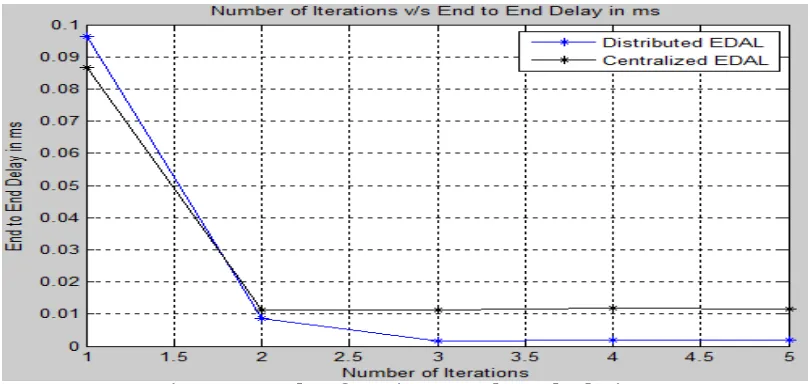
Figure 6.1: Number of Iterations v/s End to End Delay in ms
Figure 6.2: Number of Iterations v/s Number of Hops
As shown in the figure 6.2, it shows about number of iteration v/s number of hops. From the graph we conclude that Distributed EDCL requires less number of hops as compared to Centralized EDCL as number of iterations increases.
Figure 6.3: Number of Iterations v/s Energy Consumption in mJ
Figure 6.4: Number of Iterations v/s Number of Dead Nodes
As shown in the figure 6.4, it shows about number of iterations v/s number of dead nodes. From the graph it gives about the Distributed EDCL has less number of dead nodes as compared to Centralized EDCL with respect to number of iterations increases.
Figure 6.5: Number of Iterations v/s Number of Alive Nodes
As shown in the figure 6.5 the graph shows about number of iterations v/s number of alive nodes. From the graph we conclude that Distributed EDCL has more number of alive nodes as compared to Centralized EDCL with respect to increase in number of iterations.
VII. CONCLUSION AND FUTURE SCOPE
energy consumption by nodes, number of dead nodes and number of alive nodes. It was clearly evident from the results that distributed EDCL is more efficient algorithm compared to centralized EDCL. Hence we see that the energy has been conserved, delay does not cross specified limit and therefore lifetime has also been enhanced through the simulation of distributed EDCL.
FUTURE SCOPE
1. The network routing algorithm can be further improved to implement EDCL routing which can be used to deliver
packets to the destination.
2. WSNs can further be improved to employ multiple channels to increase the efficiency of the network.
REFERENCES
[1] A. Cerpa, J. Wong, L. Kuang, M. Potkonjak, and D. Estrin, “Statistical Model of Lossy Links in Wireless Sensor Networks”, IPSN, April 2005. [2] S. Krishnamurthy, J. Stankovic, T. Abdelzaher, L. Luo, T. Yan, R. Stoleru, L. Gu, G. Zhou, J. Hui and B. Krogh, “VigilNet: An Integrated Sensor Network System for Energy Efficient Surveillance”, ACM Transactions on Sensor Networks, to appear.
[3] J. Hill, R. Szewczyk, A Woo, S. Hollar, D. Culler, and K. Pister, “System Architecture Directions for Networked Sensors”, ASPLOS, November 2000.
[4] C. Lu, B. Blum, T. Abdelzaher, J. Stankovic and T. He, “A Real-Time Communication Architecture for Large-Scale Wireless Sensor Networks”, IEEE Real-Time Applications Symposium, June 2002.
[5] C. Intanagonwiwat, R. Govindan, and D. Estrin, Directed Diffusion: “A Scalable Routing and Robust Communication Paradigm for Sensor Networks”, Mobicom, August 2000.
[6] B. Karp and H. T. Kung, “GPSR: Greedy Perimeter Stateless Routing for Wireless Sensor Networks”, IEEE Mobicom, August 2000.
[7] L. Luo, T. Abdelzaher, T. He, and J. Stankovic, “EnviroSuite: An Environmentally Immersive Pro-gramming Framework for Sensor Networks, ACM Transactions on Embedded Computing Systems”, to appear.
[8] L. Luo, T. He, T. Abdelzaher, J. Stankovic, G. Zhou and L. Gu, “Achieving Repeatability of Asyn-chronous Events in Wireless Sensor Networks with EnviroLog”, Infocom, April 2006.
[9] A. Perrig, R. Szewczyk, J. Tygar, V.Wen, and D. Culler, “SPINS: Security Protocols for Sensor Networks”, ACM Journal of Wireless Networks, September 2002.
[10] J. Polastre, J. Hill and D. Culler, “Versatile Low Power Media Access for Wireless Sensor Networks”, ACM SenSys, November 2004. [11] N. Ramanathan, K. Chang, R, Kapur, L. Girod, E. Kohler, and D. Estrin, “Sympathy for the Sensor Network Debugger”, ACM SenSys, November 2005.
[12] R. Stoleru, T. He, J. Stankovic, “Spotlight: A High Accuracy, Low-Cost Localization System for Wireless Sensor Networks”, ACM Sensys, November 2005.
[13] M. Maroti, B. Kusy, G. Simon, and A. Ledeczi, “The Flooding Time Synchronization Protocol”, ACM SenSys, November 2004.
[14] T. He, C. Huang, B. Blum, J. Stankovic, T. Abdelzaher, “Range-Free Localization and Its Impact on Large Scale Sensor Networks”, ACM Transactions on Embedded Computing System, to appear.