Experimental Study on Concrete by Partial
Replacement of Cement by Sugar Bagasse Ash
and Partial Replacement of Coarse Aggregate
by Coconut Shell
Vrinda V Maloor1, Greeshma Pradeep1, Nasif A1, Razeen Moosa1, Lakshmy E G2
B.Tech Student, Department of Civil Engineering, KMEA Engineering College, Cochin, Kerala, India1
Assistant Professor, Department of Civil Engineering , KMEA Engineering College, Cochin, Kerala, India2
ABSTRACT: The researches has shown that every one ton of cement manufacture releases half ton of carbondioxide, so there is an immediate need to control the usage of cement. On the hand materials wastes such as Sugar Cane Bagasse Ash is difficult to dispose which in return is environmental Hazard. The Silica present in the Bagasse ash imparts high early strength to concrete. Coconut shell is a light weight aggregate and coconut shell concrete is highly durable. This project mainly deals with the replacement of cement with bagasse ash accordingly in the range of 6% by weight for M-25 mix. Similarly, coconut shell as partial replacement for coarse aggregate in concrete for 0%,10%,15%, and 20% is studied. The characteristic properties of concrete such as compressive strength, flexural strength ,split tensile strength using the mix made by sugar bagasse ash and coconut shell is analyzed. The results showed that an increase of 11.1 % of strength is obtained for the substitution of 6% of cement content by sugar bagasse ash and 10% of the coarse aggregate by coconut shell when compared with normal concrete and it satisfies the requirement for structural lightweight concrete.
KEYWORDS: Sugar Bagasse Ash, Coconut shell, Light Weight Concrete
I. INTRODUCTION
Ordinary Portland cement is the most extensively used construction material in the world. Since the early 1980’s, there has been an enormous demand for the mineral admixture and in future this demand is expected to increase even more. Also in this modern age every structure has its own intended purpose and hence to meet this purpose modification in traditional cement concrete has become essential. This situation has led to the extensive research on concrete resulting in mineral admixture to be partly used as cement replacement to increase workability in most structural application. If some of raw material having similar composition can be replaced by weight of cement in concrete, then cost could be reduced without affecting its quality. A few studies have been carried out on the ashes obtained directly from the industries to study pozzolanic activity and their suitability as binders, partially replacing cement.
However, concrete manufacturing involve consumption of ingredients like cement, aggregates, water & admixtures. Among all the ingredients, aggregates form the major parts. Use of natural aggregates to a high rate leads to exploitation of natural aggregates sources. In addition, operation associated with aggregates extraction and processing is the principal causes environmental concern. In light of this in the contemporary civil engineering construction, using alternative materials in place of natural aggregate in concrete production makes concrete as sustainable and environmentally friendly construction material.
partial replacement of cement at the ratio of 6% and coarse aggregate by 0%,10%,15%, and 20% by volume respectively. The main ingredients consist of Portland cement, SCBA, m- sand, coarse aggregate, coconut shell and water. After mixing, concrete specimens were casted and subsequently all test specimens were cured in water at 28 days.
II.RELATED WORK
Some of experimental work are as follows:
Parag S. Kambli et al. [2014]prepared three different Mix Designs for M20, M35, M50 grades of concrete. Percentage replacement by coconut shell varied as 0%, 10%, 20%, 30%, 40% respectively. It is concluded in this study that for M20 grade concrete cubes with 30% replacement of CS aggregates had given strength of 23 MPa at 28 days. Concrete cubes with 30% replacement of CS aggregates had given strength of 42 MPa at 28 days for M35. For M50 grade concrete cubes with 30% replacement of CS aggregates had given strength of 51 MPa at 28 days.
Dewanshu Ahlawat et al. [2014]explored the possibility of producing M20 grade of concrete by replacing conventional aggregate by coconut shell. Forty five cubes were casted. Percentage of replacement of conventional coarse aggregate by coconut shell were 2.5%, 5%, 7.5%, 10%. Compressive strength were 19.71, 19.53, 19.08, 18.91 N/mm2 respectively at 28 days. Workability and compressive strength had been evaluated at 7, 14 and 28 days. The compressive strength of concrete reduced as the percentage replacement increased. The optimum is for 2.5% replacement.
Piyushkumar et al. [2015]studied on “ Effect of use of Bagasse Ash on Strength of Concrete”, with increasing demand and consumption of cement ,researchers and scientist are in search of developing alternate binders that are eco friendly and contributes towards waste management .In these paper SCBA has been chemically and physically characterized and partially replaced in the ratio of 0% ,5% ,10%,15% & 20% by weight of cement in concrete. The properties for fresh concrete are tested like slump cone test and for hardened concrete compressive strength at the age of 7 and 28 days by using grade M30. The test result indicate that the strength of concrete increase up to 10% SCBA replaced with cement.
R.Srinivasan, et al.[2010] studied on “Experimental Study on Bagasse Ash in Concrete”. In this paper, Bagasse ash has been chemically and physically characterized, and partially replaced in the ratio of 0%, 5%, 15% and 25% by weight of cement in concrete. Fresh concrete tests like compaction factor test and slump cone test were undertaken was well as hardened concrete tests like compressive strength, split tensile strength, flexural strength and modulus of elasticity at the age of seven and 28 days was obtained by using grade of M15. The test result indicate that the strength of concrete increase up to 15% SCBA replacement with cement.
W. Dhengare, et al. [2015] paper presents the use of sugarcane bagasse ash (SCBA) as a pozzolanic material for producing high-strength concrete.. The concrete mixtures, in part, are replaced with 0%, 10%, 15%, 20%, 25% and 30% of SCBA respectively. In addition, the compressive strength, the flexural strength, the split tensile tests were determined. The mix design used for making the concrete specimen is M20. The water –cement ratios varied from 0.44 to 0.63. The tests were performed at 7, 28, 56 and 90 days of age in order to evaluate the effects of the addition SCBA on the concrete. The test result indicate that the strength of concrete increase up to 15% SCBA replacement with cement.
III.OBJECTIVES OF THE STUDY
The main objectives of our project is listed below:
1. To prepare lightweight concrete by using coconut shell as coarse aggregate.
3. To increase the usage of waste product for the purpose of commercial work.
IV. METHODOLOGY
The materials used in this investigation are:
Cement: A cementis a binder, a substance that sets and hardens and can bind other materials together. In this project work, we used Ordinary Portland Cement (OPC) of grade 53 which is manufactured by RAMCO company.
Coarse Aggregate : Aggregates are the most mined materials in the world. Aggregates are a component of composite materials such as concrete and asphalt concrete; the aggregate serves as reinforcement to add strength to the overall composite material. In this project work, aggregate of 20 mm size is used.
M-sand: Manufactured sand (M-Sand) is a substitute of river sand for concrete construction. Manufactured sand is produced from hard granite stone by crushing. The size of manufactured sand (M-Sand) is less than 4.75mm.
Coconut shell: The waste material ,coconut shells are used as a alternative for coarse aggregate in concrete. Coconut shell used in this project is collected from various parts of Kerala. After the coconut is collected, it was tattered out and the shells were regularly discharged. The shells were cleaned from the presence of foreign particles. The fibers around the shells were kept as such. The size of coconut shell is maintained at 5-20mm. The coconut shell used in this project is subjected to 24 hours exposure to sunlight to get it free from moisture content. Figure 1 shows the coconut shell chips of 5-20 mm size which is used in this work.
Figure 1: Coconut shell chips
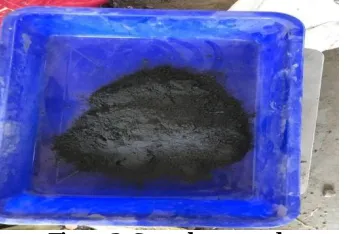
Sugar Bagasse Ash: Bagasse is a cellulose fiber remaining after the extraction of the sugar-bearing juice from sugarcane. This material contains amorphous silica which is indication of pozolanic properties. The sugar baggase ash used in this project work was produced from the sugarcane waste obtained from various parts of Kerala. The sugarcane waste obtained after the extraction of juice is subjected to drying process under sunlight. The dried sugarcane fibres were burned under normal conditions and the resulting sugar bagasse having 90 micron size is used in this project work. Figure 2 shows sugar bagasse ash used in this work.
Chemical analysis of sugar cane bagasse ash
Sugar cane bagasse ash collected for experimental work was tested for the chemical compound at Travancore Cements PVT LTD,Kottayam. Chemical compound result of bagasse ash is given in Table 1.
Table 1: Chemical composition of sugarcane bagasse ash.
SL.NO COMPONENT SYMBOL % 1. Silica SiO2 61.00
2. Alumina Al2O3 29.50
3. Ferric oxide Fe2O3 3.79
4. Manganese oxide MnO 0.004 5. Calcium oxide CaO 0.48 6. Magnesium oxide MgO 0.39 7. Loss of ignition LOI 2.71
Water: Mixing water should not contain undesirable organic substances or inorganic constituents in excessive proportions. In this project clean potable water is used for mixing and curing of samples.
V.EXPERIMENTAL WORK
Sugar cane bagasse ash preparation:
Before the preparation of bagasse ash, the bagasse was dried in sunlight to remove the moisture content. The dried sugarcane fibres were burned under normal conditions .The ash wassieved in the mechanical shivers to separate unburned particles from ash. Sugar cane bagasse ash passing from 90micron was used in this experiment work.
Coconut shell chips preparation:
The shells were cleaned from the presence of foreign particles. The fibers around the shells were kept as such. The size of coconut shell is maintained at 5-20mm. The coconut shell used in this project is subjected to 24 hours exposure to sunlight to get it free from moisture content.
Casting of Samples:
Preparation of the Specimens: For the experimental work concrete cubes of size 150x150x150mm,concrete beams of size 100x100x500mm,concrete cylinders of 300 mm height and 150 mm diameter were prepared. The53 grade OPC was replaced with 0% and 6% SCBA and coarse aggregate was replaced with 0% ,10% ,15% , and 20% coconut shell. M25 Grade of concrete is adopted throughout the study with w/c ratio of 0.5.
Sample M0: 0% SCBA and 0% CS Sample M1: 6% SCBA and 0% CS Sample M2: 6% SCBA and 10 % CS Sample M3: 6% SCBA and 15 % CS Sample M4: 6% SCBA and 20% CS
Mix Proportion for M25 concrete:
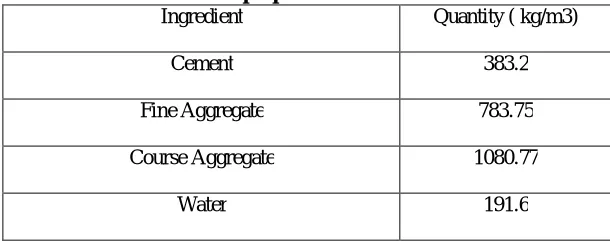
The mix proportion for M25 concrete is given in Table 2.
Table 2: Mix proportion for M25 concrete
Ingredient Quantity ( kg/m3)
Cement 383.2
Fine Aggregate 783.75
Course Aggregate 1080.77
Mix Proportion for partial replacement:
Mix proportion for partial replacement is given in Table 3.
Table 3: Mix proportion for partial replacement
CS SCBA Cement FA CA Water
M0 0 0 383.2 783.75 1080.77 191.6
M1 0 22.992 360.208 783.75 1080.77 191.6
M2 108.077 22.992 360.208 783.75 972.693 191.6
M3 162.11 22.992 360.208 783.75 918.654 191.6
M4 216.154 22.992 360.208 783.75 864.616 191.6
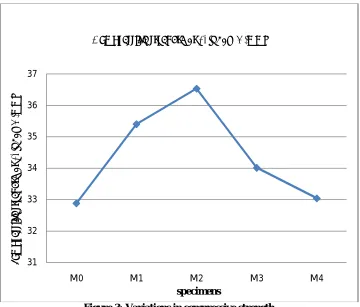
Cubes were tested in compression testing machine at 28th day of curing for compressive strength. The figure 3 given below shows the variations in compressive strength.
Figure 3: Variations in compressive strength
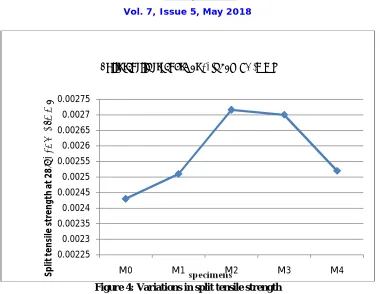
Cylinders were tested in compression testing machine at 28th day of curing for split tensile strength. The variations in split tensile strength is given in figure 4.
31 32 33 34 35 36 37
M0 M1 M2 M3 M4
c
o
m
p
r
e
ss
iv
e
s
tr
e
n
gth
at
28ᵗ
ʰ
d
ay,
N
/m
m
²
Compressive strength at 28ᵗʰ day, N/mm²
Figure 4: Variations in split tensile strength
Beams were tested in flexural testing machine at 28th day of curing for flexural strength. The variations in flexural strength is given in figure 5.
Figure 5: Variations in flexural strength
The bulk density of the casted samples were determined. The graphical representation is given below in figure 6.
0.00225 0.0023 0.00235 0.0024 0.00245 0.0025 0.00255 0.0026 0.00265 0.0027 0.00275
M0 M1 M2 M3 M4
Sp lit t e n si le s tr e n gt h a t 2 8 ᵗʰ d ay , KN /m m ²
Split tensile strength at 28ᵗʰ day, kN/mm²
0 0.001 0.002 0.003 0.004 0.005 0.006
M0 M1 M2 M3 M4
Fl e xu ra l s tr e n gt h a t 2 8 ᵗʰ d ay , KN /m m ²
Figure 6: Variations in bulk density
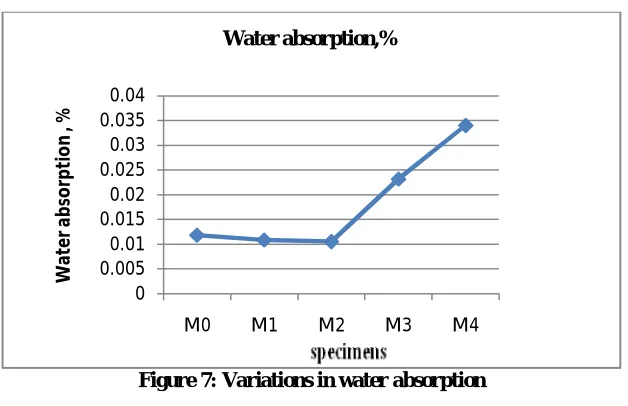
Observation for water absorption test is represented in figure 7 given below:
Figure 7: Variations in water absorption
VI.CONCLUSION
Due to the addition of Sugarcane bagasse ash and coconut shell it is proved that overall effectiveness of concrete increases. From the above study, it is concluded that the SCBA and CS can be used as a replacement material for cement and coarse aggregate respectively and for 6 % replacement of SCBA and 10% replacement of coarse aggregate gives an excellent result in strength aspect and it is better than the control mix. The results showed that the substitution of 6% of the cement content by SCBA and 10 % of the coarse aggregate by CS induced higher compressive strength, higher splitting tensile strength, high flexural strength and improvement of properties related to durability.
0 5 10 15 20 25 30
M0 M1 M2 M3 M4
B
u
lk
d
en
si
ty
,
kg
/m
³
Bulk density, kg/m³
0 0.005 0.01 0.015 0.02 0.025 0.03 0.035 0.04
M0 M1 M2 M3 M4
W
at
e
r
ab
so
rp
ti
o
n
,
%
The following conclusions can be made from this project:
1. The compressive strength, split tensile strength ,flexural strength of SCBA and CS added concrete ( 6 % SCBA and up to 10 % CS ) gives better results than the control mix and thereafter strength starts decreasing. 6% SCBA and 10 % CS added concrete attains maximum strength .
2. The bulk density decreases by the addition of coconut shell. Bulk density for 20% addition of CS was found to be 1720 kg/m3. So that the obtained concrete comes under Light Weight Concrete (LWC) category whose bulk density is with in the range of 1440-1840 kg/m3 . Therefore, CS added concrete can be used in light construction works ,thus resulting in minimum transportation cost and difficulty.
3. The SCBA and CS added concrete is much durable since water absorption is less and can be adopted for construction works. 6% SCBA and 10% CS added concrete is most durable.
REFERENCES
[1]. R.Srinivasan and K. Sathiya, “Experimental Study on Bagasse Ash in Concrete”, International Journal for Service Learning in Engineering, Vol. 5, Issue No. 2, pp. 60-66, 2010.
[2].K Meeravali1, K V G D Balaji & T. Santhosh Kumar, “Partial replacement of cement in concrete with sugar cane bagasse ash”,International
Journal of Advance Research In Science And Engineering, Vol. No.3, Issue No.7, 2014.
[3]. Jayminkumar A. Patel and Dr. D. B. Raijiwala, “Experimental Study on Use of Sugar CaneBagasse Ash in Concrete by Partially Replacement with Cement”, International Journal of Innovative Research in Science, Engineering and Technology, Vol. 4, Issue 4,2015.
[4]. Mr. Patil S. C. and Miss. Gadhave Kalyani, “Partially Replacement of Cement by Bagasse Ash”, International Journal for Research in Applied
Science & Engineering Technology,Vol.No. 5 ,Issue No.5, 2017.
[5]. R.Geerthana1 and J.Gnanasoundari, “Evaluation of sugarcane bagasse ash as a partialreplacement of cement in concrete”, International Journal of Advanced Research Trends in Engineering and Technology ,Vol.No.3,Issue No.2, 2016.
[6]. Ankur Anand and Dr.A.K.Mishra, “Comparative study of concrete strength by partially replacing cement with sugarcane bagasse ash”,International Journal of Science, Engineering and Technology Research, Vol.No.5, Issue No.4, 2016.
[7]. Akshay S. Shelke and Kalyani R. Ninghot, “Coconut Shell as Partial Replacement for Coarse Aggregate: Review”, International Journal of Civil Engineering Research, Vol.No.5,Issue No.3, pp. 211-214,2014.
[8]. Ajim S Shaikh & Sagar B Thorat, “Advance Concrete-Aggregate replaced by Coconut Shell”, International Research Journal of Engineering and Technology, Vol.No.2, Issue No. 05 , 2015.
[9].AmarnathYerramala and Ramachandrudu C, “Properties of Concrete with Coconut Shells as Aggregate Replacement”,International Journal of Engineering Inventions, Vol.No.1, Issue No.6,pp. 21-31,2012.
[10] BIS – IS 10262: 2009, “Indian Standard, recommended guidelines for concrete mix designs”, Bureau of Indian Standard, New Delhi.
[11] BIS – IS 12269: 1999, “Specification for 53grade ordinary Portland cement”, Bureau of Indian Standard, New Delhi.
[12] BIS –IS 383: 1970 “Specifications for Coarse and Fine Aggregates from Natural Sources for Concrete”, Bureau of Indian Standards, New Delhi. [13] BIS – IS 456: 2000, “Code of practice for plain and reinforced concrete” (fourth revision), Bureau of Indian Standard, New Delhi.