Characterization of PVDF-Gr Composite Films for Electromagnetic
Interference Shielding Application
Vikas Rathi1, Varij Panwar1, *, and Brijesh Prasad2
Abstract—Graphite receives tremendous attentions as filler for conducting composite due to its low cost and high electrical conductivities. In this work we use polyvinylidene fluoride (PVDF) as insulating matrix and graphite (Gr) as a filler to develop conducting composite films using solvent casting technique. The dielectric properties of the developed PVDF-Gr films were analysed for the frequency range of 100 kHz to 10 MHz. The morphology of the obtained films was investigated by scanning electron microscopy. The EMI shielding properties of the PVDF-Gr composite films were evaluated theoretically usingε, tanδ, andσ in the desired radio frequency region. Mechanical strength of the films was tested by universal testing machine. Due to advantages such as light weight, flexibility, and low cost the developed film with the thickness of ∼ 0.15 mm had very good potential to be used for fabricating electromagnetic compatible electronic devices.
1. INTRODUCTION
In today’s world electromagnetic interference (EMI) increases exponentially as technologies increase. To make a device work satisfactorily without interference from any other device in a confined frequency space is a challenging task, and to do so we have to make a device electromagnetically compatible [1, 2]. Electromagnetic interference (EMI) shielding is needed to make a device electromagnetically compatible [2]. For an EMI shielding material, electrical conductivity is the primary requirement which is the reason that initially metal was suitable for this application. Drawbacks of metal such as weight, prone to corrosion, and rigid shape had shifted the attention of researchers from metal to conducting polymer composites [3, 4]. A conducting polymer composite can be obtained with the incorporation of small fractions of non-metallic electrically conducting fillers with a non-conducting plastic matrix using techniques such as mechanical mixing, hot compression moulding, solvent casting, and insitu-polymerization [5]. Due to poor dispersion and lack of interfacial adhesion with other materials the high concentration of conducting filler can significantly decrease the mechanical strength of the composite films [6]. So good mechanical strength is always the priority in fabricating composite films for EMI shielding application.
Eswaraiah et al. [7] prepared a composite of functionalized graphene and (f-G)-polyvinylidene fluoride (PVDF), and investigated their electrical conductivity and EMI shielding efficiency. An EMI shielding effectiveness of ∼ 20 dB and ∼ 18 dB was obtained in different frequency bands for 5 wt.% composite. Taka [8] prepared a composites by mixing chemically synthesized poly (3-octyl thiophene) PS, PVC, and EVA in the melt state. EMI shielding efficiency at frequency range from 100 kHz to 1 GHz was measured. Shielding of the composites (3 mm thick) was∼45 dB with a polymer loading of 20% in the PVC matrix. In this work, due to its natural abundance and cost-effective property graphite (Gr) is used as a conducting filler material [9] and polyvinylidene fluoride (PVDF) as an insulating polymer
Received 2 September 2019, Accepted 19 November 2019, Scheduled 17 December 2019
* Corresponding author: Varij Panwar ([email protected]).
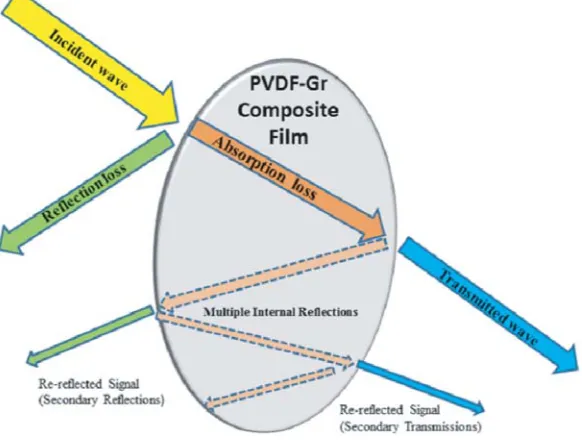
Figure 1. EMI shielding mechanism.
2. EXPERIMENTAL
2.1. Materials
Natural graphite flakes with average particle size of 10–20µm, supplied by Graphite India Ltd. The conductivity of graphite flakes was 1.33 ×10⁴S/cm with density 1.75 g/cm3. PVDF powder (Mw 440,000 g/mol) was purchased from Sigma Aldrich.
2.2. Preparation of Composite
Figure 2. Fabrication process of composite films.
under vacuum at 80◦C for 24 h and then at 100◦C for 12 h to remove the solvent. The film membrane was stripped off from the glass petri dish.
2.3. Measurement of Dielectric properties
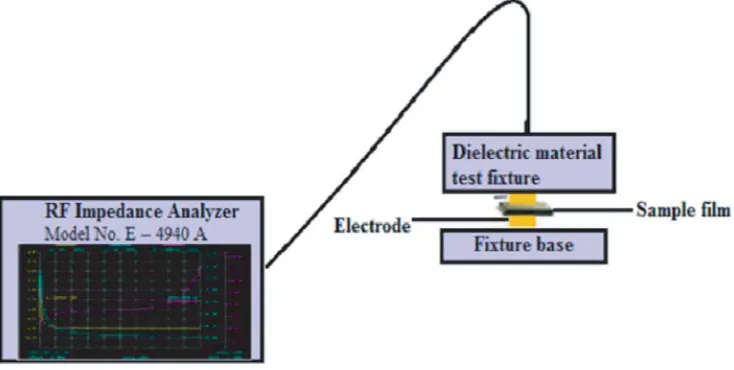
The dielectric properties (the dielectric constant (ε) and dissipation factor (tanδ)) of the samples were used to calculate the absorption loss and reflection loss of composite films. RF impedance analyser (Model No. E-4940 A) with a dielectric material test fixture was used to measure the capacitance (C) and tanδ of the samples in the frequency range of 100 kHz–10 MHz. For the measurement after both opposite surfaces of the films were coated with conductive silver paint and copper connecting wires were bonded to the surfaces with conductive silver paint films placed in dielectric material test fixture between electrodes as shown in Fig. 3. The AC conductivity of composites is calculated from the formula σ =ωε0εtanδ where ω = 2πf. Thickness of conducting films was measured using electronic
micrometre (Yamayo Classic-IP54). The values of reflection and absorption are accordingly calculated with the equations explained in Section 2.4.
Figure 3. Measurement setup for dielectric properties.
2.4. Calculation of Shielding Effectiveness
as
R= 168−10 log10
fμ σ
(3)
The correction factor represents internal reflections inside a conducting film. As the resultant of multiple-reflection is an increment in transmitted wave, it has a negative influence on the overall EMI shielding. The correction factor can be defined as
C = 20 log10
1−
η0−η1
η0+η1 2
e−2yt
(4)
whereη0 is the impedance of free space, and η1 is the intrinsic impedance of shielding film.
3. RESULTS AND DISCUSSION
3.1. Structural Analysis
The composite films were analysed for their morphology using scanning electron microscopy (SEM) (Hitachi, Model S-4700). Fig. 4(a) shows the SEM image of pure PVDF, and we can see a smooth surface of PVDF without any impurity. Fig. 4(b) shows the SEM image of PVDF-Gr composite having 12 wt.% of Gr content. The blue arrow shows the conducting graphite particles on the surface of PVDF polymer. With the magnified image of the composite film in Fig. 4(c) we can see a complete conducting graphite channel forming on the interfacial region of polymer.
3.2. Dielectric Analysis
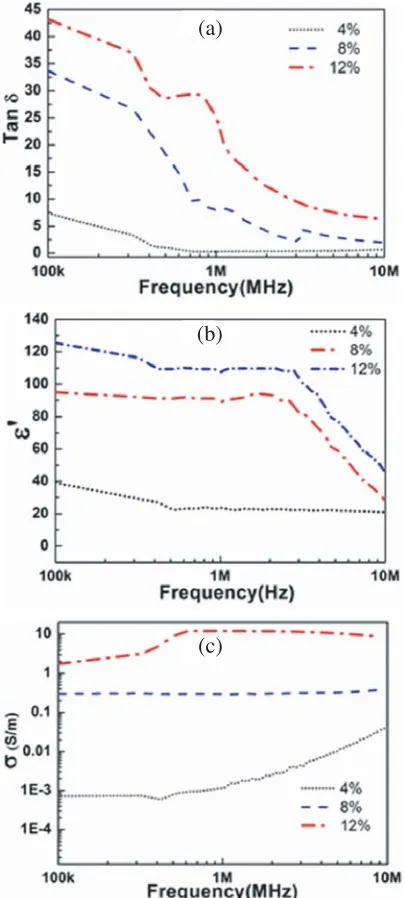
The analysis of dielectric behaviour of PVDF-Gr conducting polymer composite films is necessary for the EMI shielding application [12]. To investigate the dielectric behaviour of the PVDF-Gr composites at radio frequencies,ε and tanδof the composites were calculated in the frequency range from 100 kHz to 10 MHz. Fig. 5(a) shows tanδ of the PVDF-Gr composite films as a function of frequency for various contents of Gr. The ε of the composite films as a function of frequency for various contents of Gr is shown in Fig. 5(b). It is clear from the graph that tanδ and ε increase with increasing Gr wt.%. The reason for this is the formation of graphite conducting channels between the interfacial region of polymer, which tends to increase dipole moments including tanδandε of conducting polymer composite. Fig. 5(c) shows the conductivity (σ) of PVDF-Gr composites as a function of frequency. We can see that σ was also increased with Gr wt.% in a similar manner. The reason for this is that it depends on the values ofε and tanδ (σ =ωε0εtanδ). The PVDF-Gr composite films with 12 wt.% of
Gr attained the highest value of σ at 10 MHz.
3.3. Mechanical Strength Analysis
(a)
(b)
(c)
Figure 4. (a) SEM image of pure PVDF, (b) SEM image of composition with 12% of Gr, (c) magnified image of composition with 12% of Gr.
(a)
(b)
(c)
Figure 5. (a), (b), (c) ε, tanδ, and σ as a function of frequency, for different Gr wt.%.
From the stress strain curve we can observe the comparison of these three films. The film with 12 wt.% of Gr is most brittle, and film with 4 wt.% of Gr is ductile. The composite with 4 wt.% of Gr exhibits maximum elongation of 25% and ultimate tensile strength of 2.72±0.2 MPa. The composite with 8 wt.% of Gr exhibits maximum elongation of 12% and ultimate tensile strength of 2.78±0.2 MPa. The composite with 12 wt.% of Gr exhibits maximum elongation of 9.8% and ultimate tensile strength of 1.75±0.2 MPa. It is clear from these data that all the developed films have good mechanical properties.
3.4. EMI Shielding Analysis
Figure 6. Stress strain curve for developed films with different Gr wt.%.
(a) (b)
(c)
Figure 7. (a), (b), (c) A, R and C as a function of frequency for different Gr wt%.
PVDF-Gr is shown in Fig. 7(a). We can see from the graph as the concentration of Gr increases, the absorption loss increases. It is also clear from the equation that the conductivity is directly proportional to absorption. Equation (3) will be used to calculate R of the film. The R of all three composition of PVDF-Gr is shown in Fig. 7(b). Again as the concentration of Gr increases, the reflection loss also increases. Equation (4) will be used to measure C of the developed films. We can see from Fig. 7(c) that as the concentration of graphite increases, the correction factor decreases.
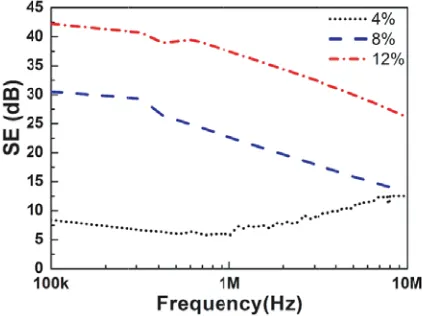
Figure 8. Total SE as a function of frequency for different concentration of Gr.
composite with 12 wt.% of Gr content shows the highest value of SE. The high value∼42 dB is obtained for 12 wt.% of Gr filled PVDF-Gr conducting polymer composite at 100 kHz and∼28 dB at 10 MHz.
4. CONCLUSION
In this work, we have developed inexpensive PVDF-Gr composites for EMI shielding application using dry mixing and solvent casting technique. With the increase of Gr content, the values ofε, tanδ, andσ increase. The PVDF-Gr composite with 12 wt.% of Gr shows high value of SE∼42 dB at 100 kHz and
∼28 dB at 10 MHz. However, samples of 8 wt.% Gr also show satisfactory result of SE for the whole radio frequency region (100 kHz–10 MHz). The mechanical properties of the film also show satisfactory results. Due to the flexible nature of the composite film, the film can be coated on any electronic device to diminish the effect of EMI.
ACKNOWLEDGMENT
This work was supported by the Science and Engineering Research Board, File No.-ECR/2016/001113 and Graphic Era University Dehradun. (Corresponding author: VarijPanwar)
REFERENCES
1. Zhao, C., R. Zhao, S. Hamidinejad, and C. Park, “Flexible, ultrathin, and high-efficiency electromagnetic shielding properties of poly(vinylidene fluoride)/carbon composite films,” ACS
Appl. Mater. Interfaces, Vol. 9, No. 24, 20873–20884, Jun. 2017.
2. Rathi, V., V. Panwar, G. Anoop, M. Chaturvedi, K. Sharma, and B. Prasad, “Flexible, thin composite film to enhance the electromagnetic compatibility of biomedical electronic devices,”
IEEE Transactions on Electromagnetic Compatibility, Vol. 61, No. 4, 1033–1041, Aug. 2019. 3. Li, J., H. Liu, J. Guo, Z. Hu, Z. Wang, B. Wang, L. Liu, Y. Huang, and Z. J. Guo, “Flexible,
conductive, porous, fibrillar polymer-gold nanocomposites with enhanced electromagnetic interference shielding and mechanical properties,” Mater. Chem. C, Vol. 5, No. 5, 1095–1105, 2017.
4. Chen, M., L. Zhang, S. Duan, S. Jing, H. Jiang, M. Luo, and C. Li, “Highly conductive and flexible polymer composites with improved mechanical and electromagnetic interference shielding performances,”Nanoscale, Vol. 6, No. 7, 3796–3803, 2014.
Vol. 45, No. 6, 1777–1784, Jun. 2009.
11. Loya, S., “Analysis of shielding effectiveness in the electric field and magnetic field and plane wave for infinite sheet metals,” IJEA, Vol. 6, No. 2, 31–41, 2016.
12. Panwar, V. and M. Mehra, “Analysis of electrical, dielectric, and electromagnetic interference shielding behavior of graphite filled high density polyethylene composites,” Polym. Eng. Sci., Vol. 48, No. 11, 2178–2187, Sep. 2008.