Available Online atwww.ijcsmc.com
International Journal of Computer Science and Mobile Computing
A Monthly Journal of Computer Science and Information Technology
ISSN 2320–088X
IJCSMC, Vol. 4, Issue. 6, June 2015, pg.907 – 916
RESEARCH ARTICLE
BRAIN INFORMATICS BASED
ANALYTIC LEARNING FRAMEWORK
Hamid Faisal, Vikrant Chole, Shruti Kolte
[email protected], [email protected], [email protected]
Abstract:
In order to achieve human level intelligence, we need to incorporate human understanding, thinking and learning processes or methodologies into machines or systems. Although various approaches to machine learning are made, still they were limited to some specific context and were not fully sufficient to reach human level intelligence as it is more complex, dynamic and flexible in nature and incorporative as well. We thus strongly need a systematic approach of learning conclusions, new knowledge and skills; and later utilize the same in order to get newer ones.
We proposed and implemented an automated learning system based on analysis principles, in which we simply need to put in the context or aspect in which we need to perform analysis and learning called Analysis Purpose Definition. Rest of the process is performed automatically by the system. Thus, for that provided context, the different levels of guiding process are carried out in order to obtain Information and Knowledge, in the form of conclusions and workflows.
Index Terms: Human Information Processing Systems (HIPS), Ontology, Brain Informatics (BI), Process Planning, domain driven data mining
I.
INTRODUCTION
So, in order to reach human level intelligence, we need to incorporate or embed dynamic, flexible, random in nature, but still systematic approach of human thinking process into machines or system. In human day to day life, as well as computers, we have ample of data, information in it that needs to be derived; and ultimately the knowledge that lies just about information and wisdom which lies at the top of this Data-Information-Knowledge-Wisdom (DIKW) pyramid or hierarchy.
In humans, the emotions, various tendencies, various biological deeply complex minute nano level biological aspects, various prerequisites, perception, psychology, skills and its proficiency values etc. are attached or connected along with computation induction reasoning logistics process bus these are as well a major part of human attitude.
While emotions and creativity are the things which cannot be possible in machines as they are natural as well as biologically complex in nature; still, we can make machines or systems intelligent enough to perform human like thinking using both computing techniques along with human thinking centric approaches and mechanisms.
II.
BACKGROUND AND RELATED WORK
The [1] shown a detailed review of Brain Data Analysis and Evaluation approaches. It briefed about data-brain model, the systematic brain data analysis and the KDD process planning for multi-aspect brain data analysis.
In [2], a multiagent system, named Global Learning Scheme for BI (GLS-BI) has been proposed that is claimed to perform a data-brain driven process planning. They proposed that it could perform the KDD process planning to integrate the needed data and analytical methods and create various mining workflows for guiding the multiaspect brain data analysis. This approach adopted the agent-Based Web Service workflow model.
The [3], explained the Data-Brain, a conceptual model of brain data and How to construct it. Data-Brain explicitly represents numerous relationships between numerous human brain data sources, with respect to all major capabilities and aspects of human information processing systems (HIPS).
The [4], shown that the systematic BI methodology resulted in the brain big data, including various raw brain data, data-related information, extracted data features, found domain knowledge related to human intelligence, and so forth.
In [5], the notion of Wisdom Web of Things (W2T) is proposed in order to address the urging research issue to realize the organic combination and symmetrical mutualism among humans, computers, and things in the hyper world, that consists of social world, physical world and the information world (cyber world). Also, the Hyper World is shown parallel between the Social World and the Cyber World.
the BI meets WI in Principle, how BI meets WI meets BI in fundamental research and finally, impending „WI meets BI‟ research. Web intelligence, according to this study is becoming a central area that revolutionizes artificial intelligence and information technologies to achieve human-level Web intelligence.
The [22], specified self-adaptiveness and the harmonious intelligence in the hyper world. The Self adaptive technologies or procedure in W2T is shown there. It refers the adaptive requirement description language as two parts viz. service description files and the self adaptive wisdom-service scheme definition files. All these files are described in XML form. The Reasoning and planning in W2T is specified in this paper. The extended Heuristic Rete Algorithm is used to achieve forward reasoning for this. The Heuristic Task Network (HTN) is also described to achieve backward planning.
III.
BIALS
Based on the approaches of Brain Informatics, we have developed a Global Web based Distributed kind system, in which, experimental and other scientific data can be separately added, viewed and dynamically selected for the purpose of analysis in order to extract some globally meaningful information (conclusion) from it.
In this approach, we are utilizing the ontology graph approach along with multiagent aspects in order to form concluding reasoning agents based on available data. In our approach, we are utilizing data from various aspects or stream which are common in nature and forming analysis upon them. Data Agents are utilized to form analysis agents which are helpful in performing analysis and then the next level of analysis agents are derived with the help of KnowledgeBase. Whatever the information on knowledge will be there by the system, it will be stored in the knowledge base in a very systematic manner in order to utilize it in the future analytic learning process. Furthermore, the previous full knowledge base can be utilized to learn new facts information on knowledge by this system.
3.1 System Architecture
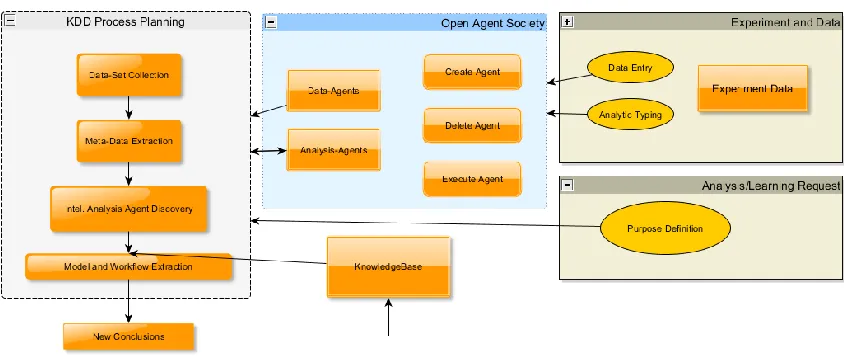
The architecture consists of three main sections as Open Agent Society, Knowledge Base, and KDD Process Planning Engine. The Experimental data, Research Data, Brain Data or any other Scientifically Collected day-to-day data can be entered and wrapped in this system in the form of Data Agents.
3.1.1 Open Agent Society
The Open Agent Society in BIALS is the world of unlimited or infinite number of agents which are loosely coupled at all. This means, these are fully independent to each other and also to any other process, methodology or system.
The Open Agent Society consist of two major types of agents namely Data Agents & Analysis Agents.
Definition 1: A data agent description, denoted by ds, is a five-tuple
(Name, ET, Function, EM, Type) ………..………. (1)
where Name is the identifier of the data agent, ET represents the cognitive experimental task corresponding to the data set provided by the data agent and is annotated by an instance of experimental task concepts of experiment dimension, Function represents the cognitive function reflected by ET and is annotated by an instance of cognitive function concepts of function dimension, EM represents the measuring method corresponding to the data set provided by the data agent and is annotated by an instance of measuring instrument concepts of experiment dimension, and Type represents the type of data provided by the data agent and is annotated by a data concept of data dimension.
For example, the ds1 = (Analysis-of-TV-Remote-Game-on-Touch-Phone1, Determining-Role-of-Touch-Sense-in-Decision-Making-Time, Touch-Perception, Time, Slow)
Definition 2: An analysis agent description, denoted by as, is a five-tuple
(Name, Task, Method, Input, Output) ………. (2)
where Name is the identifier of the analysis agent, Task represents the data processing function realized by the analysis agent and is annotated by an analytic task concept of analysis dimension, Method represents the tool used by the analysis agent and is annotated by a software concept of analysis dimension, Input represents the input data type of the analysis agent and is annotated by a data concept of data dimension, and Output represents the output data type of the analysis agent and is annotated by a data concept of data dimension.
For example, as3 = (as1, Comparing-Expt-Results, Comparison-Logic, Slow, Slow)
3.1.2 KnowledgeBase of BIALS
The KnowledgeBase of BIALS consist of functional dimension, that is, various
functional relationships and intellectual relationship among the brain functions. This KnowledgeBase is composed by using schematic markup language i.e. XML. So, knowledge can be stored and extracted to and from this KnowledgeBase.
3.1.3 Agents Entry & Composition Console
From here, we can add Data Agents, Analysis Agents and the Purpose definition at the time of carrying analysis. The Data Agents can be added by entering the datasets in the specific data Agents format discussed above. The Analysis Agents could be formed or composed in the system automatically and with the additional information of the same which are to be entered in the system via this console. The Purpose Definition is added by entering Desired Cognitive Function where we need to carry analysis along with the list of data features we need to select for carrying out the analysis.
3.1.4 Process Planning Engine of KDD
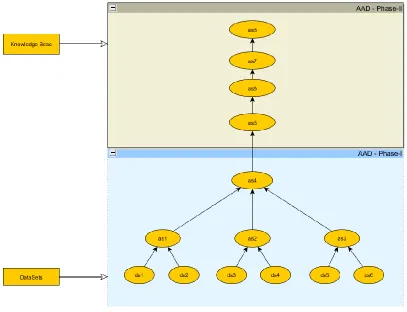
Figure III-2: Analytic Evaluative Process of BIALS
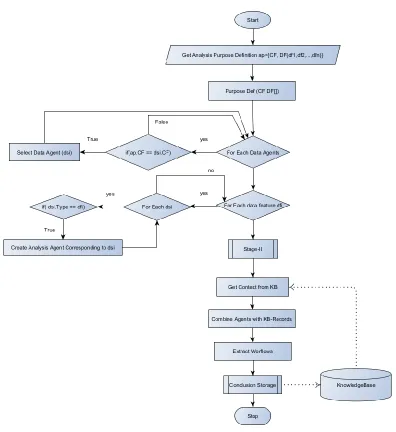
The Process Planning Engine of KDD mainly consists of the proposed algorithm shown below which accepts the analysis request in the form of analysis purpose definition and finds the desired outcomes.
This KDD Process Planning Engine of BIALS performs the analysis and thus finally derives the Topological Graph which looks like tree shown below.
3.2 The flowchart for Proposed Prediction Algorithm
Figure III-3: Flowchart of Proposed Algorithm
3.3 Pseudo Code for Proposed Predicted Algorithm:
1. Get the Analysis Purpose (Context) Definition (APD)
Get Cognitive Function (CF)
Get Data Features (DF) List
2. Data Selection
if matchOf(dsi.CogitiveFunction, CF) == exact or plugin then
Add dataAgent(dsi) in SelectedDSList
end if
end for
3. Metadata Extraction
for : each dfi in dataFeatures List
for : each dsi in SelectedDSList
matched = match(dfi , dsi.DataType);
if matched == true then
Compose asi
Set asi.InputDType = dsi.DataType;
Keep asi in a List SRTS
End if
End for
End for
4. Analysis Agent Discovery
for : each AnalysisAgent asi in SRTS list
if matchOf(asi.InputDType, KB.CogFn) == exact or plugin then
add asi to TopologicalGraph
end if
end for
5. Return TopologyGraph Work Flows
3.4 Implementation Details
IV.
SCENARIO
A System is developed on the basis of proposed approach. The System was provided with the six numbers of experimental records or datasets which were wrapped into six Data Agents into the Open Agent Society of this System. Apart from these relevant records, 10 more records were also added which were not related with this cognitive function i.e. of Touch Perception. Now these six data agents can be used with any learning or analysis runs as they are actually the part of the numerous other Data Agents. The five datasets i.e. ds1, ds2, ds3, ds4, ds5 were obtained from playing a game on Touch based smartphone. The only dataset obtained from playing the same game on old Remote-Button based TV game was ds6.
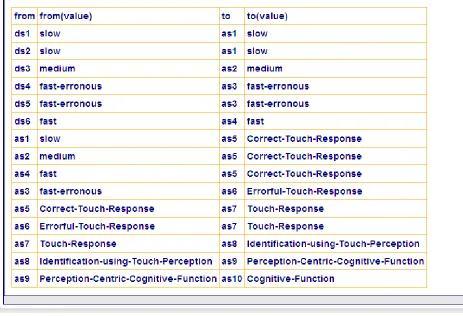
When System was supplied with Analysis Purpose Definition with CF = „Touch-Perception‟ and DF={Fast, Slow, Normal} then the following workflows were obtained.
Fig. IV.1 – Obtained Workflows with above dataset and analysis purpose definition
medium or fast erroneous. The only data agent ds6 was from the button remote based TV game, which was fast.
Thus, from the drawn output, it‟s clear that, there is a direct relation between touch-perception and the decision making process during touch perception centric task performance.
V.
CONCLUSION
Considering the need of time and the requirements of the analytic learning approaches towards human thinking centric machine learning, an algorithm is proposed which extracts useful conclusions from the world of ample of data sets available in the form of data agents. The Open Agent Society is formed in which, data agents and the derived analysis agents are present. The Algorithm furthermore made use of available functional relationship contexts present in the form of Knowledge Base in order to evaluate more specific conclusions. The derived information and knowledge can be placed back to the Knowledgebase. The Experiments show that the accurate conclusions are obtained regardless of size or nature of datasets. The conclusions could also be deriver among multi-domain data based upon the common context or the Cognitive Function for which we are performing that a particular analysis.
REFERENCES
[1] Hamid Faisal, Shruti Kolte, Vikrant Chole, “Systematic Brain Data Analysis : A Review”, International Journal of Computer Applications, Volume 110 – No. 5, January 2015
[2] Jianhui Chen and Ning Zhong, “Toward the Data-Brain Driven Systematic Brain Data Analysis”, IEEE TRANS. ON SYSTEMS, MAN, AND CYBERNETICS: SYSTEMS, VOL. 43, NO.1, JAN-2013
[3] Ning Zhong and Jianhui Chen, “Constructing a New-style Conceptual Model of Brain Data for Systematic Brain Informatics”,
[4] Ning Zhong, “Research Issues and Challenges on Brain Informatics Towards Computing & Intelligence in the Big Data Era”, IEEE TRANS. ON KNOWLEDGE AND DATA ENGINEERING
[5] Ning Zhong, Jian Hua, et al. “Research challenges and perspectives on Wisdom Web of Things (W2T)” , Springer Science+Business Media, LLC 2010 online publication, (26 Nov 2010, J Supercomput DOI 10.1007/s11227-010-0518-8)
[6] Ning Zhong, “WI Based Multi-Aspect Data Analysis in a Brain-Informatics Portal” , Automonous Intelligent Systems: Agents and Data Mining, June 2007
[7] Jianhui Chen, et. al., “Data-Brain Modeling Based on Brain Informatics Methodology” , Web Intelligence and Intelligent Agent Technology, 2008. WI-IAT '08. IEEE/WIC/ACM International Conference on (Volume:1 )
[8] Ning Zhong and Shinichi Motomura, “Agent-Enriched Data Mining: A Case Study in Brain Informatics” , In proc. of Agents And data Mining, IEEE INTELLIGENT SYSTEMS, www.computer.org/intelligent
[10] Wang, Yingxu, et. al., “Contemporary Cybernetics and Its Facets of Cognitive Informatics and Computational Intelligence” , Systems, Man, and Cybernetics, Part B: Cybernetics, IEEE Transactions on(Volume:39, Issue:4 )
[11] Ning Zhong et. al. , “Brain Informatics” , Intelligent Systems, IEEE (Volume:26 , Issue: 5 ) [12] Yulin Qin, “Various Levels from Brain Informatics to Web Intelligence”, Web Intelligence and
Intelligent Agent Technologies, 2009. WI-IAT '09. IEEE/WIC/ACM International Joint Conferences on (Volume:1 )
[13] Jianhui Chen , “Multi-Task Learning via Structured Regularization: Formulations, Algorithms, and Applications”, A Dissertation Presented in Partial Fulfillment of the Requirements for the Degree Doctor of Philosophy , Approved August 2011 by the Graduate Supervisory Committee , ARIZONA STATE UNIVERSITY
[14] M. Jarrar, J. Demey, and R. Meersman, “On Using Conceptual Data Modeling for Ontology Engineering,” Journal of Data Semantics, vol. 1, no. 1, pp. 185-207, 2003.
[15] M. Uschold and M. Gruninger, “Ontologies principles, methods and applications”, Knowledge Engineering Review, vol. 11, no. 2, pp. 93-155, 1996.
[16] F. Fonseca and J. Martin, “Learning the Differences Between Ontologies and Conceptual Schemes through Ontology-driven Information Systems,” Journal of the Association for Information Systems - Special Issue on Ontologies in the Context of IS, vol. 8, no. 2, pp. 129-142, 2007.
[17] L. B. Cao and C. Q. Zhang, “The evolution of KDD: Towards domain driven data mining,” Int. J. Pattern Recognit. Artif. Intell., vol. 21, no. 4, pp.677–692, 2007.
[18] N. Zhong, J. Liu, Y. Yao, J. Wu, S. Lu, Y. Qin, K. Li, and B. Wah, “Web Intelligence meets brain informatics,” in Proc. WImBI, 2007, pp. 1–31.
[19] D. L. McGuinness and F. V. Harmelen, OWL Web Ontology Language Overview, Feb.
2004,WorldWideWeb Consortium (W3C) recommendation. [Online]. Available:
http://www.w3.org/TR/owl-features/
[20] J. H. Chen and N. Zhong, “Data-brain modeling for systematic brain informatics,” in Proc. Int. Conf. BI, 2009, pp. 182–193.
[21] Jianhui Chen , Ning Zhong Data-Brain Modeling Based on Brain Informatics Methodology, 2008 IEEE/WIC/ACM International Conference on Web Intelligence and Intelligent Agent Technology.
[22] Yang Gao, Mufeng Lin, Ruili Wang, “Adaptive support framework for wisdom web of things”, World Wide Web (2013) 16:379–398, DOI 10.1007/s11280-012-0183-3.