Volume 2008, Article ID 243534,18pages doi:10.1155/2008/243534
Research Article
Object Tracking in Crowded Video Scenes Based on
the Undecimated Wavelet Features and Texture Analysis
M. Khansari,1H. R. Rabiee,1M. Asadi,1and M. Ghanbari1, 2
1Digital Media Lab, AICTC Research Center, Department of Computer Engineering, Sharif University of Technology, Azadi Avenue, Tehran 14599-83161, Iran
2Department of Electronic Systems Engineering, University of Essex, Colchester CO4 3SQ, UK
Correspondence should be addressed to H. R. Rabiee,[email protected]
Received 9 October 2006; Revised 21 May 2007; Accepted 8 October 2007
Recommended by Jacques G. Verly
We propose a new algorithm for object tracking in crowded video scenes by exploiting the properties of undecimated wavelet packet transform (UWPT) and interframe texture analysis. The algorithm is initialized by the user through specifying a region around the object of interest at the reference frame. Then, coefficients of the UWPT of the region are used to construct a feature vector (FV) for every pixel in that region. Optimal search for the best match is then performed by using the generated FVs inside an adaptive search window. Adaptation of the search window is achieved by interframe texture analysis to find the direction and speed of the object motion. This temporal texture analysis also assists in tracking of the object under partial or short-term full occlusion. Moreover, the tracking algorithm is robust to Gaussian and quantization noise processes. Experimental results show that the proposed algorithm has good performance for object tracking in crowded scenes on stairs, in airports, or at train stations in the presence of object translation, rotation, small scaling, and occlusion.
Copyright © 2008 M. Khansari et al. This is an open access article distributed under the Creative Commons Attribution License, which permits unrestricted use, distribution, and reproduction in any medium, provided the original work is properly cited.
1. INTRODUCTION
Object tracking is one of the challenging problems in im-age and video processing applications. With the emergence of interactive multimedia systems, tracked objects in video sequences can be used for many applications such as video surveillance, visual navigation and monitoring,
content-based indexing and retrieval, object-content-based coding, traffic
monitoring, sports analysis for enhanced TV broadcasting, and video postproduction.
Video object tracking techniques vary according to user interaction, tracking features, motion-model assumption, temporal object tracking, and update procedures. The tar-get representation and observation models are also very im-portant for the performance of any tracking algorithm. In general, the temporal object tracking methods can be
classi-fied into four groups: region-based [1], contour/mesh-based
[2], model-based [3,4], and feature-based methods [5,6].
Two major components can be distinguished in all of the tracking approaches; target representation/localization and filtering/data association. The former is a bottom-up pro-cess dealing with the changes in the appearance of the object,
while the latter is a top-down process dealing with the
dy-namics of the tracking [7]. Feature-based algorithms, along
with Kalman or particle filters, are widely used in many
ob-ject tracking systems [4,7].
Color histogram is an example of a simple and good feature-based method for object tracking in the spatial
do-main [7–12]. The color histogram techniques are robust to
noise and they are typically used to model the targets to combat partial occlusion and nonrigidity of objects. How-ever, color histogram only describes the global color distri-bution and ignores spatiality or layout of the colors, and the tracked objects are easily confused with a background having similar colors. Moreover, it cannot deal easily with illumina-tion changes and full occlusion. Therefore, feature descrip-tion based on color histogram for target tracking, particu-larly in the crowded scenes where similar small objects exist (e.g., heads of the crowd), will most likely fail.
Mean-shift tracking algorithms that use color histogram have been successfully applied in object tracking and proved
to be robust to appearance changes [7,10,13, 14].
best of our knowledge, such a motion filter for tracking and occlusion handling in the crowded scenes has not been re-ported yet. More recently, color histogram with spatial
in-formation has been used by some researchers [15,16]. Color
histogram has also been integrated into probabilistic
frame-works such as Bayesian and particle filters [9,11,17,18]
or kernel-based models along with Kalman filters [7].
Com-parative evaluation of different tracking algorithms shows
that among histogram-based techniques, the mean-shift
ap-proach [13] leads to the best results in absence of occlusions,
and probabilistic color histogram trackers are more robust to partial or temporary occlusions over a few frames than the
other well-known techniques [12]. In addition, the
kernel-based histogram tracker performs better in longer sequences
[7]. A good discussion on the state-of-the-art object tracking
under occlusion can also be found in [19].
In recent years, feature-based techniques in the wavelet
domain have gained more attention in object tracking [20–
23]. In [20], an object in the current frame is modeled by
using the highest energy coefficients of Gabor wavelet
trans-form as local features, and the global placement of the feature point is achieved by a 2D mesh structure around the feature points. In order to find the objects in the next frame, the 2D golden section algorithm is employed.
In [21], a wavelet subspace method for face tracking is
presented. At the initial stage, a Gabor wavelet representa-tion for the face template is created. The video frames are then projected into this subspace by wavelet filtering tech-niques. Finally, the face tracking is achieved in the wavelet
subspace by exploiting the affine deformation property of
Gabor wavelet networks and minimization of Euclidean dis-tance measure.
In [22], a particle filter algorithm for object tracking
us-ing multiple color and texture cues has been presented. The
texture features are determined using the coefficients of a
three-level conventional discrete wavelet transform expan-sion of the region of interest. In addition, a Gaussian sum particle filter based on a nonlinear model of color and tex-ture cues is also presented.
In [23], a real-time multiple object tracking algorithm is
introduced. In their algorithm, instead of using the wavelet
coefficients as object features, the original frame is only
pre-processed using a two-level discrete wavelet transform to suppress the fake background motions. The approximation band of the wavelet transform is then used to compute the
difference image of successive frames. Then, the concept of
connected components is applied to the difference image to
identify the objects. The classified objects are then marked by a bounding box in the original approximation image, and some color and spatial features are extracted from the bounding box. These features are then used to track the ob-jects in successive frames.
Most of the previous work based on wavelet transform has been evaluated on simple scenarios: either a talking head
with various movements or face expressions [20,21] or
walk-ing people who might have been occluded by another person
in the reverse direction in a short period of time [22,23]
and not for more complex scenes such as dense crowds of very close and similar objects with short- or long-term
occlu-sions. The general drawback of these techniques is that simi-lar nearby objects (e.g., heads in the crowd) with short- and long-term occlusions may impair their reliability. Other chal-lenging issues of the aforementioned methods are robustness against noise and stability of the selected features in presence of various object transformations and occlusions.
In this paper, we present a new algorithm for tracking arbitrary user-defined regions that encompass the object of interest in the crowded video scenes. It is based on feature
vectors generated via the coefficients of the undecimated
wavelet packet transform (UWPT) for target representa-tion/localization and filtering/data association are achieved through an adaptive search window by using an interframe texture analysis scheme. The key advantage of UWPT is that it is redundant and shift-invariant, and it gives a denser approximation to continuous wavelet transform than that provided by the orthonormal discrete wavelet transform
[24,25].
The main contribution of this paper is the adaptation of a feature vector generation and block matching algorithm
in the UWPT domain [26] for tracking objects [27, 28]
in crowded scenes in presence of occlusion [29] and noise
[30,31]. In addition, it uses an interframe texture analysis
scheme [32] to update the search window location for the
successive frames. In contrast to the conventional methods for solving the tracking problem that use spatial domain fea-tures, it introduces a new transform domain feature-based tracking algorithm that can handle object movements,
lim-ited zooming effects, and, to a good extent, occlusion.
More-over, we have shown that the feature vectors are robust to
various types of noise [30,31].
Organization of the rest of this paper is as follows. After
presenting an overview of the UWPT inSection 2, the
ele-ments of the proposed algorithm are described inSection 3.
These elements include feature generation, temporal track-ing, and search window updating mechanism. Performance of the proposed algorithm under various test conditions is
evaluated in Section 4. Finally,Section 5provides the
con-cluding remarks and the future work.
2. OVERVIEW OF THE UWPT
The process of feature selection in the proposed algorithm relies on the multiresolution expansion of images. The idea is to represent an image by a linear combination of elemen-tary building blocks or atoms that exhibit some desirable properties. Recently, there has been a growing interest in the representation and processing of images by using dictionar-ies of basis functions other than the traditional dictionary of sinusoids such as discrete cosine transform (DCT). These new sets of dictionaries include Gabor functions, chirplets,
warplets, wavelets, and wavelet packets [25,33–35]. In
con-trast to DCT, the discrete wavelet transform (DWT) gives good frequency selectivity at lower frequencies and good
time selectivity at higher frequencies. This tradeoffin the
x
wA
1 wD1
wA
2 wD2 wA3 wD3
w4A w4D wA5 ww5D5D w6A w6D wA7 wD7
(a)
The search area for the test clip of figure 12
UWPT: LL-LL-LH band
Bounding box in the UWPT: LL-LL-LL band
UWPT: LL-LL-HL band
UWPT: LL-LL-LL band
UWPT: LL-LL-HH band (b)
Figure1: (a) Undecimated wavelet packet transform tree for one-dimensional signalx, whereAstands for the approximation (lowpass) signal andDfor the detailed signal (highpass). (b) Sample bands of UWPT for the search area for the test clip ofFigure 12(L stands for lowpass and H for highpass filtered images).
of shift invariance. The reason is that there are many
legiti-mate DWTs for different shifted versions of the same signal
[25].
Wavelet packets were introduced by Coifman and Meyer
as a library of orthogonal bases forL2(R) [24].
Implemen-tation of a “best-basis” selection procedure for a signal (or family of signals) requires introduction of an accept-able “cost function,” which translates “best” into a mini-mization process. The cost function can be simplified in an
additive nature when entropy [24] or rate distortion [36]
is used. The cost function selection is related to the spe-cific nature of the application at hand. Entropy, for ex-ample, may constitute a reasonable choice if signal clas-sification, identification, and compression are the applica-tions of interest. A major deficiency of decimated wavelet packet is sensitivity to the signal location with respect to the chosen time origin, that is, lack of shift-invariance prop-erty.
The desired transform for object tracking application should be linear and shift-invariant. The wavelet transform, which is both linear and shift-invariant, is the undecimated
wavelet packet transform (UWPT) [25,35]. Moreover, the
UWPT expansion is redundant and provides a denser ap-proximation compared to the apap-proximation provided by the
orthonormal discrete wavelet transform [24,25].
From the implementation point of view in the context of filter banks, in addition to the lowpass band, we repeat the filtering on the highpass band without any downsampling (decimation). The result is a complete undecimated wavelet packet transform. A tree representation and sample bands of
UWPT are depicted inFigure 1.
The computational complexity of the UWPT is as follows
[25]:
NMUWPT(N,L,M)=M
2L+1−1N,
In the above formulas, the length of the input signal isN, the length of the quadrature mirror filter (QMF) for creating the
subbands isM, and the number of decomposition levels is
Lsuch thatL≤ log2N. NM and NA represent “number of
multiplications” and “number of additions” that are needed to convolve the signal with both highpass and lowpass QMFs, respectively. It is important to note that there are a number of fast and real-time algorithms to compute DWT and UWPT
of natural signals and images [25].
3. THE PROPOSED ALGORITHM
3.1. Overview of the proposed algorithm
In our algorithm, object tracking is performed by temporal tracking of a rectangle around the object at a reference frame. The algorithm is semi-automatic in the sense that the user draws a rectangle around the target object or specifies the area around pixels along the boundary of the object in the reference frame. A general block diagram of the algorithm is
shown inFigure 2.
Initially, the user specifies a rectangle around the bound-ary of the object at the reference frame. Then, a Feature Vec-tor (FV) for each pixel in the rectangle is constructed by using
the coefficients in the undecimated wavelet packet transform
(UWPT) domain. The final step before finding the object in a new frame is the temporal tracking of the pixels in the rectan-gle at the reference frame. The temporal tracking algorithm uses the generated FVs to find the new location of the pixels in an adaptive search window. The search window is updated at each frame based on the interframe texture analysis.
The main advantages of this algorithm are as follows.
(1) It can track both rigid and nonrigid objects without any preassumption, training, or object shape model.
(2) It can efficiently track the objects in the crowded video
sequences such as crowds on stairs, in airports, or at train stations.
(3) It is robust to different object transformations such as
translation and rotation.
(4) It is robust to different types of noise processes such as
additive Gaussian noise and quantization noise. (5) The algorithm can handle object deformation due to
perspective transform.
(6) Partial or short-term full occlusion of the object can be successfully handled due to the robust transform do-main FVs and temporal texture analysis.
3.2. The feature vector generation
In the first step, the wavelet packet tree for the desired object in the reference frame is generated by the UWPT. As men-tioned in the previous section, the UWPT has two properties that make it suitable for generating invariant and robust
fea-tures in image processing applications [26–31].
(1) It has the shift-invariant property. Consequently,
fea-ture vectors that are based on the wavelet coefficients
in framet can be found again in framet+ 1, even in
the presence of partial occlusion.
(2) All the subbands in the decomposition tree have the same size equal to that of the input frame (no down-sampling), which simplifies the feature extraction
pro-cess (seeFigure 3).
Moreover, UWPT alleviates the problem of subband aliasing associated with the decimated transforms such as DWT.
As shown inFigure 1, there are many redundant
repre-sentations of a signalx, by using different combinations of
subbands. For example,x = (w1A,w1D), x = (wA2,wD2,w1D),
andx=(w4A,w4D,wD2,wD1) are all representations of the same
signal.
The procedure for generating an FV for each pixel in the
regionr(which contains the target object) at framet can be
summarized in the following steps.
(1) Generate UWPT for regionr(note that UWPT is
con-structed with zero padding when needed).
(2) Perform basis selection from the approximation and
detail subbands. Different pruning strategies can be
applied on the tree to generate the FV as follows.
(a) Apply entropy-based algorithms for the best
ba-sis selection [24, 36] and prune the wavelet
packet tree. The goal of this type of basis se-lection is removing the inherent redundancy of UWPT and providing a denser approximation of the original signal. Entropy-based basis selection algorithms have been mostly used in
compres-sion applications [36].
(b) Select leaves of the expansion tree for repre-senting the signal. This signal representation in-cludes the greatest number of subbands which imposes an unwanted computational complex-ity to solve our problem. For example, in Figure 1,x = (w4A,w4D,w5A,w5D,wA6,wD6,w7A,w7D). We should note that, in the presence of noise, this set of redundant features may be used to enhance the performance of the tracking algorithm. (c) As the approximation subband provides an
aver-age of the signal based on the number of levels at the UWPT tree, we prune the tree to have the
most coefficients from the approximation
sub-bands. This type of basis selection gives more weight to the approximations which are useful for our intended application. For example, in Figure 1, we may letx=(w4A,w4D) orx =(w4A). For our application, this type of basis selection is more reasonable, because the comparison in the temporal tracking part of the algorithm is carried out between two regions that are represented by similar approximation and detail subbands.
The output of this step is an array of node index num-bers of the UWPT tree that specifies the selected basis for the successive frame manipulations.
(3) The FV for each pixel in regionrcan be simply created
by selecting the corresponding wavelet coefficients in
User assistance
Input video sequence
Specifying a rectangle around the object at the
reference frame
Feature vector generation for every pixel in the rectangle
Temporal object (rectangle)
tracking
Object location at the current frame Update the
search window based on texture analysis
Figure2: A block diagram of the proposed algorithm.
x
wA
1 wH1 wV1 wD1
wA
2 w2H wV2 w2D
wA6 wH6 wV6 w6D
(a)
wD 1 wV1 wH
1 wD
2 wV
2 wH
2 wD
6 wV
6 wH
6 wA6 y
z
x
(b)
FV(x,y)= {w6A(x,y),w6H(x,y),w6V(x,y),w6D(x,y),wH2(x,y),wV2(x,y),wD2(x,y),wH1(x,y),wV1(x,y),wD1(x,y)} (c)
Figure3: Feature vector selection: (a) a selected basis tree, (b) ordering of the subband coefficients to extract the feature vector, (c) FV generation formula for pixel (x,y).
number of elements in the FV is the same as the num-ber of selected basis nodes.
Consider a pruned UWPT tree and the 3D
representa-tion of the selected basis subbands in Figures3(a)and3(b),
respectively. In this case, FV for the pixel located at position
(x,y) can simply be generated as shown inFigure 3(c).
3.3. The temporal tracking
The aim of temporal tracking is to locate the object of interest in the successive frames based on the information about the object at the reference and current frames. As stated in the previous section, we can construct a feature vector that cor-responds to each pixel in the region around the object. These FVs can be used to find the best matched region in
succes-sive frames; that is, pixels within regionrare used to find the
correct location of the object in framet+ 1. The process of
matching regionrin frametto the corresponding region in
framet+ 1 is performed through the full search of the region
in a search window in framet+ 1, which is adaptively
deter-mined by the texture analysis approach that will be discussed inSection 3.4[32].
More specifically, every pixel in regionr may undergo a
complex transformation within successive frames. In general, it is hard to find each pixel using variable and sensitive spa-tial domain features such as luminance, texture, and so forth.
Our approach to trackrin framet makes use of the
afore-mentioned FV of each pixel and Euclidean distances to find the best matched regions as described below.
The procedure to matchrin framettor+ 1 in framet+
1 is as follows.
(1) Generate an FV for pixels in both region r and the
search window by using the procedure presented in Section 3.2.
(2) Sweep the search window with a search region that has
the same dimension asr.
(3) Find the best match forrin the search window by
cal-culating the minimum sum of the Euclidean distances between the FVs of the pixels of search regions and FVs
of the pixels within regionr(e.g., full search algorithm
The procedure to search for the best matched region is similar to the general block-matching algorithm, except that it exploits the generated FV of a pixel rather than its
lumi-nance. Therefore, when some pixels ofrdo not appear in the
next frame (due to partial occlusion or some other changes), our algorithm is still capable of finding the best matched re-gion based on the above search procedure.
3.4. The search window updating mechanism
The change of object location requires an efficient and
adap-tive search window updating mechanism for the following reasons.
(1) The proper search window location ensures that the object always lies within the search area and thus pre-vents loss of the object inside the search window. (2) A location-adaptive fixed size search window decreases
computational complexity that results due to a large
and variable size search window [27].
(3) If a moving target is occluded by another object, use of direction of motion may alleviate the occlusion prob-lem.
To attain an efficient search window updating
mecha-nism, different approaches can be employed. Most of these
techniques use spatial and/or temporal features to guide the search window and to find the best match for it with the least
amount of computation [32].
We have considered two different mechanisms for
updat-ing the location of the search window as follows.
(1) Updating the center of the search window based on the center of the rectangle around the object at the cur-rent frame. In this case, the center of search window is not fixed and it is updated at each new frame to the center of the matched rectangle at the previous frame. This approach is simple, but loss of tracking
propa-gates through the frames [28]. In addition, when
oc-clusion occurs at the current frame, the object may not be found correctly in the following frames.
(2) Another approach is to estimate the direction and the speed of motion of the object to update the location of the search window.
In this paper, we have selected the latter approach as our updating strategy by using the interframe texture analysis
technique [32]. To find the direction and speed of the
ob-ject motion, we define the temporal difference histogram of
two successive frames. Coarseness and directionality of the
frame difference of the two successive frames can be derived
from the temporal difference histogram [32]. Finally, the
di-rection and speed of the motion are estimated through the
use of temporal difference histogram of coarseness and
di-rectionality.
3.4.1. Temporal difference histogram
The temporal difference histogram of two successive frames
is derived from absolute difference of gray-level values of
cor-responding pixels at the two frames.
δ8 δ1 δ2
δ3
δ4 δ5
δ6 δ7 Search window
Figure4: Distance assignment in the different directions to find the maximum inverse difference moment (IDM).
Consider the current search windowSAt(x,y) at framet
and a new search windowSAt+1(x,y) determined by a
dis-placement valueδ=(Δx,Δy) of the current search window
center in the next frame. We assumeNxandNyare the width
and height of the search window, respectively. It should be noted that the two search windows have the same size. We
define absolute temporal difference (ATDδ) of the two
win-dows as follows:
ATDδ(x,y)=SAt(x,y)−SAt+1(x+Δx,y+Δy), (2)
Then, we calculate the histogram of the values of ATDδ. Note
that the histogram hasM bins, whereM is the number of
gray levels in each frame (256 for an 8-bit image).
Finally, the histogram values are normalized with respect
to the number of pixels in the search window (Nx×Ny) to
ob-tain the probability density function of each gray-level value
pδ(i),i=0,. . .,M−1.
3.4.2. The search window direction
Assume that the search window is a rectangular block.
Con-sider eight different blocks at the various directions with
dis-tance δi from the center of search window at the current
frame (seeFigure 4).
Then, calculate the temporal difference histogram, pδi,
for each block with respect to the original block (search
win-dow). Now, we can easily compute the inverse difference
mo-ment, IDMi, corresponding to each block using (3). The
in-verse difference moment, IDM, is the measure of
homogene-ity and it is defined as
IDM=
M−1
i=0
pδ(i)
i2+ 1. (3)
In a homogeneous image, there are very few dominant
gray-level transitions. Hence, pδi has a few entries of large
magnitudes. Here, IDM contains information on the
distri-bution of the nonzero values of pδi, and it can be used to
identify the main texture direction. If a texture is directional, it is coarser in one direction than in the others, then the
direction ofδi, assuming that its magnitude is in the proper
range. Thus, texture directionality can be analyzed by
com-paring spread measures ofpδifor various directions ofδ.
To derive the motion direction from texture direction, the direction that maximizes IDM should be found:
IDMmax =max
IDMi
, i=1, 2,. . ., 8. (4)
The maximum value of IDM, IDMmax, indicates that the
frame difference is more homogenous in that direction than
in the others, implying that the corresponding blocks in the successive frames are more correlated.
3.4.3. The search window displacement
The quantitative measure for coarseness of texture is the tem-poral contrast which is defined as the moment of inertia of
pδaround the origin, and it is given by
TCON=
M−1
i=0
i2p
δ(i), (5)
whereMis the number of gray-level values in each frame as
stated inSection 3.4.1.
The parameter TCON gives a quantitative measure for the coarseness of the texture and its value depends on the amount of local variations that are present in the region of interest. The existence of high local variations in a frame im-plies an object activity in the frame and this frame is called active compared to the frames with small variations. Since active frames of an image sequence exhibit a large amount of local variations, the temporal contrast derived from the
frame difference signal is related to the picture activity. The
parameter TCON is normalized to local contrast (LCON) in
order to minimize the effect of size and texture of the search
window (SW). The parameter LCON which defines the pixel variance within the search window is given by
LCON= 1
SW
SW
g(x,y)−g 2, (6)
whereg(x,y) is the gray-level value of the pixel located at
po-sition (x,y) andgis the average gray-level value of the pixels
in the search window. Based on the temporal and local
con-trasts, a good estimate of the average motion speed,S, within
a block can be defined as
S=kTCON
LCON, (7)
wherekis a constant with empirically selected values. The
average motion speed,S, in (7) is not only independent of
the size of the moving objects but also invariant to the
ori-entation of their texture. The value ofSapproaches zero for
stationary parts of the picture such as background,
indepen-dent of their texture contents [32].
The displacement value of the search window for the next frame is given by
Rj−1=Sj−1−Dispj−1,
Dispj=
Sj+Rj−1
. (8)
In some future frames, the value ofSmight be less than 1.
Thus, the displacement of the search window will be equal to
zero. ParameterRj−1denotes the displacement residue at the
previous frame. Assuming low-speed object movements, the
parameterRj−1helps to sum up the values of displacements
that are less than one pixel away until they reach at least one pixel displacement.
4. EXPERIMENTAL RESULTS
Throughout our experiments, we have assumed that there are no scene cuts. Clearly, in case of a scene cut, the reference frame and the target object should be updated and a new user intervention is required.
Several objective evaluation measures have been
sug-gested in the literature [37,38]. In this section, we have used
the ground truth information to objectively evaluate the per-formance of our algorithm.
The experimental results of the proposed tracking algo-rithm have been compared with the conventional wavelet transform (WT) as well as the well-known color
histogram-based tracking algorithms with two different matching
dis-tance measures, that is, chi-squared and Bhattacharyya. In the figures, color histogram-based tracking with the chi-squared distance measure is denoted by CHC, the color histogram-based tracking with Bhattacharya distance mea-sure by CHB, wavelet transform by WT, and the proposed al-gorithm by UWPT. We have used biorthogonal wavelet bases, which are particularly useful for object detection and gen-eration of the UWPT tree. In fact, the presence of spikes in the biorthogonal wavelet bases makes them suitable for
tar-get tracking applications [39]. In all experiments, we have
used 3 levels of UWPT tree decomposition with theBior2.2
wavelet [35]. In the color histogram-based algorithm
imple-mentation, the number of color bins was set to 32.
To evaluate the algorithms in a real-environment setting,
we have applied them to different real-time video clips of
Tehran Metro Stations in cooperation with the Tehran Metro authorities as well as to a longer sequence extracted from the
dataset S7 of IEEE PETS 20061workshop. These video clips
show the crowds at different parts of the metro such as
get-ting on/offthe train and up/down the stairs. Moreover, they
include different conditions in crowded scenes such as partial
and complete occlusions, high and low speed, variable occlu-sion duration, zooming in and out, object deformation, and object rotation. In all the snapshots, solid rectangles corre-spond to the rectangles around the objects, and the rectan-gles with dashed lines represent the search window. Note the
difficulty in tracking heads in a crowded scene, as there are
several nearby similar objects.
In addition, for each tracking result, the corresponding
set of video clips is available through Internet2 for more
detailed subjective evaluation. Moreover, we have defined
1Ninth IEEE International Workshop on Performance Evaluation of Track-ing and Surveillance.
Reference: frame no. 245 (a)
UWPT: frame no. 252 UWPT: frame no. 309 (b)
CHC: frame no. 252 CHC: frame no. 309 (c)
CHB: frame no. 252 CHB: frame no. 309 (d)
WT: frame no. 252 WT: frame no. 309 (e)
60 50 40 30 20 10 0
Distanc
e
(pix
el)
250 260 270 280 290 300 310 320 330 340 350 Frame number
CHC CHB
WT UWPT (f)
Reference: frame no. 97 (a)
UWPT: frame no. 139 UWPT: frame no. 160 (b)
CHC: frame no. 139 CHC: frame no. 160 (c)
CHB: Frame no. 139 CHB: Frame no. 160 (d)
WT: frame no. 139 WT: frame no. 160 (e)
25
20
15
10
5
0
Distanc
e
(pix
el)
100 110 120 130 140 150 160
Frame number CHC
CHB
WT UWPT (f)
Reference: frame no. 635 (a)
UWPT: frame no. 657 UWPT: frame no. 660
UWPT: frame no. 672 UWPT: frame no. 678 (b)
CHC: frame no. 672 CHC: frame no. 678 (c)
CHB: frame no. 672 CHB: frame no. 678 (d)
WT: frame no. 672 WT: frame no. 678 (e)
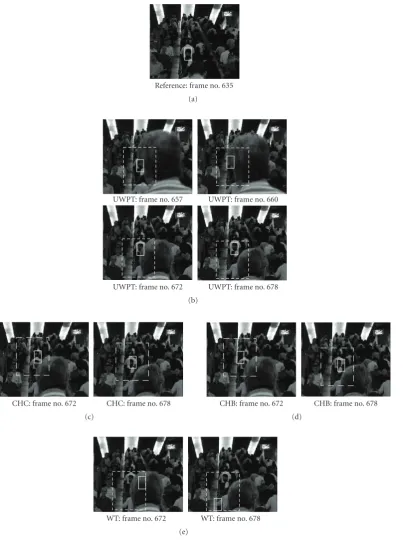
Figure7: Tracking a man moving up the stairs, with full occlusion in some frames: (a) UWPT, (b) CHC, (c) CHB, (d) WT.
a measure for objective evaluation of tracking techniques based on the Euclidian distance of the center of gravity of the tracked and actual objects. Here, at the start of track-ing, a bounding rectangle located at the center of the grav-ity of the desired object is selected. In the following frames, the bounding rectangle represents the tracked object, and its distance with the center of the gravity of the actual object is measured.
Figure 5shows the snapshots of tracked head of a man, shown in frame 245, coming down the stairs in a crowded metro station. The size of the rectangle around the object was
set to 19×13 pixels, and the size of the search window was
57×51 pixels. Empirical parameters to find the direction and
speed of the motion for updating the search window were
set tod = 1 and k = 6. The object is stepping down the
Reference: frame no. 35 (a)
UWPT: frame no. 51 (b)
UWPT: frame no. 62 (c)
UWPT: frame no. 77 (d)
UWPT: frame no. 88 (e)
UWPT: frame no. 105 (f)
CHC: frame no. 77 (g)
CHC: frame no. 88 (h)
CHC: frame no. 105 (i)
CHB: frame no. 77 (j)
CHB: frame no. 88 (k)
CHB: frame no. 105 (l)
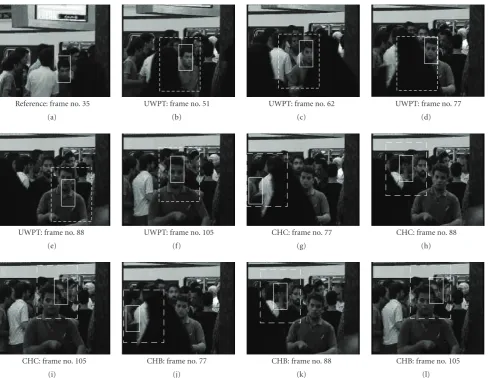
Figure8: Tracking a man getting offthe train in various kinds of partial and long-duration full occlusions and zooming in effects: UWPT, CHC, and CHB.
some cross-movements. There is no partial or full occlusion of the object in this case, but there are similar faces within the search window that complicate the tracking process.
As the results show, the object of interest has been suc-cessfully tracked by UWPT despite the presence of several
similar objects inside the search window (see Figure 5(b)).
The WT and color histogram-based algorithms (CHC and CHB) have mistakenly tracked a wrong object in frame no.
309 (see Figures5(c),5(d), and5(e)). For detailed analysis,
we present the result of our objective measure on a
frame-by-frame basis in Figure 5(f). For both CHC and CHB,
from frame no. 252, their Euclidian distance of the center of gravity is well above the bounding rectangle size, im-plying that the objects are totally miss-tracked. The color histogram-based algorithms are able to find the objects in a random manner, however in some cases their behavior is unpredictable (for instance, see the CHB tracking
re-sults before and after frame no. 320 in Figure 5(f)). The
WT-based tracking has also miss-tracked the object after frame 330, and its performance is worth than UWPT for the previous frames. On the contrary, our proposed
algo-rithm is tracking the object in a consistent and stable man-ner.
Figure 6shows the result of tracking a person moving up the stairs and away from the camera in a metro station.
Frame no. 97 was the reference frame (seeFigure 6(a)), the
size of the rectangle around the object was 17×15 pixels, and
the size of the search window was 51×49 pixels. Empirical
parameters to find the direction and the speed of the motion
for updating the search window were set tod=1 andk=6.
The target object is stepping up the stairs with a constant speed and its movement exhibits a small amount of zoom-ing out, some degree of rotation of the head, and partial occlusion. The WT and color histogram-based algorithms (CHC and CHB) have mistakenly tracked a wrong object in
frame nos. 139 and 160 (see Figures6(c),6(d), and6(e)).
As shown inFigure 6(f), after frame no. 124, both CHC and
CHB miss the target offand on randomly because of the
par-tial occlusion and zooming out effects. The WT algorithm
Reference: frame no. 162 (a)
UWPT: frame no. 175 (b)
UWPT: frame no. 176 (c)
UWPT: frame no. 179 (d)
UWPT: frame no. 184 (e)
UWPT: frame no. 256 (f)
UWPT: frame no. 260 (g)
UWPT: frame no. 261 (h)
UWPT: frame no. 268 (i)
UWPT: frame no. 276 (j)
UWPT: frame no. 277 (k)
UWPT: frame no. 278 (l)
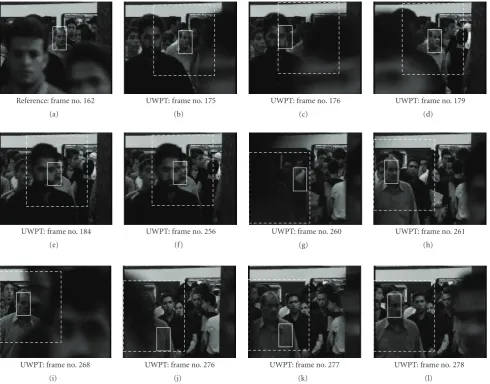
Figure9: A man is tracked in the crowd in the metro in the presence of partial and full occlusions and zooming effects (all figures are the results of the proposed algorithm).
of object rotation and partial occlusion. The tracking re-sults are available in separate video clips through the Internet (http://ce.sharif.edu/∼khansari).
Figure 7shows the result of tracking a person moving up the stairs and away from the camera in a metro station.
Frame no. 635 was the reference frame (seeFigure 7(a)), the
size of the rectangle around the object was 25×15, and the
search window size was 75×65 (±25 pixels). Empirical
pa-rameters to find the direction and speed of the motion for
updating the search window were set tod=2 andk=8. The
object is moving up with a constant speed, and in a number of frames, it is fully occluded by the head of another per-son. The partial occlusion has started in frame no. 656 and turned into full occlusion in frame nos. 660–669. As shown inFigure 7(b), our algorithm successfully handles partial and full occlusions in this experiment. It has been observed that if during occlusion the object is still in the search area, immedi-ately after reappearing, our algorithm can successfully detect it. The CHC, CHB, and WT fail to track the object because
of occlusion, as shown in Figures7(c),7(d), and7(e).
There are two reasons for occlusion handling of UWPT inFigure 7and the following figures.
(1) The proposed FV is robust against the partial occlusion compared to the spatial space feature vectors such as those used in color histogram-based algorithms. (2) Long-duration occlusion originates from the fact that
the object of interest and the occluding object both move at the same direction. Since the algorithm uses activity analysis to find the motion and direction of the search window and hence updates the search window location, it can predict the location of the object
af-ter occlusion [29,32]. Therefore, our updating
mech-anism ensures that the object lies within the search window in case of occlusion, and our robust FV al-lows for successful tracking afterward. In case of short-duration occlusion, motion directions of the object
and the occluding object are different. Therefore, for a
Reference: frame no. 97 (a)
UWPT: frame no. 130 UWPT: frame no. 152 (b)
CHC: frame no. 130 CHC: frame no. 152 (c)
CHB: Frame no. 130 CHB: Frame no. 152 (d)
WT: frame no. 130 WT: frame no. 152 (e)
70 60 50 40 30 20 10 0
Distanc
e
(pix
el)
100 110 120 130 140 150 160
Frame number CHC
CHB
WT UWPT (f)
Reference: frame no. 97 (a)
UWPT: frame no. 108 UWPT: frame no. 156 (b)
CHC: frame no. 108 CHC: frame no. 156 (c)
CHB: Frame no. 108 CHB: Frame no. 156 (d)
WT: frame no. 108 WT: frame no. 156 (e)
45 40 35 30 25 20 15 10 5 0
Distanc
e
(pix
el)
100 110 120 130 140 150 160
Frame number CHC
CHB
WT UWPT (f)
Reference: frame no. 505 (a)
UWPT: frame no. 506 UWPT: frame no. 646 UWPT: frame no. 830
UWPT: frame no. 855 UWPT: frame no. 894 UWPT: frame no. 976 (b)
150
100
50
0
Distanc
e
(pix
el)
500 550 600 650 700 750 800 850 900 950 1000 Frame number
WT UWPT
(c)
Figure 8shows the result of tracking where the crowd is
getting offthe train. Frame no. 35 is the reference frame with
the bounding rectangle having the size of 42×22 and the
search window having the size of 84×64. Empirical
param-eters to find the direction and speed of the motion for
up-dating the search window were set tod=1 andk=3. The
object is passing through the crowd and experiencing partial occlusions, and some zooming is also present in a number of frames. The partial occlusion begins from frame no. 62, and then in frame no. 64 it turns almost into complete
oc-clusion that lasts for 10 frames. As demonstrated inFigure 8,
our algorithm can successfully handle partial occlusions even in presence of zooming, due to the robustness of FVs and the adaptability of the search window. Although in few frames the algorithm cannot exactly find the object (e.g., frame nos. 85–89) due to the high movement of the object, lack of fea-ture vector updating mechanism, and object blurring com-pared to the reference frame, in contrast to the histogram-based techniques it never loses object in the process of track-ing.
Figure 9shows the result of tracking a man where he moves inside the crowd in the presence of repeated partial and full occlusions and zooming. Frame no. 162 of the se-quence was considered as the reference frame; the size of the rectangle around the object and the search window size were
37×22 and 111×96 (±37 pixels), respectively. Updating
pa-rameters of the search window were chosen to bed=1 and
k =3. As the object (the man with the bright shirt) moves
in various directions, he is partially and fully occluded by others at several successive frames. The object was occluded completely in a number of frames, for example, frame nos. 176–178. It is important to note that when both complete oc-clusion and zooming are present, it takes a number of frames before the object can be tracked successfully (the last row of Figure 9).
Figure 10shows the result of tracking the sequence in Figure 6in the presence of additive white Gaussian noise with a peak signal-to-noise ratio (PSNR) of 20 dB. This type of noise is very common with low-light video, especially in un-dergrounds. Again, the noisy reference frame is frame no.
97 (seeFigure 10(a)). To highlight the resilience of the
pro-posed algorithm against noise [30,31], we have used a larger
bounding box (23×16) and therefore a larger search area
(62×69). Empirical parameters to find the direction and
speed of the motion for updating the search window were
set tod=1 andk=3 inFigure 10.
The presence of noise has degraded the performance of the color histogram-based algorithms tremendously
with-out having any effect on the wavelet-based methods (see
Figure 10(f)). However, the performance of WT is not con-sistent and is worse than the UWPT algorithm.
Figure 11 shows the impact of quantization noise on tracking objects, where the quantization distortion was set for a 0.22 bit per pixel compression with a PSNR of 31.95 dB.
The directional motion search parameters were set tod=1
andk=6.
Again, the proposed algorithm outperforms the CHC, CHB, and WT algorithms because of the robustness of the proposed feature vector to object tracking in the noisy
crowded environments. It should be noted that in the last few frames of this test clip, because of the larger bounding box and search area, almost full occlusion of the target object, and longer distance between the feature vectors of those frames and the feature vectors of the reference frame, the tracking results are not precise.
The proposed algorithm was also applied to longer-duration sequences with complex contents. The test
se-quence shown inFigure 12is the dataset S7 (camera 1) from
IEEE PETS 2006 workshop, which is one of the most diffi
-cult datasets with long duration. It contains a single person with a suitcase who loiters before leaving his luggage unat-tended. There is a long-term occlusion in the captured video
from camera 1 (the scene has been captured using 4 different
cameras from different locations).
The search window size should be large enough to han-dle the occlusion and encompass the target object after the
occlusion. Therefore, for a bounding box of 56×21 pixels,
the search window size was 212×177 (±78 pixels). The
di-rectional motion search parameters were set tod = 4 and
k = 16. Since the previous results clearly demonstrate that
UWPT outperforms the other methods, we only objectively compare the performances of WT and UWPT for this test clip.
For the sake of clarity of the images, all of them (except for the reference frame) are zoomed in to better show the bounding box and search window status. Note that the size of the bounding box is kept unchanged during the tracking,
and the object has a fast progressive zoom in effect. After 140
frames at the beginning of the clip, a full occlusion starts for a rather long period of 200 frames. However, our search win-dow updating mechanism acts very well in this occlusion pe-riod and keeps the object in search area during and after the occlusion. Moreover, the robustness of our FV enables the proposed algorithm to find the object of interest after
occlu-sion as depicted inFigure 12(b).
As shown inFigure 12(c), there is an initial 18-pixel offset
between the gravity center of the bounding box and the per-son for both WT and UWPT methods. This error is mainly due to the large size of the bounding box. The WT tracker be-haves inconsistently even at the starting frames, while UWPT can track the bounding box consistently, with the exception of few frames after the occlusion.
Because of the unusual movement of the target object, its exact position at the start of tracking and after occlusion will
be too much different. In other words, due to the perspective
transformation as well as deformation, some pixels may dis-appear or dis-appear within the bounding box, and hence it is not expected that in this situation any kind of object track-ing algorithm will work properly. In addition, after frame no.
976, the object reappears with a completely different view
with respect to the original reference frame, and hence the tracking is inconsistent.
In [26], it has been shown that the core of the
proposed algorithm is about 10–15 frames per second (FPS) depending on the size of the bounding box, search area, and specific I/O of the algorithm (on the screen, in JPEG or MAT-LAB file). As an example, the processing rate for the setting in Figure 5is equal to 15 FPS. Therefore, by using an optimized C code, real-time performance can be achieved.
5. CONCLUSIONS AND FUTURE WORK
A new object tracking algorithm for crowded scenes based on pixel features in the wavelet domain and a novel adap-tive search window updating mechanism based on texture analysis have been proposed for object tracking in crowded scenes. Based on the properties of UWPT, existence of in-dividual robust FVs for each pixel, and the adaptive search window, this method can tolerate complex object transfor-mations including translation, small rotation, scaling, and partial or complete occlusions in a reasonable number of
suc-cessive frames. Moreover, the algorithm is robust to different
types of noise processes such as additive Gaussian and quan-tization noises, and it can be implemented in real time. We have also shown that the performance of UWPT is signifi-cantly better than that of the usual decimated wavelet trans-form, and color histogram-based methods for object track-ing.
In the current algorithm, the FVs are kept unchanged during a tracking session. A memory-based FV updating mechanism combined with Kalman filtering for search area prediction can improve the performance of our algorithm in presence of abrupt zooming in/out or object scaling. Particle filters can also be integrated with the proposed FV genera-tion to cope with the complex object movement and search window updating.
Finally, we can use color components and combination of spatial domain features such as edge and texture to further improve the performance of our algorithm in color video clips. In this case, additional information can weight the FV and improve the searching mechanism.
ACKNOWLEDGMENTS
This research has been funded by the Advanced Informa-tion and CommunicaInforma-tion Technology Center (AICTC) of Sharif University of Technology. The authors also would like to acknowledge the helpful comments of the anonymous re-viewers and Tehran Metro authorities for providing crowded scene video clips.
REFERENCES
[1] D. Xu, J.-N. Hwang, and J. Yu, “An accurate region based ob-ject tracking for video sequences,” inProceedings of the 3rd IEEE Workshop on Multimedia Signal Processing (MMSP ’99), pp. 271–276, Copenhagen, Denmark, September 1999. [2] C¸. E. Erdem, A. M. Tekalp, and B. Sankur, “Video object
track-ing with feedback of performance measures,”IEEE Transac-tions on Circuits and Systems for Video Technology, vol. 13, no. 4, pp. 310–324, 2003.
[3] Y. Chen, Y. Rui, and T. S. Huang, “JPDAF based HMM for real-time contour tracking,” inProceedings of the IEEE Computer Society Conference on Computer Vision and Pattern Recognition (CVPR ’01), vol. 1, pp. 543–550, Kauai, Hawaii, USA, Decem-ber 2001.
[4] S. K. Zhou, R. Chellappa, and B. Moghaddam, “Visual track-ing and recognition ustrack-ing appearance-adaptive models in par-ticle filters,” IEEE Transactions on Image Processing, vol. 13, no. 11, pp. 1491–1506, 2004.
[5] C. Gu and M.-C. Lee, “Semiautomatic segmentation and tracking of semantic video objects,”IEEE Transactions on Cir-cuits and Systems for Video Technology, vol. 8, no. 5, pp. 572– 584, 1998.
[6] D. Wang, “Unsupervised video segmentation based on water-sheds and temporal tracking,”IEEE Transactions on Circuits and Systems for Video Technology, vol. 8, no. 5, pp. 539–546, 1998.
[7] D. Comaniciu, V. Ramesh, and P. Meer, “Kernel-based object tracking,”IEEE Transactions on Pattern Analysis and Machine Intelligence, vol. 25, no. 5, pp. 564–577, 2003.
[8] T.-L. Liu and H.-T. Chen, “Real-time tracking using trust-region methods,”IEEE Transactions on Pattern Analysis and Machine Intelligence, vol. 26, no. 3, pp. 397–402, 2004. [9] P. P´erez, C. Hue, J. Vermaak, and M. Gangnet, “Color-based
probabilistic tracking,” inProceedings of the 7th European Con-ference on Computer Vision-Part I (ECCV ’02), pp. 661–675, London, UK, May 2002.
[10] D. Xu, Y. Wang, and J. An, “Applying a new spatial color histogram in mean-shift based tracking algorithm,” in Pro-ceedings of the Image and Vision Computing New Zealand (IVCNZ ’05), University of Otago, Dunedin, New Zealand, November 2005.
[11] A. Jacquot, P. Sturm, and O. Ruch, “Adaptive tracking of non-rigid objects based on color histograms and automatic param-eter selection,” inProceedings of the IEEE Workshop on Motion and Video Computing (WACV/MOTION ’05), vol. 2, pp. 103– 109, Breckenridge, Colo, USA, January 2005.
[12] B. Deutsch, Ch. Gr¨aßl, F. Bajramovic, and J. Denzler, “A com-parative evaluation of template and histogram based 2D track-ing algorithms,” inProceedings of the 27th DAGM Symposium on Pattern Recognition, vol. 3663 of Lecture Notes in Com-puter Science, pp. 269–276, Springer, Vienna, Austria, August-September 2005.
[13] D. Comaniciu and P. Meer, “Mean shift: a robust approach toward feature space analysis,”IEEE Transactions on Pattern Analysis and Machine Intelligence, vol. 24, no. 5, pp. 603–619, 2002.
[14] Z. Zivkovic and B. Krose, “An EM-like algorithm for color-histogram-based object tracking,” inProceedings of the IEEE Computer Society Conference on Computer Vision and Pattern Recognition (CVPR ’04), vol. 1, pp. 798–803, Washington, DC, USA, June-July 2004.
[15] H. Zhang, W. Gao, X. Chen, and D. Zhao, “Learning informa-tive features for spatial histogram-based object detection,” in Proceedings of the IEEE International Joint Conference on Neu-ral Networks (IJCNN ’05), vol. 3, pp. 1806–1811, Montreal, Quebec, Canada, July-August 2005.
[17] A. D. Jepson, D. J. Fleet, and T. F. El-Maraghi, “Robust on-line appearance models for visual tracking,” inProceedings of the IEEE Computer Society Conference on Computer Vision and Pattern Recognition (CVPR ’01), vol. 1, pp. 415–422, Kauai, Hawaii, USA, December 2001.
[18] B. Han, C. Yang, R. Duraiswami, and L. Davis, “Bayesian fil-tering and integral image for visual tracking,” inProceedings of the Worshop on Image Analysis for Multimedia Interactive Ser-vices (WIAMIS ’05), Montreux, Switzerland, April 2005. [19] P. F. Gabriel, J. G. Verly, J. H. Piater, and A. Genon, “The state
of the art in multiple object tracking under occlusion in video sequences,” inProceedings of the Advanced Concepts for Intelli-gent Vision Systems (ACIVS ’03), pp. 166–173, Ghent, Belgium, September 2003.
[20] C. He, Y. F. Zheng, and S. C. Ahalt, “Object tracking using the Gabor wavelet transform and the golden section algorithm,” IEEE Transactions on Multimedia, vol. 4, no. 4, pp. 528–538, 2002.
[21] R. S. Feris, V. Krueger, and R. M. Cesar Jr., “A wavelet sub-space method for real-time face tracking,”Real-Time Imaging, vol. 10, no. 6, pp. 339–350, 2004.
[22] P. A. Brasnett, L. Mihaylova, N. Canagarajah, and D. Bull, “Particle filtering with multiple cues for object tracking in video sequences,” in Image and Video Communications and Processing, vol. 5685 ofProceedings of SPIE, pp. 430–441, San Jose, Calif, USA, January 2005.
[23] F.-H. Cheng and Y.-L. Chen, “Real time multiple objects track-ing and identification based on discrete wavelet transform,” Pattern Recognition, vol. 39, no. 6, pp. 1126–1139, 2006. [24] R. R. Coifman and M. V. Wickerhauser, “Entropy-based
algo-rithms for best basis selection,”IEEE Transactions on Informa-tion Theory, vol. 38, no. 2, pp. 713–718, 1992.
[25] H. Guo, “Theory and applications of shift invariant, time-varying and undecimated wavelet transform,” M.S. thesis, Rice University, Houston, Tex, USA, 1995.
[26] M. Amiri, H. R. Rabiee, F. Behazin, and M. Khansari, “A new wavelet domain block matching algorithm for real-time ob-ject tracking,” inProceedings International Conference on Im-age Processing (ICIP ’03), vol. 3, pp. 961–964, Barcelona, Spain, September 2003.
[27] M. Khansari, H. R. Rabiee, M. Asadi, M. Ghanbari, M. Nos-rati, and M. Amiri, “A semi-automatic video object extraction algorithm based on joint transform and spatial domain fea-tures,” inProceedings of the International Workshop on Content-Based Multimedia Indexing (CBMI ’05), Riga, Latvia, June 2005.
[28] M. Khansari, H. R. Rabiee, M. Asadi, M. Ghanbari, M. Nos-rati, and M. Amiri, “A shape tracking algorithm based on gen-erated pixel features by undecimated wavelet packet,” in Pro-ceeding of the 10th Annual Computer Society of Iran Computer Conference (CSICC ’05), Tehran, Iran, February 2005. [29] M. Khansari, H. R. Rabiee, M. Asadi, P. Khadem Hamedani,
and M. Ghanbari, “Adaptive search window for object tracking in the crowds using undecimated wavelet packet features,” in Proceedings of the World Automation Congress (WAC ’06), pp. 1–6, Budapest, Hungary, July 2006.
[30] M. Khansari, H. R. Rabiee, M. Asadi, M. Ghanbari, M. Nos-rati, and M. Amiri, “A quantization noise robust object’s shape prediction algorithm,” inProceedings of the 13th European Sig-nal Processing Conference (EUSIPCO ’05), Antalya, Turkey, September 2005.
[31] M. Khansari, H. R. Rabiee, M. Asadi, M. Nosrati, M. Amiri, and M. Ghanbari, “Object shape prediction in noisy video based on undecimated wavelet packet features,” in Proceed-ings of the 12th International Multimedia Modelling Conference (MMM ’06), Beijing, China, January 2006.
[32] V. E. Seferidis and M. Ghanbari, “Adaptive motion estimation based on texture analysis,”IEEE Transactions on Communica-tions, vol. 42, no. 2–4, pp. 1277–1287, 1994.
[33] M. Vetterli and J. Kovaˇcevic,Wavelets and Subband Coding, Prentice-Hall, Upper Saddle River, NJ, USA, 1st edition, 1995. [34] I. Cohen, S. Raz, and D. Malah, “Orthonormal shift-invariant wavelet packet decomposition and representation,”Signal Pro-cessing, vol. 57, no. 3, pp. 251–270, 1997.
[35] I. Daubechies, Ten Lectures on Wavelets, vol. 61 of CBMS-NSF Regional Conference Series in Applied Mathematics, SIAM, Philadelphia, Pa, USA, 1994.
[36] K. Ramchandran and M. Vetterli, “Best wavelet packet bases in a rate-distortion sense,”IEEE Transactions on Image Processing, vol. 2, no. 2, pp. 160–175, 1993.
[37] C¸. E. Erdem, B. Sankur, and A. M. Tekalp, “Performance mea-sures for video object segmentation and tracking,”IEEE Trans-actions on Image Processing, vol. 13, no. 7, pp. 937–951, 2004. [38] P. Correia and F. Pereira, “Video object relevance metrics for
overall segmentation quality evaluation,”EURASIP Journal on Applied Signal Processing, vol. 2006, Article ID 82195, 11 pages, 2006.