W&M ScholarWorks
W&M ScholarWorks
Dissertations, Theses, and Masters Projects Theses, Dissertations, & Master Projects
2003
School improvement through site -based management practices
School improvement through site -based management practices
Annie Lunette Todd
College of William & Mary - School of Education
Follow this and additional works at: https://scholarworks.wm.edu/etd
Part of the Educational Administration and Supervision Commons
Recommended Citation Recommended Citation
Todd, Annie Lunette, "School improvement through site -based management practices" (2003). Dissertations, Theses, and Masters Projects. Paper 1539618698.
https://dx.doi.org/doi:10.25774/w4-2hjq-5y69
This Dissertation is brought to you for free and open access by the Theses, Dissertations, & Master Projects at W&M ScholarWorks. It has been accepted for inclusion in Dissertations, Theses, and Masters Projects by an authorized
U MI
MICROFILMED 2003
Reproduced with permission of the copyright owner. Further reproduction prohibited without permission.
SCHOOL IMPROVEMENT THROUGH SITE-BASED MANAGEMENT PRACTICES
A Dissertation Presented to
The Faculty of the School of Education The College of William and Mary in Virginia
In Partial Fulfillment O f the Requirement for the Degree
Doctor o f Education
by
Annie Lunette Todd March 2003
SCHOOL IMPROVEMENT THROUGH SITE-BASED MANAGEMENT PRACTICES
by Annie Lunette Todd
Approved March 2003
„
n
J a i ^ H . Stronge, Ph.D
Chair of Dissertation Committee
Brenda Williams, Ed.D.
David Leslie, Ed.D.
ii
ACKNOWLEDEMENTS
The journey to completing my dissertation has been a challenging and gratifying experience but certainly not a solitary one. First, I am compelled to give thanks and credit to God for giving me the strength to persevere and for guiding me around obstacles.
I also gratefully acknowledge the members of my dissertation committee, who have contributed to the completion of this work: Dr. James Stronge, Dr. Brenda Williams, and Dr. David Leslie. Dr. Stronge, who chaired this committee, afforded immeasurable expertise, guidance, and support throughout the preparation o f this work and throughout my graduate studies. Dr. Williams has been exceedingly helpful in enhancing the scope of this research; her expertise is critical to the development of many of the ideas in this dissertation. Dr. Leslie’s expertise also enhanced this document; moreover, his revitalizing spirit motivated me to persevere. In addition, I am grateful to Dr. Thomas Ward and Dr. Gerald Burton for sharing their invaluable expertise germane to the research methodology and statistics for this study.
Without the constant emotional and physical support o f Joel, my husband, this dissertation would not have been possible. As a source o f daily motivation, he
encouraged me to continue pacing my research and writing. Whenever I had to travel long distance to the campus library to do research, he spared me the physical exhaustion by driving, helping retrieve books, transporting heavy crates of books home, and
subsequently returning them.
iii
I am also appreciative o f my mother and my daughters, Jovanna and Natalie, for their unfaltering confidence in my capabilities. Furthermore, their unconditional love helped pave the path to complete this journey.
iv
LIST OF TABLES
1. Governance o f American Schools... 29
2. Definitions Related to Site-based Management... 32
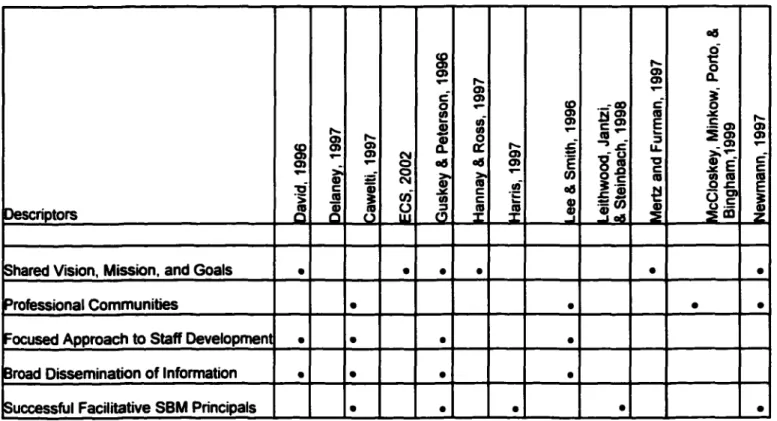
3. Characteristics Related to Site-based Management... 40
4. Advantages o f Site-based Management... 42
5. Disadvantages o f Site-based Management... 43
6. Site-based Management Related to School Improvement... 53
7. Site-based Management Related to School Improvement...60
8. Correlation o f SBM Components and Number of Probing Questions... 75
9. Table of Specifications: survey items Matched with Supporting Empirical Studies... 77
10. Distribution o f Site-based Management Components and Survey Questions.... 78
11. Data Collection and Analysis... 80
12. Frequencies and Percentages for Experienced Teachers... 87
13. Frequencies and Percentages of Responses to Shared Decision-Making Items... 92
14. Frequencies and Percentages of Responses to School Climate Items... 96
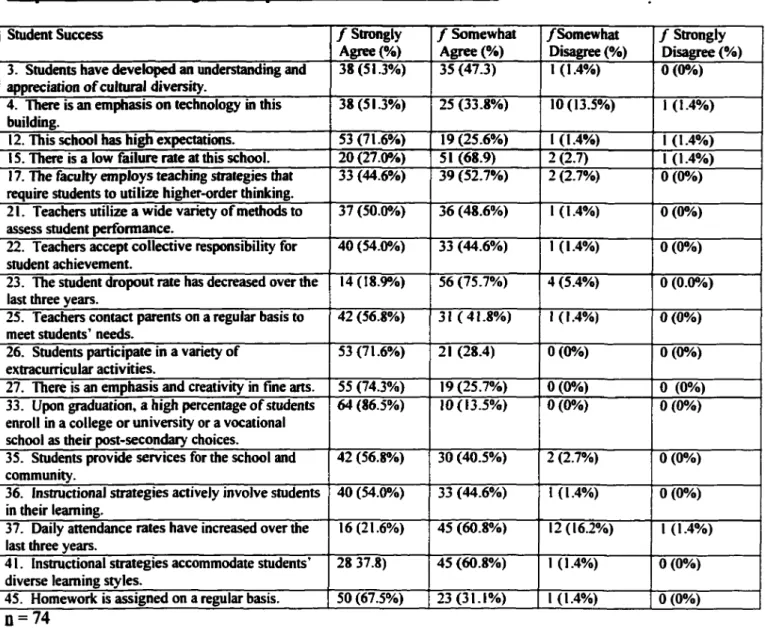
15. Frequencies and Percentages of Responses to Student Success Items... 101
16. Analysis o f Variance Results for Key Components of Site-based Management...102
17. Qualitative Sources Relative to the Success of the School... 104
18. Data Sources Relative to Challenges... 119
19. Related Recent Research Supporting Major Findings Relative to School Success...141
20. Recent Research Addressing Barriers to SBM...144
v
ABSTRACT
The purpose o f this single site case study was to examine administrators’, teachers’, and guidance counselors’ perceptions of site-based management components and school improvement. The study addressed the following three questions:
1. What are the perceptions o f experienced teachers toward key aspects o f site- based management (shared decision making, school climate, and student success)?
2. What factors do experienced educators identify with promoting the successful implementation o f site-based management components (shared decision making, school climate, and student success)?
3. What factors do experienced educators identify with hindering the successful implementation o f site-based management components (shared decision making, school climate, and student success)?
The study employed both quantitative and qualitative methodology.
Administered to only experienced teachers with three or more years of teaching, a questionnaire was used to collect data for three sub-scales: shared decision making, school climate, and student success. To answer question one, descriptive statistics were reported, and an ANOVA was used, resulting in no significant difference among the sub scales. Qualitative data were collected from a focus group comprised of the School Improvement Team and from semi-structured interviews to identify factors promoting and hindering the successful implementation of site-based management components.
Results indicate that the implementation of SBM strategies was overall positive. Participants’ responses revealed that shared decision making is an effective strategy for
vi
improving the school. Furthermore, the school climate is conducive to teaching and learning, and students are successful at this recently recognized Blue Ribbon School. As a professional community, the administrators and teachers collaborated to develop the vision, mission, and school improvement plan, especially with a focus on student achievement. Although the results were positive overall, participants also identified barriers, such as time, funding, and lack of technological assistance, sometimes hindering improvement efforts.
ANNIE LUNETTE TODD
PROGRAM IN EDUCATIONAL ADMINISTRATION THE COLLEGE OF WILLIAM AND MARY IN VIRGINIA
vii
SCHOOL IMPROVEMENT THROUGH SITE-BASED MANAGEMENT PRACTICES
viii
TABLE OF CONTENTS
ACKNOWLEDGMENTS... iii
LIST OF TABLES... v
ABSTRACT... vi
CHAPTER 1: INTRODUCTION... 1
Statement of the Problem... 6
Research Questions... 10
Significance of the Study... 11
Definitions of Related Terms... 13
Limitations of the Study... 14
Assumptions... 15
Organization of the Study... 15
CHAPTER 2: REVIEW OF THE LITERATURE... 16
History o f the Governance of American Public Schools... 16
The Beginnings... 16
Efficiency and Productivity... 18
Early Arguments for Democratic Decentralization... 19
Teacher Council Movement... 20
Quality o f Work Life... 22
Early Attempts at Site-based Management... 24
National Crisis in American Schools... 25
Site-based Management... 30
ix
Definitions o f Site-based Management... 30
Characteristics o f Site-based Management... 32
Advantages o f Site-based Management... 40
Disadvantages o f Site-based Management... 42
Site-based Management and School Improvement...44
Shared Vision, Mission, and Goals... 44
Professional Communities...45
Focused Approach to Staff Development... 47
Broad Dissemination of Information...47
Recognition... 48
Effective Facilitative SBM Principals... 49
Organizational Considerations... 51
Site-based Management and Student Success... 53
Curriculum and Instructional Considerations... 53
Indicators of Student Success. ... 57
Summary...61
CHAPTER 3: METHODOLOGY...64
Research Design... 64
Case Study Methodology... 65
Rationale for Using Qualitative Case Study Methodology...66
Setting... 67
Participants... 71
Data Collection... 72
X
Focus Group Protocol... 72 Interview Protocol... 74 Instrumentation... 75 Pilot Study... 78 Data Analysis... 79 Trustworthiness o f Data... 80 Credilbilty... 81 Transferability... 83 Dependability... 83 Confirmability... 83 Ethical Safeguards... 84
CHAPTER 4: ANALYSIS OF THE RESULTS... 85
Return Rate... 86
Demographic Information... 86
Results from the Questionnaire... 88
Shared Decision Making... 88
School Climate... 93
Student Success... 97
ANOVA: Sub-scales of Site-based Management Practices... 102
Statistics Used... 102
Results from the Focus Group and Interviews... 105
Leadership... 105
Shared Decision Making... 108
xi
School Climate... 1 13
Professional Community... 117
Results from the Focus Group and Interviews... 120
Funding... 120
Time... 121
Technology... 121
CHAPTER 5: SUMMARY, DISCUSSION, IMPLICATIONS, AND RECOMMENDATIONS... 123
Summary o f Findings from the Questionnaire... 123
Shared Decision Making... 123
School Climate... 125
Student Success... 126
ANOVA... 128
Summary o f Findings from the Focus Group and Interviews... 128
Leadership... 129
Shared Decision Making... 130
School Climate... 130
Professional Community... 131
Barriers... 132
Discussion o f the Findings... 134
Leadership... 134
Shared Decision Making... 136
School Climate... 138
xii
Professional Community... 139
Barriers... 141
Evidence That Site-based Management Practices Can W ork... 145
Structure... 145
Teacher Empowerment... 146
Collaborative Principal Leadership... 146
Trust... 147
Professional Community... 148
Evidence That School Change Is Important... 148
Improvement of Standards of Learning Tests... 149
Blue Ribbon School... 150
Implications for Practice... 151
Recommendations for Future Research... 153
Conclusion... 153
REFERENCES... 155
Appendix A: Correspondence... 170
Appendix B: Questionnaire... 172
Appendix C: Focus Group Protocol... 177
Appendix D: Interview Protocol... 179
Vita... 181
Chapter 1 Introduction
Because American schools have not fulfilled the promise o f universal education that American democracy espouses for all children, reformers have continued to attack the
performance o f schools. Incorporating the tenet, “All students can leant” in mission statements, the educational system has recognized that all children can leant and has realized the need to restructure to serve all populations o f children. Although millions of students have been successful, there are millions of other students whose needs schools do not accommodate (Bowsher, 2001). Dissatisfied with the quality of school performance, the public has increased demands for restructuring the educational system across America. In their discussion on
restructuring American public schools, Barnett and Whitaker (1996) expounded three rationales for the public’s dissatisfaction with schools:
1. Indicators, such as declining test scores, a reduced capability to compete in the global economic market, and graduates' readiness levels for the job market, signify that schools are not meeting society's needs.
2. Those closest to the level o f the students should be empowered to make decisions that affect student outcomes. Specifically, teachers should be treated as professionals who can assess best the needs o f their students.
3. Market forces and accountability are often the impetus for reform. Advocates o f this claim argue that schools are not forced to change because of little competition for their services.
Not debilitated by the avalanche of policies, programs, and regulations that most states generated in the 1980’s, the National Governor’s Association adopted restructuring as part of its
l
educational agenda for the twentieth-first century (Cohen, 1988). As astute politicians, the governors were responding to constituents’ outcry for improvements “in the efficiency and productivity of schools, in tune with massive restructuring in business, industry, and agriculture and with rapid demographic and social changes” (Prasch, 1990, p. 1). Ironically, these were similar problems American schools experienced in the nineteenth century.
The perceived current status of American schools has continued to receive public criticism regarding the performance of the nation’s schools. An education manifesto by the Center for Educational Reform (1998) stated that
... today’s high school seniors had not even started [school] when the Excellence Commission’s report was released. A whole generation of young Americans has passed through the education system in the years since. But many have passed through without learning what is needed. Since 1983, over 10 million Americans have reached the 12th grade not even having learned to do basic math. Almost 25 million have reached the 12th grade not even having learned to read at the basic level. Over 20 million have reached the 12th grade not knowing the essentials o f U.S. History. And those are the young people who complete their senior year. In the same period, over 6 million Americans dropped out of high school altogether. The numbers are even bleaker in minority communities. In 1996, 13% of all blacks aged 16 to 24 were not in school and did not hold a diploma. Seventeen percent of first-generation Hispanics had dropped out of high school, including a tragic 44% of Hispanic immigrants in this age group, (p. 1)
Rose and Gallup (2001) also expressed concerns about the status of American education in the 33rd Annual Phi Delta Kappa/Gallup Poll o f the Public s Attitudes Toward the Public
Schools. Respondents were asked to grade the nation’s schools and their own community
schools. Results indicate that respondents assigned higher grades to their community schools with a combined percentage of Als and Bis climbing to 51% for all respondents to 62% for public school parents and to 68% when these same parents assigned grades to the community schools their oldest child attends, reflecting the highest rating in the poll’s 33 years. When grading the nation’s schools, only 23% of the respondents assigned an A or B. Respondents also identified the biggest problems facing schools today are lack of school funding and lack of discipline. In fact, 68% reported that the quality of education in schools depended upon allocation o f funding. Other significant problems, included in the top five, were
fighting/violence/gangs, overcrowded schools, and use of drugs/dope. Moreover, 54% of the respondents indicated that schools need a varied curriculum as well as an emphasis on basic courses. In addition, 81% noted that students reach only a small part o f their potential. Although respondents reported that schools can do a better job in closing the achievement gap among white, African-American, and Hispanic students, 72% of them supported reforming the existing system instead of utilizing public funds for choice and private schooling.
Even though much o f the rhetoric on the need to restructure is convincing, there is not much information on how to restructure. Perhaps, this is the case because reformers do not necessarily define this term similarly. However, as the term restructuring implies, this type of research reform effort focuses on fundamental changes in the structural patterns of educational organizational problems. “The underlying assumption is that organizational problems typically originate from inappropriate structures or inadequate systems and can be resolved through restructuring or developing new systems” (Bolman & Deal, 1991, p. 48). To clarify the meaning o f restructuring, Barnett and Whitaker (1996) synthesized common elements from viewpoints on
the term. According to them, the enumerated indicators below describe a restructured school environment:
1. Allowing those at the school site to make decisions on such issues as personnel selection, budget oversight, curriculum development, scheduling, and staff development;
2. Developing an integrated curriculum that focuses on higher-order thinking skills and on student-centered learning;
3. Altering the reward and salary structure for teachers and administrators; 4. Establishing new forms o f student performance assessment and accountability; 5. Establishing new forms o f student performance assessment and accountability
systems;
6. Changing the roles and relationships between principals, teachers, and central office personnel;
7. Involving the total school community, including community groups and service agencies;
8. Encouraging procedures for obtaining waivers from local, state, and federal regulations, (pp. 6-7)
These elements indicate that the pendulum has swung again to decentralization for the early twenty-first century.
In deference to decentralization, researchers have observed that decentralization has emerged again as the organizing principle of the educational reform movement. According to Mirel (1990), “decentralization is one o f those recurring elements o f educational reform. The history of school decentralization, like that of back to basics or the open classroom, is a history
4
of perpetual motion, rising and falling but never fading away” (p. 4). Bimber (1993) stated that decentralization will decrease the bureaucratic and hierarchical structure of schools and will have positive effects on American public education. Moreover, he commented, ‘i t has almost been an article of faith, that greater freedom from the effects o f centralized bureaucracy, hierarchy, and adm inistrative rules will serve the interest of improving U.S. schools” (p. 1). In addition,
Hargreaves and Hopkins (1996) noted that school improvement “implies a very different way of thinking about change than the ubiquitous ‘top-down' approach so popular with policy makers” (p.234). They further explained that a concentrated emphasis on the internal context o f the school does not ignore the external environment. According to them, when “schools adapt external changes to internal purpose, they usually improve” (p. 33). Hopkins (1996) further described the influence o f the external environment on policy and school improvement:
Although policies set directions and provide a framework, they do not and cannot determine student outcomes. It is also the case that the most effective school
improvement strategies seem to be internal rather than external to the school.. .What is needed is ‘implementation-policy’ that is concerned with the process as well as the substance of change at the teacher and school level, (p. 41)
As the American school system has forged through one restructuring/reorganizing battle afrer another, the concept o f site-based management (SBM) has emerged with the prospects of reorganizing with students in the forefront. Proponents of school reform have advocated that site-based management has the potential to permit individual schools to resolve school problems. More specifically, site-based management attempts to restructure the delegation of authority and the decision-making processes. When the state or central bureaucracy delegates authority to individual schools, school personnel make decisions regarding better programs for students
5
because they know their students’ needs (Lasher, 1997; Schlecty, 1997; Schmaus, 1996; Wohlsetter, 1996). Additionally, the costly support o f an overstaffed central bureaucracy will diminish as school staffs make more curricular and instructional decisions at the school.
Perhaps, the students can benefit from the funds resulting from a decrease in central staff. Nevertheless, even though site-based management supplants some of the authority of central office, public schools will still need the support o f school boards, superintendents, specialists, and community stakeholders to fructify success.
Statement of the Problem
Changes in American society have been influencing the organizational structures that school administrators utilize to govern schools. The rapidly changing demographics, heightened public interest, financial and social problems, to name a few, appear to have corroded the
progress of school improvement, especially student achievement. To cure the ills of American schools, reformers recommended site-based management as a stand-alone reform in response to crises in schools during the 1980’s and mid 1990’s.
Site-based management is a restructuring approach that shifts the locus o f control for some decisions from central office to the school site. Even though site-based management has surfaced as a buzzword in restructuring efforts, it still remains conceptually elusive because it can vary from one district to another or from one school to another in the same district. Nevertheless, many school districts adopted SBM without implementing, monitoring, and evaluating a plan to make the transition from a traditional management approach to SBM approaches (Bauer & Bogotch, 1997; Cheong, 1996). Therefore, for many years, early SBM initiatives have existed in such haphazard forms without a clear focus on school performance. Because of this thrust to implement SBM, often without clear parameters or a focus, school
6
districts initially viewed SBM as an end in itself (Drury, 1999). If schools utilized school
councils, sites rarely defined council roles, provided team building training, and targeted student learning (McCloseky, Mikow-Porto, & Bingham, 1998; Wohlstetter & Mohrman, 1996).
Instead, schools expected site-based teams to set their own guidelines and address issues, usually non-related to student achievement (Bauer & Bogotch. 1997; Levey & Acker-Hocevar. 1998).
As a result of districts implementing SBM as a reform entity in the 1980's until the mid- 1990’s, reviewers and researchers criticized SBM literature and the lack of empirical evidence relative to the earlier attempts or studies. After conducting a meta-analysis of over 200 studies. Malen, Ogawa. and Kranz (1990) described the nature of the literature on site-based
management:
...most writings on school-based management are either project descriptions, status reports, or advocacy pieces. Those sources tend to rest on the impressions of a single individual and emphasize exceptional cases, such as achievement attained in a small number of the most successful pilot schools, (p. 30)
They also reported that there exists very little quantitative research on site-based management. Barnett and Whitaker (1996) stated that ‘There is an overabundance of conceptual work. . . ; however, little empirical research, especially longitudinal studies” (pp. 3-4). Furthermore, other researchers indicated that there are few systematic studies of SBM and that much o f the
literature comprises glowing advocacy pieces, plan descriptions, and anecdotal accounts of what works (Bauer, 1997; Sharpe, 1996). Barnett and Whitaker (1996) suggested that the lack of studies may be due to the newness of systemic reform efforts requiring a massive change in educational structures and the understanding of the complexities of such change.
7
In addition, researchers reported that poorly designed and poorly implemented stand alone SBM programs had little or no effect on improving student achievement (Bauer, 1997; Drury, 1999; Holloway, 2000; Latham, 1998). After an extensive review o f the literature, Leithwood and Menzies (1998) concluded that empirical evidence relative to SBM engendering improvement has not been substantial. They cited the following reasons for the lack of
evidence: (I) difficulties associated with measuring change and SBM outcomes, (2) politics on the local, state, and national levels, and (3) change of work practices requiring significant collaboration among teachers, principals, and district personnel.
Some researchers have found that the relationship between site-based management and student achievement is problematic. Studying the impact of site-based decision-making strategies and methods on student achievement in high schools. Everett (1998) investigated the degree to which SBM strategies and methods impacted percentile scores measured by the Texas Assessment o f Academic Skills (TASS), which comprises three examinations - reading, writing, and math. Based on the site-based committee member responses, she categorized the schools into one of three SBM categories: low-level, moderate-level, and high-level management. Her findings indicated that there was no significant difference among the three levels of SBM and the three areas o f focus on the TASS. Moreover, in her study. Bell (1996) substantiated evidence that the effect o f site-based management on standardized test scores warrants further
investigation. After conducting a study o f 35 elementary schools over a period o f three years, she concluded that the socioeconomic status o f the students contributed the most to the variations among the scores. An analysis of the data indicated a decrease of test scores in 18 of the sample schools and an increase of scores in 13 scores. The scores of the remaining schools did not change.
8
On the other hand, recent research reported that SBM integrated with a comprehensive approach to school reform rather than a stand-alone approach can augment school improvement, including benefiting instructional programs and increasing student achievement. A large-scale study of SBM sponsored by the Center on Organization and Restructuring of Schools (CORS) and conducted by Marks and Louis (1997) documented that school culture improved when administrators empowered teachers to make decisions beyond the classroom but decisions still related to student learning. Such empowerment promoted a strong sense of professional community. In another recent study o f SBM, Leithwood and Menzies (1998) cited evidence of increased teacher commitment and morale, collaboration among teachers, an increased school- wide focus on professional development, and acceptance o f accountability. In addition, a study conducted through the Chicago Consortium of School Reform (CCSR) concluded that teacher participation in decision- making in SBM schools related positively to improved instructional programs and to increased student learning (Smylie, Lazarus. & Brownlee-Conyers, 1996). Mork (1998) conducted a study SBM that comprised 2100 Western Washington state public schools teachers representing 111 elementary, middle, and high schools. He examined the relationship between the type of site-based management (e.g. shared decision making and degree of collaboration) and the extent to which teachers at their schools perceived the following had occurred: (1) improvement in student learning, (2) changes in school and/or classroom practices, and (3) the degree o f restructuring. He found that teachers in schools with higher levels o f site- based decision making (SBDM) and collaboration indicated statistically significant higher level of school-wide practices, including a emphasis on staff development and parental involvement programs. He also found that teachers in high SBDM/collaboration schools significantly decreased their heavy reliance on the textbook and lectures as modes of instruction and noted
higher rates o f the use o f alternative assessment procedures, the utilization of student portfolios, and teaming with another colleague. Furthermore, these teachers indicated higher increases in student learning. Thus, this study concluded that site-based management and shared decision making can be a viable education restructuring practice. In the urban district o f Austin, Texas, more than one half of its students come from low-income families. Since the implementation of SBM, this district’s annual dropout rate has decreased, and its standardized test scores have increased.
Still other recent studies have investigated the relationship between SBM and student achievement. Evaluating SBM in the Chicago Public Schools since 1988, the Chicago
Consortium on School Reform (CCSR) recently presented a large-scale study, reporting evidence o f learning gains that linked to the implementation of this governance change (Bry. Thum. Easton, & Luppescu, 1998). The CCRS also conducted a smaller five-year study of fourteen Chicago schools and presented another recent report that confirmed that changes in student achievement related to SBM from the adoption of the 1995 amendments to the 1988 Chicago School Reform Act (Hess, 1999).
Research Questions
The purpose of this single site case study research was to examine administrators’, teachers’, and guidance counselors’ perceptions of site-based management components and school improvement. Specifically, this research collected data to address the following questions:
1. What are the perceptions of experienced teachers toward key aspects of site-based management (shared decision-making, school climate, and student success)?
2. What factors do experienced educators identify with promoting the successful implementation of site-based management components (shared decision making, school climate, and student success)?
3. What factors do experienced educators identify with hindering the successful implementation of site-based management components (shared decision making, school climate, and student success)?
Significance of the Study
As Murphy (cited in Lawton, 1996) stated, “site-based management used by itself... won’t do anything to help student achievement. But it can be helpful if employed in a school community already committed to teaching and learning." However, the majority of research on site-based management has focused on this structure as a governance issue. Concerned with the implementation o f the technology of site-based management as an end in itself, most studies have not addressed student improvement or focused on student outcome goals (Cotton, 1992). Although goals related to curriculum and instruction can powerfully impact student outcomes. SBM efforts rarely have addressed these areas (Cotton, 1992; Drury, 1999). Furthermore, the few studies that exist in the literature on student achievement measured student performance based on standardized tests (Banicky, Rodney, and Foss, 2000; Haynes-Pearson, 1997; Slavin & Madden, 1995; Wohlstetter et al., 1997). In some cases, test scores rose; in others, scores declined slightly or remained the same. As a result of this conflicting research on student achievement, researchers have found no direct link—positive or negative - between SBM and student achievement or other student outcomes (Beck & Murphy, 1996; Cotton, 1992). Although test scores are important indicators o f student achievement, the present study will
address the need to encompass a wider spectrum of student outcomes such as passing rates, dropout rates, attendance, and post-secondary activities.
Implementing site-based management is more than a governance issue. As an approach, SBM affords principals and teachers the opportunity to identify problems and derive solutions in a timely manner. With the implementation o f SBM components, school site stakeholders also can tailor their decisions to implement programs and strategies to address the needs o f their schools and students. Because SBM can vary from school to school, this flexibility is crucial to any implementation o f this approach (Barth, 1997; Schlechty, 1997; Wohlsetter et al., 1997). In light of the paucity o f research on site-based management and school performance, this study may help fill a void in research examining the relationship between site-based management and school improvement in the areas of shared decision making, school climate, and student success. In addition, this study has the potential to provide insight into effectively empowering teachers to share in decision making as a collaborative community. Furthermore, this research may prove beneficial to schools planning to increase implementation o f more components of site-based management.
Additionally, this study will address the need for a heightened understanding of the efficacy o f SBM. Commenting on a research paradigm devolution, Sharpe (1996) expressed the need for further study and evaluation of SBM and its impact on school improvement. Wohlsetter (1996) also agreed that SBM has limited success when implemented as an end in itself or solely for compliance issues as opposed to being connected to the real work o f schools. Therefore, the researcher will depict SBM as an integrated approach that has the potential to yield school improvement. For schools that plan to engage in a school renewal or school improvement process, this study may present a viable integrated restructuring approach. Also, substantiated
12
with quantitative and qualitative data, the results of this research may shed light on what
components o f site-based management and school improvement work and those that do not work effectively.
Definitions o f Related Terms
The researcher used the following definitions for this study:
1. Decentralization is a governance structure that shifts the locus o f control over some school functions from a central administration to individual schools.
2. Fmpowerment is the “act o f inclusion that fosters the notion o f expanding or strengthening a leader’s power by involving others in the decisions of the organization’ (Short & Greer. 1997). For the purpose of this study, empowerment is the practice of utilizing the expertise of school staff to attain school goals.
3. F.xperienced educator is defined by three or more years o f experience in a public school setting as a principal, an assistant principal, a teacher, or guidance counselor.
4. School climate refers to the positive or negative perceptions of the school staff about the school.
5. School improvement refers to increases in school effectiveness or school development that have yielded a positive measure of success. This research will study school improvement in the areas of shared decision making, school climate, and student success.
6. School restructuring means to retain what has been successful (or sometimes improve) and to redesign those areas or aspects that have failed to yield desirable outcomes.
7. Shared decision making is the “philosophy and practice o f including different perspectives in the process of making decisions for a school, a committee, a district, or another organization. This involvement may include input, advisory moments, or decision making (Brouse, 2001).
13
For the purpose of this study, shared decision making is a process or practice o f involving key stakeholders in making decisions that will improve their quality of work life and student improvement at the individual school site.
8. Site-hased m anagem ent is an approach that emphasizes “delegating authority to the school instead of central office, shared decision-making model engaging various stakeholders and facilitative rather than directive leadership” (Cromwell, 2000, p. 1). For the purpose of this study, site-based management is defined as a philosophy, an approach, or a strategy that delegates authority from central administration to individual schools to make decisions that affect school improvement.
9. Student success refers to indicators such as test scores, dropout rates, attendance, passing rates, and post-secondary activities.
10. Vision is a compelling mental picture depicting the difference between what exists in a school and what improvement will exist at a designated time in the future.
Limitations o f the Study
The limitations of this study are as follows:
1. Participants in this study are a principal, an assistant principal, teachers, and guidance counselors. Therefore, the results of the study cannot be generalized to other school staffs. 2. Teachers and guidance counselors are usually loyal to their schools and may not respond
negatively about school improvement.
3. This study will be conducted in one high school whose district has not fully implemented a site-based management program.
4. This study examines SBM practices in one school. Therefore, results may not be generalizable to the entire county or other districts.
14
Assumptions
1. Shared decision making at the local site has the potential to improve the overall effectiveness of a school.
2. School climate impacts the overall performance o f a school. Organization of the Study
Chapter 1 included an introduction to site-based management as a form of
decentralization. In addition, the introduction stated the problem, the purpose o f the study, the significance, operational definitions, limitations, and major assumptions, followed by the organization of the study. In Chapter 2, the researcher will review related literature, describe methodology in Chapter 3, and conduct an analysis of the data in Chapter 4. The final chapter. Chapter 5, will provide a summary of the study, along with conclusions and recommendations for further research.
Reproduced with permission of the copyright owner. Further reproduction prohibited without permission.
Chapter 2
Review of the Literature
HISTORY OF THE GOVERNANCE OF AMERICAN PUBLIC SCHOOLS
Divided into four major sections, this chapter is designed to present a systemic review o f literature and findings on SBM as a reform strategy. The first section examined a historical perspective o f the governance of the American educational system as a need to reform American public schools. The second section overviewed the context of SBM - definitions, common characteristics, and advantages. The next section addressed the relationship between successful implementation o f SBM and school improvement. The fourth section explored instructional practices and indicators o f student success.
Education always has been important to Americans. Since the seventeenth
century, the American society has touted education as the road to upper mobility. As a result, reformers throughout the history o f American schools have debated the type of governance structure that best contributes to the quality o f school improvement or performance in American schools. Some argue that centralization, a top-down approach, is best, while others advocate decentralization, a bottom-up approach, to education.
Prior to 1900, decentralization was the governance structure o f schools. In the rural areas, one-room schoolhouses dotted the countryside. Operation of this one-room school involved a teacher and usually a lay school board that governed as needed. As the effects of industrialization, specifically mass production of goods, impacted America, people migrated to cities and to find jobs. This increased population shift, along with child labor and compulsory attendance laws, created a need for larger and more comprehensive school systems. Thus, the one-room schools evolved into a substantial number of multi-room schools. Recognizing their
16
lack of expertise in instruction, school boards appointed a principal to operate the multi-unit schools but continued to manage the financial resources. As America became increasingly industrialized and as the multi-unit schools developed into multi-campuses, the board appointed a superintendent. Subsequently, the board created layers of centralization with the addition of a business manager and specialists o f every type. As school districts and school boards rapidly increased, control became even more centralized with district boards of education becoming the primary unit of management (Sewall, 1999).
In urban America, each city had many school districts organized around neighborhoods or wards, each with its own school board. Usually in urban areas, politicians called “ward bosses” appointed school boards and often assumed responsibility for maintaining facilities, selecting and requisitioning supplies and books, selecting vendors, determining general policies about curriculum, and staffing. However, local control by “ward bosses” led to corruption (Sergiovanni, Burlingame, Coombs, & Thurston, 1999).
Around 1900, reformers sought to eliminate the widespread corruption of the ward bosses, especially in the city. These bosses had corrupted the schools by awarding contracts to unqualified family members, accepting kickbacks, and threatening teachers’ job security. Educational and political reformers replaced ward bosses with citywide boards primarily comprised of business and professional men (Snauwaert, 1993). School board members were now either elected or appointed through nonpolitical offices. Moreover, reformers decreased the school board’s involvement in the daily operation of the school and assigned this responsibility to a superintendent (Snauwaert, 1993; Sewall, 1999).
Efficiency and Productivity
In the early twentieth century, Taylor (cited in Palestini, 1999) advocated top-down management, division o f labor, specialization, and a regulated work environment to increase the efficiency and productivity of industry. Reacting to the societal demands to operate schools more efficiently, educational leaders advocated utilizing Taylor’s management principles, thus fueling an era of centralization. He believed that one could achieve maximum job efficiency through the scientific study of that job by experts. Furthermore, he purported that jobs should be broken down into minute parts and that workers should be retrained to yield the largest payroll from each motion and second spent at work. Taylor’s principles were so widely accepted that many began to apply the principles o f scientific management to other aspects of American life, such as military, the legal profession, the home, the family, the household, the church, and education (Conway & Calz, 1996; Sergiovanni, Burlingame, Coombs, & Thurston, 1999).
This industrial model resulted in schools being run like factories. Top-down
management characterized this model, creating layers of managers of administrators to increase the efficiency of the school system and to supervise day-to-day operations (Sewall, 1999). When measured by Taylor’s principles, the system o f autonomous, small, locally controlled schools taught by generally trained teachers seemed wasteful and inefficient, thus providing an impetus for the school consolidation movement. In addition, the migration of people from the country to the city contributed to the consolidation of schools (Carlson. 1996). Between 1930 and 1950. the school population increased from 28 million to 46 million, while the number o f school districts decreased by 400% (Lindelow, 1989, p. 155). In 1938, there were 119,001 districts; by 1990 there were 15,367 districts (Digest of Educational Statistics. 1991, p. 93).
During the Roosevelt Era, centralization o f schools gained even more momentum. As a result of the agencies and bureaus that were created to deal with Depression problems,
superintendents reinforced the notion to run their schools systems as bureaucracies were run. “The government structure o f schools was, like government and industry, top-down with little input from clients o f the system” (Marburger, 1985, p 5). However, devastated by the collapse of the stock market in 1929 and with the social unrest in the United States during the Great Depression, Americans began doubting the long-held belief that the business sector could resolve America's problems.
Early Arguments for Democratic Decentralization
Dissatisfied with schools resembling educational factories and with the inherent
bureaucracy, democratic reformers voiced concerns that school administrators had become too autocratic and unresponsive to the needs of the students. During the 1920's. Mary Follett (cited in Murphy and Beck, 1995) criticized the scientific concept of efficiency. In response, she introduced the idea o f participatory leadership, "‘power with” rather than “power over” (p. 150). Instead of hierarchical structures, she suggested selecting the leadership structure and staff based on the nature of the problem. In addition to Follett’s work, Elton Mayo (cited in Sergiovanni et al., 1999) studied worker productivity in Western Electric’s Hawthorne plant in Chicago. This study concluded that workers are more productive under the following conditions: shared
p l a n n i n g o f varied work, friendly and democratic environment, and award o f group incentives.
Forefront in advocating a shift from centralization to decentralization was John Dewey. Democratic reformers utilized Dewey’s article, “Democracy in Education” as an impetus to revisit decentralization o f schools. In the following famous excerpt, Dewey (quoted in Murphy
& Beck) posed questions about empowering individuals to share decision making about their jobs:
What does democracy mean save that the individual is to have a share in determining the conditions and the aims o f his own work and that on the whole, through the free and mutual harmonizing o f different individuals, the work o f the world is better done than when planned, arranged, and directed by a few, no matter how wise or how good intent that few? How can we justify our belief in the democratic principle elsewhere, and then go back entirely upon it when we come to education? (p. 197)
Teacher Council Movement
Employing Dewey’s work, democratic reformers catapulted the teacher council
movement from 1920-1929. This movement was perhaps the first major attempt to reverse the trend of centralization, which supported scientific management to increase efficiency o f schools. According to Ortman (quoted in Murphy & Beck), the purpose o f teacher councils was “the betterment of schools and education of children “ (p. 1). He also delineated two goals o f the teacher council movement: (1) “the derivation of workable politics” and (2) “the improvement of educational workers in service through policy determining participation” (p. 1).
Teachers protested administrators operating schools like factories and campaigned in several large cities to gamer democratic participation in the administration of schools.
According to Ortman (quoted in Murphy & Beck), teacher councils “attacked ten big problems in school administration” (p.33). Enumerated below are the big ten problems:
1. Constructing or reorganizing courses o f study 2. Adopting textbooks and materials for teaching
3. Establishing methods of instruction for subjects and classes
20
4. Building up teacher training requirements and courses 5. Constructing teacher rating systems
6. Modifying school building plans
7. Building up more comprehensive systems of reports 8. Helping increase salaries
9. Reorganizing the rules and regulations of the school 10. Cooperating in community work (p.33)
The labor movement strongly influenced the teacher council movement. Paralleling industrial councils, teacher councils comprised elected representatives that sought to increase employee participation by giving input on policies that affect them and by participating in decision making to enhance their quality of work life.
In 1921. General Motors promoted decentralization in industry. This company shifted decision-making authority and accountability at lowest appropriate level and downsizing the number of levels in the organizational hierarchy. Other large companies implemented General Motors’ decentralization model, including International Harvester in 1943 and Ford Motor company in 1946 (Carlson, 1996).
After the World War II until the late 1960’s, teacher unions became more prevalent. As a result, administrators and teachers were often in conflict. Principals informed teachers of policies and expected them to accept and implement them. Sometimes, principals and staff informally conferred in the school’s hallways or through quick meetings. Nevertheless, authority in the school gradually became more and more centralized, resulting in the union conflicts of the decade impairing collegiality (Taylor & Levine, 1991). In 1965, Herbert Klausman at the University of Wisconsin began a school improvement program, incorporating some school-based
21
management techniques. This Individually Guided Education (IGE) school improvement
program created research and instruction units in schools, which gradually evolved to comprise a school team -- the principal and teachers -- and required district support for coordination of a top-down and bottom-up effort (Taylor & Levine, 1991).
Quality of Work Life
In the 1960’s. American corporations began using the Quality of Work programs that are still popular today in private and public sectors. Vying with the success of Japanese corporations, American businessmen visited Japan corporations to discover the secrets of their success. The American corporations liked what they observed and subsequently implemented the program in their corporations using the title Quality of Work Life (Herman, 1993). According to Herman, private and public sectors also named this program Quality Circles, Employee Participation Circles, Job Enrichment Teams, Professional Development Teams. School Improvement Circles, and Working Groups. In addition, Herman defined this concept:
Quality Work Life (1) is a philosophy that states people are good, they want to
help themselves, and their fellow employees, and their particular school organizations to improve; (2) has a goal of involving employees in improving the quality of their work environment, and (3) is a process which involves employees in problem solving and in employee satisfaction activities through action programs which the employees develop to improve the quality of their work life. (p. 64)
In 1978, Westinghouse became a model for implementing Quality Circles in other industries. The implications drawn from the implementation of Quality Circles at Westinghouse included the following: those directly affected solve problems best, participative management fosters a sense of ownership among workers, and the ability to influence change in the job is
22
directly related to morale and motivation. Tangible results included greatly increased productivity; intangible results included higher employee morale, less resistance to change, improved communication between employees and managers as well as between departments, and the development o f a work environment characterized by learning, problem solving, and problem preventing (Carlson, 1996).
Other corporations that successfully implemented the Quality Circle included Honeywell. 3M Company, and Ford Motor Company. Quality circles at Ford Motor Company contributed to better product quality, many improvements in production, higher employee morale, improved efficiency, and reduced grievances and absenteeism (Carlson. 1996). Hansen (1990) indicated that these quality circles exhibited the following distinctive characteristics:
1. The voluntary association o f members;
2. Information gathering and data-based decision making; 3. Formal brainstorming to insure participation;
4. Problems identified and defined by the group; 5. Analysis and interpretation by the group;
6. Recommendation and presentation by the group;
7. Involvement in the dissemination, implementation, and adaptation of the recommendation and plans; and
8. Evaluation of both the processes and outcomes, (p. 102)
Thus, the Quality circle brought individuals together in a constructive way to improve communication, solve problems, and make effective decisions.
Early Attempts at Site-based Management
During the 1970’s, some early site-based management (SBM) forms began to appear as an attempt to respond to the needs o f increased desegregated and multicultural neighborhood and community schools. These programs were antecedents for site-based management (Carlson,
1996). Still other early indicators o f a shift toward site-based management appeared in scattered districts during the 1970’s and 1980’s. In 1971, the Fleischman Commission proposed the development o f school-based management in New York. As a result of state reform legislation, Monroe County, Florida, phased in site-based management, including an advisory council, between 1971 - 1976. Through grant funding and with the assistance of four universities, the superintendent, other central office staff, and principals received extensive training in team management and decision making Fairfield-Suisun began decentralization in 1973, employing community and staff input in the budget process and delegating authority to purchase materials and equipment to school councils and principals. Also, in 1973 in Florida, the Governor's Citizens Committee on Education report promoted allocating funds to schools based on the needs of the students, developing educational objectives by those closest to the school level,
determining curriculum based on the needs of the school site, and empowering parents to
participate in decision making (Oliver, 1992). Moreover, in 1979, a Florida law allotted funds to establish an advisory committee at each school in the districts. The California’s Early Childhood Act and School Improvement Program encouraged the inclusion o f parent involvement and councils. Addressing desegregation and collective negotiations issues impacted the
implementation o f site-based management in Cleveland, Ohio, the Boston School District, and the San Diego School District. In addition, Minnesota, Oregon, and New Jersey received grant funding for site-based management (Carlson, 1996). Jefferson County, Kentucky, in 1986 at a
24
grant-supported academy exercised flexibility in policies and procedures. In 1988, the Memphis School system formed a deregulated school district and waived guidelines so that the eight selected schools could establish decision making, assume increased responsibility for instruction, and develop local programs and services.
National Crisis in American Schools
Dissatisfied with the failure o f the reform efforts o f the 1970’s to meet the needs of a ever changing information-based society fueled state and national efforts to improve the
performance of public schools by restructuring the American school system. The National Commission on Excellence in Education (1983) assembled to address the needs o f American public schools and published A Nation at Risk, a landmark report that described a national crisis of mediocrity in American public schools. Moreover, this report generated an
unprecedented examination o f public schools by America's political, educational, and financial communities. According to this report and a flurry of other literature. American schools were losing the global race in education. As Chubb (1988) commented:
In the earlyl980’s Americans awoke to discover that their public schools were failing them. Student test scores, declining for nearly two decades, showed American trailing the rest of the world’s democracies in mathematics and science achievement.. .[Americans] worried whether the nation possessed the intellectual talent to revitalize its industries and compete with the technological sophistication of east Asia. (p. 50)
Another problem noted in these reports was that schools were not addressing the increasingly changing demographics of the nation. Cohn (1989) elaborated on this urgency:
What gives this issue more urgency today is that he percentage o f students who
Are at risk o f poor academic performance or dropping out altogether - those drawn from poor and minority backgrounds - represents an increasing share o f both population and our workforce, (p. 257)
Such literature o f this first wave reform movement engendered national attention and prompted governors and state legislatures to initiate guidelines and mandates for local school districts to implement. For example, state legislatures and local school districts and local school boards required more credits for graduation, developed exit tests for graduations, restricted participation in extracurricular activities to students who maintained certain grade averages, and required more courses for teachers. In addition, teachers acquired more responsibilities but had little autonomy. Educators argued that they still had to contend with organizational structures that were appropriate for the Industrial Age but not for the Information Age (Bowsher, 2001). Even with these layers of centralization, this top-down approach did not fructify the desired outcome of educational excellence.
Comparing the performance of American students with that of students in other countries, critics continued to launch an attack on American schools around 1986. As Raywid (1990) asserted, 'piecemeal supplements, or peripheral modifications that leave most school practices unaffected, are likely to prove futile. Nothing short o f fundamental change affecting the
practices o f everyone within a school will suffice” (p. 152). The Carnegie Forum on Education and the Economy (1986) published A Nation Prepared, one of the most influential reports o f this reform movement. This report recommended giving teachers more control over their work, accountability for student achievement, and incentives for school-wide improvement. Fueled with an arsenal o f educational report cards from task forces, governors, commissions, and
26
education boards hailed the need to restructure American schools by empowering teachers to share decision making. The rationale was that decisions made closest to the locus of the implementation resulted in better classroom decisions (Bauer, 1997; Lashway, 1997; Short & Greer, 1997; Schmoker, 1996). Therefore, in order to improve education and to compete in the global race, most states enacted site-based management legislation (Hoyle, 1992). Hence, during this second wave o f reform, site-based management, sometimes called school-based management surfaced as a buzzword in reform efforts.
Eight years, however, after the publication o f A Nation Prepared, American students were still performing poorly in the global education race. Hence, the federal government again endeavored to improve student achievement by enacting the American Goals 2000: Educate
America Act in 1994. This act attempted to standardize education with adherence to the
following eight goals.
1. All children in America will start school ready to learn.
2. The high school graduation rate will increase to at least 90 percent.
3. All students will leave grades 4,6, and 12 having demonstrated competency over challenging subject matter including English, mathematics, science, foreign languages, civics and government, economics, the arts, history, and geography, and every school in America will ensure that all students learn to use their minds well, so that they may be prepared for responsible citizenship, further learning, and productive employment in our nation’s modem economy.
4. United States students will first in the world in mathematics and student achievement.
5. Every adult American will be literate and will possess the knowledge and skills necessary to compete in a global economy and exercise the rights and responsibilities o f citizenship.
6. Every school in the United States will be free o f drugs, violence, and the presence of firearms and alcohol and will offer a disciplined environment conducive to learning. 7. Th nation’s teaching force will have access to programs for the continual improvement
o f their professional skills and the opportunity to acquire the knowledge and skills needed to instruct and prepare all American students for the next century.
8. Every school will promote partnerships that will increase parental involvement and participation in promoting the social, emotional, and academic growth of children. (Bushweller, 1999, pp. A6-A11)
In January 2001, President George W. Bush announced his framework for improving the nation’s schools for all children, especially the neediest children being left behind. Called the No Child Left Behind Act o f 2001 (NCLB Act), this framework seeks bipartisan solutions relative to accountability, choice, and flexibility in Federal education programs. To help ensure that no child is trapped in a failing school, parents of students attending Title I schools, for example, have the choice beginning with the 2002-2003 school year to enroll their children in another public or private school and to provide increased supplemental educational services. Therefore, already failing school districts will lose some of their funding because o f the choice and supplemental service requirements if their low performance does not improve. On the other hand, an important goal o f this act is to grant school districts greater flexibility in the use o f Federal education funds in exchange for increased accountability for results. As a result of this flexibility, districts can now transfer up to 50 percent of the funding for Teacher Quality State
28
Grants, Educational Technology, Innovative Programs, and Safe and Drug-Free Schools to one of these programs or to Title I. Furthermore, the Reading First initiative of this act helps ensure that every child can read by third grade; thus, it has the potential to reduce the identification of children for special education because of a deficiency o f reading skills in their early years. Table
1 presents a synthesis of research relative to the governance of American schools. Table 1
Governance of American Schools
Descriptors Car ls o n , 1 9 9 6 C ar ne gi e Fo ru m on E du ca ti on a n d th e E co n o m y , 1 9 8 6 C on w ay & C al z, 1 9 9 6 H an se n , 1 9 9 0 M ur ph y & B ec k, 1 9 9 5 Th e N at io n al C om m is si on in E xc el le nc e in E d u ca ti o n , 1 9 8 3 i Pal es ti n i, 1 9 9 5 S er g io v an n i, B u rl in g am e, C o m b s, & T h u rs to n , 1 9 9 9 S ew el l, 1 9 9 9 S n au w er t, 1 9 9 3 T ay lo r & L ev in e, 19 91 G oa ls 2 0 0 0 ,1 9 9 4 No C hi ld L ef t B eh in d , 2 0 0 1 Decentralized one-room school with teacher and
lay school board •
Rapid growth of schools
requiring principals •
Centralization as a result of school consolidation and corruption requiring superintendents, principals,
and staff of central office specialists
• • • •
• •
Scientific management •
Early arguments for democratic decentralization • • • Quality circles • • National crisis of mediocrity
In American public schools • • •
Empowerment of teachers • •
SITE-BASED M A N A G EM EN T Definitions o f Site-base d Management
Although ambiguity has surrounded the term, many researchers and educational practitioners have attempted to define site-based management. Oliver’s study (1992) reported that the educational literature abounds with numerous attempts to provide precise meanings such as school-based management, building -based management, decentralized management, school- site autonomy, the autonomous school concept, responsible autonomy, school-based budgeting, school-site lump-sum budgeting, school improvement process, school-based curriculum
development, teacher empowerment, shared governance, administrative decentralization, and shared decision making. Ponder (1997) also noted the different labels for concept and practice of employee involvement in education: site-based management, site-based decision making, and participative decision making.
Still others have attempted to provide precise definitions to capture the elusive nature of site-based management. Levey and Acker-Jocevar (1998) defined it as a delegation of authority, a shared decision-making model, and facilitative leadership at the school site. Similarly,
Lindelow and Hynderick (1989) described site-based management as “a system of administration in which the school is the primary unit of educational decision making” (p. 1). Herman (1993) defined site-based management as a structure or process o f decentralizing school site decisions in some or all areas of budget, curriculum, instruction, staffing, policy, and other matters of
governance; and a process o f involving stakeholders in making decisions for the individual school site. Vincent and Johnson (2000) also stressed that SBM is a “way to structure
relationships between districts and school sites in a manner that places much more accountability in the schools” (p. 1).
30
In her synthesis o f research on site-based management during the second wave of educational reform, David (1989) cited the following definition:
Under school-based management, professional responsibility replaces bureaucratic regulation; districts increase school autonomy in exchange for the staffs assuming responsibility for results ... it represents a change in how the district operates - how authority and responsibility are shared between the district and its schools, (p. 46) However, in a more recent article on SBM. David (1996) defined SBM as “basically an attempt to transform schools into communities where the appropriate people participate constructively in major decisions that affect them” (p. I).
The Education Commission of the States (2002) added a more comprehensive definition to the literature:
In the realm o f public education, site-based management (SBM) is one form of decentralization that devolves budgetary, instructional and/or other decision making authority from centralized school administrations to individual schools. The rationale behind SBM is that those closest to the student are most capable o f making important decisions that will lead to change and improvement. Creating school autonomy and empowering principal, school administrators, parents and other community members through participatory decision making are central themes of site-based management, (p.
1)
The Florida Department of Education (1996) described site-based management as a strategy that has facilitated improvements in education by transferring significant decision making authority from state and central offices to individual schools. Thus, the school has become the primary decision-making unit. In some Florida districts, principals have delegated
31
almost all authority to the teachers, but the superintendent and the school board maintain all authority. However, with SBM, the schools and community members have assumed
responsibilities for decisions relative to school budgeting, staffing and dismissing personnel, and developing curricula. Involving principals, teachers, students, parents, and other community members, SBM has created a more positive learning environment for students. Table 2 presents a synthesis of definitions of SBM.
Table 2
Definitions Related to Site-based Management
Key Elements at CO at S > m
s
at 3> « E du ca ti on C o m m is sio n |of th e S ta te s, 2 00 2 F lo ri da D ep art m en t |of E d u ca ti o n , 19 96 00010» m • iL 5*5 S o L in de lo w and H y n d er ic k , 19 91 O li ve r, 19 92s
w • ■o e £ Vin ce nt & Jo h n so n ,2 0 0 0 Is a form of district organization • •Alters the governance of education • • •
Represents a shift of • •
authority toward decentralization Focuses on the school as the
primary unit of educational change • • • • •
Delegates increased decision-making
|to the school site • • m •
Characteristics of Site-based Management
Even though site-based management programs vary from one building to another, researchers (e.g., David, 1996; Lashway, 1996; Odden & Wohlsetter, 1995; Wohlsetter, Kirk, Robertson, and Mohrman, 1997) found common characteristics among schools that implemented
32
site-based management programs. The following sections will overview autonomy, shared decision making, and teacher empowerment.
Autonomy. Considered the backbone o f site-based management, school autonomy or the delegation o f authority from central office to individual schools is a one critical characteristic. The review literature revealed that schools operate under varying degrees of autonomy stemming from a state regulatory framework empowering school districts to delegate autonomy to the school level. To increase district and school autonomy, states typically utilize three strategies that regulate restrictions on autonomy: (1) freeing schools from state rules and regulations; (2) enhancing flexibility to schools to improve student achievement by reducing some state rules and regulations; and (3) granting districts and schools waiver options and exemptions (Camoy & MacDonell, 1990).
School districts usually delegate autonomy in the areas of budget priorities, staffing next, and then curriculum (Taylor, 1992). Herman and Herman (1994) also noted that school districts that allowed SBM on a voluntary basis delegated formal authority to sites in the three essential areas of budget, instruction, personnel, and governance. Having consulted with departments or teams, the principal submitted budget initiatives to central office for each fiscal year. Upon notification of the school’s categorical funding, the principal, in turn, allocated funding for materials, supplies, projects, and staff development. He or she also encouraged teachers to develop curricula, to evaluate and select instructional materials, and to plan in-service training appropriate to meet the needs of their students (Herman, 1997). Furthermore, principals defined positions that needed to be filled, interviewed perspective staff, and recommended applicants for employment.