doi:10.1155/2009/864185
Research Article
Detection and Localization of Transient Sources:
Comparative Study of Complex-Lag Distribution Concept Versus
Wavelets and Spectrogram-Based Methods
Bertrand Gottin,
1Cornel Ioana,
1Jocelyn Chanussot,
1Guy D’Urso,
2and Thierry Espilit
31GIPSA-Lab, Grenoble INP, Domaine Universitaire Saint-Martin d’Heres, 38402 Saint-Martin d’Heres, France 2Research and Development of EDF, 78401 Chatou, France
3Research and Development of EDF, 77250 Moret sur Loing, France
Correspondence should be addressed to Bertrand Gottin,[email protected]
Received 11 June 2009; Accepted 25 September 2009
Recommended by A. Enis Cetin
The detection and localization of transient signals is nowadays a typical point of interest when we consider the multitude of existing transient sources, such as electrical and mechanical systems, underwater environments, audio domain, seismic data, and so forth. In such fields, transients carry out a lot of information. They can correspond to a large amount of phenomena issued from the studied problem and important to analyze (anomalies and perturbations, natural sources, environmental singularities,
. . .). They usually occur randomly as brief and sudden signals, such as partial discharges in electrical cables and transformers tanks.
Therefore, motivated by advanced and accurate analysis, efficient tools of transients detection and localization are of great utility. Higher order statistics, wavelets and spectrogram distributions are well known methods which proved their efficiency to detect and localize transients independently to one another. However, in the case of a signal composed by several transients physically related and with important energy gap between them, the tools previously mentioned could not detect efficiently all the transients of the whole signal. Recently, the generalized complex time distribution concept has been introduced. This distribution offers access to highly concentrated representation of any phase derivative order of a signal. In this paper, we use this improved phase analysis tool to define a new concept to detect and localize dependant transients taking regard to the phase break they cause and not their amplitude. ROC curves are calculated to analyze and compare the performances of the proposed methods.
Copyright © 2009 Bertrand Gottin et al. This is an open access article distributed under the Creative Commons Attribution License, which permits unrestricted use, distribution, and reproduction in any medium, provided the original work is properly cited.
1. Introduction
Transient signals can be globally defined as impulsive or very short duration signals often with oscillations. These
signals exist in many different applications and systems from
underwater acoustic [1] with opportunity sources to audio
signals with sound attacks [2] or electrical systems with
partial discharges and faults in cables [3]. The main
pro-cessing done on this type of signal aims to detect them and localize their source in multisensor configuration. One issue point concerning transient signals is that they are typically
defined on very few samples and are difficult to modelize by
asymptotic approach. Consequently, their characterization remains a very challenging goal of increasing interest. Until now, several signal processing tools such as Higher-Order
Statistics (HOS), Wavelets (WVT) coefficients, and
well-known Time-Frequency analysis by Spectrogram are widely used to perform the goals of detection and localization. The HOS are very suitable to detect transients drowned in additive white Gaussian noise. The HOS give high value statistics for non-Gaussian components as transients, whereas all Gaussian parts of the signal have higher-order
statistics very closed to zero [4,5]. Wavelet coefficients and
spectrogram are based on energy criteria and give high energetical value signatures where transient components
occur [6,7]. One of the common points of these approaches
is the use of energy coefficients to prove the transients
phase derivatives of the studied signal and to detect the transitions as the signal parts which provide significant values of phase derivatives at several orders. Recently, for phase derivatives analysis, the time-frequency distribution
based on complex lag arguments has been introduced [8,9].
This distribution is able to reduce inner interferences terms which appear when studying nonlinear TF components. It
also offers access to an instantaneous law representation of
any phase derivative order.
Unlikely to HOS, WVT, and Spectrogram, this concept of complex-lag distribution focuses directly on the phase law of the signal with no regard to its amplitude. Therefore, in a task of transients detection, when the amplitude of the transient is too low, the statistics obtained by HOS (Skewness, Kurtosis
or fourth-order cumulant) as well as WVT coefficients could
be too weak and not enough significant for detection. In the same way, the spectrogram distribution could miss low amplitude transients masked by other transients or components of strong amplitude. Using the complex-lag distribution, despite low amplitude signal, the phase break due to the transient remains significant and visible for detection in the “Time-Phase Derivatives” representation plane.
In this paper, we consider transient signals from a multipath configuration. This configuration is encountered in many application areas such as electrocardiograms (EKG), underwater acoustic, seismic, and so forth. A good illus-trative case of such configuration signals is the one of signals from reflectometry studies using Gaussian pulse transmission in electric power cables. This reflectometry signal is composed by the emitted pulse and several other pulses due to some reflections on particular cable spots (end
of cable, junction points, faults points) [10]. These reflection
pulses come back to the cable reflectometry transmission point with some delay, amplitude attenuation, and phase shift.
The paper is organized as follows. InSection 2a
presen-tation of the complex time distribution concept is done. The capability of each method to deal with full detection and localization of transients contained in typical reflectometry
signals is presented inSection 3. We conclude inSection 4.
2. Time-Frequency Distribution Based on
Complex Lag Arguments
The concept of complex lag distributions has been
intro-duced in [8] as a way for inner interferences reduction with
respect to Wigner distribution. Recently, this concept has been generalized in order to focus on arbitrary instantaneous
phase derivative of a signal [9]. Let us consider the signal
defined as
s(t)=A·ejφ(t). (1)
The case of A depending of t can also be addressed since
the effect of slowly varying amplitude is “visible” on the
instantaneous phase. Otherwise, after a signal normalization,
we can considerA=1.
−1 +1
Re Im
Figure1: Lag coefficients taken on the real axis.
In order to better understand the concept of complex lag distribution and its generalization, applied on such a signal, let us introduce the very well-known Wigner distribution with appropriate analysis of its moment and lags definition.
2.1. The Wigner Ville Distribution. The Wigner Ville distri-bution of a signals(t) is by definition [11]:
WVD(t,ω)=Fτ
⎡ ⎢ ⎢ ⎢ ⎣
Mwv(t,τ)
s t+τ 2
s∗ t−τ
2
⎤ ⎥ ⎥ ⎥
⎦. (2)
This corresponds to the Fourier transform, with respect
to the lag variable τ, of a higher-order moment denoted
Mwv(t,τ). As illustrated inFigure 1, this moment is
calcu-lated using two lag coefficients taken on the real axis.
For a signal defined in (1), the expression of the moment
becomes
Mwv(t,τ)=ej[φ(t+τ/2)−φ(t−τ/2)]. (3)
Let us express the signal phase law in terms of Taylor series expansion:
φ t+τ 2
=+φ(t) τ 211!+φ
(2)(t) τ2 222!+φ
(3)(t) τ3
233!+· · ·,
φ t−τ
2
= −φ(t) τ 211!+φ
(2)(t) τ2 222!−φ
(3)(t) τ3
233!+· · ·. (4)
Using the derivation results above, the expression (3)
becomes
Mwv(t,τ)=ejφ
(t)τ
×ej[φ(3)(t)(τ3/223!)+···]
. (5)
By substituting (5) in (2), we obtain a new analytical
expres-sion (6) of the WVD defining it as an ideally concentrated
representation of the Instantaneous Frequency Law (IFL), but degraded because of the convolution with a spreading factor.
WVD(t,ω)=δω−φ(t)∗ωFτ
ejQwv(t,τ)
, (6)
whereQwvis the spread function defined as
Qwv(t,τ)
=φ(3)(t) τ3 223!+φ
(5)(t) τ5 245!+φ
(7)(t) τ7 267!· · ·.
−1 +1 Re Im
−j +j
Figure2: Lag coefficients taken on the real and imaginary axis.
From this spread function expression, it is easy to understand that the concentration of the WV representation for a chirp signal (polynomial phase law of second order) will be
optimal in so far as allφ’s derivates terms inQwvwill be equal
to zero.
2.2. The Complex-Time Distribution. The Complex-Time distribution of a signals(t) is by definition [8]:
CTD(t,ω)
=Fτ
⎡ ⎢ ⎢ ⎢ ⎣
Mct(t,τ)
s t+τ 4
s∗ t−τ
4
s−j t+jτ 4
sj t−jτ 4
⎤ ⎥ ⎥ ⎥ ⎦.
(8)
In the same way as WVD, this corresponds to the Fourier
transform, with respect of the lag variable τ, of a higher
order moment denotedMct(t,τ). As illustrated inFigure 2,
this moment is in this case of order four and calculated
using two lag coefficients taken on the real axis as well as
on the imaginary axis, hence the concept of “complex-time arguments emerges”.
Following the same frame of analysis described in Section 2.1leads to a new expression of CTD defined with the
same form as (6). The spread function for this distribution is
[8]
Qct(t,τ)=φ(5)(t) τ 5
445!+φ (9)(t) τ9
489!+φ
(13)(t) τ13 41213!· · ·.
(9)
Defining a distribution using well-chosen “complex-lag”
arguments (+j and −j on the imaginary axis) involves
a significant decreasing of the spread factor. The first
term of Qct(t,τ) is of the fifth order. The terms of phase
derivatives of order 3, 7, 11, . . .are completely eliminated
and all remaining terms are much more reduced with respect to the ones in the Wigner distribution. The Complex Time Distribution improves the concentration of the IFL representation comparing to the one obtained by Wigner
Distribution (Figure 4). In the case of a nonlinear and rapidly
varying TF structure, the inner interferences are strongly reduced.
2.3. The Generalized Complex-time Distribution. Recently, a generalization of the concept of CTD has been defined
[9]. The starting point of this generalization procedure was
p=2
p=1
Re Im
p=0
p=N−1 θ
t τ
Figure3: The complex lag coordinates.
the Cauchy’s integral formula [12]. Using this theorem,
it is possible to compute the Kth order derivative of the
instantaneous phase as
φ(K)(t)= K! 2π j
γ
φ(z)
(z−t)K+1dz. (10)
This relation shows the interest of the complex time concept:
theKth order derivate of functionφat instantt(which could
correspond to one signal singularity) can be computed as the
complex integral over the integration pathγdefined, in the
complex plane, around this point. Applying the theory of
Cauchy’s integral theorem [12] and considering a circle as
integration path, the expression (10) becomes [9]
φ(K)(t)= K! 2πτK
2π
0 φ
t+τejθe−jKθdθ. (11)
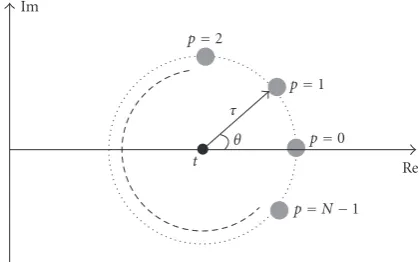
As illustrated in Figure 3, the discrete version of (11) is
defined forθ=2π p/Nandp=0,. . .,N−1, whereNis the
number of discrete values of the angleθ(expression (12)).
φ(K)(t)= K! NτK
N−1
p=0
φt+τej(2π p/N)e−j(2π pK/N) +ε, (12)
whereεis the discretization error.
Using the property of the unitary roots ωN,p = ej2π p/N
and the variable changeτ ← Kτ(K!/N), the expression (12)
becomes (cf.Appendix A)
N−1
p=0 φ
⎛ ⎝t+ωN,p
K
τK! N
⎞ ⎠ωN−K
N,p =φ(K)(t)τ+Q(t,τ), (13)
whereQis the spread function defined as [9]:
Q(t,τ)=N +∞
r=1
φ(Nr+K)(t) τ Nr/K+1
(Nr+K)!
K! N
Nr/K+1
. (14)
As indicated by (13) and (14), the sum of the phase
samples defined in the complex coordinates (left side of
(13)) islineardepending onτ if theφ’s derivates of orders
define the generalized complex-lag moment (GCM) ofsas
the operation leading to (13):
GCMKN[s](t,τ)= N−1
p=0 sωN−K
N,p
⎛
⎝t+ωN,pK
τK! N
⎞ ⎠
=ejφ(K)(t)τ+jQ(t,τ).
(15)
The computation of GCMs implies the evaluation of signal samples at complex coordinates. This is achieved using the
analytical continuation of a signal defined as [9]
st+jm=
+∞
−∞S
fe−2πm fej2π f tdf, (16)
whereS(f) is the Fourier transform of signals. Taking the
Fourier transform of GCM with respect toτ, we define the
generalized complex-lag distribution (GCD):
GCDKN[s](t,ω)=Fτ
GCMKN[s](t,τ)
=δω−φ(K)(t)∗
ωFτ
ejQ(t,τ). (17)
As stated by this definition, theKth order distribution of the
signal, obtained forNcomplex-lags, highly concentrates the
energy around theKth order derivate of the phase law. This
concentration is optimal if theφ’s derivates of orders greater
thanN+Kare 0, exactly like in the case of chirps represented
by Wigner distribution.
The general definition (17) leads to a large number of
TF Representations (TFRs), part of them well known in
literature. For example, for K = 1; N = 2 the WVD
is obtained (Section 2.1), whereas the case K = 1; N =
4 corresponds to the complex-time distribution (CTD) (Section 2.2). In [5], we have shown that increasing the number of complex lags leads to an attenuation of inner interferences due to the time-frequency nonlinearity. This is
illustrated by the example inFigure 4for the following test
signal having a transient-behavior TF structure:
s1(t)=ej(3 cos(πt)+cos(3πt)+(2/3) cos(6πt)+(1/3) cos(9πt)). (18)
We remark the better concentration of time-frequency
energy in the case of GCD16than in the case of the other TFRs.
This is analytically proved by the spread function expression
(14) and illustrated by the example inFigure 4.
The next example (Figure 5) points out the derivability
property of GCD. The signal s2 used in this example is a
train of three frequency modulations (FM) corrupted by
some additive noise (SNR=35 dB). The three FM have short
duration (two linear FM s2−1 ands2−3 in phase opposition
defined on 128 samples and one parabolic FMs2−2 defined
on 64 samples) compared to the analysis time frame (1510 samples). Their analytical expressions are given by:
s2−1(t)=ejφ2−1(t)=ej(c0+c1t+c2t 2
),
s2−2(t)=ejφ2−2(t)=ej(d0+d1t+d2t 2+d3t3
),
s2−3(t)=s2∗−1(t)=ejφ2−3(t)=e−j(c0+c1t+c2t 2)
.
(19)
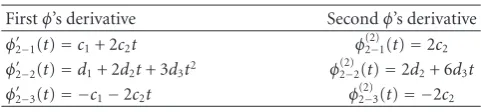
Table1: Expressions of the first and second phase derivatives.
Firstφ’s derivative Secondφ’s derivative
φ2−1(t)=c1+ 2c2t φ(2)2−1(t)=2c2
φ2−2(t)=d1+ 2d2t+ 3d3t2 φ(2)2−2(t)=2d2+ 6d3t
φ2−3(t)= −c1−2c2t φ2(2)−3(t)= −2c2
Such signal could correspond to a received signal from
two different radars using linear and parabolic FM
wave-forms, respectively (Figure 5(a)). The derivability capability
of GCD is used here to enable the characterization of
tran-sient natures which would be more difficult using just
time-frequency representation because of confusing TF signatures.
As shown inFigure 5(b)and expressed inTable 1, the two
linear FM have their well-expected TF structure whereas the transient parabolic FM looks like a chirp in the TF plane.
This is because of the short duration effect on the large frame
of analysis. We can observe that the linear and parabolic shapes of the FM are not easily distinguishable. The parabolic shape appears to be linear. Without a priori knowledge about the signal, the TF representation alone leads to consider three transients of chirp nature which is actually wrong. To point
out the true nature of the parabolic FM, the GCD26is used. As
analytically proved by the equations inTable 1, considering
the second-order phase derivative allows to stationarize the linear FM and gives a linear signature for the parabolic FM (Figure 5(c)).
The TF rate representation plane avoids the previous confusion.
3. Transients Detection by Wavelets and
Higher-Order Statistics, Spectrogram and
Complex-Lag Distribution
In this section, we compare the phase derivative capabilities of GCD, in the context of transients detection, with the wavelet transform and time-frequency based methods. The signal used in this section comes from a reflectometry study using a Gaussian pulse emission in electric cables. Reflectometry is used to analyze and control anomalies in electric cables. A signal is emitted at one extremity of the cable and during its propagation when there is a fault at some point of the cable, a part of the emitted signal, amplitude is reflected due to the impedance discontinuity at this point. The reflected part of the signal comes back to the cable extremity point. The aim of the reflectometry study is to detect and localize the faults by analyzing the signal at the emission point after its propagation and reflections. In our case, a Gaussian pulse is used as emission signal at the entry point of a cable network. The cable network
corresponds here to two different cables separated by a
junction (Figure 6). During the propagation in the line “cable
1-junction-cable 2”, the pulse is reflected at junction points P2 and P5, faults points if there are some, and end of line
point P6. As illustrated inFigure 7, the overall analyzed signal
is composed by the original emitted pulse and the reflected
−50 −40 −30 −20 −10 0 10 20 30 40 50
F
req
uency
(bins)
0 50 100 150 200 250 Time (samples)
WVD
(a)
−50 −40 −30 −20 −10 0 10 20 30 40 50
F
req
uency
(bins)
0 50 100 150 200 250 Time (samples)
CTD
(b)
−50 −40 −30 −20 −10 0 10 20 30 40 50
F
req
uency
(bins)
0 50 100 150 200 250 Time (samples)
GCD1 6
(c) Figure4: Inner interferences reduction property of GCD.
−2.5 −2 −1.5 −1 −0.5 0 0.5 1 1.5 2 2.5
0 500 1000 1500
(a) Real part of signal
−1.5 −1 −0.5 0 0.5 1 1.5
Fre
q
u
en
cy
0 500 1000 1500 Time
(b) GCD1 2
−3 −2 −1 0 1 2 3
Fre
q
u
en
cy
ra
te
0 500 1000 1500 Time
Parabolic FM
(c) GCD2 6
P1 P2 P3 P4 P5 P6 Cable 1 Junction Cable 2
Figure6: Configuration scheme with two cables separated by one junction.
−0.2 0 0.2 0.4 0.6 0.8 1 1.2
0 200 400 600 800 1000 1200 1400 1600 1800 2000 Samples
Figure7: Total signal obtained at the cable entry point P1.
phase shifts. Figure 8 explains more precisely how the
different transients composing the signal are matched to
the propagation of the emitted pulse in the cable network physical system.
3.1. Method of Higher-Order Statistics and Wavelets. Higher-order statistics measure the non-Gaussianity of a compo-nent. Therefore, for a signal composed of transients with additive white Gaussian noise, HOS allow to detect them by giving high values for transient components that are over-Gaussian and putting to zero the rest of the signal corre-sponding with Gaussian noise. The fourth-order cumulant and the Kurtosis (normalized version of 4th-order cumulant) are the HOS usually considered in time or in frequency. The 4th-order cumulant and time Kurtosis use the signal in time domain and are obtained via estimators calculated from the
signal samples and affected by bias and variance [4]. Their
frequency versions use estimators calculated with the signal
samples in frequency domain, that is,X(ν)=TF[x(t)].
The wavelet transform is widely used for transients detection. Using Discrete Wavelet Transform, the signal is decomposed in a time-scale plane segmented in blocks and representing a wavelets basis. Each block is a basis vector and
corresponds to the main wavelet affected by some delay and
scale factor. The representation obtained by DWT is formed
by wavelet coefficients which are the projections of the signal
on each basis vector. DWT proves its efficiency in transients
detection in so far as wavelets signals are usually very similar to transient signals. Consequently, the DWT distribution gives higher inner products between transients and wavelet basis vectors. Transients are then detected and located where
higher energetical wavelet coefficients are obtained in the
distribution.
In 1996, an efficient method blending the advantages
of both HOS and wavelets was proposed to detect and
localize transient signals with improved performances [5,13,
14]. This method is based on the adapted segmentation of
the time-frequency plane by Malvar wavelets. The criteria used to fit the wavelets for the TF plane segmentation are based on HOS, especially the 4th-order cumulant. The final detection curve corresponds to this 4th-order cumulant calculated at each time-delay regions resulted from the final wavelet distribution optimally segmented in terms of Gaussian and non-Gaussian signal components. This curve will be then normalized for the performance analysis by ROC curves.
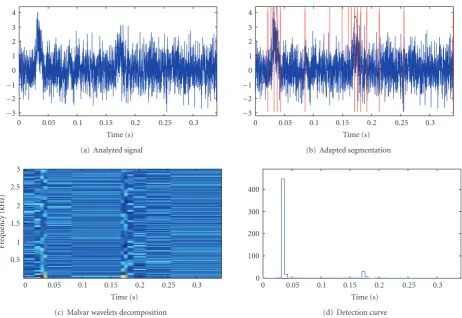
Figures 9 and 10 show the good performances of this
method to detect efficiently transient components embedded
in white Gaussian noise with very low SNR. The two
strongest transients of the signal noised at SNR=−8 db are
as well detected as in the case SNR =30 db. However, the
limitation of this method, in terms of simultaneous detection
ofallthe transitions contained in the signal, is illustrated as
well. With a signal to noise ratio of 30 db, the four transients of the signal are all well visible but, as well as the case
SNR =−8 db for which the transients are highly drowned
in the noise, they cannot be detected in the same time in
an efficient way. This is because of the amplitude difference
between the two highest pulses (from emission and end of line reflection in the cable network) and the two lowest ones. From Figure 8, we know that the two lowest pulses result from the presence of a junction separating the two cables.
As shown inFigure 9, the detection curve gives for the two
low pulses HOS quasi equal to zero relatively with the highest HOS from the other pulses. Consequently, such a detection result leads to consider that we have only the emitted pulse and its reflection at the end of the line but with no presence of a junction. The physical system is therefore badly interpreted.
As illustrated in Figure 11, in terms of ROC curves (cf.
Appendix B), for a threshold equal to zero the detection and false alarm probabilities (Pd and Pfa) are equal to one, but for a threshold higher than zero of just one calculation
step equal to 0.01, the Pd cannot be more than 50%.
However, the Pfa is always quasi equal to zero, even when
SNR is−8 db.
3.2. Method of Spectrogram. In order to eliminate the limita-tions of the Fourier Transform when analyzing nonstationary signals, the idea is to consider the signal as locally stationary on an adapted time frame. The principle is to make the Fourier analysis of successive time blocks of the signal weighted by a time frame (Uniform, Hanning, Hamming . . .). This is equivalent to express the signal by a set of basis
functions localized both in time and frequency [11]:
STFT(xh)
t,f=
Rx(θ)h ∗ t,f(θ)dθ
=
Rx(θ)h
∗(θ−t)e−j2π f θdθ.
(20)
The above expression corresponds to the inner
product between signal x(t) and the basis functions
ht,f(θ) = h(θ − t)e−j2π f θ. The representation resulting
from relation (20) is named the Short Time Fourier
P1 P2 P3 P4 P5 P6 Cable 1 Junction Cable 2
T1 T2 T3 T4 Emitted signal at P1
Total signal obtained at P1 after propagation and reflections
Figure8:T1=emitted pulse at P1;T2=pulse resulting from the reflection at junction point P2 (cable1/junction) ofT1;T3=pulse resulting
from the reflection at end of line point P6 ofT1−T2;T4=pulse resulting from the reflection at P6 of the part ofT3coming from its reflection
at junction point P5 (cable2/junction).
0 1 2 3 4 5 6 7
0 0.05 0.1 0.15 0.2 0.25 0.3 Time (s)
(a) Analyzed signal
0 1 2 3 4 5 6 7
0 0.05 0.1 0.15 0.2 0.25 0.3 Time (s)
(b) Adapted segmentation
0.5 1 1.5 2 2.5 3
Fre
q
u
en
cy
(k
H
z)
0 0.05 0.1 0.15 0.2 0.25 0.3 Time (s)
(c) Malvar wavelets decomposition
0 0.5 1 1.5 2 2.5 3 3.5 ×10⁴
0 0.05 0.1 0.15 0.2 0.25 0.3 Time (s)
(d) Detection curve Figure9: Detection of transient components by adapted wavelet analysis; SNR=30 db.
of a signal is a complex values representation. For this reason, its square modulus is generally represented and used as a traditional Time-Frequency (TF) distribution.
This distribution is named the Spectrogram [11]. The
spectrogram as well as the STFT considers actually the whole nonstationary signal as a succession of short quasi-stationary signals defined on the time domain of the weighting frame
h(u). These TF representations are limited by the Heisenberg
uncertainty principle [11]:
Δt·Δf ≥ 1
4π,
(Δt)2=
+∞
−∞t2|x(t)|2dt
+∞
−∞|x(t)|2dt
, Δf2=
+∞
−∞f2|X(f)|2df
+∞ −∞X
−3 −2 −1 0 1 2 3 4
0 0.05 0.1 0.15 0.2 0.25 0.3 Time (s)
(a) Analyzed signal
−3 −2 −1 0 1 2 3 4
0 0.05 0.1 0.15 0.2 0.25 0.3 Time (s)
(b) Adapted segmentation
0.5 1 1.5 2 2.5 3
Fre
q
u
en
cy
(k
H
z)
0 0.05 0.1 0.15 0.2 0.25 0.3 Time (s)
(c) Malvar wavelets decomposition
0 100 200 300 400
0 0.05 0.1 0.15 0.2 0.25 0.3 Time (s)
(d) Detection curve Figure10: Detection of transient components by adapted wavelet analysis; SNR=−8 db.
0 0.2 0.4 0.5 0.6 0.8 1
Pd
0 0.2 0.4 0.6 0.8 1 Pfa
ROC curve
Figure 11: ROC curve for detection based on Malvar wavelet adapted segmentation.
whereΔtandΔf are respectively the distribution resolution
in time and frequency. This uncertainty principle means that the distribution cannot have in the same time good resolution in time and frequency. These two parameters are
antagonistic and there is always a trade-offto do between
time and frequency resolutions.
The methodology of detection based on spectrogram consists in calculating the spectrogram distribution of
the reflectometry signal (Figure 7). Our study focuses on
detection and localization of transient signals which are, by definition, short in time and large band in frequency. The spectrogram is consequently calculated using a very
short frame h(u) in order to have a good resolution in
time resulting in a limited resolution in frequency which
is not actually problematic (Figure 12). A good resolution
in time is moreover suitable and necessary in so far as two transient components of the signal can be very close. The
final detection curve DCSpectro(t) corresponds to the curve
of maxima of each column of the obtained distribution. This curve will be then normalized for the performance
analysis by ROC curves. As illustrated in Figure 12(a), the
spectrogram of the reflectometry signal gives high energetical values where transients occur, and we can note that the energy signatures of the two small energy transients (samples
600 and 1450) are not visible. Thus, for SNR = 30 db
(the signal is the same as Figure 9(a)) the detection curve
represented in Figure 12(b) shows that the two strongest
pulses are well detected whereas the two lowest ones are not significantly detected. Only the low transient at sample 600 gives a very weak detection signature. As well as in Section 3.1, the two low pulses, associated with the presence of a junction in the system, have an amplitude much weaker than the other pulses. Their energy is consequently masked in the distribution by the higher energy of the other transients.
This detection based on spectrogram, as well as the
500 1000 1500 2000
F
req
uency
(bins)
200 400 600 800 1000 1200 1400 1600 1800 2000 Time (samples)
(a)
0 1 2 3 4 5 6
0 200 400 600 800 1000 1200 1400 1600 1800 2000 Time (samples)
(b)
Figure12: (a) Spectrogram of the reflectometry signal noised at SNR=30 db; (b) associated detection curve.
500 1000 1500 2000
F
req
uency
(bins)
0 200 400 600 800 1000 1200 1400 1600 1800 2000 Time (samples)
(a)
02 4 6 8 10 12 14
0 200 400 600 800 1000 1200 1400 1600 1800 2000 Time (samples)
(b)
Figure13: (a) Spectrogram of the reflectometry signal noised at SNR=−8 db; (b) associated detection curve.
be robust to noise. For SNR=−8 db, the signal in time (the
same asFigure 10(a)) is highly corrupted and the transients
contained in the signal are strongly drowned in the noise.
As illustrated in Figure 13(a), the distribution obtained by
spectrogram still gives well visible high energetical signatures for the two strongest pulses. The energy of the two low pulses remains masked in the distribution and the noise is spread on the whole TF plane. The noisy detection curve represented in Figure 13(b)leads to a good detection of the two main transients, whereas the two weak pulses are totally drowned
in the noise. This second method has the same efficiency
limitations as the one presented inSection 3.1in terms of
simultaneous detection of all the transitions contained in the
signal. As illustrated inFigure 14, in terms of ROC curves
(cf.Appendix B), for a threshold equal to zero the Pd and the Pfa are equal to one. For a threshold higher than zero of just
one calculation step equal to 0.01, the two main pulses and
0 0.2 0.4 0.5 0.6 0.075.8 1
Pd
0 0.2 0.4 0.6 0.8 1 Pfa
ROC curve
Figure 14: ROC curve for detection by spectrogram for SNR= 30 db.
−0.5 0 0.5 1 1.5
0 200 400 600 800 1000 1200 1400 1600 1800 2000 Time (samples)
(a) Reflectometry signals
−2 0 2 4
0 200 400 600 800 1000 1200 1400 1600 1800 2000 Time (samples)
(b) instantaneous phase law
Figure15: (a) Reflectometry signals; (b) instantaneous phase law of the analytic signal associated tos.
the first small one are detected. The Pd is consequently of 75%. However, for higher threshold the Pd cannot be more than 50% because only the two main pulses can be detected.
3.3. Method of Complex-Lag Distribution. The Generalized
Complex-time Distribution (GCD) presented inSection 2.3
represents an efficient phase analysis tool. Using directly the
signal samples, enables to give highly concentrated repre-sentations of any instantaneous phase derivatives, indepen-dently of the signal amplitude. Using this concept, another methodology of transients detection and localization can be defined. This methodology is based on the analysis of the
signal instantaneous phase. It allows to detect efficiently and
in the same time one or several transients contained in a signal. The transients are detected via the phase discontinuity they cause in the instantaneous phase and consequently with no regard to their amplitude.
−0.15 −0.05 0.05
Fre
q
u
en
cy
0 200 400 600 800 1000 1200 1400 1600 1800 2000 Time (samples)
(a)
−1 0 1
Fre
q
u
en
cy
0 200 400 600 800 1000 1200 1400 1600 1800 2000 Time (samples)
(b)
0 2 4 6
Fre
q
u
en
cy
0 200 400 600 800 1000 1200 1400 1600 1800 2000 Time (samples)
(c)
Figure16: (a) Theoretical instantaneous frequency law (IFL) ofs; (b) IFL obtained by GCD for SNR=30 db; (c) associated detection curve.
As shown inFigure 15(a), signals is composed of four
transients with two of them having a very low amplitude comparing to the others. This disparity “strong amplitude— weak amplitude” between the transients of the signal makes
difficult the simultaneous detection of all of them, as
explained in Sections3.1and3.2. The two weakest pulses do
not give significant signatures and are missed in detection by classical tools (HOS, wavelets, spectrogram). This limitation in detection leads to a bad interpretation of the system which will be considered as a cable line without junction. According toFigure 15(b), analyzing the phase of the signal proves its interest in so far as the four phase breaks due to the four transients have the same importance. The analytic signal
associated to thereal valuessignalsis used here.
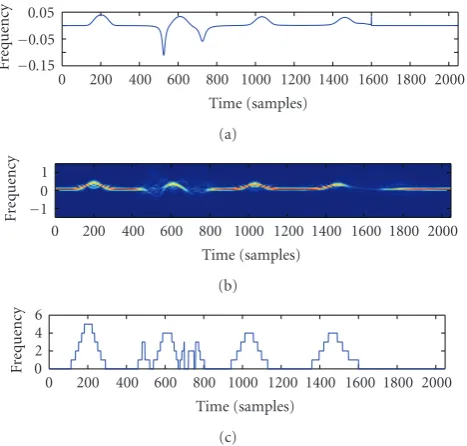
Figure 16(a) represents the theoretical instantaneous
frequency law (IFL) of s obtained by first derivation of
the theoretical instantaneous phase law. As illustrated in Figure 16(b), the GCD calculates, using directly the signal samples, the representation of the IFL. This representation is very well concentrated around the theoretical law to
analyze. The final detection curve DCGCD(t) used in this
methodology comes from the curve of positions in frequency of the maximum value of each column of the obtained distribution. As the distribution obtained by GCD is well concentrated around the IFL, the argmax curve obtained is also very close to the theoretical law. The modulus of the argmax curve defines the detection curve represented in Figure 16(c). On this curve (22), all the transients are well detected with the same importance via pulse signatures resulting from the derivation of the phase discontinuities. This curve will be normalized for the performance analysis by ROC curves.
DCGCD(t)=Arg maxfGCD
t,f. (22)
−2 2 6
0 200 400 600 800 1000 1200 1400 1600 1800 2000 Time (samples)
(a)
−1.5 −0.5 0.5 1.5
Fre
q
u
en
cy
0 200 400 600 800 1000 1200 1400 1600 1800 2000 Time (samples)
(b)
0 2 4 6
Fre
q
u
en
cy
0 200 400 600 800 1000 1200 1400 1600 1800 2000 Time (samples)
(c)
Figure17: (a) Signalsnoised at SNR=20 db; (b) IFL obtained by GCD; (c) associated detection curve.
Unlikely to adapted wavelets and spectrogram analysis, phase analysis is sensitive to noise. Adapted wavelets and spectrogram can detect only the two main pulses giving consequently probability of detection not more than 50% but a false alarm rate always quasi equal to zero even for very low SNR. On the opposite, detection by phase analysis allows to detect, on the same signal realization, all the transients
of the signal in spite of their differences. But, as shown
by Figures 17 and 18, for decreasing SNR, the sensitivity
to noise of the phase analysis involves an increasing false alarm rate. However, in terms of detection performances
illustrated by ROC curvesFigure 19, this method allows to
reach probabilities of detection which remain equal to one until very high threshold and for very low false alarm rates (cf.Appendix B).
4. Conclusion
In this paper, three methods for transients detection and localization have been presented in the case of an analyzed signal composed of several transients. All the transients contained in the signal result from a common physical
phenomenon but are marked by strong differences between
one another, in terms of difference of amplitude or phase
shift. In such a context, a method by phase analysis using the tool of Generalized Complex-time Distribution proves its advantages. In terms of phase, the transient signatures by phase breaks remain all in the same way more significant than the ones obtained by consideration of energetical or statistical criteria. ROC curves illustrating and comparing the
performances of the different methods lead to consider the
−2 2 6
0 200 400 600 800 1000 1200 1400 1600 1800 2000 Time (samples)
(a)
−1.5 −0.5 0.5 1.5
Fre
q
u
en
cy
0 200 400 600 800 1000 1200 1400 1600 1800 2000 Time (samples)
(b)
0 2 4
Fre
q
u
en
cy
0 200 400 600 800 1000 1200 1400 1600 1800 2000 Time (samples)
(c)
Figure18: (a) Signalsnoised at SNR=10 db; (b) IFL obtained by GCD; (c) associated detection curve.
0 0.2 0.4 0.6 0.8 1
Pd
0 0.2 0.4 0.6 0.8 1 Pfa
ROC curves
GCD 30 dB GCD 20 dB GCD 10 dB
Figure19: ROC curves for detection by GCD for decreasing SNR.
HOS methods remain preferable in spite of their efficiency
limitation to detectallthe transients of the signal.
This work about detection and localization performances represents the first step of a more complete study concerning the analysis of transients. A next step would be to characterize the transient signal. It means to be able to match a transient and its characteristics to a particular phenomenon. The
Generalized Complex-time Distribution tool offers access
to any derivative order of the phase law of a signal. Using this derivability property could lead to characterization via analysis of the successive phase derivates of a signal
composed of several transients of different nature.
Appendices
A. Derivation of the Spread
Function Expression
The final spread function expression is obtained as follows. We start by considering the discrete version of Cauchy’s
integral formula expressed inSection 2.3equation (12). By
using the unitary roots notationωN,p=ej2π p/N, this equation
becomes
φ(K)(t)Nτ K
K! = N−1
p=0
φt+ωN,pτ
ω−NK,p+ε
NτK
K! . (A.1)
The unitary rootsωN,pverify the following property:
N−1
p=0 ωk
N,p=
⎧ ⎨ ⎩
N, ifk=0 (modN)
0, otherwise. (A.2)
Using the Taylor series expansion ofφand the property
expressed in (A.2), we obtain
N−1
p=0
φt+ωN,pτ
ω−K N,p=
N−1
p=0
⎛ ⎝+∞
u=0 φ(u)(t)τ
uωu N,p
u!
⎞ ⎠ω−K
N,p
= +∞
u=0
cf.(A.2)
⎛ ⎝N−1
p=0 ωNu−,pK
⎞
⎠φ(u)(t)τu u!
= +∞
r=0
Nφ(Nr+K)(t) τNr+K
(Nr+K)!
=φ(K)(t)NτK
K! +Q(t,τ).
(A.3)
As a result of (A.1) and (A.3), it follows that the error
term expression is
Q(t,τ)= −εNτ
K
K! =N +∞
r=1
φ(Nr+K)(t) τNr+K
(Nr+K)!. (A.4)
Applying the variable changeτ ← Kτ
(K!/N) makes
lin-ear, comparing to variableτ, theKth order phase derivative
term. As a result of this variable change inserted in expression
(A.4), the final expression of the spread function is obtained
as
Q(t,τ)=N +∞
r=1
φ(Nr+K)(t) τNr/K+1
(Nr+K)!
K! N
Nr/K+1
. (A.5)
B. ROC Curves Calculation
The detection and false alarm probabilities Pd and Pfa are calculated through a statistical estimation based on a
significant set of realizations of the noised signal. LetNbe
(i) Detection probability Pd : each realization of the signal with additive random noise is composed of
T transients at known instants. On the detection
curve resulted from the chosen method, we calculate
qi corresponding to the number of good detections
for each realizationiand for a set threshold η. The
detection criteria (i.e., statistic of detection> η) are
checked on each block of the T transients, which
enables a number of maximumTgood detections per
realization. The Detection Probability is estimated as
#
Pd=
$N i=1qi
T×N. (B.6)
(ii) False alarm probability Pf a : for each realizationi,
we calculaterithe number of detection curve samples
(transients blocks excluded), where the detection
cri-teria are checked. LetLbe the length of the detection
curve andLBlockthe length of eachT transients time
domain block. The False alarm Probability for a set
thresholdηis estimated as
#
Pf a=
$N i=1ri
(L−T×LBlock)×N. (B.7)
Each point (Pd;Pf a) of the ROC curves is obtained for a
set threshold value. The final ROC curves must be calculated
on a significant number of points. The threshold valueηis
varying here from 0 to 1 per step of 0.01, which involves ROC
curves composed of 101 calculation points (Pd;Pf a).
C. GCD Calculation Cost
The GCD complexity depends on the time and frequency resolutions of the distribution, that is, the length of the signal
and the range of lagτ. As expressed in equation (15), the
GCM is obtained by calculating, for eachτ, a product ofN
complex-lagged signals. Each of these signals is obtained by
the analytical continuation (16) and involves the calculation
cost of an Inverse Fast Fourier Transform (IFFT matlab algorithm). Once the GCM is obtained, the GCD is obtained by Fast Fourier Transform (FFT matlab algorithm) with
respect to τ at each time sample (cf. equation (17)). The
GCD calculation cost is the one of multiple FFT and IFFT. It remains fast.
Acknowledgments
This work was supported by the French project PHC Pelikan. The signals of reflectometry come from a software simulating the propagation of Gaussian pulses in power cables, work realized by the Research and Development site of EDF in Paris with the participation of Guy D’Urso and Thierry Espilit.
References
[1] Z.-H. Michalopoulou, “Underwater transient signal process-ing: marine mammal identification, localization, and source
signal deconvolution,” in Proceedings of the IEEE Interna-tional Conference on Acoustics, Speech, and Signal Processing (ICASSP ’97), vol. 1, pp. 503–506, Munich, Germany, April 1997.
[2] C. Duxbury, M. Davies, and M. Sandler, “Separation of transient information in musical audio using multiresolution analysis techniques,” in Proceedings of the COST G-6 Con-ference on Digital Audio Effects, Limerick, Ireland, December 2001.
[3] F. Leonard, D. Fournier, and B. Cantin, “On-line location of partial discharges in an electrical accessory of an underground power distribution network,” inProceedings of the Interna-tional Conference on Insulated Power Cables (JICABLE ’07), Paris, France, 2007.
[4] J. L. Lacoume, P. O. Amblard, and P. Comon,Higher Order Statistics for Signal Processing, Masson, Paris, France, 1997. [5] P. Ravier and P.-O. Amblard, “Combining an adapted wavelet
analysis with fourth-order statistics for transient detection,” IEEE Transaction on Signal Processing, vol. 70, no. 2, pp. 115– 128, 1998.
[6] A. Papandreou-Suppappola, Ed., Applications in Time-Frequency Signal Processing, CRC Press, Boca Raton, Fla, USA, 2003.
[7] A. Quinquis, “A few practical applications of wavelet packets,” Digital Signal Processing, vol. 8, no. 1, pp. 49–60, 1998. [8] Lj. Stankovi´c, “Time-frequency distributions with complex
argument,”IEEE Transactions on Signal Processing, vol. 50, no. 3, pp. 475–486, 2002.
[9] C. Cornu, S. Stankovi´c, C. Ioana, A. Quinquis, and Lj. Stankovi´c, “Time-frequency distributions with generalized complex lag argument,”IEEE Transactions on Signal Processing, vol. 55, no. 10, pp. 4831–4838, 2007.
[10] N. Ravot, J. Cohen, P. Chambaud, and CEA, “Method and device for analyzing electric cable networks,” World Organization of Intellectual Property, WO 2008/009566 A2, January 2008.
[11] L. Cohen,Time-Frequency Analysis, Pretince-Hall, Englewood Cliffs, NJ, USA, 1995.
[12] W. Rudin,Real and Complex Analysis, McGraw Hill, Boston, Mass, USA, 1987.
[13] P. Ravier and P. O. Amblard, “Using Malvar wavelets for tran-sient detection,” inProceedings of the IEEE-SP International Symposium on Time-Frequency and Time-Scale Analysis, pp. 229–232, Paris, France, June 1996.