
H
IGH
-P
ERFORMANCE
P2P-
BASED
D
ATA
T
RANSFER
IN
S
CIENTIFIC
C
OMPUTING
for the degree Doctor of Philosophy
in the Department of Computer Science, Indiana University
Doctoral Committee _______________________________ Prof. Geoffrey C. Fox (Principal Advisor)
________________________________ Prof. Dennis Gannon
________________________________ Prof.
________________________________ Prof.
Abstract
With the advances in network bandwidth, computational power, memory capabilities, and the development of new storage technologies, computational science has been evolving over the past few years into data intensive computing. In contrast to this evolvement, TCP – Transmission Control Protocol has remained to be the most commonly used protocol for data transfer. TCP is unsuitable for moving large volume of data sets across the networks particularly for wide area networks (WANs) because of the default TCP settings on most hosts, which are configured to deliver reasonable data transfer performance -instead of optimal performance- both on Ethernet local area networks (LANs) and on WANs. Therefore, in order to circumvent the performance drawbacks over wide area high-speed networks originating from window-based congestion control mechanism of TCP and its default settings, different solutions have been proposed over the years. However, most of these solutions are based on client/server paradigm; thus, they are focused on improving the performance of data transmission between the sender and the receiver. When there are multiple receivers which are interested in the same data sets, which is very common in scientific computing, this approach fails to ameliorate the performance of bulk data transfer between the receivers.
Table of Contents
Chapter 1 - Introduction...1
1.1 Motivation...4
1.2 Use Cases...5
1.3 Research Issues...6
1.4 Contributions...7
1.5 Organization of the Thesis...9
Chapter 2 - Literature Survey...12
2.1 Introduction...12
2.2 Overview...14
2.3 System-level Data Movement Techniques...16
2.4 Application-level Data Movement Techniques...17
2.4.1 TCP -based Data Movement Techniques...17
2.4.1.1 GridFTP...18
2.4.1.2 GridHTTP...22
2.4.1.3 bbFTP...22
2.4.1.4 The BaBar Copy Program (bbcp)...23
2.4.2 UDP -based Data Movement Techniques...23
2.4.2.1 Simple Available Bandwidth Utilization Library (SABUL)...24
2.4.2.2 UDP-based Data Transfer Protocol (UDT)...24
2.4.2.5 Tsunami...26
2.4.2.6 UFTP...27
2.5 Peer-to-Peer based Data Movement Techniques...27
2.5.1 BitTorrent...30
2.6 Network-level Data Transfer Techniques...34
2.7 Discussion...38
Chapter 3 - The GridTorrent Framework Architecture...40
3.1 The Overview of the GridTorrent Framework...40
3.2 Main Components of the GridTorrent Framework...42
3.3 Summary...47
Chapter 4 - The GridTorrent Framework Client Architecture...48
4.1 Introduction...48
4.2 Overview of the GridTorrent Framework Client Architecture...50
4.3 Torrent Data Sharing Logic...52
4.4 Core Modules Layer...53
4.4.1 Data Transfer Modules...53
4.4.2 Management Modules...55
4.4.2.1 Task Manager...56
4.4.2.2 WS-Tracker Client...56
4.5 Security Manager...58
4.6 Task Generation and Exchange...59
4.6.1.3 Share Content Response Task...65
4.6.1.4 Download Content Request Task...66
4.6.1.5 Download Content Response Task...66
4.6.1.6 Access Control List Request Task...68
4.6.1.7 Access Control List Response Task...69
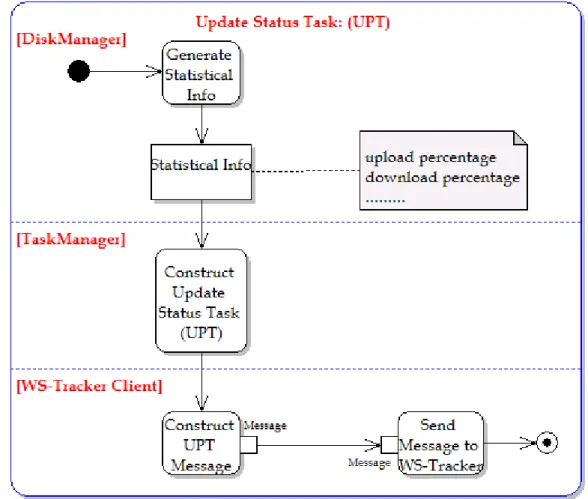
4.6.1.8 Update Status Task: (UPT)...70
4.7 Summary...71
Chapter 5 - Asynchronous Collaboration and Content Management Architecture....72
5.1 Introduction...72
5.2 The concept of Asynchronous Collaboration and Content Management...73
5.2.1 Definition of term “Asynchronous Collaboration”...73
5.2.2 Definition of term “Content” and “Content Management”...74
5.2.3 Requirements...74
5.3 Related Work...75
5.4 Access Control Schemes...81
5.5 The Collaboration and Content Management...83
5.5.1 Objects of the System...85
5.5.2 Services of the System...87
5.5.5 Content Management Module...93
5.6 Summary...94
Chapter 6 - WS-Tracker Architecture...95
6.1 Introduction...95
6.2 Web Service...97
6.3 WS-Tracker Service...100
6.3.1 Multiple Trackers...102
6.3.2 Fault Tolerance...103
6.3.3 Security...105
6.4 Summary...106
Chapter 7 - Security Modules and Issues of GridTorrent Framework...107
7.1 Introduction...107
7.2 The Grid Security Infrastructure (GSI)...110
7.2.1 History of the GSI...110
7.2.2 Overview of the Grid Security Infrastructure...111
7.2.3 GT4 WS Security...112
7.3.1 Security at Collaboration and Content Manager (CCM)...117
7.3.2 Security at WS-Tracker Service...120
7.3.3 Security between GTF Clients...121
7.4 Dealing with Various Attack Scenarios...123
7.4.1 Man-in-the-middle Attacks...123
7.4.2 Replay Attacks...124
7.4.3 Denial of Service Attacks...124
7.4.4 Non-Repudiation...125
7.5 Summary...125
Chapter 8 - Performance Evaluation...126
8.1 Introduction...126
8.2 PTCP Architecture...129
8.3 LAN Test...130
8.3.1 Scenario I: Testbed...132
8.3.2 Scenario I: LAN Test Result...134
8.3.3 Overhead...137
8.4.2 Scenario II: Test Result...144
8.4.3 Overhead...148
8.5 Multi-nodes...152
8.6 Summary...159
Chapter 9 - Conclusions and Future Work...160
9.1 Conclusion...160
9.2 Summary of Answers for Research Questions...161
9.2.1 How can we build a peer-to-peer data transfer mechanism which utilizes SOA for scientific community? Which one of available peer-to-peer system is best for this purpose and what type of modifications and new features are needed to be added to it?...162
9.2.2 How can we provide a medium that allows participants to manage, share, discover, and download their contents and integrate it with data transfer mechanism?...162
9.2.3 Is the data transfer mechanism scalable?...163
9.2.4 How is the performance of data transfer mechanism and it is acceptable?...164
9.2.5 What is the overhead of this system and is it reasonable?...164
9.2.6 How can we make it enough secure for scientific community as security is not a concern in peer-to-peer to networks for non-scientific community?...165
9.4.1 Data Transfer Component...167
9.4.2 WS-Tracker Service...167
9.4.3 Asynchronous Collaboration and Content Management...168
List of Tables
Table 4-1 Tasks Overview...60
Table 4-2 Presentation of Task List Request Task in XML format...63
Table 4-3 Illustration of Share Content Request Task in the XML message...64
Table 4-4 Representation of Share Content Response Task in the form of XML
message...66
Table 4-5 An example of Download Content Request Task in XML format...66
Table 4-6 Illustration of Download Content Response Task in the XML message67
Table 4-7 Presentation of Torrent Data Task in XML format...67
Table 4-8 Representation of Torrent No Data Task in the form of XML message68
Table 4-9 Illustration of Access Control List Request Task in the XML message.68
Table 4-10 An example of Access Control List Response Task in XML format....70
Table 4-11 Presentation of Update Status Task in XML format...70
Table 5-1 Partial List of Sakai 2.5 Tools...79
Table 5-2 Overview of objects used in the Collaboration and Content Manager. .86
Table 5-3 Summary of services used in the Collaboration and Content Manager.88
Table 8-1 Server and client machines’ descriptions and their locations...128
Table 8-2 Performance characteristics of Iperf, PTCP disk-to-disk and PTCP
memory-to-memory with various parallel streams or sources on LAN
...134
Table 8-3 Bandwidth utilization of GridTorrent with various parallel streams and
seeds for useful data transmission on LAN...135
Table 8-4 Bandwidth utilization of GridTorrent including overhead with various
parallel streams and seeds on LAN...138
Table 8-5 Performance characteristics of Iperf, PTCP disk-to-disk and PTCP
memory-to-memory with various parallel streams or sources on WAN
...145
Table 8-6 Bandwidth utilization of GridTorrent with various parallel streams and
seeds for useful data transmission on WAN...146
Table 8-7 Bandwidth utilization of GridTorrent including overhead with various
parallel streams and seeds on WAN...149
Table 8-8 Transmission sequence matrix of PTCP...156
List of Figures
Figure 3-1 GridTorrent Framework is composed of a client, a Web Service
Tracker, and a Collaboration and Content Manager. Each component
communicates with another one via different protocols such as HTTP,
TCP, and PTCP...44
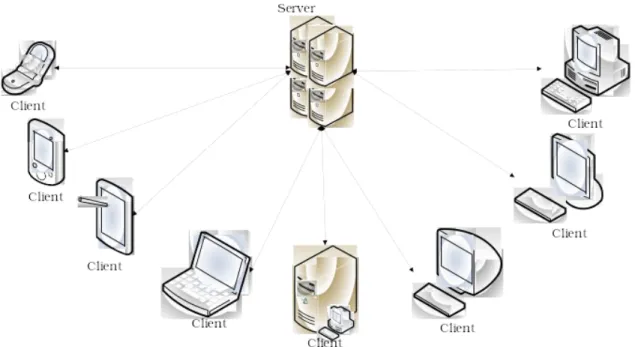
Figure 4-1 Client/Server model...50
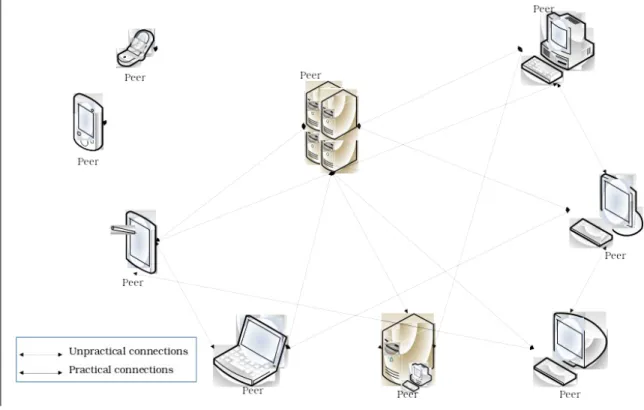
Figure 4-2 Peer-to-peer model...51
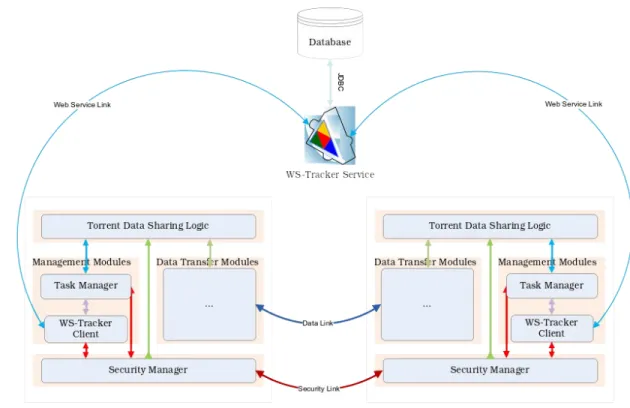
Figure 4-3 GridTorrent Framework Client Architecture...52
Figure 4-4 Simulation Architecture...54
Figure 4-5 Representation of XML schema of Task...61
Figure 4-6 Activity diagram of GTF’s tasks...62
Figure 4-7 Processes workflow of share content request task and share content action task...65
Figure 4-8 Access Control List (ACL) request task's processes workflow...69
entities of the GridTorrent Framework...84
Figure 5-2 Anatomy of the Collaboration and Content Management module...85
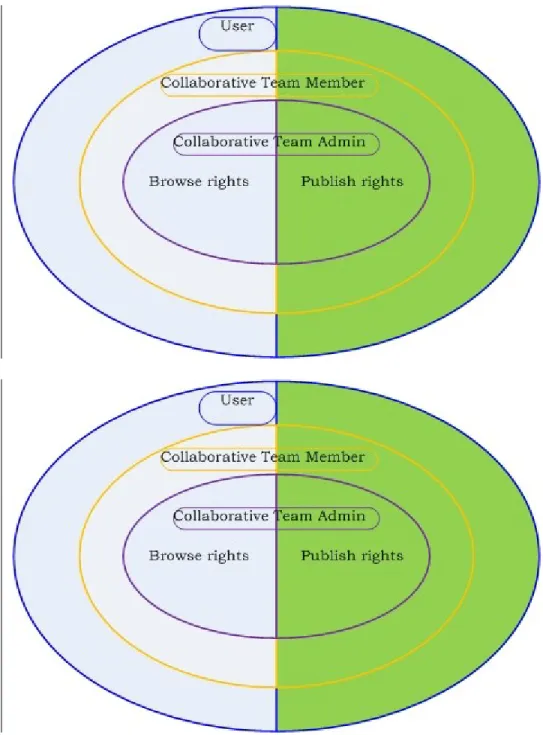
Figure 5-3 Possible roles and rights in the Collaboration and Content
Management Module...91
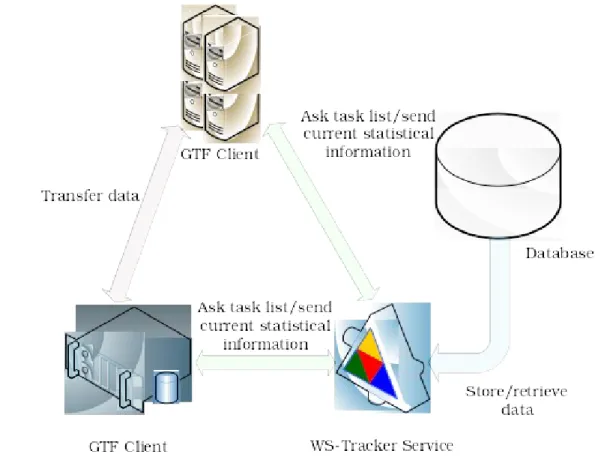
Figure 6-1 The flow of information between a user and GTF Peer through Content
and Collaboration Manager and WS-Tracker service...100
Figure 6-2 Message flow between GTF peers via WS-Tracker Service...102
Figure 7-1 GT4 security protocols from [103]...112
Figure 7-2 All possible interaction among components of GTF require security
services...116
Figure 7-3 Establishing security credentials at Collaboration and Content
Manager Server...118
Figure 7-4 Security Credentials obtaining process between GTF and GSI
components...122
Figure 8-1 A parallel TCP socket architecture...129
Figure 8-2 Client and server configuration for PTCP test case. Server, machine A,
is located at Bloomington, IN, whereas client, machine B, is at
case configuration, regular single Java sockets are used for data transfer
in GridTorrent test case. However, server and client’s configuration and
location is same as that of PTCP test case...133
Figure 8-4 Achieved average data transfer rate of Iperf, PTCP and GridTorrent
with various parallel flows versus the number of seeds on LAN type
computer network (IU-IU settings)...136
Figure 8-5 Achieved average useful data throughput of GridTorrent with various
parallel flows versus the number of seeds on LAN type computer
network (IU-IU settings)...136
Figure 8-6 The ratio of wasted throughput of GridTorrent with various parallel
streams versus the number of seeds on LAN (IU-IU settings)...138
Figure 8-7 Achieved average throughput of GridTorrent with and without
overhead using one stream with various number of seeds on LAN type
computer network (IU-IU settings)...139
Figure 8-8 Achieved average throughput of GridTorrent with and without
overhead using two parallel streams with various number of seeds on
overhead using four parallel streams with various number of seeds on
LAN type computer network (IU-IU settings)...140
Figure 8-10 Achieved average throughput of GridTorrent with and without
overhead using eight parallel streams with various number of seeds on
LAN type computer network (IU-IU settings)...140
Figure 8-11 Achieved average throughput of GridTorrent with and without
overhead using sixteen parallel streams with various number of seeds on
LAN type computer network (IU-IU settings)...141
Figure 8-12 Client and server layout for PTCP test case. Parallel TCP streams
were used for data transfer. Server is located at Bloomington, IN,
whereas client is at Baton Rouge, LA...142
Figure 8-13 GridTorrent test case topology for wide area network test. Similar to
PTCP test case configuration, parallel Java sockets are used for data
transfer in GridTorrent test case. Seeds and peer’s configurations and
locations are same as that of PTCP test case...143
Figure 8-14 Achieved average data transfer rate of Iperf, PTCP and GridTorrent
with various parallel flows or seeds on wide area network (IU-LSU
parallel flows or seeds on WAN (IU-LSU settings)...147
Figure 8-16 The ratio of wasted throughput of GridTorrent with various parallel
streams versus the number of seeds on WAN (IU-LSU settings)...148
Figure 8-17 Achieved average throughput of Iperf vs GridTorrent with and
without overhead using one stream with various number of seeds on
WAN (IU-LSU settings)...149
Figure 8-18 Achieved average throughput of Iperf vs GridTorrent with and
without overhead using two parallel streams with various number of
seeds on WAN (IU-LSU settings)...150
Figure 8-19 Achieved average throughput of Iperf vs GridTorrent with and
without overhead using four parallel streams with various number of
seeds on WAN (IU-LSU settings)...150
Figure 8-20 Achieved average throughput of Iperf vs GridTorrent with and
without overhead using eight parallel streams with various number of
seeds on WAN (IU-LSU settings)...151
Figure 8-21 Achieved average throughput of Iperf vs GridTorrent with and
Figure 8-23 Achieved average aggregated bandwidth of GridTorrent with various
parallel streams versus the number of peers on LAN (IU-IU settings) 157
Figure 8-24 Achieved average aggregated bandwidth of GridTorrent with various
parallel streams versus the number of peers on WAN (IU-LSU settings)
Introduction
“There is nothing permanent except change.” –Heraclitus of Ephesus. This is very true for nearly seventy years of the history of computing systems and computational science. When the first modern computers emerged in 1940, computer systems were so large in size and expensive to build that they had a roomful size and only a few very big companies and institutions were able to afford them. These computer systems operated independently without communicating to each other. In fact, there was no reason to connect them at that time.
The groundbreaking integrated circuit (IC) technology and manufacturing of microprocessors were introduced in the 1970s. IC technology and microprocessor architecture caused manufacture of smaller, faster, more reliable, and cheaper computers. Modern computers based on ICs are enormously more capable but a fraction of the space and price of the first version of IC technology. Another important advancement of the late 1960s and early 1970s was the development several packet switched networking solutions to address the network interoperability problems.
By the 1980s, computers became so affordable, small, and simple that regular people could afford to buy computers for personal purposes and used them at their homes. Nowadays, computers are ubiquities. For example, embedded computers are used in machines ranging from spaceship to industrial robots, digital cameras, children’s toys, and wristwatches. Following the introduction of privately run the Internet Service Providers in the 1980s, the Internet became prevalent which led to invention of high speed computer networks with multitude of connected machines.
The scientific disciplines with the above characteristic are as diverse as high-energy physics and bioinformatics. To exemplify, petabytes of data generated by the Large Hadron Collider (LHC) experiment at European Council for Nuclear Research, Conseil Européen pour la Recherche Nucléaire (CERN), are required to be distributed
worldwide. Another example is that the Pacific Northwest National Laboratory is building new Confocal microscopes with enhanced capabilities. High resolution video of the subject samples, which are typically protein molecules, are provided by these microscopes of which typical use of is multidisciplinary, requiring the data stream to be multicast to multiple scientists at multiple remote institutions. Within 6 months, 625 Mbps of data rates are expected per microscope. In addition to the microscopes, there is a proteomics simulation program that will be generating 5 petabytes of data annually, within the next 5 years [7].
Consequently, bulk data transfer and management have become one of the immensely popular research fields in computational science. Particularly, for wide-area networks (WANs), a lot of work and solutions have been proposed. At the beginning, some of these works had only concentrated on data transmission aspect [8]. Solutions for data catalog and management drew researchers’ attention later. However, proposed systems with regard to data catalog and management were employed for only the data location discovery and they may not be functioning as collaboration framework.
This dissertation is motivated by the need for a Peer-to-Peer based High Performance Data Transfer Framework that effectively combines “Data management
parameters in terms of simplicity, scalability, security, performance, and platform independency; and evaluating the influence these factors on overall infrastructure.
1.1
Motivation
The number of the Internet users greatly increased with the dramatic expansion of the Internet over the past few years. As a consequence, high-performance networks with low-cost and powerful computational machines were proposed. This led to the genesis of new distributed computing infrastructure termed Computational and Data Grid. Computational and Data Grid is the base of large-scale distributed computing
systems by interconnecting geographically distributed computational resources via very high-performance networks [9]. High performance data transfer techniques coupled with collaboration and data management is required for handling widely geographically dispersed data resources. However, existing solutions have shown limitations since most of their systems and unpublished protocols are incompatible with each other and these solutions are usually platform dependent solutions [8].
resource (e.g. network, CPU, storage) usage by exploiting unutilized resources; however, very few efforts have yet been devoted to harness fully peer-to-peer network. Secondly, present data management systems are separate and heavy systems and they are tightly-coupled to their underlying data transfer mechanisms. Administrator tasks which require a great deal of the knowledge have been mainly been performed by people. There is a need for simple and lightweight data management frameworks requiring minimum administrator efforts.
Thirdly, existing data management systems lack collaboration feature. As the large datasets are generated and users of them dynamically distributed, sharing, discovering, and transferring of these datasets are becoming more problematical. To this end, we see a greater need for a collaboration framework that is very valuable and needed for geographically dispersed scientific communities to escalate scientific research output.
Finally, as it is evident that Service Oriented Architecture (SOA) [10] and its current implementation, Web services [11], will have profound impact on the next generation of distributed systems, it would be great opportunity to investigate challenges and benefits of exploiting SOA in a high performance bulk data transfer service.
1.2
Use Cases
Replication: Replication is the process of copying data from one location to another to ensure consistency between redundant resources to improve reliability, fault-tolerance, or accessibility. Data transfer techniques based on peer-to-peer network architecture would convert machines which download data from master-source into active sources and enable to utilize their unused resources, particularly their network bandwidth capacity.
1.3
Research Issues
In this thesis, we describe the design and implementation of a peer-to-peer based high performance data transfer system architecture with data management and collaboration framework. We have thoroughly analyzed the system to determine how the system would respond and have presented benchmarks on different number of peers. A major goal of this thesis is to provide a simple and lightweight data transfer framework from which any size of scientific community would benefit.
We now summarize the research issues we plan to address in this dissertation: 1. How can a peer-to-peer bulk data transfer mechanism that utilizes SOA be
built for scientific communities? Which one of the available peer-to-peer systems is best for this purpose and what type of modifications and new features should be added to it?
2. How can a collaborative medium that allows participants to manage, share, discover, and download their contents be provided and integrated with data transfer mechanism?
3.
Is the data transfer mechanism scalable? 4.
How is the performance of data transfer mechanism and is it acceptable? 5.
6. How can an adequate security mechanism be implemented in this system to meet the requirements of security of scientific communities, as security is not a concern in peer-to-peer networks for non-scientific communities?
1.4
Contributions
In this thesis, the expected contributions can be summarized as following. We
will identify a novel system for collaboration framework for scientific community. We
will also define the minimum set of requirements to build a collaboration framework
dedicated to share and cooperate on users’ data with given access control rights. We
will identify the additional essential features and services needed to be included into the
selected best practice of peer-to-peer systems.
Existing data transfer techniques focus on the problems of aggressive high
performance data transfer rate and do not consider collaboration or optimal use of
resources.
There are some systems used for the data location discovery and they may not
be functioning as collaboration framework. We are going to look into for determining
the features for collaboration framework for scientific environment.
Available high performance oriented data transfer techniques for scientific
computing are broadly categorized File Transfer Protocol (FTP) and Hypertext Transfer
Protocol (HTTP) based techniques. GridFTP [8] is an example of FTP based data
transfer means. GridFTP is not fully portable, due to its implementation, for every
platform; in fact, it is completely deployable only Unix/Linux operating systems
GridHTTP [18], which is implemented by adding new features like authentication and
authorization to HTTP. There are some other techniques; however, they use GridFTP as
the underlying data transfer mechanism.
Peer to peer network structure providing optimal usage of resources is another
technique for data moving. It is utilized as a data transfer method for non-scientific
community to share mainly video, mp3, and game files. We can investigate existing
peer to peer systems to find the most suitable candidate and to decide the essential
features needed to be implemented to render the more suitable peer-to-peer system
utilizable in scientific community by meeting the requirements of scientific data
transfer such as security.
In designing our architecture, we have identified the following requirements to
build a collaborative framework with high-performance peer-to-peer based data transfer
for Scientific Computing. First, the architecture should have a medium to let users to
publish and subscribe to their contents. Second, the architecture should allow users to
create a group or friend list in which they can add other users. Third, the system should
enable users to set access control rights to a specific content for a specific user or
groups due to great sensitivity attribute of scientific data. In order to provide a
collaborative framework satisfying the requirements stated above, there are several
issues that we will study and investigate in building our architecture.
1.5
Organization of the Thesis
prominent peer-to-peer technologies. We will also give an overview of BitTorrent algorithm because it inspired us to implement our data transferring mechanism.
In Chapter three, we give an overview of the overall architecture and explain shortly the main components of proposed system to provide a clear understanding of the whole system.
In Chapter Four, we present the architecture of the first major component of the GridTorrent Framework (GTF), the GridTorrent Peer (GTP). The GTP is responsible for actual data sharing and transfer tasks. It has modular and layered structure so that it can be enhanced and maintained easily effortlessly. Each of its modules and layers is discussed in detail in this chapter.
The details of collaboration and content manager module which is of paramount importance to data sharing and participant cooperation are given in Chapter five. Users can publish (i.e. make their contents available to other users) their contents and subscribe –content download process- to available contents through CCM. Similar to the structure of GTP, the structure of CCM is modular. At the beginning of the Chapter, the big picture of architecture is presented to demonstrate the general idea and principles. Its modules and layers are explored in the remainder of the chapter.
serve for scientific community, it needs to satisfy their requirements such as security and access right control. As a result, it is more advanced than BitTorrent’s regular Tracker. Its architectural details and differences between them are explained in chapter six.
In Chapter seven, we present the security issues and its implementation in the GTF. There are different security requirements at different communications happening between aforementioned components. It is very difficult to deploy all the security protocols, as well as it is availability of myriads of choices. Consequently, we had to choose some of them. We selected the Grid security infrastructure (GSI) as a security frame model to build our security component in GTF because not only do the characteristics of the Grid community fit our targeted user profile, but also it is one of the largest scientific communities in the world. Besides, it is proven, common standard, and its participants are exceptionally diverse and geographically dispersed. At the beginning of Chapter seven, we give short and historical overview of the GSI. The way GSI and other security schemes schemas are followed to implement secure the GTF components are explained in the remainder of the chapter.
and what the limits of the system are in terms of the maximum number of data seeds and clients that can be supported without a significant loss in performance.
Chapter 2
Literature Survey
2.1
Introduction
A basic computer system consists of three fundamental services: data
processing, data storing, and data transferring. Although all of these services are of
equal importance, data transferring is the most appealing, functional and active one
among three of them since it renders the data meaningful and useful by moving it from
one place to another. The distance between the source and the destination of the data
which will be transferred ranges from few millimicrons to a few terrameters [19];
hence, application fields of data transferring are much more diverse than that of others.
of transmission; therefore, these characteristics require different methods and apparatus
for the data transmission. For instance, the size of data at Level1 cache is only few KB
and data loss probability is nearly impossible while transferring data from Level1 cache
to central processing unit (CPU). The transmission time only takes few CPU cycles.
On the other hand, transferring data from one computer to another one on wide area
network may take seconds to hours or maybe days depending on the size of data,
capacity of bandwidth, and physical distance between source and destination.
Another extreme example is data transmission from Voyager 1[19] to Earth.
The Voyager 1 spacecraft, launched on September 5, 1977, is a robotic space probe that
was sent for an expedition to Jupiter, Saturn, Uranus, Neptune and the outer solar
system and beyond. It is over 16 billion kilometers from the Sun as of May 9, 2008. It
returns its data through the Deep Space Network (DNS) with X band transmitter that
provides downlink telemetry at 160 bit/s normally and 1.4 kbit/s for playback of
high-rate plasma wave data. It is expected that Voyager 1 will continue to return valuable
data until at least 2025 [19-21].
Another important example of data transfer technique is utilized in
wide-area-network (WAN) environments and being part of this thesis subject as well. This type of
data transfer has been gaining great importance because of the dramatic expansion of
the Internet in recent years, availability of low-cost high-performance powerful
computational engines, production of huge amount of data –either raw or processed– by
scientific gadgets, and interconnection of geographically distributed computational
resources via very high-performance networks [22]. These factors have given rise to
appearance of Computational Grid resulted in dramatic increase in state-of-the-art high
performance distributed applications.
For high volume data transfer in WAN type of computer networks, a lot of work
and solutions have been proposed. At the beginning, some of these works had only
concentrated on data transmission aspect [8]. Solutions for data catalog and
management drew researchers’ attention later. However, those systems the results of
studies in the area of data catalog and management are utilized for only the data
location discovery and they may not be functioning as collaboration framework.
Although some of these existing data transfer techniques may be considered
successful, most of their systems and unpublished protocols are incompatible with each
other and they are dispersed solutions [8]. Moreover, they focus on the problems of
aggressive high performance data transfer rate and do not take into consideration of
collaboration and optimum use of resources seriously. In addition, they failed to
harness fully newly emerged technology such as peer-to-peer network. As a result,
there is still a need for new solutions to address above requirements.
The objective of this thesis is to leverage data transferring mechanism in
distributed systems for achieving fast and economical data transmission by exploiting
peer-to-peer protocol -BitTorrent algorithm- and providing collaboration framework. In
this chapter, we present an overview of the various strategies relevant to our work.
2.2
Overview
Data-intensive applications have gained widespread attentions and become
information, in terabyte-scale or even petabyte-scale, in wide-area computing
environments [23].
There are many aspects that can be used to categorize data transfer techniques;
the place where they operate, the characteristics of their communication over an IP
structure (e.g., point-to-point, multicast, peercasting), their design architecture (e.g.,
client/server, peer-to-peer), and the characteristics of data that they used for to name a
few. Since the operating place is the relatively broader and the most accepted
perspective, we, as well, categorized them with respect to their operating places.
Data transferring techniques can be deployed at network-level, system-level, or
application-level. The data movement technologies at network-level, as the name
implies, are network-based solutions and they are categorized into NAS and SAN [24].
There are certain similarities between system-level and application-level data transfer
techniques; both of them involve endeavors in order to overcome the limitations of
Transmission Control Protocol (TCP) [25]. However, they adopt different approaches
to cope with the limitations of TCP. The system-level solutions usually include
modifications to the operating systems of the machine, of the network apparatus, or of
both [25]. These techniques sometimes require development of new versions of TCP
such as Selective Acknowledgment TCP [26], High Speed TCP [27], and Scalable TCP
[28]. In order to accomplish some of those modifications, the privilege of system’s
super user is required.
Unlike application-level solutions, both network and system-level solutions can
yield very good performance. In exchange, they usually require substantial costly
modifications. In spite of their better performance, they suffer from the distance
limitations and high network cost.
Application-level techniques, on the other hand, attempt to overcome the
limitations of high bandwidth delay product networks by using software based
techniques such as exploiting parallel streams, increasing TCP window size when it
possible, or employing rate-based control algorithms [25]. Application-level solutions
are based on either TCP (Transmission Control Protocol) or UDP (User Datagram
Protocol) [25]. They have much broader use because they do not require any system or
network level modifications or upgrades to deploy them.
After our extensive survey of the data movement techniques, we must
acknowledge that there has been a tremendous amount of research with regard to the
development of application level data transfer protocols; thus, it is impossible to cover
all types of data transfer techniques and solutions in spite of our best efforts.
2.3
System-level Data Movement Techniques
The system-level solutions usually include modifications to the operating systems
of the machine, of the network apparatus, or of both [25]. Group Transport Protocol for
Lambda-Grids (GTP) [29] is a good example of system-level data delivery techniques.
The development team of GTP focused on achieving high performance in complex
network structures in lambda-grids [29]. Multicast data delivery and shifting the rate
and congestion control to end-points were their motivations to develop receiver-driven
transport protocol [29]. Even though, it is a software package, operating on TCP and
Wavelength Division Multiplexing (DWDM) links [29]. DWDM is a technology that
multiplexes multiple optical carrier signals on a single optical fiber by using different
wavelengths of laser light.
2.4
Application-level Data Movement Techniques
Having communication links cover a large geographic area subjects the wide-area
networks (WAN) to very high round-trip latencies. It is because of this that they are
often termed high Bandwidth Delay Product (BDP) network [25]. TCP is the most
widely used protocol in the Internet and de facto data transmission protocol on any type
of computer networks including WAN for reliable data movement. However, it
substantially underutilizes network bandwidth over high-speed connections with long
delays because TCP employs its window size as the congestion control techniques [29]
in order to impose a limit on the amount of data it will send before it waits for an
acknowledgement [25]. This is because traditional TCP and its variants were developed
for shared networks where the bandwidth on internal links is a critical and limited
resource. Hence, as stated in [29], accomplishing high performance data transfer in
high BDP networks is a long-standing research challenge for point-to-point data
transfer.
2.4.1
TCP -based Data Movement Techniques
All TCP-based data transfer techniques use TCP connections to overcome
TCP’s window size problems by using parallel streams. In this method, an aggregated
provided by the high BDP network. In other words, the larger congestion window size,
the higher the throughput [30].
As the classic File Transfer Protocol [31] (FTP) is the most common protocol
used for bulk data transfer on the Internet [32]. It is a well-understood IETF standard
and widely implemented protocol, and it supports dynamic discovery of the extensions
[22]. Most TCP-based Data transfer techniques, therefore, are the derivations of the
classic File Transfer Protocol (FTP); for instance, GridFTP [32] and bbFTP [33]. The
Secure Copy Protocol [34] (SCP) is another data transfer tool provided by Unix/Linux
based operating systems. The Babar Copy Program [35] (bbcp) is an example of data
movement technique implemented based on the peer-to-peer architecture.
2.4.1.1 GridFTP
GridFTP is a common data transfer and access protocol that extends the standard FTP
protocol. The standard FTP protocol does not meet the key features necessary to Grid
applications such as advanced security support, third-party control of data transfer and
striped data transfer. In order to make GridFTP a high-performance, secure, reliable
data transfer protocol [32, 36, 37], the GridFTP development team has defined new
extensions to enhance the standard FTP by providing new features. The GridFTP
protocol includes the following features that are new extensions to the standard FTP:
Grid Security Infrastructure (GSI) and Kerberos support: Security is one of
the crucial features required in Grid computing when transferring or managing
files. To meet the security requirements, GridFTP implemented the GSS API
to support GSI and Kerberos authentication, with user controlled setting of
various levels of data integrity and/or confidentiality[36, 39].
Automatic negotiation of TCP buffer (window sizes): The performance of
data transfer in wide area networks can be improved significantly by using
optimal settings for TCP window sizes. However, manually setting TCP
window size is not an easy operation since it requires super user privileges to
perform it. Therefore, in order to support both manual setting and automatic
negotiation of TCP buffer sizes for large files and for large sets of small files,
GridFTP extends the standard FTP command set and data channel protocol [36].
Third-party control of data transfer: Authenticated third-party control of data
transfers between storage servers is requisite in order to manage large datasets
for distributed communities easily. By adding GSSAPI (Generic Security
Services Authentication Programming Interface) security to the existing
third-party control of data transfer, a user or an application at one site can initiate,
monitor and control a data transfer operation between storage servers [22, 36].
Parallel data transfer: Aggregating bandwidth by using multiple TCP streams
in parallel (even between the same source and destination) improves high
performance data transfer in high BDP networks [36]. Through FTP command
extensions and data channel extensions, GridFTP supports parallel data transfer
not only from a single server but also from multiple servers as well [40].
Striped data transfer: Besides using multiple TCP streams in parallel, striping
or interleaving data across multiple servers may be used to provide further
system [36]. Striped transfers allows portions of the data to come from different
servers. In other words, striped data transfer permit having multiple network
endpoints at the source, destination, or both when the same file is transferred
among them.
Partial file transfer: Transferring portions of files rather than complete files
could be beneficial for some applications: for instance, high-energy physics
analyses that require access to relatively small subsets of massive, object
oriented physics database files [36]. GridFTP supports the capability by
specifying the byte position in the file to begin the transfer [36].
Support for reliable and restartable data transfer: Due to distributed nature
of Grid computing, reliable transfer and fault tolerant features are of great
importance for many applications that manage data. Fault recovery methods are
needed to handle failures such as transient network and server outages. GridFTP
exploits these features and extends them to cover the new data channel protocol
[36].
Although GridFTP has many good features and impressive data transfer
performance, in our opinion, it still suffers from some drawbacks that stemmed from
the nature of the standard FTP and TCP. GridFTP team has been devising and adding
new features or systems on top of the GridFTP to circumvent these problems. For
instance, Reliable File Transfer [41-43] (RFT) was developed to provide reliability in
the face of local failure. When the client loses its state, transfer process has to restart
[22]. In addition to RFT, Globus-url-copy [44] and UberFTP clients are other
advantage of a 10 or 30 Gb/s network link for an individual file transfer, is a wrapper
over globus-url-copy and RFT in order to provide a SCP-style GridFTP interface to
users [45]. The Replica Location Service (RLS) [46, 47] is design for creating and
managing multiple copies of files by providing a framework for tracking the physical
locations of data has been replicated. At its simplest, RLS maps logical names to
physical names, and it is intended to be used in conjunction with other components like
RFT service, GridFTP, the Metadata Catalog Service, and reliable replication and
workflow management services [48].
Another problem is the performance of GridFTP servers which suffers
drastically if the dataset is large but consists of many small files (smaller than 100 MB),
known as the “lots of small files (LOSF)”. This poor performance is because of the
command/response semantics of the RFC959 FTP protocol. It is similar to
acknowledgement process of TCP. If a client has multiple files to receive, it waits to
initiate another request until it receives “226 Transfer Complete” acknowledgement
message. To solve the LOSF problem, they use pipelining approaches by forcing the
client to make next request instead of waiting for the 226 Transfer Complete”
acknowledgement message [49]. According to test result in [49], pipelining improves
the throughput of LOSF transfers considerably.
GridFTP has attempted to circumvent TCP problems by incorporating UDP
based solutions and diving a TCP connections into a set of shorter connections into
2.4.1.2 GridHTTP
GridHTTP [18] is a protocol, defined within the GridSite [50] framework that
supports bulk data transfers via unencrypted HTTP connection, but first requires
authentication of the clients via HTTPS. The aim of this protocol is to allow large
(gigabyte) files to be transferred at optimal speeds while still maintaining some level of
security. The problem of authentication over HTTP (usually achieved via usernames
and passwords) is avoided by using the certificate handling capabilities of the GridSite
software as well as the access control list functionality. Clients must connect to a web
server over HTTPS and set the value of the “Upgrade” header in the request to
“GridHTTP/1.0” in order to retrieve a file using the GridHTTP protocol [18].
2.4.1.3 bbFTP
bbFTP [33] is an open source file transfer software which implement its own
transfer protocol optimizing for large files (larger than 2 GB). Similar to GridFTP,
bbFTP is built upon the standard FTP protocol and uses parallel TCP streams [51]. The
main strength of bbFTP is the ability to use SSH and certificate based authentication,
data compression on-the-fly, and customizable time-outs [52]. Due to being more
secure and attempting to optimize network bandwidth usage, it is preferable over than
traditional FTP [53].
There are other FTP based solutions such as SafeTP [54, 55], which is
developed at the University of California at Berkeley to provide a secure method for
file transfer between Unix/Windows clients and secure FTP server [54], but their main
2.4.1.4 The BaBar Copy Program (bbcp)
The Babar Copy Program [35], successor of Secure Fast Copy (sfcp), is another
high-performance data transfer program and it was purely built upon the peer-to-peer
architecture, in contrast to many other solutions. It is because of the bbcp’s peer-to-peer
architecture that it is well suited to environments where information flow is equal. The
important features of bbcp are that carrying with a very low administrative overhead,
using SSH [35] for authentication, providing an elegant and simple model. Similar to
previous solutions, it exploits multiple TCP stream in parallel in order to accelerate the
movement of data [35].
2.4.2
UDP -based Data Movement Techniques
To improve the bandwidth throughput in wide-area networks, the other
alternative approach is to employ UDP-based application-level solutions. UDP is a
connection-less unreliable messaging protocol, whereas TCP is a connection-oriented
reliable data streaming protocol[56]. Unreliability is a major drawback for data transfer.
Therefore, UDP-based application-level solutions implement congestion control
algorithm and reliability control mechanism at application layer that is fifth layer and
above the transport layer, consisted of TCP and UDP, in the layered Internet
architecture [56]. SABUL[57], UDT[56], FOBS [9], RBUDP [58], Tsunami [59, 60],
UFTP [61], and FRTP [62] are ongoing works using rate-based UDP for high
performance data transfer to overcome inefficiency of TCP [56]. Since some of these
UDP-based solutions are derivations of existing ones, we only present main or
2.4.2.1 Simple Available Bandwidth Utilization Library (SABUL)
SABUL is an application-level a rate-based protocol designed for data-intensive
applications over high BDP networks to transport data reliably [22, 57]. Although
SABUL uses UDP as data transfer channel and TCP as a control channel, it can coexist
with TCP since it was not designed to replace TCP [57]. As stated by Gu and Grossman
[57], it is designed for reliability, high performance, fairness and stability. In addition,
since SABUL has implemented as an open source library, it can be easily deployed
without requiring any significant modifications to network stacks of an operating
system or to the existing network infrastructure [57]. Experimental studies, As claimed
in [57], have demonstrated that SABUL can efficiently use available bandwidth in links
with high BDP.
Fixed Rate Transport Protocol (FRTP) is a modified version of SABUL for
end-to-end circuits [62]. SABUL was designed for packet-switched networks according to
[62]; thus, it has poor performance on circuit-switched networks since congestion
control service is not needed when the circuit is provisioned successfully due to fact
that resource reservation and congestion is handled during the circuit setup [62].
Congestion control mechanism, on the other hand, adjusts data sending rates during the
data transmission in packet-switched networks [62]. Therefore, eliminating problems of
SABUL stemmed from end-to-end circuit is the main motivation behind the FRTP.
2.4.2.2 UDP-based Data Transfer Protocol (UDT)
The UDT protocol, a UDP-based protocol and designed to effectively utilize
data transfer protocol [56]. In order to attain high throughput data transfer with low
data loss, UDT combines rate-based, window-based and delay-based congestion control
mechanisms[25, 56]. It is more TCP friendly than other rate-based schemes due to its
slow start and AIMD control schemes for flow control [25].
Notwithstanding the fact that it is the successor of SABUL, it is a
re-implementation from scratch with a new protocol design [56]. The main reason for
redesigning it, as stated by Gu and Grossman [56], is the use of TCP as an control
message channel for the simplicity of design and implementation in SABUL because
TCP’s own reliability and congestion control mechanism can result in unnecessary
delay of control information in other protocols with their own reliability and congestion
control mechanism. Therefore, UDT uses UDP protocol for both data and control
packet transmission.
Similar to SABUL, it does not require any changes to network stacks of an
operating system or to the existing network infrastructure and it is released as free
software [22]. In addition, it permits applications to send data of any size by removing
the concept of sending data block by block over UDP [56]. Moreover, it can be
employed above other packet-switched network layer in such a way that it can be
deployed as a transport layer protocol by using IP directly [22, 63].
2.4.2.3 Fast Object –Based data transfer System (FOBS)
FOBS [9] is an application-level, UDP-based, highly efficient large scale data
transmission system designed for the high-bandwidth, high-delay network environment
typical of computational Grids [64]. Similar to many other UDP-based solutions, it
exchange. It uses, however, two TCP channels to transfer control information between
sender and receiver; one channel for ENDOFSEGMENT/DONE/FEEDBACK/ACK
packets and one for COMPLETEDPKT/WRITECOMPLETEDPKT packets [9].
Developing multiple congestion control mechanisms with the ability to dynamically
switch between mechanisms to adapt to changes in the state of the end-to-end system is
the uniqueness of FOBS [64].
2.4.2.4 Reliable Blast UDP (RBUDP)
The Reliable Blast UDP (RBUDP) is an aggressive bulk data transfer scheme
designed for extremely high bandwidth, Quality-of-Service enabled networks, such as
optically switched networks [58]. In order to fully leverage the underlying
high-bandwidth network structure for pure data delivery, it not only purges slow-start and
congestion control mechanisms of TCP, but also aggregates acknowledgements [58].
Similar to SABUL, hosts exchange data packets via UDP, and control packets via TCP
[25].
2.4.2.5 Tsunami
Tsunami is a reliable file transfer protocol intended for faster transfer of large
files over the uncongested high-bandwidth, high-delay networks [59]. As stated by
Ansari [65], the architecture of Tsunami follows a classic client server model typical of
conventional FTP. Tsunami, similar to FTP, uses a control channel to authenticate and
negotiate the connection and a data session to transfer data [65]. Tsunami contrasts with
window algorithm [60]. In addition, it implements negative acknowledgements to
notify the sender for lost packages as opposed to TCP’s sending the acknowledgement
of received data [59].
2.4.2.6 UFTP
UFTP, utilizing a protocol based on Starburst MFTP, is a UDP-based multicast
file transfer program [61]. It is designed for efficient and reliable bulk data transfer to
multiple receivers concurrently [52]. This is useful for distributing large files to a large
number of receivers [61]. Mattmann et al [52] commented that although UFTP is
particularly effective for data dissemination over a satellite link with two way
communication or high-delay Wide Area Networks (WANs) where the reliability and
congestion mechanisms of TCP cause underuse of throughput capabilities of the
available network, it suffers the disadvantage of having extremely poor reliability with
the fault rate a function of the total dataset volume.
2.5
Peer-to-Peer based Data Movement Techniques
Peer-to-peer (P2P) has become one of the most widely argued term in
information technology [66]. Due to wide application areas of P2P systems, it could be
considered as a set of protocols, an IT architecture, decentralized design model, or a
business model [67]. Therefore, there is a great deal of number of different definitions
of P2P.
According to Androutsellis-Theotokis and Spinellis [14], completely distributed
systems composed of completely equivalent nodes in terms of functionality and tasks
words, there is no discernable client or server role in a P2P architecture, although two
nodes communicate with each other [35, 67] using appropriate information and
communication systems and are able to spontaneously collaborate without necessarily
needing central coordination. However, there are some systems which employ the
concept of super-nodes, function as mini-servers, such as Kazaa [14, 68], which are
widely accepted as peer-to-peer systems. The definition of P2P given by [14] is
broader enough to encompass all type of peer-to-peer systems:
Peer-to-peer systems are distributed systems consisting of interconnected
nodes able to self organize into network topologies with the purpose of sharing
resources such as content, CPU cycles, storage and bandwidth, capable of
adapting to failures and accommodating transient populations of nodes while
maintaining acceptable connectivity and performance, without requiring the
intermediation or support of a global centralized server or authority.
Even though, the client/server model appears more prevalent architecture than
peer-to-peer model for today’s Internet, the peer-to-peer architecture, at the outset, is
the foundation that the original Internet was essentially built upon [69]. It has, however,
changed into increasingly client/server model when the millions of clients
communicating with a relatively privileged set of servers [69]. Yet there are, still a
good deal number of peer-to-peer applications employed in the Internet.
In order to classify peer-to-peer systems, there are many distinguishing
characteristics such as their network structure, the degree of network centralization,
their purpose, their methods for distributed object location and routing, etc. We should
about peer-to-peer systems in [14] and analysis of peer-to-peer systems according to
their purpose of use is an adaptation and simplification of the one presented in their
work. As to their use, they categorized peer-to-peer systems into five groups; (1)
communication and collaboration, (2) distributed computation, (3) Internet service
supporter, (4) database systems, and (5) content distribution.
1.
Communication and Collaboration: Peer-to-peer systems of this category
provide the infrastructure for assisting direct, generally real-time,
communication and collaboration between peer computers. The foremost
applications in this category are chat and instant messaging applications, such
as Chat/IRC, Instant Messaging (AOL, ICQ, Yahoo, MSN, Google Talk), and
Jabber [14, 70].
2.
Distributed Computation: The main purpose of systems in this category is
to exploit the available peer computer’s resources, for instance, processing
power (CPU cycles) [14]. Seti@home [12-14] and Genome@home [14-16]
are the well-know projects in this category. Since the main purpose of the
Grid Computing [2-5] is to enable the large-scale coordinated used and
sharing of geographically dispersed resources, it can be, to some extent,
considered a system in this category.
3.
Internet Service Support: This category includes systems that support wide
assortment of Internet services. Such applications as peer-to-peer multicast
systems [14, 71, 72], Internet indirection infrastructures [14, 73], and security
provide protection against of denial of service or virus attacks [14, 74-76]
respectively.
4.
Database Systems: Distributed database systems are one of the most
attractive research fields for peer-to-peer applications. The Local Relational
Model (RLM) [14, 77] proposes translations rules and semantic dependencies
between the set of all data stored in peer-to-peer network. PIER [14, 78] is a
distributed query engine built on top of a peer-to-peer overlay network
topology.
5.
Content Distribution: This category includes most of the existing peer
-to-peer systems. They are intended to share of digital media and other data
between users [14]. Peer-to-peer systems designed for content distribution
range from simple direct file-sharing applications to more complex systems.
The sophisticated peer-to-peer content sharing systems provides services of
publishing, organizing, indexing, searching, updating, and retrieving data
with security and efficiency [14]. There are a great number of systems and
infrastructures fall into this category. Examples of such systems include the
Napster [79], Publius [80], Gnutella (RIP) [81], Kazaa [68], Freenet [82],
MojoNation (RIP), Past [83], Chord [84], FreeHaven [85], BitTorrent[86]
and JXTA[87].
2.5.1
BitTorrent
All of these peer-to-peer systems are widely used applications, but the last
and gathering momentum since its first appearance. Before explaining the rationales
behind its success, we present a brief overview of what BitTorrent is.
BitTorrent is a peer-to-peer file sharing protocol like FTP in client/server
paradigm. According to [88], “The key philosophy of BitTorrent is that users should
upload (transmit outbound) at the same time they are downloading (receiving inbound.)
In this manner, network bandwidth is utilized as efficiently as possible. BitTorrent is
designed to work better as the number of people interested in a certain file increases, in
contrast to other file transfer protocols”.
Despite its peer-to-peer nature, there is still a central server (called a tracker)
which is only responsible for coordination of peers connections without storing any
information of the content of the files to be distributed. This feature enables tracker to
support a large number of users with relatively limited tracker bandwidth [88].
The peer that has a complete copy of certain content and serves it is called seed.
When a seed wants to share its file, first process executed by the seed is to create a
small static metadata file (it ends in .torrent and called torrent file) which contains
information about the file to be shared and the location of the tracker. Then the seed
uploads this metadata file to tracker. This torrent file is vital for BitTorrent as all peers
need to acquire it to start the download process. A peer is the opposite of the seed. In
other word, it does not have the complete file and demands pieces of the file from seeds
and other peers [86, 88]. A file is split into fixed-size pieces that are all the same size
except for the last one. The length of pieces and its corresponding SHA1 hash are
described in the torrent file. However, a peer requests a block (a portion of data and two
The main reason behind wide acceptance of BitTorrent is that it defines a
peer-to-peer content distribution protocol with very high data transfer speeds rather than
offering another peer-to-peer application for end-users to share their contents such as
movie and mp3 files. In addition, it not only separates content distribution medium
from content discovery and access services, for instance, indexing and searching, but
also ensures integrity of the file content and prevents free-riding [89-91], which is a
major problem from which many peer-to-peer applications suffer. It uses an embedded
set of incentive mechanisms, such as SHA1 hash and tit-for-tat-ish algorithm, in order
to compel the participating peers to contribute. These features promote it as a suitable
candidate for frameworks which provide storage service, for instance, Amazon Simple
Storage Service [92].
Notwithstanding the great features of BitTorrent, the widespread adoption of
BitTorrent based peer-to-peer data transmission mechanism as an automatic choice in
scientific community depends upon reducing the problems that lie on the way. First
and foremost problem is the lack of security feature in BitTorrent. In standard
BitTorrent implementation, it is impossible to authenticate, authorize the joining peers
and to ensure the integrity of the data exchanged among peers.
The second problem is that BitTorrent is designed for data sharing on networks
having limited bandwidth capacity. On the other hand, usually high-performance
networks are deployed in scientific community so bulk data transmission techniques
should utilize the underlying network bandwidth as much as possible in order to
achieve high-performance data transfer. Therefore, BitTorrent needs modifications such
The third problem is the primitive tracker of BitTorrent [88] which is a simple
HTTP/HTTPS service that responds to HTTP GET requests. Since HTTP is ubiquitous
protocol in the Internet, it is conceivable that using HTTP protocol may be of great
advantage to it. However, it is unsuitable for an environment that is very dynamic and
requires complex services (explained in next sections) to coordinate participating
nodes, and communications taking place not just between the GridTorrent Framework
peers, but even between the users and their GridTorrent Framework peers.
In BitTorrent, the communications taking place between peers and tracker are
passive communications; in other words, the tracker only delivers a list of available
seeds and peers of a requested file, and collects statistics of uploading and downloading
processes from the peers. File downloading process is the only required responsibility
of a general BitTorrent peer and each downloading task is independent from each other.
After the initial communication, peer can continue its downloading process without the
help of its tracker.
cooperate on some files as a group. This creates diverse users’ and groups’ profile in scientific community.
The final problem is stemmed from the importance of data and its access. As the
current design of BitTorrent, by itself, does not provide a search facility to find files by
name or by other keywords; a user must find the initial torrent file by other means, such
as a exhaustive web search. Conversely, searching, finding and accessing to desired
data are of paramount importance in scientific community, hence a reliable search
service must be offered to scientific users. To enable to use BitTorrent based data
sharing system in scientific community, a mechanism enforcing security and involving
regulation for content access with pre-defined rights is needed in addition to
integration of a content and collaboration framework with a search facility into
BitTorrent because those services are is vital for a data sharing system designed for
scientific community.
To summarize, BitTorrent is especially useful for large, popular files; however,
it cannot directly be utilized in scientific environment because of its limitations like
lacking of security and integrated tools for data sharing and discovery and inflexibility
of its existing tracker. On the other hand, the main advantage of BitTorrent is being
designed for a clear separation between file transfer mechanism and file discovery and
network maintenance components, which enables us to implement each of them as an
independent service from other components. These characteristics render it as one of
the ideal data transfer mechanisms for scientific communities, for example, Grid
tracker. The components of BitTorrent and GridTorrent Framework are summarized in
Table 2 -1.
Table 2-1 Summary of BitTorrent and GridTorrent Framework components
BitTorrent
GridTorrent
Reason
P2P data-sharing protocol
P2P data-sharing protocol No modification
Simple HTTP Client SOA-based Tracker Client To enable advanced operations exchange with WS-Tracker
- Task Manager To enable execution of advanced
operations in Client such as remote sharing and ACL Web Server based
Tracker
Advanced SOA-based Tracker
To allow the system to build and to handle complex actions
required by scientific community
- Security Manager To provide authentication and
authorization mechanism
- Collaboration and Content
Manager
To empower users to control access rights to their content and to start remote sharing,
downloading processes and permit interactions between them - Parallel Streaming support To improve further data



![Table 7-32 Comparison of transport-level and message-level security from [102]](https://thumb-us.123doks.com/thumbv2/123dok_us/8134849.243223/153.918.156.807.192.493/table-comparison-transport-level-message-level-security.webp)
