Skills Task Force
Research Paper 10
New Technology Industries
Chris Hendry
City University Business School Frobisher Crescent
Barbican Centre London WC2Y 8HB
Telephone No: 0171 477 8666
Skills Task Force Research Group
Foreword
The Secretary of State for Education and Employment established the Skills Task Force to assist him in developing a National Skills Agenda. The Task Force has been asked to provide advice on the nature, extent and pattern of skill needs and shortages (together with associated recruitment difficulties), how these are likely to change in the future and what can be done to ease such problems. The Task Force is due to present its final report in Spring 2000.
The Task Force has taken several initiatives to provide evidence which can inform its deliberations on these issues. This has included commissioning a substantial programme of new research, holding consultation events, inviting presentations to the Task Force and setting up an academic group comprising leading academics and researchers in the field of labour market studies. Members of this group were commissioned to produce papers which review and evaluate the existing literature in a number of skills-related areas. The papers were peer-reviewed by the whole group before being considered by members of the Task Force, and others, at appropriate events.
This paper is one of the series which have been commissioned. The Task Force welcomes the paper as a useful contribution to the evidence which it has been possible to consider and is pleased to publish it as part of its overall commitment to making evidence widely available.
Introduction
1. The recent White Paper, Our Competitive Future: Building the Knowledge Driven Economy, stressed the importance of knowledge as the means for improving economic performance (Cmd 4176, 1998). Others, such as the World Bank and OECD, have made the same point. At the heart of a knowledge-based economy are the so-called ‘new technology industries’, which exploit science and technology for industrial and social purposes in a way which is, indeed, revolutionary. In essence, they involve the manipulation of materials at the atomic and molecular level. This requires a variety of refined engineering techniques applied to a knowledge of the fundamental materials and disciplines concerned, whether based in physics, chemistry or biology. In many instances, this also means a ‘fusion’ of different sciences and technologies (Kodama, 1992). For example, opto-electronics combines optics and electronics, and exploits the properties of light (photons) and electrons.
2. This combination of advanced engineering techniques and fundamental science, together with the fusion of sciences, has enormous implications for skills. At the highest level, and especially during the early stages when the fundamental properties of the new technology are being worked out, scientists have to be able to work across disciplines. This implicates the higher education system and the cross-disciplinarity of courses. Those firms making the basic materials which form the building blocks for end-products then need to master a range of new techniques for working at the atomic and molecular level (the new discipline of nanotechnology).
3. Further downstream, as the basic science and technology become
established, and companies start to solve the technical problems of making things, they need people who can work within the new technology and apply established production technologies and disciplines in fabrication and
assembly. This means a gradation of skills through NVQ levels 2-4, from clean-room operations to project management and process control. During the phase when the new hybrid skills are being formed, such skill
may be externalised into the education and training system. Characterising and responding to the skill needs of a new technology-based industry therefore means understanding its stage of development.
4. This paper will consider skill needs and how they are formed in three new technology industries - viz. advanced materials, biotechnology, and opto-electronics - against the background of their past and future growth. In
addition, the formation of a new industry entails transferring basic science out of the laboratory, whether from a university or large company. This means grafting on business and entrepreneurial skills to basic scientific expertise. The technology transfer and new firm formation process is therefore also a significant skill issue for the new technology industries. The structure of the industry in terms of small and large firms also has implications for how SMEs (small-medium enterprises) compete for and develop technical skills.
5. These issues are variously reflected in the remit for this paper, viz:
1. to provide a picture of the growth of new technology industries;
2. to define and describe key types of skill that are needed;
3. to throw light on how future skill needs can be identified (we include in addition observations on actual shortages);
4. to consider the relationship between people with high level scientific and technological skills and those with other business and
intermediate level skills (that is, are there issues in effectively utilising skills inside the firm);
5. identify how high level scientific and technical skills are best provided, in particular identifying the role of HE and possible collaborations between key stakeholders.
in another paper). Since the circumstances of these industries differ, we will consider each separately and then compare the issues raised.
7. One factor to note at the outset is the variability of published information available. Advanced Materials is a well-organised sector (or series of
sectors), with an over-arching body in the Institute of Materials; Biotechnology is relatively well-documented (one suspects because it offers investors the promise of substantial stock-market returns); but Opto-Electronics, although in revenue terms by far the largest of the three, is highly fragmented and poorly served by over-arching institutions. This is also despite its perceived scientific and industrial strengths (in, for example, sensors). To supplement published sources in all three sectors, we therefore contacted a wide range of organisations for information and views on the five key topics covered by our remit (including trade associations, TECs and LECs, NTOs, universities, and professional bodies). (Appendix 1 lists those replying.) In the case of opto-electronics, we are also able to draw on field research studies undertaken by the author and colleagues at City University Business School.
Advanced Materials Sector Profile
8. The Technology Foresight (1995a:1) report on Materials observes: “In the UK, as with all advanced industrial economies, new and improved materials underpin the competitiveness of most industries, including automotive,
aerospace, construction, electronics and health care because they are critical to manufacturing processes.” While the Foresight report notes that
improvements to existing materials should not be neglected, it is the
transformation of the sector into a science-based, knowledge-intensive field which is the vital factor. Scientists have begun to design materials on the basis of a fundamental understanding of their physical and chemical properties, and are learning to design and fabricate them to fit the exact needs of a specific end use. As Kaounides (1995:1-2) comments:
“Scientists and engineers ... are becoming increasingly able to understand, intervene and rearrange the atomic and molecular
corporations and nations: those who 'control' materials will therefore 'control' several technologies and their fusion in the twenty-first century. Those who see only continuity and evolution in the materials field today miss the revolutionary nature of the developments under way.... The strategic implications of the materials revolution are clearly recognised by most firms and governments in the Far East, and in particular Japan, the Republic of Korea and Taiwan.”
9. Advanced materials are defined as polymers, ceramics, and
high-performance metals, and composites or laminates of these (US Bureau of Mines). Materials associated with opto-electronics, and also biomaterials (biotechnology), are also often included under this generic heading (for example, in the Technology Foresight report). The ‘intelligent processing’ of these materials has been facilitated by advances in computing, IT and
sensors to allow complex mathematical modelling and process control; while new surface treatments, coating technologies and advanced adhesives contribute to their effective use in industrial and consumer applications. The result is materials which have superior strength, hardness, and heat
resistance, and superior thermal, optical and/or electrical properties, leading (in principle) to lower costs, higher quality, more reliable properties, reduction of waste, environmentally acceptable products/processes, and a reduction in lead times.
Growth Prospects
10. While leading nations (including the USA, Japan, Germany, and the UK) have published similar lists of critical and emerging technologies, acceptance and the commercialisation of new materials is often slow and expensive, with low-volume applications that are more costly than established materials. Major companies have consequently withdrawn from advanced materials altogether (for example, ICI, Rhone-Poulenc, Courtaulds, and BASF), leaving a field made up of many SMEs pursuing niche markets. 90% of firms in polymers, for example, employ fewer than 30 people. This diversity makes an
11. Market size and growth is often expressed in volumes shipped. On this basis, ceramics (which has widespread applications, but is dominated by its use in electronics) is projected to grow at an annual rate of 4-5%, and polymers at 5-6% (Kline & Co., in Kaounides, 1995). Metals are expected to be slower at nearer 3%. Kaounides also quotes an “authoritative” French source which stated that the world market for all advanced materials was around $170bn at the end of the 1980s and likely to grow at just over 6% p.a. The principle drivers for growth continue to be the automotive and aerospace industries.
12. The economic significance of advanced materials, however, is much greater than the revenue generated from the basic materials themselves. It is their contribution to the added value and performance of end-products further along the supply chain which is the true measure.
13. The UK seems to be well placed in many areas of advanced materials. As an indication of competitiveness, Technology Foresight (1995a) concluded that the UK’s science base and industry were well matched and especially strong in ceramics, polymers and high performance metals (although in polymer processing, industry was perceived to lead the science base).
Key Skills
14. Three sets of skills in advanced materials can be defined:
(i) fundamental understanding of the (specific) materials concerned, with skills in synthesis, design, processing, and fabrication;
(ii) supporting infrastructure (generic) technologies such as ultra-precise measurement and testing techniques, modelling and simulation;
15. Within the firm, the last of these implies continuous improvement (kaizen) techniques, and process-orientated teamwork; externally, it means
maintaining networks and information flows with supplier firms, the research infrastructure, and customers. Such collaboration is especially important, considering the uncertainty in developing new materials applications. An analysis of employers’ views on the provision of postgraduate materials scientists by the Institute for Employment Studies and the Institute of Materials in 1998 confirms the relevance of these implied ‘soft skills’.
Companies recruiting people for R&D want “a set of soft skills focused around creativity, problem solving, proactivity and communication skills”; while even those being recruited mainly for their knowledge also need “business
awareness, communication skills and the ability to use and integrate other disciplines” (Kenward, 1998).
16. While application requirements necessarily differ, the understanding of materials also has a generic character, which requires an education and skill development that emphasizes inter-disciplinarity and flexibility:
“Materials science is now a multi-disciplinary science requiring inputs from solid-state physics, chemistry, metallurgy, ceramics, composites, surface and interface sciences, mathematics, computer science, metrology and engineering. In fact, rigid separation of the different disciplines is becoming inappropriate and barriers or boundaries between them are beginning to erode. The examination of elementary particles, atoms and molecules cuts across materials whatever their origin....” (Kaounides, 1995:15)
Skill Needs, Gaps and Shortages
17. The identification and provision of higher level skills in advanced materials is institutionally well-catered for through the EPSRC, which has a dedicated Materials programme, and the Institute of Materials, with18,000 professional members. NTOs for each of the component industries bring together
18. Technology Foresight (1995a:21-31) identified twelve priority topics for advanced materials R&D, based on market and technological opportunities and existing strengths within the UK, plus nine further areas for longer-term ‘blue sky’ research. These were derived from a Delphi exercise with 484 respondents from industry and academia. This process provides a good model for developing an agenda for action, and the proposals may be taken as a useful guide on which to build prescriptions for skills.
19. The remit of Technology Foresight, however, was not to consider skill needs, but simply to identify topics which should be “researched, developed and applied to make a significant impact on wealth creation and the quality of life in the UK over the next 10-20 years” (1995a:10). Nevertheless, the Materials panel clearly recognises skills are an issue that needs to be addressed, also that there is a problem: “The panel is ... conscious of the severe shortage of good quality materials graduates and the need to secure the supply of trained manpower” (www.foresight.gov.uk).
20. The ‘problem’, however, appears to be one of the right type of skills, rather than a ‘shortage’ as such. The IES/IOM survey for the EPSRC in1998 found no general evidence of postgraduate shortages in engineering and materials science. But it did find “very real and repeated concern was voiced as to the problems encountered recruiting postgraduates in the traditional materials areas such as metals. The introduction of generalised University and College materials courses, which merely include modules of Metallurgy in the final year were cited by many employers as the primary contributory factor”
(Institute of Materials press release, February 1999). This concern is echoed by all three NTOs. The polymer industry NTO commented that the application of materials knowledge to the development of skills and competences specific to the polymer industry “is almost non-existent”, and similar remarks were made about the need for specific training in metallurgy and ceramics.
22. A variety of other difficulties were reported to us in relation to the three sets of skills outlined above. A general problem where new materials continue to evolve and improve is that these may be ‘unknown’ to designers and specifiers in industry. This is a growing problem in the polymer industry (Polymer & Associated Industries NTO). The Labour Market Assessment for 1996-1997 also identified a problem with younger workers in the polymer industry, where qualification levels are reportedly well below the national average (Baker, 1998). Project management is also a problem in polymers. On the other hand, in refractories (where advanced ceramics are used) “there is no skill shortage as such” (Refractories and Building Products Training Council).
23. Materials education and training has come in for close attention following the Technology Foresight study, with a ‘think tank’ set up in conjunction with the Institute of Materials “to take a fresh look at industry requirements for
graduates, the perceptions of schools and the balance of courses in Higher Education establishments”. A working group under Professor Peter Goodhew of Liverpool University is currently assessing education and training needs, while the Institute of Materials has recently introduced a pack, Tomorrow’s Materials, launched by the Science Minister, David Sainsbury, which has gone to 6,000 schools. This is one of a number of intiatives which the Institute is enthusiastically pursuing under the heading, ‘Junior Foresight’.
Skill Utilisation
24. The three sets of skills identified can be thought of as ‘vertical’ skills, which are needed in different measure and degrees of sophistication by different levels of employee. The ability to translate requirements down through these levels is therefore critical to success, and intermediate skills at technician level play a vital role in this. There are some problems in this respect.
25. The Polymer & Associated Industries NTO, for example, identified a major problem in the “lack of supervisory skills, team-working and project
provision, but level 4 is on hold because few companies are willing to adopt it. Instead, companies take people from traditional courses (degree, BTEC, HNC). In steel, take-up at level 3 is small (although the NTO is piloting graduate apprenticeships with DfEE funding). In ceramics, level 3 take-up is similarly low (although a laboratory technician qualification, where level 3 and 4 standards exist, will be introduced shortly).
Provision of High Level Skills
26. The EPSRC’s Materials programme ensures support for research and training in advanced materials. The Ph.D Research Studentships and Advanced Fellowships schemes support postgraduate training, while there are a variety of schemes involving industrial collaboration. As an indication of what this means in technology and science as a whole, the total number of research students and assistants supported by the EPSRC remains broadly constant (at 11,800) (www.epsrc.ac.uk). At undergraduate level, the Institute of Materials offers bursaries to qualifying students in accredited institutions, and, as we note above, is taking a lead in investigating skill needs in the industry.
27. The key skill themes for the growth of the industry are breadth (in skills) and collaboration (between firms). Technology Foresight advocated extensive partnerships between end-user customers, materials producers, scientists and engineers (in university and industry) throughout the supply chain, and suggested the Institute of Materials could facilitate these partnerships. Given its membership of 18,000 individuals throughout the UK and Europe, it is well placed to do so.
The common core curriculum for all science and engineering
undergraduates should include an overview of applications in industry of each of the basic sciences, “so that graduates in any of these disciplines can communicate well with each other and have the necessary understanding to carry out cross disciplinary research....” (Technology Foresight, 1995a:47).
29. From Autumn 1999, a four-year undergraduate degree is being introduced for engineering degrees generally (following a review by the Engineering
Council). This specified a set of competences for engineers, and this framework has been adopted for materials engineers.
Summary
in advanced materials, there is a strong science base, and a well-developed infrastructure to serve higher level skills;
there is a need for cross-disciplinary knowledge and skills which is well-recognised - but there have been difficulties establishing the right balance in undergraduate education between generic and material-specific knowledge;
project management and collaborative skills to work with customers, suppliers, and the research infrastructure are important; but
there is a weakness in advanced materials industries (particularly in polymers) in this area, especially in certificated technician training.
Biotechnology Sector Profile
30. Biotechnology is defined as “those companies whose primary commercial activity depends on the application of biological organisms, systems or processes” (Arthur Andersen, 1997). It is based on three core technologies - monoclonal antibodies, recombinant DNA, and protein engineering
(McNamara and Baden-Fuller, 1997). This definition excludes many
products are still primarily based on synthetic chemistry. However, as we shall see, biotechnology and the traditional pharmaceutical industry (sometimes referred to disparagingly by the biotech companies as “big Pharma”) are coming increasingly closer together.
31. The sector can be divided into four segments:
Agbio and environmental (agriculture, horticulture, animal healthcare, and food technology)
Biopharmaceuticals and human healthcare
Diagnostics (biological-based systems with both clinical and industrial applications)
Suppliers (of biological reagents, such as enzymes and monoclonal antibodies, and other proteins - in other words the raw materials for biotech), and service providers (equipment).
Growth Prospects
separate figures for UK employment, but Arthur Andersen (1997) give the following figures:
Agbio Biopharm Diagnostics Suppliers Total
1992/93 700 2,700 2,800 2,100 8,300
1995/96 870 4,870 2,850 2,000 10,590
End 98 (est.) 1,080 6,160 3,680 2,860 13,780
33. However, the BioIndustry Association (1999) has just published a survey which calculates that the ‘UK bioscience SME sector’ comprises over 460 companies, and has a total employment of 35-40,000 people. There is
obviously some discrepancy, and it is not immediately clear how the statistical basis differs from either Arthur Andersen or Ernst and Young. Clearly, though, the industry is growing fast.
34. A large proportion of the rise in employment in the UK and the rest of Europe relates to newly-formed companies. This contrasts with the USA, reflecting the fact that the biotech industry in the UK (and Europe) is at an earlier stage of development. Thus, over 40% of UK firms are less than five years old, and employ fewer than 10 people (Arthur Andersen, 1997). In 1996, only twenty six companies employed more than 100 people (nevertheless almost double that of two years earlier). The largest UK biotech firms in 1997 were Scotia Holdings (420), British Biotech (454) and Celltech (220) (Ernst and Young, 1998).
36. Moreover, despite this growth, the sector is everywhere still loss-making. US firms made a combined loss in 1997 of 3.7bn ecu, compared with Europe’s 2.0bn ecu (Ernst & Young, 1998). Again, it is important to notice that while US losses are reducing, those in Europe are increasing - reflecting the fact that Europe’s firms are still in an earlier development stage for most products. Only ten US biotech firms are reckoned to be profitable, and only three are reckoned to have drug sales of more than $100m a year (FT, 1998).
37. The reason for this pattern of increasing numbers of new firms, rising employment, increased revenues, and large losses, is obvious: this is an industry which requires vast expenditure on R&D and long lead times (an average of ten years) to get products to market through the rigorous testing requirements of the control agencies for medicines and related products. Publicly-quoted firms have high capital values which are based on
expectations that they will one day deliver vastly lucrative, blockbusting drugs, just as the more traditional pharmaceutical companies have done. Their stock market valuations are therefore highly inflated in terms of actual performance, and are vulnerable to any suggestion of bad news. Thus, Scotia Holdings, Celltech and Biotech - the UK’s three largest firms - all suffered setbacks in their product development and saw large falls in their stock market price during 1997-98. Such problems (and management departures, as in the well-publicised case of British Biotech (Economist, 1998)) affect the image of the whole sector.
38. Ernst and Young, however, believe that the US biotech industry is “within striking distance of the highly symbolic break-even point”, and that Europe is on the verge of its first important product launches. In any case, as an
moreover, on other industries, such as chemicals and petrochemicals (Anon., 1999).
Key Skills
39. As with advanced materials, biotechnology brings together a number of disciplines based in biology and others more associated with engineering (hence, for example, the Department of Biochemical Engineering at University College London). Thus, one element in the development of new drugs is the use of bioinformatics involving computers to identify potential targets. At this stage in the development of the industry, the emphasis is primarily on the training of research scientists in universities, and
collaborations between the university research base and new biotech
companies or biotech departments in established pharmaceutical companies. Biotechnology firms are currently absorbed in R&D, and the numbers of scientific and technical employees in research, product development and sales functions far exceed those in manufacturing, with around 60% of total personnel (Arthur Andersen, 1997). Internally, to get the best from this R&D effort, companies like Celltech have found they need to promote
inter-disciplinarity by organising around therapeutic issues (‘problems’) rather than on the basis of technical disciplines (McNamara, Baden-Fuller and Howell, 1997).
40. This early stage development, however, also puts a premium on
entrepreneurial and management skills. This has three aspects - (i) the entrepreneurial inclination to commercialise basic science; (ii) the ability to project-manage complex product developments and maintain ordinary management disciplines in a creative environment (this includes resource management, especially cash); and (iii) the ability to develop external alliances (especially with large pharmaceutical companies in the Biopharm sector) , which means negotiating skills.
41. As David Brister, Investment Director of 3i plc, says in the Arthur Andersen (1997:34) report, “There are three critical elements for success for a
start-up remains the single biggest challenge.” Likewise, The Economist (1998:57):
Running a biotech company is like managing other high-growth industries such as information technology, only worse. For much of their first decade biotech firms live on promises rather than products, while their bright ideas make their way through pre-clinical and clinical trials. Sustaining investors’ and employees’ enthusiasm is a daunting task. Worst of all, a biotech manager must cope with his own free-wheeling researchers. Paul Haycock, a venture capitalist with Apax partners in London, says ‘Managing scientists is like trying to train cats with a whip. They’re never really under control.’”
42. One aspect of the management/entrepreneurial task is the ability to form alliances. This is vital in a new technology industry to accelerate the time to market, secure access to finance for development, and gain access to sales and marketing channels. There is increasing evidence of this in biotechnology (Arthur Andersen, 1997; Deeds and Hill, 1999), and that the ability to
construct such alliances is crucial to success (Estades and Ramani, 1998). From the the large pharmaceutical companies’ point of view the driving force for this is that:
“Biotechnology represents a competence-destroying innovation because it builds on a scientific basis (immunology and molecular biology) that differs significantly from the knowledge base (organic chemustry) of the more established pharmaceutical industry. Consequently, biotech provides enhanced research productivity... (Powell et al, 1996)... All these factors are driving biotech and
pharmaceutical firms into an ever closer relationship (McNamara and Baden-Fuller, 1997:7).
43. The size and importance of the UK pharmaceutical industry (with 6% of world sales and 27% of all UK R&D (Technology Foresight, 1995b)) makes it
Skill Needs, Gaps and Shortages
44. Biotechnology clearly operates from a strong scientific research base and is well-supported by its own research council (the Biotechnology and Biological Sciences Research Council) and large companies in cognate product-market areas. Some concerns were raised, nevertheless, about the supply of
graduates in biochemical engineering and bioinformatics. Views differed on whether the latter would remain in short supply. But the supply of biochemical engineers was seen as an acute problem by the Biochemical Society and the largest provider of UK graduates, University College London. Only 50
graduates qualify each year (compared with 1,000 chemical engineers and more than 5,000 biologists), while fewer than 40 a year convert from these disciplines (although UCL is to double its own output of graduates from 20 to 40). Biochemical engineering entails a fusion of biology and physical science, but these remain separate in school teaching, and are, moreover, isolated from technology studies. The result is that “the UK is weakest in developing those skills needed to translate discovery into practical outcome” (Advanced Centre for Biochemical Engineering, UCL).
45. Courses relating to biomaterials, however, are in general popular with students; and in 1997-98, 727 graduates at all levels qualified in
biotechnology (Higher Education Statistics Agency). The bigger issue for the industry is not the science, but management. One aspect of this is the
commercialisation of research, to take ideas out of university research departments into the marketplace. In their review of Technology transfer in the UK life sciences, Arthur Andersen (1998:10-11) state the problem as follows:
Academic scientists’ understanding of the commercialisation process must be improved.
believe that business awareness training should be offered as an assessed element in all life sciences postgraduate degree courses.
New metrics must be devised for assessing institutional performance in a way that does not jeopardise the exploitation potential of
innovative research. The criteria used in the Research Assessment Exercise (RAE) to assess the research excellence of universities place a heavy emphasis on the publication of research findings. Interviewees believe this may encourage scientists to publish their research findings before the underlying intellectual property has been protected.
The resources of university and research institutes’ technology transfer offices (TTOs) must be improved.
Appropriate remuneration and career development structures for technology transfer professionals must be devised to attract and retain the high calibre talent needed to successfully exploit life sciences discoveries.
46. This view of academic training is endorsed by those who have made the leap from academia to set up biotech companies:
“What does seem to be missing from the education process is an understanding of how the business works. Academia is till focused very heavily on research for its own sake and not on research as a means to an end. I believe that we need to instil an entrepreneurial spirit and provide the associated business training if the UK is really going to benefit from the wealth of scientific talent available. Too few people seem to believe enough in their science to take a risk.” (Kim Tan, Chief Executive, K S Biomedix Holdings Plc, quoted in Arthur Andersen, 1997:144).
major constraint in identifying and commercialising UK life science
discoveries” (Arthur Andersen, 1998:80). However, given the UK’s record, compared with other European countries, of biotech start-ups, the situation cannot be quite as bad as suggested.
48. The second management problem is a more general one. The situation here is agreed to be quite promising, with a visible improvement in the quality of management teams:
“Although the depth and breadth of the management pool in the UK biotech sector does not compare to that in the US, I do think we are catching up pretty quickly. The serial entrepreneurs who have set up several biotech companies clearly understand the financing and business environment. We are also beginning to see the second tier management in older biotech companies progress to become the key managers in the new generation of companies that are being created... It is important to note that the UK’s pool of management talent also includes people who are returning to the UK having worked in the US. This will further improve the UK management talent available.” (David Brister, Investment Director, 3i plc, Arthur Andersen, 1997: 34).
49. The best source of management for biotech start-ups is those who have been through the process already (‘industry veterans’). Although this is less
common than in the USA, there are a number of examples of this
phenomenon of ‘serial entrepreneurs’ and spin-out managers (for example, from Celltech to Hexagen and Quadrant). McNamara et al (1997) have traced the profusion of such links emanating from some of the top UK biotech firms. The situation is not unlike that in the IT industry of Silicon Valley, where “in the senior levels, it is likely that everyone knows everyone else directly or indirectly via common colleagues and experiences in firms in which they have worked or collaborated” (McNamara et al, 1997:8). These links embrace biotech firms, universities, and the large pharmaceutical companies, both here and in North America.
firms, such as SmithKline Beecham and Glaxo Wellcome, and executive and non-executive positions on biotech boards. This has been aided by
rationalisation and refocusing within the pharmaceutical industry itself, which has released a pool of senior managers with experience of managing drug development and commercialisation programmes. Although the environment of a start-up firm is very different from the large company, the expertise and industry standing of such executives can bring a biotech firm valuable
credibility in the eyes of the financial community (Arthur Andersen, 1997). On the other hand, they may bring inappropriate ‘big company’ attitudes and perspectives.
51. While these are useful sources of skills, there is also considerable leakage (‘brain drain’) to the USA, because of better salaries, especially of those who have commercial experience (BioIndustry Association). While the industry is growing rapidly in the USA, it too reports a shortage of management skills, and is therefore bound to look to its nearest rival to fill this gap.
Skill Utilisation
52. This does not seem to be such an issue as it is in advanced materials. This may be to do with the stage of development most firms are at. It does arise in the sense of translating research out of the university laboratory; and it is highlighted in concerns about the lack of biochemical engineers being trained. But it does not seem a problem in terms of the ‘hierarchy’ of skills within firms. In this respect, new biotechnology is backed by traditional technician training for the pharmaceutical industry, where NVQ standards are established for laboratory operations for levels 1-4, with an NVQ level 5 coming on stream in 1999/2000 for analytic chemists (Pharmaceutical Industry NTO).
Provision of High Level Skills
53. As with advanced materials, biotechnology seems well served institutionally through the research councils (the Medical Research Council and the Biotechnology and Biological Sciences Research Council), industry associations (BioIndustry Association and Association of the British
(www.foresight.gov.uk); while the Advanced Centre for Biochemical
Engineering at UCL, sponsored by the research council and with the largest share of UK grant support, has over 20 research collaborations with other universities and over 25 with industry. In the present round of Foresight, the Biochemical Society is coordinating all findings relating to biological-based industries, from the various panels.
54. However, one university commented that the matching of supply and demand for high level skills is “very haphazard” - “institutions seem to put on courses they think students will join, rather than from a detailed analysis of needs”. Arthur Andersen (1997) sees this as a key focus for the BIA and APBI to do work together on, a role they do play in relation to the universities.
55. A final way in which the market for skills may be facilitated is through the particular phenomenon of ‘clustering’. This is a fashionable idea, and has been often remarked in relation to biotechnology, both here and in the USA (Prevezer, 1997). There are four main geographical biotechnology clusters in the UK - Glasgow/Edinburgh, Cambridge, Oxford, and the South-East (with 60% of firms). The latter includes a concentration in Kent, alongside major pharmaceutical firms such as Glaxo Wellcome, Pfizer and Zeneca/Astra. As the ‘Locate in Kent’ brochure notes, the Kent cluster benefits from the
presence of world class universities and colleges, a good supply of flexible and highly skilled labour (some 13,000 employees in pharmaceuticals and biotechnology), and large pharmaceutical companies.
56. The attraction of such a cluster is that it acts as a magnet for skills, research activity and other companies to locate (for example, US firms, of which some 50 have established subsidiaries in the UK). The cluster provides a focus for local labour market specialisation through the TEC, and enhanced
Summary
biotechnology is a fast-growing sector in which the UK has a strong global position, on account of a strong science base and a relatively large population of new young firms;
it is at an early stage of development, and is as yet negligible in overall employment terms, but this will change as successful products come through the lengthy cycle of product development;
management is a critical skill at this time, although the industry is able to draw on a number of sources for experienced people from
pioneering first generation companies and through its symbiotic relationship with large pharmaceutical firms;
as the industry grows, and as new products get closer to production, skill shortages are likely to become more pressing in such areas as biochemical engineering, which reflects the fundamental challenge of ‘technology fusion’;
biotechnology is a ‘competence-destroying’ technology, and as such is likely to have major impacts on skills and employment in
pharmaceuticals and chemicals, where these rely on organic chemistry.
Opto-electronics Sector Profile
57. Opto-electronics (also known as photonics) has been defined as “the
integration of optical and electronic techniques in the acquisition, processing, communication, storage, and display of information” (ACOST, 1988). As such, it is a prime example of ‘technology fusion’ (Kodama, 1992; Dubarle and Verie, 1993), involving the interaction of photons (light) with electrons, and their distinctive properties. Photons travel at the speed of light and interact very slightly with material environments, so are ideal for the
information processing. Managing these processes and creating these effects requires the development of highly refined advanced materials.
58. Opto-electronics emerged after the second world war, with the invention of the transistor and the development of the semiconductor industry, with lasers to transmit light, and the discovery of optical fibres as an effective means of transmitting information using these intense laser beams (Sieppel, 1981) (much of this development work being done in the UK at STC). These technologies emerged from a period of laboratory-based R&D in the 1960s and ‘70s, into an applications and diffusion phase in the 1980s and '90s (Miyazaki, 1995). Other key technologies were also developed, including liquid crystal displays which was lost to Japan after the basic development work had been done in the UK.
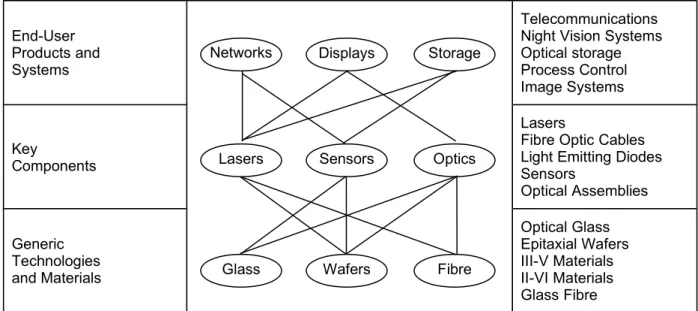
59. Technologically, the industry can be analysed at three levels - a basic level of generic technologies and materials, a key components level, and products and systems with end-user applications (Miyazaki, 1995). End-products emerge from the combination of intermediate components and underlying generic technologies. Because the industry has developed out of a number of different technologies, it has given rise to a great diversity of applications and product-markets which remain somewhat fragmented. Some of these (such as optical lenses) are more dependent on craft traditions, whereas others (such as lasers) are more based in ‘high science’. As a result of this affiliation with other technologies and industries, it is difficult to get accurate and
consistent measures of revenues and the size of the industry. Figure 1 gives an idea of some of the products deriving from opto-electronics. (A detailed analysis of constituent technologies and markets can be found in ACOST (1988), Dubarle and Verie (1993), Miyazaki (1995), Kaounides (1995), and the USA’s National Research Council (1998) report, Harnessing Light.)
60. The early growth of the industry in the UK (as in the USA) was largely due to the impetus of military and telecommunications markets, and to the
Photonics, by providing funds and a focus for research. Early on, optoelectronics was recognised as of strategic importance for the UK’s industrial base, and in 1988 ACOST (the forerunner of the Office of Science and Technology) published a report (Optoelectronics - Building on our
Investment) reviewing the sector’s prospects and setting out a strategy for its further development.
End-User Products and Systems
Telecommunications Night Vision Systems Optical storage Process Control Image Systems Key Components Lasers
Fibre Optic Cables Light Emitting Diodes Sensors Optical Assemblies Generic Technologies and Materials Optical Glass Epitaxial Wafers III-V Materials II-VI Materials Glass Fibre
Figure 1: Miyazaki’s three level model of the opto-electronics industry, with examples of typical products at each level (Source: Hendry et al, 1997).
Growth Prospects
61. All observers agree that opto-electronics is a fundamental underlying
technology, with applications in telecommunications, IT, defence, consumer products, manufacturing (materials processing), process control, medicine and aerospace. The Technology Foresight (1995c:48) report on
Communications, for example, comments that “opto-electronics will play a major (if not the major) role in the provision of network/bandwidth capacity” in the basic infrastructure for telecommunications. The report on IT and
Electronics similarly remarks:
“Information Technology, Electronics and Communications (ITEC) will be one of the biggest industries in the world by the year 2000. It represents the coming together of several previously separate fields,
Networks Displays Storage
Glass Wafers Fibre
Optics Sensors
all based on the underlying technologies of microelectronics and photonics.” (Technology Foresight (1995d:1)
62. Although obviously large and growing rapidly, it is difficult to get consistent estimates of the size of the industry. A variety of reports cover different aspects - for example, Frost & Sullivan (European fibre optic components), Strategies Unlimited (the world’s top fifty opto-electronics firms), Laser World Focus (the laser market), and Photonics Spectra (an annual industry survey). Those that attempt an overview use different bases for counting. The USA’s Optoelectronics Industry Development Association uses a very broad
measure, which includes distribution costs and items such as TV monitors. In 1993, the OIDA (1994) estimated the worldwide market at $70bn. Japan’s Optoelectronics Industry and Technology Development Association, which uses a much narrower measure, reported Japan’s production of equipment and components in 1993 as $35bn. A review by the American Japanese Technology Evaluaton Center (1996) subsequently estimated that the Japanese opto-electronics industry was worth $40bn, compared with the USA’s $6bn, and that Japan dominated 90% of the world market. While these figures clearly do not add up, this estimate of Japan’s dominance may be explained by their strength in consumer electronics (including CDs) which account for 50% of the worldwide opto-electronics market, and in optical storage data. Telecommunications equipment, by comparison, accounted for only 3% of the world market (although it was predicted to grow to 7% by 2000).
64. In world terms, the UK ranks fourth in output of opto-electronics, behind Japan, USA and Germany. Overall figures for sales and employment in the UK, however, are difficult to find. The best source of data that we are aware of is a survey of UK firms carried out in November -December 1997, as part of a study of opto-electronics in the UK, Germany and USA (Hendry and Brown, 1998). This identified 289 UK firms, and received responses from 131. Applying a multiplier of 289/131 to get a crude indicator for the economy as a whole, we estimate total annual sales for UK opto-electronics (covering all three levels in the industry) at £2.8bn ($4.5bn), and employment at 32,000. Over the preceding five years, this represents 11% p.a. growth in revenues (slightly higher than the OIDA prediction for the industry worldwide), and 2% p.a. growth in employment. In Scotland, where there is a particular
concentration of opto-electronics (with around fifty firms), the regional
development agency (Scottish Enterprise) expects annual revenue growth of 10-20%.
Key Skills
65. Since the sector is very diverse, skill needs vary considerably according to the technologies companies make use of and the markets they serve. Also, the industry has developed through a high degree of in-house development and adaptation of skills to particular needs, as companies have ‘invented’ the industry. As Miyazaki (1995:203) writes in her study of competence building by the industry’s large firms in Europe and Japan:
“One critically important finding from this study is that .. in-house development has been the primary mode of competence building, especially in the early and middle phases of development. Firms have been building capabilities in generic technologies for one to two
decades, incrementally adding to their technological bases, through trial and error and organizational learning.”
(i) the industry needs a wide range of skills in fundamental science, from materials science through optics and photonics to software
engineering;
(ii) beyond this, there are specialist sub-sectoral needs (for example, imaging science for displays), and emerging inter-disciplinary skills relating to specialist markets (for example, biology combined with photonics for biosensors, and chemistry with photonics/optics for pollution monitors);
(iii) while some firms have very high numbers of graduates (at 60-70%), there are older sectors of the industry which rely on key craft skills (“one important category we have is the glass blower - it takes about five years to make someone really effective as a glass blower - they may not have the brains of a graduate, but the skill level they have is enormous”);
(iv) in manufacturing, many firms need employees with only low levels of skill;
(v) in the fast-moving areas of the industry, firms are being constantly stretched by customers (they “learn from the market”), and therefore emphasize the importance of flexibility, a readiness to take on new challenges, and a willingness “to learn by doing”;
(vi) companies need people who can combine scientific/engineering and business skills.
in-house skills and “experiential learning” (which Miyazaki and a number of firms emphasize).
Skill Needs, Gaps and Shortages
68. If the pattern of growth in the industry of the past five years continues, we may expect growth in employment of 2% p.a. - or 3,200 employees over the next five years. Our survey of UK firms (Hendry and Brown, 1998) found that on average 15% of employees were in R&D. The supply of higher level skills into this area, at first sight, does not seem to be a problem. For instance, the twelve Scottish universities, with over 500 graduates and postgraduates a year, have for some time produced a considerable surplus over local needs - indeed, “most of these skills are exported” (Scottish Enterprise) (it is not clear whether this refers to the rest of the UK or the world).
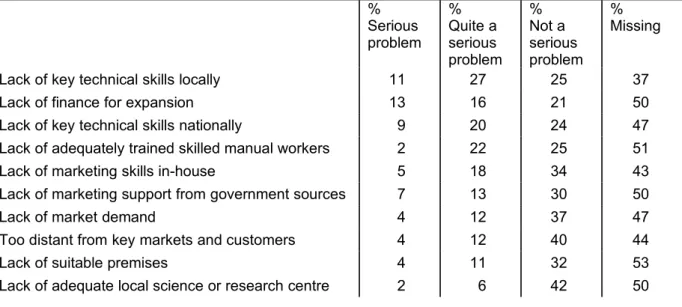
69. Despite this surplus of graduates in Scotland, however, UK firms report major difficulties recruiting technical skills. Our UK survey specifically asked about problems which were holding back companies’ development. As Table 1 shows, lack of key technical skills locally and nationally are at the top of the list (when those rating items ‘serious’ or ‘quite serious’ are added together). The inference from this might be that the loss of skills abroad is not because there are no jobs, but that countries such as the USA offer more attractive salaries and/or research opportunities. Lack of adequately trained skilled manual workers, on the other hand, is of only moderate concern.
70. Specific technical shortages are mentioned in opto-mechanical design
engineering and optical software design. But a more general complaint is the lack of graduates with scientific and engineering training who have
commercial knowledge, skills or aptitudes, for sales/marketing and project management. This is identified as a major need for Scottish firms -
71. Skill requirements in technical areas, however, cannot be guaged simply in terms of the recruitment needs of existing firms. The Technology Foresight (1995c:38) report on IT and Electronics makes the point several times in relation to ITEC generally, and opto-electronics specifically, that the research base is an important attractor for a global industry dominated by large
multinational companies:
“The probability of UK owned industry exploiting [light emitting
polymers] technology is considered to be unlikely, so that if work of this type is supported in future, it should be used as an attractor to ensure that foreign investors build on the technology base with their own R&D and manufacturing. Other major opportunities in this area include large-area colour displays and projection displays.”
72. Finally, ACOST (1988), ten years ago, identified skill shortages arising from the multidisciplinarity of opto-electronics. Although it regarded this as to some degree inevitable when a new technology emerges, the report commented specifically on the neglect in the science curriculum of optics (although it noted the situation at technician, graduate and postgraduate level was more encouraging). This remains an issue. In the USA, the National Research Council (1998:26) recently commented that “optics remains an ill-defined educational program at most institutions”, and posed a fundamental question for education and training: “How does one support and strengthen a field such as optics whose value is primarily enabling?” (National Research Council, 1998:6).
Table 1 Factors inhibiting the development of opto-electronics companies in the UK (Source: Hendry and Brown, 1998)
% Serious problem
% Quite a serious problem
% Not a serious problem
% Missing
Lack of key technical skills locally 11 27 25 37
Lack of finance for expansion 13 16 21 50
Lack of key technical skills nationally 9 20 24 47
Lack of adequately trained skilled manual workers 2 22 25 51
Lack of marketing skills in-house 5 18 34 43
Lack of marketing support from government sources 7 13 30 50
Lack of market demand 4 12 37 47
Too distant from key markets and customers 4 12 40 44
Lack of suitable premises 4 11 32 53
Lack of adequate local science or research centre 2 6 42 50
Sample size = 131 firms.
% missing indicates number not answering question, suggesting such firms do not consider the particular item as a problem.
Skill Utilisation
74. As was the case for biotechnology, this was seen as a problem of scientists and engineers adapting to the needs of business, and commercialising products:
“There is a shortage of people that have got the technology base and the business acumen... I can find lots of people who will quite happily work on the technical details of the product’s technology, but when they have developed something new, they would not know what to do with it.”
75. Plus ca change... With regard to intermediate and technican skills, however, we may be on the verge of a significant change as recruitment shifts towards a graduate intake. While technican levels at NVQ 3-4 remain difficult to fill, the Engineering Employers’ Federation predicts a future scenario involving a greater role for graduates in opto-electronics (as in engineering generally):
traditional craft skills may disappear, though they will be replaced and supplemented by other, higher-level, technology-based skills.”
76. Unfortunately, we do not have evidence of how far this shift has taken place in opto-electronics. Difficulties at NVQ 3-4 suggest it has not yet taken effect.
77. However, we do have some useful insight into how companies build higher level skills in a research environment, through in-house development, which may have some bearing on this. One major company, for example, inteprets ‘intermediate skills’ as graduate engineers and scientists with 3-5 years experience, and ‘higher skills’ as those with 5-10 years experience:
“Underpinning this [utilisation] is graduate recruitment direct from universities as ‘lower level skills’ that can develop into intermediate and hopefully higher level... Our view is that intermediate skills are
provided by Ph.Ds. Industry provides the higher level skills.”
78. While we cannot extrapolate from this (‘intermediate’ having a different connotation here from ‘technician’ level), it indicates a distinctive philosophy to recruitment and skill development, which may be more likely to take root in a high-technology, high skill environment.
Provision of High Level Skills
79. Despite ACOST (1988), and a high-level research focus on opto-electronics, the industry has lacked a national focus for developing skills. The
concentration of research funding on the Scottish universities and on new centres such as Southampton, set up as a result of ACOST, has stimulated the training of graduates and postgraduates. However, until the founding of UKCPO (UK Coalition for Photonics and Optics) in 1997, the industry has lacked an umbrella organisation to bring together the professional institutes, universities, trade associations, local bodies, and industry. Although the immediate purpose is to facilitate technology transfer, it could fulfill a role in identifying skill needs and shortages.
Germany and the USA) (Hendry et al, 1999). In the UK, there are distinct clusters in Scotland, N.Wales, East Anglia, and around London. In Scotland and Wales, the regional development agencies have helped form the Scottish Optoelectronics Association and Welsh Optoelectronics Forum, with local firms, universities and others such as the TECs, to promote and develop the industry, including developing the skills base. Thus, regional collaborations to develop skills can be built on the fact that the industry has a distinctive local labour market character (more so even than biotechnology).
Summary
81. opto-electronics is a large, but very diverse, sector with enormous growth prospects, which employs a wide range of skills;
firms, however, complain of quite serious shortages of technical skills which restrict their development;
there is a particular shortage of people who combine technological knowledge with business skills;
in-house development of skills has been a particular feature of the industry, and as firms continue to grow and change by responding to the market, there will continue to be a premium on experience and learning developed inside the firm;
the clustering of the industry makes it feasible to identify skill needs regionally, although the market for higher-level skills is a national (and international) one.
Conclusion
82. The theme of this paper is that new technology industries are the future. The three industries discussed here - advanced materials, biotechnology and opto-electronics - are enabling technologies which underpin developments in other major industries. Success in them will determine the survival of many other sectors. As enabling technologies, however, they suffer from the
This is least true of biotechnology, which is the most visible in the public mind and attracts considerable attention from the investment community, even if its range and character is not well understood. Such industries require a
‘champion’ if they are to attract people to learn relevant skills. Biotechnology has strong champions, whose influence is increasingly well focused.
Advanced materials has begun to develop an effective champion. But opto-electronics, despite a considerable and long-standing research investment, has lacked a national focus for developing skills or projecting the industry to schools.
83. All three industries have a strong UK science base, and a well-developed infrastructure in higher education to supply scientific and technical skills. Apart from certain ‘hot spots’ which have been noted, where skills are in short supply, the need for cross-disciplinary knowledge and skills, which is
fundamental to these new technologies, is well-recognised and suitable courses and research training mostly exist. The UK’s success in this respect is reflected in the OECD’s favourable assessment of innovation and
technology diffusion policy in the UK (OECD, 1998). Technology Foresight appears to have done much to focus issues for future research and
development.
84. Where problems arise is in the lack of management and commercial skills to complement technological training. The requirement for this differs according to the stage of development the industry is at, but all three industries
experience this problem in some respect - whether it is for project
management, cost control, negotiation skills for alliance-building, marketing, or the ability to recognize the commercial implications of research. Most observers put this down to a failure in university education. But it surely goes wider than this. The professional institutes, for instance, in these three
85. The situation for technician and intermediate level skills, not surprisingly, is patchy. Company attitudes to support NVQs at levels 3-4 are largely the problem. In rapidly changing new technologies, however, in-house development of skills is often the only way, and likely to be in advance of formally accredited skills. Companies look to build on a broad-based
education and learning aptitudes. The development of a graduate intake to fill technician roles might meet this need for broadly trained and adaptable employees better than trying to fit employees to level 3-4 NVQ standards.
86. It is hard to avoid the impression, in any case, that NTOs are the cinderellas of the training system, and have difficulty making an impact. We should not forget, either, that new technologies are ‘competence-destroying’, and in competition with traditional skills and techniques. NTOs have a difficult job to serve both traditional firms and the new technologies.
87. Finally, the new technology industries have a high proportion of smaller firms. The entire UK biotechnology industry is made up just of SMEs. SMEs can have difficulties locating the right people; they need people who can be flexible; and they can be difficult for the training system to reach. They also encounter particular difficulties as they grow, especially if fast-growing, in basic areas of production control/materials control (Institute of Operations Management). It is useful, therefore, to recognize how SMEs relate to larger firms (as a source of employees, and as customers), and how clustering in industries like opto-electronics and biotechnology can provide leverage for outside agencies. New technology clusters, however, rarely match up with the boundaries of local TECs, but are often regional in character. With the
APPENDIX A
Acknowledgement
I would like to thank my colleagues, Sally Woodward and James Brown, for their considerable help in gathering the material on which this report is based.
Organisations responding to the request for information
The help of the following organisations in supplying information and comment is gratefully acknowledged:
Arthur Andersen
Association for Ceramic Training and Development Bell College
BioIndustry Association BPTA Awarding Body
Business Link London North West Calderdale and Kirklees TEC CELTEC: North Wales TEC De Montfort University Dorset TEC
Engineering Employers Federation Glass Training NTO
Gwent TEC
Higher Education Statistical Analysis (HESA) Services Ltd. Institute of Materials
Institute of Operations Management Institute of Physics
James Watt College of Technology Kent TEC
Lancashire Area West TEC London East TEC
Manchester TEC
Marconi Electronic Systems Norfolk and Waveney TEC
Polymer and Associated Industries NTO
Refractories and Building Products Training Council Royal Society of Chemistry
Scottish Enterprise
SET: Vocational Qualifications in Science, Engineering and Technology Somerset TEC
Steel Industry NTO TEC National Council Tees Valley TEC
The Biochemical Society The Maltsters Association Trades Union Congress
UK Consortium of Photonics and Optics (UKCPO) University of Abertay Dundee
University College, University of London University of Northumbria at Newcastle University of Oxford
University of Strathclyde University of Wales
REFERENCES
ACOST (1988). Opto Electronics: Building on our Investment. London: HMSO.
Anonymous (1999), ‘Chemical industry begins restructuring in wake of biotech revolution’, Chemical Market Reporter, 26 January, pp.22-23.
Arthur Andersen (1997). UK Biotech ‘97 - making the right moves.
Arthur Andersen/Garretts/Dundas & Wilson (1998). Technology transfer in the UK lifesciences. London.
Baker, P. (1998), ‘Treading a path through polymer technology’, Works Management, November, pp.24-25.
BioIndustry Association (1999). Industrial markets for UK biotechnology - trends and issues. London. Cmd 4176 (1998). Our Competitive Future: Building the Knowledge Driven Economy. London: HMSO.
Deeds, D.L. and Hill, C.W.L. (1999), ‘An examination of opportunistic action within research alliances: Evidence from the biotechnology industry’, Journal of Business Venturing, 14, 2, pp.141-163.
Dubarle, P., & Verie, C. (1993). Technology Fusion: A Path to Innovation. The Case of Opto-electronics. Paris: OECD.
Economist, The (1998), ‘Business: Management shortfall’, July 18, pp.57-58.
Ernst & Young (1998). European Life Sciences 98: Continental Shift: The fifth Annual Ernst and Young Report on the European Entrepreneurial Life Sciences Industry. London: Ernst and Young International.
Estades, J. and Ramani, S.V. (1998), ‘Technological competence and the influence of networks: A comparative analysis of new biotechnology firms in France and Britain’, Technology Analysis & Strategic Management, 10, 4, pp.483-495.
Hendry, C., Brown, J. and DeFillippi, R. (1997). The Development and Performance Of Opto-Electronics in the UK, Germany and the USA: Report to the Welsh Development Agency. City University Business School.
Hendry, C. and Brown, J. (1998), ‘Clustering and Performance in the UK Opto-Electronics Industry’, conference on ‘Regional Advantage and Innovation’, Universidade Catolica Portugese, Porto, 23-24 October.
Hendry, C., Brown, J., DeFillippi, R. and Hassink, R. (1999), ‘Industry Clusters as Commercial, Knowledge and Institutional Networks: Opto-Electronics in Six Regions in the UK, USA and
Germany’, in A. Grandori (Ed.) Interfirm Networks: Negotiated Order and Industrial Competitiveness, London: Routledge.
Japanese Technology Evaluation Center (1996). Optoelectronics in Japan and the United States. Kaounides, L. (1995). Advanced Materials - Corporate Strategies for Competitive Advantage in the 1990s. London: Pearson Professional.
Kenward, M. (1998), ‘Doctors’ Dilemma’, Professional Engineering, vol.11, no.18.
Locate in Kent (undated). Kent Business Focus: Biotechnology & Pharmaceutical Industries. McNamara, P. and Baden-Fuller, C. (1997), ‘A Note on Biotechnology and Principle UK Biotech Independents’, City University Business School.
McNamara, P., Baden-Fuller, C. and Howell, J. (1997), ‘The CellTech Story: A Jewel in the Crown of the UK Biotechnology Sector’, City University Business School.
Milmo, S. (1999), ‘Europe in a contract mode’, Chemical Market Reporter, 18 January, pp.11-13.
Miyazaki, K. (1995). Building Competences in the Firm: Lessons from Japanese and European Opto-electronics. London: MacMillan Press Ltd.
National Research Council (1998). Harnessing Light: Optical Science and Engineering for the 21st century. Washington, DC: National Academy Press.
OECD (1998). Technology, Productivity and Job Creation: Best Policy Practices. Paris: OECD. OIDA (Optoelectronics Industry Development Association) (1994). Technology Roadmaps for Optoelectronics, 1993-2013. Washington, D.C.
Pilat, D. (1998). ‘The Economic Impact of Technology’, OECD Observer No. 213, August/September. Powell, W., Koput, K. and Smith-Doerr, L. (1996), ‘Interorganisational Collaboration and the Locus of Innovation: Networks of Learning in Biotechnology’, Administrative Science Quarterly, 41, pp.116-145.
Prevezer, M. (1997), ‘The dynamics of industrial clustering in biotechnology’, Small Business Economics, 9, 3, pp.255-271.
Sieppel, G. (1981). Opto-electronics. Reston, Virginia: Prentice-Hall.
Technology Foresight (1995a). Materials. London: HMSO, Office of Science and Technology. Technology Foresight (1995b). Health and Life Sciences. London: HMSO, Office of Science and Technology.
Technology Foresight (1995c). IT and Electronics. London: HMSO, Office of Science and Technology.
More Information
More copies of this report are available free of charge (quoting the appropriate SKT reference) from:
Prolog
PO Box 5050 Sudbury Suffolk CO10 6YJ
Tel 0845 60 222 60
Fax 0845 60 333 60
This report and the others in the series are also available on the world wide web at:
www.dfee.gov.uk/skillsforce
Reports SKT 6 To 16 are currently available, the remainder will be published towards the end of this year. A complete list of all the planned reports follows.
SKT 6 Anticipating Future Skill Needs: Can it be Done? Does it Need to be Done? SKT 7 The Dynamics of Decision Making in the Sphere of Skills’ Formation SKT 8 Management Skills
SKT 9 Intermediate Level Skills - How are they changing?
SKT10 Jungle Trekking: Vocational Courses and Qualifications for Young People SKT11 The Leisure Sector
SKT12 Engineering Skills Formation in Britain: Cyclical and Structural Issues SKT13 The Market Value of Generic Skills
SKT14 Employment Prospects and Skill Needs in the Banking, Finance and Insurance Sector SKT15 New Technology Industries
SKT16 Funding Systems and their Impact on Skills SKT17 Skills Requirements in the Creative Industries SKT18 Skills Issues in Small and Medium Sized Enterprises SKT19 Spatial Skill Variations: their extent and implications SKT20 Employers’ Attitude to Training
SKT21 Skills Issues in Other Business Services - Professional Services SKT22 Science Skills Issues
SKT23 Empirical Evidence of Management Skills in the UK
SKT24 Monitoring and measuring occupational change: the development of SOC2000
If you would like more information on the work of the Skills Task Force, or to comment on their proposals, please write to:
Saiqa Butt
Skills Task Force Secretariat Room W1120
Moorfoot Sheffield S1 4PQ
Tel 0114 359 4240
Fax 0114 259 3005 or