A Distributed Algorithm for Delay-Constrained Unicast Routing
H.F. Salama
D.S. Reeves
Y. Viniotis
Center for Advanced Computing and Communication
North Carolina State University
Box 7911, Raleigh, NC 27695
Phone: (919) 515-5348 Fax: (919) 515-2285
f
hfsalama,reeves,candice
g@eos.ncsu.edu
Abstract
We define the problem of unicast routing subject to delay constraints in point-to-point connection-oriented networks
as a delay-constrained least-cost path problem. This problem is NP-complete, and therefore we propose a simple,
efficient, distributed heuristic solution: the delay-constrained unicast routing (DCUR) algorithm. DCUR requires
limited information about the network state to be kept at each node. This information is stored in a cost vector and
a delay vector which resemble the distance vectors of some existing routing protocols. We prove the correctness of
DCUR by showing that it is always capable of constructing a loop-free delay-constrained path within finite time, if
such a path exists. The number of computations DCUR performs at each node participating in the path construction
process is fixed, irrespective of the size of the network. The message complexity of DCUR is
O
(jV
j3
)messages in the
worst case, wherej
V
jis the number of nodes in the network. However, simulation results show that, on the average,much fewer messages are required. Therefore, DCUR scales well to large networks. We also use simulation to compare
DCUR to the optimal delay-constrained least-cost path algorithm, and to the least-delay path algorithm. Our results
show that DCUR yields satisfactory performance with respect to both path cost and path delay.
Keywords: Routing, Delay Constraints, Quality of Service, Distributed Algorithms
1
Introduction
New distributed applications are emerging at a fast rate. These applications typically involve real-time traffic that
requires quality of service (QoS) guarantees. Traffic streams carrying voice, video, or critical real-time control signals
have particularly stringent end-to-end delay requirements. In addition, real-time traffic usually utilizes a significant
amount of resources while traversing the network. Hence the need for routing algorithms which are able to satisfy the
delay requirements of real-time traffic and to manage the network resources efficiently.
Routing problems can be divided into unicast (point-to-point) problems and multicast (point-to-multipoint or
multipoint-to-multipoint) problems. In this paper, we only consider the unicast routing problem. Unicast routing
proto-cols can be classified into two categories: distance-vector protoproto-cols, e.g., the routing information protocol (RIP) [1, 2],
and link-state protocols, e.g., the open shortest path first protocol (OSPF) [3]. Distance-vector routing protocols are
based on a distributed version of Bellman-Ford shortest path (SP) algorithm [4]. Considering the message complexity,
distance-vector routing protocols scale well to large network sizes, because each node (router) sends periodical topology
update messages only to its direct neighbors. No flooding or broadcasting operations are involved. Each node maintains
only limited information about the shortest paths to all other nodes in the network. Due to their distributed nature,
distance-vector protocols may suffer from looping problems when the network is not in steady state. In link-state
routing protocols, on the other hand, each node maintains complete information about the network topology, and uses
this information to compute the shortest path to a given destination centrally using Dijkstra’s algorithm [4]. Link-state
protocols have limited scalability, because flooding is used to update the nodes’ topology information. They do not suffer
from looping problems, however, because of their centralized nature. Recently, Garcia-Luna-Aceves and Behrens [5]
proposed a distributed protocol, based on link vectors, that avoids looping problems and scales well to large networks.
Both Bellman-Ford and Dijkstra SP algorithms are exact and run in polynomial time. As the name indicates, an
SP algorithm minimizes the the sum of the lengths of the individual links on the path from source to destination. The
properties of the SP depend on the metric the link length represents. If unit link lengths are used, the resulting SP is a
minimum-hop (MH) path. If the length of a link is a measure of the delay on that link, then an SP algorithm computes
the least-delay (LD) path, and if the link length is set equal to the link cost, then an SP algorithm computes the least-cost
(LC) path. Many variations of the SP problem have been studied over the years. For example, Simha and Narahari [6]
studied the case where queueing delay is the dominant component of a link’s delay, and Aida et. al [7] proposed an
investigated the interaction between routing and call admission control for multimedia traffic. Plotkin [9] proposed a
strategy that unifies the routing and call admission decisions. Chen and Liu [10] showed that the problem of routing a
multimedia connection subject to a cell loss constraint is NP-complete and proposed heuristic solutions for that problem.
We study the problem of unicast routing of real-time traffic with end-to-end delay requirements (delay constraints)
in connection-oriented networks. We formulate the problem as a delay-constrained LC (DCLC) path problem. This
problem has been shown to be NP-complete [11]. The only prior work on this problem was reported by Widyono [12].
He proposed an optimal centralized delay-constrained algorithm to solve the DCLC problem. His algorithm, called the
constrained Bellman-Ford (CBF) algorithm, performs a breadth-first search to find the DCLC path. Unfortunately, due
to its optimality, CBF’s worst case running times grow exponentially with the size of the network. Delay-constrained
unicast routing is a special case of the delay-constrained multicast routing problem which has received a lot of attention
in recent years [13]. Thus, delay-constrained multicast routing heuristics can be used to solve the DCLC problem.
However, these delay-constrained multicast heuristics require complete information about the network topology to be
available at every node, and their running times grow at fast rates with the network size [13]. Therefore, neither CBF
nor the delay-constrained multicast routing heuristics can be applied to large networks.
We propose a distributed heuristic to solve the DCLC problem: the delay-constrained unicast routing (DCUR)
algorithm. DCUR requires a limited amount of computation at any node, and its communication complexity is
O
(jV
j3
)
in the worst case. On the average, however, DCUR requires much fewer messages, and therefore, it scales well to large
network sizes. DCUR requires only a limited amount of information at each node. This information is stored in a delay
vector and a cost vector that are similar to the distance vectors of some existing routing protocols [1]. The basic idea of
DCUR is that when a node receives a request to construct a delay-constrained path to a given destination, that node is
given the choice between two alternatives only. The node can either follow the direction of the LC path or the direction
of the LD path. After deciding which direction to follow, the node sends a request to the next hop node in that direction
to take over responsibility for the rest of the path construction operation. When the next hop node receives a request to
construct a delay-constrained path, it follows the same procedure that has been explained for the previous node. Each
node hands over the responsibility for path construction to the next hop node in the direction of the destination until the
destination itself is reached. Limiting the number of paths to choose from at any node to only two restricts the amount
of computation DCUR requires considerably.
Establishing a connection that provides guaranteed service involves routing, signaling, call admission control, and
future investigation. The remainder of this paper is organized as follows. In section 2, we formulate the DCLC problem.
In section 3, we describe the routing information needed at each node for successful execution of DCUR. Then, in
section 4, we present the distributed DCUR algorithm, prove its correctness, and study its complexity. In section 5, we
evaluate DCUR’s performance using simulation. Section 6 concludes the paper. work in section 6.
2
Problem Formulation
A point-to-point communication network is represented as a directed simple connected network
N
=(V;E
), whereV
isa set of nodes and
E
is a set of directed links. A link(u;v
)2E
is an outgoing link for nodeu
2V
and an incoming linkfor
v
2V
. Any linke
=(u;v
)2E
has a costC
(e
)(same asC
(u;v
)) and a delayD
(e
)(same asD
(u;v
)) associatedwith it.
C
(e
)andD
(e
)may take any nonnegative real values. The link delayD
(e
)is a measure of the delay a packetexperiences when traversing the link
e
. The link costC
(e
)may be either a monetary cost or some measure of the link’sutilization.
We define a path as an alternating sequence of nodes and links
P
(v
0;v
k
)=v
0;e
1;v
1;e
2;v
2;:::;v
k
?1
;e
k
;v
k
;
suchthat every
e
i
=(v
i
?1;v
i
) 2
E
, 1i
k
. A path contains loops if not all its nodes are distinct. If all nodes aredistinct, then the path is loop-free. In the remainder of this paper, it will be explicitly mentioned if a path contains
loops. Otherwise a “path” always denotes a loop-free path. We will use the following notation to represent a path:
P
(v
0;v
k
) = fv
0 !v
1 !:::
!v
k
?1!
v
k
g. For a given source nodes
2V
and destination noded
2V
,P(
s;d
)=fP
1;:::;P
m
gis the set of all possible alternative paths froms
tod
. The cost of a pathP
i
is defined as thesum of the costs of the links constituting
P
i
.Cost(P i
)= X
e
2P
iC
(e
) (1)Similarly, the end-to-end delay along the path
P
i
is defined as the sum of the delays on the links constitutingP
i
.Delay(P i
)= X
e
2P
iD
(e
) (2)The DCLC problem finds the LC path from a source node
s
to a destination noded
such that the delay along that pathdoes not exceed a delay constraint∆. It is constrained minimization problem that can be formulated as follows.
Delay-Constrained Least-Cost (DCLC) Path Problem: Given a directed network
N
=(V;E
), a nonnegative costpositive delay constraint∆, the constrained minimization problem is:
min
P
i 2P0 (
s;d
)Cost(P i
) (3)
whereP
0
(
s;d
)is the set of paths froms
tod
for which the end-to-end delay is bounded by∆. ThereforeP0
(
s;d
)P(s;d
).If
P
i
2P(s;d
)thenP
i
2P0
(
s;d
)if and only ifDelay(P i
)∆
:
(4)The DCLC problem is NP-complete [11]1. It is also NP-complete in the case of undirected networks. However, it is
solvable in polynomial time if all link costs are equal or all link delays are equal.
3
Routing Information
In this section, we discuss the routing information which needs to be present at any node in the network to assure
successful execution of DCUR. Then, in section 4, we describe the operation of DCUR. Every node
v
2V
must havethe following information available during the computation of the delay-constrained path: the costs of all outgoing links,
the delays of all outgoing links, a cost vector, a delay vector, and a routing table.
The cost vector at node
v
consists ofjV
jentries, one entry for each nodew
in the network. Each entry in the costvector holds the following information:
the destination node ID,
w
,the cost of the LC path from
v
tow
,least cost value
(v;w
), andthe ID of the next hop node on the LC path from
v
tow
,least cost nhop
(v;w
).Similarly, the delay vector at node
v
has one entry for each nodew
in the network. However, each entry in the delayvector holds:
the destination node ID,
w
,the total end-to-end delay of the LD path from
v
tow
,least delay value
(v;w
), andthe ID of the next hop node on the LD path from
v
tow
,least delay nhop
(v;w
).The cost vectors and delay vectors are similar to the distance vectors of some existing routing protocols [1].
Distance-vector based protocols discuss in detail how to update the distance Distance-vectors in response to topology changes, and how
to prevent instability. These procedures are simple and require the contents of the distance vector at each node to
be periodically transmitted to direct neighbors of that node only. They do not involve any flooding or broadcasting
operations. The same procedures used for maintaining the distance vectors can be used for maintaining the cost vectors
and delay vectors. We will not discuss these procedures in this paper, because our focus is on a routing algorithm that
uses the cost vectors and delay vectors as input information. Thus, we assume, in the remainder of this paper, that the
cost vectors and delay vectors at all nodes are up-to-date. We also assume that the link costs, the link delays, the contents
of the cost vectors, and the contents of the delay vectors do not change during the execution of the routing algorithm.
In addition to the cost vector and delay vector, each node
v
maintains a routing table. Each entry in the routing tablecorresponds to an established path from a source node
s
to a destinationd
that passes throughv
. A routing table entrywill be described in the next section. Routing table entries are created during the connection establishment phase for a
session involving real-time traffic that flows from a source
s
to a destinationd
. In addition to the routing information, arouting table entry could also be used to hold information about the resources reserved for the connection from
s
tod
.When that a real-time session terminates, the corresponding path is torn down, and all routing table entries corresponding
to that path are deleted.
4
The Delay-Constrained Unicast Routing (DCUR) Algorithm
We start by presenting a simple version of DCUR, and explaining how to implement it in a distributed fashion. Then we
discuss how loops may be created, and how DCUR detects them and eliminates them. After completing the description
of DCUR we prove its correctness and study its complexity.
DCUR is a source-initiated algorithm that constructs a delay-constrained path connecting source node
s
to destinationnode
d
. The path is constructed one node at a time, from the source to the destination. Any nodev
at the end of thepartially-constructed path can choose to add one of only two alternative outgoing links. One link is on the LC path from
v
to the destination, while the other link is on the LD path fromv
to the destination. This limitation restricts DCUR’s ability to construct the optimal path, but it considerably reduces the amount of computation required at any node.In the following, we describe a simple version of DCUR which assumes that no routing loops can occur. The source
node
s
initiates path construction by looking up theleast delay value
(s;d
)from its delay vector. If this value is greaterhowever, delay-constrained paths do exist, i.e.,
least delay value
(s;d
)∆;
(5)the algorithm proceeds. The source
s
becomes the current active node, denotedactive node
. At all times there is onlyone active node, at the end of the partially-constructed path. The variable
delay so far
is set to 0, and the variableprevious active node
is set tonull
.The
active node
reads the ID of the next hop node on the LC path towardsd
,least cost nhop
(active node;d
),from its cost vector. We denote
least cost nhop
(active node;d
)aslc nhop
for convenience. Thenactive node
sendsa
Query
message tolc nhop
, requesting about the LD value fromlc nhop
tod
.lc nhop
looks up the requested valueleast delay value
(lc nhop;d
)from its delay vector, and sends aResponse
message back toactive node
with thisinformation. After
active node
receives theResponse
message, it checks ifdelay so far
+D
(active node;lc nhop
)+least delay value
(lc nhop;d
)∆:
(6)If the inequality is satisfied, then there exist delay-constrained paths from
active node
tod
which use the link(
active node;lc nhop
), andactive node
selects the direction of the LC path towardsd
. If the inequality is notsatisfied, then
active node
selects the direction of the LD path towardsd
. The LD path fromactive node
tod
isguaranteed to be part of at least one delay-constrained path from
s
tod
; otherwise,active node
could not have beenselected in a previous step (a proof is provided in subsection 4.2). After deciding which direction to follow,
active node
creates a routing table entry with the following information:
the ID of
s
,the ID of
d
,
previous node
=ID of theprevious active node
,
next node
= 8 > <> :
lc nhop;
if the LC path direction is chosen,least delay nhop
(active node;d
);
if the LD path direction is chosen,previous delay
=delay so far
, and
flag
= 8 > <> :
LCPATH
if the LC path direction is chosen,LDPATH
if the LD path direction is chosen.Then
active node
addsD
(active node;next node
)to the variabledelay so far
. Finally theactive node
sends aConstruct Path
message tonext node
that contains: the ID of the sources
, the ID of the destinationd
, the value of the delay constraint∆, and the updated value ofdelay so far
which represents the delay along the already constructedWhen a node
v
6=d
receives aConstruct Path
message, it becomes the newactive node
. The newactive node
sets
previous active node
to be the ID of the node which sent it aConstruct Path
message. Then the newactive node
executes the same procedure just described.
When the destination node
d
receives aConstruct Path
message, it records the ID of the node which sentthe message.
d
creates a routing table entry, with the following values: ID of the sources
, ID of the destinationd
,previous node
=previous active node
,next node
=null
, andprevious delay
=delay so far
. Then thedestination sends an acknowledgment back to the source. When the source receives the acknowledgment message2, it
signals to the application that the path construction has been successfully completed, and traffic can be transmitted along
that path.
An
active node
, does not send aQuery
message if the next hop node is the same on both the LC path and the LDpath from
active node
to the destination, i.e.,least cost nhop
(active node;d
)=least delay nhop
(active node;d
).It is known in advance that the LD direction satisfies the delay constraint, so there is no need for the
Query
message. Inthis case,
active node
sets theflag
in the routing table entry toLDPATH
. The reason for that particular setting willbe explained later in this section, when routing loops are discussed.
The need for the
Query
andResponse
messages can be completely eliminated by making use of the fact that a nodetransmits the contents of its cost vector and delay vector periodically to all its neighbors. Thus if a node saves a copy
of the cost vector and delay vector from each of its neighbor nodes, then there is no need for the
Query
andResponse
messages. However, this increases the storage requirements at each node.
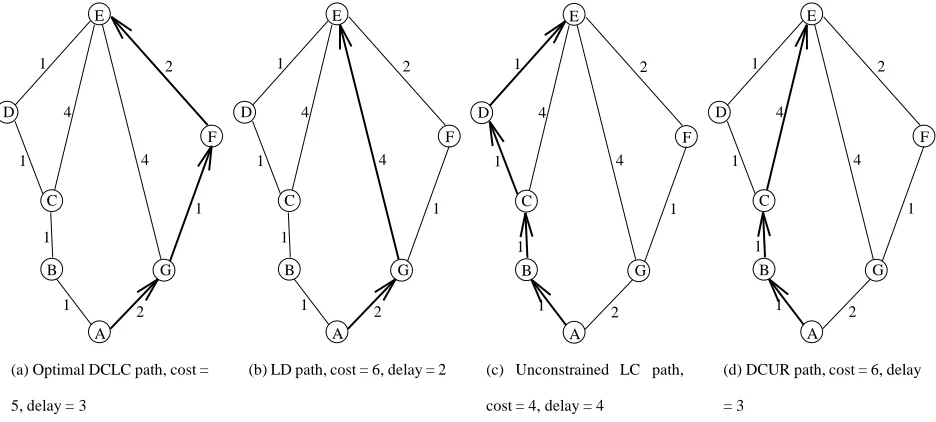
Figure 1 shows an example3 of the paths obtained by different routing algorithms to connect source node
A
todestination node
E
, with a delay constraint of 3. Subfigure 1(d) shows the path DCUR constructs. DCUR proceedsas follows. The source
A
adds the first link on the LC path towardsE
, link(A;B
), after checking that there existdelay-constrained paths from
A
toE
that utilize(A;B
). Then nodeB
adds the first link on its LC path towardsE
, link(
B;C
), after checking that there exist delay-constrained paths fromA
toE
that utilize(A;B
)and(B;C
). NodeC
next determines that the first link on its LC path towards
E
, link(C;D
), cannot be used. This is because the subpathf
A
!B
!C
!D
gis not part of any delay constrained path fromA
toE
. ThusC
decides to continue via the LDpath direction. It adds the first link in that direction, link(
C;E
), which leads directly to the destination.2The acknowledgment message can either travel the constructed path backwards or it can be sent over either the LC path or the LD path from
the destination to the source. The choice is straight-forward and will not be described in this paper. Tearing down an existing path is also a simple
operation that will not be discussed in this paper.
1 1 1 1 1 A B C D E F G 4 4 2 2
(a) Optimal DCLC path, cost =
5, delay = 3
1 1 1 1 1 A B C D E F G 4 4 2 2
(b) LD path, cost = 6, delay = 2
1 1 1 1 A B C D E F G 4 4 2 2 1
(c) Unconstrained LC path,
cost = 4, delay = 4
1 1 1 1 A B C D E F G 4 4 2 2 1
(d) DCUR path, cost = 6, delay
= 3
Figure 1: Paths constructed by different algorithms from source node
A
to destination nodeE
. All link delays are equalto 1, and are not shown in the figure. Link costs are shown next to each link. The delay constraint,∆, is equal to 3.
The paths constructed by existing distance-vector protocols are guaranteed to be loop-free if the contents of the
distance vectors at all nodes are up-to-date and the network is in stable condition. However, up-to-date cost vectors
and delay vectors contents and stable network condition are not sufficient to guarantee loop-free operation for DCUR.
In DCUR, each node involved in the path construction operation selects either the LC path direction or the LD path
direction as has been explained before. If all nodes choose the LC path direction, or all nodes choose the LD path
direction, then no loops can occur, because the resulting paths are the LC path or LD path respectively. However, if
some nodes choose the LC path direction while others choose the LD path direction, loops may occur. In the following
subsection, we discuss how DCUR detects and eliminates loops.
4.1
Loop Removal
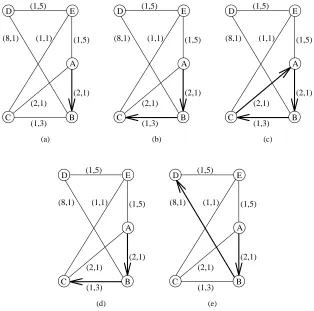
Figure 2 shows a scenario that results in a loop. The source node
A
initiates the construction of a path towards thedestination node
D
with an imposed delay constraint value of 8. Subfigures 2(a), 2(b), and 2(c) show successive stagesof path construction until a loop is created. The source
A
follows the LD path direction towards the destinationD
andstarts the path construction by adding link(
A;B
). NodeB
follows the LC path direction towardsD
and adds link(B;C
)to the path. Node
C
also attempts to follow the LC path direction towardsD
by using link(C;E
). This is not possible(1,5) (2,1) (1,1) (8,1) (2,1) D E A B C (1,3) (1,5) (a) (1,5) (2,1) (1,1) (8,1) (2,1) D E A B C (1,3) (1,5) (b) (1,5) (2,1) (1,1) (8,1) (2,1) D E A B C (1,3) (1,5) (c) (1,5) (2,1) (1,1) (8,1) (2,1) D E A B C (1,3) (1,5) (d) (1,5) (2,1) (1,1) (8,1) (2,1) D E A B C (1,3) (1,5) (e)
Figure 2: Example of a loop scenario.
A
is the source andD
the destination. Link costs and link delays are shown nextto each link as (cost,delay). The delay constraint,∆, is equal to 8.
path to
D
(the least total delay that can be achieved in this case is 10). ThusC
follows the LD path direction and addslink(
C;A
)to the path being constructed. This creates the loopfA
!B
!C
!A
g, as shown in subfigure 2(c).DCUR detects loops as follows. When a node receives a
Construct Path
message, it searches its routing table. Aloop is detected if a routing table entry already exists for the source-destination pair specified in the
Construct Path
message.
The active node,
active node
, that detects a loop initiates the loop removal operation. The contents ofactive node
’srouting table entry are left unchanged.
active node
sends aRemove Loop
message to the previous node on theloop,
previous active node
(the node from whichactive node
received the lastConstruct Path
message), and thenactive node
becomes inactive. The IDs of the source and destination nodes are all that needs to be included in theRemove Loop
message. TheRemove Loop
message traverses the loop backwards, removing routing table entries, until it finds a nodew
whose routing table entry’sflag
is set toLCPATH
indicating that this node is followingdirection, because, as we mentioned before, loops can not be created if all nodes follow the LD path direction. The
Remove Loop
message is not sent any further backwards along the loop, after it arrives atw
. Nodew
then decides to follow the LD path direction, instead of the LC path direction, in order to avoid the conditions that caused the loop.This decision can never lead to any delay constraint violations. Thus
w
adjusts the contents of its routing table entry sothat
next node
=least delay nhop
(w;d
)andflag
=LDPATH
. The variablesprevious node
,previous delay
,and
delay so far
remain unchanged. Thenw
sends aConstruct Path
message tonext node
, and path constructioncontinues.
For the example of figure 2, node
A
detects the existence of a loop.A
reacts by sending aRemove Loop
messagethat traverses the loop backwards. Node
C
receives theRemove Loop
message fromA
, butC
is already followingthe LD path direction towards the destination, so all it does is to send the
Remove Loop
message further backwards toB
, and to delete its routing table entry, thereby removing link(C;A
)from the path (subfigure 2(d)). NodeB
receivesthe
Remove Loop
message. It is following the LC path direction towards the destination, so it decides to follow theLD path direction instead, and modifies its routing table entry accordingly. Thus removing link(
B;C
)from the pathand adding link(
B;D
)instead. ThenB
continues constructing the path by sending aConstruct Path
message toD
,which is the destination. The final delay-constrained path from
A
toD
is the one shown in subfigure 2(e).It was mentioned above that, at a node
w
, the routing table entry’sflag
is set toLDPATH
when both the LCpath direction and the LD path direction share the same link to the next hop. The reason is that if the
flag
was set toLCPATH
, and thenw
received aRemove Loop
message, it would have removed the link leading to the next node in the LC path direction, and then it would have added the same link to the path again, because that link leads also to thenext node in the LD path direction. The result would have been the same loop occurring twice.
The description of DCUR is now complete. Pseudo code for the algorithm is given in the appendix. In the remainder
of this section, we prove the correctness of DCUR and study its complexity.
4.2
Correctness of DCUR
We verify the correctness of DCUR by proving that it can always construct a loop-free delay-constrained path within
finite time, if such a path exists. If no feasible path exists for a given source-destination pair, DCUR fails immediately at
the source node after it determines that inequality 5 is not satisfied. Thus there is no unnecessary overhead if no solution
Theorem 1 DCUR always constructs a delay-constrained path for a given source
s
and destinationd
, if such a pathexists.
Proof. If no feasible path exists for a given source-destination pair, DCUR fails immediately at the source node after
checking that the delay along the LD path exceeds the delay constraint, i.e., inequality 5 is not satisfied. If the LD
path can not satisfy the delay constraint, there can be no other path that satisfies the given constraint. If at least one
delay-constrained path from
s
tod
exists, then inequality 5 will be satisfied, and path construction can start. Initially, thesource
s
is the only member in the path. The rest of this proof is done by induction onj
, whereP
j
denotes the subpathconstructed starting at the source
s
andj
denotes the length of the path in hops. The basis for induction isP
0=fv
0gwherev
0=s
. Since inequality 5 is satisfied andDelay(P 0)=0, it follows thatDelay(P 0
)+
least delay value
(v
0;d
)∆.Assume that
Delay(P j
)+
least delay value
(v
j
;d
)∆ (7)where
P
j
=fv
0!:::
!v
j
g. Inequality 7 guarantees that the subpathP
j
is part of a delay-constrained path froms
tod
. Whenv
j
is theactive node
, DCUR proceeds by adding either the first link along the LC path fromv
j
tod
or the first link along the LD path fromv
j
tod
. If DCUR adds the first link along the LC path, then inequality 6 must be satisfied.We restate that Inequality for the sake of clarity.
delay so far
+D
(active node;lc nhop
)+least delay value
(lc nhop;d
)∆Note that
delay so far
=Delay(P j)and
active node
=v
j
andlc nhop
=v
j
+1. Thus the inequality can be rephrased
as
Delay(P j
)+
D
(v
j
;v
j
+1)+
least delay value
(v
j
+1;d
) =
Delay(P j+1
)+
least delay value
(v
j
+1;d
) ∆ (8)
The other alternative for DCUR is to proceed from
active node
=v
j
by adding the first link along the LD path,link(
v
j
;v
j
+1). Using
least delay value
(v
j
;d
)=D
(v
j
;v
j
+1)+
least delay value
(v
j
+1;d
), the inequality 7 can be
rewritten as
Delay(P j
)+
D
(v
j
;v
j
+1)+
least delay value
(v
j
+1;d
) =
Delay(P j+1
)+
least delay value
(v
j
+1;d
) ∆ (9)
In both cases,
v
j
+1 becomes the nextactive node
. Therefore DCUR guarantees that the subpath froms
to thebecomes the
active node
. 2Theorem 2 The final path constructed by DCUR for a given source
s
and destinationd
does not contain any loops.Proof. We denote
s
asv
0andd
asv
k
for convenience. The final path constructed by DCUR,P
(v
0;v
k
)=fv
0!v
1!:::
!v
k
?1!
v
k
g, contains a loop if it includes the same node twice, i.e.,v
i
=v
j
wherei
6=j
and 0i;j
k
. DCURstarts at the source, and adds one link at a time to the path being constructed. When DCUR adds a link(
v
y
;v
x
), then,if the node
v
x
is added to the path for the first time, DCUR creates a routing table entry for the given source-destinationpair at
v
x
. The resulting path afterv
x
is added for the first time isfv
0 !:::
!v
x
g. If, at a subsequent point in time,DCUR adds a link(
v
z
;v
x
), the result would befv
0!:::
!v
x
!:::
!v
z
!v
x
g. This is a path that contains aloop. Node
v
x
becomes theactive node
immediately after link(v
z
;v
x
)is added.v
x
may be the sourcev
0or any nodein the network other than the destination
v
k
.v
x
checks its routing table and finds that a routing table entry already existsfor the given source-destination pair, thus detecting a loop. As a result
v
x
initiates the loop removal operation. The loopis broken using the technique described in subsection 4.1. Then, the path construction resumes, and DCUR attempts to
use an alternate path towards the destination
v
k
. Thus the final path constructed by DCUR,P
(v
0;v
k
), can not includethe source
v
0or any intermediate node more than one time, because each time such a node is added to the path for thesecond time, it immediately detects a loop and removes it. The destination
v
k
is also included only once in the path,because DCUR stops as soon as it reaches the
v
k
for the first time. 2Theorem 3 The execution time of DCUR for a given source
s
and destinationd
is always finite.Proof. If no delay-constrained paths exist, then DCUR fails immediately at the source after determining the inequality 5
is not satisfied. If inequality 5 is satisfied, then DCUR proceeds. If no loops occur, then, after adding at most(j
V
j?1)links, DCUR reaches the destination
d
. It is sufficient to show that, even if loops occur, DCUR will still reachd
withinfinite time. Assume that DCUR constructs a subpath that contains a loop,
P
loop
=fs
!:::
!v
q e
LC?!
:::
!v
(1)x
!:::
!v
r
e
0 LC?!
:::
!v
(2)x
g.v
(1)x
denotes the first occurrence ofv
x
andv
(2)x
denotes the second occurrence of thesame node
v
x
. After a loop is detected atv
(2)x
, the loop removal operation described in subsection 4.1 traversesP
loop
backwards, removing links, until it reaches a node
v
r
whose routing table entry’sflag
is set toLCPATH
. There mustbe at least one such node between
v
(1)x
andv
(2)x
(v
r
may bev
(1)x
), because loops can not be created if all nodes followthe LD path direction towards the destination. Node
v
r
is then forced to follow the LD path direction, instead of the LCpath direction, and it removes the first link on the LC path from
v
r
to the destination, linke
0LC
, and adds the first link on the LD path instead. This link switching procedure prevents the same subpathP
loop
from occurring another time. If,the loop removal operation. Then if, when path construction resumes after that, DCUR adds the node
v
r
and the linke
0LC
to the path once again. Still the the same subpathP
loop
can not be reconstructed another time, because the second loop removal operation (which removed nodev
r
) must have selected a nodev
q
, further upstream fromv
r
(v
q
may bes
), that followed the LC path direction, and forced it to follow the LD path direction instead, thus removing the linke
LC
and replacing it with another outgoing link fromv
q
. Therefore the same subpath containing a loop,P
loop
, can not be constructed twice during the execution of DCUR. Each loop removal operation removes a number of nodes (0)from the path being constructed, and forces one more of the remaining nodes to follow the LD path direction instead of
following the LC path direction. Therefore if loops keep occurring, the solution paths, DCUR attempts to construct, will
converge towards the LD path from the
s
tod
. Since the size of the network is finite, the number of possible subpathsstarting at
s
and containing a loop is also finite. Hence DCUR will always converge towards the LD path solution froms
tod
within a finite time, if its attempts to reach the destinationd
via other paths keep failing because of loops. The LD path is guaranteed to reach the destination and to satisfy the delay constraint or else DCUR would have failed andstopped immediately at the source. 2
4.3
Complexity of DCUR
Each time a node receives a
Construct Path
message or aRemove Loop
message, it performs a fixed amountof computations, irrespective of the size of the network. Therefore, the computational complexity of the proposed
distributed algorithm at any node is
O
(1)time4
.
We now consider the worst case message complexity of DCUR, i.e., the number of messages needed in the worst
case, in order to construct a path for a given source-destination pair. If no loops occur, then the number of messages
needed to construct a path is proportional to the number of links in the path. This is because a node running DCUR
exchanges three messages (one
Query
message, oneResponse
message, and oneConstruct Path
message) to addone link. For a network size ofj
V
jnodes, the longest possible loop-free path from source to destination consists ofjV
jnodes and(j
V
j?1)links. Therefore the number of messages needed in the worst case isO
(jV
j), if it is guaranteed thatno loops will occur. Unfortunately, the occurrence of loops complicates the analysis.
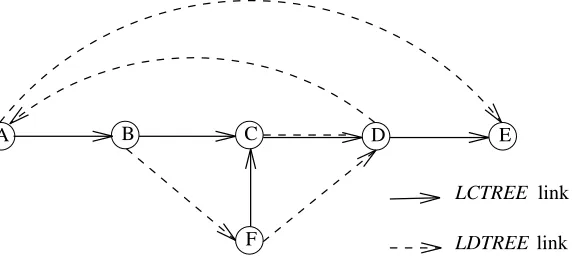
The tree of the LC paths from any node in the network to the destination node
d
, denoted LCTREE, consists of(jV
j ?1)links. Similarly, the tree of the LD paths from any node in the network to the destination
d
, denoted LDTREE, also consists4In this analysis we consider the complexity of DCUR only. We do not consider the complexity of the underlying mechanisms for maintaining and
LDTREE LCTREE
link link C
B D E
A
F
Figure 3: An example of a subnetwork constructed by taking the union of the LCTREE and the LDTREE. The destination
is node
E
.of(j
V
j?1)links. The union of these two trees is a subnetworkN
0=(
V;E
0), where(j
V
j?1)jE
0j2(j
V
j?1),because some links may be members of both trees. Figure 3 shows an example of the union of an LCTREE and an
LDTREE. In this example, the link(
C;D
)is a member of both trees. ThejE
0
jlinks are the only links considered by
DCUR when constructing a path from a source
s
to the destinationd
, because, as has been explained before, at any nodeDCUR considers only the LC path direction and the LD path direction towards the destination.
Let the links of LCTREE be called tree links. We add the links of the LDTREE to the LCTREE to obtain the
subnetwork
N
0. The links of the LDTREE which are not already in the LCTREE will be classified into one of the
following three link types:
a back link which may result in a loop,
a descendent link which may provide one or more nodes with two alternate paths towards the destination, or
a cross link which may also provide one or more nodes with two alternate paths towards the destination
5
.
In the example of figure 3, links(
A;B
),(B;C
),(C;D
),(D;E
), and(F;C
)are tree links. The link(D;A
)is a backlink. Links(
A;E
)and(F;D
)are descendent links, and the link(B;F
)is a cross link.A subnetwork
N
0has
X
back links,Y
descendent links, andZ
cross links where 0X;Y;Z
(jV
j?1)andX
+Y
+Z
(jV
j?1). Adding a back link to a path under construction may or may not result in loop. Since we arestudying the worst case, we assume that adding a back link to a path always results in a loop. Consider only one back
link,
e
. Linke
may be added and removed from the path being constructed several times, if it is reachable via multiplealternate paths from the source node. A loop results each time
e
is added. The back linke
is reachable via(Y
+Z
)alternate paths in the worst case. This happens when the(
Y
+Z
)descendent links and cross links are upstream (closer tothe source node) from the back link
e
. In this case each time DCUR attempts to use one of the(Y
+Z
)resulting alternatepaths, it may continue downstream (towards the destination) and add the link
e
, thus creating a loop. If DCUR attemptsto use all(
Y
+Z
)alternate paths while constructing the delay-constrained path, the linke
will be added and removed(
Y
+Z
)times, which means that(Y
+Z
)loops will be created and removed during the path construction. The exampleof figure 3 is not a worst case scenario. However, it shows how the back link(
D;A
)can be reached via three alternatepaths when node
A
is the source. The first alternative is the original path along the LCTREE:fA
!B
!C
!D
g.The second alternative was created due to the addition of the cross link(
B;F
), and it isfA
!B
!F
!C
!D
g.The final alternative isf
A
!B
!F
!D
g. This path was brought to existence by the descendent link(F;D
).So far we considered only one back link. However, the subnetwork
N
0contains
X
back links. In the worst case,each of the
X
back links is reachable via(Y
+Z
)alternate paths. In this case we may end up withX
(Y
+Z
)loops.Since
X
+Y
+Z
(jV
j?1), it follows that, in the worst case, DCUR may create and removeO
(jV
j2
)loops before
completing the construction of the delay-constrained path.
The largest possible loop consists of(j
V
j?1)nodes and(jV
j?1)links (the destination can not be part of a loopin DCUR). A maximum of three messages are needed to add one loop link. Thus it takes
O
(jV
j)messages to create thelargest loop. One message is needed for removing one loop link, which means that at most
O
(jV
j)messages are neededif all loop links have to be removed before path construction resumes. Therefore
O
(jV
j)messages are needed, to createand remove the largest loop. In the worst case
O
(jV
j2
)loops may be created and removed. This means that, in the worst
case, DCUR needs
O
(jV
j3
)messages to handle loops. Compared to the
O
(jV
j)messages required to add the permanentlinks that constitute the final loop-free path, it is obvious that, in the worst case, loop handling dominates the operation
of DCUR, and that the overall worst case message complexity of DCUR is
O
(jV
j3
). Fortunately, our simulation results
show that DCUR’s average performance is much better than the worst case just studied. These results will be presented
in the next section.
5
Simulation Results
We used simulation for our evaluation of the average performance of DCUR. Full duplex, directed, simple, strongly
connected networks of different sizes with homogeneous link capacities of 155 Mbps (OC3) were used in the experiments.
The positions of the nodes were fixed in a rectangle of size 30002400 Km
2, roughly the area of the USA. A random
Figure 4: A randomly generated network, 20 nodes, average degree 4.
nodes. The output of this random generator is always a connected network in which each node’s degree is at least 2. The
probability a link exists between any two nodes
u
andv
is given by:P
(u;v
)=exp?
l
(u;v
)L
(10)where
l
(u;v
)is the distance betweenu
andv
, andL
is the maximum distance between any two nodes. The parameter controls the ratio of short links to long links, whilecontrols the average node degree of the network. We obtained realistic network topologies with an average node degree of 4 by carefully adjusting the values ofand6. Figure 4shows an example of a randomly generated network.
The propagation speed through the links was taken to be two thirds the speed of light. Under this assumption, the size
of the rectangle enclosing our network is 1512 msec
2. In addition, we assumed a high-speed networking environment
with small packet (cell) sizes and limited buffer space at each node. The link propagation delay was dominant under
these assumptions, and the queueing component of the link delay was neglected. The link delays were thus symmetric,
D
(u;v
)=D
(v;u
), because the link lengths were symmetric.We defined the cost,
C
(e
), of linke
, as a function of its utilization7
. Link costs were asymmetric, because
C
(u;v
)6The average node degree of current internetworks ranges between 3 and 4. The denser the network connectivity the clearer the advantages and
disadvantages of a routing algorithm appear in the simulation results. That’s why we used an average node degree of 4.
7In our experiments we reserved bandwidth along the constructed path. The amount of bandwidth reserved on each link of a path connecting a
and
C
(v;u
)were independent. Two experiments were conducted over the networks we have just described.5.1
The Average Message Complexity of DCUR
In the first experiment, we measured the average number of messages DCUR requires to establish a delay-constrained
path. For each run of the experiment, we generated a random set of links to interconnect the fixed nodes, we selected a
random source node, and we generated random background traffic to utilize each link. The cost (utilization) of a link
was a random variable uniformly distributed between 5 Mbps and 125 Mbps. The experiment was repeated with network
sizes ranging from 20 nodes up to 200 nodes. We also varied the delay constraint value from 15 msec to 55 msec. The
delay constraint represents only an upper bound on the end-to-end propagation time across the network. Relatively small
values were chosen for the delay constraint in order to allow the higher level end-to-end protocols, at both the source
and the destination, enough time to process the transmitted information without affecting the quality of the real-time
session. In this experiment, we measured the average number of messages exchanged between the nodes which execute
the distributed DCUR algorithm to construct a delay-constrained path. Note that any message generated by DCUR at
some node is always destined to an immediate neighbor of that node. Therefore any DCUR generated message travel a
distance of one only hop. Unless otherwise stated, DCUR was run repeatedly until confidence intervals of less than 5%
of the mean value, using 95% confidence level, were achieved for all measured values presented in this subsection and
in the next subsection. At least 500 different networks were simulated for each measured value.
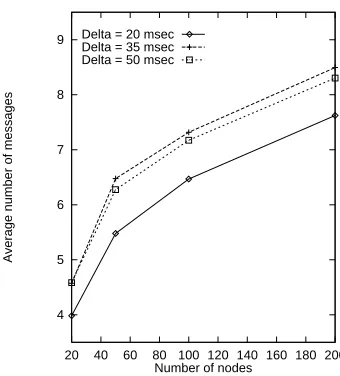
Figure 5 shows the average number of messages versus the size of the network for three different values of the delay
constraint: a strict delay constraint of 20 msec, a moderate delay constraint of 35 msec, and a lenient delay constraint of
50 msec. All three curves of figure 5 indicate clearly that the average number of messages grows very slowly with the
size of the network. For any of the delay constraint values shown in the figure, doubling the size of the network increases
the average number of DCUR’s messages by roughly one message only. Thus the average growth rate of the number of
messages is roughly logarithmic in the network size, for the experiments we ran.
The number of messages exchanged while constructing a path is smallest when the delay constraint value is small.
This is due to the following:
A path that satisfies the strict delay constraint consists on the average of fewer links than a path the satisfies a
lenient delay constraint.
4 5 6 7 8 9
20 40 60 80 100 120 140 160 180 200
Average number of messages
Number of nodes Delta = 20 msec
Delta = 35 msec Delta = 50 msec
Figure 5: Average number of messages, variable network size, average node degree 4, three delay constraint settings:
20 msec, 35 msec, and 50 msec.
Therefore, the probability of the occurrence of a loop is small. As has been discussed in the previous section, the
occurrence of loops increases in the number of messages.
When the delay constraint is increased to 35 msec, the number of messages is largest. One reason is that the average
number of links on the solution path is greater than it is when the delay constraint is only 20 msec8. The other reason
is that 35 msec is a moderately strict delay constraint, and DCUR may be able to follow the LC path direction at some
nodes and to follow the LD path direction at others. This toggling between LC path direction and LD path direction
increases the probability loop occurrence, and hence increases the average number of messages exchanged.
Increasing the delay constraint further, from 35 msec to 50 msec, leads to a reduction in the average number of
messages. 50 msec is a lenient delay constraint. Thus DCUR is able to follow the LC path direction most of the time
without violating the delay constraint, and therefore it no longer toggles between the LC path direction and the LD path
direction. The consequence is that loops occur rarely. Of course when the delay constraint is increased to 50 msec, the
average number of links per path also increases, but figure 5 indicates that the lack of loop occurrence has the dominant
effect in this case.
It has been mentioned in the previous section that when the LC path direction and the LD path direction from a node
towards the destination coincide, then there is no need for sending the
Query
message and waiting for theResponse
message. Both messages can be eliminated, and only one message is needed to add the next link, the
Construct Path
8For a 200-node network the average number of links per path is 4.28 for a 20 msec delay constraint, 4.72 for a 35 msec delay constraint, and 5.12
0 0.02 0.04 0.06 0.08 0.1 0.12
0.015 0.025 0.035 0.045 0.055
Avg. no. of loops per constructed path
Delay constraint (seconds) 20 nodes 50 nodes 100 nodes 200 nodes
Figure 6: Average number of loops occurring while constructing a single delay-constrained path, network sizes of 20
nodes, 50 nodes, 100 nodes, and 200 nodes, average node degree 4, variable delay constraint.
message. Otherwise, three messages are needed to add one link. Our simulation results show that, at many nodes, the
LC path direction and the LD path direction towards the destination are identical, and thus eliminating the
Query
andResponse
messages at such nodes, results in a significant reduction in the number of messages per added link. For example, figure 5 shows that for a 200-node network and a delay constraint of 50 msec, on the average 8.3 messagesare needed to construct the path. We also measured the average number of links on the path, and it is 5.12 links. Thus
(8.3/5.12) = 1.62 messages are needed per added link assuming that no loops occur. This is more than a 45% reduction
when compared to the need for 3 messages per added link if the
Query
andResponse
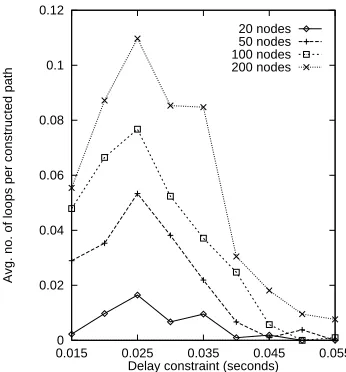
messages were always exchanged.In order to verify our assumption, that loops occur most frequently when the delay constraint is moderately strict,
we measured the average number of loop occurrences during one successful run of DCUR, i.e., a run that successfully
constructs a delay-constrained path for a given source-destination pair. We found that loops do not occur frequently
(less than 12 loops every 100 successful runs of DCUR). Therefore, it was not possible (due to the excessive simulation
times) to repeat the experiment until small enough confidence intervals were achieved for the measured values of the
average number of loop occurrences. 1,000 successful runs of DCUR were simulated for each point in figure 6. Figure 6
shows the average number of loop occurrences per successful run of DCUR versus the delay constraint for different
network sizes. Figure 6 shows that loops occur most frequently when the delay constraint value ranges from 20 msec
to 45 msec. When the delay constraint is lenient (larger than 45 msec) loop occurrences are very infrequent, less than
one loop every 100 successful runs of DCUR. The average number of loop occurrences also decreases when strict delay
the network sizes we simulated. However, the figure also indicates that loops occur more frequently as the size of the
network increases.
5.2
Comparison to Other Algorithms
In this subsection, we show the results of the second experiment which compares DCUR with two algorithms that are also
suitable for delay-sensitive applications. The first algorithm is the LD path algorithm, or simply LDP. LDP is optimal
with respect to the end-to-end delay, but it does not attempt to minimize the cost of the constructed path. Therefore,
it may result in inefficient utilization of the link bandwidth. Simple, distributed implementations of LDP already exist
over current networks. The other algorithm is CBF which was briefly described in section 1. CBF constructs the
optimal DCLC path, but it is centralized and its execution time grows exponentially with the network size. Note that
CBF and LDP are the only existing unicast routing algorithms capable of satisfying the delay requirements of real-time
applications.
The structure of the second experiment is similar to that of the first experiment. The only difference is that for
each randomly selected source-destination pair we applied DCUR, LDP, and CBF, one at a time, to construct the
delay-constrained path from source to destination. For each algorithm, we measured the average path cost, the average
inefficiency relative to CBF, the average end-to-end delay, and the success rate (how frequently the algorithm succeeds
to find a delay-constrained path). The average inefficiency of an algorithm
x
is defined as:ineciency x
= (cost
x ?cost
CBF ) cost
CBF
(11)
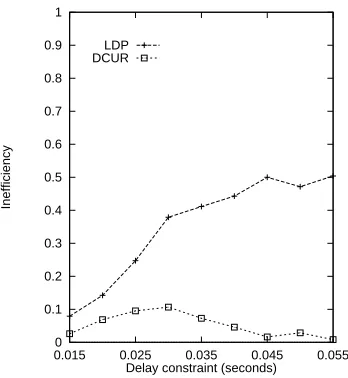
We show the results of the experiment for 200-node networks and variable delay constraint. Figure 7 shows the
average inefficiency of LDP and DCUR relative to CBF. When the delay constraint is small (15 msec) the number of
alternate delay-constrained paths, available for the algorithms to choose from, is small, and therefore the differences
between the algorithms are also small. For delay constraint values between 20 msec and 45 msec, DCUR is up to 10%
worse than the optimal CBF. The reason is that, because of the tight delay constraint, DCUR can not always follow the
unconstrained LC path direction. In some cases, it has to follow the LD path direction instead. The toggling between
these two directions affects DCUR’s ability to create low-cost paths. However, DCUR remains on the average more
efficient than LDP. When the value of the delay constraint exceeds 45 msec, its effect on the constructed path is minimal.
In that range, DCUR’s inefficiency approaches zero, because it almost exclusively elects to follow the LC path direction.
0 0.1 0.2 0.3 0.4 0.5 0.6 0.7 0.8 0.9 1
0.015 0.025 0.035 0.045 0.055
Inefficiency
Delay constraint (seconds) LDP
DCUR
Figure 7: Inefficiency, 200-node networks, average node degree 4, variable delay constraint.
0.015 0.025 0.035 0.045 0.055
0.015 0.025 0.035 0.045 0.055
End-to-end delay (seconds)
Delay constraint (seconds) CBF
LDP DCUR Delay Constraint
Figure 8: Average end-to-end delay, 200-node networks, average node degree 4, variable delay constraint.
value is large.
Figure 7 indicates that the path cost of DCUR is always within 10% from the path cost of the optimal CBF. Thus
DCUR’s cost performance is quite satisfactory, especially when considering that CBF is a centralized algorithm that
requires global information about the network topology while DCUR is a distributed heuristic that requires only limited
information to be maintained at each node (one cost vector and one delay vector).
The average end-to-end delays of DCUR and CBF are considerably larger than the minimal delays achieved by LDP
as shown in figure 8. This is not a big advantage for LDP, though. More important is that all three algorithms have
the same success rate in satisfying the imposed delay constraint. The success rates of the three different algorithms
algorithms achieve a 100% success rate when the delay constraint value is greater than 30 msec. As the delay constraint
value decreases below 30 msec the success rate decreases indicating that delay-constrained solutions do not always exist
for networks spanning large areas when the delay constraint value is sufficiently small.
In addition to the 200-node networks, we simulated 20-node, 50-node, and 100-node networks as well. The results for
the different network sizes are similar to results shown above for the 200 nodes case. This indicates that the performance
of the different algorithms relative to each other does not depend significantly on the network size.
6
Conclusions
We studied the delay-constrained routing problem in point-to-point connection-oriented networks. Our work was
motivated by the fast evolution of sensitive distributed applications. We formulated the problem as a
delay-constrained least-cost path problem, which is known to be NP-complete. Therefore we proposed a distributed,
source-initiated heuristic solution, the delay-constrained unicast routing (DCUR) algorithm, to avoid the excessive complexity
of the optimal solutions. DCUR is always capable of constructing a delay-constrained path within a finite time, if one
exists, for a given source-destination pair. DCUR requires only a limited amount of information at each node. The
information at each node is stored in a cost vector and a delay vector. These vectors are constructed and maintained in
exactly the same manner as the distance vectors which are widely deployed over current networks. DCUR is capable
of detecting and eliminating any loops that may occur while it constructs a delay-constrained path. We proved the
correctness of DCUR by showing that it is always capable of constructing a loop-free delay-constrained path within
finite time, if such a path exists. The number of computations at each node participating in the path construction process
is fixed, irrespective of the network size. The worst case message complexity of DCUR is dominated by the occurrence
and removal of loop. It requires
O
(jV
j3
)messages to construct a single path in the worst case. Fortunately, however, our
simulation results show that DCUR requires much fewer messages on the average, because loop occurrence is rare in
realistic networks. We compared the performance of DCUR to CBF, which is an optimal DCLC algorithm with running
times that grow exponentially with the size of the network. We also compared DCUR to LDP, a shortest path algorithm
that minimizes the end-to-end delay, but does not attempt to minimize the path cost. Our results indicated that DCUR
yields satisfactory performance with respect to both path cost and path delay. Our evaluation of the cost performance
of the algorithms showed that DCUR is always within 10% from the optimal CBF, while LDP is up to 50% worse than
sizes.
References
[1] C. Hedrick, “Routing Information Protocol.” Internet RFC 1058, June 1988.
[2] G. Malkin, “RIP Version 2, Carrying Additional Information.” Internet RFC 1723, November 1994.
[3] J. Moy, “OSPF Version 2.” Internet RFC 1583, March 1994.
[4] D. Bertsekas and R. Gallager, Data Networks. Prentice-Hall, second ed., 1992.
[5] J. Garcia-Luna-Aceves and J. Behrens, “Distributed, Scalable Routing Based on Vectors of Link States,” IEEE
Journal on Selected Areas in Communications, vol. 13, pp. 1383–1395, October 1995.
[6] R. Simha and B. Narahari, “Single Path Routing with Delay Considerations,” Computer Networks and ISDN
Systems, vol. 24, pp. 405–419, 1992.
[7] M. Aida, I. Nakamura, and T. Kubo, “Optimal Routing in Communication Networks with Delay Variations,” in
Proceedings of IEEE INFOCOM ’92, pp. 153–159, 1992.
[8] S. Rampal and D. Reeves, “An Evaluation of Routing and Admission Control Algorithms for Multimedia Traffic,”
Computer Communications, vol. 18, pp. 755–768, October 1995.
[9] S. Plotkin, “Competitive Routing of Virtual Circuits in ATM Networks,” IEEE Journal on Selected Areas in
Communications, vol. 13, pp. 1128–1136, August 1995.
[10] W.-T. Chen and U.-J. Liu, “Routing Problem with Performance Requirement Translation for Multimedia Commu-nications in an ATM Wide-Area Network,” in Proceedings of IEEE ICC ’94, pp. 1490–1494, 1994.
[11] M. Garey and D. Johnson, Computers and Intractability: A Guide to the Theory of NP-Completeness. New York: W.H. Freeman and Co., 1979.
[12] R. Widyono, “The Design and Evaluation of Routing Algorithms for Real-Time Channels,” Tech. Rep. ICSI TR-94-024, University of California at Berkeley, International Computer Science Institute, June 1994.
[13] H. Salama, D. Reeves, Y. Viniotis, and T.-L. Sheu, “Evaluation of Multicast Routing Algorithms for Real-Time Communication on High-Speed Networks,” in Proceedings of the Sixth IFIP Conference on High Performance
Networking (HPN ’95), pp. 27–42, Chapman and Hall, September 1995.
[14] S. Baase, Computer Algorithms, Introduction to Design and Analysis. Addison-Wesley Publishing Company, 2nd ed., 1988.
[15] B. Waxman, “Routing of Multipoint Connections,” IEEE Journal on Selected Areas in Communications, vol. 6, pp. 1617–1622, December 1988.
Appendix
Pseudo-Code of DCUR
First here is a list of all the control messages exchanged between nodes implementing DCUR:
Construct Path
(source node, destination node, delay constraint value, value of the delay fromthe source to the downstream node receiving the message)
Query
(destination node)Response
(destination node, least delay value from the responding node to the destination)The following function is executed by the source node
s
when it receives a request from an application to construct a delay-constrained path to a destination noded
.Initiate Path Construction(source node
s
, destination noded
, delay constraint∆)fif
least delay value
(s;d
)>
∆send a failure indication to the application;elsef
active node
:=s
;previous active node
:=null
;delay so far
:=0;call Path Construction(
active node
,previous active node
,s
,d
,∆,delay so far
);g; g;
The following function is executed by node
active node
when it receives aConstruct Path
message from a nodeprevious active node
. It is also called a the source node when initiating the path construction process.Path Construction(current node
active node
, previous nodeprevious active node
, source nodes
, destination noded
, delay constraint∆, current delaydelay so far
)fif
active node
=d
fcreate a routing table entry with
source
:=s
,destination
:=d
,previous node
:=previous active node
,next node
:=null
, andprevious delay
:=delay so far
;send an acknowledge message (path construction is complete) back to
s
;g
elsef
if a routing table entry corresponding to the source
s
and destinationd
already exists, send aRemove Loop
(s;d
)message toprevious active node
;elsef
use LDPATH
:=False
;if
least cost nhop
(active node;d
)=least delay nhop
(active node;d
)use LDPATH
:=True
;if
use LDPATH
=False
flc nhop
:=least cost nhop
(active node;d
);send
Query
(d
)message tolc nhop
;wait to receive a
Response
(d;delay
)message fromlc nhop
;if(
delay so far
+D
(active node;lc nhop
)+delay
)∆fcreate a routing table entry with
source
:=s
,destination
:=d
,previous node
:=previous active node
,next node
:=lc nhop
,previous delay
:=delay so far
, andflag
:=LCPATH
;delay so far
:=delay so far
+D
(s;lc nhop
);send a
Construct Path
(s;d;
∆;delay so far
)message tolc nhop
;g
else
use LDPATH
:=True
;g;
if
use LDPATH
=True
fld nhop
:=least delay nhop
(n;d
);create a routing table entry with
source
:=s
,destination
:=d
,previous node
:=previous active node
,next node
:=ld nhop
,previous delay
:=delay so far
, andflag
:=LDPATH
;delay so far
:=delay so far
+D
(s;ld nhop
);send a
Construct Path
(s;d;
∆;delay so far
)message told nhop
;The following function is executed by node
n
when it receives aQuery
message from nodeactive node
.Process Query(current node
n
, querying nodeactive node
, destination noded
)fsend a
Response
(d;least delay value
(n;d
))message back toactive node
;g;
The following function is executed by node
active node
when it receives aRemove Loop
message.Loop Removal(current node
active node
, sources
, destinationd
)ffind the routing table entry corresponding to
s
andd
; in that routing table entry, ifflag
=LCPATH
fnhop
:=least delay nhop
(active node;d
);in the routing table entry corresponding to
s
andd
, setfflag
:=LDPATH
;next node
:=nhop
; g;delay so far
:=previous delay
+D
(active node;nhop
);(
previous delay
is given in the routing table entry) send aConstruct Path
(s;d;
∆;delay so far
)message tonhop
;g
elsef
send a
Remove Loop
(s;d
)message to theprevious node
given in that routing table entry;delete that routing table entry;