CLINICAL UPDATES
Influenza
OPEN ACCESS
Sam Ghebrehewet
consultant in communicable disease control and head of health protection
1,
Peter MacPherson
academic clinical lecturer
1 2 3, Antonia Ho
specialty registrar in infectious diseases
4 51
Cheshire and Merseyside Health Protection Team, Public Health England North West, Liverpool, UK;
2Department of Public Health and Policy,
The Farr Institute@HeRC, University of Liverpool, UK;
3Department of Clinical Research, Liverpool School of Tropical Medicine, Liverpool, UK;
4Department of Infectious Diseases, Queen Elizabeth University Hospital, Glasgow, UK;
5Institute of Infection and Global Health, University of
Liverpool, Liverpool, UK
The World Health Organisation estimates that approximately
one billion people are infected and up to 500 000 people die
from influenza each year.
1The greatest burden of illness usually
occurs among children, while the highest burden of severe
disease (in terms of hospitalisation and death) occurs in those
with underlying medical conditions, infants and young children,
and elderly people.
2Current circulating influenza strains in
humans include influenza A(H1N1)pdm09, influenza A(H3N2),
and both influenza B viruses (B/Victoria and B/Yamagata).
3 4This article provides non-specialists with information on how
to diagnose, manage, and prevent flu.
What is influenza virus?
There are four types of influenza viruses: influenza A, B, C,
and D,
3-6but only influenza A and B viruses cause clinically
important human disease and seasonal epidemics (table 1
⇓
).
1Influenza A viruses cause the most severe clinical disease and
are the commonest cause of seasonal epidemics and pandemics
in human populations.
1What are the symptoms of influenza?
Influenza is characterised by sudden onset of fever, myalgia,
headache, malaise, dry cough, sore throat, and nasal congestion
(fig 1
⇓
).
13-15Gastrointestinal symptoms including nausea,
vomiting and diarrhoea are also common.
16The incubation
period of influenza (time from infection to development of
symptoms) is 1 to 4 days.
17Viral shedding, when the virus is
infectious, usually occurs from one day before the onset of
symptoms, to 5-7 days after.
18-20Influenza can cause severe illness or death, particularly in high
risk populations (box 1).
23Mortality is higher among individuals
with complicated influenza (illness necessitating hospital
admission, or an exacerbation of an underlying chronic illness)
across all age groups, but is highest in infants aged 6 months
or younger.
2How do influenza epidemics and
pandemics occur?
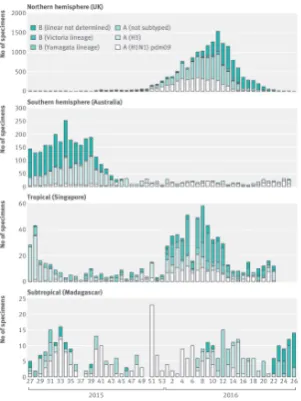
Minor changes that occur in virus proteins between influenza
seasons (known as antigenic drift) result in annual epidemics,
with winter peaks in temperate regions (November-April in the
northern hemisphere, and May-October in the southern
hemisphere, see fig 2
⇓
).
3In tropical and subtropical regions the
seasonality of influenza is less well defined (fig 2
⇓
).
24 25In contrast, pandemics (severe global epidemics) of influenza
occur when a new influenza A subtype emerges abruptly because
of a major shift in the proteins on the virus surface (antigenic
shift), often because of combination with viruses circulating in
animals.
26As most people have no immunity to the new subtype,
infection spreads quickly (table 2
⇓
).
How is influenza diagnosed?
Most influenza is diagnosed clinically in the community at times
when the virus is known to be circulating. Patients admitted to
hospital may have respiratory samples taken for testing by
polymerase chain reaction (PCR), rapid antigen test, or
immunofluorescence assay. With respiratory outbreaks in a
closed setting (such as care homes, schools, hospitals) nasal
swabs may be taken from the first few symptomatic individuals
to identify the responsible organism.
Corresponding author: S Ghebrehewet [email protected]
What you need to know
• Influenza is an acute viral infection of the respiratory tract that spreads easily from person to person • Influenza is usually self limiting in healthy individuals, with recovery in 3-7 days
• Elderly people, children under 6 months old, pregnant women, and people with chronic conditions or immunosuppression are at increased risk of complications
• Offer influenza vaccination to people at risk of complications and increased influenza exposure, as well as to young children, who are efficient infection spreaders
• People in high risk groups may benefit from antiviral therapy, hospitalisation, or intensive care
Box 1: Who should be prescribed antiviral treatment for influenza?*
Individuals at risk of influenza related complications
• Adults >65 years old
• Individuals with underlying chronic health conditions (chronic heart, lung, kidney, liver, neurological, and metabolic diseases, such as diabetes)
• Individuals with reduced immunity (such as after chemotherapy, asplenia, prolonged steroid treatment, splenic dysfunction, or HIV infection)
• Pregnant women, including up to two weeks post-partum
• Any other individual whom the clinician feels is at increased risk of developing complications from influenza • Morbidly obese individuals (body mass index >40)
Individuals admitted to hospital with suspected or confirmed influenza
*Based on guidance from National Institute for Health and Care Excellence (NICE)
21 22What treatments are available for
influenza?
Influenza is usually self limiting in healthy individuals.
Treatment of uncomplicated disease in healthy individuals is
supportive and includes antipyretics, adequate fluid intake, rest,
and staying off work or school until 24 hours after resolution
of fever to limit spread to others.
21Most randomised trials of antiviral drugs have been conducted
among otherwise healthy individuals and have shown modest
reductions in symptom duration (0.7 days).
27Fewer studies have
been conducted among individuals at risk of complicated
influenza. Data from observational studies and trials suggests
that antiviral treatment may reduce adverse outcomes.
28-30For
example, the meta-analysis from 2015 reported fewer lower
respiratory tract complications requiring antibiotics after
oseltamivir treatment compared with placebo (risk difference
−3.8%) and fewer hospital admissions (risk difference −1.1%).
30NICE,
21Public Health England,
12UK Chief Medical Officers,
31and the WHO
32recommend treatment of suspected and
confirmed influenza for individuals at risk of complicated
influenza (box 1). General practitioners considering prescription
of antivirals should discuss with patients likely benefits, as well
as possible harms including nausea (number treated to cause
nausea in one patient=28)
27and vomiting (number treated to
cause vomiting in one patient=22).
27Individuals with complicated influenza may be helped by
antiviral treatment.
21 22Treatment is most effective if started
within 48 hours of symptom onset, and it should not be delayed
while awaiting results of investigations.
12 28Neuraminidase
inhibitors oseltamivir and zanamivir inhibit viral release from
infected cells and reduce the rate of viral replication.
Meta-analysis of individual participant data found that,
compared with late treatment, early treatment (within 48 hours
of symptom onset) of hospitalised individuals with complicated
influenza reduced the odds of mortality by 52%.
28Some
individuals may require antibiotic therapy to treat secondary
bacterial infections.
How can influenza be prevented?
Vaccination
Vaccination is the most effective means of preventing influenza
and its complications. Immunity developed in one influenza
season may not provide protection in future years mainly
because of changes in circulating strains, antigenic drift, and
waning immunity. Influenza vaccines are updated annually to
include the viral strains that are predicted to circulate in winter.
3 4Box 2 lists the UK recommendations for vaccination.
23Vaccination schedules may vary internationally, and so it is
important to check local policies. In healthy adults, trivalent
inactivated vaccines have an overall vaccine efficacy of 60%.
33 34Newer quadrivalent vaccines are being increasingly adopted
due to the broader protection provided by the inclusion of an
additional influenza B virus.
35-38Since 2013, the UK influenza vaccination programme has been
extended to children aged 2-4 years, with planned phased
introduction to children of school ages,
23as it reduces morbidity
by directly protecting children and provides indirect protection
to vulnerable groups (such as grandparents) by reducing
transmission in the community.
39 40Attenuated live nasal spray
formulation is recommended in children aged 2-<17 years based
on its superior efficacy and greater immunity against
Box 2: Who is offered influenza vaccination in the UK?
23People at risk of influenza related complications*
• Adults over 65 years old
• Individuals with underlying chronic health conditions (for example, chronic heart, lung, kidney, liver, neurological, and metabolic diseases, such as diabetes)
• Individuals with reduced immunity (such as after chemotherapy, asplenia or splenic dysfunction, or HIV infection) • Pregnant women
• Morbidly obese individuals (body mass index >40)
People at risk of influenza exposure or transmitting influenza to vulnerable groups
• Health and social care workers
• Individuals who live with or care for vulnerable people
People living in settings where rapid spread is likely after introduction of infection, potentially resulting in high morbidity
and mortality
• Individuals living in long-stay care facilities
Efficient influenza spreaders
• Children aged 2-<17 years
*Children <6 months old are not eligible to receive influenza vaccines and should be protected against influenza through
vaccination of their mother during pregnancy.
Antiviral chemoprophylaxis
Influenza may be prevented or rendered less severe by
post-exposure prophylaxis (PEP) with antivirals (oseltamivir
and zanamivir).
27 48NICE
21and Public Health England
12recommend that, when influenza is circulating, antivirals are
offered to those who are:
•
In at-risk groups (box 2)
and
•
Who have had close contact with people with confirmed
or suspected influenza (that is, living in the same household
or residential setting)
and
•
Able to start prophylaxis within 48 hours (oseltamivir) or
36 hours (zanamivir) of contact
and
•
Have not received vaccination in the current influenza
season, or who have been vaccinated <14 days since contact
or where there is significant mismatch between vaccine
and circulating strains, or during an outbreak in a closed
setting regardless of vaccination history.
Infection control and isolation
Although published evidence for effectiveness is limited, hand
and cough hygiene are likely to be important interventions to
reduce influenza spread in the community, as well as in closed
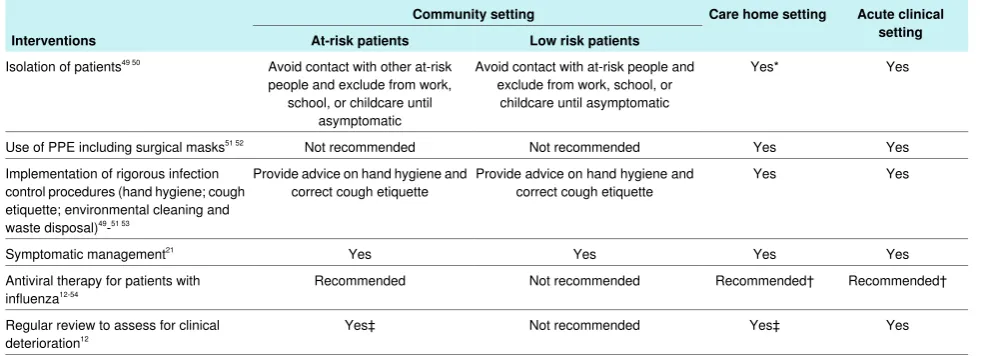
settings (table 3
⇓
).
During an outbreak, consider isolation of residents of closed
settings for the duration of the infectious period (five days after
symptom onset) to limit spread to others. Cohorting of patients
(that is, in separate hospital bays or on separate floors of a
residential home) may be necessary. Residential homes may
need to be closed to new admissions until the outbreak is
controlled. Care must be taken when discharging a patient from
a ward with a known influenza outbreak to a care home, or vice
versa.
New developments in prevention and
treatment of influenza
Vaccine candidates have recently been developed that can elicit
antibodies against multiple influenza strains, and thus could
overcome the need for annual influenza vaccines.
55-57Several
antiviral drugs are currently in development for influenza
treatment, including favipiravir,
58nitazoxanide,
59 60and
arbidol.
61 62Contributors: SG and PM conceived of the review. SG is the guarantor
of the manuscript. SG, PM, and AH undertook the literature review, and
were supported by Dr Bethan Roberts, foundation year 2 trainee in
health protection, Cheshire and Merseyside Health Protection Team,
Public Health England North West. SG, PM, and AH contributed to
writing drafts of the manuscript. PM designed and wrote code for the
interactive application. All authors have seen and approved the final
manuscript version.
Competing interests: We have read and understood BMJ policy on
declaration of interests and declare that we have no competing interests.
Provenance and peer review: Not commissioned; externally peer
reviewed.
1 World Health Organization. Influenza (seasonal)—Fact sheet No 211. 2014. www.who. int/mediacentre/factsheets/fs211/en/.
2 Cromer D, van Hoek AJ, Jit M, Edmunds WJ, Fleming D, Miller E. The burden of influenza in England by age and clinical risk group: a statistical analysis to inform vaccine policy.
J Infect2014;68:363-71. doi:10.1016/j.jinf.2013.11.013 pmid:24291062.
3 World Health Organization. Global Influenza Surveillance and Response System (GISRS). 2016. www.who.int/influenza/gisrs_laboratory/en/.
4 World Health Organization. Influenza vaccine viruses and reagents. 2016. www.who.int/ influenza/vaccines/virus/en/.
5 Ferguson L, Eckard L, Epperson WB, et al. Influenza D virus infection in Mississippi beef cattle.Virology2015;486:28-34. doi:10.1016/j.virol.2015.08.030 pmid:26386554. 6 Hause BM, Collin EA, Liu R, et al. Characterization of a novel influenza virus in cattle and
Swine: proposal for a new genus in the Orthomyxoviridae family.MBio2014;5:e00031-14. doi:10.1128/mBio.00031-14 pmid:24595369.
7 A revision of the system of nomenclature for influenza viruses: a WHO memorandum.
Bull World Health Organ1980;58:585-91.pmid:6969132.
8 Webster RG, Bean WJ, Gorman OT, Chambers TM, Kawaoka Y. Evolution and ecology of influenza A viruses.Microbiol Rev1992;56:152-79.pmid:1579108.
9 Olson DR, Heffernan RT, Paladini M, Konty K, Weiss D, Mostashari F. Monitoring the impact of influenza by age: emergency department fever and respiratory complaint surveillance in New York City.PLoS Med2007;4:e247. doi:10.1371/journal.pmed. 0040247 pmid:17683196.
10 Kawai S, Nanri S, Ban E, et al. Influenza vaccination of schoolchildren and influenza outbreaks in a school.Clin Infect Dis2011;53:130-6. doi:10.1093/cid/cir336 pmid: 21690619.
11 Matsuzaki Y, Sugawara K, Furuse Y, et al. Genetic Lineage and Reassortment of Influenza C Viruses Circulating between 1947 and 2014.J Virol2016;90:8251-65. doi:10.1128/JVI. 00969-16 pmid:27384661.
12 Public Health England. PHE guidance on use of antiviral agents for the treatment and prophylaxis of seasonal influenza. Version 7.0. PHE, 2016.
13 Lam PP, Coleman BL, Green K, et al. Predictors of influenza among older adults in the emergency department.BMC Infect Dis2016;16:615. doi:10.1186/s12879-016-1966-4 pmid:27793117.
14 Monto AS, Gravenstein S, Elliott M, Colopy M, Schweinle J. Clinical signs and symptoms predicting influenza infection.Arch Intern Med2000;160:3243-7. doi:10.1001/archinte. 160.21.3243 pmid:11088084.
15 Ohmit SE, Monto AS. Symptomatic predictors of influenza virus positivity in children during the influenza season.Clin Infect Dis2006;43:564-8. doi:10.1086/506352 pmid:16886147. 16 Minodier L, Charrel RN, Ceccaldi PE, et al. Prevalence of gastrointestinal symptoms in
Sources and selection criteria
We searched PubMed and the Cochrane Library databases (search terms “influenza,” “flu,” “influenza-like illness”). We obtained information on the epidemiology of influenza from annual reports produced by authoritative bodies and organisations such as Public Health England (PHE), Centers for Communicable Disease Prevention and Control (CDC), and the World Health Organization (WHO). We reviewed up-to-date influenza guidelines and reviews, including those published by PHE, Cochrane Reviews, and the National Institute for Health and Care Excellence (NICE).
Education into practice
• What steps have you taken to improve the uptake of influenza vaccination among staff and eligible patients under your care? • Have you reviewed your organisation’s infection control policy for responding to an outbreak of influenza-like illness? • Have you reviewed antivirals prescribed (treatment or prophylaxis) for eligible patients with influenza and their close contacts?
Further educational resources
• Public Health England. Chapter 19: Influenza. In:Immunisation Against Infectious Disease. 2013, updated 2015. www.gov.uk/ government/uploads/system/uploads/attachment_data/file/456568/2904394_Green_Book_Chapter_19_v10_0.pdf
• National Institute for Health and Care Excellence. Clinical Knowledge Summaries: Influenza-seasonal. https://cks.nice.org.uk/influenza-seasonal
• Public Health England. Flu Plan: Winter 2016/17. www.gov.uk/government/uploads/system/uploads/attachment_data/file/525967/ Annual_flu_plan_2016_to_2017.pdf
• Wellcome Trust & Academy of Medical Sciences. Use of neuraminidase inhibitors in influenza. 2015. www.acmedsci.ac.uk/policy/ policy-projects/treating-influenza/
How patients were involved in the production of this article
No patients were involved in the production of this article
viruses in faecal samples: what do we know?Virol J2015;12:215. doi:10.1186/s12985-015-0448-4 pmid:26651485.
17 Lessler J, Reich NG, Brookmeyer R, Perl TM, Nelson KE, Cummings DA. Incubation periods of acute respiratory viral infections: a systematic review.Lancet Infect Dis
2009;9:291-300. doi:10.1016/S1473-3099(09)70069-6 pmid:19393959.
18 Department of Health. Routes of transmission of the influenza virus: scientific evidence base review. DoH, 2011.
19 Killingley B, Greatorex J, Digard P, et al. The environmental deposition of influenza virus from patients infected with influenza A(H1N1)pdm09: Implications for infection prevention and control.J Infect Public Health2016;9:278-88. doi:10.1016/j.jiph.2015.10.009 pmid: 26653976.
20 Lau LLH, Cowling BJ, Fang VJ, et al. Viral shedding and clinical illness in naturally acquired influenza virus infections.J Infect Dis2010;201:1509-16. doi:10.1086/652241 pmid: 20377412.
21 National Institute for Health and Care Excellence. Clinical Knowledge Summaries: Influenza-seasonal. 2015. https://cks.nice.org.uk/influenza-seasonal.
22 National Institute for Health and Care Excellence. Amantadine, oseltamivir and zanamivir for the treatment of influenza (technology appraisal guidance 168). 2009. www.nice.org. uk/Guidance/ta168.
23 Public Health England. Chapter 19: Influenza. In: Immunisation Against Infectious Disease. 2013, updated 2015. www.gov.uk/government/uploads/system/uploads/attachment_data/ file/456568/2904394_Green_Book_Chapter_19_v10_0.pdf
24 Viboud C, Alonso WJ, Simonsen L. Influenza in tropical regions.PLoS Med2006;3:e89. doi:10.1371/journal.pmed.0030089 pmid:16509764.
25 Moura FE. Influenza in the tropics.Curr Opin Infect Dis2010;23:415-20. doi:10.1097/ QCO.0b013e32833cc955 pmid:20644472.
26 World Health Organization. Pandemic influenza preparedness and response. WHO, 2010. 27 Jefferson T, Jones MA, Doshi P, et al. Neuraminidase inhibitors for preventing and treating
influenza in healthy adults and children.Cochrane Database Syst Rev
2014;4:CD008965.pmid:24718923.
28 Muthuri SG, Venkatesan S, Myles PR, et al. PRIDE Consortium Investigators. Effectiveness of neuraminidase inhibitors in reducing mortality in patients admitted to hospital with influenza A H1N1pdm09 virus infection: a meta-analysis of individual participant data.
Lancet Respir Med2014;2:395-404. doi:10.1016/S2213-2600(14)70041-4 pmid:24815805. 29 Zambon M. Developments in the treatment of severe influenza: lessons from the pandemic of 2009 and new prospects for therapy.Curr Opin Infect Dis2014;27:560-5. doi:10.1097/ QCO.0000000000000113 pmid:25333476.
30 Dobson J, Whitley RJ, Pocock S, Monto AS. Oseltamivir treatment for influenza in adults: a meta-analysis of randomised controlled trials.Lancet2015;385:1729-37. doi:10.1016/ S0140-6736(14)62449-1 pmid:25640810.
31 Department of Health. Chief Medical Officer and Chief Pharmaceutical Officer: advice on using antiviral medicines: influenza season 2015 to 2016. DoH, 2016.
32 World Health Organization. WHO Guidelines for pharmacological management of pandemic influenza A(H1N1) 2009 and other influenza viruses. WHO, 2010.
33 Demicheli V, Jefferson T, Al-Ansary LA, Ferroni E, Rivetti A, Di Pietrantonj C. Vaccines for preventing influenza in healthy adults.Cochrane Database Syst Rev
2014;3:CD001269.pmid:24623315.
34 Kliner M, Keenan A, Sinclair D, Ghebrehewet S, Garner P. Influenza vaccination for healthcare workers in the UK: appraisal of systematic reviews and policy options.BMJ Open2016;6:e012149. doi:10.1136/bmjopen-2016-012149 pmid:27625062.
35 Beran J, Peeters M, Dewé W, Raupachová J, Hobzová L, Devaster JM. Immunogenicity and safety of quadrivalent versus trivalent inactivated influenza vaccine: a randomized, controlled trial in adults.BMC Infect Dis2013;13:224. doi:10.1186/1471-2334-13-224 pmid: 23688546.
36 Kieninger D, Sheldon E, Lin WY, et al. Immunogenicity, reactogenicity and safety of an inactivated quadrivalent influenza vaccine candidate versus inactivated trivalent influenza vaccine: a phase III, randomized trial in adults aged ≥18 years.BMC Infect Dis
2013;13:343. doi:10.1186/1471-2334-13-343 pmid:23883186.
37 Pépin S, Donazzolo Y, Jambrecina A, Salamand C, Saville M. Safety and immunogenicity of a quadrivalent inactivated influenza vaccine in adults.Vaccine2013;31:5572-8. doi:10. 1016/j.vaccine.2013.08.069 pmid:24016810.
38 Tinoco JC, Pavia-Ruz N, Cruz-Valdez A, et al. Immunogenicity, reactogenicity, and safety of inactivated quadrivalent influenza vaccine candidate versus inactivated trivalent influenza vaccine in healthy adults aged ≥18 years: a phase III, randomized trial.Vaccine
2014;32:1480-7. doi:10.1016/j.vaccine.2014.01.022 pmid:24486352.
39 Baguelin M, Flasche S, Camacho A, Demiris N, Miller E, Edmunds WJ. Assessing optimal target populations for influenza vaccination programmes: an evidence synthesis and modelling study.PLoS Med2013;10:e1001527. doi:10.1371/journal.pmed.1001527 pmid: 24115913.
40 Loeb M, Russell ML, Moss L, et al. Effect of influenza vaccination of children on infection rates in Hutterite communities: a randomized trial.JAMA2010;303:943-50. doi:10.1001/ jama.2010.250 pmid:20215608.
41 Belshe RB, Edwards KM, Vesikari T, et al. CAIV-T Comparative Efficacy Study Group. Live attenuated versus inactivated influenza vaccine in infants and young children.N Engl J Med2007;356:685-96. doi:10.1056/NEJMoa065368 pmid:17301299.
42 Fleming DM, Crovari P, Wahn U, et al. CAIV-T Asthma Study Group. Comparison of the efficacy and safety of live attenuated cold-adapted influenza vaccine, trivalent, with trivalent inactivated influenza virus vaccine in children and adolescents with asthma.Pediatr Infect Dis J2006;25:860-9. doi:10.1097/01.inf.0000237797.14283.cf pmid:17006278. 43 Ambrose CS, Luke C, Coelingh K. Current status of live attenuated influenza vaccine in
the United States for seasonal and pandemic influenza.Influenza Other Respir Viruses
2008;2:193-202. doi:10.1111/j.1750-2659.2008.00056.x pmid:19453395.
44 Englund JA, Mbawuike IN, Hammill H, Holleman MC, Baxter BD, Glezen WP. Maternal immunization with influenza or tetanus toxoid vaccine for passive antibody protection in young infants.J Infect Dis1993;168:647-56. doi:10.1093/infdis/168.3.647 pmid:8354906. 45 Zaman K, Roy E, Arifeen SE, et al. Effectiveness of maternal influenza immunization in
mothers and infants.N Engl J Med2008;359:1555-64. doi:10.1056/NEJMoa0708630 pmid: 18799552.
46 Naleway AL, Irving SA, Henninger ML, et al. Vaccine Safety Datalink and Pregnancy and Influenza Project. Safety of influenza vaccination during pregnancy: a review of subsequent maternal obstetric events and findings from two recent cohort studies.Vaccine
2014;32:3122-7. doi:10.1016/j.vaccine.2014.04.021 pmid:24742490.
47 Tamma PD, Ault KA, del Rio C, Steinhoff MC, Halsey NA, Omer SB. Safety of influenza vaccination during pregnancy.Am J Obstet Gynecol2009;201:547-52. doi:10.1016/j.ajog. 2009.09.034 pmid:19850275.
48 National Institute for Health and Care Excellence. Oseltamivir, amantadine and zanamivir for the prophylaxis of influenza (technology appraisal guidance 158). 2008. www.nice.org. uk/guidance/ta158.
50 Siegel J, Rhinehart E, Jackson M, Centers for Disease Control and Prevention. Guideline for isolation precautions: preventing transmission of infectious agents in healthcare settings. CDC, 2007.
51 Health and Safety Executive. Pandemic flu—workplace guidance. HSE, 2016. 52 European Centre for Disease Prevention and Control (ECDC). Technical document. Safe
use of personal protective equipment in the treatment of infectious diseases of high consequence: A tutorial for trainers in healthcare settings. Version 2, 2014. 53 Public Health England. PHE guidelines on the management of outbreaks of influenza-like
illness in care homes. 2016. www.gov.uk/government/publications/acute-respiratory-disease-managing-outbreaks-in-care-homes.
54 Public Health England. Managing outbreaks of acute respiratory disease in care homes. 2012 (and supplement 2014). www.gov.uk/government/publications/acute-respiratory-disease-managing-outbreaks-in-care-homes.
55 Impagliazzo A, Milder F, Kuipers H, et al. A stable trimeric influenza hemagglutinin stem as a broadly protective immunogen.Science2015;349:1301-6. doi:10.1126/science. aac7263 pmid:26303961.
56 Yassine HM, Boyington JC, McTamney PM, et al. Hemagglutinin-stem nanoparticles generate heterosubtypic influenza protection.Nat Med2015;21:1065-70. doi:10.1038/ nm.3927 pmid:26301691.
57 Joyce MG, Wheatley AK, Thomas PV, et al. NISC Comparative Sequencing Program. Vaccine-induced antibodies that neutralize group 1 and group 2 influenza A viruses.Cell
2016;166:609-23. doi:10.1016/j.cell.2016.06.043 pmid:27453470.
58 Furuta Y, Gowen BB, Takahashi K, Shiraki K, Smee DF, Barnard DL. Favipiravir (T-705), a novel viral RNA polymerase inhibitor.Antiviral Res2013;100:446-54. doi:10.1016/j. antiviral.2013.09.015 pmid:24084488.
59 Rossignol JF, La Frazia S, Chiappa L, Ciucci A, Santoro MG. Thiazolides, a new class of anti-influenza molecules targeting viral hemagglutinin at the post-translational level.J Biol Chem2009;284:29798-808. doi:10.1074/jbc.M109.029470 pmid:19638339. 60 Haffizulla J, Hartman A, Hoppers M, et al. US Nitazoxanide Influenza Clinical Study Group.
Effect of nitazoxanide in adults and adolescents with acute uncomplicated influenza: a double-blind, randomised, placebo-controlled, phase 2b/3 trial.Lancet Infect Dis
2014;14:609-18. doi:10.1016/S1473-3099(14)70717-0 pmid:24852376.
61 Leneva IA, Russell RJ, Boriskin YS, Hay AJ. Characteristics of arbidol-resistant mutants of influenza virus: implications for the mechanism of anti-influenza action of arbidol.
Antiviral Res2009;81:132-40. doi:10.1016/j.antiviral.2008.10.009 pmid:19028526. 62 Pécheur EI, Borisevich V, Halfmann P, et al. The synthetic antiviral drug arbidol inhibits
globally prevalent pathogenic viruses.J Virol2016;90:3086-92. doi:10.1128/JVI.02077-15 pmid:26739045.
Published by the BMJ Publishing Group Limited. For permission to use (where not already granted under a licence) please go to http://group.bmj.com/group/rights-licensing/ permissions
Tables
Table 1
| Influenza viruses
At risk groups
Reservoir
Classification
Influenza
type
Infects people of all ages, but
disproportionately causes severe disease in
older adults and individuals with underlying
chronic health problems
The primary reservoir is aquatic
birds, but viruses also circulate
among many other species, such
as pigs, horses, and sea mammals
8• Classified into subtypes on the basis of haemagglutinin (H) and
neuraminidase (N) antigens on the surface of the viral envelope
• To date, 18 haemagglutinin subtypes and 11 neuraminidase
subtypes have been identified
• Only three haemagglutinin types (H1, H2, and H3) are
recognised to cause epidemic disease in humans
• Nomenclature includes the virus type and subtype, natural host
species, geographical origin, year of isolation, and strain number
(such as H1N1/A/duck/Alberta/35/76)
7A
Children are affected by influenza B infection
at a disproportionately higher rate among the
general population
9 10Mainly infects humans
Divided into lineages on the basis of the haemagglutinin
glycoprotein
B
Affects individuals of all ages, but tends to
cause mild illness
11Mainly infects humans
Unlike influenza A or B, which have two glycoproteins (HA and
NA), influenza C has only one glycoprotein (HEF)
C
Not known to cause human disease
5Mainly infects pigs and cattle
Little known about it, but is thought to be related to influenza C
viruses
Table 2
| Antigenic drift versus antigenic shift: implications for epidemics and pandemics
Antigenic shift
Antigenic drift
A sudden major change in the virus antigenicity
Accumulation of mutations in genes that code for antibody binding sites on viruses
leading to emergence of new strains
From one or more virus strains (from genome reassortment)
Only one virus strain (accumulation of point mutations)
Occurs occasionally
Occurs frequently
Gives rise to pandemics, which occur irregularly and unpredictably due to a
lack of immunity to the new strain in the human population
Usually responsible for seasonal influenza epidemics and affects effectiveness of
influenza vaccine
Table 3
| Responding to influenza cases and clusters or outbreaks by setting
Acute clinical
setting
Care home setting
Community setting
Interventions
At-risk patients
Low risk patients
Yes
Yes*
Avoid contact with at-risk people and
exclude from work, school, or
childcare until asymptomatic
Avoid contact with other at-risk
people and exclude from work,
school, or childcare until
asymptomatic
Isolation of patients
49 50Yes
Yes
Not recommended
Not recommended
Use of PPE including surgical masks
51 52Yes
Yes
Provide advice on hand hygiene and
correct cough etiquette
Provide advice on hand hygiene and
correct cough etiquette
Implementation of rigorous infection
control procedures (hand hygiene; cough
etiquette; environmental cleaning and
waste disposal)
49-
51 53Yes
Yes
Yes
Yes
Symptomatic management
21Recommended†
Recommended†
Not recommended
Recommended
Antiviral therapy for patients with
influenza
12-54Yes
Yes‡
Not recommended
Yes‡
Regular review to assess for clinical
deterioration
12*If not possible or practical, consider cohorting of patients as soon as possible.
Figures
Fig 1
Symptoms and complications of influenza. Complicated influenza is defined as an infection that requires hospital