Performance Analysis of Joint Network Channel
Coding In Various Network Topologies
D.Rajeswari1, K.Vijayalakshmi2
1 M.E(Applied Electronics), S.K.P Engineering College, Thiruvannamalai 2Asst. Professor, S.K.P Engineering College, Thiruvannamalai
Abstract
—
JNCC seamlessly couples channel coding and network coding to effectively combat the detrimental effect of fading of wireless channels. In this paper we used Joint Network-Channel Coding scheme, for reliable multiple access relay channel. Specifically, JNCC combines irregular low-density parity-check (LDPC) channel coding and random linear network coding through iterative joint decoding, which helps to fully exploit the spatial diversity and redundancy residing in both channel codes and network code through this we have analyse BER,GER,FER,PER in order to achieve diversity gain. The simulation results show that JNCC provides selection gain compared to the direct Transmission. Analytical and simulation results are presented to evaluate the performance of this system.Keywords—JNCC, LDPC Codes
I. INTRODUCTION
We consider the multiple-access relay channel with N sources, one or multiple relay and M destination node .We focus on the time-division MARC with half-duplex terminals where the sources and the relay transmit in separate time slots. These assumptions simplify practical implementation, in particular with regard to synchronization. Network coding (NC) was recognized as an effective way to improve spectral efficiency in such a setting. Information-theoretic limits for the MARC with decode-and forward (DF) and compress-and-forward (CF) protocols have been established. Diversity has been an effective technique in combating channel fading. In a relay system, the source sends its information to the relays. The relays then process the received signals, and forward them to the destination. To achieve the spatial diversity and code optimization we use joint network channel coding scheme and relays in this work employ the same non binary LDPC codes at the physical layer and generate then networked coded packets based on symbol-wise combination of incoming packets with randomly generated non binary coefficients. This allows the relays to process and forward packets independently without pre-scheduled collaboration, rendering the proposed solution suitable for large-scale multi-path multi-hop wireless networks.
To further improve the network capacity, the application of network coding in wireless relay networks has recently drawn significant attention. In particular, NC has been studied in multiple access, multicast and two-way relay channels, where two users communicate with each other with the help of relays . Some physical layer NC schemes, joint network-channel coding and scheduling algorithms, etc., Most of the current work on two-way relay channels considers the use of a single relay node to
aid communication in the system . In this paper, we consider a multiple relay networks, if all relays participate in the relayed transmission, it is usually assumed that they transmit on orthogonal channels so that they do not cause interference to each other. Relaxing the orthogonality constraint can lead to a capacity increase with an increased system complexity.
To overcome these problems, relay selection algorithms using various relay protocols, such as amplify and forward, decode and forward (DAF), and their variations, have been proposed to facilitate system design for one way non-orthogonal multiple relay networks. A commonly used relay selection strategy in one way relay networks is to select a single best relay, which has the optimal end to end performance or capacity among all relays, or among all relays whose received signal to- noise ratios (SNRs) are larger than a threshold. It was shown that the single relay selection can achieve the full spatial diversity order as if all relays are used. Furthermore, the system bit error rate (BER) performance and capacity compared to all-participation relaying schemes is improved.
II.PRELIMINARIES A. Joint Network Channel Coding
Wireless communication suffers from high and
A full-diversity joint network-channel code (JNCC) for the multiple access relay channel is proposed but it is not extended to large networks. Thus, we can generate the extrinsic information for each packet using a prioriinformation from two other packets. Here we choose the two packets that have smaller numbers of unsatisfied parity checks relative to other packets. Specifically, let us take the network updating of packet x1 as an example.
Suppose that x1 can be represented as a linear combinations
of two packets chosen from the three other packets, x2, y1
andy2. For instance x2 and y1 are better than y2 in the
sense of having smaller numbers of unsatisfied parity checks, then we represent x1 as a linear combination of x2
and y1. The a prior information from x2 and y1 is used to
generate the extrinsic information of x1, using the
parity-check node updating rule ct in standard sum-product based LDPC decoding. The above selection updating rule can be easily generalized to any network coding matrix M.
One way to gain diversity through network coding for the MARC with noisy channels is to treat network and channel coding separately. Then, channel coding is used in the physical layer for each transmission to transform the noisy channels to erasure-based links. On the network layer, one performs network coding for the erasure-based networks which is provided by the lower layers. However, relay cannot only be used to gain diversity. Its transmission can be seen as additional redundancy which improves the performance compared to a point-to-point communication if the relay has a better connection to the base station than the mobile station. For this case relays are also useful for noisy channels without fading where diversity is not relevant. Distributed channel codes can be applied to efficiently exploit the (direct) redundancy from the mobile station and the additional redundancy from the relay. Of course, the relay of the MARC delivers also additional redundancy. To efficiently exploit this redundancy, we have to generalize the concept of distributed channel codes to joint network-channel coding. Distributed network-channel codes for the relay channel can be seen in this context as joint routing channel coding.
While for the application of network coding to wire line networks only the network layer is considered and it is assumed that the lower layers deliver error-free or erasure-based links with the help of channel coding, the principle of joint network channel coding is that the redundancy in the network code should be used to support the channel code for better error protection. It is similar to the principle of joint source-channel coding, where the remaining redundancy after the source encoding helps the channel code to combat noise. We know in general, capacity can only be achieved by treating network and channel coding jointly, if we consider the communication in wireless relay networks. It was shown in fig how joint network-channel coding based on low-density parity-check (LDPC) codes can be used for the MARC.
Joint Network channel decoding: We propose a two-tier
iterative joint network-channel decoding scheme, which implements soft decoding and allows information exchange inside and across packets.
B. Channel coding:
Wireless communication suffers from high and time-varying packet losses due to the detrimental effect of fading of wireless channels. One method to provide reliable communication is using redundant information to recover errors in the original information, which can be added either inside a packet (redundant bits/symbols at the physical layer) or across multiple packets (redundant packets at the network layer). To add redundancy inside a packet is called as channel coding or error correction. The channel coding is a conventional error correction technique used for point-to-point communication over a single channel. It is implemented at the physical layer to recover erroneous bits/symbols through redundant parity check bits/symbols appended to a packet. The error recovery capability depends on the specific coding strategy and the amount of redundant bits/symbols. The purpose of channel coding is to find codes which transmit quickly, contain many valid code words and can correct or at least detect many errors. So, different codes are optimal for different applications. The needed properties of this code mainly depend on the probability of errors happening during transmission.
C. LDPC CODES
In JNCC, we choose non-binary irregular low-density parity-check (LDPC) codes as the channel coding scheme. The reason for adopting this scheme is three-fold: 1) the LDPC codes can be graphically represented using factor graphs; 2) the adopted codes can approach the Shannon limit of various channels and can be encoded in linear time and in a parallel fashion; and 3) the channel coding/decoding on non-binary Galois field can be seamlessly combined with the network coding/decoding and underlying high order modulation.
An LDPC code is a linear error correcting code specified by a parity-check matrix H and a generator matrix G, satisfying the relationship GHT = 0. Given H, the
corresponding generator matrix G can be obtained via
Gaussian elimination. A source packet u of length k is
encoded into a coded packet x through x = uG, where u and x are row vectors.
A key property of LDPC codes is that the parity-check matrix H is of low density in terms of the number of
non-zero entries. An LDPC code can be represented using a sparse bipartite graph called Tanner graph as shown later in Fig. Decoding of an LDPC code is done in an iterative manner via message passing along edges of its corresponding Tanner graph. At the receiver side, the decoding process stops once the tentative copy ˆx satisfies HˆxT = 0.The column weight distribution and row weight
distribution of the H matrix highly affect the code’s
performance and complexity. Degree distribution optimized LDPC codes can approach Shannon limit in various channels. In this paper, we use the non binary LDPC codes whose parity check matrices consist of columns of weight 2 and columns of weight t (t ≥ 3).
D. Network Coding
Secondly, the non-binary operation on a high order Galois field can provide independent network codes with high probability. Thirdly, the randomness of such network coding scheme renders itself applicable to large scale networks as it allows distributed operation on each node without interrupting others.
In random linear network coding over a high order Galois field GF(2q), the source generates the original packets, groups them into generations and linearly combines packets in a generation using randomly generated coefficients. More specifically, let x1, . . . , denote the K
packets in a generation. The source linearly combines these K packets to compute K’(K’≥ K) outgoing packets, denoted as y1, y2, . . . , where =K’ j=1 xi. The
coefficient is picked randomly from GF(2q). The set of coefficients (gi1, . . . , ) is referred as the encoding
vector for Suppose a relay, r, receives M incoming
packets, , . . . , . Let (fi1, . . . , ) denote the encoding vector carried by i = 1, . . .,M.
Since transmitting dependent packets is not useful for decoding at the sink, relay r encodes M_ new packets, where M is the rank of the coefficient matrix [ ], i = 1, . . .,M, j = 1, . . .,K, and hence M’ ≤ min(M,K). Let
yr1, . . . , denote the outgoing packets,
where is randomly selected from GF(2q). Let ( . . . , ) denote the encoding vector of , i = 1, . . . , M’. The sink will receive multiple packets in the same generation. These packets are independent with high probability over high order Galois field, thus can be used to recover original packets.
Network Decoding Component: The network decoding for the k-th symbol, x1,k in packet x1, where for ease of
exposition, xnc1,k represents x1,k in the network decoding component. For network decoding, belief propagation based decoding algorithm is not applicable because in general the network coding matrix, M, is not sparse. We therefore
propose a selectionupdating rule for network decoding as
described below. For the particular matrix M shown in (7),
suppose that any two rows of M are linearly independent
(this assumption holds for JNCC with high probability over a high order Galois field), then any row can be represented as a linear combination of any two other rows. Thus, we can generate the extrinsic information for each packet
using a priori information from two other packets. Here we choose the two packets that have smaller numbers of unsatisfied parity checks relative to other packets.
Specifically, let us take the network updating of packet x1 as an example. Suppose that x1 can be
represented as a linear combinations of two packets chosen from the three other packets, x2, y1 and y2. For instance x2
and y1 are better than y2 in the sense of having smaller
numbers of unsatisfied parity checks, then we represent x1
as a linear combination of x2 and y1. The a priori
information from x2 and y1 is used to generate the extrinsic
information of x1, using the parity-check node updating
rule in standard sum-product based LDPC decoding. The
above selection updating rule can be easily generalized to any network coding matrix M.
III.WIRELESS RELAY NETWORKS A. System model
MARC is based on the relay system where multiple sources (two in our case) use a common relay. A typical example is in a cellular systems where two mobile terminals (MTs) communicate with a base station (BS) using a third MT as the relay. In metropolitan mesh network application, the relay terminal can even be a fixed node mounted in higher locations such as street light posts and roof tops.
B. Topology
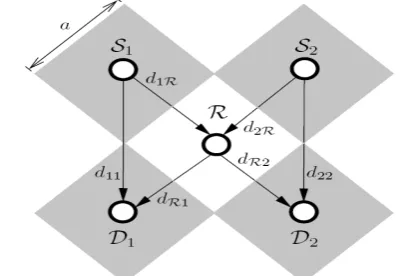
Fig (1): A simple topology with two sources, one relay, and two destinations.
Let us start with an example, the butterfly network in Fig. 1, which is a special case of Fig. 1 for N = M = 2. The information at the sources S1 and S2 is multicasted to both the destination nodes D1 and D2 via the relay R, where D1/D2 is able to overhear S1/S2. The distances of the direct links between source and destination nodes and the relay, resp., are denoted as dℓi, dℓR, and dRi for ℓ, i 2 {1, 2}.
We employ binary network coding of the decoded information words at the relay before physical layer error correction is applied. This corresponds to a separation of channel and network coding. The transmission is carried out in three time slots: in the first time slot, S1 broadcasts to D1 and R, in the second time slot, S2 broadcasts to D2 and R, and in the third time slot, R broadcasts to D1 and D2. For a transmission rate of R on each link the throughput in bits / time slot is given as T = 2R/3.
C. Code Construction
In traditional LDPC coding, the parity-check matrix
H is designed first to guarantee the sparsity property, and
the generator matrix G is derived accordingly. H should be
agreed on by both the transmitter and the receiver or carried by the packet. As aforementioned, many studies used specific generator matrix at each relay to design joint network channel codes with good equivalent parity-check matrix H for good performance and full diversity, where
paths depending on the routing strategy. Thus, it is challenging to use individualized generator matrix at each node and optimize the joint network channel codes throughout the whole network. For simplicity and scalability, we choose a common pair of H and G from a
well-designed LDPC code for all nodes, while network coding coefficients are generated at each node randomly and carried by the packet.
We assume that source S1 generates a packet u1
with k symbols (each of q bits) from Galois field GF(2q), then encodes it into x1 using the common generator matrix G of size k × n as,
x1 = u1G (1) x2 = u2G (2)
Where x1 and u1 are row vectors of length n and k
respectively. Thus the channel code rate . Similarly, the packet generated at source S2 can be obtained as x2 = u2G.Assume packets x1 and x2 are broadcast
respectively to the relays and the sink using orthogonal channels (at different time slots or via different frequencies). After receiving packets from the sources (recall that the channels between the sources and the relays are assumed to be lossless in this simple topology),the relays first decode and obtain the original packets, the generate packets using network coding and non-binary LDPC channel coding. The network codes at relays R1 represented as,
y1 = α11u1G+ α12u2G, (3)
Where the network coding coefficients (i, j = 1, 2) are drawn randomly from GF(2q). Packets y1 will be
sent to the sink from R1 respectively. Given the equivalent generator matrix G_, one can apply the Gaussian
elimination algorithm (over an appropriate Galois field) to obtain the corresponding parity-check matrix H’, which
satisfies H’G’T = 0.One option for decoding is to adopt
some version of belief propagation operating on H’.
However, it is usually hard and sometimes infeasible to perform this kind of decoding because the integrated belief propagation decoding is too complicated owing to the fact that H’ is not sparse in general.
IV.PERFORMANCE EVALUATION
We evaluate the performance of JNCC over the simple network topology using both analysis and simulation. We compare JNCC with two other schemes:
1. Joint Network-Channel Coding, which seamlessly couples non-binary irregular LDPC channel coding and non binary random linear network coding. Different from existing joint network-channel code designs that focus on code optimization, the relays in this work employ the same non binary LDPC codes at the physical layer and generate the networked coded packets based on symbol-wise combination of incomingpackets with randomly generated non binary coefficients. This allows the relays to process and forward packets independently without pre-scheduled collaboration, rendering the proposedsolution suitable for large-scale multi-path multi-hop wirelessnetworks.
2.Direct Transmissions (DT), where the sources directly transmit packets to the sink, and the relays do not forward any packets. To make the comparison fair, in this scheme, we set the transmission power at the sources twice that in other schemes and the data rate to be the same.
We treat the two packets, u1 and u2, as a generation
of size two. Then the redundant packets in network coding allow the sink to recover the whole generation from a subset of received packets. This is due to the fact that packets transmitted through independent channels can provide spatial diversity. We next obtain packet error rate (PER), i.e., the probability that an original packet cannot be recovered, and generation error rate (GER), i.e., the probability when at least one packet in a generation cannot be recovered for all the schemes. For ease of analysis, we assume that all lossy links in Fig. 1 are identical and independent, with link outage probability P_e under DT and Pe under other schemes, P_e < Pe since the sources in DT transmit at a power twice that in other schemes. Furthermore, we assume packet losses are independent. For DT, it is easy to see that
PERDT = P`e (4)
And
GERDT = 1− (1 − PERDT)2
= 2P`e – P`e2
= 2P`e + o(P`e ). (5)
For JNCC, when the size of the Galois field is sufficiently large, any two packets can recover the whole generation. Take packet x1 as an example. It cannot be retrieved only
when itself and more than two packets among x2, y1 are
corrupted. Therefore
PER ≈ Pe(P3e +(3 2)P2e (1−Pe)) = 3P3e +o(P3e ) (6)
Since any two independent packets can recover the whole generation, the GER is the probability that at least three packets are corrupted. Therefore
GER ≈ P4e +( 4 3 )P3e (1 − Pe) = 4P3e + o(P3e ) (7)
V.SIMULATION RESULTS
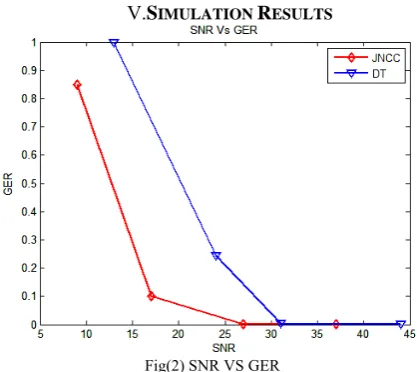
Fig(2) SNR VS GER
Fig(3) SNR VS BER
Fig (3) shows the plot of SNR VS BER. The BER is the packets are successfully decoded and we get number of bits has been changed. JNCC achieves the BER. shows the plot of SNR VS BER. Here we observe that JNCC leads to much faster decrease in BER than DT. DT has performance loss is 15db then JNCC.
Fig(4) SNR VS PER
Fig (4) shows the plot of SNR VS PER: In which two relays assist the sources by transmitting redundant packets to the sink. We now investigate the SNR VS PER .The PER is the packets are successfully decoded and we get number of bits has been changed. JNCC achieves the PER. shows the plot of SNR VS PER. Here we observe that JNCC leads to much faster decrease in PER than DT. DT has performance loss is 13db then JNCC.
Fig(5)SNR VS FER
Fig (5) shows the plot of SNR VS FER. In which two relays assist the sources by transmitting redundant packets to the sink. We now investigate the SNR VS FER. Here we observe that JNCC leads to much faster decrease in FER than DT. DT has performance loss is 12 db then JNCC.
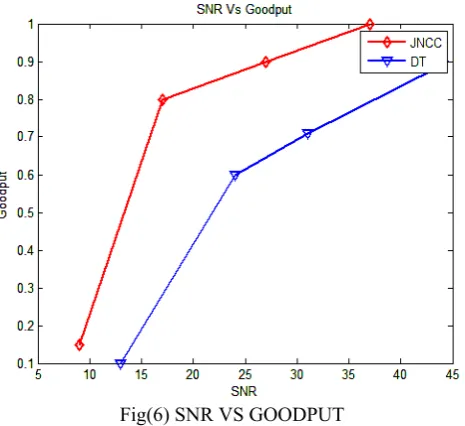
Fig(6) SNR VS GOODPUT
Fig (6) we shows the plot of GOODPUT VS SNR under two conditions. The good put is the number of packets in
successfully decoded generations at the sink per second .In this way, we ignore the packets in partially recovered generations. JNCC achieves as much higher good put than the other two schemes because more generations can be recovered. JNCC achieves higher good put than the DT because more generations can be recovered.
VI. CONCLUSION
We proposed to use joint network-channel coding (JNCC) based on LDPC codes for the multiple access relay channel (MARC). We showed with simulation results that JNCC for the MARC increases cooperative diversity compared to distributed channel codes for the relay channel. Although the diversity gain can be also achieved, JNCC allows to more efficiently exploit the redundancy which is contained in the transmission of the relay. Simulation results confirmed that the generation error rate of JNCC can outperform the one of direct transmission by up to 13dB. The JNCC achieves the reduced BER, GER,FER,PER and improves the good put and SNR.
REFERENCES
1) Z. Guo, J. Huang, B. Wang, J.-H. Cui, S. Zhou, and P. Willett, “A practical joint network-channel coding scheme for reliable communication in wireless networks,” in Proc. 2009 ACM MOBIHOC.
2) S.-Y. R. Li, R. W. Yeung, and N. Cai, “Linear Network Coding,”
IEEE Trans. Inf. Theory, vol. 49, no. 2, pp. 371–381, Feb. 2003. 3) C. Fragouli, J.-Y. L. Boudec, and J.Widmer, “Network coding: an
instant primer,” ACM SIGCOMM Comput. Commun. Rev., no. 1, Jan. 2006.
5) “On the Performance of Joint and Separate Channel and Network Coding in Wireless Fading Networks” J¨org Kliewer, Thedoros Dikaliotis,
6) X. Bao and J. Li, “Adaptive network coded cooperation (ANCC) for wireless relay networks: matching code-on-graph with network-ongraph, IEEE Trans. Wireless Commun., vol. 7, no. 2, pp. 574– 583,Feb. 2008.
7) “A unified channel-network coding treatment for user cooperation in wireless ad-hoc networks,” in Proc. 2006 IEEE International Symp. Inf. Theory.
8) “Generalized adaptive network coded cooperation (GANCC): a unified framework for network coding and channel coding,”
IEEE Trans. Commun., vol. 59, Nov. 2011.
9) Bletsas, A. Khisti, D.P. Reed, A. Lippman, “A Simple Cooperative Diversity Method based on Network Path Selection”, submitted for publication, IEEE Journal on Selected Areas of Communication, Special Issue on 4G, January 2005.
10) J. N. Laneman, D.N. Tse, G. W. Wornell, “Cooperative Diversity in Wireless Networks: Efficient Protocols and Outage Behavior”, submitted for publication to IEEE Transactions of Information Theory, available at http://www.nd.edu/ jnl/pubs/.