61:>b""'b\rz.
FACTORS
AFFECTING
TRANSITION,
PERFORMANCE
AND
RETENTION
OF GIRLS'
IN SECONDARY
SCHOOLS
IN ARID AND
SEMI ARID LAND: A CASE OF RHAMU TOWN - MANDERA
COUNTY,
KENYA
BY
AFTIN K. DUBE
A RESEARCH
PROJECT
SUBMITTED
IN PARTIAL
FULFILLMENT
OF
THE
'REQUIREMENT
FOR THE DEGREE OF MASTER OF EDUCATION
OF KENYATTA
UNIVERSITY
Dube, Aftin K. Factors affecting transition,
1111111 ~11111111111111111111111111111111111111111111111111111III 2012/380911
IENVATT A
UNIVERSITY LI8RAR \
DECLARATION
This research project is my original work and has never been submitted for a degree in any other university.
Sign: __ ~~i!..:~~\~~O~ _ Date:
AFTIN K. DUBE
REG. NO.: E55/CE/15552/08
This project has been submitted for examination with our approval as university supervisors
Sign:
__
~
e
PROF JACK GREEN OKECH PROFESSOR OF EDUCATION,
DEPARTMENT OF EDUCATIONAL MANAGEMENT, POLICY AND CURRICULUM
STUDIES, KENYATTA UNIVERSITY
-Sign:
--~fl.Ik'
--
>·
..<:.-:>0\,,-. _ DateDR. ORPHA ONGITI
DIRECTOR NAIROBI CAMPUS, AFRICA NAZARENE UNIVERSITY
DEDICATION
This work is most dedicated to the Almighty God that helped me to accomplish it. I also wish to
dedicate this work to my wife Lul Adan Osman for believing and encouraging me all through the
programme and my brother Kerrow K. Dube for standing by me during the hardest moments of
my life, and the entire family for their support, encouragement and prayer while undertaking the
course.
ICENYATTA
UNIVERSITY
LIBRAI
ACKNOWLEDGEMENT
I am thankful to Kenyatta University and particularly to my supervisors Prof Jack Green Okech, and Dr. Orpha Ongiti for imparting to me the knowledge of the task. I also wish to express my gratitude to my fellow colleagues Mr. Adan Hussein Ibrahim, Philip Gilly and Mohammed Abdi Adan for their support; whenever I require them in all my undertaking. My gratitude also goes to Mrs. Eunice Achero who typed my draft copy and final copy.
ABSTRACT
TABLE OF CONTENT
Declaration
.
Dedication
.
ii
Acknowledgement..-
.
Abstract
.
III
IV
Table of Contents
.
VList of Tables
.
VlllList of Figures
.
IXAcronyms . X
CHAPTER ONE: INTRODUCTION
1.0 Introduction...
.
.
...
.
.
....
.
...
.
..
..
.
.
...
.
...
.
1
1.1
Background ofthe study. .
.
.
.
. .
..
...
..
. .
.
. .
.
. .
.. .
.
..
.
.
..
1
1.2 Statement of the pt-oblem...
10
1.2.1 Purpose of the Study...
.. ....
.. ..
.
.. .... .... ..
..
...
....
.
. ... ...
11
1.3 Objective of the study..
.
...
.
12
1.4 Research Questions
.
...
..
..
.
.
.
..
.
12
1.5 Significance ofthe Study...
.
...
.
...
.
...
.
....
.
...
13
1.5.1 Justification of the Study...
.
...
13
1.6 Assumptions...
.
...
.
...
.
...
.
.
13
1.7
Scope of the Study
.
...
.
.
..
..
.
...
..
...
.
.
.
..
.
...
.
...
.
...
13
1.8 Limitation of the Study...
.
..
.
..
..
...
..
.
.
...
.
..
.
...
.
...
.
...
14
1
.
9 Delimitation...
...
.
..
...
.
...
.
...
.
...
.
...
..
...
.
....
..
..
14
1.9.1 Theoretical framew
o
rk
:
~...
.
...
.
...
14
1
.
9.2 Conceptual fr~mework
~
16
1.9.3 Definition of Operational Terms...
.
...
.
.
.
.
...
....
..
.
.
.
..
..
...
...
...
.
.
..
..
.
.
..
.
...
.
..
.
..
18
CHAPTER TWO: REVIEW OF RELATED LITERATURE
2.0 Introduction...
.
...
.
...
.
...
.
...
.
...
..
..
...
.
.
...
.
...
.
.
.
..
.
...
.
.
19
2.1 Factors affecting Enrolment, Retention and Performance
of Girls...
19
2.4 Suggestions and Mitigation measures for Addressing the Problems... 26
2.5 Gaps the Study attempts to Address... 27
CHAPTER THREE: RESEARCH METHODOLOGY 3.0 Introduction ~... 28
3;1 Research Design )... 28
3.2 Location of the Study... 28
3.3 Study Population... 30
3.4 Sampling Technique... 30
3.5 Research Instruments.. . .. . . ... ... .. . ... . ... ... . ... . . .. . .... . .. . . ... . ... .... . .. 31
3.6 Questionnaire Development... 31 3.7 Interview schedule Development... 32
3.8 Piloting :... 32 3.9 Validity ofInstrument.... 33
3.10 Reliability of Instruments., , 33 3.11 Data collection Pro~dure... 34 3.12DataAnalysis :... 35
CHAPTER FOUR: PRESENTATION AND ANALYSIS OF DATA 4.0 Introduction... 36
4.1 Background Information.. 37
4.1.1 General Demographic Information of the Students... 37
4.1.2 Class of the students... 38
4.1.3 Demographic Information of the Teachers... . 38
4.1.4 Level.ofEducation... 39
4.1.5 Years of Service... 40
4.1.6 Age Distribution... 40 4.1.7 Demographic;Information of Parents... 41 4.1.8 Level of Education... 41 4.1.9 Age Distribution ; :... 42 4.2 Status of girls' secondary education... 43
4.5 Challenges that Prevent Girls from Accessing Secondary Education... ....
48
4.6 Suggestions and Mitigation Measures for Addressing the Problem...
49
CHAPTER FIVE: SUMMARY, CONCLUSION AND RECOMMENDATION
5.0 Introduction...
51
5.1 Summary of the Study...
51
5.2 Conclusion...
.
....
.
...
.
...
.
...
.
...
.
.
..
..
.
.
.
...
.
...
.
.
....
..
.
.
54
5.3 Recommendations..
.
....
.
...
57
5
.
4 Suggestions for Further Studies...
58
REFERENCES...
.
...
.
...
..
...
59
APPENDICES...
.
..
...
63
APPENDIX A: Letter of
Introduction.v.c.v.L... . .. ..63
APPENDIX B: Pupil's Questionnaire....
.
..
.
....
64
APPENDIX C: Teacher
'
s Questionnaire.
68
APPENDIX D: Parents Questionnaire...
73
APPENDI
X E
: Intervi
e
w Schedule...
78
APPENDIX F
:
Time Fr
a
m
e
..
..
..
.
.
.
..
.
.
.
..
.
.
.
.
.
....
.
.
...
..
.
.
.
.
.
..
.
...
.
.
...
.
...
....
...
81
LIST OF TABLES
Table 3.1:
The Sample Size...
32
Table 4.1: Sampled Schools
;...
39
Table 4.2: Level of Education of Teachers.
..
41
Table 4.3: Years of Service by the Teachers...
42
Table 4.4: Age Distribution of the Teachers...
43
Table 4.5: Level of Education of the Parents...
44
Table 4.6: Age Distribution ofthe Parents
:...
45
Table 4.7: Reasons why Girls are Dropping out of Schools According to Students....
46
Table 4.8: Reasons why Girls are Dropping out of Schools According to Teachers... ....
47
LIST OF FIGURES
Figure 1.1: Relationship of Variables.. 20
ACRYNOMS
ASAL
EFA
FAWE
FGM
GER
NEP
NER
NGO
SSA
UNESCO
UNICEF
- Arid and Semi-Arid Lands
- Education for All
- Forum for African Women Educationists.
- Female Genital Mutilation
- Gross Enrolment Ratio
-North Eastern Province
-Net Enrolment Ratio
- Non Governmental Organization
-Sub-Saharan Africa
- United nation Education and Scientific organization
CHAPTER ONE
INTRODUCTION
1.0 Introduction
This section of
the study gives details on the background to the study, statement of the problem,
purpose of the study, objectives of the study,
research questions, and significance of the study,
theoretical and conceptual frameworks, and assumptions of the study, limitation of the study and
definition of significant terms.
1.1 Background of the Study
The
future
of
m
an
y
countries depends on how well their
citizens are
educated,
the type of
education offered and how well it is developed (Todaro, 1997). At independence, Kenya had
three major problems to solve; poverty,
ignorance and disease. Kenya decided to lay more
emphasis on education as the key
to economic
,
social and politicaJ development (Republic of
Kenya, 1964). In spite of the fact that improving and widening access to educ~tion has been
major goal of the Kenya government, the history of education opportunity especially in pastoral
areas still holds cultural inequality and disparity between boys and girls (UNICEF, 2003).
The right to education has been reaffirmed internationally
(UNICEF, 2001).Artic1e
28 of the
United Nations Convention on the rights of the child states that every child has a right to
education no matter what his or her circumstances and the Government of Kenya has stated its
commitment to making this a reality (Republic of Kenya,
2005).
Indeed the Government of
Kenya seeks to ensure equity in terms of equal access to education (Republic of Kenya, 2005).
This commitment to achieving equity is of utmost importance since equity in education is a
should ensure provision of appropriate, relevant and viable learning opportunities to all children
wi thout distinction of location.
In the case of sub-Saharan Africa, Hyde (1989) has suggested that poverty ansing from
marginalization of these countries in the global economy, as well as the countries' low levels of
economic development, may be important factors in how much stakeholders can avail for the
purposes of education.
Studies on access and retention in primary and lower secondary education in Ghana show that
although the FCUBE made an overall enrolments increase, children from poor households
continue to be underrepresented in enrolments (Akyeampong, 2009; Rolleston, 2009).
Akyeampong (2009) and Rolleston (2009) made it explicit that not only indirect costs hinder
access of the poor but also opportunity costs substantially affect the chances of poor children to
enroll in and complete basic education. A study of access patterns in Malawi also concludes that
access to education in the country continues to reflect household wealth (Chimombo, 2009).
Thus, despite direct fees being abolished, these studies clarify that the abolition of fees has not
been enough to ensure access to education for the poor.
For instance, a study by Mensch and Lloyd (1998) on gender difference in primary school
experiences in Kenya shows that some primary school teachers limit girls' incentives to continue
further education and to delay marriage and child bearing. Their study also found for example
that, the awarding of academic prizes appears to be biased in favour of boys that boys
outperformed girls in the primary leaving examination and that gender gaps in achievement were
greater in low-performing schools. In fact, teachers' low expectations towards girls' academic
performances can reduce girls' motivations and discourage them from continuing further
education (UNESCO, 2008). Gender-stereotyped households and occupational roles presented in
textbooks and curriculum also negatively affect girls' aspirations to further education. !
The remoteness has had a negative impact on the number of teachers in schools. Many teachers
are unwilling to work in these areas especially if these are not their home districts as Otieno
(2006) has observed that ASAL areas suffer high teacher turn over owing to the interplay of
factors such as harsh climatic conditions, poor infrastructure, insecurity and lack of teacher
housing. Further, teachers from other parts of the country do not want to serve in these areas.
ASALs are harsh areas and teachers find it difficult to survive in these regions and hence look
for transfers leaving the areas deprived of teaching force.
Another major threat affecting girls is unique climatic condition of the Arid and semi-Arid lands
which makes provision of education a challenge. These areas experience extremes in climatic
conditions which are at times characterized by frequent droughts. The terrain is harsh as much of
it is dry with average rainfall of only 2S0mm. (Republic of Kenya, 1976). In arid and semi-arid
areas such as NEP, the level of poverty and economic under-development may be higher than in
other parts of the country with more reliable weather patterns. This is because the mainstay of
the country is agriculture and therefore weather patterns play an important role in the economy.
The economic activity in the region also affects education. The major economic activity carried
out is pastoralism, with many of the communities being nomadic. Worldwide, nomads are among
considered to be one of the homes of the poorest of the poor with over 60 percent of the
population living below the poverty line (Republic of Kenya,
2005).
This is the reality for the
children in North E~stern province areas. All these factors point to the variety of handicaps the
girl child faces. This situation is summed up well by Poole (1981) whose studies in Australia
observed that multiple factors produce and reproduce disadvantage. Students from North Eastern
region are disadvantaged, this being a condition that is experienced by minority groups.
In Kenya, the selection into secondary school
is fixed by the quota system of selection. Entry
marks to national schools are flexible, in
that admission is determined by the highest
performance in each district, thus making it possible for rural schools to send their children to
these schools (Bogonko,
1992).
Access to government secondary school system in Kenya is meritocratic; selection is based
.
purely on performance in the primary leaving examination and admission to public secondary
schools is highly competitive (Knight &Sabot,
1990).
Since the quota system of selection is
used with a view of promoting national integration and unity among the youth (Ministry of
Education, 1996), the national secondary schools are a meeting point for students from varied
social, economic and cultural backgrounds..
Lockheed and Verspoor, (1991) state that certain
groups of children are educationally disadvantaged in virtually all societies;
this is reflected in
their educational attainment.
a) The transition from primary to secondary school
Given that
.those children who reach the last grade of primary school are more likely to be from
better-off households, children from poorer households are less likely to be able to access
secondary education. The transition rate in 1967/68 was 24.1 percent Ministry of Education and
Republic of Kenya (1972a-2006a) Economic Survey. This means that fewer than one in four
children who enrolled in the last grade of primary school in 1967 accessed secondary education
.r, ~
in 1968. Since then, while the transition rate fluctuated until recently, the overall transition rate
has improved. In 2006/07, it is estimated that the transition rate reached 60 percent. This
suggests that six in every 10 children enrolled in the last grade of primary school in 2006,
) became enrolled in secondary school in 2007. Available data on the transition to secondary
school by gender show that more boys than girls have enrolled in secondary school in the past
decade. The Gender Parity Index (GPI) indicates that there are 89 girls for every 100 boys in
form 1 in 2005, and this figure has not significantly changed since 1995. This suggests that there
are persistent gender disparities in access to secondary education, despite rapid increases in form
1 enrolments in recent years. There are still concerns about who accesses secondary school in
Kenya, despite increases in overall numbers.
b) Secondary school enrolments by household wealth and gender
In 2005, it was estimated that there were 4,169 secondary schools in Kenya, of which 83 percent
were public and 17 percent were private. Data from the Ministry of Education show that the
number of secondary enrolments in 2005 was approximately 928,000, of whom 8.9 percent were
in private secondary schools. This suggests that the majority of secondary school students in
Kenya attend government schools. Though there are several reasons for low transition rates,
insufficient school supply and high costs of fees are two important causes (Ministry of Education,
2004, 2005). In general, the comparison of grade enrolments from the first grade of primary
wealth becomes an increasing factor in access as children move through the grades. As primary
and secondary enrolment figures show, the chances of a child getting into secondary school are
determined by hou
1
ehold wealth. This therefore raises concerns about whether enrolments insecondary school can be helped via bursaries and free secondary education for the poor. The
Ministry of Education's documents (2004, 2005) point out other reasons such as high level of
poverty, extra levies for private tuition, unfriendly school environment, negative effects of
HIV/AIDS pandemic and rising repetition rates.
c) A government bursary scheme for the poor
To deal with the inability of poor and vulnerable households to pay secondary school fees, the
Government of Kenya ·created a bursary scheme in 1994. The underlying rationale is that no
child who qualifies academically for secondary education should be denied access to secondary
education because of the inability to pay school fees. The objective therefore is to provide
financial assistance to economically and socially needy students in all public secondary schools
(Republic of Kenya, 2DD2c). In order to achieve a fair and equitable allocation of the bursary, the
government set up the following formula when the scheme was established:
• 25 percent of all bursaries were to be allocated to arid and semi-arid land (ASAL)
districts;
• 70 percent of all bursaries were to be allocated to schools in all districts (including
ASAL);
• 5 percent of the bursaries were to be allocated to the national schools to cater for students
Another study by Njeru and Orodho (2003) on the bursary scheme found that although there
were students who benefited from bursaries, this had no significant impact on enrolment by the
poor. They concluded that because the scheme targeted students already enr~lled in secondary
school, it missed students who had failed to raise the initial school fees, so the scheme ignored
students who had not already been able to gain access, despite their academic eligibility. These
reports raise critical questions about whether government bursaries reach intended beneficiaries
and in so doing expand access for those who are excluded, or whether the government reinforces
the exclusion of the poor by awarding bursaries to financially able groups whose children are
already in secondary school. Since children from the bottom wealth quintiles have fewer chances to enroll in secondary school than children from the top wealth quintiles, it is important that
government bursaries reach the poor
d) The introduction of free secondary education
The Government of Kenya officially launched the Free Secondary Education Programme at the
beginning of 2008 because many Kenyan children who completed primary school were not
getting access to secondary school, mostly because of school fees. The underlying assumption of
the new policy was that all children who were academically qualified for secondary education
ought to be able to gain access to it. The President of Kenya emphasized that the main objective of providing free secondary education is to ensure that children from poor households acquire a
quality education that enables them to access opportunities for self-advancement and become
productive members of society (Speech by President Kibaki, February 2008: para 8). There seem
to be some
factors
that formed the basis for the introduction of free secondary education in thewith the promise to achieve a 70 percent transition rate from primary to secondary by 2008, a
study by the Government via the Ministry of Education on the possibility of implementing free
secondary education, and free secondary education as one of the manifestos of the 2007
Presidential campaign. Several recent government documents refer to the government's high
commitment to meeting the EF A and MDGs targets (Republic of Kenya, 2002b; MoEST, 2004,
2005). In particular, the Sessional Paper No.1 of 2005 by the then Ministry of Education Science
and Technology (MoEST) underscores that costs of secondary education are the main reason for
the low transition rate to secondary education. The report (MoEST, 2004) proposes that the
government should address transition rates. In response, the Government developed the Kenya
Education Sector Support Programme 2005-2010, which clearly states their intention to integrate
secondary education as part of basic education (MoEST, 2005: 177). This policy framework
became the backbone for implementing free secondary education. It seems that the Government
assumed there was adequate physical capacity to accommodate more students in schools; that the
government's current budget for secondary education was sustainable; and that the free primary
education programme was successful (IPAR, 2007). Hence, the Ministry of Education looked at
why low transition rates to secondary school were continued by addressing five thematic areas: i)
the unit cost of secondary education; ii) the structure of tuition fees; iii) non-teaching staffing
norms and wage guidelines; iv) essential versus luxurious needs in secondary education; and v)
tuition fee waivers and their implementation challenges (ibid, 2007). As a result of this study the
Government concluded free secondary education was viable In order to implement the policy, it
In elections, education has almost always become a strategy for candidates to gain popular votes
(Sifuna, 2005; Oketch & Rolleston, 2007). During the election campaign of 2007 most
,
candidates had free secondary education as part of their manifesto (Malenya, 2008). Thus, while
~
implementing free secondary education was the government's intention, the Presidential election
in 2007 created the momentum for its introduction. However, free secondary education would be
only sustainable with radical changes in cost structures. The Government of Kenya spends a
relatively high proportion of total public expenditure on education as a percentage of Gross
National Product (GNP). In 2006, total public expenditure on education was 6.9 percent of GNP
(UNESCO, 2008). Despite the relatively high expenditure on education, the GER in secondary
education was only 31 percent in 2006 (UNESCO, 2008). Lewin (2007b) suggests that in general
to achieve GERs of 110 percent in primary, 100 percent in lower secondary and 50 percent in
upper secondary, approximately 8.6 percent of GNP would be required to be spent on education
without any cost saving reforms; or 6.3 percent of GNP with cost saving reforms.
Lewin (2007) further suggests that no country with ratios of secondary to primary unit costs of
more than 3:1 succeeds in universalizing secondary education. This is a critical challenge in
Kenya, given the fact that the ratios of secondary to primary unit costs were roughly 3.4: 1 in
2004/2005.
This suggests that if Kenya were to achieve universal secondary education, theoverall public expenditure on education would have to be increased to 8.4 percent of GNP. Of that, at least three percent of GNP would be required for secondary education with cost saving
reforms of no imore than 3: 1 in the ratios of secondary to primary unit costs. Unless the
government radically changes the cost structure, it is unlikely that Kenya will be able to achieve
the extent to which the reductions in household contributions enabled the poor and girls to
increase access to secondary schools
1.2 Statement of the Problem
Secondary enrolment in Sub-Saharan Africa (SSA) continues to be the lowest in the world. Of
approximately 104 million secondary school-age children in the region, only one in four (25%)
were enrolled in secondary school in 2006 (UNESCO, 2008: 330-331). Of those, there were 83
girls for every 100 boys (ibid, 2008). This figure in SSA is a critical challenge as compared with
other regions. For instance, net enrolment ratio (NER) in secondary education in the Caribbean is
40 percent with 107 girls for every 100 boys. Secondary NER in South and West Asia is 45
percent with 86 girls for every 100 boys. The world average on secondary NERs shows that
slightly more than half (58%) of the secondary school-age children are enrolled in secondary
schools in 2006, with 96 girls for every 100 boys (ibid, 2008). The gaps in NERs between SSA
and the world average are 33 percentage points.
Statistics provided by UNESCO (2008) show that children, particularly girls, in SSA have the
lowest opportunity to enroll in secondary school at their official age. In line with the stated
obligation, the Governrnent of Kenya has put focus on policies such as initiating out of school
programmes for pastoralist children like mobile schools and strengthening boarding institutions i
to cater for nomadic children (Government of Kenya, 2003). These are mechanisms that seek to
ensure that children from disadvantaged areas particularly girls access secondary schools. The
government has produced various policy guidelines addressing gender differences in enrolment
(1994-1996) is the most detailed government statement addressing gender in education concerns.
The plan records the guideline on readmission of adolescent mothers back to school. It also gives
guidelines for removal of stereotyping in all educational materials and the provision of
appropriate role models. These should be coupled with community mobilization and sensitization
for the girl-child education to address social-cultural factors and household dynamics and the
creation of a database on the education of disadvantaged girls, such as rural/urban poor and the
nomadic girL This development plan also seeks to address teachers' expectations and attitudes
towards boys and girls, based on the premise that teachers' expectations and negative comments
tend to inhibit girls' learning and success in the education system.
Although a number of studies have been done on factors affecting access, performance and
retention in secondary schools in other parts of the Country, no specific study has investigated
the continued inaccessibility and low retention among the girl child in secondary schools in
ASAL regions particularly in Mandera County in Kenya in spite of free secondary education.
Scholars therefore need to delve deeper and explore this problem. The study attempted to address
some aspects on factors affecting transition, performance and retention in girls secondary schools
from arid areas not fully covered in the studies discussed hitherto.
1.2.1 Purpose of the study
The purpose of this study was to find out factors affecting transition, performance and retention
1.3 Objectives of the Study
The following objectives guided the study:
1. To determine the factors that affect enrolment, retention and performance in secondary schools among girls within Mandera County.
2. To assess the perception of the girl-child and the view of the community regarding educating girls.
3. To identify the key challenges that prevents girls from accessing secondary education despite free secondary education.
4. To identify the local peoples suggestions and mitigation measures for addressing the problem
1.4 Research Questions
The study was guided by the following research questions
1. What are the factors that affect retention and performance m secondary schools among girls within Mandera County?
2. What is the perception of the girl-child and the view of the community regarding educating girls?
3. What a~e the key challenges that prevent girls from enrolling in secondary' education despite free secondary education?
4. What are the local people's suggestions and mitigation measures for addressing the
1.5 Significance of the Study
The research findings on the factors affecting transition, performance and retention in girls'
secondary schools in Arid and Semi Arid land are hoped to provide useful information to the
~ ~
youth in the Mandera County. The study paid attention to factors related to gender disparity
which affects access and retention of female students in secondary school in the County. Such
information would be useful for stakeholders and education planners in designing customized
and more effective strategies or interventions to the problem. The information collected would
add to the scanty information that is available on the factors contributing to drop out of female
students. This would help identify specific mobilization campaigns and strategies by the area
education officials to address the situation. The parents and teachers would use the research
findings in counseling the female students towards completing their education and underlying the
benefits of graduating in all levels of education. Finally, the study would forma basis for further
research.
1.6 Assumptions
1.
Girl child Students from Mandera areas desire to join secondary schools.
2. That all respondents are capable of identifying the factors leading to drop out among
female students in secondary school.
3. All the respondents will be cooperative and provide reliable responses.
1.7 Scope
of the
StudyThe study focused on factors that prohibit girls from educational access, retention and
secondary schools in Rhamu town. Respondents during the study were drawn from the sampled
population in Rhamu town; and they included students, teachers and the local community.
1.8 Limitations of the Study
1. The sample size for the study was too small to allow generalization of the results in the
entire district.
2. The return rate for the questionnaire was not 100% thus reduced the generalizability of
the study results.
3. The limitation of the study was lack of adequate records kept in the schools on the
students drop out which caused delays in filling the questionnaires.
1.9 Delimitations
TIle area had poor infrastructure and poor means of transport making the movement and the
logistics of carrying out the research a problem. It also implies a lot of cost implication. The
majority of community were also illiterate making research work a problem.
1.9.1 Theoretical Framework
The researcher adopted the classical liberal theory of opportunity and social Darwinism. The
theory asserts that each person is born with a given amount of capacity, which to a large extent is
inherited and cannot be substantially changed. It also states that social mobility is promoted by
equal opportunity of education. Natural statesmen were born equal and personal qualities should
not jeopardize social equality as long as society rewards people according to their status
(Rousseau, 1712-1778).
Thus education system should be designed so as to remove barriers of any nature be it economic,
advantage of inborn talents, which accelerates them to a social promotion. The theory demands
for further going through education at primary and secondary levels to which access would be ,
determined on the basis of individual's merit and not social or geographical background.
Social Darwinism emphasizes that every citizen should be given, through education the social
status which entitles him or her to inherit aptitude (Organization for economic co-operation
development 1975). It can docrnnent who deserves the money because his/her achievements are
determined by inherited capabilities and he/she will use them and not arbitrary conditions like
economic status or geographic conditions.
The theory was found appropriate for the study because of equity consideration; it becomes
practically impossible to ignore the fact that unequal participation in education will in the long
run affect the status of the poor and the vulnerable groups like the girl- child from ASAL areas.
For example, if the government fails to provide mitigating factors to arrest the issue of low
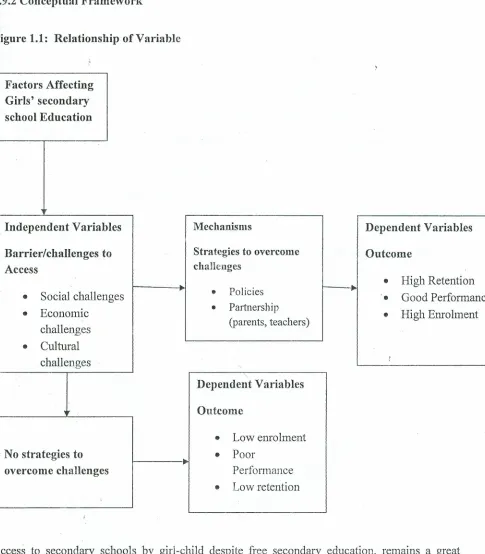
1.9.2 Conceptual Framework
Figure 1.1: Relationship of Variable
Factors Affecting Girls' secondary school Education
Independent Variables Mechanisms Dependent Variables
Barrier/challenges to Strategies to overcome Outcome Access challenges
•
High Retention Social challenges•
Policies-,..
•
•
Good PerformanceEconomic
•
Partnership•
•
High Enrolmentchallenges (parents, teachers)
•
Culturalchallenges ~
Dependent Variables
Outcome
•
Low enrolment No strategies to•
Poorovercome challenges Performance
•
Low retentionAccess to secondary schools by girl-child despite free secondary education, remains a great
challenge. This is as aresult of barriers which includes; social, economic and cultural challenges.
To overcome these challenges, mechanisms and strategies should be put in place which requires
these strategies are adopted, it would result to the following outcome: Access to secondary
schools, high retention and performance and high enrolment. If however there are no strategies
and mechanism putin place to overcome the challenges, the following will be the outcome: Low
enrolment, low retention and poor performance. Girl child students gain access to secondary
schools by being beneficiaries of the free secondary education just like the boys. This selection
means that both the students have equal opportunities as compared to their boys counter parts.
These girls face social as well as academic challenges which lead to low performance and
retention rate. All these aspects pose challenges to the students and they are forced to deal with
the situation that they find themselves in. The coping techniques they adopt will produce varying
results. The whole experience will be too overwhelming and they will experience feelings of
1.9.3 Definition of Operational Terms
Access -Access simply means the right to education. It is also the opportunity provided for the girl-child to be educated. Access deals with the
availability, convenience and ability to be educated
Attitude - Negative or positive predisposition towards certain individual or things
Coping mechanism - An action undertaken by an individual facing a challenging situation
Disparities - Marked difference in terms education opportunities.
Dominant culture - the norms, standards, social practices.
Gender - A social construct conceptualized in terms of sex roles in males and female.
Majority -Group with access to society's resources and has the greater influence on shaping the society's cultural system.
Marginalization - Some level of neglect or being treated unequally because of geographical or political factors.
Minority - Condition of being inferior or subordinate.
Muhrin - A person whom you cannot legally marry according to Islamic sheri a e.g. mother, sister and aunt.
CHAPTER TWO
REVIEW OF RELATED LITERATURE 2.0 Introduction
This study was concerned with the low enrolment rate of the girl-child students of ASAL areas in
government secondary schools and how these students cope with the given challenges. This
section review literature on factors affecting enrolment, retention and performance of girls,
perception of the girl-child and the community toward girls' education. It considered the
challenges that the girls-child from ASAL areas faces which affects them in terms of access,
performance and retention in secondary school and the strategies they employ to mitigate these
challenges.
2.1 Factors affecting Enrolment, Retention and Performance of Girls in Secondary Schools
Communities in arid and semi-arid lands have lagged behind in education, (Government of
Kenya, 2003). Part of the reason for this situation was the historical background. Eshiwani
(1993) traces the origin of inequality in education in Kenya to the colonial period. During the
colonial period, the state concentrated its resources on European and some Asian children.
Historically, Kenya's ASALs received low priority in allocation for development resources. This
for a long time was justified on economic grounds that aimed to maximise productivity in areas
with known and proven potential.
Republic of Kenya (1976) points to the fact that there are imbalances of access to education
socio-cultural and environmental factors. The report pointed out that the imbalances were particularly serious among the nomadic communities. These areas were formerly demarcated as 'closed' districts ofiEastern, North Eastern and Rift Valley provinces during the colonial period. Movement to and out of the districts was restricted. This meant that the ASAL regions were entirely neglected in the development of education. At independence the country had to deal with these disparities which various education commissions have sought to remove (Republic of Kenya, 1964, 1976, 1999). Despite the government's commitment to provide education for all, ASAL areas still remain disadvantaged.
Girls' education is also affected by the fact that they have to contribute to house hold chores. TIley are sometimes taken away from school to help in the home, nurse babies, clean the house, fetch firewood and water, cook food and mille cows (Juma, 1994). Such heavy household duties, long distances from school result in physical and mental exhaustion which makes learning boring and difficult. All this leaves the child overwhelmed both at school and at home.
Accessibility to school is another problem that faces girls in ASAL areas. In her study, Noor (2003) notes that in Mandera district, the distance between home and school is a major problem to girls since many parents do not allow their daughters to walk alone. They are thus kept out of school unless there
is
'
somebody preferably an older brother to accompany her to school. This decision is bound to affect the girls' performance in school.(2003) further observes that distance between school and home affects girls more than it does
boys because parents are afraid to let the girls walk alone unless she is accompanied by an older
brother. Security in.and out of school is of utmost concern for girls. Some of the girls who walk
long distances to school end up being raped and sexually abused by older boys and male adults
(Noor, 2003).
Building boarding schools as a solution to curb the problem of distance between school and
home has not tackled the problem. A study carried out by Khalif (2008) revealed that despite the
presence of boarding schools in Garissa municipality, there was no single girl, despite the fact
that boarding for girls would give the girls greater security. There was no girl boarder since a girl
should not be left to stay away from her parents or adult relative. This decision is a further
reflection of how cultural practices affect access to education in the ASAL areas. Although
boarding schools solve the problem of distance, culture does not free the young girls to stay in
boarding school, therefore the girls miss school.
School related factors have also inhibited enrolment and participation in education in North
Eastern Kenya (Otieno, 2006). A study carried out by Otieno (2006) reveals that school factors
not only inhibit but also negatively affect children's performance. The study observes that poor
school environment including rudimentary shelters, lack of desks, overcrowding, lack of water
sanitation facilities and poor safety standards are factors blocking enrolment and successful
,
completion of schooling. This particularly affects the girls.
The North Eastern province suffers high teacher turn over owing to interplay of factors such as
harsh climatic conditions, poor infrastructure, insecurity and lack of teacher housing. As a result,
these areas difficult to survive in they look for transfers as quickly as possible leaving the area
deprived of teaching force
Lack of teachers ana teacher absenteeism are a source of demotivation to the.learners. (Otieno,
2006) Several studies have been carried out on secondary education in ASAL areas (Ombongi,
2008; Abdi, 2008; Mbatia, 2005; Noor, 2003), which document the difficulties children in ASAL
areas face in education. Despite the challenges facing boys and girls from these regions, there are
students who do well enough to gain enrolment into secondary schools.
The student personal attributes can lead to dropout from school. This includes student's
characteristics and pregnancy. These have different effects on various students. Once students
are enrolled in school they interact and form peer groups. Wrigley (1995) observed that there is a
simple relation between education and gender equality. Schools act as a site of pervasive gender
socialization. This sometimes spurs students to think beyond the ideological limits laid on them.
Wanyoike (2003) concurs with Wrigley and points out that the students peer groups if not guided
can lead to devastating results like engage in drugs and substance abuse, early sex and then get to
dangerous diseases like HIV and AIDS and early pregnancies. This leads to students dropping
out of school. Thus the study will seek to find out peer pressures that lead to student drop out of
school.
2.2 Perception of the Girl-cbild and the Community regarding educating Girls.
;
According to a study carried out by Mbatia (2005), the enrolment of boys in ASAL areas was
higher than that of girls throughout the years covered by the study. Education of sons is
considered an investment in security far old age (Psacharopoulos & Woodhall, 1997). This
education over girls the boys still face challenges in education ... in addition to their school work,
boys also have to help their parents with fencing, herding and help in branding livestock during
market days (Khalif 2008, Ombongi, 2008).
According to Obura (1991) textbooks used in Kenyan pnmary schools shows that books
continue to portray stereotyped images of men and women. The study had a component that
examined girls' attitudes and aspirations in a selected group of secondary schools. The study
found girls'.attitudes toward education, and particularly science subjects, to be positive. Girls
also had high aspirations for higher education particularly in science based careers. Kakonge
(2000) had a component that examined teachers' thinking or level of reflection on gender gaps in
education and particularly in science subjects. The analysis showed that a majority of teachers
had perceptions of girls and science that were gender stereotyped and traditional. A smaller cluster of teachers, however, had quite girl-friendly perceptions. Thus studies emanating from
the Kenyan context show that text books, curricula and teachers may be important factors
contributing to gender gaps in education at the moment.
According to Wanjiru (2007) girls are socialized to know that their brothers' education is much
more important than theirs and they are ready to drop-out of school for the sake of their brothers.
Wanyoike (2003) concurs with Wanjiru and observed that the way the family foundations are
laid down, it is difficult to erase the attitudes and behavior patterns that are formed about girls
and boys. He further observes that the boys and girls are received differently at birth thus
attaching diverse value to them. Boys are valued to be superior to girls and hence even in
A research study carried out by Wanjiru (2007) in Mombasa on factors contributing to school
drop out in public secondary schools revealed that 52.4% respondents valued boys education better than that of girls. Families which cannot easily afford to send both sons and daughters to
- ,
school reckon that financial returns on the expenditure for girls education are a good deal smaller
than those of boys.
2.3 Challenges that Prevents Girls from Accessing Secondary Education
A study carried out by Khalif (20U8) notes the effects the arid nature has on education. The
drought situation reduces the economic capacity of the families rendering the community
vulnerable to poverty. Given that the main activity is livestock rearing, any threat to livestock is
a direct threat to economic livelihood of the people. During drought, families lose a lot of
livestock either due to absence of pasture or indirectly as a result of inability to sustain long
journeys with little food or water. As such families cannot afford to cater for indirect costs of
education that are not taken care of by the free secondary education programme. Some of these
costs include uniform, health, food and any other requirements that a pupil may need to
concentrate in their learning fully. According to the study by Khalif (2008) this affects both boys
and girls. Parents are however ready to sacrifice daughters and let boys continue with education.
Challenges in ASAL are not only limited to the physical and economic conditions. Njeru and
Orodho (2003) further point out that some retrogressive, socio economic and cultural traditions,
religious values and practices have greatly affected access and participation in secondary school
education. A study by Saru (2006) revealed that some of the socio-cultural factors affecting
performance in ASAL area: circumcision, early marriages, low opinion of women and a lack of
the boy child is favoured over the girl (Noor, 2003; Juma, 1994,). Many of these studies try to
explain the factors affecting the girl-child education. In a study carried out by Noor (2003) on
accessibility and re~ention of girls in secondary education in North Eastern Kenya, a variety of
~
reasons are given that prevent girl education, pointing to the fact that girls are clearly
disadvantaged.
A study carried out by Jja (1994) identified cultural practices such as nomadic pastrolism,
which is a way of life ~ASAL communities, as a factor which influences girls' aspirations in
school. In this practice, families move far away from settlement areas where schools are located in search of water and pasture for their livestock. When this movement happens parents are
forced to withdraw their children from schools. In her study, Noor (2003) found that girls are
more affected than boys since girls cannot be entrusted with anybody and have to accompany
their parents wherever they go.
Early marriages also affect access and retention in education in ASAL areas. Ombongi (2008) in
his study carried out in Isiolo, one of the ASAL districts, found that early marriages influenced
participation in education. Girls in standard 4 or between 12 and 14 years were withdrawn from
school to be married off to wealthy men in the community in exchange for dowry. The study
goes on to say that girls who remained in school were under constant pressure from their peers
and community members including their own parents to drop out of school. Boys on the other hand are expected to marry and establish families almost immediately after circumcision. Upon
circumcision the boys are given a herd of cattle so as to start accumulating wealth for the family
they are about to establish. This practice has led to a low value being attached to education since
2.4 Suggestions and Mitigation Measures for Addressing the Problems
Once an individual or group of people find themselves with social, economic and cultural
challenges, they need to come up with responses to deal with these challenges. In the proposed
~, ~
study, responses to the mentioned challenges are referred to as coping mechanisms. Coping
mechanisms lie within the framework of an individual's risk aversion or tolerance level (ILRI,
2000). ILRI (2000) further observes that, while some coping mechanisms may be brought into
play by stress factors, others may be an intensification of an already in-built strategy. It is human
nature to deal with any situation that is stressful or foreign. The students from arid areas have
this in them and are able to come up with responses to challenges in academic life that they find
themselves in. The students have in-built capabilities to go through their current situation.
Among the most important interventions by government are grants in aid to secondary schools in
.ASALs. Others include the girl-child projects and boarding and mobile schools for nomadic
girls. Interventions by NOOs include material support for construction of classrooms, bursaries,
food, clothing, health care for the very poor, provision of learning resources, and human resource
deveiopment through training seminars and workshops. In spite of all the interventions, the
examination data given earlier show that performance and participation have remained low for
both boys and girls; the situation of girls is considerably worse, with large and increasing gender
gaps in enrolments (FA WE, 2001).
2.3 Gaps the Study Attempts To Address
The study attempted to address some aspects on factors that prohibit the girl-child from access,
discussed hitherto. The literature reviewed has shown that students from arid and semi arid areas
face challenges in the education process. Studies outline challenges faced at the primary level of
education. Despite these challenges there are students who make the transition to secondary
- ~
school. A gap exists regarding girls who gain admission to secondary schools and yet they either
CHAPTER THREE
RESEARCH METHODOLOGY
3.0 Introduction
This chapter focuses on the study design, study area, target population, sampling strategies,
research instruments, data collection procedures and methods of data analysis.
3.1 Research Design
This study adopted the descriptive survey design. This design is ideal for gathering information
regarding people's behaviour, feelings and opinions about educational issues (Kombo & Tromp,
2006). Engelhart (1972) argues that the survey method is widely used to obtain data useful in
evaluating present practices and providing basis for decisions. This is also stated by Borg (1989)
who says that survey collects data about variables or subjects as they are foundin a social system
or society.
3.2 Location of the Study
This study was conducted in Rhamu town of Mandera County, North eastern province, in Kenya.
Mandera is one of the arid districts of Kenya with an erratic mean annual rainfall of 255mm,
mean temperatures of 28'c and a population of 312,000 persons. It shares border with the
country of Ethiopia on the North, Somalia on the East and Wajir District of Kenya on the South.
The district has three parliamentary constituencies and two local authorities with 18 divisional
administrative units (ALRMP, 2003-2006). These areas have been selected because of
convenience and accessibility for the study and the possibility of getting a good mixture of
enrolment of girl child despite the free secondary education. This prompted the researcher to find
out the root causes and how to deal with the situation. There is a serious trend of events like early
marriages that cont,nue to be a matter of concern. The fluctuating numbers in enrolment have
triggered interest and thus caused curiosity for investigation in terms of access and retention.
Arid lands are defined as places with deficient rainfall (Hills, 1966). The dominant elements in
these regions are scarcity and variability of rainfall. The low rainfall is usually insufficient for
sustained agriculture, but can support pastoralist.
This study dealt with the area that is 100 percent ASAL which is Rhamu town of Mandera
County. Arid and semi-arid areas cover about 80 percent of Kenya's land surface and have 25
percent of the country's population, which was about 10 million people, (Republic of Kenya,
2003).
These vast areas occupying about 80 percent of the country's land have very harsh climate. They
are hot and dry, with low and highly varied rainfall. This greatly varies in space and time,
(Republic of Kenya, 2003). These areas experience irregular but frequent droughts. They
experience extremes of climatic conditions which greatly reduce crop production and hence lead
to food shortage.
This region faces socio-economic problems such as poverty. The widespread poverty is largely
due to the under development of local resources. Pastoralist areas have the highest incidences of
poverty and the least access to basic services. According to the Republic of Kenya (2003), these
areas have an average of 65 percent poverty and characterized by very low access to basic
services. The low access to services is partly due to the fact that many of the arid and semi-arid
3.3 Study Population
The target population refers to all the members of real or hypothetical set of people, events or objects to which we.wish to generalize the results of our research (Borg and Gall 1977). The total
~
population for this study was 1280 respondents which consisted of 120 teachers, 800 students and 360 parents. This study was conducted in Rhamu Town of Mandera Central District North Eastern province. The target group also included teachers, parents and students. The accessible population was the form one to four students with a population of 800 students and 120 form four class teachers and 360 parents, giving a population of 1280 respondents.
3.4 Sampling Technique
Gay (1992) suggests that at least 10% of the population is a good representation where the population is large and 20% where the population is small. He observes that a researcher selects the sample due various limitations that may not allow researching the whole population drawn.
The table below illustrates the percentage of each of the respondents from the target population represented by the sample.
Table 3.1:Sample Size
Respondents Target Population Sample Size % of Sample
Teachers 120 18 15
Students 800 120 15
Parents 360 54 15
The study used simple random sampling technique to select the study respondents particularly
the teachers and parents. Simple lottery was used to identify the respondents. Stratified sampling
was used as it is suitable for studying a large group of students, by studying a few of its
.'
members; it is also suitable when dealing with homogenous subgroups like schools which forms
several segments or strata. In stratified sampling, the sampling is done in such a way that the
researcher is assured that certain sub-group in the population is represented in the sample in
proportion to their numbers in the population itself. In stratified sampling, the population is first
subdivided into two or more mutually exclusive segments, called strata based on categories of
one or a combination of relevant variables simple random samples are drawn from each stratum
and then these sub-samples are joined to form complete samples (Orodho, 2005). Random
sampling is then selected for each strata (Mugenda & Mugenda, 1999). In this study, there were two
strata made up of girl's schools and mixed schools. Five schools were selected out of the 19
schools. Form four class teachers and form one to four students were selected in order to obtain
varied opinions they could understand the questionnaire items and would give appropriate
responses. The parents were randomly selected.
3.5 Research Instruments
In order to address the research objectives and research questions, data was collected by use of
questionnaires and interview schedule. Data from the head teachers were collected using
interview schedules. Interviews provide in-depth data which is not possible to get by using a
questionnaire, (Mugenda &Mugenda, 1999). It is also possible to get more information using
probing questions (Orodho, 2005). Questionnaires were developed to suit the purpose of this
formulation of questions: enrolment, accessibility and the affordability of the schools. The
questionnaires also focused on the attitudes of students towards secondary education and
performance in thfse secondary schools. Other variables were included the knowledge,
perception of the girls, teachers and community towards girls' education. Finally questionnaire
determined the Challenges and obstacles (social, economic, institutional barriers) in accessing
secondary education and their performance. The questionnaires as well focused on the factors
that prohibit retention of the girls and local people's suggestions and mitigation measures for
addressing these problems. The interview schedules were used to provide in-depth data which is
not possible to get by using a questionnaire. It focused on getting one-on-oneknowledge about
their satisfaction on educational facilities, enrolment, accessibility and the affordability of the
schools. The researcher also interviewed them on the attitudes of students towards secondary
education and performance in these secondary schools. Other variables included the knowledge,
perception of the girls and community towards girls' education.
3.6 Piloting
Piloting was done using test-retest method after writing the questionnaires and before starting the
actual data collection. Two schools were selected through stratified random sampling procedure.
The two strata included one girl's school and one mixed school. A total of 10 form four girls, 2
form four class teachers, 2 parents were used for piloting. Pre- testing was done to enable the
researcher modify, restructure and eliminate any ambiguous items. The instruments were
pre-tested in two schools in Mandera County. Piloting was done with the sole purpose of detecting
unclear questions that arose during the pre-testing were sorted out by reframing the questions.
This helped the researcher establish the validity and the reliability of research instrument.
3.9 Validity of Instrument
According to Orodho (2005), validity refers to the extent to which an instrument measures what
isWaS supposed to measure. The instrument were evaluated for content validity that is the extent
to which the questionnaire contents which include the use of appropriate vocabulary, sentence
structure and whether the questions are suitable for the intended respondents. According to Huck
(2000), content validity is done by expert judgment. The instrument was scrutinized by my supervisors and lecturers in the department to determine whether the items in the instruments adequately address the objectives of the study.
3.10 Reliability
i'Reliabilit
y is a measure of the degree to which a research instrument yields consistent results >~ Mugenda and Mugenda (2003). Reliability in research is influenced by random error, which is
~ .
~
~. the deviation from a true measurement, after the pilot study, the respondents questionnaire was tested using split-half technique.
Split-half method is
a
type of reliability based on the co-efficient of internal consistency of questionnaire as a research instrument. It divides the instrument in to two halves in terms of even and odd numbers after it has been administered. Each half is scored independently of the otherwith items of the two halves marched on content and difficulty, if test is reliable, the score on the two halves have a high positive association co-efficient Orodho (2005). This procedure is
preferred because of its ability to measure internal consistency of the instrument being tested.
The researcher used test-retest method to assess the reliability of data. This involves
administering sameinstruments twice to the same group of subjects. There is usually time lapse
~ ~
between the first testing period and the second testing period. Then correlation coefficient is
obtained to ascertain the co-efficient of reliability or stability. If the co-efficient is high, the
instrument is said to yield data that has high test-retest reliability and vice versa (Mugenda,
2003). The co-efficient of internal consistency was established at 0.86. The 0.86 point indicated
a high degree of reliability of the instrument.
3.11 Data Collection
Permission was sought from the University and Ministry of Education where request for a
written authority from the District Education Officer to collect data from the study area was
sought, consent from the parents and the student was sought before data collection. During data
collection, the introduction was done to the head teachers and explained to them the purpose and
objective of the study. The data collection was confidential and anonymous.
The questionnaire for 120 students and 54 parents were given and self administered in schools in
separate class by the students and collected by the researcher after three days. For out of school,
it was administered through snowballing where the researcher interviewed specific girls who
dropped out of school and for what reasons in their homes and market places in Rhamu town
Mandera County and each interview took between 25 to 30 minutes. The direction from one
respondent to another and so on until most girls who dropped out are interviewed and their
reasons known was done. For teachers it was administered in their work place through interview
3. 12 Data Analysis
Data collected was subjected to qualitative and quantitative analysis where qualitative data
comprised answers .to open-ended questions. Coding was used to prepare quantitative data for !
analysis. Quantitative data comprised the close-ended questions and categorized data.
Quantitative data was analyzed by coding the data using SPSS (statistical package for social
scientist) software and generate descriptive statistics such as percentages and frequency tables
where applicable. This enabled data to be presented in an organised and meaningful fashion, and
data can be simplified so that the general trend can be seen (Orodho, 2005) while Qualitative data
was analysed thematically. This qualitative method was chosen because the data were
categorized according to themes and objectives in relation to the opinion, views and perception
of the respondents. This method is also faster when applied in analyzing transcripts of oral
interviews and interview schedules as well as questionnaires which are the major instruments in
data collections for the study.
Recorded interviews were transcribed with consent of the interviewees; interviews done in
mother tongue were translated in English and interpretation done according to emerging patterns
from the respondents. The data was analyzed by being very objective to ensure that there are no
biases or subjectivity when the entire data is analyzed.
CHAPTER FOUR
PRESENTATION AND ANALYSES OF DATA
4.0 Introduction
This chapter deals with the presentation and analysis of data gathered from the study of factors
that prohibit the girl-child from transition, performance and retention in secondary schools in
arid and semi arid land: in Rhamu town - County District, Kenya. The research was based on the
following objectives; to examine the status of girls' secondary education in the district, that is the
number of girls enrolled at each level, dropout and performance in national examinations,
determine the factors that affect enrolment, retention and performance in secondary schools
among girls within Mandera County. The study assessed the perception of the girl-child and the
view of the community regarding educating girls and identified the key challenges that prevent
girls from accessing secondary education despite free secondary education. It finally identified
the local people's suggestions and mitigation measures for addressing the problem.'
The analysis is based on data gathered from the respondents, interviews and discussions of major -~
investigations under pertinent research questions. Questionnaires and interview schedules were
used to gather the data. A total of one hundred and eighty-four (184) copies of the questionnaire
consisting of close ended and open-ended items were distributed to the selected respondents;
(120) given to sampled pupils; (18) teachers, (54) parents and interview schedules to get in-depth
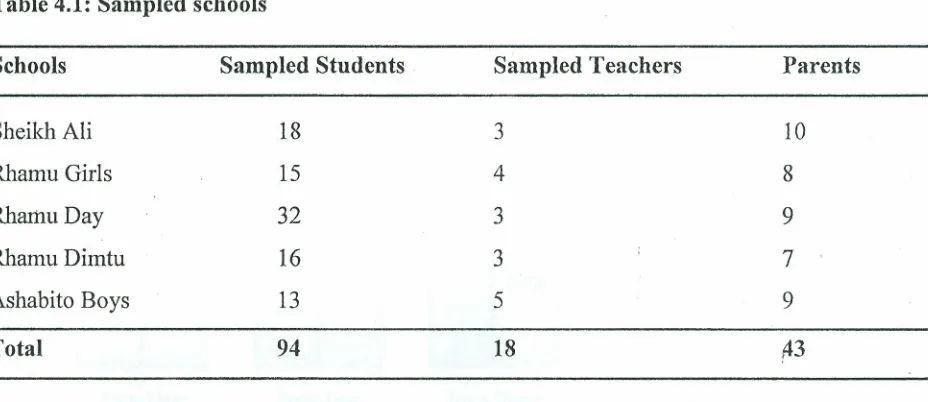
data which is not possible to get by using a questionnaire in Mandera County. Of these, 155 that
is 84.2 percent copies were properly filled and returned, two (2) were returned but were not