Assessing and Enhancing Quality
using Toolkits
The authors
Martin Oliver is a Research Fellow at the Teaching and Learning Technology Centre, in the University of North London.
Grainne Conole is Director of the Institute for Learning and Research Technology, at the University of Bristol.
Email: [email protected]
The Teaching and Learning Technology Centre, University of North London, 236-250 Holloway Road, London, N7 6PP
Email: [email protected]
Institute of Learning and Research Technology, 8-10 Berkeley Square, University of Bristol, Bristol, BS8 1HH
Abstract
“Toolkits” are decision-making frameworks based on expert models. This paper outlines one toolkit, which provides support for practitioners involved in the process of embedding Learning Technology into their courses. Although the toolkit was created as a design tool, feedback from evaluations identified its value as a means of assessing Quality. This paper outlines the background of the creation and scope of the toolkit, examines how it can be used to assess and enhance the quality of courses and concludes by summarising how toolkits can be used as part of Quality procedures in other areas.
Introduction
Nationally policy has placed considerable emphasis on the embedding of new technology into the teaching and learning process (e.g. HEFCE, 1997). However, the process of embedding Learning Technology is not trivial, and uptake has been patchy (Laurillard et al., 1993). One reason for this is the considerable range of skills that need to be acquired if embedding is to be carried out in a professional way (Phelps et al., 1999). To address this skill gap, research was undertaken into the development of a resource that allowed professional educators with little or no prior experience of Learning Technology use to engage in the embedding process. This research is outlined below.
Toolkits: resources for supporting decision making
different discipline areas, this resource needed to be supportive, not prescriptive (Conole & Oliver, 1998).
These requirements positioned the resource between two more common types of support tool: conceptual frameworks and software Wizards (Oliver & Conole, 1999). A framework is taken to mean a theoretical overview of an area, which can be used as a point of reference in order to relate topics within the area. It is less restrictive than a toolkit, and, as a consequence, less supportive. By contrast, a wizard is taken to be a software tool that makes decisions on behalf of the user, based on solicited information and drawing on pre-defined templates. In most cases, the way in which these outputs are generated is hidden from the user. As a result, it is easier to use than a toolkit, but is far more restrictive in terms of potential outputs. To summarise, frameworks, toolkits and wizards lie at different points along a continuum, with open but unsupportive theoretical maps at one end, and restrictive but easy to use software ‘black boxes’ at the other. No value judgement is made about which of these points is ‘best’ for users; clearly, each is suited to supporting users with different needs and varying levels of expertise.
The pedagogic toolkit
In order to ground the resource in existing Best Practice, a conceptual framework was developed that drew on existing cases, models and educational theory (e.g. Maier et al., 1997; Laurillard, 1993). This was then repeatedly tested to assess its utility and identify revisions to the resource (Oliver & Conole, 1998; Kewell et al., 1999a). This resulted in a resource that contained a series of activities that practitioners could engage with to structure the process of embedding technology. These activities were structured around the following model of the embedding process:
1) A review of current course structure
2) An examination of the current course structure to establish areas of learning that could be enhanced
3) Working through the media comparison tables to establish possible replacements
or additions to the learning situations in the course (Practitioners should customise these tables to reflect their own practice)
4) A comparison between the original and enhanced course models to establish
which should be adopted, to cover:
i) Development/preparatory work requirements, aiming to minimise these
ii) The educational interactions each supports, aiming to maximise these iii) The delivery constraints, specifying the time and location requirements of
each option, aiming to make these as flexible as possible
5) Building a new course by integrating the elements from the final shortlist of
techniques
Media Advisor
Media Advisor consists of a series of linked software tools, three of which are illustrated here. The first (Figure 1) provides a tool that allows practitioners to model and compare their teaching strategies in terms of a recognised educational model (Laurillard’s conversational framework; Laurillard, 1999).
Figure 1: Media Rater
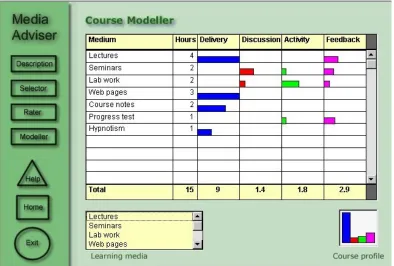
The second tool, Course Modeller (Figure 2), allows models of courses to be created by specifying how many hours students are expected to spend experiencing each teaching technique.
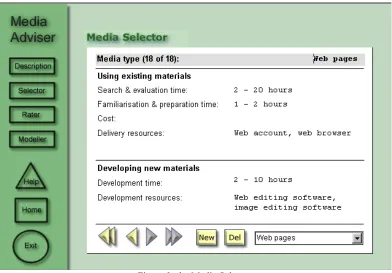
The third tool, Media Selector (Figure 3), allows practitioners to describe and cost the process of developing a course in terms of money and time.
Figure 3: the Media Selector
Assessing the Quality of courses using Media Advisor
Evaluation of the use of Media Advisor identified its potential for Quality Assessment (Kewell et al., 1999c). These uses concentrate on the notion of Quality as fitness for purpose (Green, 1994).
Media Advisor’s primary application is in the provision of a framework that makes explicit assumptions about the role and nature of different teaching techniques. Evaluation has shown (Kewell et al., 1999a), for example, that:
• practitioners find it hard to articulate the suitability or relative merits of, say, web pages over lectures
• practitioners have difficulty assessing the suitability of unfamiliar teaching techniques (with most practitioners, Learning Technologies provide a vivid illustration of this)
• agreeing on the meaning of even common terms such as “lecture” is problematic when dealing with a range of subject disciplines
• gaining an overview of the suitability of a mix of teaching techniques is an abstract and conceptually difficult task
These problems are all facilitated through the use of the descriptive and modelling framework provided by Media Advisor (ibid).
different assumptions and practices. In this role, Media Advisor can be used to provide common understanding either in preparation for or as part of a Quality Assessment process. The impact of this is that a common, agreed definition of Quality in teaching can be achieved – something which is of prime importance to the development of Quality Assurance systems (Martens & Prosser, 1998).
Moreover, as illustrated in Figure 2, Media Advisor provides immediate visual and numerical feedback on the ‘profile’ of courses (the relative importance of different components of the learning process). This allows practitioners to make judgements as to the fitness for purpose of their current mix of teaching techniques. Since this judgement consists of documented assumptions and models, this represents an extremely useful piece of evidence for Quality Assessment and Assurance purposes.
The creation of a Quality Enhancement strategy using Media Advisor Strategies for Quality Enhancement rely on the identification of areas of potential improvement and the specification and implementation of plans to address these. Media Advisor’s model of embedding resources is ideally suited to supporting this process. As described in the outline of the expert model underlying the pedagogic toolkit, the embedding process requires practitioners to identify strengths and weaknesses, to shortlist alternative strategies that address these weaknesses, and construct a course model that incorporates these elements.
A standard application of Media Advisor to date has followed and extended this pattern. Practitioners start by rating the teaching techniques they currently use to deliver their course, then input the student hours allocated to each in order to produce a course profile. This allows them to make judgements as to the suitability of their current course in terms of the balance between different parts of the teaching and learning process. Their next activity is to consider how alternative teaching techniques, particularly those that incorporate Learning Technology, could address these weaknesses. This leads to a revised course plan with a profile better suited to the course aims.
With a map of the current course and an alternative that demonstrates enhancements to Quality, the next part of the activity process involves making use of the Media Selector tool. This is used to identify costs and resources that are required to implement the changes needed to move from the current provision to the enhanced course. As a final step, this information can be used as the basis of a project plan.
The application of toolkits in other domains
As outlined above, the pedagogic toolkit can be used to fulfil a variety of roles in the Quality Assurance process, including acting as part of the Quality Assessment process or as a structure for devising Quality Enhancement plans. Similar benefits can be obtained by developing and applying other toolkits. In this section, a range of Quality-related applications of toolkits will be outlined.
Furthermore, by providing a common conceptual framework (particularly one in which multiple interpretations of terms can be negotiated and agreed), it becomes possible to define and establish standards. Through this, common practice can be developed and service thresholds agreed.
By providing activities that require recorded outputs, the toolkits produce documentary evidence of assumptions, processes and outputs. These provide a rich source of evidence for Quality Assurance and Assessment purposes, and are of value to individuals seeking recognition for professional development through assessed reflective portfolios.
Specific applications of toolkits, such as that outlined above for the pedagogic toolkit, can be designed to contribute to Quality Enhancement procedures. In general, this could be achieved for any domain by asking practitioners to work through the toolkit in terms of their current practice, assessing the strengths and weaknesses highlighted by this process, and then devising alternative approaches that redressed these.
Finally, toolkits contribute to the traditional notion of quality as excellence, by bringing Best Practice within the reach of all practitioners in a usable format. This allows widespread innovation and improvements to Quality, in marked contrast to the implicit and tacit expertise that frequently remains with the ‘early adopters’ within communities.
Conclusions
Toolkits are a specialist type of resource that fall between conceptual frameworks and automated software tools. Because of this position, they are ideally suited to supporting decision-making processes.
What makes toolkits particularly relevant in the context of Quality Assurance is the importance of sound procedures and documentary evidence for decision making. As illustrated in this paper, the pedagogic toolkit has been demonstrated to be extremely versatile. In addition to allowing practitioners to embed Learning Technology into their courses, but also provide a mechanism for generating a range of evidence and outputs that can be incorporated into Quality procedures. In particular, its relevance as a focus for negotiation as part of Assessment procedures and its role as a structure for Quality Enhancement planning have been outlined. These roles have then been set against a wider range of Quality-related benefits that can be identified for toolkits in general.
References
Conole, G. & Oliver, M. (1998), A pedagogical framework for embedding C&IT into the curriculum, ALT-J, 6, 2, pp.4-16.
Green, D. (1994), What is quality in higher education? Concepts, policy and practice, In Green, D. (Ed.) What is quality in higher education? pp. 3-20. Buckingham: Open University Press.
HEFCE (1997), Teaching and Learning Technology Programme Phase 3: Invitation to bid, Circular 14/97, TLTP, Bristol.
Kewell, B., Hopkinson, S., Oliver, M. & Conole, G. (1999c), A New Kind of Knowledge Transfer? A Report into the Feasibility of Embedding Learning Technologies within the SME Market for Vocational Training, Cascade report no. 1, University of North London.
Kewell, B., Oliver, M. & Conole, G. (1999a), Assessing the Organisational Capabilities of Embedding Learning Technologies into the Undergraduate Curriculum. The Learning Technologies Studio Programme: A Case Study, BP ELT report no. 10, University of North London.
Kewell, B., Oliver, M., Beaumont, D., Standen, R., Hopkinson, S. & Conole, G. (1999b), The creation of Media Advisor: from theoretical framework to multimedia resource, BP ELT report no. 5, University of North London.
Laurillard, D. (1993), Rethinking University Teaching, London: Routledge.
Laurillard, D., Swift, B. & Darby, J. (1993), Academics’ use of courseware materials: a survey, ALT-J, 1, 1, pp.4-14.
Maier, P., White, S. & Barnett, L. (1997), Using Educational Development Strategies to Integrate Learning Technologies, Active Learning 6, pp. 10-14.
Martens, E. & Prosser, M. (1998), What constitutes high quality teaching and learning and how to assure it, Quality Assurance in Education, 6, 1, pp. 28-36.
Oliver, M. & Conole, G. (1998), Re-implementing the pedagogic toolkit to support staff development, ELT report no. 4, University of North London.
Oliver, M. & Conole, G. (1999), From theory to practice: A model and project structure for toolkit development, BP ELT report no. 12, University of North London.