Copyright to IJIRSET www.ijirset.com 3201
ANALYSIS THE EFFECTS OF PROCESS
PARAMETERS IN EN24 ALLOY STEEL
DURING CNC TURNING BY USING MADM
Raman Kumar
1, Raman Kumar
2, Jaspreet Singh Rai
3and Navneet Singh Virk
4Associate Professor, Department of Mechanical Engineering, Ludhiana Group of Coleges, chaukimann, Punjab,India1
Assistant Professor, Chandigarh University, Punja, India2
Research Scholar, GZSCET, Punjab, India3
Research Scholar, HCTM, Haryana, India4
Abstract: Much of modern day machining is carried out by computer numerical control (CNC). In this research work an attempt has been made to analysis the effects of input parameters such as speed (rpm), feed (mm/rev), depth of cut (mm) and nose radius (mm) on output parameter such as material removal rate and surface roughness. The experiment was performed with different combination values of input parameter. Equal weightage has been assigned to all input parameter and a (Multi attribute decision making) MADM approach then performed to find out the best result.
Keywords- Machining, CNC, MADM
1.
INTRODUCTION
Copyright to IJIRSET www.ijirset.com 3202
II. RESEARCH METHODOLOGY
Step 1. Data Collection.
The data was collected through Experiment performed in workshop. The input parameters such as Speed (rpm), Feed (mm/rev.), D.OC (mm) and Nose radius and output parameters such as MRR, Surface roughness and time has been considered in experiment work. The value of experiment data is shown in Table 1.
Step 2. Weightage to output parameter
The analytical Hierarchy process developed by [5] has been used to find out the priority weight of parameters.
Table 2: The pairwise comparison matrix
.
MRR SR Time Priority weight
MRR 1 2 5 0.582
SR 1/2 1 3 0.309
Time 1/5 1/3 1 0.109
Step 3. Normalized matrix (TOPSIS Method, Hwawg and Yoon, 1981) The normalized matrix has been computed by using following formula: n
rij = aij / ∑(aij)2
i=1
Exp. No. Speed (rpm) Feed (mm/rev.) D.OC
(mm)
Nose radius
MRR
(mm3/s) Ra (µm)
Time (Sec)
1 1500 0.08 0.6 0.4 188
1.144 38
2 1500 0.1 0.8 0.8 314
0.936 32
3 1500 0.12 1 1.2 471 0.786 27
4 1600 0.08 0.8 1.2 268
0.576 38
5 1600 0.1 1 0.4 419
1.082 32
6 1600 0.12 0.6 0.8 301
0.502 26
7 1700 0.08 1 0.8 356 0.59 36
8 1700 0.1 0.6 1.2 267
0.51 30
9 1700 0.12 0.8 0.4 427
Copyright to IJIRSET www.ijirset.com 3203
Table 3: Values of Normalized Matrix
MRR SR Time
1 0.181 0.454 0.397
2 0.303 0.371 0.334
3 0.454 0.312 0.282
4 0.259 0.229 0.397
5 0.404 0.429 0.334
6 0.29 0.199 0.272
7 0.343 0.234 0.376
8 0.258 0.202 0.313
0.412 0.432 0.261
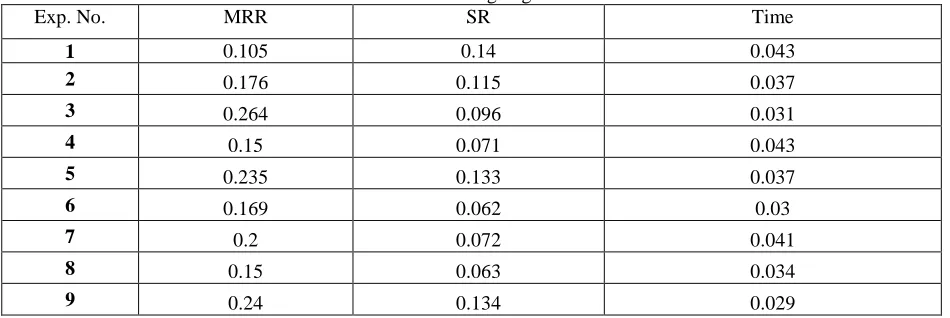
Step 4. Weightage Matrix
Calculate the weighted normalized decision matrix by multiplying the normalized decision matrix by its associated weights. Vij = Wj×Rj
Table 4: Values of Weightage Normalized Matrix
Exp. No. MRR SR Time
1 0.105 0.14 0.043
2 0.176 0.115 0.037
3 0.264 0.096 0.031
4 0.15 0.071 0.043
5 0.235 0.133 0.037
6 0.169 0.062 0.03
7 0.2 0.072 0.041
8 0.15 0.063 0.034
9 0.24 0.134 0.029
Step 5:- Determine the positive-ideal (best) and ideal (worst) solutions. The positive-ideal (best) and negative-ideal (worst) solutions can be expressed as;
max min
V + = {(∑Vij / jє J), (∑Vij / j є J’) / i=1,2,3,……,N},
i i
= {V1+, V2+, V3+, V4+ ,….. VM+ }
min max
V - = {(∑Vij / jє J), (∑Vij / jє J’) / i=1,2,3,……,N},
i i Table 5: Values of positive-ideal and negative-ideal solutions.
MRR SR Time
V+
0.264 0.062 0.029
V-
Copyright to IJIRSET www.ijirset.com 3204
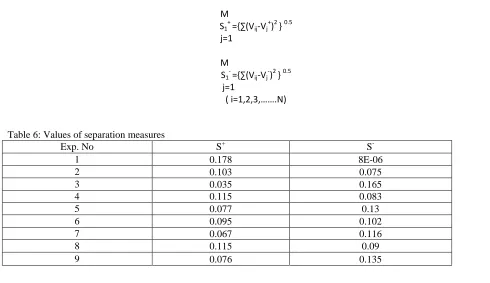
Step 6: Calculate the separation measures
The separation of each alternative from the positive-ideal solution and negative-ideal solution is given by following equations. The values of separation measures are shown in Table 6.
M
S1+ ={∑(Vij-Vj+)2 } 0.5
j=1
M
S1- ={∑(Vij-Vj-)2 } 0.5
j=1
( i=1,2,3,…….N)
Table 6: Values of separation measures
Exp. No S+ S
-1 0.178 8E-06
2 0.103 0.075
3 0.035 0.165
4 0.115 0.083
5 0.077 0.13
6 0.095 0.102
7 0.067 0.116
8 0.115 0.09
9 0.076 0.135
Step 7: Calculate the relative closeness
Exp. No Relative closeness Rank
1 4E-05 9
2 0.422 7
3 0.826 1
4 0.418 8
5 0.627 4
6 0.517 5
7 0.636 3
8 0.44 6
9 0.639 2
II. CONCLUSION
Copyright to IJIRSET www.ijirset.com 3205
been investigated. The results shown that Speed 1500 (rpm), Feed 0.12 (mm/rev.), D.O.C (mm) 1 and Nose radius at 1.2 is the appropriate best input parameters setting.
REFERENCES
1. R. Q. Sardiñas, M. R. Santana and E. A. Brindis, Genetic algorithm-based multi-objective optimization of cutting parameters in turning processes, Engineering Applications of Artificial Intelligence, Volume 19, Issue 2, March 2006, Pages 127-133.
2. M. Korat and Neeraj Agarwal, Optimization of Different Machining Parameters of En24 Alloy Steel In CNC Turning by Use of Taguchi Method, International Journal of Engineering Research and Applications (IJERA), Vol. 2, Issue 5, September- October 2012, pp.160-164. 3. H. K. Dave, L. S. Patel and H. K. Raval , Effect of machining conditions on MRR and surface roughness during CNC Turning of different
Materials Using TiN Coated Cutting Tools – A Taguchi approach, International Journal of Industrial Engineering Computations, 3 (2012) 925-930.
4. K. Hassan, Anish Kumar and M.P.Garg , Experimental investigation of Material removal rate in CNC turning using Taguchi method, International Journal of Engineering Research and Applications, Vol. 2, Issue 2,Mar-Apr 2012, pp.1581-1590.
5. T.L. Satty, The Analytic Hierarchy Process, McGraw-Hill, New York, NY, 1980.