Cobalt -Platinum Alloys
A CRITICAL REVIEW
OF
THEIR CONSTITUTION
AND PROPERTIES
By A.
s.
Darling,
Ph.D., A.M.1.Mech.E. Research Laboratories, Johnson Matthey & Co LimitedBelow the solidus cobalt and platinum form a continuous series of solid solutions, although transformations based on the alloys containing
25 and 50 atomic per cent of cobalt occur at lower temperatures. Preliminary studies by Carter (I) and Constant (2, 3, 4) were con-
firmed by Nemilow ( 5 ) who in 1933 established the miscibility of cobalt in platinum over the complete composition range.
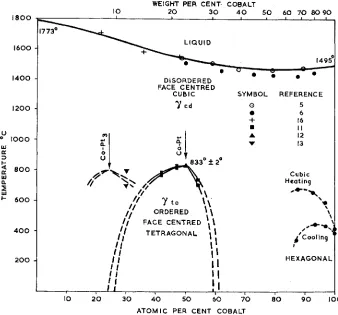
The annotated equilibrium diagram is shown in Fig. I . Nemilow's liquidus curve, extending to alloys containing 51 atomic per cent of platinum links up almost completely with recent melting point data on platinum- rich alloys obtained in the Johnson Matthey Research Laboratories (16) and it must be concluded that the melting point determina- tions made by Gebhardt and Koster (6) were seriously in error. No investigator has reported a second cooling arrest and it is likely that the liquidus and solidus in this system are almost coincident.
Order-Disorder Transformations
Although Jellinghaus (7) suspected the existence of an ordering reaction at the equi- atomic composition, he was unable to detect any superlattice lines. Direct evidence of ordering was first provided by Gebhardt and Koster (6) who showed that the face centred cubic structure of alloys containing approxi- mately equal proportions of the two types of atoms transformed, at temperatures below
825"C, into one having tetragonal symmetry. It was erroneously concluded that the tet- ragonal phase began to order only at tempera- tures below 500°C.
Hultgren and Jaffee (8) showed that the ordered tetragonal phase was stable up to 800°C if sufficiently prolonged heat treat- ments were employed. Weil (9) reported in 1947 that a completely ordered tetragonal structure could be obtained by reducing the co-precipitated cyanides of platinum and cobalt in hydrogen at 500-6oo'C for two hours. The stability of the ordered face centred tetragonal phase at all temperatures up to 825°C was finally established beyond all doubt in the course of a co-operative investi- gation by Newkirk and Smoluchowski of the Carnegie Institute of Technology, and Geisler and Martin of the General Electric Research Laboratories (10). At compositions on either
side of the 50 atomic per cent alloy Newkirk et al (11) demonstrated the existence of
discrete regions of order in equilibrium within regions of disorder. The ordered particles, unstrained when in equilibrium, had mini- mum dimensions much greater than
IOOOA.
These findings, together with the sharp discontinuities observed on the resistance- temperature curves, confirmed that the ordering process based on the equi-atomic cobalt-platinum alloy was a phase change of the first order, and should therefore be included in the constitutional diagram.WEIGHT PER CENT- COBALT
10 2 0 3 0 4 0 5 0 6 0 7 0 8 0 9 0 I800
1 6 0 0
1400
I200
V
O 1000
a
w
3
8 0 0
W
a
5
6 0 0
4 0 0
2 0 0
1
L I Q U I DDISORDERED FACE CENTRED
CUBIC
Y
c dSYMBOL REFERENCE
0 5
0 6
+
16I I
A 12
.I 13
Cubic
Heating
A--
Y
-\
'!
,*-+-.
*'Cooling I
HEXAGONAL
0
A T O M I C PER CENT COBALT
Fig. 1 Equilibrium diagram of the cobalt-platinum system
that the a o o > directions of the ordered particles are parallel with the corresponding axes in the parent lattice. In the early stages of the process considerable stresses are caused by platelets of the tetragonal phase which lie on and are coherent with the (110) planes of
the cubic lattice. These stresses are accom- modated by a self-deformation process which gives rise to twinning, and by recrystallisation which predominates at the lower ageing temperatures. In the duplex regions the ordered phase assumes a Widmanstatten structure aligned with the (100) planes of the disordered lattice.
As a result of careful X-ray work by Rudman and Averbach (12) the true critical
temperature was established as 833' &2'C.
The long range order parameter, unity at
615"C, was found to be 0.78 at the critical
temperature. Roberts' axial ratio theory (21)
accurately describes the shape of the order parameter curve. Short range order persists in the platinum-cobalt system at temperatures above the critical. There is in this region a preference for unlike neighbours.
A superlattice of the type to be expected for the Pt,Co composition was reported in
1952 by Geisler and Martin (13). The symmetry of the lattice is undisturbed by this ordering process which results in a movement
of cobalt atoms to the corner sites and platinum atoms to the face centres of the original unit cell. The critical temperature of
this transformation, which causes no internal stresses, is between 700 and 800°C.
4.0
oq 3.9
Ul CC
W
t-
W
I -7 3.8
a
aQ
:
3.7w
u
4
-1
3.6
3‘5
SYMBOL R E F E R E N C E
1.9158
3,543
2 0 40 6 0 €30
ATOMIC P E R CENT COBALT
ordering. The activity of cobalt in the alloys was determined by electro-potential measure- ments in a sealed cell, complete reversibility being attained over the temperature range 7oo-920°C. The heat of solution was found to be positive and the entropy of solution was very much greater than the ideal value. Over much of the composition range the activity of platinum showed positive deviations from Raoult’s Law.
Lattice Parameters
and
Transformations
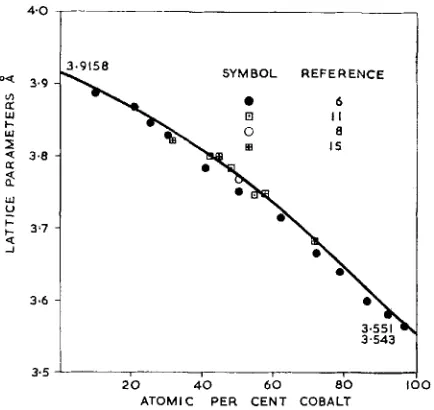
As shown in Fig. 2, the lattice parameter curve for disordered alloys quenched from IOOO~C exhibits a slight positive deviation from Vegard’s law. Although self-consistent, the corrected data of Gebhardt and Koster are rather lower than those of more recent
I
Fig. 2
the alloys quenched from 1000°C Lattice parameter curve f o r
investigators. The equi-atomic alloy, fully ordered at 700”C, has an “a” value of 3.803A ( I S ) . The axial ratio is strongly influenced by the temperature of heat treat- ment. As shown by Fig. 3 it increases from 0.9680 at 600°C
to 0.9800 at the critical tempera- ture. The lattice parameter of the Pt,Co alloy, disordered at 800°C is 3.829A after quenching (13). )
Ordering at 700°C changes this value to 3 . 8 3 ~ 4 . Because of the small volume changes involved strain markings are not observed when this alloy transforms.
The only values yet reported for the allotropic transformation temperatures in the cobalt-rich alloys are those of Gebhardt and Koster. Newkirk ef al (11) suggest that
the mean values of the heating and cooling inflexions reported afford a reasonable ap- proximation to the true transformation temperature.
Electrical Properties
The peak resistivity of this system, approxi- mately 46 microhm-cm, is exhibited by the
35 atomic per cent alloy quenched from the disordered region. Ordering reduces the room temperature resistance considerably,
0.9800 -
T, = 83322’C
0,9750 -
1 . l
I t -
0.9700 -
0 - 9 6 8 0
6 0 0 700 8 0 0 9 0 0
TEMPERATURE ‘C
Fig. 3 Variation with temperature of the axial ratio of the ordered 50
Fig. 8 Elcrtrical resistivity
and temperature coeficient of cobalt-platinum alloys
although the reverse effect is obscrved at equilibrium tempcra- tures. Fig. 4, which summariscs the avail- able data, shows the excellent agreement be- tween the results of
Martin (15) and of Gebhardt and Koster (6).
Between 20 and 60
atomic per cent of
cobalt the temperature coefficient of resis- tance is strongly affected by heat treatment, the tendency being to in- crease with time of
1
I I I -1 ___)
2 0 40 6 0 8 0 100
ATOMIC PER CENT COBALT
ageing until equilibrium is approachcd. I n order to obtain accurate equilibrium resis- tance-temperature curves such as that shown in Fig. 5, annealing periods of several weeks are required (11). The inflexion at 400°C is caused by passage through the Curie point and not by atomic rearrangcment as suggested by Gebhardt and Kiistcr (6). The slight discontinuities at higher temperatures mark the phase boundaries of the two-phase region.
Although the change is slight, the equili- brium resistivity of the disordered phase is lower than that of the tetragonal structure. After quenching, however, the ordered structure has the lower resistance. This increase of resistivity upon ordering is contrary to classical theory.
Physical
and
Mechanical Properties
The specific gravity of the quenched alloys varies with atomic composition in a remark- ably uniform manner, being 18.04, 16.34, 15.95, 15.87, 15.64, 15.30, 14.92 and 12.60 g per cc at room temperature for the 30, 43.9, 49.0, 49.3, 49.4, 53.2, 56.7 and 72.5 atomicper cent cobalt alloys respectively (15). The
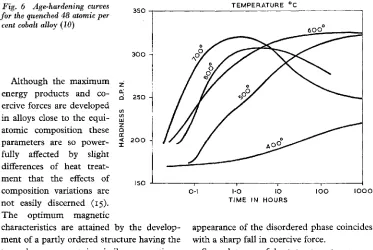
hardness of the alloys varies greatly with heat treatment. Those containing 48 to 54 atomic per cent of cobalt have a hardness of 170 to 190 Hv when quenched from the disordered region. By subsequently ageing at lower tempcratures higher hardnesses can be achiev- ed as indicated by Fig. 6, which shows that the maximum values are attained a t 600 C
(10).
The Young's Modulus of the 50 atomic per cent alloy decreases from 20,ooo kg mm2 at 20°C to 13,000 kg mm2 at 900-C. The modulus-temperature curve exhibits a slight reversible inflexion on passing through the Curie point at 4 0 - C and pronounced hysteresis in the vicinity of the critical temperature (6).
Melting and Working
12s
100
7s
Y
u
z 4
2
5 0 '"-I ul
U
f 2 5 I
W
I-
z w
U
UI a 0
a
-25
- 5 0
2 0 0 4
TEMPERATURE'C
I
30
1
4 0 0 6 0 0 8 0 0 I000 QUENCHING TEMPERATURE OC
600 8 0 0 1000
TEMPERATURE OC
range are best hot worked above 1000°C. After quenching from
IIOOT
the alloys can then be worked to the desired shape by cold rolling, swaging or drawing, annealing being accomplished when required by quenching from IIOO'C. To avoid excessive oxidation heat treatments are best carried out in a reducing or inert atmosphere.Although ductile metal having good mag- netic properties can be obtained by powder metallurgy, the workability of the melted and cast product usually renders this technique unnecessary.
Magnetic Properties
The ferromagnetic properties of the plati- num-rich alloys are of considerable theoretical interest and those of the equi-atomic compo- sition of appreciable industrial significance. Fig. 7 shows the depression in Curie point due to ordering in the vicinity of the 25
Fig. 5 Equilibrium resistame temperature curue of the 42 atomic per cent cobalt ulloy. Lower curve
shows the resistivity of the quenched alloy ( 1 1 )
atomic per cent cobalt alloy. Simpson and Tredgold (17)
account for the ferromagnetic properties of the platinum- rich alloys in terms of strong intra-atomic exchange forces in the cobalt atoms, or suggest alternatively the existence of exchange interaction between cobalt and platinum atoms. Wohlfarth (I 8), however, finds
it reasonable to assume that the magnetic properties are due to holes in the "8' band.
A calculated value of 0.96 holes per atom accounted satisfac- torily for the Curie point of the 30 atomic per cent cobalt alloy. The outstanding permanent magnet properties of the 50 atomic per cent alloy were first reported in 1936 by Jellinghaus
(7), who found that a coercive force of 4000 oersteds could be developed by quenching and ageing cast material of this composition. Comparable, but rather lower values of coercive force and residual induction were quoted one year later by Neumann (19). Recent studies (15, 16, 20, 22) have shown that by suitable heat treatments, coercive forces of the order of 4000 oersteds can be obtained in conjunction with maximum energy products of 9 x 10⁶ gauss-oersteds. These values indicate that the equi-atomic cobalt platinum alloy can provide more powerful permanent magnets than any other material so far developed. Its closest rival is Columax (a columnar Alcomax) which, although having a (BH) max value of 7 to 8 X
Fig. 6 Age-hardening curves for the quenched 48 atomic per
cent cobalt aEloy (10)
Although the maximum energy products and co- ercive forces are developed in alloys close to the equi- atomic composition these parameters are so power- fully affected by slight differences of heat treat- ment that the effects of
composition variations are not easily discerned (15). The optimum magnetic characteristics are attained
TEMPERATURE OC
3 0 0
i a'
ri 2 5 0
VI VI W
z
n U
-l2 0 0
I:
I 5 0
I
Y
$7
1l -
by the develop- ment of a partly ordered structure having the two phases present in similar proportions. The diffuse diffraction lines characteristic of
material in this condition have been inter- preted as evidence for a coherent bond between the ordered phase and its matrix (10).
I n Fig. 8 the variations of coercive force and energy product during the ageing of a previously quenched 48 atomic per cent cobalt alloy are correlated with the corres- ponding changes of structure and electrical resistance. Both the coercive force and energy product reach a maximum while appreciable quantities of the disordered phase
0.1 1.0 10 100 1000
T I M E I N HOURS
appearance of the disordered phase coincides with a sharp fall in coercive force.
Several types of heat treatment are em- ployed to develop the desired magnetic characteristics in cobalt-platinum alloys. An essential feature of one widely used process is the strictly controlled cooling rate from
1000' to 200 C at I to 10' per second which precedes an ageing treatment at 6 0 0 T (20).
Equally satisfactory results can, however, be achieved by quenching from the disordering temperature to 500 to 750'c, the alloy being maintained at the final temperature for periods up to five hours (22). T o magnetise
the alloy after such heat treatment field still remain, the electrical 1400
resistance having at this
stage decreased by approxi- 1 2 0 0 -
mately 40 per cent. The
peak energy product, 1000- arrived at after fifteen O
hours of heat treatment,
is followed by a rapid
5
6oog
8 0 0 -REFERENCE
+ Cranglc I Porsons 2 9
decline. The final dis- a A Gcbhardt I K o s t c r 6
o Constant 2 3 4
I C 400-
w
Fig.
7
Variation
of
Curie
temperature with composition
ATOMIC PER C E N T C O B A L T
for cobalt-platinum alloys
BOO0
,
r B0
w
0
0
I N I T I A L 0.1 10 100 1000 HOURS AT 600 'C
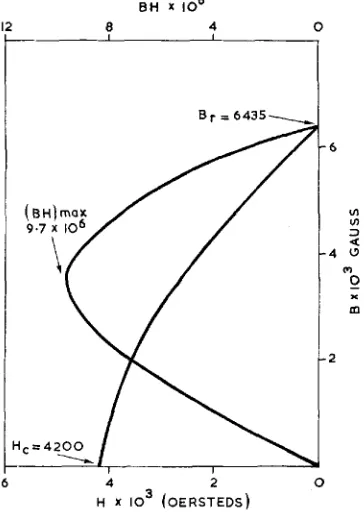
strengths of the order of 20,000 oersteds are required. Fig. 9 illustrates the test character- istics of a specimen which after two hours at
IOOO'C had been quenched to 660°C and held at this temperature for forty-five minutes. A peak energy product of 9 . 7 ~ 1 0 ~ gauss- oersteds is associated with a coercive force of 4200 oersteds.
Although Martin suggested (15) that the good permanent magnet properties of cobalt- platinum might be explicable on the basis of
the single domain particle theory, Craik and Nuiiez (23) have since shown this theory to be untenable. A careful examination of the domain structure showed only a small pro- portion of the ordered region to be single domains. The general form of the domain structure corresponded, however, to the magnitude of the crystal anisotropy of the tetragonal phase, about 107 erg and to the low value of saturation magnetisation.
The high coercive force of cobalt-platinum is now generally attributed to the large localised strains induced by the ordering process, and the effectiveness of the various heat treatments employed is probably due
Fig. 9 Magnetic test characteristics of a 50 per cent cobalt-platinum specimen quenched from I000"C
to 660°C and held at this latter temperature for 45
minutes
Fig. 8 Variation of co- erciveforce, energy product, remanent magnetism, and electrical resistivity of the 48 atomic per cent cobalt alloy during ugeing (10)
entirely to the high internal stresses which they generate. Woolley and Bates (24) suggest that the optimum magnetic condition corresponds to the incipient stage when the nuclei of the ordered phase remain coherent with the disordered matrix, thus causing large localised lattice strains. At room temperature the (110)
plane of the disordered phase is 0.18 per cent smaller in area than the ( 1 0 1 ) plane of the ordered phase with which it is coherent (25).
BH X lo6
6 4 0
- I
4 2 0
This difference in area diminishes as the temperature increases, thus accounting for the rapid decrease in coercive force and magnetic viscosity which occurs when cobalt- platinum magnets are heated. The peak magnetic viscosity is observed at a field strength comparable to the coercive force (26). These results support the view that the viscosity effects are thermally activated.
Small quantities of iron and nickel have been shown by Woolley and Bates (24, 27) to have little effect on the disregistry between the ordered and disordered phases in cobalt- platinum, thus making it unlikely that the strain of incipient precipitation in these alloys would be significantly increased. The ordering temperature increases rapidly with iron additions and decreases gently with nickel content. Although details of the magnetic characteristics of these ternary alloys have not yet been published, technical interest is likely to be greater in that con- taining nickel which permits continuous control over the ordering process.
Al’tman ( 2 8 ) has recently reported that palladium can be substituted for up to 5
atomic per cent of platinum in the 50 per cent cobalt alloy without significant effect upon magnetic properties. Such alloys can be advantageously produced by powder metal- lurgy.
Applications
Cobalt-platinum alloys are employed pri- marily for magnetic purposes and numerous applications exist in which the outstanding performance of the equi-atomic alloy justifies its high basic cost, No other alloys of comparable magnetic properties are capable of
being worked, and the fact that cobalt- platinum can be supplied in the form of rod, sheet, foil or wire ensures for this material a unique position in the instrument field.
I n many applications space limitations dictate the use of cobalt-platinum where less powerful magnetic materials would be in- adequate. Examples arise in miniature relays, electric wrist watches, hearing aids, micro- phones, and the magnetic drives used to transmit rotary or reciprocating motion into sealed vessels.
The alloy can, in some instances, fulfil the dual role of magnet and electrical contact. While not essential when hermetically sealed, cobalt-platinum contact faces are advan- tageously covered with a thick layer of hard gold plating to minimise contact resistance. When the contact must form a ferromagnetic link in a magnetic current it is best employed in the magnetically soft disordered condition. Such magnetic contacts are frequently acti- vated by an external solenoid. Magnetic contacts have the advantage that a definite ‘make’ is obtained without bounce or resonance.
The nobility of cobalt-platinum means that
it can advantageously be employed in flow meters handling corrosive liquids and for the magnetic jigs used in electropolishing baths. Whatever application is envisaged, the alloy is most advantageously cmployed with an approximate length-diameter ratio of 0.7. This must be compared with a ratio of
5 for Alnico V and 2 for Alnico VII. Although cobalt-platinum in the magnetically soft condition is ductile and readily machined, it becomes very hard when heat treated for optimum magnetic properties.
References
I F. C . Carter, Proc. A.I.M.E., Inst. Metals Div.,
2 F.
w.
Constant, P b s . Rev., 1929, 34, 12173
w.
Constant, PhY. Re% 19301 35, 1165 W. Nemilow, Z. Anorg. Chem., 1933, 213,283
6 E. Gebhardt and W . Kdster, Z. Metallkunde,
7 W . Jellinghaus, Z. tech. Physik, 1936, 17, 33 8 R. Hultgren and R. I. Jaffee,
J.
Appl. Phys.,9 L. Weil, Compt. rend., 1947, 224, 923-925
1928,759-782 1940, 32, 253
I 0
I 1
I 2
I3
16
I7
J. B. Newkirk, A. H. Geisler, D. L. Martin and R. Smoluchowski, J . Metals, 1950, 188, 1249-1260
T . B. Newkirk, R. Smoluchowski, Phys. Rev., " 1 9 4 9 ~ 76, (3j, 471
J. B. Newlurk, A. H. Geisler and D. L. Martin,
J. Appl. Pkys., 1949, 20, 816
J. I3, Newkirk, R. Smoluchowski, A. H. Geisler and D. L. Martin, .7. . Appl. Phys., .~
1951, 22,290-298
J. B. Newkirk, R. Smoluchowski, A. H. Geisler and D. L. Martin, Acta Cryst., 1951, 4, (61, 507-512
P. S. Rudman and B. L. Averbach, USAEC, NYO, 7051, Technical Report No. 29, Acta Met., 1957, 5 , 6 5 1 3
A. H. Geisler and D. L. Martin, J . Appl. Phys., 195% 23,375
R. A. Oriani, Acta Met., 1953, I, 144-152
D. L. Martin, Conference on Magnetism and Magnetic Materials, AIEE, 1957, 188. Trans. Metall. SOC., AIME, 1958, 213, 478 L. A. Ford, Johnson Matthey Research
Laboratories. Unpublished data
A. W. Simpson and R. H. Tredgold, Proc. Phys. SOC., 1954, B.67,38-41
IS E. P. Wohlfarth, Phil. Mag., 1954,45,647-649 19 H. Neumann, Archiw. Techm'sches Messen,
20 D. L. Martin and A. H. Geisler, U.S. Patent
2,622,050, 1952, British Patent 697,595, I953
1937>69> T38
21 B. W. Roberts, Acta Met., 1954, 2, 597
22 Johnson Matthey & Co Ltd, British Patent
23 D. S. Craik and Felip NuAez, Proc. Phys. Soc.,
24 J. C . Woolley and B. Bates, J. Less-Common Metals, 1959, I ,
(s),
382-38925 J. H. Phillips, J. C. Woolley and R. Street,
Proc. Phys. Soc., 1955, (B), 68, ( 6 ) , 345-352 26 A. W. Simpson and R. H. Tredgold, Proc.
27 J. C. Woolley and B. Bates, J . Less-Common Metals, 1960, 2, (I), 11-18
28 A. B. Al'tman, Izvest. Akad. Nauk S.S.S.R., Otdel. Tekhn. Nauk, Met. i Topl., 1959, ( 4 , 135-142
29 J. Crangle and D. Parsons, Proc. Roy. SOC.,
Series A, 1960, 255, (1283), 509-519 849,505
1961,78,225--232
P ~ Y s . SOC., 1953, (B), 66, (9), 805-807
Point Defects and Radiation Damage
in
Platinum
OSCILLATORY VACANCY LOOPS
Platinum is a particularly attractive metal for lattice defect studies as it does not become very active when irradiated and its high melting point ensures that radiation damage does not anneal out completely at reactor temperatures. A recent transmission electron microscopy study by a group of Belgian workers ( I ) has provided remarkably con- vincing visual evidence of the type of defects existing in platinum foils after annealing, quenching, neutron bombardment, and fission fragment damage.
The dislocations in annealed platinum foils were dissociated; annealing twins were common and the general structural features were typically those of a face centred cubic metal with a medium-high stacking fault energy. Rapidly quenched foils exhibited spherical voids, some of which extended to the free surfaces. T h e authors of the paper suggest that because of the high surface energy of platinum these spherical cavities may find it difficult to transform to the vacancy loops common in baser metals.
Foils subjected to fission fragment radiation
showed black spots indicative of defect clusters and fragments passing through the foil at very oblique angles sometimes caused straight line dot formations within the grains. Some of the vacancy loops oscillated slowly and jerkily between two limiting positions. This vibration was accomplished without energy dissipation; although shape and size changes occurred during movement the defect had the same size when it returned to its original position.
Quenched foils were damaged more rapidly by fission fragments than annealed material, thus supporting the hypothesis that damage is caused by vacancies rather than interstitials. T h e defect concentration was less along a denuded zone parallel to the twin boundaries.
A. S. D.
Reference