Clinical Interventions in Aging
Dovepress
O r I g I n A l r e s e A r C h
open access to scientific and medical research
Open Access Full Text Article
Xing-hui shao1
Yan-Min Yang1
Jun Zhu1
han Zhang1
Yao liu1
Xin gao1
li-Tian Yu1
li-sheng liu1
li Zhao2
Peng-Fei Yu3
hua Zhang4
Qing he5
Xiao-Dan gu6
1emergency and Intensive Care
Center, Fuwai hospital, Chinese Academy of Medical sciences and Peking Union Medical College, Beijing, 2Department of emergency,
Fu Xing hospital, Capital Medical University, Beijing, 3Department of
Cardiology, Pingdu People’s hospital, Pingdu, 4Department of emergency,
Qingdao Municipal hospital, Qingdao,
5Department of emergency, West
China hospital, sichuan University, Chengdu, 6Department of emergency,
sixth People’s hospital of Chengdu, Chengdu, People’s republic of China
Correspondence: Yan-Min Yang emergency and Intensive Care Center, state Key laboratory of Cardiovascular Disease, Fuwai hospital, national Center for Cardiovascular Diseases, Chinese Academy of Medical sciences and Peking Union Medical College, 167 Beilishilu, Beijing 100037, People’s republic of China Tel +86 10 8839 8471
Fax +86 10 8836 4591 email [email protected]
Comparison of the clinical features and outcomes
in two age-groups of elderly patients with atrial
fibrillation
Background: Atrial fibrillation (AF) disproportionately affects older adults. However, direct comparison of clinical features, medical therapy, and outcomes in AF patients aged 65–74 and 75 years is rare. The objective of the present study was to evaluate the differences in clinical characteristics and prognosis in these two age-groups of geriatric patients with AF.
Materials and methods: A total of 1,336 individuals aged 65 years from a Chinese AF registry were assessed in the present study: 570 were in the 65- to 74-year group, and 766 were in the 75-year group. Multivariable Cox hazards regression was performed to analyze the major adverse cardiac events (MACEs) between groups.
Results: In our population, the older group were more likely to have coronary artery disease, hypertension, previous stroke, cognitive disorder, or chronic obstructive pulmonary disease, and the 65- to 74-year group were more likely to have valvular heart disease, left ventricular systolic dysfunction, or sleep apnea. The older patients had 1.2-fold higher mean CHADS2 (congestive heart failure, hypertension, age 75 years, diabetes, stroke) scores, but less probability of being prescribed drugs. Compared with those aged 65–74 years, the older group had a higher risk of death (hazard ratio 2.881, 95% confidence interval 1.981–4.189; P0.001) or MACE (hazard ratio 2.202, 95% confidence interval 1.646–2.945; P0.001) at the 1-year follow-up. In mul-tivariable Cox analyses, secondary AF diagnosis, a history of chronic obstructive pulmonary disease, and left ventricular systolic dysfunction were independent predictors of MACE in the older group.
Conclusion: Patients aged 75 years had a worse prognosis than those aged 65–74 years, and were associated with a higher risk of both death and MACE.
Keywords: atrial fibrillation, geriatric patients, mortality, major adverse cardiac events (MACE)
Introduction
Atrial fibrillation (AF) is the most common cardiac arrhythmia, and it increases in prevalence with age, ranging from 0.1% among persons 55 years to 9.0% in adults aged 80 years.1,2 It is estimated that the current prevalence of AF in the US is 2.3
mil-lion, with 75% aged 65 years and 45% aged 75 years.3 According to the American
College of Cardiology (ACC)/American Heart Association (AHA)/European Society of Cardiology (ESC) guidelines, antithrombotic therapy is the first recommended for AF patients.4,5 Nevertheless, using anticoagulants in the elderly is a great challenge, because
the risks of stroke from AF and hemorrhage from anticoagulation both increase with age.6,7 Moreover, older patients with AF more frequently have coexisting concomitant
conditions, such as heart failure or thromboembolism, which predispose them to worse
Journal name: Clinical Interventions in Aging Journal Designation: Original Research Year: 2014
Volume: 9
Running head verso: Shao et al
Running head recto: AF features and outcomes in elderly DOI: http://dx.doi.org/10.2147/CIA.S67123
Clinical Interventions in Aging downloaded from https://www.dovepress.com/ by 118.70.13.36 on 20-Aug-2020
For personal use only.
This article was published in the following Dove Press journal: Clinical Interventions in Aging
12 August 2014
Dovepress
shao et al
prognosis. With the exacerbation of the aging population, AF in the elderly will increase as a health problem and represent both a management burden and cost burden for physicians, patients, and health care systems.8–10
It is well recognized that stroke prevention is central to the management of AF, and advanced age has been identi-fied as an independent predictor for stroke in various stroke risk-stratification schemes.11 A recently study, based on a
large cohort of AF patients, demonstrated that the relative hazard for increased stroke and thromboembolism was 2.97-fold in the 65- to 74-year age-group and 5.28-fold for age 75 years, with age 65 years as reference.12 In
addition, the 2012 focused update of the ESC guideline strongly recommends the CHA2DS2-VASc (congestive heart failure, hypertension, age 75 years, diabetes, stroke, vascular disease, age 65–74 years, sex category) score to extend to the most widely used CHADS2 (congestive heart failure, hypertension, age 75 years, diabetes, stroke) score by giving 2 points to age 75 years, and 1 point to age 65–74 years.13 This suggested that AF patients aged
75 years were associated with higher risks for stroke compared with those aged 65–74 years. Nonetheless, direct comparison of the clinical features, medical therapy, and major end-point events in AF patients aged 65–74 years and 75 years has not been illustrated yet. The objective of this study was to evaluate the differences in clinical characteristics and prognosis in these two age-groups of geriatric patients with AF.
Materials and methods
The Chinese AF registry was a multicenter, prospective, observational study with a 1-year follow-up. Twenty rep-resentative centers from different areas participated (see “Participating investigators” section). The registry enrolled patients who presented to an emergency department with AF or atrial flutter from November 2008 to October 2011, either as the primary or secondary diagnosis. The main objective was to evaluate the clinical characteristics, medical treatments, risk factors, and long-term outcomes in Chinese patients with AF. Among the included patients, 1,336 indi-viduals aged 65 years were assessed. According to the design of the present study, the population was divided into two groups: age 65–74 years and 75 years.
Patients were identified using electronic hospital data-bases recording emergency department (ED) diagnosis, review of electrocardiograms and telemetry recording from the ED, and direct screening by research staff. For each patient, demographics, medical history, and clinical
variables were collected at baseline. For blood pressure (BP) and heart rate, initial data at registration were docu-mented. Body mass index (BMI; weight [kg]/height [m]2)
was calculated using the weight and height measured at enrollment. The definitions of AF types were in accor-dance with ACC/AHA/ESC 2006 guidelines for AF. We combined persistent AF and permanent AF as sustained AF. All treatment decisions were left to the discretion of the treating physician.
Follow-up was carried out at 1 year from time of enroll-ment by telephone interview. The main study outcomes included all-cause mortality, stroke, non-central nervous system (CNS) systemic embolism and major bleed. Primary stroke included all strokes – ischemic and hemorrhagic – that were associated with focal neurological symptoms lasting more than 24 hours. Non-CNS systemic embolism was defined as the occurrence of myocardial infarction, pulmo-nary embolism, or peripheral embolism. Major bleeding was defined as fatal bleeding and/or symptomatic bleeding in a critical area or organ, such as intracranial, intraspinal, intraocular, retroperitoneal, intra-articular or pericardial, or intramuscular with compartment syndrome, and/or bleeding causing a fall in hemoglobin level of 20 g/L (1.24 mmol/L) or more, or leading to transfusion of two or more units of whole blood or red cells. Major adverse cardiac events (MACEs) included all-cause mortality, stroke, non-CNS systemic embolism, and major bleeding.
The study was approved by the ethics committees of each institution, and all the patients enrolled in the registry gave written consent for study participation. Data were collected on a standardized case-report form through searching medical records and patient interviews from each center. The forms were sent to Fuwai Hospital by fax at the earliest opportunity. Using a validation plan integrated in the data-entry software, data were checked for missing or contradictory entries and values out of the normal range. Additional edit checks were performed by the staff in Fuwai Hospital.
statistical analysis
Categorical variables were expressed as frequencies and percentages, and normally distributed continuous variables were presented as means with standard deviation. Different patients’ strata were compared with two-sided Student’s
t-test for continuous variables, and χ 2 tests for
categori-cal variables. For the main outcomes, time to the first event was recorded, whereas other events were censored. Cox proportional hazard regression analyses were used to identify the association of the main outcomes between
Clinical Interventions in Aging downloaded from https://www.dovepress.com/ by 118.70.13.36 on 20-Aug-2020
Dovepress AF features and outcomes in elderly
age-groups and the independent predictors of all-cause mortality and MACEs in each group, as well as the inter-actions between age-groups and each baseline covariate. The model included sex, primary diagnosis of AF, history of myocardial infarction, coronary artery disease, heart failure, hypertension, diabetes, previous stroke/transient ischemic attack, history of left ventricular systolic dys-function, left ventricular hypertrophy, chronic obstruc-tive pulmonary disease, hyperthyroidism, valvular heart diseases, prior major bleeding, smoking, CHADS2-score stratification, and medications (including angiotensin-con-verting enzyme [ACE] inhibitors or angiotensin II-receptor blockers, β-blockers, calcium-channel blockers, digoxin, diuretics, anticoagulants, aspirin or platelet inhibitors, and lipid-lowering drugs). Kaplan–Meier curves were constructed for time to event and were compared by log-rank test. The data were analyzed with SPSS 17.0 (SPSS, Chicago, IL, USA), and a two-sided P-value 0.05 was considered statistically significant.
Results
A total of 2,016 AF patients were enrolled in the Chinese AF registry. Of the whole cohort, 1,336 participants
(age 65 years) entered the present study: 570 in the 65- to 74-year group, and 766 in the 75-year group. Figure 1 shows the trial profile.
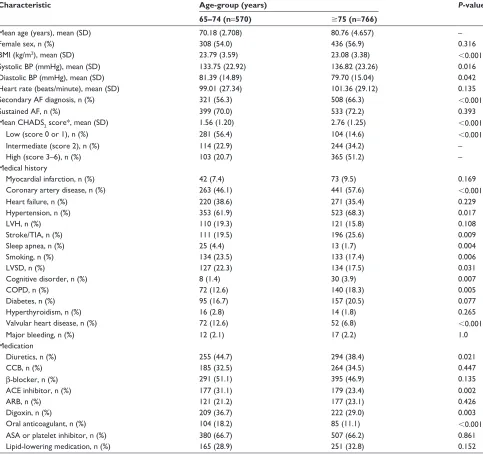
Patient demographics, past medical history, and medi-cation during the ED visit of the two groups are shown in Table 1. At enrollment, more patients presented to EDs with AF as a secondary diagnosis in the 75-year group. Com-pared with the 65- to 74-year group, the older group had a lower BMI and diastolic BP but a higher systolic BP. The mean CHADS2 score was 1.2-fold higher in the 75-year group than in the 65- to 74-year group. Coronary artery disease, hypertension, previous stroke/transient ischemic attack, cognitive disorder, and chronic obstructive pulmonary disease (COPD) were more represented in the older group, while sleep apnea, smoking, history of left ventricular systolic dysfunction, and valvular heart disease were more prevalent in the 65- to 74-year group.
During hospitalization, diuretics, ACE inhibitors, digoxin, and oral anticoagulants were all given significantly more often in patients aged 65–74 years. Warfarin prescrip-tion by CHADS2-score stratification between groups is shown in Figure 2. There was no difference between the groups with regard to angiotensin II-receptor blockers, β-blockers,
2,016 patients with AF identified in the registry
2,015 patients with complete data
1,336 patients analyzed in the present study (age ≥65 years)
679 excluded (age <65 years)
570 patients (65–74 years)
8 lost to follow-up
570 analyzed 766 analyzed
9 lost to follow-up 766 patients (age ≥75 years)
1 excluded
Figure 1 Trial profile.
Abbreviation: AF,atrial fibrillation.
Clinical Interventions in Aging downloaded from https://www.dovepress.com/ by 118.70.13.36 on 20-Aug-2020
Dovepress
shao et al
calcium-channel blockers, antiplatelet inhibitors, or lipid-lowering medication (Table 1).
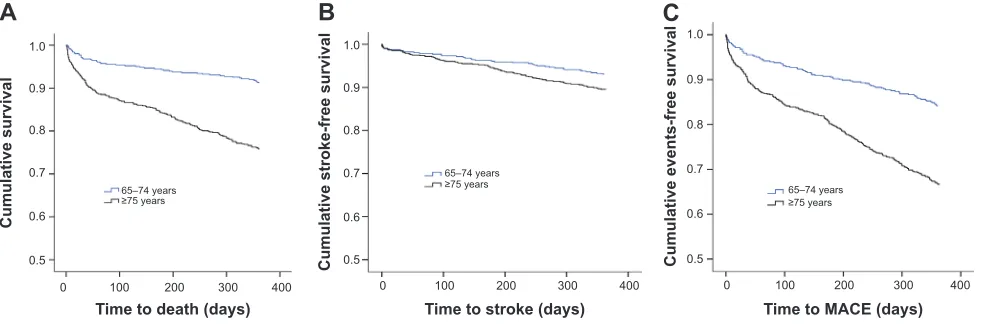
We had 1 year’s follow-up data available for 98.8% (n=1,992) of the baseline population, including 562 in the 65- to 74-year age-group and 757 in the 75-year age-group (Figure 1). Table 2 shows the major end-point events. In time-to-first-event analyses, there were 342 MACEs during the follow-up period, of which all-cause mortality represented 233 cases. The older group had a 1.4-fold increased unadjusted risk of MACEs than the 65- to 74-year group,
which persisted after adjusting for differences in baseline characteristics. As with MACEs, the unadjusted risk of all-cause mortality was 2.1-fold increased in the 75-year group than in the 65- to 74-year group, remaining significant after adjusting for baseline covariates. Of note, the unadjusted risk of stroke alone was 0.55-fold higher in the 75-year group than in 65- to 74-year group, whereas the differences were not significant after adjustment for confounders. There was a trend for higher risk of non-CNS systemic embolism and lower risk of major bleeding in the older group than
Table 1 Baseline characteristics by age-group
Characteristic Age-group (years) P-value
65–74 (n=570) 75 (n=766)
Mean age (years), mean (sD) 70.18 (2.708) 80.76 (4.657) –
Female sex, n (%) 308 (54.0) 436 (56.9) 0.316
BMI (kg/m2), mean (sD) 23.79 (3.59) 23.08 (3.38) 0.001
systolic BP (mmhg), mean (sD) 133.75 (22.92) 136.82 (23.26) 0.016
Diastolic BP (mmhg), mean (sD) 81.39 (14.89) 79.70 (15.04) 0.042
heart rate (beats/minute), mean (sD) 99.01 (27.34) 101.36 (29.12) 0.135
secondary AF diagnosis, n (%) 321 (56.3) 508 (66.3) 0.001
sustained AF, n (%) 399 (70.0) 533 (72.2) 0.393
Mean ChADs2 score*, mean (sD) 1.56 (1.20) 2.76 (1.25) 0.001
low (score 0 or 1), n (%) 281 (56.4) 104 (14.6) 0.001
Intermediate (score 2), n (%) 114 (22.9) 244 (34.2) –
high (score 3–6), n (%) 103 (20.7) 365 (51.2) –
Medical history
Myocardial infarction, n (%) 42 (7.4) 73 (9.5) 0.169
Coronary artery disease, n (%) 263 (46.1) 441 (57.6) 0.001
heart failure, n (%) 220 (38.6) 271 (35.4) 0.229
hypertension, n (%) 353 (61.9) 523 (68.3) 0.017
lVh, n (%) 110 (19.3) 121 (15.8) 0.108
stroke/TIA, n (%) 111 (19.5) 196 (25.6) 0.009
sleep apnea, n (%) 25 (4.4) 13 (1.7) 0.004
smoking, n (%) 134 (23.5) 133 (17.4) 0.006
lVsD, n (%) 127 (22.3) 134 (17.5) 0.031
Cognitive disorder, n (%) 8 (1.4) 30 (3.9) 0.007
COPD, n (%) 72 (12.6) 140 (18.3) 0.005
Diabetes, n (%) 95 (16.7) 157 (20.5) 0.077
hyperthyroidism, n (%) 16 (2.8) 14 (1.8) 0.265
Valvular heart disease, n (%) 72 (12.6) 52 (6.8) 0.001
Major bleeding, n (%) 12 (2.1) 17 (2.2) 1.0
Medication
Diuretics, n (%) 255 (44.7) 294 (38.4) 0.021
CCB, n (%) 185 (32.5) 264 (34.5) 0.447
β-blocker, n (%) 291 (51.1) 395 (46.9) 0.135
ACe inhibitor, n (%) 177 (31.1) 179 (23.4) 0.002
ArB, n (%) 121 (21.2) 177 (23.1) 0.426
Digoxin, n (%) 209 (36.7) 222 (29.0) 0.003
Oral anticoagulant, n (%) 104 (18.2) 85 (11.1) 0.001
AsA or platelet inhibitor, n (%) 380 (66.7) 507 (66.2) 0.861
lipid-lowering medication, n (%) 165 (28.9) 251 (32.8) 0.152
Notes: Data are expressed as n (%) or mean (standard deviation [SD]). *Data excluded those with valvular heart disease. For the risk-stratification scheme for atrial fibrilla-tion, a score of 0–6 was derived based on the following factors: congestive heart failure (1 point), hypertension (1 point), age 75 years (1 point), diabetes mellitus (1 point), and previous stroke or TIA (2 points).
Abbreviations: BMI, body mass index; BP, blood pressure; AF, atrial fibrillation; CHADS, congestive heart failure, hypertension, age 75 years, diabetes, stroke; lVh, left ventricular hypertrophy; TIA, transient ischemic attack; lVsD, left ventricular systolic dysfunction; COPD, chronic obstructive pulmonary disease; CCB, calcium-channel blocker; ACe, angiotensin-converting enzyme; ArB, angiotensin II-receptor blocker; AsA, acetylsalicylic acid (aspirin).
Clinical Interventions in Aging downloaded from https://www.dovepress.com/ by 118.70.13.36 on 20-Aug-2020
Dovepress AF features and outcomes in elderly
in the 65- to 74-year group, which did not reach statistical significance. Kaplan–Meier cumulative hazard curves of the events are shown in Figure 3.
In age-stratified multivariable Cox analyses, we identified the predictors for all-cause mortality and MACEs in both groups (Table 3). In the 65- to 74-year group, use of digoxin was an independent risk factor of all-cause mortality. In the 75-year group, patients with AF as a secondary diagnosis and a history of COPD were significantly associated with a higher mortality rate. Also, secondary AF diagnosis, a his-tory of COPD, and left ventricular systolic dysfunction were independent predictors of MACEs in the older group. To gain further insights into the hazard ratios for the events, we tested for interactions between age and the baseline variables. For all-cause death, interactions between age-group and sex and between age-group and use of digoxin were statistically significant.
Discussion
To the best of our knowledge, this is the first study to directly compare the clinical profile and long-term outcomes between patients aged 65–74 years and 75 years with AF. The
present analysis indicated that patients aged 75 years had a worse prognosis compared with the 65- to 74-year group, regardless of the risk profile and medication. Patients aged 75 years with AF as a secondary diagnosis were indepen-dently associated with higher risk of MACEs.
In multivariable Cox analysis, we observed a 1.2-fold higher risk for MACEs in the older group, which suggested that being aged 75 years was an independent predictor for major adverse events compared with the 65- to 74-year group. As is known, the 2012 focused update of the ESC guideline strongly recommended the CHA2DS2-VASc score, which assigns 1 point for age 65–74 years and 2 points for age 75 years, to complement the traditional CHADS2-score risk factors for stroke prevention in AF patients.13 That means
that patients aged 75 years have a higher risk of suffering a stroke than the 65- to 74-year group. Here, our results extend the concept to MACEs. Although the risk of stroke did not reach statistical significance after adjustment for baseline characteristics in the present study (10.6% versus 6.9%, unadjusted hazard ratio 1.553 [95% confidence interval 1.059−2.278], adjusted hazard ratio 1.557 [95% confidence interval 0.980−2.474]), we conjecture small sample size and the combination analysis of ischemic stroke and hemorrhagic stroke might be possible reasons.
Our study demonstrated a notable age-related difference in baseline variables in patients aged 65 years. More than a decade ago, the analysis from the Framingham study illustrated that diastolic pressure tends to decline as systolic pressure levels off at older ages.14 We confirmed this in the
present study. In our population, the older group were more likely to have coronary artery disease, hypertension, previ-ous stroke, cognitive disorder, or COPD, and the 65- to 74-year group were more likely to have valvular heart dis-ease, left ventricular systolic dysfunction, or sleep apnea. Also, compared with the 65- to 74-year group, the older patients were less probably being prescribed with drugs, such as ACE inhibitors, diuretics, digoxin, and warfarin. These factors might partly explain the difference in prog-nosis between the groups in terms of more comorbidities
Low
Intermediate
High 0
2% 4% 6% 8% 10% 12% 14% 16% 18%
65–74 years ≥75 years
Figure 2 Anticoagulation rate by ChADs2-score stratification in 65- to 74-year-old (blue) and 75-year-old (red) groups.
Abbreviation: ChADs,congestive heart failure, hypertension, age 75 years, diabetes, stroke.
Table 2 Major outcomes during follow-up
Outcomes Age-group (years) P-value Univariate analysis P-value Multivariate analysis P-value
65–74 (n=562), n (%)
75 (n=757), n (%)
HR (95% CI) HR (95% CI)
All-cause mortality 49 (8.7) 184 (24.3) 0.001 3.052 (2.227–4.183) 0.001 2.881 (1.981–4.189) 0.001
stroke 39 (6.9) 80 (10.6) 0.027 1.553 (1.059–2.278) 0.024 1.557 (0.980–2.474) 0.061
non-Cns systemic embolism 2 (0.4) 9 (1.2) 0.130 3.373 (0.725–15.674) 0.121 2.766 (0.426–17.983) 0.287
Major bleeding 7 (1.2) 5 (0.7) 0.380 0.528 (0.167–1.672) 0.277 0.492 (0.101–2.403) 0.381
MACe 89 (15.8) 253 (33.5) 0.001 2.363 (1.856–3.009) 0.001 2.202 (1.646–2.945) 0.001
Abbreviations: HR, hazard ratio; CI, confidence interval; CNS, central nervous system; MACE, major adverse cardiac event.
Clinical Interventions in Aging downloaded from https://www.dovepress.com/ by 118.70.13.36 on 20-Aug-2020
Dovepress
shao et al
with less medication. It is worth mentioning that although we presented a 1.2-point higher mean CHADS2 score in the older group, the effective difference in the CHADS2 score was 0.2 points, since age 75 years gave 1 point to the older patients.
The anticoagulation rate in the present study was 18.2% in the 65- to 74-year group and 11.1% in the 75-year group (P0.001). Moreover, in the older group, the proportion of warfarin prescription decreased as the CHADS2 score increased (Figure 2). Despite its benefits, the underuse of warfarin is quite common for the elderly.15
In a single US institution, warfarin was prescribed at discharge to 75% of those aged 65–69 years, 59% of those aged 70–79 years, 45% of those aged 80–89 years, and 24% of those aged
90 years.6 For geriatric patients with AF, treatment with
anticoagulation agents is a great challenge, because the older patients that will probably benefit most from anticoagulation therapy are also at the highest risk of bleeding complication.16
Guo et al declared that patients aged 90 years were five times more likely to develop diseases with risks of both hemorrhage and thromboembolism compared with those aged 80 years.17 In
clinical practice, this confusion might have an impact on deci-sion making regarding antithrombotic therapy, and currently less than one-third of elderly receive warfarin.18 Nonetheless,
recent large trials have proven that novel oral anticoagulants have a greater net clinical benefit than warfarin, including in subgroups of older patients.19–21 We expect a promising
application of novel oral anticoagulants for elderly patients, and also prospective, randomized, controlled trials of newer agents in the elderly population with AF are needed.
In this study, we found that secondary AF diagnosis and a history of COPD were independent risk factors for
B
A
1.0
0.9
0.8
0.7
0.6
0.5
1.0
0.9
0.8
0.7
0.6
0.5
1.0
0.9
0.8
0.7
0.6
0.5
0 100 200 300 400 0 100 200 300 400 0 100 200 300 400
C
Cumulative surviva
l
Cumulative events-free survival
Cumulative stroke-free survival
Time to death (days) Time to stroke (days) Time to MACE (days)
65–74 years
≥75 years 65–74 years
≥75 years ≥75 years
65–74 years
Figure 3 Kaplan–Meier plots of time to events.
Notes: (A) All-cause death (log-rank P0.001); (B) stroke (log-rank P=0.023); (C) major adverse cardiac event (MACe; log-rank P0.001).
all-cause death and MACEs in the 75-year group, rather than in the 65- to 74-year group. It is suggested that con-comitant diseases, especially COPD, were independently associated with adverse clinical events in older individu-als. COPD is common in the elderly, particularly those aged 75 years.22 Pathological changes in patients with
COPD may lead to a high relative risk for occurrence or development of AF.23 The frequent coexistence of AF and
COPD in the elderly may complicate the treatment of both conditions, exacerbate the diseases, and ultimately jeopar-dize health outcomes, resulting in a heavy economic burden. Based on these considerations, we put forward the recom-mendation that management of the underlying COPD exac-erbation should take priority in older patients with AF.
The limitation of our study was that it was a hospital-based study, which might not reflect the status of the general community. Moreover, subjects in the present analysis were derived from the Chinese AF registry. Due to the nature of an observational study, there may exist selection bias. However, we encouraged all participating centers to recruit consecutive patients so as to minimize the bias. Finally, we had no echocardiography data on admission, and this might have had an influence on dis-tinguishing the relationship between cardiac function and major end-point events.
Conclusion
In geriatric patients with AF, there were apparent differences between the 65- to 74-year group and the 75-year group. Patients aged 75 years had a worse prognosis than the 65- to 74-year group and were associated with higher risks of both death and MACEs.
Clinical Interventions in Aging downloaded from https://www.dovepress.com/ by 118.70.13.36 on 20-Aug-2020
Dovepress AF features and outcomes in elderly
Table 3
Independent predictors of all-cause mortality and MAC
es by subgroup
Variable
All cause mortality
P
-value interaction
MACEs
P
-value interaction
HR (95% CI);
P
-value
HR (95% CI);
P -value 65–74 years 75 years 65–74 years 75 years Female sex
0.479 (0.248–0.924); 0.028
1.012 (0.736–1.392); 0.942
0.031
0.832 (0.518–1.337); 0.448
1.206 (0.915–1.590); 0.184
0.165
secondary AF diagnosis
1.588 (0.814–3.094); 0.175
1.768 (1.229–2.543); 0.002
0.814
1.444 (0.901–2.315); 0.127
1.394 (1.043–1.862); 0.025
0.687
MI
1.968 (0.645–6.003); 0.234
0.784 (0.443–1.390); 0.406
0.143
1.217 (0.506–2.927); 0.661
0.808 (0.504–1.296); 0.377
0.486
CAD
1.093 (0.551–2.169); 0.799
0.815 (0.568–1.168); 0.265
0.565
1.020 (0.624–1.668); 0.936
0.908 (0.667–1.235); 0.538
0.878
h
F
1.950 (0.771–4.930); 0.158
1.173 (0.736–1.876); 0.502
0.097
1.308 (0.656–2.608); 0.446
1.055 (0.708–1.570); 0.794
0.486
h
ypertension
0.753 (0.330–1.718); 0.500
1.235 (0.817–1.868); 0.316
0.447
0.814 (0.417–1.591); 0.547
1.348 (0.947–1.917); 0.097
0.303
lV
h
0.900 (0.416–1.947); 0.789
0.726 (0.459–1.146); 0.169
0.363
0.791 (0.441–1.418); 0.431
0.737 (0.499–1.090); 0.126
0.397
stroke/TIA
1.311 (0.360–4.778); 0.682
1.474 (0.934–2.328); 0.096
0.454
1.750 (0.680–4.505); 0.246
1.401 (0.951–2.066); 0.088
0.388
smoking
0.903 (0.450–1.811); 0.774
0.820 (0.537–1.252); 0.358
0.327
0.926 (0.535–1.603); 0.784
1.097 (0.769–1.563); 0.609
0.864
lV
sD
0.822 (0.388–1.741); 0.609
1.494 (0.954–2.339); 0.079
0.820
1.347 (0.757–2.395); 0.311
1.556 (1.055–2.295); 0.026
0.561
COPD
0.928 (0.401–2.148); 0.862
1.932
(1.377–2.712);
0.001
0.208
0.907 (0.470–1.750); 0.770
1.467 (1.081–1.990); 0.014
0.262
Diabetes
0.802 (0.311–2.069); 0.649
1.285 (0.864–1.911); 0.216
0.425
0.754 (0.379–1.499); 0.420
1.138 (0.809–1.600); 0.458
0.194
h
yperthyroidism
1.403 (0.181–10.900); 0.746
1.782 (0.644–4.929); 0.266
0.611
0.483 (0.065–3.581); 0.477
2.095 (0.966–4.546); 0.061
0.150
Valvular heart disease
0.924 (0.391–2.185); 0.857
1.142 (0.620–2.105); 0.670
0.536
0.904 (0.463–1.764); 0.767
1.077 (0.624–1.859); 0.791
0.724
Major bleeding
0.563 (0.067–4.746); 0.598
0.862 (0.348–2.136); 0.749
0.956
0.942 (0.218–4.077); 0.936
1.273 (0.618–2.622); 0.513
0.833
Digoxin
2.131 (1.066–4.262); 0.032
0.984 (0.675–1.435); 0.933
0.026
1.481 (0.876–2.501); 0.142
1.003 (0.724–1.390); 0.986
0.157 Abbreviations: MACEs, major adverse cardiac events; HR, hazard ratio; CI, confidence interval; AF, atrial fibrillation; MI, myocardial infarction; CAD, coronary artery disease ; HF, heart failure; LVH, left ventricular hypertrophy;
TIA, transient ischemic attack;
lV
sD, left ventricular systolic dysfunction; COPD, chronic obstructive pulmonary disease.
Clinical Interventions in Aging downloaded from https://www.dovepress.com/ by 118.70.13.36 on 20-Aug-2020
Clinical Interventions in Aging
Publish your work in this journal
Submit your manuscript here: http://www.dovepress.com/clinical-interventions-in-aging-journal
Dovepress
Clinical Interventions in Aging is an international, peer-reviewed journal focusing on evidence-based reports on the value or lack thereof of treatments intended to prevent or delay the onset of maladaptive correlates of aging in human beings. This journal is indexed on PubMed Central, MedLine,
CAS, Scopus and the Elsevier Bibliographic databases. The manuscript management system is completely online and includes a very quick and fair peer-review system, which is all easy to use. Visit http://www.dovepress. com/testimonials.php to read real quotes from published authors.
Dovepress
shao et al
Participating investigators
Jun Zhu (Beijing), Yan-Min Yang (Beijing), Chun-Sheng Li (Beijing), Xiao-Juan Bai (Shenyang), Fang Zhang (Qingdao), Jun-Xia Li (Shijiazhuang), Yi-Ming Lu (Shanghai), Han-Sheng Tang (Wuhan), Ji-Yuan Han (Wuhan), Qing He (Chengdu), Hong-Ke Zeng (Guangzhou), Jian-Hua Lu (Guangzhou), Shu-Qing Wang (Qiqihaer), Li Zhao (Beijing), Hua Zhang (Qingdao), Peng-Fei Yu (Pingdu), Xiao-Ping Hui (Shanghai), Shi-Ping Liu (Nanchong), Xi-Zhou Zhang (Yibin), Xiao-Dan Gu (Chengdu), Zhao-Xia Zan (Langfang).
Acknowledgment
This study was supported by a grant from Boehringer Ingelheim.
Disclosure
The authors report no conflicts of interest in this work.
References
1. Lip GY, Tse HF, Lane DA. Atrial fibrillation. Lancet. 2012;379(9816): 648–661.
2. Go AS, Hylek EM, Phillips KA, et al. Prevalence of diagnosed atrial fibrillation in adults: national implications for rhythm management and stroke prevention: the AnTicoagulation and Risk Factors in Atrial Fibrillation (ATRIA) Study. JAMA: the journal of the American Medical Association. 2001;285(18):2370–2375.
3. Kazemian P, Oudit G, Jugdutt BI. Atrial fibrillation and heart failure in the elderly. Heart Fail Rev. 2012;17(4–5):597–613.
4. Lip GY. Using the CHA(2)DS(2)-VASc score for stroke risk stratification in atrial fibrillation: a clinical perspective. Exp Rev Cardiovasc Ther. 2013;11(3):259–262.
5. Kirchhof P, Lip GY, Van Gelder IC, et al. Comprehensive risk reduction in patients with atrial fibrillation: emerging diagnostic and therapeutic options. Executive summary of the report from the 3rd AFNET/EHRA consensus conference. Thromb Haemost. 2011;106(6):1012–1019. 6. Hylek EM, D’Antonio J, Evans-Molina C, Shea C, Henault LE, Regan S.
Translating the results of randomized trials into clinical practice: the challenge of warfarin candidacy among hospitalized elderly patients with atrial fibrillation. Stroke. 2006;37(4):1075–1080.
7. Mant J, Hobbs FD, Fletcher K, et al. Warfarin versus aspirin for stroke prevention in an elderly community population with atrial fibrillation (the Birmingham Atrial Fibrillation Treatment of the Aged Study, BAFTA): a randomised controlled trial. Lancet. 2007;370(9586):493–503.
8. Miyasaka Y, Barnes ME, Gersh BJ, et al. Secular trends in incidence of atrial fibrillation in Olmsted County, Minnesota, 1980 to 2000, and implications on the projections for future prevalence. Circulation. 2006; 114(2):119–125.
9. Camm AJ, Kirchhof P, Lip GY, et al. Guidelines for the management of atrial fibrillation: the Task Force for the Management of Atrial Fibrillation of the European Society of Cardiology (ESC). Eur Heart J. 2010;31(19):2369–2429.
10. Lip GY, Lim HS. Atrial fibrillation and stroke prevention. Lancet Neurol. 2007;6(11):981–993.
11. Van Staa TP, Setakis E, Di Tanna GL, Lane DA, Lip GY. A compari-son of risk stratification schemes for stroke in 79,884 atrial fibrillation patients in general practice. J Thromb Haemost. 2011;9(1):39–48. 12. Friberg L, Rosenqvist M, Lip GY. Evaluation of risk stratification
schemes for ischaemic stroke and bleeding in 182,678 patients with atrial fibrillation: the Swedish Atrial Fibrillation cohort study. Eur Heart J. 2012;33(12):1500–1510.
13. Camm AJ, Lip GY, De Caterina R, et al. 2012 Focused update of the ESC Guidelines for the management of atrial fibrillation: an update of the 2010 ESC Guidelines for the management of atrial fibrillation. Developed with the special contribution of the European Heart Rhythm Association. Eur Heart J. 2012;33(21):2719–2747.
14. Wolf PA, D’Agostino RB, Belanger AJ, Kannel WB. Probability of stroke: a risk profile from the Framingham Study. Stroke. 1991;22(3):312–318. 15. Gallagher AM, Rietbrock S, Plumb J, van Staa TP. Initiation and persis-tence of warfarin or aspirin in patients with chronic atrial fibrillation in general practice: do the appropriate patients receive stroke prophylaxis?
J Thromb Haemost. 2008;6(9):1500–1506.
16. Nantsupawat T, Nugent K, Phrommintikul A. Atrial fibrillation in the elderly. Drugs Aging. 2013;30(8):593–601.
17. Guo Y, Wu Q, Zhang L, et al. Antithrombotic therapy in very elderly patients with atrial fibrillation: is it enough to assess thromboembolic risk? Clin Interv Aging. 2010;5:157–162.
18. Quilliam BJ, Lapane KL. Clinical correlates and drug treatment of resi-dents with stroke in long-term care. Stroke. 2001;32(6):1385–1393. 19. Granger CB, Alexander JH, McMurray JJ, et al. Apixaban versus warfarin in
patients with atrial fibrillation. N Engl J Med. 2011;365(11):981–992. 20. Patel MR, Mahaffey KW, Garg J, et al. Rivaroxaban versus warfarin in
nonvalvular atrial fibrillation. N Engl J Med. 2011;365(10):883–891. 21. Eikelboom JW, Wallentin L, Connolly SJ, et al. Risk of bleeding with
2 doses of dabigatran compared with warfarin in older and younger patients with atrial fibrillation: an analysis of the randomized evaluation of long-term anticoagulant therapy (RE-LY) trial. Circulation. 2011; 123(21):2363–2372.
22. Bourbeau J, Bartlett SJ. Patient adherence in COPD. Thorax. 2008; 63(9):831–838.
23. Lopez CM, House-Fancher MA. Management of atrial fibrillation in patients with chronic obstructive pulmonary disease. J Cardiovasc Nurs. 2005;20(2):133–140.
Clinical Interventions in Aging downloaded from https://www.dovepress.com/ by 118.70.13.36 on 20-Aug-2020