Experimental Study on Effect of Cutting Parameters on
Chip-Tool Interface Temperature and Chip Formation in Turning
EN-31 Hardened Steel Under Flooded and MQL Conditions
Arif Pathan1, Dr.M.S.Kadam 2 1
M.E.Student, Mechanical.Engg.Dept, MGM’s J.N.E.C, Aurangabad - 431003 Maharashtra, India
2
Professor & Head, Mechanical.Engg.Dept, MGM’s J.N.E.C, Aurangabad -431003 Maharashtra, India
Abstract
Hard turning is mainly used in industries to increase dimensional
accuracy and surface finish so as to fulfill functional requirement of the product. In Hard turning cutting velocity (Vc) is high due to which high amount of heat is generated at the chip-tool interface which not only increase the tool wear and deteriorates the job quality but also has an effect on chips formation as chip formation indirectly indicate the rate of heat transfer under the influenced of machining environment. Therefore large amount of cutting fluid (flooded lubrication) is used to increase the performance of hard turning operation due to which it becomes easier to keep tight tolerances but on the other hand use of cutting fluid has become more problematic in terms of cost, disposal, wastage and environmental pollution. Minimum quantity lubrication (MQL) is a good alternative to this flooded lubrication. This study compares performance of MQL with flooded lubrication in turning EN-31 by using Response Surface Methodology (RSM). ANOVA was used to find out the significant parameters. The results indicated that when range of cutting parameters (cutting velocity, feed & D.O.C) was low to medium turning with MQL provides some favorable chips but with increase in Vc MQL totally fails to provide better results both in terms of favorable chips formation and reduction in chip-tool interface temperature (θ
i) as compared to flooded
lubrication, thereby restricting the application of MQL to a certain range of parameter only.
Keywords: Hard turning, MQL, chip-tool interface temperature
(θ
i), chip formation, RSM
1.
Introduction
Turning is the most widely used machining process in industries. Industries mainly focus on the achievement of high quality turned parts in terms of surface finish, production rate, less wear on the cutting tools , economy in machining based on cutting fluids and favorable chip formation (chip shape, color and thickness) as it indirectly indicate the nature of chip-tool interaction which is helpful for determining the sources of increase in temperature, Hard turning is mainly used to increase surface finish and production rate but in hard turning large amount of heat is
generated at the chip-tool interface mainly due to increase in cutting velocity therefore it becomes necessary to use cutting fluids to remove the heat generated thereby
maintaining the economy of cutting tools but effecting the
economy of coolant as very large amount of coolant is required i.e. coolant flow rate (flooded) for hard turning is generally 5 to 10 L/min depending upon cutting speed. Minimum quantity lubrication (MQL) is an established alternative to the traditional flood cooling as it come over the negative side of flood cooling. MQL also known as near dry machining (NDM), refers to the use of cutting fluids of very small amount typically of a flow rate of 50 to 500 ml/hour which is very less than the amount commonly used in flood cooling condition .The MQL technique consists of a mixture of drops of cutting fluids (neat oils or emulsions) in a flow of compressed air, generating a “spray” called as aerosols (mists) which is impinged with high velocity on the cutting zone through the nozzle. The Manner of lubricant supply is as important as total amount of lubricant supplied. That means the amount which actually reaches in the chip-tool interface as maximum heat is generated at chip –tool interface.
2. Literature Review
Prianka B. Zaman and N. R. Dhar [1] studied the effects of MQL on different machinability characteristics (cutting temperature, chip thickness ratio, tool wear and machined surface quality) of hard turned parts by using different cutting fluids (soluble oil, vegetable oil and VG 68 cutting oil), as compared to complete dry machining. The thickness of the chips was repeatedly measured by a slide caliper. The results indicated that the use of MQL with VG 68 cutting oil performed better in comparison to other cutting fluids and dry environment in respect of chips thickness ratio, cutting temperature, tool wear, surface roughness and dimensional deviation.
steel having hardness 245BHN at industrial speed-feed combinations. Results include significant reduction in tool wear rate, surface roughness by MQL mainly through reduction in the cutting zone temperature.
Panda.A et al. [3] has done study on hard turning of EN 31 steel (55HRC) under varying process parameters such as cutting speed, feed and depth of cut with respect to surface roughness using TiN/TiCN/Al2O3 multilayer coated
carbide inserts through Taguchi L16 orthogonal array design by investigating Ra under dry environment. Machining time was fixed as 3 minute for each run. The surface quality appered better with increase in cutting velocity and with low feed rate, where as an increase in feed deteriorated surafce finish noted as detrimental factor from ANOVA study.
Prasanna P Kulkarni et al. [4] has performed experiments to determine the effect of cutting fluids and cutting parameters on chip formation mode and cycle time in turning of EN-24 and EN-31 material under dry & flooded condition. Based on the results of experimental investigation in wet condition Chip thickness is decreased at 210rpm to 450 rpm range as compared to dry with bright color (Golden color and light blue color) with smooth surface due to reduction in temperature for both materials.
3. Experimental Condition and Procedure
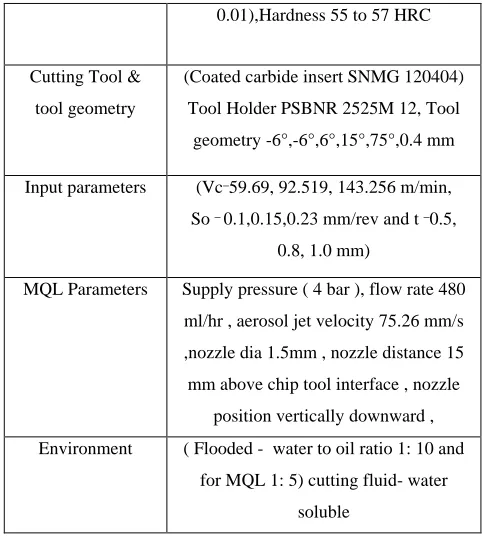
Experiments were carried out by plain turning of 38mm diameter and 75mm long rod of EN-31steel using a powerful and rigid semi-automatic geared lathe (Pioneer 250-PL, Rajkot, India) and new cutting edge for each run at different cutting velocities (Vc) and feed rates (So) and D.o.C (t) combination each at three different levels using Response Surface Methodology to study the effect of cutting parameters on chip-tool interface temperature and favorable chip formation under flooded and MQL conditions. The experimental condition is given in table.1 and output response with DOE is given in table.2. External MQL set up was designed in such a way that a mist is produced having a flow rate of 480 ml/hr. at a pressure of 4 bar impinged at cutting zone so that the aerosol or mist (air + coolant) reaches as close to the chip-tool and the work-tool interfaces as possible. The photographic view of the MQL set-up is shown in Fig.1.a,b & c.
Table: 1 Experimental Condition
Particulars Description
Material EN31(C:1.02 Si:0.26 Mg:0.42 Cr:1.25 Ni:0.14 Mo:0.025 S:0.022 P:
0.01),Hardness 55 to 57 HRC
Cutting Tool & tool geometry
(Coated carbide insert SNMG 120404) Tool Holder PSBNR 2525M 12, Tool
geometry -6°,-6°,6°,15°,75°,0.4 mm
Input parameters (Vc_59.69, 92.519, 143.256 m/min, So _ 0.1,0.15,0.23 mm/rev and t _0.5,
0.8, 1.0 mm)
MQL Parameters Supply pressure ( 4 bar ), flow rate 480 ml/hr , aerosol jet velocity 75.26 mm/s ,nozzle dia 1.5mm , nozzle distance 15 mm above chip tool interface , nozzle
position vertically downward , Environment ( Flooded - water to oil ratio 1: 10 and
for MQL 1: 5) cutting fluid- water soluble
The figure clearly show the basic parts of the MQL set up. The set up of MQL is based on External supply i.e. coolant and compressed air is flown separately, firstly flow control valve is open due to which the stored coolant in the sump will flow vertically downward (passing from inner pipe ) up to coolant pipe, at the end of coolant pipe the inner pipe is extended and nozzle is attached so as to increase the velocity and then compressed air is blown (passing from outer pipe) up to coolant pipe at the end compressed air will transmits its energy to the coolant/liquid jet and the jet will break into mist or aerosol ( air + coolant).This aerosol is then supplied at the cutting zone.
Table 2: Design of Experiments with Observed Response i.e. machining time (Tm) & Avg Chip-tool interface temperature (θ
i
) under flooded and
MQL Conditions.
Exp.
Run (m/min) Vc (mm/rev) So (mm) t
θ
if ( ₒC )
θ
im ( ₒC )
13 92.519 0.15 0.5 63.7 81.4 14 92.519 0.15 1.0 71.5 116.3 15 92.519 0.15 0.8 68.4 102.5 16 92.519 0.15 0.8 68.6 102.7 17 92.519 0.15 0.8 68.8 102.9 18 92.519 0.15 0.8 64.5 101.8 19 92.519 0.15 0.8 64.8 102.1 20 92.519 0.15 0.8 64.7 103.2
.
Fig.1.a: Photographic view of External MQL Set- up
Fig.1.b: Photographic view of Co-Axial pipe
Fig. 1.c: MQL Nozzle supplying mist
4. Study of chip formation (chip shape, size
and color) under Flooded and MQL system.
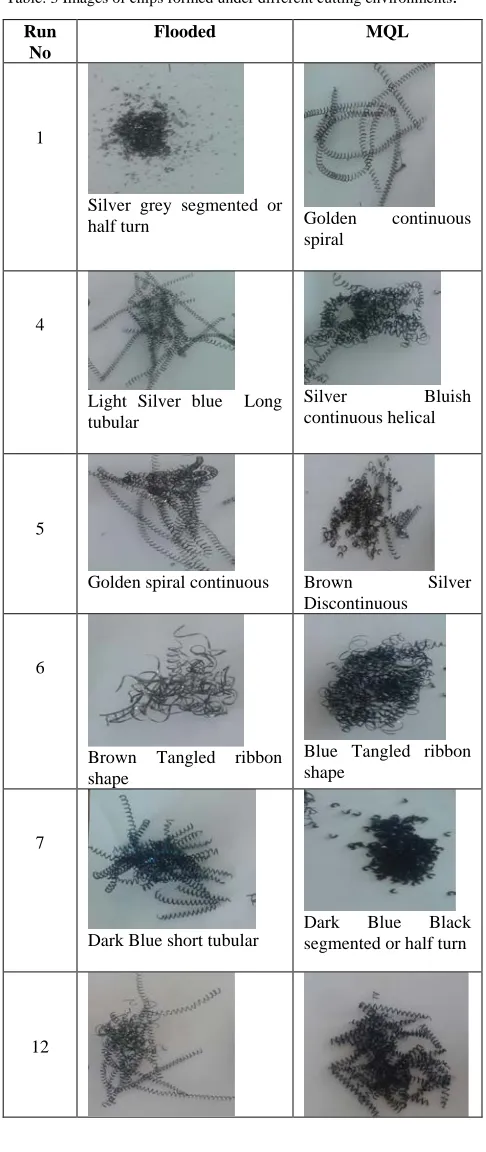
The chip color, thickness, shape, size etc. directly and indirectly indicate the nature of chip-tool interaction influenced by the machining environment. The chip samples were collected during each experimental run. .
Table: 3 Images of chips formed under different cutting environments.
Run No
Flooded MQL
1
Silver grey segmented or
half turn Golden continuous spiral
4
Light Silver blue Long tubular
Silver Bluish continuous helical
5
Golden spiral continuous Brown Silver Discontinuous
6
Brown Tangled ribbon shape
Blue Tangled ribbon shape
7
Dark Blue short tubular
Dark Blue Black segmented or half turn
12
Flow Control Valve
Sump/ Reservoir
with marking
T-Joint
Coolant pipe with nozzle
Co-Axial pipe (Inner- oil &
Silver Blue continuous Dark Blue discontinuous
14
Brown Short helical Blue Long spiral
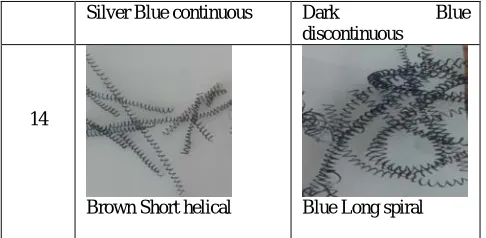
It was found from visual inspection that mostly discontinuous chips, ribbon type chips, tubular chips and spiral chips were obtained during machining of EN31 with SNMG120404 insert under flooded and MQL conditions. EN31steel when machined under wet condition produced ribbon type continuous chips with more curl at medium to higher Vc (92.519 m/min to 143.256 m/min) and at low to medium feed rate (0.1 to 0.15 mm/rev) similarly under MQL at medium to higher Vc(92.519 m/min to 143.256 m/min) and at low feed rate (0.1 to 0.15 mm/rev) ribbon type continuous chips were obtained at some runs (Run No.6 ). The observations further showed that more discontinuous chips were obtained at Low Vc(59.69 m/min) when machining under flooded condition as compared to MQL and more discontinuous chips were obtained at medium Vc (92.519 m/min) when machined under MQL with more chip thickness as compared to flood cooling. Similarly more spiral shape chips were obtained under MQL as compared to flood cooling at low Vc.Also more continuous chips were produced while machining under MQL as compared to flooded condition at high Vc. When machined with MQL the shape of chips did change much as compared to flooded but their surface appeared darker then that appeared under flooded lubrication this indicates that the amount of reduction of temperature in case of flooded enabled favorable chip–tool interaction, where as chips formed under application of MQL shows that in most of the cases they are not favorable but at some runs favorable chips were obtained i.e. at low to medium cutting speed and feed range bright color chips were obtained.
5. Result and Discussion
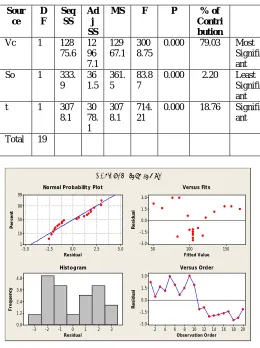
The Analysis of variance (ANOVA) is a necessary test which is performed in most of the optimization process due to its accuracy in prediction of P-values. If the p-value is lower than 0.05 then the factor is significant.
5.1 Adequacy and ANOVA of the Model for θ
if :
The analysis was done using uncoded units Avg Chip-tool interface Temperature (θ
if) = - 8.9431 + 0.5307Vc
+89.2051 So + 17.3859 t
Table 4: Coefficient Table for Temperature (θ
if
)
Term Coef SE Coef T P Constant -8.9431 2.59751 -3.443 0.003 Vc 0.5307 0.01337 39.684 0.000 So 89.2051 8.58178 10.395 0.000 t 17.3859 2.23844 7.767 0.000 S = 1.78695 PRESS= 73.9170
R-Sq = 99.09% R-Sq(pred) = 98.69% R-Sq(adj) = 98.92%
Table 5: ANOVA Table
4 2 0 -2 -4 99 90 50 10 1 Residual Pe rc en t 100 80 60 40 3.0 1.5 0.0 -1.5 -3.0 Fitted Value Re si du al 3 2 1 0 -1 -2 -3 8 6 4 2 0 Residual Fr eq ue nc y 20 18 16 14 12 10 8 6 4 2 3.0 1.5 0.0 -1.5 -3.0 Observation Order Re si du al
Normal Probability Plot Versus Fits
Histogram Versus Order
Residual Plots for θi
Graph 1: Residual Plot for Avg Chip-tool interface Temperature (θ
if
)
under flooded condition.
5.2 Adequacy and ANOVA of the Model for θi
m The analysis was done using uncoded units
So ur ce
DF Seq SS
Adj SS
MS F P % of Contrib
ution
Vc 1 504 3.91 502 8.71 5028.7 1 157 4.82 0.0 00
90.33 Most Signif icant So 1 338.
24 345. 02
345.02 108. 05
0.0 00
6.19 Signif icant t 1 192.
63 192. 63
192.63 60.3 3
0.0 00
3.46 Least Signif icant To
Avg Chip-tool interface temperature (θ
i m ) = -43.7777 +
0.8523Vc + 91.3077 So + 69.4982 t
Table 6: Coefficient Table for for Temperature (θ
im
)
Term Coef SE Coef T P Constant 43.7777 3.01768 -14.507 0.000 Vc 0.8523 0.01554 54.852 0.000 So 91.3077 9.96994 9.158 0.000 t 69.4982 2.60053 26.725 0.000 S = 2.07600 PRESS= 109.039
R-Sq = 99.58% R-Sq(pred) = 99.33 % R-Sq(adj) = 99.50%
Table 7: ANOVA Table
5.0 2.5 0.0 -2.5 -5.0 99
90
50
10
1
Residual
P
e
rc
e
n
t
150 100
50 3.0
1.5
0.0
-1.5
-3.0
Fitted Value
R
e
si
d
u
a
l
3 2 1 0 -1 -2 -3 4.8
3.6
2.4 1.2
0.0
Residual
F
re
q
u
e
n
cy
20 18 16 14 12 10 8 6 4 2 3.0
1.5
0.0
-1.5
-3.0
Observation Order
R
e
si
d
u
a
l
Normal Probability Plot Versus Fits
Histogram Versus Order
Residual Plots for θi
Graph 2: Residual Plot for Avg Chip-tool interface Temperature (θ
i m
)
under MQL
6. Comparative Study of Flooded and MQL in
terms of chip-tool interface temperature
As shown in graph it is clear that with decrease in machining time (Tm decreases mainly with increase in cutting velocity and feed rate) there is rise in the chip-tool interface temperature as shown in graph. Under MQL the increase in temperature obtained is high as compared to flooded with increase in the level of cutting parameters (Vc, So & t).
Graph 3: chip-tool interface temperature (θ
i
) flooded vs. MQL
Graph 4: Response Surface Plot of Chip-tool interface Temp vs. Vc, t
Fig.2: Measurement of temperature using K- type infrared thermometer
7. Optimized results
Source D F
Seq SS
Ad j SS
MS F P % of
Contri bution
Vc 1 128 75.6
12 96 7.1
129 67.1
300 8.75
0.000 79.03 Most Signific ant So 1 333.
9 36 1.5
361. 5
83.8 7
0.000 2.20 Least Signific ant t 1 307
8.1 30 78. 1
307 8.1
714. 21
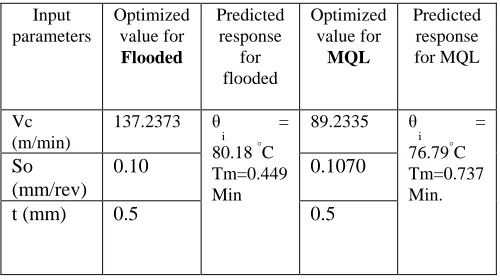
The process optimization was done using RSM’s D-Optimal Test. The optimized value of input parameters for the response is shown in the table below.
Table 8: Optimized results
Input parameters
Optimized value for
Flooded
Predicted response
for flooded
Optimized value for
MQL
Predicted response for MQL
Vc (m/min)
137.2373 θ
i =
80.18 °C Tm=0.449 Min
89.2335 θ
i =
76.79°C Tm=0.737 Min.
So (mm/rev)
0.10 0.1070
t (mm) 0.5 0.5
8. Conclusion
From the analysis of chip-tool interface temperature and chip formation in flooded and MQL system the following conclusions can be drawn:
1) By using MQL system very large amount of coolant can be saved also at some runs ( when cutting velocity & feed was low to medium) the performance of MQL was near to flooded in terms of chip formation but with increase in cutting velocity,the color of chips surface appeared darker then that appeared under flooded lubrication.This indicates that the amount of reduction of temperature in case of flooded enabled favorable chip–tool interaction, where as chips formed under application of MQL shows that in most of the cases they are not favorable .
2) MQL totally fails to provide better results in terms of reduction in chip-tool interface temperature (θ
i) as
compared to flooded lubrication, there by restricting the application of MQL to a certain range of parameter only i.e. optimized value for MQL found was medium cutting velocity (89.2335 m/min) , Low feed (0.1070 mm/rev) and low D.o.C ( 0.5 mm) where as flooded lubrication permitting use of high cutting velocity which is required for hard turning i.e. optimized value for flooded found was high cutting velocity (137.2373 m/min) , Low feed (0.10 mm/rev) and low D.o.C ( 0.5 mm).
It is clear that flooded lubrication system performance was better as compared to MQL in most of the experimental runs.
Acknowledgments
I am very much thankful to our Pricipal Dr.S.D.Deshmukh Sir and our workshop superitendent of Mechanical Engg.Dept,MGMs’J.N.E.C,Aurangabd.Prof.R.A.Katharfo r providing necessary facilities required for manufacturing of MQL set up and for carrying out the experimentation.
REFERENCES
[1] Dhar, N.R and Khan, M. M. A. (2006), “A study of effects of MQL on temperature, force, tool wear and product quality in turning AISI 9310 steel” Net Fieldwise Seminar on Manufacturing and Material Processing, issue(2), 2006.
[2] Thamizhmanii, S., and Hasan, R. S. (2009), “A study of minimum quantity lubrication on Inconel 718 steel”, Archives of Material Science and Engineering, Volume 39, Pages 38-44, September 2009.
[3] Abhang, L B., Hameedullah, M. (2010), “Experimental Investigation of Minimum Quantity lubricants in Alloy Steel Turning”, International Journal of Engineering Science and Technology, Volume 2(7), Pages 3055 – 3053, 2010.
[4] Chaudhary, S. M. A., Dhar, N. R. and Bepari, M. M. A. (2007) “Effect of Minimum Quantity Lubricant on Temperature Chip and Cutting Force in Turning Medium Carbon Steel, International Conference on Mechanical Engineering, ICME (2007), December 2007.
[5]. Young Kug Hwang and Choon Man Lee ‘’Surface roughness and cutting force prediction in MQL and wet turning process of AISI 1045 using design of experiments ‘’Journal of Mechanical Science and Technology .2006.www.springerlink.com
[6]. Prianka B. Zaman1 and N. R. Dhar ‘’Effects of Minimum Quantity Lubrication (MQL) by DifferentCutting Fluids on the Cutting Performance of Hardened Steel’’ RAMTM-2010, February, 19-20, 2010Production Engineering Department, Jadavpur University, Kolkata – 32.
[7].Panda, Dutta, and S.K Sahoo, (2014), “Experimental investigation on surface roughness characteristics in hard turning of EN31 steel using coated carbide insert: Taguchi and mathematical modeling approach” School of Mechanical Engineering, KIIT University, Bhubaneswar-751024, Odisha, India.
[8].Prasanna P Kulkarni and Shreelakshmi.C.T., ( 2014) “An Experimental Investigation of Effect of Cutting Fluids on Chip Formation and CycleTime in Turning of EN-24 and EN-31 Material”, International journal of engineering sciences & research technology.
BIOGRAPHIES
Arif Pathan Pursuing M.E (Manufacturing) in Department of Mechanical Engineering at MGMs’ Jawaharlal Nehru Engineering College, Aurangabad, Maharashtra. (India).