Functional Encryption for Turing Machines
Prabhanjan Ananth
∗Department of Computer Science and
Center for Encrypted Functionalities,
UCLA, USA
[email protected]
Amit Sahai
†Department of Computer Science and
Center for Encrypted Functionalities,
UCLA, USA
[email protected]
Abstract
In this work, we construct an adaptively secure functional encryption for Turing machines scheme, based on indistinguishability obfuscation for circuits. Our work places no restrictions on the types of Turing machines that can be associated with each secret key, in the sense that the Turing machines can accept inputs of unbounded length, and there is no limit to the description size or the space complexity of the Turing machines.
Prior to our work, only special cases of this result were known, or stronger assumptions were required. More specifically, previous work (implicitly) achieved selectively secure FE for Turing machines with a-priori bounded input based on indistinguishability obfuscation (STOC 2015), or achieved FE for general Turing machines only based on knowledge-type assumptions such as public-coin differing-inputs obfuscation (TCC 2015).
A consequence of our result is the first constructions of succinct adaptively secure garbling schemes (even for circuits) in the standard model. Prior succinct garbling schemes (even for circuits) were only known to be adaptively secure in the random oracle model.
∗
This work was partially supported by a grant from the Simons Foundation (#360584 to Prabhanjan Ananth).
†
Contents
1 Introduction 3
2 Preliminaries 7
2.1 Functional Encryption for Turing machines . . . 7
2.2 (Compact) FE for circuits . . . 8
2.2.1 Public-Key FE . . . 8
2.2.2 Function-private Private Key FE . . . 9
3 Adaptive 1-Key 1-Ciphertext FE for TMs 11 3.1 Semi-Adaptive 2-ary FE for TMs: 1-Key 1-Ciphertext Setting . . . 12
3.2 Adaptive FE from Semi-Adaptive 2-ary FE for TMs . . . 13
3.3 Constructing Semi-Adaptive 2-ary FE for TMs: Overview . . . 15
3.4 Constructing Semi-Adaptive 2-ary FE for TMs: Formal Description . . . 16
3.4.1 3-stage KLW . . . 17
3.4.2 Construction of 3-stage KLW . . . 18
3.4.3 2-ary FE for TMs from 3-stage KLW. . . 21
4 Adaptive FE for TMs 23 4.1 Proof of Correctness and Efficiency . . . 26
5 Proof of Theorem 5 27 5.1 Proof Overview . . . 27
5.2 Formal Proof: Hybrids . . . 29
5.3 Formal Proof: Indistinguishability of Hybrids . . . 33
5.3.1 Proof of Lemma 6 . . . 35
6 Future Directions 41 A Tools Used in [KLW15] 43 A.1 Positional Accumulators . . . 43
A.2 Iterators . . . 44
A.3 Splittable Signatures . . . 45
B Preliminaries (cont’d) 45 B.1 Standard Notions . . . 45
B.2 Turing machines . . . 46
1
Introduction
Contemporary cloud-based computing systems demand encryption schemes that go far beyond the traditional goal of merely securing a communication channel. The notion of functional encryption, first conceived under the name of Attribute-Based Encryption in [SW05] and formalized later in the works of [BSW11,O’N10], has emerged as a powerful form of encryption well-suited to many contemporary applications (see [BSW11,BSW12] for further discussion of application scenarios for functional encryption). A functional encryption (FE) scheme allows a user possessing a key associated with a function f to recover the outputf(x), given an encryption of
x. The intuitive security guarantee of a FE scheme dictates that the only information about xrevealed to the user isf(x). Furthermore, if the user obtains keys for many functionsf1, . . . fk, then the user should only learn
f1(x), . . . , fk(x) and nothing more. It turns out that formalizing security using a simulation-based definition leads
to impossibility results [BSW11,AGVW13]; however, there are sound adaptive indistinguishability-based formu-lations [BSW11] that also imply simulation-based security in restricted settings [CIJ+13]. Following most recent work on FE [GGH+13,Wat15,GGHZ14,ABSV15], we will focus on achieving this strong
indistinguishability-based notion of security here.
In this work, we address the following basic question:
“Is FE possible for functions described by arbitrary Turing machines?”
Previous work and its limitations. There have been many works on functional encryption over the past few years but a satisfying answer to this question has remained elusive.
The first constructions of FE considered only limited functions, such as inner product [KSW08]. The first constructions of FE that allowed for more general functions considered the setting where the adversary can just request a single (or a bounded number of) key queries [SS10, GVW12], but only for functions represented by circuits. A major advance occurred in the work of [GGH+13], which constructed an FE scheme allowing for functions specified by arbitrary circuits, with no bound on key queries, based on indistinguishability obfuscation (iO) for circuits. Since this work, the assumption of iO for circuits has become the staple assumption in this area.
However, [GGH+13] and other FE results deal with functionalities represented bycircuits– and representing functions as circuits gives rise to two major drawbacks. The first drawback is that a circuit representation takes the worst case running time on every input. Research to deal with this issue was initiated by Goldwasser et al. [GKP+13], and there have been several recent works [BGL+15,CHJV15,KLW15,CCC+15], that (implicitly
or explicitly) give rise to FE schemes with input-specific runtimes based on iO for circuits.
The second drawback is that the input length of the function is a-priori bounded. In many scenarios, especially involving large datasets, having an a-priori bound is clearly unreasonable. For example, if functional encryption is used for allowing a researcher to perform some data analysis on hospital records, then having a bound on input length would require that there be an a-priori bound, at the time of setting up the encryption scheme, on the length of encrypted hospital records, which seems quite unreasonable. In general, we would like to represent the function being computed as a Turing Machine, that can accept inputs of arbitrary length. The problem of constructing FE schemes which can handle messages of unbounded length has remained largely open: the recent works of [BGL+15,CHJV15,KLW15] construct iO for Turing Machines only with bounded input length, where the bound must be specified at the time of obfuscating the Turing Machine. If this iO method is combined, for example, with the FE construction recipe of [GGH+13], then this would only yield FE for functions with a bound on input length specified at the time of setting up the FE scheme.
There have been works [BCP14,IPS15] on overcoming the issue of a priori bounded input lengths but these are based on strong knowledge-type assumptions called differing inputs obfuscation [BGI+12,BCP14,ABG+13] or
more recently public-coin differing inputs obfuscation [IPS15]. Our main contribution is developing new technical approaches that allow us to remove the need for such assumptions, and use only iO for circuits1.
Results and Technical Overview. We prove the following informal theorem.
Results and Technical Overview. We prove the following informal theorem.
Theorem 1 (Informal). There exists a public-key FE scheme, assuming the existence of indistinguishability obfuscation and one-way functions, that satisfies the following properties:
1
1. There is no a priori bound on the number of functional keys issued.
2. The secret keys correspond to Turing machines.
3. It achieves adaptive security.
4. There is no a priori bound on length of the plaintext and the size of the Turing machine.
5. The running time of encryption is independent of the Turing machine size. The running time of the key generation is independent of the plaintext size.
A corollary of the above theorem is the first construction of succinct adaptively secure garbling schemes for TMs (with indistinguishability-based security) in the standard model. By succinctness, we mean that the size of the input encoding is independent of the function (circuit or TM) size. Prior solutions were either shown in the random oracle model [BHR12,AIKW15] or under restricted settings [BGG+14].
We now give a roadmap for the overall approach and the techniques we use to achieve our result.
To gather some ideas towards achieving our goal of adaptive FE for TMs, we first focus on the simplest possible scenario of FE for Turing machines: adversary can make only a single ciphertext query and a function query, and furthermore we work in the secret-key setting. We call a FE scheme satisfying this security notion to be 1-CT 1-Key Private-key FE.
Initial goal: Adaptive 1-CT 1-Key Private-key FE for TMs. To build an adaptive 1-CT 1-key private-key FE for TMs scheme, we first take inspiration from the corresponding FE forcircuits constructions known in the literature to see what tools might be helpful here. Sahai and Seyalioglu [SS10] and Gorbunov et al. [GVW12] give constructions using the tool of randomized encodings (RE) of computation. A randomized encoding is a representation of a function along with an input that is simpler to compute than the function itself. Further this representation reveals only the output of the function and nothing else. In other words, given functions
f1, f2 and inputs x1, x2 such that f1(x1) = f2(x2), it should be the case that the encoding of (f1, x1) should
be computationally indistinguishable from an encoding of (f2, x2). Such randomized encodings for TMs were
recently constructed in [BGL+15,CHJV15,KLW15], based on iO for circuits.
The essential difference between a randomized encoding and what we need for a 1-CT 1-key FE scheme concerns two additional features that we would need from the randomized encoding:
• First, we need the randomized encoding to be computableseparatelyfor the function and the input. That is, given onlyf, it should be possible to compute an encoding ˆf; and given onlyx, it should be possible to compute an encoding ˆx; such that ( ˆf ,xˆ) constitute a randomized encoding of (f, x). We need this because the ciphertext will be akin to the encoding of the input, whereas the private key will be akin to the encoding of the function. This is essentially the notion of a decomposable randomized encoding [AIK06].
• Then, more crucially, we also need to strengthen our notion of security: In a standard randomized encoding scheme, the adversary needs to declaref1, f2, x1, x2 all at the beginning, and then we have the guarantee
that ( ˆf1,xˆ1) is computationally indistinguishable to ( ˆf2,xˆ2). However, for an FE scheme, even with just
“selective” security, the adversary is given the power to adaptively specify at leastf1, f2 after it has seen
the encodings ˆx1 and ˆx2. More generally, we would like to have security where the adversary can choose
whether it would like to specifyf1, f2 first orx1, x2 first.
It turns out that achieving these two properties is relatively straightforward when dealing with randomized encodings of circuits using Yao’s garbled circuits [Yao86]. It is not so straightforward for us in the context of TMs and adaptive security, as we explain below.
as long as the length of ˆxand ˆf respectively. This would mean that the size of the new input encoding (resp., new function encoding) depends on the function length (resp., input length) – which violates our main goal of achieving FE without restrictions on input length!
Revisiting the KLW randomized encoding. In order to achieve our goal, we will need to look at the specifics of the decomposable RE for TMs construction in [KLW15]. We then develop new ideas specific to the construction that help us achieve adaptive security. Before we do that, we revisit the KLW randomized encoding at a high level, sufficient for us to explain the new ideas in our work. The encoding procedure of a Turing machineM and inputxconsists of the following two main steps:
1. The storage tape of the TM is initialized with the encryption ofx. It then builds an accumulator storage tree on the ciphertext. The accumulator storage tree resembles a Merkle hash tree with the additional property that this tree is unconditionally sound for a select portion of the storage. The root of the tree is then authenticated.
2. A program that computes the next step function of the Turing machineM is then designed. This program enables computation ofM one step at a time. This program has secrets that enable decrypting encrypted tape symbols and also to perform some checks on the input encrypted symbol. To hide the secrets, this program is obfuscated.
The decoding just involves running the next message function repeatedly on the computation obtained so far until the Turing Machine terminates. At this point, the decode algorithm will output whatever the Turing Machine outputs.
First Step towards Adaptivity: 3-Stage KLW. The main issue with trying to use the random masking technique was that we were trying to use randomness to mask the entire input encoding or the function encoding, which could be of unbounded length. So our main goal will be to find a way to achieve adaptivity where randomness need only be used to maskbounded portions of the encoding.
As a first step towards achieving this, we want to symmetrize how we treat the input x and the function
f. We do this by treating both xandf as being inputs to a Universal Turing MachineU, where U is both of bounded size and is entirely known a-priori, such thatU(f, x) =f(x).
That is, we have three algorithms2: InpEncoutputs an encoding of inputx,FnEncoutputs an encoding off,
andUTMEncoutputs a TM encoding of UTM.
A natural approach would be to try to use the KLW scheme sketched above to achieve the goal. The only difference is that, unlike the original KLW scheme, in the 3-stage KLW scheme, the input encoding is split into two encodings (InpEnc and FnEnc) and so there must be a way to stitch the input encodings into one. We develop a mechanism, calledcombiner, to achieve this goal. A combiner is an algorithm that combines two input encodings into one input encoding. Furthermore, the combiner algorithm we develop is succinct; it only takes a portion of the two encodings (of say,xand f) and spits out an element that together with the encodings of x
andf representx||f. Note, however, that the combiner algorithm needs secret information in order to perform its combining role correctly.
The key to constructing this combiner is the accumulator storage scheme of KLW. Recall that the accumulator storage on (x||f) was essentially a binary tree onx||f. We modify this accumulator storage such that the storage tree on (x||f) can be built by first building a storage tree onx, then building a separate independent storage tree onf, and then joining both these two trees by making them children of a root node. Once we have this tool, developing our combiner algorithm is easy: the input encoding ofxconsists of a storage tree on an encryption ofx, encoding off consists of a storage tree on the encryption off. The combine algorithm then takesonly the root nodes of both these two trees and creates a new root node which is the parent of these two root nodes. The combiner then signs on the root node as a means of authenticating the fact that this new root node was created legally.
We are almost ready to now apply the random masking technique to achieve adaptive security by masking our new succinct representations. However, there is a problem: the combineralgorithm. In 3-stage KLW, once we have encodings ofxandf, before we can have a randomized encoding, these two encodings need to be combined
2
using secret information. This is not allowed in a randomized encoding, where the decode algorithm must be public.
Getting rid of combiner: 2-ary FE for TMs (1-CT 1-Key setting). Since we need to eliminate the need for the combiner algorithm, we start by trying to delegate the combine operation to the decoder. We can attempt to do so by including an obfuscated version of the combiner program as part of the encoding itself, where obfuscation is needed since the combiner procedure contains some secret values that have to be hidden. By itself, however, this approach does not work, because the adversary who now possesses the obfuscated combine program can now illegally combine different storages (other than those corresponding toxandf) – we term this type of attack as amixed storage attack.
To prevent mixed storage attacks, we use splittable signatures: the challenger can sign the root of the storage ofxas well as the root of the storage off. The obfuscated program now only outputs the combined value if the signatures can be verified correctly. By using splittable signatures, we can argue that the adversary is prevented from mixed storage attacks relying only on indistinguishability obfuscation for circuits.
Once we have the obfuscated combiner program, the next issue is whether the obfuscated combiner should be included as part ofInpEncorFnEnc. Including it in either of them will cause problems because the simulator needs to simulate the appropriate parameters in the combiner algorithm and it can do that only after looking at both the InpEnc and FnEncqueries. Here we can (finally!) apply the random masking technique since the size of the combiner is independent of the size of the input as well as the function and thus the length of the random mask needed is small. The resulting scheme that we get is a 2-ary FE [GGG+14] for TMs, where the adversary can only make a single message and key query – note that it is essentially the same as 3-stage KLW scheme except that it does not have the combiner algorithm.
Using some additional but similar ideas, we can show that the algorithmsFnEncandUTMEnccan be combined into one encoding. The result is a scheme with an input encoding, function encoding and a decode algorithm with the security guarantee that the input query and the function query can be made adaptively, which is precisely the goal we had started off with.
Boosting mechanism: 1-Key 1-CT (private-key) FE to many-key (public-key) FE.Now that we have achieved the goal of single-ciphertext single-key private key FE for TMs, the next direction is to explore whether there is any way to combine this with other known tools to obtain a public-key FE with unbounded number of function queries. We give a mechanism of combining the 1-Key 1-CT FE scheme with other FE schemes that are defined forcircuits to obtain a public-key FE scheme for Turing machines. Further, our resulting FE scheme is such that it is adaptively secure assuming only that the 1-Key 1-CT FE scheme is adaptively secure. The high level approach is that the ciphertexts and the functional keys are designed such that every ciphertext-functional key pair gives rise to a unique instantiation of single-ciphertext single-key private FE. This is reminiscent of the approach of Waters [Wat15], later revisited by [ABSV15], in the context of constructing adaptively secure FE for circuits.
Our boosting mechanism, however, diverges in several ways from the previous works of [Wat15, ABSV15]. First, we note that just syntactically, our boosting mechanism is the first such mechanism that uses only 1-Key 1-CT FE as a building block; in contrast, for example, [ABSV15] neededmany-Key 1-CT FE as a building block. Zooming in on the main new idea we develop for our boosting mechanism, we find that it is used exactly to deal with the fact that unbounded inputs that must be embedded in ciphertexts. Note that all previous FE schemes placed an a-priori bound on the inputs to be encrypted in ciphertexts. Therefore, to build our encryption mechanism, we cannot use previous FE encryption to encode inputs. We also cannot directly use the 1-Key 1-CT FE, since this scheme can only support a single key and a single ciphertext. To resolve this dilemma, we note that even though previous FE schemes could not handle inputs of unbounded length, previous FE schemes can handle keys corresponding to arbitrary-length circuits. Therefore, crucially in our boosting procedure, when encrypting an input x, we actually prepare a circuit Hx that hasxbuilt into it, and then use
an existing FE scheme to prepare a key corresponding toHx. Here we make use of the Brakerski-Segev [BS14]
transformation to guarantee that the key forHx does not leakx. We utilize a new layer of indirection, where
this circuitHx expects to receive as input the master secret key of a 1-Key 1-CT FE scheme, and then uses this
master secret key to create a 1-Key 1-CT encryption ofx. In this way, the final FE scheme that we construct inherits the security of the 1-Key 1-CT encryption scheme, but a fresh and independent instance of the 1-Key 1-CT scheme is created for each pair of (input, function) that is ever considered within our final FE scheme.
which allows for embedding user information in the issued keys. One of the main tools used to construct this primitive is an adaptively secure FE scheme. As a first step, they show how to achieve a traitor tracing scheme from a private linear broadcast encryption (PLBE) scheme defined for a large identity space. In the next step, they show how to design a PLBE scheme from adaptive FE.
2
Preliminaries
We denoteλto be the security parameter. We say that a functionµ(λ) is negligible if for any polynomialp(λ) it holds that µ(λ) < 1/p(λ) for all sufficiently large λ ∈ N. We use the notation negl to denote a negligible
function.
The standard cryptographic notions of pseudorandom functions and symmetric encryption schemes are de-fined in Appendix B.1. We also recall the definition of Turing machines in the same section. We use the convention that a Turing machine also outputs the time it takes to execute. As a consequence, if we have
M0(x) =M1(x) then it means that not only are the outputs same but even the running times are the same.
2.1
Functional Encryption for Turing machines
We now define the notion of functional encryption (FE) for Turing machines. This notion differs from the traditional notion of FE for circuits (to be defined later) in that the functional keys are associated to Turing machines as against circuits. Further, the functional keys can be used to decrypt ciphertexts of messages of arbitrary length and the decryption time depends only the running time of the Turing machine on the message. A public-key functional encryption scheme, defined for a message space M and a class of Turing machines
F, consists of four PPT algorithmsFE= (Setup,KeyGen,Enc,Dec) described as follows.
• Setup(1λ): The setup algorithm takes as input the security parameter λ in unary and outputs a public key-secret key pair (PK,MSK).
• KeyGen(MSK, f ∈ F): The key generation algorithm takes as input the master secret keyMSK, a Turing machinef ∈ F 3, and outputs a functional keysk
f.
• Enc(PK, m ∈ M): The encryption algorithm takes as input the public key PK, a message m ∈ M and outputs a ciphertextCT.
• Dec(skf,CT): The decryption algorithm takes as input the functional keyskf, a ciphertextCTand outputs
ˆ
m.
The FE scheme defined above, in addition to correctness and security, needs to satisfy the efficiency property. All these properties are defined below.
Correctness.
The correctness notion of a FE scheme dictates that there exists a negligible functionnegl(λ) such that for all sufficiently large λ ∈ N, for every message m ∈ M, and for every Turing machine f ∈ F itholds that Pr [f(m)←Dec(KeyGen(MSK, f),Enc(PK, m))] ≥1−negl(λ), where (PK,MSK) ← Setup(1λ), and the probability is taken over the random choices of all algorithms.
Efficiency.
The efficiency property of a public-key FE scheme says that the algorithm Setup on input 1λshould run in time polynomial in λ, KeyGen on input the Turing machine f (along with master secret key) should run in time polynomial in (λ,|f|), Encon input a messagem(along with the public key) should run in time polynomial in (λ,|m|). Finally,Decon input a functional key of f and an encryption ofm should run in time polynomial in (λ,|f|,|m|,timeTM(f, m))).
Security.
The security is modeled in the form of a game between the challenger and an (efficient) adversary. The adversary is allowed to request for an arbitrary number of functional keys from the challenger. In addition, the adversary can also submit message pairs of the form (m0, m1), where|m0|=|m1| and in return it receivesa ciphertext of mb, where b
$
←− {0,1} is sampled by the challenger. At the end of the game, the adversary
3
outputs a bitb0. The adversary wins the game ifb0=band iff(m
0) =f(m1), for all Turing machine queriesf,
message pair queries (m0, m1). Recall that, we only consider Turing machines which also output the time taken
to execute and hence,f(m0) =f(m1) ensures that the running time off onm0 andm1 are the same.
Definition 1. A public-key functional encryption schemeFE= (Setup,KeyGen,Enc,Dec)over a class of Turing machinesF and a message spaceMisadaptively secureif for any PPT adversaryAthere exists a negligible function µ(λ)such that for all sufficiently large λ∈N, the advantage of Ais defined to be
AdvFEA =
Prob[Expt FE
A(1
λ,0) = 1]
−Prob[ExptFEA(1λ,1) = 1]
≤µ(λ),
where for eachb∈ {0,1} andλ∈Nthe experimentExptFEA(1λ, b), modeled as a game between the challenger and the adversary A, is defined as follows:
1. The challenger first executesSetup(1λ)to obtain(PK,MSK). It then sends PKto the adversary.
2. Query Phase I: The adversary submits a Turing machine queryf to the challenger. The challenger sends back skf to the adversary, whereskf is the output ofKeyGen(MSK, f).
3. Challenge Phase: The adversary submits a message-pair (m0, m1) to the challenger. The challenger
checks whether f(m0) =f(m1) for all Turing machine queries f made so far. If this is not the case, the
challenger aborts. Otherwise, the challenger sends backCT=Enc(MSK, mb).
4. Query Phase II: The adversary submits a Turing machine query f to the challenger. The challenger generates skf, whereskf is the output of KeyGen(MSK, f). It sends skf to the adversary only iff(m0) =
f(m1), otherwise it aborts.
5. The output of the experiment isb0, whereb0 is the output ofA.
We can also consider a weaker notion, termed as selective security, where the adversary has to submit the challenge message pair at the beginning of the game itself even before it receives the public parameters and such a FE scheme is said to beselectively secure.
Private Key Setting.
We can analogously define the notion of FE for TMs in the private-key setting. The difference between the public-key setting and the private-key setting is that in the private-key setting, the encryptor needs to know the master secret key to encrypt the messages. We provide the formal definition of private-key FE for TMs in AppendixB.3.2.2
(Compact) FE for circuits
2.2.1
Public-Key FE
One of the building blocks in our construction of FE for TMs is a public-key FE for circuits (i.e., the functions are represented as circuits). We now recall its definition from [BSW11, O’N10].
A public-key functional encryption (FE) scheme PubFE, defined for a class of functions F ={Fλ}λ∈N and message spaceM={Mλ}λ∈N, is represented by four PPT algorithms, namely (Setup,KeyGen,Enc,Dec). The input length of anyf ∈ Fλ is the same as the length of anym∈ Mλ. The description of these four algorithms
is given below.
• Setup(1λ): It takes as input a security parameter λ in unary and outputs a public key-secret key pair
(PK,MSK).
• KeyGen(MSK, f∈ Fλ): It takes as input a secret keyMSK, a functionf ∈ Fλ and outputs a functional key
skf.
• Enc(PK, m∈ Mλ): It takes as input a public keyPK, a messagem∈ Mλand outputs an encryption ofm.
• Dec(skf,CT): It takes as input a functional keyskf, a ciphertextCTand outputsmb.
Correctness.
The correctness property says that there exists a negligible functionnegl(λ) such that for all sufficiently large λ∈ N, for every messagem ∈ Mλ, and for every function f ∈ Fλ it holds that Pr[f(m)←Dec(KeyGen(MSK, f),Enc(PK, m))]≥1−negl(λ), where (PK,MSK)←Setup(1λ), and the probability is taken
over the random choices of all algorithms.
Efficiency.
At a high level, the efficiency property says that the setup and the encryption algorithm is independent of the size of the circuits for which functional keys are produced. More formally, the running time of the setup algorithm,Setup(1λ) is a polynomial in just the security parameterλand the encryption algorithm,Enc(PK, m) is a polynomial in only the security parameterλand length of the message,|m|.
An FE scheme that satisfies the above efficiency property is termed as compact FE. It was shown by [AJ15,
BV15] that iO is implied by (sub-exponentially hard) compact FE. However, we don’t place any sub exponential hardness requirement on compact FE in our work.
Remark 1. We note that the definitions of FE for circuits commonly used in the literature do not have the above efficiency property.
Security.
The security definition is modeled as a game between the challenger and the adversary as before.Definition 2. A public-key functional encryption schemeFE= (Setup,KeyGen,Enc,Dec)over a function space F={Fλ}λ∈Nand a message spaceM={Mλ}λ∈Nis anadaptively-secure public-key functional encryp-tion scheme if for any PPT adversary A there exists a negligible function µ(λ) such that for all sufficiently largeλ∈N, the advantage ofAis defined to be
AdvFEA =
Prob[Expt FE
A(1λ,0) = 1]−Prob[ExptFEA(1λ,1) = 1]
≤µ(λ),
where for eachb∈ {0,1} andλ∈Nthe experimentExptFEA(1λ, b), modeled as a game between the challenger and the adversary A, is defined as follows:
1. The challenger first executesSetup(1λ)to obtain(PK,MSK). It then sends PKto the adversary.
2. Query Phase I: The adversary submits a function query f to the challenger. The challenger sends back skf to the adversary, whereskf is the output ofKeyGen(MSK, f).
3. Challenge Phase: The adversary submits a message-pair (m0, m1) to the challenger. The challenger
checks whetherf(m0) =f(m1)for all function queriesf made so far. If this is not the case, the challenger
aborts. Otherwise, the challenger sends backCT=Enc(MSK, mb).
4. Query Phase II: The adversary submits a function query f to the challenger. The challenger generates skf, where skf is the output of KeyGen(MSK, f). It sends skf to the adversary only if f(m0) = f(m1),
otherwise it aborts.
5. The output of the experiment isb0, whereb0 is the output ofA.
We define the FE scheme to be selectively secure if the adversary has to declare the challenge message pair even before it receives the public parameters.
2.2.2
Function-private Private Key FE
We now give an analogous definition of FE for circuits in the private-key setting. In particular, we focus on the private-key FE that is function-private.
A function-private private-key functional encryption (FE) scheme PubFE, defined for a class of functions
F={Fλ}λ∈Nand message spaceM={Mλ}λ∈N, is represented by four PPT algorithms, namely (PrivFE.Setup,
PrivFE.KeyGen, PrivFE.Enc, PrivFE.Dec). The input length of any f ∈ Fλ is the same as the length of any
m∈ Mλ.
We give the description of the four algorithms below.
• PrivFE.Setup(1λ): It takes as input a security parameterλin unary and outputs a secret keyPrivFE.MSK.
• PrivFE.KeyGen(PrivFE.MSK, f ∈ Fλ): It takes as input a secret key PrivFE.MSK, a function f ∈ Fλ and
• PrivFE.Enc(PrivFE.MSK, m ∈ Mλ): It takes as input a secret key PrivFE.MSK, a message m ∈ Mλ and
outputs an encryption ofm.
• PrivFE.Dec(PrivFE.skf,CT): It takes as input a functional keyPrivFE.skf, a ciphertextCTand outputs ˆm.
We require the above function-private private key FE scheme to satisfy the correctness, efficiency and the function privacy properties of the above FE scheme.
Correctness.
The correctness notion of a function-private private-key FE scheme dictates that there exists a negligible functionnegl(λ) such that for all sufficiently largeλ∈N, for every messagem∈ Mλ, and for everyfunction f ∈ Fλ it holds that Pr[f(m) ← PrivFE.Dec(PrivFE.KeyGen(PrivFE.MSK, f),PrivFE.Enc(PrivFE.MSK,
m))]≥1−negl(λ), wherePrivFE.MSK←PrivFE.Setup(1λ), and the probability is taken over the random choices of all algorithms.
Efficiency.
At a high level, the efficiency property says that the setup algorithm and the encryption algorithm is independent of the size of the circuits for which functional keys are produced. More formally, the running time ofPrivFE.Setup(1λ) is just a polynomial in the security parameter λ, andPrivFE.Enc(PrivFE.MSK, m) is apolynomial in only the security parameterλand length of the message,|m|.
Function Privacy.
We now recall the definition of function privacy in private key FE as defined by Brakerski, and Segev [BS14]. In the security game of function privacy, a function query made by the adversary is a pair of functions and in response it receives a functional key corresponding to either of the two functions. As long as both the functions are such that they do not split the challenge message-pairs, the adversary should not be able to tell which function was used to generate the functional key. That is, the output of the left function on the left message should be the same as the output of the right function on the right message.Note that the function privacy property below subsumes the usual notion of security (when only one function is submitted).
Definition 3. A private-key functional encryption schemePubFE= (PrivFE.Setup, PrivFE.KeyGen,PrivFE.Enc, PrivFE.Dec)over a function space F ={Fλ}λ∈N and a message space M={Mλ}λ∈N is a function-private adaptively-secure private-key FE schemeif for any PPT adversaryAthere exists a negligible functionµ(λ)
such that for all sufficiently largeλ∈N, the advantage ofAis defined to be
AdvPubFEA =
Prob[Expt PubFE
A (1λ,0) = 1]−Prob[Expt
PubFE
A (1λ,1) = 1]
≤µ(λ),
where for eachb∈ {0,1} andλ∈Nthe experiment ExptPubFEA (1λ, b), modeled as a game between the challenger and the adversary A, is defined as follows:
1. The challenger first executes PrivFE.MSK ← PrivFE.Setup(1λ). The adversary then makes the following
message queries and function queries in no particular order.
• Message queries: The adversary submits a message-pair(m0, m1)to the challenger. In return, the
challenger sends backCT=PrivFE.Enc(PrivFE.MSK, mb).
• Function queries: The adversary then makes functional key queries. For every function-pair query
(f0, f1), the challenger sendsPrivFE.skfbto the adversary, wherePrivFE.skfbis the output ofPrivFE.KeyGen(
PrivFE.MSK, fb)only iff0(m0) =f1(m1), for all message-pair queries(m0, m1). Otherwise, it aborts.
2. The output of the experiment isb0, whereb0 is the output ofA.
We define a function-private private key FE to be selectively secure if the adversary has to declare all the challenge message pairs at the beginning of the security game.
Single-key setting.
A single-key function-private functional encryption scheme (in the private-key setting) is a functional encryption scheme, where the adversary in the security game (either selective or adaptive) is allowed to query for only one function. There are several known constructions [SS10, GVW12, GKP+12] butnone of them satisfy the efficiency property of our FE definition – in particular, the size of the ciphertexts in these constructions grow with the circuit size (for which functional keys are computed). We later describe how to obtain a single-key scheme that indeed satisfies the efficiency property.
3
Adaptive 1-Key 1-Ciphertext FE for TMs
One of the main tools in our constructions is a single-key single-ciphertext FE for TMs in the private key setting. In the security game, the adversary only gets to make a single message and function query. Since we are interested in adaptive security, the message and the function query can be made in any order. In the language of randomized encodings (RE), this primitive is nothing but an adaptively securesuccinctdecomposable RE. The formal definition of single-ciphertext single-key FE for TMs is provided below.
In the adaptive security game of single-ciphertext single-key FE, the adversary can only make a single function query and a single challenge message query. We define this notion for the case when the functions are represented by Turing machines.
Definition 4(Single-ciphertext Single-key Private-key FE for TMs).A private-key functional encryption scheme OneCTKey= (OneCTKey.Setup,OneCTKey.KeyGen,OneCTKey.Enc,OneCTKey.Dec)for Turing machines over a function spaceF={Fλ}λ∈Nand a message spaceM={Mλ}λ∈Nis anadaptively-secure single-ciphertext single-key private-key FE scheme for Turing machinesif for any PPT adversaryAthere exists a negli-gible functionµ(λ)such that the advantage of Ais defined to be
AdvOneCTKeyA =
Prob[Expt
OneCTKey
A (1
λ,0) = 1]−Prob[ExptOneCTKey
A (1
λ,1) = 1]
≤µ(λ),
where for eachb∈ {0,1}andλ∈Nthe experimentExptOneCTKeyA (1λ, b), modeled as a game between the challenger and the adversary A, is defined as follows:
1. The challenger first executesOneCTKey.Setup(1λ)to obtain OneCTKey.MSK.
2. Query Phase I: The adversary can submit a single Turing machine query f to the challenger during this phase. The challenger generatesOneCTKey.skf, whereOneCTKey.skf is the output of OneCTKey.KeyGen(
OneCTKey.MSK, f). It then sends OneCTKey.skf to the adversary. We emphasize that the adversary can
only make at most one function query in this phase.
3. Challenge Phase: The adversary submits a message pair (m0, m1) to the challenger. The challenger
generates CT = OneCTKey.Enc(OneCTKey.MSK, mb). If f(m0) = f(m1) for a Turing machine query f
made in Query Phase I, the challenger sends CT to the adversary. Otherwise, it aborts. We emphasize that the adversary can make at most one message query in this phase.
4. Query Phase II: If the adversary has already made a Turing machine query during Query Phase I then the adversary can make no more Turing machine queries during this phase. Otherwise, the adversary can sub-mit a Turing machine queryf to the challenger during this phase. The challenger generatesOneCTKey.skf,
where OneCTKey.skf is the output of OneCTKey.KeyGen(OneCTKey.MSK, f). If f(m0) =f(m1), for the
message query (m0, m1), it sends OneCTKey.skf to the adversary and otherwise, it aborts. As in Query
Phase I, we emphasize that the adversary can only make at most one Turing machine query in this phase.
5. The output of the experiment isb0, whereb0 is the output ofA.
As before, we can define a single-ciphertext single-key private-key FE to be selectively-secure if the adversary has to declare the challenge message pair even before he submits the function query.
i.e., the arity of the functions is 2. We refer to this notion as 2-ary FE for TMs. We describe this notion formally in Section3.1.
Prior to this work, we knew how to construct this only based on (public coins) differing inputs obfuscation. Later we show how to construct this primitive assuming just iO for circuits and one-way functions.
3.1
Semi-Adaptive 2-ary FE for TMs: 1-Key 1-Ciphertext Setting
The formal description of the 2-ary FE for TMs is given below. A 2-ary FE for a class of Turing machines F
consists of four PPT algorithms,2FE= (2FE.Setup,2FE.Enc,2FE.KeyGen,2FE.Dec), as described below.
• 2FE.Setup(1λ): On input the security parameter λ, the algorithm 2FE.Setup outputs a master secret key
2FE.MSK.
• 2FE.KeyGen(2FE.MSK, M): On input the master secret key 2FE.MSK and Turing machine M ∈ F, it outputs the key2FE.skM.
• 2FE.Enc(2FE.MSK, x, b): On input the master secret key 2FE.MSK, message x ∈ {0,1}∗ and position b∈ {0,1}, it outputs2FE.CTx.
Remark 3. The bit b essentially indicates the position with respect to which the message needs to be encrypted. For convenience sake, we refer to the first position as the0th position and the second position
as the1st position.
• 2FE.Dec(2FE.skM,2FE.CTx,2FE.CTy): On input the functional key2FE.skM and ciphertexts2FE.CTxand
2FE.CTy, it outputs the valuez.
For the above notion to be interesting, a 2-ary FE for TMs scheme is required to satisfy the following correctness, efficiency and security properties.
Correctness: This property ensures that the output of2FE.Dec(2FE.skM,2FE.CTx,2FE.CTy) is alwaysM(x, y)
where (i) 2FE.MSK ← 2FE.Setup(1λ), (ii) 2FE.sk
M ← 2FE.KeyGen(2FE.MSK, M), (iii) 2FE.CTx ← 2FE.Enc(
2FE.MSK, x,0) and (iv)2FE.CTy ←2FE.Enc(2FE.MSK, y,1).
Efficiency: This property says that the size of the ciphertexts (resp., functional key) depend solely on the size of the message (resp., machine) and the security parameter. That is, the complexity of2FE.Enc(2FE.MSK, x, b) is a polynomial in (λ,|x|) and the complexity of2FE.KeyGen(2FE.MSK, M) is a polynomial in (λ,|M|). Furthermore, we require that the complexity of2FE.Dec(2FE.skM,2FE.CTx,2FE.CTy) is just a polynomial in (λ,|x|,|y|,|M|, t),
wheretis the time taken by M to execute on the input (x, y).
Semi-Adaptive Security: The security guarantee states that the adversary cannot distinguish joint ciphertexts of (x0, y0) from the joint ciphertexts of (x1, y1) given the functional key ofM, as long asM(x0, y0) =M(x1, y1).
Note that we adopt the convention that the Turing machine also outputs its running time and thus this alone ensures that the execution time ofM(x0, y0) is the same as the execution time ofM(x1, y1).
Depending on the order of the message and the Turing machine queries the adversary can make, there are many ways to model the security of a 2-ary FE scheme. We adopt the notion where the adversary can make the message queries corresponding to 0thand 1stposition in an adaptive manner but the TM query should be made
only after both the message queries. We term this notionsemi-adaptive security. SupposeAbe any PPT adversary. We define an experimentExptASemiAd below.
ExptSemiAdA (1λ):
1. The challenger first executes2FE.Setup(1λ) to obtain2FE.MSK. It then chooses a bitb at random.
2. The following two bullets are executed in an arbitrary order (depending on the choice of the adversary).
• The adversary submits the message query (x0, x1), corresponding to 0th position, to the challenger.
The challenger responds with 2FE.CTx ← 2FE.Enc(2FE.MSK, x0,0) if b = 0 else it responds with
• The adversary submits the message query (y0, y1), corresponding to 1st position, to the challenger.
The challenger responds with 2FE.CTy ← 2FE.Enc(2FE.MSK, y0,1) if b = 0 else it responds with
2FE.CTy ←2FE.Enc(2FE.MSK, y1,1).
3. After both the message queries, the adversary then submits a Turing machine M to the challenger. The challenger aborts if either (i) M(x0, y0) =6 M(x1, y1) or (ii) |x0| 6= |x1| or (iii) |y0| 6= |y1|. If it has not
aborted, it executes2FE.skM ←2FE.KeyGen(2FE.MSK, M). It then sends2FE.skM to the adversary.
4. The adversary outputsb0.
The experiment outputs 1 ifb=b0, otherwise it outputs 0. We now define the semi-adaptive security notion.
Definition 5. A 2-ary FE scheme is semi-adaptive secure if for any PPT adversary A, we have that the probability that the output of the experimentExptSemiAdA is 1 is at most1/2 +negl(λ), for any negligible function negl.
3.2
Adaptive FE from Semi-Adaptive 2-ary FE for TMs
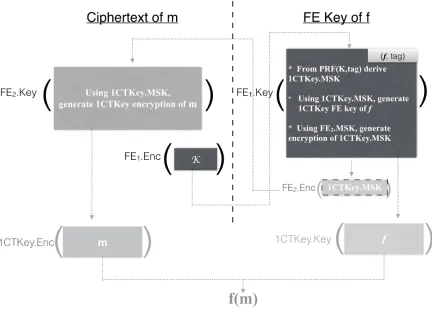
We now show how to achieve adaptively secure single-ciphertext single-key FE starting from asemi-adaptively secure2-ary FE for TMs. Recall that in the semi-adaptive security game of 2-ary FE, the key query can be made only after the message queries but however, the message queries corresponding to the first and the second position can be made in an adaptive manner. This leads to the main idea behind our construction – symmetrization of the input and the TM. That is, the adaptive FE functional key of a machine M is the 2-ary FE encryption of
M w.r.t the 1st position and the adaptive FE encryption of a messagemis essentially the 2-ary FE encryption
of m w.r.t the 0th position. This takes care of the adaptivity issue. To facilitate the execution of M onm, a
2-ary FE key of a universal TM (UTM) is also provided. The question is whether we include the 2-ary FE key of UTM in the ciphertext or the functional key. This is crucial because the UTM key can only be provided by the challenger after seeing the queries corresponding to both the 0th and 1st position. To solve this issue, we
additively secret share the UTM key across both the ciphertext and the functional key. This gives the challenger leeway to provide a random string as part of the response to the first query and by providing the appropriate secret share in the second response it can reveal the UTM key – at this point the challenger has seen both m
andM. The formal scheme is described next.
Consider a 2-ary FE for TMs, denoted by 2FE= (2FE.Setup,2FE.KeyGen,2FE.Enc,2FE.Dec), for a class of Turing machinesF. We construct a single-ciphertext single-key FE,OneCTKey, for the same class F.
Denote by UTM=UTMλ, the universal Turing machine, that takes as input a Turing machineM, message
mand outputsM(m) if it halts within 2λsteps else it outputs⊥. Further, we denote by`UTMto be the length
of the output of a2FEkey ofUTM.
OneCTKey.Setup(1λ): On input the security parameter λ, it first executes 2FE.Setup(1λ) to obtain the master
secret key2FE.MSK. It also picks a random stringRin {0,1}`UTM. It outputs the secret keyOneCTKey.MSK= (2FE.MSK, R) as the master secret key.
OneCTKey.KeyGen(OneCTKey.MSK, M ∈ F): On input the master secret keyOneCTKey.MSK= (2FE.MSK, R), and a Turing machineM ∈ F, it executes 2-ary FE encryption ofM w.r.t 0thposition,2FE.Enc(2FE.MSK, M,0),
to obtain2FE.CTM. It then computes a 2-ary FE key ofUTMby generating2FE.skUTM←2FE.KeyGen(2FE.MSK,
UTMλ). Finally, it outputs the functional keyOneCTKey.skM = (2FE.CTM,2FE.skUTM⊕R).
OneCTKey.Enc(OneCTKey.MSK, m): On input the master secret keyOneCTKey.MSK= (2FE.MSK, R), and mes-sagem, it generates a 2-ary FE encryption ofmby executing2FE.CTm←2FE.Enc(2FE.MSK, m,1). It outputs
the ciphertextOneCTKey.CT= (2FE.CTm, R).
OneCTKey.Dec(OneCTKey.skM,OneCTKey.CT): On input the functional key OneCTKey.skM = (2FE.CTM, S)
and ciphertext OneCTKey.CT = (2FE.CTm, R). It computes S ⊕R to obtain 2FE.skUTM. It then executes
2FE.Dec(2FE.skUTM,2FE.CTM,2FE.CTm) to obtainz. Finally, it outputs z.
Proof. We prove the correctness, efficiency and adaptive security properties below.
Correctness.
Suppose the master secret keyOneCTKey.MSK= (2FE.MSK, R) is the output ofOneCTKey.Setup( 1λ). And let the ciphertext OneCTKey.CT = (2FE.CTm, R), be the output of OneCTKey.Enc on input (
OneCTKey.MSK, m). Further let the functional key OneCTKey.skM, parsed as (2FE.CTM, S), be the output
ofOneCTKey.KeyGen, where (i) S =2FE.skUTM⊕R, (ii) 2FE.skUTM←2FE.KeyGen(2FE.MSK,UTMλ) and (iii)
2FE.CTM ←2FE.Enc(2FE.MSK, M,0). Then, from the correctness property of the 2-ary FE, we have the output
of the decryption algorithm2FE.Decon input (2FE.skUTM,2FE.CTM,2FE.CTm) to beM(m). Thus, we have the
output of the decryption algorithmOneCTKey.Dec on input (OneCTKey.skf,OneCTKey.CT).
Efficiency.
We need to argue about the efficiency of the key generation, encryption as well as the decryption procedures.• The running time of OneCTKey.Setup is essentially the running time of2FE.Setup which is a polynomial inλ.
• Observe that the execution time of 2FE.Enc(2FE.MSK, M,0) is a polynomial in (λ,|M|). Further the execution time of 2FE.KeyGen(2FE.MSK,UTMλ) is polynomial in λ. Thus the total execution time of
OneCTKey.KeyGen(OneCTKey.MSK, M ∈ F) is a polynomial in (λ, M).
• The execution time of OneCTKey.Enc(OneCTKey.MSK, m) is a polynomial in (λ,|m|), since the running time of2FE.Enc(2FE.MSK, m,1) is a polynomial in (λ,|m|).
• The running time ofOneCTKey.Dec(OneCTKey.skM,OneCTKey.CT) is a polynomial in (λ,|m|,|f|, t), where
t is the running time of M(m). This follows from the fact that the running time of2FE.Dec(2FE.skUTM,
2FE.CTM,2FE.CTm) is a polynomial in (λ,|m|,|M|, t).
Adaptive Security.
We need to argue that the FE schemeOneCTKeythat we constructed above is indeed an adaptively secure single-ciphertext single-key FE. More formally, we prove the following. The proof of the theorem essentially follows from the security of the 2-ary FE scheme.Lemma 1. Assuming the security of 2-ary FE2FE, the scheme OneCTKeyis adaptively secure.
Proof. Suppose OneCTKey is not adaptively secure, that is, there exists a PPT adversaryA that breaks the security ofOneCTKey. We then design a reductionBthat internally runs the adversaryAand breaks the security of2FE.
The reductionBessentially simulates the role of the challenger in the security game ofOneCTKeyand at the same time takes the role of the adversary in the game of2FE. Depending on the order in which the adversary makes the function and the message query, there are two cases.
1. Adversary first submits a TM query: Suppose the adversary submits the TM query M to B. The reduction then sends (M, M) as a message query w.r.t 0th position to the challenger of2FE. In return it
receives the ciphertext2FE.CTM. It then sends the functional key (2FE.CTM, R) to A, whereR is picked
at random from {0,1}`UTM. The reduction then receives the input pair (m
0, m1) from the adversary A.
The reduction then submits the message query (m0, m1) w.r.t the 1stposition to the challenger of2FE. In
response to this query, it receives the ciphertext 2FE.CTm. Then, B sends the universal Turing machine
UTMλ as a key query to the challenger and it receives the functional key2FE.skUTM. The reduction then
sends the challenge ciphertext (2FE.CTm, R⊕2FE.skUTM) toA.
2. Adversary first submits a message query: Suppose the adversary submits the message pair query (m0, m1) to B. The reduction B then forwards this message query (m0, m1) w.r.t the 1st position to
the challenger of 2FE. In return it receives 2FE.CTm. The reduction then sends the challenge ciphertext
(2FE.CTm, R) to the adversary A, where R is a random string of length {0,1}`UTM. The adversary then
sends the Turing machine M to B, who then composes the message query (M, M) w.r.t 0th position and
sends it to the challenger of2FE. The reductionBreceives back the ciphertext2FE.CTM. Balso submits,
as a key query, the universal Turing machine UTMλ, to the challenger of 2FE. In response, it receives
In both the cases, we note that the distribution of the functional key and the challenge ciphertext as produced by
Bis identical to the distribution as produced according to the scheme. Thus, ifAbreaks the security ofOneCTKey
with non-negligible probability thenBbreaks the security ofOneCTKeywith non-negligible probability.
3.3
Constructing Semi-Adaptive 2-ary FE for TMs: Overview
Lets begin with the following simple idea: the 2-ary FE encryption ofxw.r.t 0thposition will just be a standard
public key encryption ofx0. Since this encryption should not be malleable, we provide an authentication of the
ciphertext. Similarly, the 2-ary FE encryption ofy w.r.t 1st position is also a public key encryption ofy along
with its authentication. The functional key of M is an obfuscated program that takes as input an encrypted tape symbol; decrypts it; executes the next message function and then outputs an encryption of the new symbol. The evaluation is performed by executing next message function one step at a time while updating the storage tape which is initialized to the encryptions ofxandy along with their respective authentications.
This however suffers from consistency issues. An adversary could re-use encrypted storage tape values of the current tape in the future steps. It would seem that using signatures to bind the time step to the tape symbol should solve this problem. In fact, if we had virtual black box obfuscation this idea would work. However, we are stuck with indistinguishability obfuscation and it is not clear how to make this work – signatures in general aren’t compatible with iO because signatures guarantee computational soundness whereas iO demands information theoretic soundness. Looking back at the literature, we notice that Koppula-Lewko-Waters had to deal with similar issues in their recent work on randomized encodings (RE)4for TMs [KLW15]. The template of
their construction comprises of two components as described below. The actual construction of KLW has more intricate details involved from what is presented below but to keep the discussion at an intuitive level, we choose to describe it this way.
LetM andxbe the input to the encoding procedure.
• Storage tree: Encryptxusing a public key encryption scheme. Initialize the work tape with this cipher-text. Compute a storage tree on this ciphercipher-text. The root of the storage tree along with the current time step (which is initially 0) is then signed using a signature scheme. This signature serves as an authentication of the work tape and the current time step.
• Obfuscated next message program: The obfuscated program takes as input an encrypted tape symbol (leaf node), its path to the root of the storage tree and the signature on the root. It performs few checks to test whether the encrypted tape symbol is valid. It then decrypts the encrypted tape symbol, computes the next message function of the TMM and then re-encrypts the output tape symbol. Finally, it computes the new root of the storage tree (this can be done by just having the appropriate path from the new tape symbol leading up to the root) and signs it.
There are two main hurdles in using the above template for our construction of 2-ary FE for TMs: (i) the TM only takes a single input in the above template whereas in our setting the TM takes two inputs. Moreover, we require that the TM and the inputs are encoded separately and, (ii) the security notion considered by KLW is
weak-selective– the adversary is required to declare both the TM and the input at the beginning of the game. On the other hand the security notion we consider is stronger. Because of these two main reasons, we employ new techniques to achieve our construction.
Ciphertext combiner mechanism.
As remarked earlier, we require that the TM and the inputs are encoded separately. We exploit the fact that inherently KLW has two components – storage tree and obfuscated next message program – that depend upon the input and the TM separately. But note that we have two inputs and so we need to further split the storage tree component. The tree structure automatically allows for such a decomposition. We compute a storage tree on the (encrypted) 0th position input and another tree on the(encrypted) 1st position input. We can then combine the roots of both the trees, during the decryption phase,
to obtain a new root. But the root of the new tree needs to be authenticated and this operation needs to be public. We could provide the decryptor the signing key but then we end up sacrificing security!
4
To overcome this problem, we provide a combiner program, as part of one of the ciphertexts, that takes as input two nodes in the tree and outputs a new node along with a signature. This signature is signed using a signing key which is part of the combiner program. Of course the combiner program needs to be obfuscated to hide the signing key. As we will see later in the actual construction, we require “iO-compatible” signatures a.k.a splittable signatures scheme of KLW to make this idea work.
While using combiner seems to solve the problem, the next question is in which ciphertext do we include the combiner? We will see next that this becomes crucial for our proof of security.
Ensuring semi-adaptivity.
Suppose we decide to include the combiner as part of the 0th ciphertext. Inline with the techniques used in proving the security using iO, we require that in the proof of security we hardwire the resulting (combined) root node in the combiner. But this is not possible if the 0thposition challenge message is requested before the 1st position challenge message. The same problem occurs if we include the combiner as part of the 1st position ciphertext – the adversary can now query for the 1st position challenge ciphertext first and then query the 0thposition challenge message.
This conundrum can be tackled by using deniable encryption. We can compute a deniable encryption of com-biner in one ciphertext and in the other ciphertext we open the deniable ciphertext. This gives us the flexibility to open the ciphertext to whatever message we want depending on the adversary’s queries. While this solves the problem, we can replace deniable encryption with a much simpler tool – one-time pad! We compute a one-time pad of the combiner with randomnessRin one ciphertext and the other ciphertext contains justR. This solves our problem just like the case of deniable encryption.
We present a high level and a simplified description of the 2-ary FE scheme below. The formal description is more involved and is presented in Section3.4 where we present the construction in a modular fashion by first describing an intermediate primitive that we call 3-stage KLW.
1. Setup: Generate a master signing key-verification key pair (SK, V K). Also generate two auxiliary signa-ture key-verification key pairs (SKx, V Kx) and (SKy, V Ky). Generate the public parametersPP of the
storage tree. Compute a random stringR of appropriate length. The public key is PP while the master secret key is (SKx, SKy, V Kx, V Ky, SK, V K, R).
2. Key generation ofM: Generate an obfuscated next message program ofM whose functionality is as in the above high level description. The pair (SK, V K) is hardwired inside the obfuscated program.
3. Encryption of x w.r.t 0th position: Compute a storage tree on x. Sign the root of the treert x using
SKxto obtainσx. Compute the obfuscated combiner programS=Comb⊕Rwhose description is as given
above. Output (rtx, σx, S).
4. Encryption of y w.r.t 1st position: Compute a storage tree ony. Sign the root of the tree rt y using
SKy to obtainσy. Output (rty, σy, R).
5. Decryption: First, computeS⊕Rto recoverComb. Then executeCombon inputs ((rtx, σx),(rty, σy)) to
obtain the joint rootrtaccompanied by the signatureσcomputed usingSK. Once this is done, using the joint tree and obfuscated next message program of M, execute the decode procedure of KLW to recover the answer.
3.4
Constructing Semi-Adaptive 2-ary FE for TMs: Formal Description
The randomized encodings construction of [KLW15] is the starting point of our construction. However, to achieve our goal, we need to make several modifications to their construction. To present things in a more modular way, we identify a primitive that is “closest” to the construction of KLW. We call this primitive,3-stage KLW. This notion is similar to the notion of 2-ary FE for TMs (in the single-key single-ciphertext) setting except that there is an algorithm called “Combine” that enables combining two encryptions (we call them encodings in the following description) into one ciphertext.
3.4.1
3-stage KLW
We first describe the syntax of 3-stage KLW scheme. The scheme we construct is denoted by3StgKLW. It con-sists of 4 PPT algorithms, namely (3StgKLW.Setup,3StgKLW.Encode,3StgKLW.Combine,3StgKLW.TMEncode, 3StgKLW.Decode).
• Setup algorithm, 3StgKLW.Setup(1λ): It takes as input security parameter λand it outputs the secret
parameters3StgKLW.sk.
• Input encoding algorithm, 3StgKLW.Encode(3StgKLW.sk, x, b): It takes as input secret parameters
3StgKLW.sk, inputx, bit band outputs an encoding ex= (bx,accx).
• Combiner algorithm, 3StgKLW.Combine(3StgKLW.sk,accx,accy): It takes as input secret parameters
3StgKLW.sk, accumulator valuesaccx,accy, and outputs joint accumulator valueaccx||y.
• TM encoding algorithm, 3StgKLW.TMEncode(3StgKLW.sk, M): It takes as input secret parameters
3StgKLW.sk, Turing machineM and outputs an encoding Mf.
• Decode algorithm,3StgKLW.Decode(x,b y,b accx||y,Mf): It takes as input, encodingsbx,yb, joint accumulator
valuesaccx||y, TM encodingMf, and outputsz.
The above scheme is required to satisfy the correctness, efficiency and security properties.
Correctness.
Suppose the output of3StgKLW.Encode(3StgKLW.sk, x,0) isxe= (bx,accx) and the output of3StgKLW.Encode(3StgKLW.sk, y,1) isye= (by,accy). And let the output of the combine algorithm3StgKLW.Combine
on input (3StgKLW.sk,accx,accy) beaccx||y. Further let the output of3StgKLW.TMEncode(3StgKLW.sk, M) be
the TM encodingMf. Then the output of the decode algorithm 3StgKLW.Decode on input (bx,yb1,accx||y,Mf) is
alwaysM(x, y).
Efficiency.
A 3-stage KLW scheme is required to satisfy the following efficiency properties:• The running time of3StgKLW.Encodeon input (3StgKLW.sk, x, b) is a polynomial in the security parameter
λand the length of the instance,|x|.
• The running time of3StgKLW.Combineon input (3StgKLW.sk,accx,accy) is a polynomial in the security
parameterλ. In particular, the run time does not depend on the length ofxorythat were used to generate the parametersaccx andaccy.
• The running time of3StgKLW.TMEncodeon input (3StgKLW.sk, M) is a polynomial in the security param-eterλand size of the Turing machine,|M|.
• The running time of3StgKLW.Decodeon input (x,e y,e accx||y,Mf) is a polynomial in the security parameter λ,|M|,|x|andt, wheretis the running time ofM on input (x, y).
Semi-Adaptive Security.
The above 3-stage KLW scheme satisfies the following semi-adaptive security property. This notion is identical to the semi-adaptive security notion defined in the context of 2-ary FE for TMs. In the game, adversary can request for input encodings, denoted by (x0, y0) and (x1, y1), in an adaptivemanner. The response to these queries are made by the challenger by encoding xb and yb, where the bit b is
picked at random. After this, the challenger sends the joint accumulator value (of encodings ofxandy) to the adversary. The adversary then queries for a TMM to the challenger who then responds with an encoding ofM. The game ends with the adversary guessing the bitb.
The game is formally described below. We denote byA, the adversary in the experiment below.
Expt3StgKLW,A(1λ, b):
1. The challenger runs3StgKLW.Setup(1λ) to obtain3StgKLW.sk. It then picks a challenge bitbat random.
2. The following two bullets are executed in an arbitrary order (depending on the choice of the adversary).
• The adversary submits the message query (x0, x1), corresponding to 0th position to the challenger.
• The adversary submits the message query (y0, y1), corresponding to 1st position to the challenger.
The challenger responds with (ye0,accy0) ifb= 0 else it responds with (ey1,accy1). 3. The challenger then sends the combined encodings,accxb||yb to the adversary.
4. The adversary then submits the Turing machine queryM to the challenger. The challenger first checks if
M(x0, y0) =M(x1, y1). If the check does not go through, it aborts. Otherwise, the challenger sends the
TM encodingMfto the adversary.
5. The adversary outputs bitb0.
We say that the adversary wins the gameExpt3StgKLW(1λ) ifb0 =b.
Definition 6. The 3-stage KLW scheme is secure if the adversary wins in Expt3StgKLW,A(1λ, b)with probability
at most1/2 +negl(λ).
3.4.2
Construction of 3-stage KLW
The starting point of our construction is the succinct randomized encodings5construction of [KLW15]. In general,
it is not clear how to generically transform a succinct randomized encodings scheme into a 2-stage scheme but we will make use of the special structure satisfied by the construction of [KLW15] to achieve our goal. We describe the encoding scheme of Koppula et al. at a high level below.
Structure of Koppula et al. [
KLW15
].
Let the input to the encoding procedure be the Turing machineM and inputx.
1. The encoding scheme begins by generating the encryption and the decryption keys of a public-key encryp-tion scheme. It then encrypts the inputx, bit by bit, using the public key encryption scheme, to obtain a tuple of ciphertexts.
2. The encoding scheme then initializes the parameters of the accumulator and the iterator scheme. This is done using the accumulator setupSetupAcc(Refer to2) and iterator setupSetupItr(Refer to2). Positional accumulators allow for compressing work tape into a small accumulator value just like a collision-resilient hash function. However, unlike a traditional collision-resilient hash function, it is possible to program the accumulator such that a hash value information theoretically binds a tape symbol.
3. The ciphertexts computed in Bullet 1 are then accumulated using the storage of the accumulator. This process is carried out using the helper algorithms of the accumulator scheme. The resulting storage that is in the form of a tree has an associated accumulator value, which is nothing but the root of the tree. This storage will be part of the encoding.
4. The accumulator value along with the iterator value and the initial state is then signed using a splittable signature scheme.
5. Finally, a program is designed that computes the next step function of the Turing machineM, that is to be encoded. This program also performs additional checks to ensure that a malicious adversary does not input incorrect values. These checks are carried out using accumulator, iterator and splittable signatures. In order to hide these checks, the program is then obfuscated. This completes the encoding process.
We first make some observations about the structure of the KLW scheme as stated above. The first observation is that the storage computed in Bullet 3 need not be part of the encoding. This is because this storage can be recomputed by the decoding algorithm using the ciphertexts and the public parameters of the accumulator scheme. The second observation is that the Bullets 1-4 do not depend on the Turing machineM to be encoded and at the same time, Bullet 5 does not depend on the inputx. Using this observation, we can split the encoding procedure into two sub procedures, one for input encoding ofxand the other for TM encoding ofM.
In addition to the above simplifications, we make one modification to the structure of the scheme. Recall that in a 2-ary FE scheme, we should be able to split the input into two parts with the ability to encode each
5
part separately and then there should be a mechanism to combine both these encodings. To do this, we should be able to split the storage, handled by the accumulator scheme, and later be able to join the storage together. Fortunately, the accumulator scheme constructed by KLW already has this property. The storage in the scheme of KLW is in the form of a tree. Joining two storage components paramounts to joining two trees into one tree with a new root node.
We now formally describe the scheme that incorporates the simplifications and the modification described above. We denote the 3-stage KLW scheme we construct to be 3StgKLW. The tools used in the below construc-tion are as follows: an indistinguishability obfuscator iO for polynomial sized circuits, accumulator scheme (SetupAcc, EnforceRead, EnforceWrite, PrepRead, PrepWrite, VerifyRead, WriteStore, Update), iterator scheme (SetupItr,ItrEnforce,Iterate) and a splittable signature scheme represented by (SetupSpl,SignSpl,VerSpl,SplitSpl,
SignSplAbo). In addition we use a puncturable pseudorandom function family and a public key encryption scheme, (PKE.Setup,PKE.Enc,PKE.Dec).
3StgKLW.Setup(1λ): It first samples puncturable PRF keys KE and KA. KE will be used for computing an
encryption of the symbol and state, and KA to compute the secret key/verification key for signature scheme.
Let (r0,1, r0,2, r0,3) =PRF(KE,0). It then executes the following:
• PKE setup. Generate (pk,sk) =PKE.Setup(1λ;r
0,1). It computesCTst←PKE.Enc(pk, q0).
• Accumulator setup. Compute (PPAcc,we0,store]0)←SetupAcc(1
λ, T).
• Iterator setup. Compute (PPItr, v0)←SetupItr(1λ, T).
Finally, output the secret key3StgKLW.sk= (KE, KA,PPAcc,PPItr, v0,CTst).
3StgKLW.Encode(3StgKLW.sk, x, b): Parse the input secret key 3StgKLW.sk as (KE, KA,PPAcc,PPItr, v0,CTst).
It then computes the following. Let`Inp=|x|.
• Encrypt the input tape. It encrypts each bit of xseparately; that is, it computes CTi =PKE.Enc(pk, xi)
for 1≤i≤`Inp. Denote byCTx to be the tuple (CT1, . . . ,CT`Inp).
• Compute the storage tree on the input tape. These ciphertexts are ‘accumulated’ using the accumulator. It computesstore]j=WriteStore(PPAcc,store]j−1, j−1,(CTj,0)),auxj=PrepWrite(PPAcc,store]j−1, j−1),
e
wj=Update(PPAcc,wej−1,Inpj, j−1, auxj) for 1≤j≤`Inp. It sets wx=we`Inp andsx=store]`Inp. Outputxe= (xb=CTx,accx=wx).
3StgKLW.Combine(3StgKLW.sk,accx=wx,accy=wy): Parse the input secret key3StgKLW.skas (KE, KA,PPAcc,
PPItr, v0,CTst). Then it does the following operation:
• Combine both the accumulator valueswx andwy to obtain w0: the public parameterPPAcc is first parsed
as a programP. Then execute the programP(wx, wy) to obtainw0. This will be the joint accumulator of
x0 andx1. LetrA=F(KA,0), (SKA,VKA) =SetupSpl(1λ;rA) andσ0=SignSpl(SKA,(v0,CTst, w0,0)).
Outputaccx||y = (w0, σ0).
3StgKLW.TMEncode(3StgKLW.sk, M0): On input (3StgKLW.sk, M0), first parse3StgKLW.skas (KE, KA,PPAcc,PPItr, v0,CTst). It first transformsM0into an oblivious TMM. It computes an obfuscationP ←iO(Prog{M,T,PPAcc,
PPItr,KE,KA}) whereProgis defined in Figure1. It outputs the machine encodingMf=P.
3StgKLW.Decode(x,b y,b accx||y,Mf): The input to 3StgKLW.Decode are input encodings bx=CTx and yb=CTy,
along with their combined encodingaccx||y = (w0, σ0).
• Initialize the storage onCTxandCTy. Computestore]x,j =WriteStore(PPAcc,store]x,j−1, j−1,(CTjx, j,0)),
auxj =PrepWrite(PPAcc,store]x,j−1, j−1), wej =Update(PPAcc,wex,j−1,Inpj, j−1, auxj) for 1≤j ≤`Inp.