A New Authenticated Encryption Technique for Handling Long Ciphertexts
in Memory Constrained Devices
Megha Agrawal, Donghoon Chang, and Somitra Sanadhya
Indraprastha Institute of Information Technology, Delhi (IIIT-D), India
{meghaa,donghoon,somitra}@iiitd.ac.in
Abstract. In authenticated encryption schemes, there are two techniques for handling long ciphertexts while working within the constraints of a low buffer size: Releasing unverified plaintext (RUP) or Producing intermediate tags (PIT). In this paper, in addition to the two techniques, we propose another way to handle a long ciphertext with a low buffer size by storing and releasing only one (generally, or only few) intermediate state without releasing or storing any part of an unverified plaintext and without need of generating any intermediate tag.
In this paper we explain this generalized technique using our new construction sp-AELM. sp-AELM is a sponge based authenticated encryption scheme that provides support for limited memory devices. We also provide its security proof for privacy and authenticity in an ideal permutation model, using a code based game playing framework. Furthermore, we also present two more variants of sp-AELM that serve the same purpose and are more efficient than sp-AELM.
The ongoing CAESAR competition has 9 submissions which are based on the Sponge construction. We apply our generalized technique of storing single intermediate state to all these submissions, to determine their suitability with a Crypto module having limited memory. Our findings show that only ASCON and one of the PRIMATE’s mode(namely GIBBON) satisify the limited memory constraint using this technique, while the remaining schemes (namely, Artemia, ICEPOLE, Ketje, Keyak, NORX,Π-cipher, STRIBOB and two of the PRIMATEs mode: APE & HANUMAN) are not suitable for this scenario directly.
Keywords: Authenticated encryption, CAESAR, Cryptographic module, Remote key authenticated encryption, Decrypt-then-mask protocol, Privacy, Authenticity.
1 Introduction
Authenticated encryption (AE), formalized in [3, 4], is a technique that combines encryption and authentication to provide both privacy and authenticity of the data by means of a single construction, usually with a single key. The formal definition of privacy and authenticity are provided in [4], whereAE is introduced as a block cipher mode of operation with the same block cipher performing both encryption and authentication. Informally, an AE scheme receives a message and a secret key as inputs and generates a ciphertext and a tag during encryption process. On the receiver side, the ciphertext and tag pair is verified, and the corresponding plaintext after decryption is returned only if the AE scheme verifies the supplied tag.
There exist a wide variety of AE modes. Some of the popular AE modes are GCM [28], OCB [30], EAX [6], CCM [15] and CWC [24]. In these “offline” AE modes, the device needs to store the complete plaintext, in the encryption mode, to produce the tag. Not all devices possess large memory to completely store a message and hence the modes mentioned earlier can’t be directly used in the case of a long message. Consequently, the concept of online authenticated encryption was proposed in [18], in which encryption can be done on the fly. If the message (resp. ciphertext) blocks are denoted by M1, M2, . . . (resp.C1, C2, . . .), then the requirement of online AE means that the ciphertext block Ci can be computed without the knowledge of plaintext block Mj for any j > i. Most of the block-cipher based authenticated encryption schemes can be used in online encryption mode. Many authenticated encryption schemes that support online encryption have been submitted to the currently on going CAESAR competition [1]. Some of these are APE [2], NORX [23], AEGIS [31] etc.
first method requires potentially large memory on the device while the second method could be implemented even on low memory devices. In fact, with the increasing usage of low cost RFID devices, sensors and trusted platform modules (TPM), the need for anAE scheme which can supports both the encryption and the decryption functions in online form is increasing day by day. None of the schemes submitted in the CAESAR competition consider this limited memory constraint explicitly.
Related work: At FSE 1996, Blaze [10] proposed a new paradigm for secret-key block ciphers: Remotely keyed encryption (RKE). RKE is concerned with the problem of “high-bandwidth encryption with low bandwidth smartcards”. A scheme to achieve the same was proposed in this work, but some limitations of the scheme were also mentioned in the same work. Later, Lucks [25] provided the first formal model for RKE and chose to interpret the question as that of implementing a remotely key pseudorandom permutation (RKPRP). The work [25] was further improved, both in terms of formal modelling and the actual construction, by an influential work of Blaze et. al [11]. It was observed in this later work that the PRP’s length preserving property implies that it can not be semantically secure when viewed as encryption function alone. Thus, in addition to the RKPRP which was termed “length preserving RKE”, the work [11] also introduced the notion of “length increasing RKE” which was also referred to as “remote key authenticated encryption” (RKAE). While the definition given in [11] was important and the first step towards formalizing this new notion, it turns out to be quite non-standard (it involves an “arbiter” who can fool any adversary). The notion of such an arbiter looks quite artificial. Later, Dodis et al. [14] provided the formal definition of a remote key authenticated encryption. The RKAE scheme solves the problem where one wishes to split the task of high bandwidth authenticated encryption between a secure client (but limited bandwidth or computationally limited device) and an insecure (but computationally powerful) host. Though RKAE is efficient, but the Crypto device (e.g. a card) that performs encryption and decryption doesn’t know the actual value of plaintext and ciphertext (Refer Table 1). Rather, it trusts the insecure host to provide these values, making it unsuitable for real world applications. Further, the security of this scheme is proved in a setting where the adversary has oracle access only to the combined functionality of the host and the card. However, the host is assumed to be insecure (subject to break-in by an adversary) in this scheme, i.e., the adversary can have access to the internal state of an encryption algorithm executed on the host side. So, the underlying assumption of having oracle access to combined functionality is not justified for defining security of the scheme.
Later, Fouque et al. at SAC 2003 proposed a decryption protocol named Decrypt-Then-Mask (DTM) [18]. The main idea behind this protocol is to blind the plaintext blocks obtained after decryption by XORing them with a pseudorandom sequence of bits and return it to the sender. These blocks do not “look” meaningful to the attacker until “unmasking” is applied. Once a tag gets verified at the receiver end, the seed of the pseudorandom number generator(PRNG) used to mask the plaintext blocks is returned to the sender. This allows the sender to run the same PRNG and un-mask the plaintext blocks. However this protocol has a drawback. The DTM requires two additional passes excluding no. of passes required for underlyingAE during decryption, which makes it computationally expensive, specially in the case of long messages. These two extra passes (one at the crypto module and another one at the user side) in DTM are due to the use of PRNG, which creates extra overhead particularly in case of long message. The scenarios mentioned above point towards the need of an authenticated encryption scheme which remains efficiently implementable with low memory crypto module even while handling long messages.
Recently, Andreeva et. al in ASIACRYPT 2014 [16] provides definitions to formalize an AE scheme’s security against release of unverified plaintexts. Even though these settings provide support for the devices with limited memory constraint but from the security point of view, it is essential to have a tag verification before releasing the plaintext.
The issue of releasing unverified plaintest has also been discussed in on going CAESAR competition [1]. Its feature page explicitly states: “Beware that security questions are raised by any authenticated cipher that handles a long ciphertext in one pass without using a large buffer: releasing unverified plaintext to applications often means releasing it to attackers and also requires an analysis of how the applications will react”. However releasing unverified plaintext is not the only solution to handle large ciphertexts in memory constrained environment. In this work, we present a new solution that serves the same purpose, even though, it requires two passes, among them only one pass is effective as another pass takes place on user side and we usually assume that the user has enough memory on their side.
a new MAC (or authenticated cipher) with different performance properties; perhaps the same type of fast rejection can be better achieved in another way”. These settings still require significant memory to store the decrypted text and tags for every packet, which may not be available for the devices with the limited memory constraint. However the scheme proposed in this paper can support intermediate tag even for devices with the limited memory as we only need to store one intermediate state for all the packets and can also support fast rejection by checking those intermediate tags. For more details one can refer to Appendix A.
Our Contribution: In this paper, we introduced a new generalized technique for authenticated encryption which store only one intermediate state instead of entire plaintext during tag verification. And then this intermediate state is used by the user on their side to decrypt ciphertext. Without releasing unverified plaintext this technique allow us to do a tag verification for a long message on the devices with limited memory settings. We explained this generalized technique using our new construction sp-AELM and its variants. This new construction and its two more variants support both online encryption as well as tag verification in constrained memory setting for long messages, which makes it suitable for implementation on devices that have limited memory. The Sponge construction supports arbitrarily long input and output sizes, and hence allows building various cryptographic primitives such as a hash function or a stream cipher [8]. More recently, use of Sponge based hash functions as an authenticated encryption primitive has been proposed in [7]. Keccak, the winner of the SHA-3 competition, is also built on the Sponge construction. Considering the acceptability and future adaptability of the Sponge construnction in Cryptographic software/hardware, we choose the Sponge function as a basic primitive for the construction of our authenticated encryption scheme sp-ALEM.
In sp-AELM, instead of returning all the plaintext blocks, we provide only one internal state to the user, using which plaintext can be computed easily at his side. Our scheme requires a total of three passes, one for encryption and two for decryption. This compares favourably with the DTM scheme, which requires overall more number of passes (discussed in Table 1), making our scheme more efficient. In sp-AELM, all computations are proposed to be done inside a cryptographic module, where the actual plaintext and ciphertext values are securely known, as opposed to the RKAE scheme [14]. More details about sp-AELM are given in Section 4. In addition to this, we also present two more efficient variants of sp-AELM. More detail about these variants are given in Section 6.
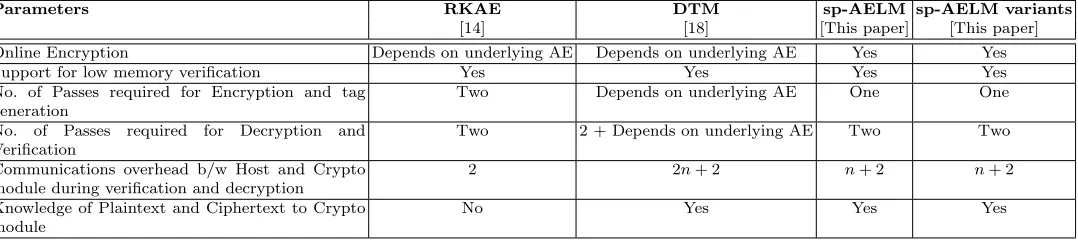
Table 1 Description: This table shows the comparison of RKAE, DTM, the proposed scheme sp-AELM and sp-AELM variants. Our proposed scheme and its variants support online encryption. However, in the case of RKAE and DTM, it depends on the underlying AE scheme that is used. All these three schemes support low memory verification, i.e., there is no need to store message blocks on a cryptographic module during decryption. Next we compare these schemes on the basis of number of passes required for encryption and decryption. For a given messageM of nblocks, we use the usual notion of a “pass” as the processing of allnblocks ofM once. The RKAE scheme requires two passes1 for encryption during execution of Conceal algorithm (one pass for encrypting
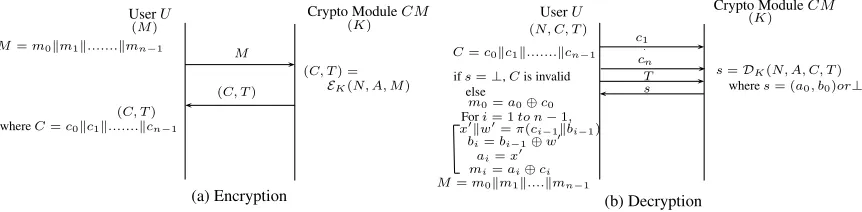
n block message and another pass for computing the hash value on the output of the first pass, explained in Fig. 1(a) ), while the number of passes required for DTM depends on the underlying AE scheme. sp-AELM and its variants require only one pass for encryption i.e. it visits thenblock message exactly once. For decryption and verification, RKAE requires two passes1 as shown in Fig. 1(b) (one pass for computing the hash value and another one for decryption). DTM uses two additional passes for pseudo random number generator (one pass for masking then block message and another for unmasking thenblocks) apart from the number of passes for the underlying authenticated decryption algorithm. sp-AELM and its variants require only two passes (one at the receiver side and another one at the sender side as shown in Fig. 4(b)) for the decryption and verification. We have also used communication overhead between the host and the Crypto module as a comparison parameter in terms of the number of message blocks n. RKAE require only 2 communications(shown in Fig. 1b in ), DTM require 2n+ 2 communications(shown in Fig. 2(b) ) whereas sp-AELM and its variants require n+ 2 communications(shown in Fig. 4(b)).
Parameters RKAE DTM sp-AELM sp-AELM variants
[14] [18] [This paper] [This paper]
Online Encryption Depends on underlying AE Depends on underlying AE Yes Yes
Support for low memory verification Yes Yes Yes Yes
No. of Passes required for Encryption and tag generation
Two Depends on underlying AE One One
No. of Passes required for Decryption and Verification
Two 2 + Depends on underlying AE Two Two
Communications overhead b/w Host and Crypto module during verification and decryption
2 2n+ 2 n+ 2 n+ 2
Knowledge of Plaintext and Ciphertext to Crypto module
No Yes Yes Yes
Table 1.Comparison of RKAE, DTM, sp-AELM and sp-AELM variants:(a) One pass is defined as processing ofnblocks of a message once.(b)The communication overhead is given in terms of number of blocksnfor a messageM.
In addition to this, we also applied the same technique used in sp-AELM on all Sponge based authenticated encryption schemes submitted to the CAESAR competition, to evaluate their suitability for supporting low memory constraint. Currently there are nine Sponge based AE schemes in the CAESAR competition. We addressed all these nine schemes using the same technique that we used in sp-AELM, i.e., during verification and decryption, storing only one intermediate state instead of storing all decrypted text and returning this intermediate state only when tag gets verified. Detailed analysis of the individual scheme is provided in Section 7. Our findings are briefly summarized in Table 2.
Sponge based AE Schemes submitted in CAESAR Support for limited memory devices
(shown in Section 7) Artemia [22], ICEPOLE [29], Ketje [20], Keyak [21], NORX [23],
PRIMATEs(APE, HANUMAN) [17],π-Cipher [13], STRIBOB [27]
No
Ascon [12], PRIMATEs(GIBBON) [17] Yes
Table 2.Analysis of CAESAR schemes showing their suitability for supporting limited memory constraint.
Roadmap : The rest of this paper is organized as follows: Section 2 gives the brief description of Remote Key Authenticated Encryption [14] and the protocol defined in [18]. Section 3 defines some preliminaries followed by Section 4 that defines the construction of the proposed AE scheme (sp-AELM). We provide the security proof of the proposed scheme in Section 5. In Section 6, we present two more efficient variants of sp-AELM. Section 7 presents the brief analysis of all Sponge base AE schemes submitted to the CAESAR competition. Finally, we conclude this paper with Section 8.
2 Previous Work
2.1 Remotely Keyed Authenticated Encryption
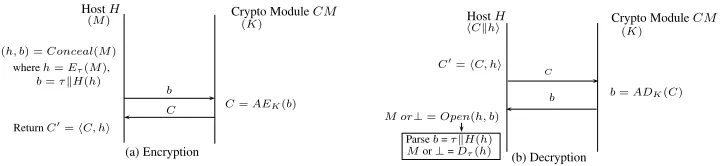
In [14] Dodis et al. proposed a formalized solution to the problem of remotely keyed authenticated encryption (RKAE). One round of the proposed scheme consists of seven different algorithms that run between two parties called the host and the cryptographic module: (RKG, StartAE, CardAE, FinishAE, StartAD, CardAD, FinishAD). In this scheme, the authors used the smart card as the Crypto module. The host is assumed to be powerful but insecure, and the Crypto module is assumed to have low bandwidth and limited memory but taken to be secure. For a given authenticated encryption scheme AE, we explain the RKAE using an example. First, the RKG runs and produces the secret keyK and this key gets stored on the Crypto module. The process of encryption is divided into 3 parts (shown in Fig. 1(a)):
1. First, the host runs a probabilistic algorithm StartAE on input M (which we conveniently rename Conceal
and produces (h, b) pair, where|b|<<|h|,h ← Eτ(M), b=τkH(h), E is any one time symmetric encryption algorithm, τ is the session key and H(.) is a collision resistant hash function. Next, b is sent to the Crypto module while h will be used as a part of the final ciphertext.
2. On receiving b, the Crypto module runs an authenticated encryption algorithm CardAE, which could be any
AE scheme using secret key K, which produces C=AEK(b) and sends it to the host. Note that the keyK is only known to the Crypto module.
3. At the end, the host runs FinishAE by producingC0= hC, hipair as the resulting authenticated encryption of
Similarly, the process of decryption is divided into 3 parts (shown in Fig. 1(b)):
1. For decryption, the host initially has the pairC0=hCkhi, out of which he sends C to the Crypto module. 2. Crypto module receivesC and runs CardAD which is an authenticated decryption algorithmAD using secret
key K, and outputs b=ADK(C) that will be sent to the host.
3. Finally, the host runs FinishAD (which we conveniently rename Open(h, b)). This deterministic algorithm Open(h, b) outputs M if (h, b) is a“valid” pair, otherwise it returns the invalid operator ⊥. Open(h, b) first parses bintoτkH(h), and then usesτ to decrypt h.
HostH Crypto ModuleCM
hCkhi (K)
C′=hC, hi C
b=ADK(C) b
M or⊥=Open(h, b)
HostH Crypto ModuleCM
(M) (K)
(h, b) =Conceal(M)
b
C=AEK(b) C
ReturnC′=hC, hi whereh=Eτ(M),
b=τkH(h)
(a) Encryption ParseMorb⊥==τDkHτ((hh)) (b) Decryption
Fig. 1.Remote Key Authenticated Encyprion
2.2 Decrypt-Then-Mask Protocol
In [18], Fouque et al. proposed a generic construction called Decrypt-then-mask. Their construction doesn’t affect encryption, only the decryption part is modified. They use a pseudorandom number generator to mask the plaintext blocks, to eliminate the need of storing plaintext blocks. Once the tag gets verified, the scheme returns the seed of the PRNG that has been used to mask the plaintext blocks. We use CM to denote cryptographic module andU
to represent user of this device in further description of the scheme. For a given authenticated encryption scheme
AE, the encryption and decryption component work as follows (shown in Fig. 2):
UserR Crypto ModuleCM
(C, T) (K)
C=c1kc2k...kcn s0← {0,1} s
c1 p1 c2 p2
cn pn T s
fori= 1,2...., n mi=ADK(ci) (ri, si)←P RN G(si−1)
pi=mi⊕ri
ifTsis valid=s 0 elses=
⊥ ifs=⊥,Cis invalid
else
s0=s
fori= 1,2...., n
(ri, si)←P RN G(si−1)
mi=pi⊕ri
$ UserR Crypto ModuleCM
(M)
M=m1km2k...kmn
(C, T) =AEK(M) (K)
(a) Encryption (b) Decryption with Masking
whereC=c1kc2k...kcn (C, T)
M
(C, T)
Fig. 2.Encryption and Decryption using Decrypt-Then-Mask Protocol: In (b)decryption, to represent it diagrammatically we assume
ADK(ci) returns the intermediate valuemi.
1. UserU is given ciphertext-tag (C, T) pair,where C=c1kc2k...kcn, and he wants to decrypt it only if it has not been modified.
2. Crypto moduleCM executes the seed generation algorithm to generate a random seeds0 for the PRNG and generates (r1, s1) = PRNG(s0). User U sends first ciphertext block c1 toCM. Crypto module CM initializes the tag computation and decryptsc1 to generatem1 =ADK(c1) and masksm1to obtainp1=m1⊕r1 and sends it to U. In general,ADK(.) takes (C, T) pair as input and returns plaintextM or invalid operator ⊥(if the tag
T is not valid). For better explaination, we assumeADK(ci) returns the intermediatemi.
4. Once the processing of all ciphertext blocks get done,U sends tagT toCM and the Crypto moduleCM checks validity of the tag. If the tag is valid then it returns s0 toU, otherwise it returns invalid symbol⊥.
5. IfU receivess0, i.e., tag is valid and it decryptsp1kp2k....kpn. Fori= 1,2...n, it generates (ri, si)= PRNG(si−1), and decrypt pi as mi= pi⊕ri. Finally plaintext M= m1km2k....kmn. If U receives ⊥ then the tag is invalid and the plaintext M can not be generated.
3 Preliminaries
Definition 1 (Ideal Online Function) Let func(A, B) be defined as set of all functions from set A to set B. Now, we define ideal online function$pad as:
$pad(N, A, M, f lag)→
(C, T) if f lag is 1,
C if f lag is 0,
where,
pad(X)=Xk10t where t is a non-negative integer s.t |Xk10t|= pr for p >0 and some fixed r.
N= nonce ofr bit,
A= Associated data, where |A|< rand A0=pad(A),
M= input message that can be partial or complete depending on the flag value,
f lag =
0 ; if user has queried partial message M ,
1 ; if user has queried complete message M .
In case f lag = 0, we are assuming user has supplied incomplete message and wlog length of supplied message (|M|) is multiple of r.
M0 =
m0k. . .kmn−1=M, where n=|M|/r and|mi|=r ; if flag=0 ,
m0k. . .kmn−1=pad(M) s.t. |mi|=r f or 0≤i≤n−1 ; if flag=1 .
C =c0kc1k. . .kcn−1 where cj =g(N, A0, m0k. . .kmj) for j= 0, . . . , n−1, and
g←−$ f unc({0,1}r× {0,1}r×({0,1}r)+,{0,1}r),
T =g0(N, A0, M0), where g0 ←−$ f unc({0,1}r× {0,1}r×({0,1}r)+,{0,1}t).
Notice that above function is online: here prefixes of outputs remain the same if prefixes of the inputs remain constant. Furthermore, if we consider that nonce and associated data are unique for each function invocation in the ideal online function, then we acheive full privacy. This is because the inputs to g and g0 will then be unique for each invocations, and sincegandg0 are functions randomly chosen from f unc, we get outputs that are independent and uniformly distributed.
Definition 2 (Privacy)For a given authenticated encryption scheme AE= (K,E,D), we define privacy in terms of the ability of an adversary A to distinguish between the output of an encryption oracle E from the output of an ideal online function $pad. We define
AdvAEpriv(A) =P r[K ←− K$ :AEK(.,.,.,.)⇒1]−P r[A$pad(.,.,.,.)⇒1]
The oracle EK on input (N, A, M, f lag), returns the C or (C, T) depending on the flag value whereas the oracle
$pad on input (N, A, M, f lag), works as defined in Def. 1. Here the advantage of an adversary A will be its ability
to distinguish between the ciphertext outputs from the EK and$pad .
Definition 3 (Authenticity). Here we give a notion of authenticity of the ciphertext tag pair of an authenticated encryption scheme. For a given authenticted encryption scheme AE = (K,E,D), let A be an adversary having an encryption oracle EK. We say that A forges if it outputs a (N, A, C, T) tuple where DK(N, A, C, T)6=IN V ALID
and adversary A didn’t ask a query EK(N, A, M, f lag) that resulted in response(C, T).
Let ExpAuthΠ (A) be the forging experiment for a given AE. Then the forging experiment is defined as follows:
1. Adversary A can query encryption oracle E, decryption oracleD atmost qenc, qdec times respectively.
3. If adversary A is able to generate a (N, A, C, T) tuple ∈/ R that produces valid message M, then he wins and output is 1 otherwise output is 0, after trying qdec number of queries.
We say adversary wins i.e. he succeed in creating forgery if ExpAuth
AE (A) = 1. So, the advantage of adversary in
forging the scheme is defined as:
AdvAEAuth(A) =P r[ExpAuthAE (A) = 1]
4 Our Construction: sp-AELM
A cryptographic module should not reveal any information about the plaintext until ciphertext-tag pair gets verified. Once the ciphertext gets verified, then crypto device is allowed to reveal the plaintext. However, a cryptographic module is likely to have some storage restriction. Therefore, it can not store a large plaintextM, verify the tag and output M only when M is valid. Traditional authenticated encryption schemes do not satisfy this usage scenario. We propose a new sponge based authenticated encryption scheme sp-AELM that considers this situation. sp-AELM uses a permutation as the underlying cryptographic primitive. Section 4.1 gives detail of the proposed scheme.
4.1 Description of sp-AELM
We now describe the new authenticated encryption scheme sp-AELM that addresses the low memory issue mentioned earlier. Schematic structure of sp-AELM is shown in Fig. 3. Our authenticated encryption scheme takes key K, nonce N, associated data A, plaintext M and f lag as inputs and returns C or (C, T) depending on the value of the f lag, where C represents the ciphertext and T denotes tag or message authentication code (M AC). We denote cryptographic module byCM and the user of this module byU. The user U uses the crypto module CM for encryption, decryption and verification. The encryption and decryption procedures are given in Algorithm 1 and Algorithm 2 respectively.
π
K N
π π
A0 m0
π c0
π mn−2 mn−1
π cn−1 cn−2
π
K A0
π π
N
⊕ ⊕
⊕
⊕ ⊕
⊕ ⊕
⊕
⊕ ⊕
⊕
⊕ ⊕
π Aj−1
⊕
0r 0c
Kr
Kc
⊕ ⊕
⊕
⊕
⊕ ⊕
Nr
Nc
a1
b1
an−2
bn−2
an−1
bn−1
an
bn a0
b0 π
Aj−1
⊕ ⊕
Z0
K′ r
K′ c
N′ r
N′ c
Fig. 3.sp-AELM Construction
4.1.1 Encryption
required initial bits ofZ0 (if tag is of 128 bit, thenT is initial 128 bit of Z0). Finally (C, T) pair is returned to the user, where C=c0kc1k....kcn−1.
Algorithm 1:EncryptionEK(N, A, M, f lag) 1 Initialization:IV1= 0r, IV2= 0c,KrkKc←− {$ 0,1}b,
Iπ={((IV1⊕K)kIV2, KrkKc)}
2 if(f lag= 1)then
3 M=m0km1k...kmn−1, Where|mi|=rand 0≤i <(n−1)
4 P ad(M) =m0km1k...k(mn−1k10r−(|mn−1|+1))
5 else
6 M=m0km1k...kmn−1, Where|mi|=r
7 if|mn−1|< rthen{return Invalid;}
8 P ad(A) =A0kA1. . .kAj−1s.t.|Ai|=rand 0≤i <(j−1)
9 x=Kr⊕N ,w=Kc
10 NrkNc=π(xkw)
11 x=Nr,w=Nc⊕w
12 fori= 0→j−1do
13 x0kw0=π(x⊕Aikw)
14 w=w0⊕w, x=x0
15 a0=x0, b0=w0
16 c0=a0⊕m0
17 fori= 1→n−1do
18 x0kw0=π(ci−1kbi−1)
19 bi=bi−1⊕w0
20 ai=x0
21 ci=ai⊕mi
22 C=c0kc1k...kcn−1
23 if(f lag= 0)then
24 ReturnC; Exit
25 ankbn=π(cn−1kbn−1)
26 x=an, w=bn
27 x=x⊕K
28 K0rkKc0=π(xkw)
29 x=K0r⊕N ,w=Kc0⊕w
30 Nr0kNc0=π(xkw) 31 x=Nr0,w=N
0 c⊕w
32 fori= 0→j−1do
33 x0kw0=π(x⊕Aikw)
34 w=w0⊕w, x=x0
35 T =Z0=x
36 Return (C, T)
Algorithm 2:Decryption DK (N, A, C, T) 1 Initialization:IV1= 0r, IV2= 0c,KrkKc←− {$ 0,1}b,
Iπ={((IV1⊕K)kIV2, KrkKc)}
2 |P ad(A)|=r 3 x=Kr⊕N ,w=Kc
4 NrkNc=π(xkw)
5 x=Nr,w=Nc⊕w
6 fori= 0→j−1do
7 x0kw0=π(x⊕Aikw)
8 w=w0⊕w, x=x0
9 a0=x, b0=w
10 m0=a0⊕c0
11 fori= 1→n−1do
12 x0kw0 =π(ci−1kbi−1)
13 bi=bi−1⊕w0
14 ai=x0
15 mi=ai⊕ci
16 M=m0km1k...kmn−1
17 x=an, w=bn
18 x=x⊕K
19 Kr0kKc0 =π(xkw)
20 x=Kr0⊕N ,w=Kc0⊕w
21 Nr0kNc0 =π(xkw)
22 x=Nr0,w=Nc0⊕w 23 fori= 0→j−1do
24 x0kw0=π(x⊕Aikw) 25 w=w0⊕w, x=x0
26 Z0=x
27 if (Z0==T)then
28 Return (a0, b0)
29 else
30 Return⊥
4.1.2 Decryption and Verification
The algorithm for decryption DK(., ., ., .) is given in Algorithm 2. The decryption process is similar to encryption. All the steps are same except for XORing with the message. The only difference is rather than XORing with
mi, we XOR with ci. Once the message block mi is evaluated we use that as input just like encryption. Here in this decryption algorithm, we just store (a0, b0) value, all m0is block not get stored anywhere. Finally tag Z0 is calculated. Once the tag becomes available , the given tagT is compared withZ0. If tag gets verified, i.e.,Z0=T, then algorithm returns (a0, b0) value. Once the user get this value, he can easily recover plaintext M from C as
m0=c0⊕a0,m1=c1⊕π(c0, b0)[initialr bit] and so on (explained in Algorithm 2). If tag doesn’t get verified, then it returns invalid operator, i.e., plaintext cannot be calculated in this case. Fig. 4(b) shows the decryption protocol used in this new scheme.
5 Security Proof
UserU Crypto ModuleCM
c1
C=c0kc1k...kcn−1
s m0=a0⊕c0
Fori= 1to n−1, x′kw′=π(c
i−1kbi−1)
bi=bi−1⊕w′
ai=x′
mi=ai⊕ci
M=m0km1k....kmn−1
s=DK(N, A, C, T)
wheres= (a0, b0)or⊥ ifs=⊥,Cis invalid
else Crypto ModuleCM UserU
(N, C, T) (K)
(M) (K)
M=m0km1k...kmn−1
(C, T) = (C, T)
(a) Encryption (b) Decryption
EK(N, A, M)
(C, T) whereC=c0kc1k...kcn−1
M cn
T
Fig. 4.Encryption and Decryption protocol for sp-AELM
simplicity of proof, we have considered associated data of one block only. This can be further extended with minor changes in proof.
5.1 Privacy
We obtain an upper bound for the advatnage of the adversary who can distinguish the output of the proposed scheme with a random oracle in the ideal permutation model.
Theorem 1. Let Π = (K,E,D) denote the proposed Authenticated Encryption scheme with defined padding rule and an permutation π, which operates on b bits. The adversary A has given access to π, π−1. Then the advantage of A relative to E is given by
AdvΠpriv(A) =P r[K ←− K$ :AEK(),π,π−1 = 1]−P r[K←− K$ :A$pad(),π,π−1 = 1] .
AdvprivΠ (A)≤ σ(σ−1)
2b+ 1 +
σ(σ−1) 2c+ 1 +
(qπ +qπ−1).qenc
2r +
2(qπ+qπ−1)σ
2c−σ +
qπ 2r .
where $padis defined in Def. 1,σ is the maximum number of block calls toπ, π−1 by encryptionEand decryption
D algorithm . qenc, qπ and qπ−1 are the maximum number of queries to encryption oracle Enc, π and π−1 oracle
respectively by adversary A.b(=r+c) is the size on which π permutation operates.
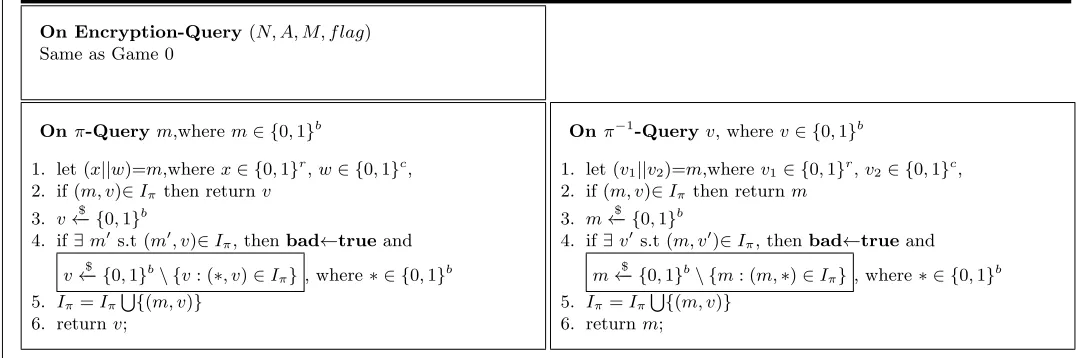
Proof. The advantage of the adversary is his ability to distinguish the proposed scheme from a random oracle. We used the game based framework to compute this advantage. We define a sequence of nine games from G0 to
G8 given in supporting document along with this paper, where Game G0 represents the proposed scheme and
G8 represents completely random output. Computations for probability difference between consecutive games are provided below.
Game G0: In this game encryption oracle perfectly simulates the proposed algorithm AE −Eπ,pad and π, π−1
oracle simulate an ideal permutation and its inverse.
P r[AEk,π,π−1 = 1] =P r[AG0= 1]
Game G1: Game G1 is exactly same as gameG0.
P r[AG0 = 1]=P r[AG1 = 1]
Game G2: Game G1 and G2 differs only when bad event occurs, otherwise, in absense of bad event, both games are same.
|P r[AG1 = 1]-P r[AG2 = 1]| ≤ P r[bad]
Bad event occurs when input toπ andπ−1 collide with the elements in setIπ. So, the probability of bad event will be equal to the probability of collision in π andπ−1. LetP r[coll] be the probability of collision in π and π−1, then
LetP r[colli] = (i−1)/2b be the probability that there is no collision tilli−1 queries and it occurs inith query. ThusP r[coll] can be calculated as:
P r[coll] =P r[coll1∨coll2∨...collσ]
≤P r[coll1] +P r[coll2] +...+P r[collσ]
≤ 1
2b + 2
2b +...+
σ−1 2b
≤ σ(σ−1)
2b+1 . Hence, the probability difference betweenG1 and G2 is
|P r[AG1= 1]-P r[AG2 = 1]| ≤ σ(σ−1) 2b+1
Game G3: Game G2 and G3 are identical. In game G3, Encoracle simulates behaviour of π, so it becomes independent ofπ. Hence, Game G2 andG3 are same from adversary point of view.
P r[AG2 = 1]=P r[AG3 = 1]
Game G4: Game G3 and G4 differ only when bad event occurs, otherwise both are exactly same. This bad
event occurs if collision happens over cbits inside Ic set inG4.
|P r[AG3 = 1]−P r[AG4 = 1]|≤P r[bad]
And, P r[bad]≤P r[collision over c bits]
P r[collision over c bits]≤ 1
2c + 2
2c +...+
σ−1 2c
≤ σ(σ−1)
2c+1
Hence, |P r[AG3 = 1]−P r[AG4 = 1]| ≤ σ(σ−1)
2c+1
Game G5: Game G4 and G5 are exactly same from adversarial point of view. We have created two new sets
Iπ0 and Iπ00, where, Iπ0 keeps store for all the queries to encryption oracle andIπ00 keeps store for all the queries toπ
and π−1 oracle. Now, set Iπ is union of Iπ0 and I
00
π. This doesn’t make any difference in functionality of game G4 and G5.
P r[AG4= 1] = P r[AG5 = 1]
Game G6: Game G5 and G6 are same, except G6 makes an additional check in sets Iπ0 and Iπ00 . But from adversary’s perspective both games are exactly same.
P r[AG5= 1] = P r[AG6 = 1]
Game G7:Game G6 and G7 will differ in presence ofbad1,bad2 and badevent.
|P r[AG6 = 1]-P r[AG7 = 1]| ≤ P r[bad1] +P r[bad2] +P r[bad]
We are assuming here that qπ and qπ−1 query already has been queried to π and π−1 oracle respectively. And
maximum number of encryption queries areqenc.
Calculation for bad1 event :bad1 is an event of having collision at the first block over r bits in setIπ00 forG6, as c bits are fixed here. So,
P r[bad1]≤ P r[collision over r bits]
And, P r[collision over r bits]≤ (qπ+qπ−1).qenc
2r
Calculation for bad2 event : bad2 is an event of having collision over c bits in set Iπ00 for G6, as r bits can be controlled by adversary (by changing message). And thesec bits are generated randomly and different each time.
And, P r[collision over c bits]≤ (qπ +qπ−1)σ
2c−σ
Calculation for probability ofbadevent : Here,badis an event of having collision in the setIπ00. This can happen either if collision occurs over c bit for a message M, as r bits can be controlled by an adversary or he is able to guess the key correctly. Hence,
P r[bad]≤P r[correct key guess] +P r[collision over c bits] Here, P r[collision over c bits]≤ (qπ+qπ−1)σ
2c−σ (same as computed above)
And, P r[correct key guess]≤ qπ
2r So, |P r[AG6 = 1]-P r[AG7= 1]| ≤ (qπ+qπ−1).qenc
2r +
2(qπ+qπ−1)σ
2c−σ +
qπ 2r
Game G8: In game G7 each ciphertext block is generated randomly, then concatenated and return to an adversary. Similarly Tag is also generated randomly. However, in GameG8, ciphertext and tag of desired length is selected as a random string and returned to an adversary. This move fromG7 to G8 doesn’t make any difference, as in both the games output is generated as completely random value. So,
P r[AG7= 1] = P r[AG8 = 1]
Finally, using the fundamental lemma of game based framework,
AdvΠpriv(A) =P r[K ←− K$ :AEK,π,π−1 = 1]−P r[K ←− K$ :A$pad(),π,π−1 = 1]
=|Pr[AG0 = 1]−P r[AG8 = 1]|
=|(P r[AG0= 1]−P r[AG1= 1])|+|(P r[AG1 = 1]−P r[AG2 = 1])|
+|(P r[AG2 = 1]−P r[AG3 = 1])|+|(P r[AG3 = 1]−P r[AG4 = 1])|
+|(P r[AG4 = 1]−P r[AG5 = 1])|+|(P r[AG5 = 1]−P r[AG6 = 1])|
+|(P r[AG6 = 1]−P r[AG7 = 1])|+|(P r[AG7 = 1]−P r[AG8 = 1])| ≤0 +σ(σ−1)
2b+ 1 + 0 +
σ(σ−1)
2c+ 1 + 0 + 0 +(qπ+qπ−1).qenc
2r +
2(qπ+qπ−1)σ
2c−σ +
qπ 2r .
5.2 Authenticity
In this section, we analyze the security of authenticity of the tag produced in our scheme. The forgery of an AE scheme is defined as the ability of an adversaryA to generate a valid (N, A, C, T) tuple, without directly querying it to the encryption oracle. The adversary is allowed to make limited number of queries to encryption, decryption,
π and π−1 oracles. For an AE scheme, we say the adversary A is successful in forging if it outputs a (N, A, C, T) tuple whereDK(N, A, C, T)6=IN V ALID and adversaryA didn’t ask a queryEK(N, A, M, f lag) that resulted in response (C, T) .
Theorem 2. Let Π = (K,E,D) be the proposed authenticated encryption scheme with defined padding rule (pad) and ideal permutation (π) which operate on b(=r+c) bits. The adversary A is given access to Encryption oracle E, Decryption oracle D,π and π−1 oracle. ThenΠ = (K,E,D) is forgeable with the probability
P r[ExpAuth
Π (A) = 1]≤
σ(σ−1) 2b+1 +
σ(σ−1) 2c+ 1 +
qdec 2|T| +
qπ 2r .
whereσ is maximum number of blocks to π, π−1 by encryption oracleE, and decryption oracleD,qdecis the number
of queries to decryption oracle, qπ is the number of queries to π oracle and|T|is the tag length.
Proof: We used code base gaming framework to calculate the adversary advantage. Here we used the set of five games(G00, G10, G20, G30, G40) that is same as initial five games for privacy proof except that decryption oracle will also work here. Games are given in supporting document with this paper. Our goal is to bound the adversary’s advantage which is defined as follows:
Here, probability calculations will be same as that of initial five games of privacy explained in Section 5.1. So, we will directly use the results from there.
Calculations forP r[ExpAuthG40 (A= 1)]: In this gameG40, adversary gets a success in generating valid tag pair either
by choosing tag randomly after trying qdec number of queries or he guesses the key correctly. Hence adversary’s ability to win in this game will be:
P r[ExpAuthG4 (A= 1)]≤P r[correct key guess] +P r[random tag generation]
≤ qπ
2r +
qdec 2|T|
On combining the results obtained in all the games, equation (1) becomes,
AdvΠAuth(A) =P r[ExpAuthΠ (A) = 1]
≤ |P r[ExpAuthG10 (A) = 1]−P r[ExpAuthG20 (A) = 1]|+P r[ExpAuthG20 (A) = 1]
≤σ(σ−1)
2b+1 +P r[Exp Auth
G30 (A) = 1]
≤σ(σ−1)
2b+1 +|P r[Exp Auth
G30 (A) = 1]−P r[ExpAuthG40 (A) = 1]|+P r[ExpAuthG40 (A) = 1]
≤σ(σ−1)
2b+1 +
σ(σ−1) 2c+1 +
qπ (2c−q
π)2
+P r[ExpAuthG40 (A) = 1]
≤σ(σ−1)
2b+1 +
σ(σ−1) 2c+1 +
qdec 2|T| +
qπ 2r .
AdvAuthAE (A) ≤0 +σ(σ−1) 2b+ 1 + 0 +
σ(σ−1) 2c+ 1 +
qπ (2c−qπ)2
+ 1
2|T| .
6 More variants of sp-AELM
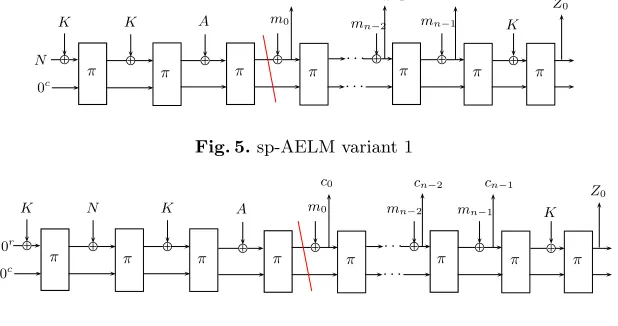
This section presents two more variants of sp-AELM. The advantage of these variants over actual construction is that it doesn’t require feed forward operation. Schematically construction of sp-AELM variants are shown in Fig. 5 and Fig. 6. These variants support the low memory constraint in a same way as in sp-AELM by storing only one intermediate state(shown using red line in Fig. 5 ) instead of storing complete text. Security proof for these constructions are not provided here due to space restrictions, although, it can be proved in same manner as sp-AELM. Intuitively, we can say these are secure as releasing intermediate state will not result for the adversary to gain any information about key. One can choose these variants over sp-AELM, when there is very limited amount of memory, which is not even capable of storing states required for feed-forward operation.
π
K K
π π
A m0
π c0
π mn−2 mn−1
π cn−1 cn−2
K Z0
. . .
⊕
. . .
⊕ ⊕ ⊕ ⊕ ⊕ ⊕
N
0c π
Fig. 5.sp-AELM variant 1
π
K N
π π
A m0
π c0
π mn−2 mn−1
π cn−1 cn−2
K Z0
. . .
⊕
. . .
⊕ ⊕ ⊕ ⊕ ⊕ ⊕
0r
0c π
K
π
⊕
Fig. 6.sp-AELM variant 2
7 Analysis of Sponge based AE schemes submitted in CAESAR
to determine their suitability for supporting devices having limited memory constraint. There are ten sponge based AE schemes submitted to CAESAR for the first round, out of which one scheme (CBEAM [26]) has been withdrawn. Currently there are nine sponge basedAE schemes competing for the next round. In the following subsections we present the brief analysis of each of these 9 schemes after applying the same technique used in sp-AELM.
7.1 ARTEMIA [22]
Artemia is family of dedicated authenticated encryption scheme. It has two variants Artemia-256 which uses 512 bit permutation and Artemia-128 which uses 256 bit permutation in the JHAE mode(shown in Fig. 7).
While analyzing this mode, we find that it can not support low memory device constraint. Our analysis is based on the same technique proposed in sp-AELM i.e., storing only one intermediate state(shown using red line in Fig. 7) instead of storing whole message during decryption, can not be applied here. Using this intermediate state attacker can find the value of key as he already knows the value ofT and can do the forward computation usingCis to get the state value after lastπ block, XORing this value withT will result in value ofK.
⊕ ⊕
⊕
⊕ ⊕
⊕ ⊕
⊕ ⊕
⊕ ⊕
⊕ ⊕
⊕
⊕ ⊕ ⊕
π π π π
π π
π IV
K
N
K T
A1 A2 Ai−1 Ai
M1 M2 Mj−1 Mj
C1 C2 Cj
Fig. 7.JHAE Mode
⊕ ⊕
⊕ ⊕
⊕
⊕
⊕ ⊕
pa pb pb pb pa
pb pb KkN
kkakbk0∗
A1 Ai
C1
P1 Pj
Cj
0∗kK 0∗k1 Kk0∗
K
T
Fig. 8.ASCON
7.2 ASCON [12]
ASCON is a family of authenticated encryption designs ASCONa,b−k. The family members are parameterized by the key lengthk≤128 and internal round numbers aand b. Each design specifies an authenticated encryption algorithm Ek,a,b and decryption algorithmDk,a,b.
On analyzing this scheme, we find out that it can support low memory devices by storing only one intermediate value(shown using red line in Fig. 8) instead of storing all decrypted blocks during decryption, without breaking the security of construction. This is due to the use of key at the end, which also prevents attcacker from doing forgery. Further, this intermediate value can be used to decrypt the message at user side.
7.3 ICEPOLE [29]
ICEPOLE is a family of authenticated ciphers with three parameters: key length, secret message number legth, nonce length. The construction of ICEPOLE is shown in Fig. 9.
Here, if we store intermediate state(shown using red line in Fig. 9) instead of whole decrypted text blocks to support low memory feature, it will result in revealing the key value, as attacker can do calculation in reverse direction to get the actual value of key.
⊕ ⊕
pad
⊕
P12
⊕
pad
⊕
pad
⊕
pad
⊕
⊕
pad
⊕
P6 P6 P6 P6 P6
KkN T
σSM N CSM N
σAD
0 σADi C0σ0P σ
P j Cj
Fig. 9.ICEPOLE
⊕ ⊕ ⊕ ⊕
⊕
IV r
c
π π π π π π π
p0 p1 p... t0 t... c0 c1 c...
d0 d...
7.4 STRIBOB [27]
STRIBOB is an algorithm for authenticated encryption with associated data. It is built on basic sponge mode of authenticated encryption(shown in Fig. 10).It uses a 512 512 bit permutation π as its cryptographic foundation.
Π in turn is built from 12 iterations of LPS transformation, interleaved with exclusive-or operation with round constants.
In STRIBOB, if we store only intermediate state(shown using red line in Fig. 10), instead of storing all Pi0s, attacker can get the actual key value by using inverse permutation.
7.5 Π-Cipher [13]
Π-Cipher is parallel, incremental, nonce based, tag second-preimage resistant, authenticated encryption cipher with associated data. Its construction is shown in Fig. 11.
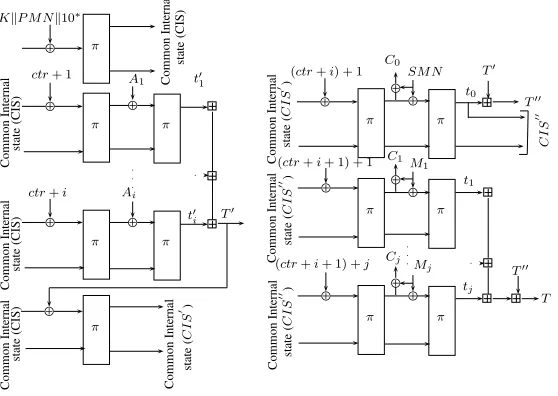
This AE scheme can not support limited memory constraint. Suppose if we store CIS00 and ctr+i+ 2 values instead of storing all decrypted text blocks. Now using these intermediate values and known ciphertext values attacker can calculate the plaintext and Tag T00. However using this T00 he can not get the key due to the unavailability of Secret message number(SMN). Though it is secure against key recovery attack but forgery is possible here. As using T00, it is easy to generate a new ciphertext C and its corresponding valid tag T using a repeated nonce(SM N). This is due to the reason that T00value will be same for a given key K and secret message number SM N.
⊕ KkP M Nk10∗
π ⊕ π ⊕ π ⊕ π ⊕ π ⊕ π A1 Ai
t′1
t′ i T′ ctr+ 1
ctr+i
C om m on In te rn al st at e (C IS ) C om m on In te rn al st at e (C IS ) C om m on In te rn al st at e (C IS ) C om m on In te rn al st at e (C IS ) C om m on In te rn al st at e ( C I S ′ ) ⊕ π ⊕ π ⊕ ⊕ π π ⊕ π π ⊕ ⊕ ⊕ ⊕
SM N T′ t0
T′′
C1M 1 Mj Cj t1 tj T′′ T (ctr+i) + 1
(ctr+i+ 1) + 1
(ctr+i+ 1) +j
C om m on In te rn al st at e ( C I S ′ ) C om m on In te rn al st at e ( C I S ′′ ) C I S ′′ C0 C om m on In te rn al st at e ( C I S ′′ )
Fig. 11.Π Cipher
7.6 PRIMATE [17]
The authenticated encryption family PRIMATEs is defined by two parameters: the security levels∈ {10,15} and mode of operation scheme∈ {GIBBON, HANUMAN, APE}. These modes are shown in Fig. 12, 13, 14.
⊕
⊕ ⊕ ⊕ ⊕
⊕ ⊕
P1 P2 P1
T
0c/2kK K A1
. . .
. . .
Ai P1
C1
Pj Cj
. . .
. . .
P2 P3 P3 P3
0c/2kK 0r
NkK
Fig. 12.GIBBON
⊕ ⊕ ⊕ ⊕
⊕
P1
T
K A1
. . .
. . .
Ai P1
C1
Pj
Cj
. . .
. . .
P4 P1 P1 P1
0r
NkK
Fig. 13.HANUMAN
⊕ ⊕ ⊕ ⊕
⊕
P1
T
K A1
. . .
. . .
Ai P1
C1
Pj−1
Cj−1
. . .
. . .
P1 P1 P1 P1
0r
K
⊕
0b−1k1
⊕
Cj
Pj
P1
Fig. 14.APE
7.7 NORX [23]
NORX is an authenticated encryption scheme supporting an arbitrary parallelism degree, based on ARX primitives yet not using modular additions. NORX has a unique parallel architecture based on the monkeyDuplex construction [19]. Fig. 15 represents layout of NORX corresponding toD= 1. Here also, revealing the intermediate state(shown using red line in Fig. 15) will result in finding value of key by doing computation in reverse direction using inverse permutation, breaking the security of construction.
⊕ ⊕
⊕
⊕ ⊕
⊕ ⊕
⊕ ⊕
⊕ ⊕
⊕ ⊕
FR FR FR FR FR FFRR FR FR FR
T ag init(K, N, W, R, D,|T|)
0
0
01 01 02 02 04 04 08
H . . . HmH P . . .
C . . . PmP
CmP
T . . . TmT
Fig. 15.NORX for D=1
7.8 Ketje [20]
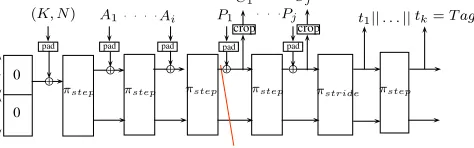
Ketje is a set of two authenticated encryption functions with support for message associated data. Ketje builds on round-reduced versions of Keccak-f[400] and Keccak-f[200].The construction calling these permutations is MonkeyDuplex [19], a variant of the duplex construction [9]. The mode that runs on top of MonkeyDuplex is called MonkeyWrap. The MonkeyWrap differ from SpongeWrap as it is built on MonkeyDuplex construction rather than on Duplex, it updates a whole state of b bits using key and nonce together instead of updating only bitrate part (r bits) in SpongwWrap and uses a different MonkeyDuplex call when transitioning to tag generation phase.
Implementation of low memory constraint is not possible for this scheme. As shown in the Fig. 16, storing intermediate state(shown using red line in Fig. 16), will result in finding value of keyK using inverse permutation.
7.9 Keyak [21]
pad pad
A1 Ai
pad
P1 C1
pad
Pj
Cj
t1||. . .||
πstep πstep πstep πstep πstride
(K, N)
pad
⊕ ⊕ ⊕ ⊕ ⊕
0
0
crop crop
πstep
tk=T ag
r
c
Fig. 16.MonkeyWrap mode of Authenticated Encryption
forward secrecy. Because of this forget call it is not possible to get the key from the intermediate state. But the forgery attack is possible by generating valid ciphertext tag pair for a different message using same key and nonce.
8 Conclusion
In this paper, we proposed a new generalized technique for AE schmes to support devices with limited memory. This new technique has been explained in this paper through a new sponge based AE scheme sp-AELM. sp-AELM can be used to support cryptographic modules having limited storage capabilities. We provided its security proof in an ideal permutation model using code based game playing framework for both privacy and authenticity. In addition to this, we also present two more variants of sp-AELM that serve the same purpose and are more efficient than sp-AELM. Further, we applied this newly introduced technique to all Sponge based AE schemes submitted to the CAESAR competition for determining their suitability to support devices with memory constraint. Our analysis shows that ASCON and one of the PRIMATEs instance namely GIBBON, can support limited memory constraint using this technique, while remaining schemes are not directly suitable for this scenario.
References
1. CAESAR: Competition for authenticated encryption: Security, applicability, and robustness, 2014. http://competitions.cr.yp. to/caesar.html.
2. Elena Andreeva, Beg¨ul Bilgin, Andrey Bogdanov, Atul Luykx, Bart Mennink, Nicky Mouha, and Kan Yasuda. APE: Authenticated permutation-based encryption for lightweight cryptography. IACR Cryptology ePrint Archive, 2013:791, 2013.
3. Mihir Bellare and Chanathip Namprempre. Authenticated Encryption: Relations Among Notions and Analysis of the Generic Composition Paradigm. J. Cryptol., 21(4):469–491, September 2008.
4. Mihir Bellare and Phillip Rogaway. Encode-Then-Encipher Encryption: How to Exploit Nonces or Redundancy in Plaintexts for Efficient Cryptography. In Tatsuaki Okamoto, editor,ASIACRYPT, volume 1976 of Lecture Notes in Computer Science, pages 317–330. Springer, 2000.
5. Mihir Bellare and Phillip Rogaway. Code-Based Game-Playing Proofs and the Security of Triple Encryption. IACR Cryptology ePrint Archive, 2004:331, 2004.
6. Mihir Bellare, Phillip Rogaway, and David Wagner. EAX: A Conventional Authenticated-Encryption Mode. IACR Cryptology ePrint Archive, 2003:69, 2003.
7. Guido Bertoni, Joan Daemen, Michael Peeters, and Gilles Van Assche. Duplexing the Sponge: Single-Pass Authenticated Encryption and Other Applications. In Ali Miri and Serge Vaudenay, editors,Selected Areas in Cryptography, volume 7118 ofLecture Notes in Computer Science, pages 320–337. Springer, 2011.
8. Guido Bertoni, Joan Daemen, Michal Peeters, and Gilles Van Assche. Cryptographic sponge functions, 2011. http://sponge. noekeon.org/.
9. Bertoni, Guido and Daemen, Joan and Peeters, Micha¨el and Van Assche, Gilles. Duplexing the Sponge: Single-pass Authenticated Encryption and Other Applications. InProceedings of the 18th International Conference on Selected Areas in Cryptography, SAC’11, pages 320–337, 2012.
10. Matt Blaze. High-Bandwidth Encryption with Low-Bandwidth Smartcards. In Dieter Gollmann, editor, FSE, volume 1039 of
Lecture Notes in Computer Science, pages 33–40. Springer, 1996.
11. Matt Blaze, Joan Feigenbaum, and Moni Naor. A Formal Treatment of Remotely Keyed Encryption. In Kaisa Nyberg, editor,
EUROCRYPT, volume 1403 ofLecture Notes in Computer Science, pages 251–265. Springer, 1998.
12. Christoph Dobraunig, Maria Eichlseder, Florian Mendel, Martin Schlaffer. Ascon v1. http://competitions.cr.yp.to/round1/ asconv1.pdf.
13. Danilo Gligoroski, Hristina Mihajloska, Simona Samardjiska, Hakon Jacobsen, Mohamed El-Hadedy and Rune Erlend Jensen. PiCipher v1. http://competitions.cr.yp.to/round1/picipherv1.pdf.
14. Yevgeniy Dodis. Concealment and Its Applications to Authenticated Encryption. In Alexander W. Dent and Yuliang Zheng, editors,
Practical Signcryption, Information Security and Cryptography, pages 149–173. Springer, 2010.
16. Elena Andreeva and Andrey Bogdanov and Atul Luykx and Bart Mennink and Nicky Mouha and Kan Yasuda. How to Securely Release Unverified Plaintext in Authenticated Encryption. In Advances in Cryptology - ASIACRYPT 2014 - 20th International Conference on the Theory and Application of Cryptology and Information Security, Kaoshiung, Taiwan, R.O.C., December 7-11, 2014. Proceedings, Part I, pages 105–125, 2014.
17. Elena Andreeva, Begul Bilgin, Andrey Bogdanov, Atul Luykx, Florian Mendel , Bart Mennink, Nicky Mouha, Qingju Wang and Kan Yasuda . PRIMATEs v1. http://competitions.cr.yp.to/round1/primatesv1.pdf.
18. Pierre-Alain Fouque, Antoine Joux, Gwena¨elle Martinet, and Fr´ed´eric Valette. Authenticated On-Line Encryption. In Mitsuru Matsui and Robert J. Zuccherato, editors, Selected Areas in Cryptography, volume 3006 ofLecture Notes in Computer Science, pages 145–159. Springer, 2003.
19. Guido Bertoni and Joan Daemen and Michal Peeters and Gilles Van Assche. G.V.: Permutationbased encryption, authentication and authenticated encryption, 2012.
20. Guido Bertoni, Joan Daemen, Michael Peeters, Gilles Van Assche, Ronny Van Keer. Ketje v1. http://competitions.cr.yp.to/ round1/ketjev11.pdf.
21. Guido Bertoni, Joan Daemen, Michael Peeters, Gilles Van Assche, Ronny Van Keer. Ketje v1. http://keyak.noekeon.org/ Keyak-1.2.pdf.
22. Javad Alizadeh, Mohammad Reza Aref and Nasour Bagheri. Artemia v1.http://competitions.cr.yp.to/round1/artemiav1.pdf. 23. Samuel Neves Jean-Philippe Aumasson, Philipp Jovanovic. NORX: Parallel and Scalable AEAD, 2014. https://norx.io/. 24. Tadayoshi Kohno, John Viega, and Doug Whiting. CWC: A High-Performance Conventional Authenticated Encryption Mode. In
Bimal K. Roy and Willi Meier, editors,FSE, volume 3017 ofLecture Notes in Computer Science, pages 408–426. Springer, 2004. 25. Stefan Lucks. On the Security of Remotely Keyed Encryption. In Eli Biham, editor,FSE, volume 1267 ofLecture Notes in Computer
Science, pages 219–229. Springer, 1997.
26. Markku-Juhani O. Saarinen. The CBEAMr1 Authenticated Encryption Algorithm. http://competitions.cr.yp.to/round1/ cbeamr1.pdf.
27. Markku-Juhani O. Saarinen. The STRIBOBr1 Authenticated Encryption Algorithm. http://competitions.cr.yp.to/round1/ stribobr1.pdf.
28. David A. McGrew and John Viega. The Security and Performance of the Galois/Counter Mode (GCM) of Operation. In Anne Canteaut and Kapalee Viswanathan, editors, INDOCRYPT, volume 3348 ofLecture Notes in Computer Science, pages 343–355. Springer, 2004.
29. Pawel Morawiecki, Kris Gaj, Ekawat Homsirikamol, Krystian Matusiewicz, Josef Pieprzyk, Marcin Rogawski, Marian Srebrny, and Marcin Wojcik. ICEPOLE v1. http://competitions.cr.yp.to/round1/icepolev1.pdf.
30. Phillip Rogaway, Mihir Bellare, and John Black. OCB: A block-cipher mode of operation for efficient authenticated encryption.
ACM Trans. Inf. Syst. Secur., 6(3):365–403, 2003.
A sp-AELM variant supporting Intermediate tag
This section shows the sp-AELM variant that support intermediate tag generation and fast rejection of forgery for the long messages. Pictorial view is shown on Fig. 17. In this variant message M(=m1km2. . .kmn−1) is divided into small packets(m1..mi, mi+1..mj, . . . , mk..mn−1)and individual tag is caluclated for every packet. Then ciphertext and tag for each packet is sent to receiver. At the receiver side ciphertext for first packet gets decrypted and tag computation id done. If computed tag for first packet matches with received tag then only further computation proceeds otherwise message gets rejected at the early stage only. During decryption only one intermediate state(shown by red line in Fig. 17) is stored instead of storing all decrypted text blocks and this intermediate state is returned to the user once complete message gets verified. Now, user can find the actual plaintext using this received intermediate state.
⊕ ⊕
⊕
⊕
⊕
⊕
⊕ ⊕
⊕
⊕ ⊕
⊕
⊕ ⊕
⊕ ⊕
π π π π π π
π π π
K N A m
0 c0
0r
0c
mi
ci T1
mi+1
ci+1 m
j
cj T2
⊕
⊕ ⊕
⊕ π π
mn−1
cn−1
⊕ ⊕
⊕
⊕
⊕ ⊕
π π π
K N A T
mkck
Fig. 17.sp-AELM variant with Intermediate tag generation
B Games for Privacy Proof
Game G1 and Game G2 : Initialise IV1 = 0r, IV2 = 0c, K ←− {$ 0,1}r,KrkKc ←− {$ 0,1}b,Iπ= {((IV1⊕K)kIV2, KrkKc)}
On Encryption-Query(N, A, M, f lag) Same as Game 0
Onπ-Querym,wherem∈ {0,1}b
1. let (x||w)=m,wherex∈ {0,1}r,w∈ {0,1}c,
2. if (m, v)∈Iπthen returnv
3. v←− {$ 0,1}b
4. if∃m0 s.t (m0, v)∈Iπ, thenbad←trueand
v←− {$ 0,1}b\ {v: (∗, v)∈I
π}, where∗ ∈ {0,1}b
5. Iπ=IπS{(m, v)}
6. returnv;
Onπ−1-Query v, wherev∈ {0,1}b
1. let (v1||v2)=m,wherev1∈ {0,1}r,v2∈ {0,1}c,
2. if (m, v)∈Iπthen returnm
3. m←− {$ 0,1}b
4. if∃v0 s.t (m, v0)∈Iπ, thenbad←trueand
m←− {$ 0,1}b\ {m: (m,∗)∈I
π}, where∗ ∈ {0,1}b
5. Iπ=IπS{(m, v)}
6. returnm;
Game G0:InitialiseIV1= 0r, IV2 = 0c,K←− {$ 0,1}r,KrkKc←− {$ 0,1}b,Iπ={((IV1⊕K)kIV2, KrkKc)}
On Encryption-Query(N, A, M, f lag) 1. if (f lag= 1)then
M =m0km1k...kmn−1, Where|mi|=rand
0≤i <(n−1)
P ad(M) =m0km1k...k(mn−1k10r−(|mn−1|+1))
else
M =m0km1k...kmn−1, Where|mi|=r
if |mn−1|< rthen{return Invalid;}
2. |P ad(N)|=|P ad(A)|=r
3. x=Kr⊕N ,w=Kc
4. NrkNc=π(xkw)
5. x=Nr⊕A,w=Nc⊕w
6. ArkAc=π(xkw)
7. x=Ar,w=Ac⊕w
8. a0=x, b0=w
9. c0=a0⊕m0
10. fori= 1→ndo
x0kw0 =π(ci−1kbi−1)
bi =bi−1⊕w 0
,ai =x 0
ci=ai⊕mi
11. C=c0kc1k...kcn
12. if (f lag= 0)then returnC. 13. x=an, w=bn
14. x=x⊕K
15. Kr0kK 0
c=π(xkw)
16. x=Kr0⊕N ,w=K 0
c⊕w
17. NrkNc=π(xkw)
18. x=Nr⊕A,w=Nc⊕w
19. ArkAc=π(xkw)
20. x=Ar,w=Ac⊕w
21. T =z0=x
22. return (C, T)
Onπ-Querym, wherem∈ {0,1}b
1. let (x||w) =m, wherex∈ {0,1}r,w∈ {0,1}c,
2. if (m, v)∈Iπthen returnv
3. v←− {$ 0,1}b
4. if∃m0 s.t (m0, v)∈Iπ, thenv $
←− {0,1}b\ {v: (∗, v)∈I π},
where∗ ∈ {0,1}b
5. Iπ=IπS{(m, v)}
6. returnv;
Onπ−1-Query v={v
1||v2}. where
v1∈ {0,1}r, v2 ∈ {0,1}c, v∈ {0,1}b
1. if (m, v)∈Iπthen returnm
2. m←− {$ 0,1}b
3. if∃v0 s.t (m, v0)∈Iπ, then
m←− {$ 0,1}b\ {m: (m,∗)∈I
π}, where∗ ∈ {0,1}b
4. Iπ=IπS{(m, v)}
5. returnm;
Game G3 and Game G4 :InitialiseIV1 = 0r, IV2 = 0c, K←− {$ 0,1}r,KrkKc←− {$ 0,1}b,Iπ ={((IV1⊕K)kIV2, KrkKc)},
Ic={w}
On Encryption-Query(N, A, M, f lag) 1. if (f lag= 1)then
M =m0km1k...kmn−1, Where|mi|=rand
0≤i <(n−1)
P ad(M) =m0km1k...k(mn−1k10r−(|mn−1|+1))
else
M =m0km1k...kmn−1, Where|mi|=r
if |mn−1|< rthen{return Invalid;}
2. |P ad(N)|=|P ad(A)|=r
3. x=IV1, w=IV2
4. x=Kr⊕N ,w=Kc
5. if ∃vs.t.(xkw, v)∈Iπ,then
NrkNc=v
else
NrkNc $
←− {0,1}b
if (Nc⊕w)∈Icthenbad←true
Nc $
←− {0,1}c\ {Nc0 : (N 0
c⊕w)∈Ic}
Iπ=Iπ∪ {(xkw, NrkNc)}
6. x=Nr⊕A,w=Nc⊕w
7. Ic=Ic∪ {w}
8. if ∃vs.t.(xkw, v)∈Iπ,then
ArkAc=v
else
ArkAc $
←− {0,1}b
if (Ac⊕w)∈Ic thenbad←true
Ac $
←− {0,1}c\ {A0c: (A 0
c⊕w)∈Ic}
Iπ=Iπ∪ {(xkw, ArkAc)}
9. x=Ar ,w=Ac⊕w
10. Ic=Ic∪ {w}
11. a0=x, b0=w
12. c0=a0⊕m0
13. fori= 1→ndo
if ∃vs.t.(ci−1kbi−1, v)∈Iπ,then
x0kw0 =v
else
x0kw0←− {$ 0,1}b
if (bi−1⊕w 0
)∈Icthenbad←true
w0 ←− {$ 0,1}c\ {w00: (b i−1⊕w
00
)∈Ic}
Iπ=Iπ∪ {(ci−1kbi−1, x 0
kw0)}
bi =bi−1⊕w 0
Ic=Ic∪ {bi}
ai=x 0
ci=ai⊕mi
14. C=c0kc1k...kcn
15. if (f lag= 0)then return C. 16. x=an, w=bn
17. x=x⊕K
Continue...
18. if ∃vs.t.(xkw, v)∈Iπ,then
Kr0kK 0 c=v
else
Kr0kK 0 c
$
←− {0,1}b
if (w⊕Kc0)∈Icthenbad←true
Kc0 $
←− {0,1}c\ {K00
c : (w⊕K 00 c)∈Ic}
Iπ=Iπ∪ {(xkw, K 0 rkK
0 c)}
19. x=Kr0 ⊕N ,w=K 0
c⊕w
20. Ic=Ic∪ {w}
21. Repeat step from 5 to 8. 22. z0=x
23. T =z0
24. return (C, T)
Onπ-Querym, wherem∈ {0,1}b
1. let (x||w) =m, wherex∈ {0,1}r,w∈ {0,1}c, 2. if ∃ {v1, v2, ...vt}s.t. (m, vi)∈Iπthen return
v←− {$ v1, v2, ...vt}
3. elsev←− {$ 0,1}b
4. Iπ=IπS{(m, v)}
5. returnv;
Onπ−1-Query v={v
1||v2}. where
v1∈ {0,1}r, v2 ∈ {0,1}c, v∈ {0,1}b
1. if ∃ {m1, m2, ...mt}s.t. (mi, v)∈Iπthen return
m←− {$ m1, m2, ...vmt}
2. elsem←− {$ 0,1}b
3. Iπ=IπS{(m, v)}
4. returnm;
Game G5 and Game G6 :InitialiseIV1 = 0r, IV2 = 0c, K←− {$ 0,1}r,KrkKc←− {$ 0,1}b,I 0
π ={((IV1⊕K)kIV2, KrkKc)},
Iπ00=φ,Iπ=I 0 π∪I
00
π,Ic={Kc},Ic0 =φ
On Encryption-Query(N, A, M, f lag) 1. if (f lag= 1)then
M =m0km1k...kmn−1, Where|mi|=rand
0≤i <(n−1)
P ad(M) =m0km1k...k(mn−1k10r−(|mn−1|+1))
else
M =m0km1k...kmn−1, Where|mi|=r
if |mn−1|< rthen{return Invalid;}
2. |P ad(N)|=|P ad(A)|=r
3. x=IV1, w=IV2
4. x=Kr⊕N ,w=Kc
5. if ∃vs.t.(xkw, v)∈Iπ,then
if∃vs.t. (xkw, v)∈Iπ00,thenbad1←true
NrkNc=v
else
NrkNc←− {$ 0,1}b
if ((Nc⊕w)∈IcORNc∈Ic0),then
Nc←− {$ 0,1}c\ {N 0 c: (N
0
c⊕w)∈Ic, Nc0∈Ic0},
Iπ0 =I 0
π∪ {(xkw, NrkNc)},Iπ=Iπ∪I 0 π
6. x=Nr⊕A,w=Nc⊕w
7. Ic=Ic∪ {w},Ic0 =Ic0∪ {Nc}
8. if ∃vs.t.(xkw, v)∈Iπ,then
if∃vs.t. (xkw, v)∈Iπ00,thenbad2←true
ArkAc=v
else
ArkAc←− {$ 0,1}b
if ((Ac⊕w)∈Ic ORAc∈Ic0)then
Ac←− {$ 0,1}c\ {A 0
c: (w⊕A 0
c)∈Ic, A0c∈Ic0}
Iπ0 =I 0
π∪ {(xkw, ArkAc)},Iπ=Iπ∪I 0 π
9. x=Ar ,w=Ac⊕w
10. Ic=Ic∪ {w},Ic0 =Ic0∪ {Ac}
11. a0=x, b0=w
12. c0=a0⊕m0
13. fori= 1→ndo
if ∃vs.t.(ci−1kbi−1, v)∈Iπ,then
if∃vs.t. (ci−1kbi−1, v)∈I 00
π,thenbad2←true
x0kw0 =v
else
x0kw0 ←− {$ 0,1}b
if ((bi−1⊕w 0
)∈IcORw0∈Ic0)then
w0←− {$ 0,1}c\ {w00: (bi
−1⊕w00)∈Ic, w00∈Ic0}
Iπ0 =I 0
π∪ {(ci−1kbi−1, x 0
kw0)},Iπ=Iπ∪I 0 π
bi =bi−1⊕w 0
Ic=Ic∪ {bi},Ic0=Ic0∪ {w0}
ai=x 0
,ci=ai⊕mi
14. C=c0kc1k...kcn
15. if (f lag= 0)then return C. 16. x=an, w=bn
17. x=x⊕K
Continue..
18. if ∃vs.t.(xkw, v)∈Iπ,then
if∃vs.t. (xkw, v)∈Iπ00,thenbad2←true
Kr0kK 0 c=v
else
Kr0kK 0 c
$
←− {0,1}b
if ((w⊕Kc0)∈Ic ORw0∈Ic0),then
Kc0 $
←− {0,1}c\ {Kc00: (w⊕K 00
c)∈Ic, K00c ∈Ic0}
Iπ0 =I 0
π∪ {(xkw, K 0 rkK
0
c)},Iπ=Iπ∪I 0 π
19. x=Kr0 ⊕N ,w=K 0
c⊕w
20. Ic=Ic∪ {w},Ic0=Ic0∪ {Kc0}
21. Repeat step from 5 to 8. 22. z0=x
23. T =z0
24. return (C, T)
Onπ-Querym, wherem∈ {0,1}b
1. let (x||w) =m, wherex∈ {0,1}r,w∈ {0,1}c, 2. if∃vs.t. (xkw, v)∈Iπ0,then bad←true
returnv;
3. if ∃ {v1, v2, ...vt}s.t. (m, vi)∈I 00
π then
returnv←− {$ v1, v2, ...vt}
4. elsev←− {$ 0,1}b
5. Iπ00=I 00
πS{(m, v)}
6. Iπ=Iπ∪I 00 π
7. returnv;
Onπ−1-Query v={v
1||v2}. where
v1∈ {0,1}r, v2 ∈ {0,1}c, v∈ {0,1}b
1. if∃ms.t. (m, v)∈Iπ0,then bad←true
returnm
2. if ∃ {m1, m2, ...mt}s.t. (mi, v)∈I 00
π then
returnm←− {$ m1, m2, ..., mt}
3. elsem←− {$ 0,1}b
4. Iπ00=I 00 π
S
{(m, v)}
5. Iπ=Iπ∪I 00 π
6. returnm;
Game G7:InitialiseIπ=∅,IV1= 0r IV2= 0c,K←− {$ 0,1}r,Im=φ
On Encryption-Query(N, A, M, f lag) 1. if (f lag= 1)then
M =m0km1k...kmn−1, Where|mi|=rand
0≤i <(n−1)
P ad(M) =m0km1k...k(mn−1k10r−(|mn−1|+1))
else
M =m0km1k...kmn−1, Where|mi|=r
if |mn−1|< rthen{return Invalid;}
2. |P ad(N)|=|P ad(A)|=r
3. x=IV1, w=IV2
4. if (f lag= 0)then
if ∃C0 s.t.(N, A, m0k. . .kmj, C0)∈Im where
0≤j <(n−1)then
c0k. . .kcj←C0
fori= (j+ 1)→(n−1)do
ci←− {$ 0,1}r
C=c0k. . .kcjkcj+1. . .kcn−1
else
fori= 0→n−1do
ci←− {$ 0,1}r
C=c0k. . .kcn−1
Im=Im∪ {(N, A, M, C)}
returnC
5. fori= 0→n−1do
ci←− {$ 0,1}r
6. C=c0k. . .kcn−1
7. T ←− {$ 0,1}r
8. return (C, T)
Onπ-Querym, wherem∈ {0,1}b
1. let (x||w) =m, wherex∈ {0,1}r,w∈ {0,1}c,
2. if (m, v)∈Iπthen returnv
3. v←− {$ 0,1}b
4. if∃m0 s.t (m0, v)∈Iπ, thenv $
←− {0,1}b\ {v: (∗, v)∈I π},
where∗ ∈ {0,1}b
5. Iπ=IπS{(m, v)}
6. returnv;
Onπ−1-Query v={v
1||v2}. where
v1∈ {0,1}r, v2 ∈ {0,1}c, v∈ {0,1}b
1. if (m, v)∈Iπthen returnm
2. m←− {$ 0,1}b
3. if∃v0 s.t (m, v0)∈Iπ, then
m←− {$ 0,1}b\ {m: (m,∗)∈I
π}, where∗ ∈ {0,1}b
4. Iπ=IπS{(m, v)}
5. returnm;