ISSN(Online): 2320-9801
ISSN (Print): 2320-9798
I
nternational
J
ournal of
I
nnovative
R
esearch in
C
omputer
and
C
ommunication
E
ngineering
(An ISO 3297: 2007 Certified Organization)
Vol. 3, Issue 5, May 2015
Efficient Vertical Handoff in Heterogeneous
Wireless Network
Ashwin Kamble1, Smith Khare1, Shubhrant Jibhkate1, Amutha Jeyakumar2
M.Tech Student, Department of Electrical Engineering, VJTI, Mumbai, India 1
Associate Professor, Department of Electrical Engineering, VJTI, Mumbai, India 2
ABSTRACT
:
Integration of heterogeneous wireless technologies is cardinal area of research for next generation mobile networks. Considering the heterogeneous environment, Universal Mobile Telecommunication System (UMTS) of cellular technology and Wireless Local Area Networks (WLAN) (over IEEE 802.11) are the most promising networks which can be integrated to facilitate the seamless communication. However, integration of UMTS and WLAN involves some challenging issues such as mobility management and handoff decision making. Handoff decision making depends on various metrics such as available bandwidth, jitter, delay, energy, cost, etc. Moreover, handoffs need to have seamless connectivity while maintaining the acceptable quality of service in heterogeneous network. Various approaches have been proposed to address handoff decision making problem. This paper proposes a novel fuzzy rule based handoff decision making algorithm for meeting the requirements of heterogeneous networks. It considers WLAN and UMTS as two integrated network entities. The algorithm allows the Mobile Terminal (MT) to always get connected to the most energy efficient and cost-effective network evaluated on the basis of various handoff metrics such as energy, traffic and cost.KEYWORDS: WLAN, UMTS, Heterogeneous Wireless Networks, Vertical Handoff
I. INTRODUCTION
The natural trend has been towards utilizing small-coverage high-bandwidth data. The WLAN (Wireless Area Local Network) can be considered as such kind of network which also facilitates switching to the low bandwidth overlay service of General Packet Radio Service network (GPRS) in case of coverage unavailability of WLAN. Moreover, various wireless networks such as UMTS (Universal Mobile Telecommunication System), WLAN WiMAX (Worldwide Interoperability for Microwave Access) have evolved to facilitate communication over a link. Different versions of WLAN such as IEEE 802.11 a/b/g/n provides the higher bandwidth with various data rates ranging from 11Mbps to 54Mbps. Unlike WLAN, UMTS (Universal Mobile Telecommunication System) can be termed as “Large
Coverage Network” which provides data rates up to 2Mbps with use of WCDMA (Wireless Code Division Multiple
Access). Every technology has individual characteristics of coverage, bandwidth, energy, traffic, security, cost, etc. It facilitates user to use the most efficient access network in different environment on the basis of its characteristics. Various homogeneous as well as heterogeneous wireless technologies have advanced as a result of technological innovations. Hence, the integration of complementary wireless technologies such as WLAN hot-spots and UMTS cellular network can provide efficient and seamless communication to user; as the features of these complementary wireless technologies would be integrated. These technologies can be integrated in such a way that the user can access WLAN connection whenever available and ‘fails over’ to UMTS in case of unavailability of WLAN network.
ISSN(Online): 2320-9801
ISSN (Print): 2320-9798
I
nternational
J
ournal of
I
nnovative
R
esearch in
C
omputer
and
C
ommunication
E
ngineering
(An ISO 3297: 2007 Certified Organization)
Vol. 3, Issue 5, May 2015
parameters namely Received signal strength, energy, traffic and cost. The main task of the paper is to provide improved method for handoff decision which is suitable for heterogeneous networks.
From Table 1, it can be seen that energy for all type of applications need not be low which means that energy is a prime requirement. Whereas for the streaming and conversational applications, packet loss should be low and that for background and interactive, medium packet loss could be considerable. Cost of the service varies according to the application type and of low importance but could be considered for better user perceived quality. So energy and traffic are considered to make a better handoff decision.
Table 1: Comparison for different traffic classes
Traffic class Energy Packet loss Service Cost
Conversational Medium Low Low
Streaming High Low Medium
Background High Medium Medium
Interactive Medium Medium Medium
As the wireless network is serving number of mobile users, it is necessary to sustain quality of service while maintaining the ongoing connection. One of the major issues is energy efficiency. Signal strength of the network is calculated from the energy itself. Also because of the increasing number of mobile users in the present day technology traffic is also a key factor to be considered of.
II. RELATED WORK
Communication environment is deeply influenced by continuous growth of mobile network and therefore it is important to find the right destination for the mobile terminal. In this section we present the work carried out to improve the quality of service for vertical handoff in heterogeneous wireless network.
A novel vertical handover decision mechanism namely FUZZY-Technique for Order Preference by Similarity to Ideal Solution (FUZZY-TOPSIS) is proposed in [1]. This is obtained by combining two methods, which are, FUZZY rule based mechanism and Technique for Order Preference by Similarity to Ideal Solution (TOPSIS). The parameters considered are bandwidth, end-to-end delay, bit-error rate and jitter. Results obtained are compared with simple additive weighting (SAW), TOPSIS, multiplicative exponent weighting (MEW) and Fuzzy and showed that Fuzzy-TOPSIS shows better results for considered parameters.
A comparative study of different vertical handoff decision algorithms, namely simple additive weighting (SAW), multiplicative exponent weighting (MEW), grey relational analysis (GRA) and Technique for Order Preference by Similarity to Ideal Solution (TOPSIS) and is presented in [8]. All algorithms consider different attributes e.g. bandwidth, delay, packet loss rate, and cost. Results show that MEW, SAW, and TOPSIS provide similar performance and GRA provides a slightly higher bandwidth and lower delay.
A vertical handoff decision algorithm proposed by Ram Kumar Singh et al [5] for UMTS and WLAN is divided into two parts: Fuzzy logic handoff initiation algorithm and an access network selection algorithm. It determines whether a vertical handoff should be initiated and dynamically selects the optimum network connection from the available access network technologies to continue with an existing service or begin another service. In addition to RSSI, different metrics such as data rate, network coverage and perceived QoS are proposed to use in order to take better decision for handoff. FarhanQamar et al [6] have proposed an algorithm for the handoff in location-aware heterogeneous access networks where a threshold criterion is applied for signal level and distance separately. Networks considered are WLAN, EDGE and CDMA. A new method for seamless vertical handoff between UMTS and WLAN using Stream Control Transmission Protocol is proposed in [7]. A new scheme using mSCTP is introduced to support UMTS/WLAN vertical handoff. Simulations evaluated two critical performance metrics, UMTS/WLAN handoff delay and overall throughput.
ISSN(Online): 2320-9801
ISSN (Print): 2320-9798
I
nternational
J
ournal of
I
nnovative
R
esearch in
C
omputer
and
C
ommunication
E
ngineering
(An ISO 3297: 2007 Certified Organization)
Vol. 3, Issue 5, May 2015
Neural Network is introduced to do one step prediction and to use the predicted output as an input to the adaptive multi criteria decision. Parameters considered are bandwidth, velocity and number of users.
Simulation results from the existing methods that have considered parameters like bandwidth, velocity, distance, monetary cost to initialize handoff show that MEW, SAW and TOPSIS provide similar performance to all four traffic classes. GRA provides a slightly higher bandwidth and lower delay for interactive and background traffic classes. Most of the methods have considered bandwidth as major requirement. But along with the bandwidth energy is also an important parameter to be considered of. Some methods have also considered energy as well as traffic alone to initiate handoff. This paper takes the number of mobile user connected at a particular base station. In addition to this cost is also an important factor to be considered because of increasing global competition among the wireless service providers. Proposed algorithm considers energy of the node, network traffic and cost for handoff.
III. PRELIMINARY OF VERTICAL HANDOFF
Vertical handoff is divided into three phases: 1. System discovery phase 2. Handoff decision phase 3. Handoff execution phase First phase is the System discovery phase where the system continuously monitors the state of the network to determine the network to which handoff to be carried out. Second is the handoff decision phase where the mobile terminal decides whether the connection should be continued with the existing network or switch to another network. It needs to decide when to carry out the handoff and to determine the best network for the handoff. Third is the handoff execution phase which is a process of handoff depending on the decision taken in the previous phase.
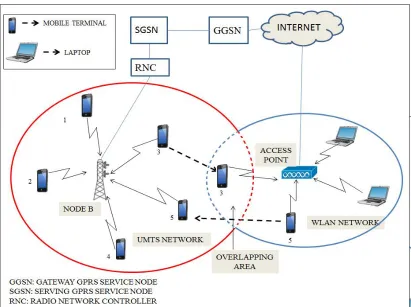
For roaming in the integrated heterogeneous environment vertical handoff between UMTS and WLAN can be seen as next evolutionary step. Consider mobile devices 1, 2, 3, 4, 5 and 2 laptops that support both UMTS and WLAN access capabilities. Mobile devices 1, 2, 3 and 4 which are served by UMTS network and mobile device 5 with 2 laptops are served by WLAN network.
ISSN(Online): 2320-9801
ISSN (Print): 2320-9798
I
nternational
J
ournal of
I
nnovative
R
esearch in
C
omputer
and
C
ommunication
E
ngineering
(An ISO 3297: 2007 Certified Organization)
Vol. 3, Issue 5, May 2015
Currently mobile terminals 1, 2, 3 and 4 are in the coverage area of UMTS network and having good signal strength. As the mobile terminal 3 is moving away from the node B, it detects the failing of the UMTS coverage. When it comes to the coverage area of the WLAN network, it detects the WLAN network and it may induce to switch to WLAN network to enjoy the higher bandwidth service. When it finds that the signal strength of WLAN network is better than the UMTS network it will switch over to the WLAN network. Similarly, mobile device 5 is connected to the internet via WLAN at a hot spot. As the mobile moves out of the coverage area of WLAN, the mobile device detects failing of WLAN coverage and switches to UMTS network.
IV. PROPOSED SYSTEM
Vertical handoff required to be more efficient while maintaining the Quality of Service requirements for different traffic classes such as conversational, streaming, background and interactive. The system is proposed by considering the two networks i.e. Wireless Local Area Network (WLAN) and Universal Mobile Telecommunication System (UMTS). Proposed algorithm consists of two parts:
a) Fuzzy Logic Handoff Initiation Algorithm to process a multi-criteria vertical handoff initiation metrics, and b) Access Network Selection Algorithm to select a suitable wireless access network.
Received signal strength must be strong enough to maintain the on-going connection. A FIS (Fuzzy Inference System) is used to compute accurately the handoff factor to determine whether a handoff initiation is necessary. When a mobile roams in a heterogeneous networks, two vertical handoff scenes are taken into consideration i.e. handoff from UMTS to WLAN and from WLAN to UMTS. The system proposed is a fuzzy rule based handoff decision system which considers Mobile-Controlled Handoff and some assistance from the network. The mobile node continuously monitors the Received Signal Strength (RSS) of the current network and the condition of the handoff.
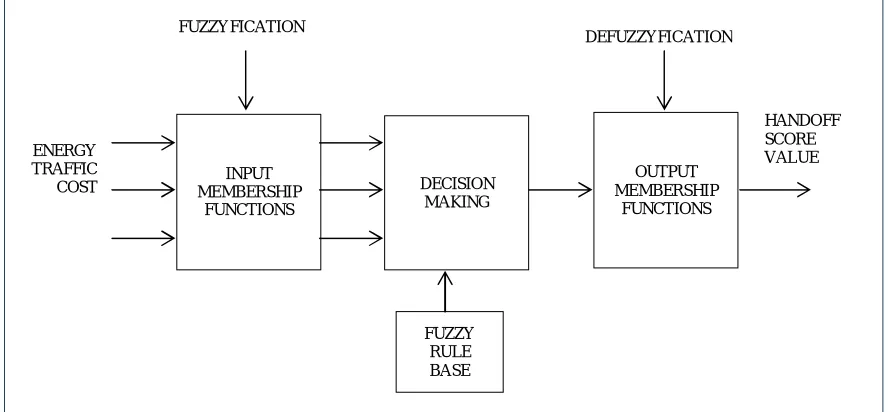
Fig 2. Block diagram of Fuzzy Logic System
A threshold level is assigned to each network according to the handoff metrics. When the RSS of the mobile node goes below the threshold level, networks in the surrounding environment are searched at the mobile node. In the second step, the parameters considered for the handoff are checked for the available network set. The fuzzy rule based mechanism proposed here considers energy, cost and traffic for the handoff. A fuzzy rule based handover decision module is applied to select the best network from the set of available networks. In the third step, the best network is selected by using the proposed Fuzzy rule based decision making algorithm. Finally the mobile node is switched from current network to the best network selected in the decision module.
DECISION MAKING INPUT
MEMBERSHIP FUNCTIONS
OUTPUT MEMBERSHIP
FUNCTIONS
HANDOFF SCORE VALUE
FUZZY RULE BASE ENERGY
TRAFFIC COST
FUZZYFICATION
ISSN(Online): 2320-9801
ISSN (Print): 2320-9798
I
nternational
J
ournal of
I
nnovative
R
esearch in
C
omputer
and
C
ommunication
E
ngineering
(An ISO 3297: 2007 Certified Organization)
Vol. 3, Issue 5, May 2015
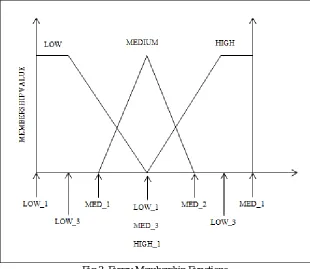
Assume the low region points Figure 3 are as follows{Low_1, Low_2,Low_3}; Medium region points as{Med_1, Med_2, Med_3}; and for high region as{High_1, High_2, High_3}, In the fuzzification process, ifX is the input value and falls in the low region then the membership value for low region will be calculated as explained below:
Δ1 = X – Low_1,
Δ2= Low_2- X
2 = −1
_2− _3
If ((Δ1≤ 0) or (Δ2≤ 0)) then the membership value of the low region will be Low_Mem = 0
else
Low_Mem = min(Δ2*S2,Max)
If X falls in the medium region then the membership value for medium region will be calculated as follows:
Fig 3. Fuzzy Membership Functions
Δ1 = X – Med_1,
Δ2= Med_2- X
1 = 1
_3− _1
2 = −1
_2− _3
If ((Δ1≤ 0) or (Δ2≤ 0)) then the membership value of the low region will be
Med_Mem = 0 Else
Med_Mem = min(Δ1*S1,Δ2*S2,Max)
If X falls in the medium region then the membership value for medium region will be calculated as follows:
ISSN(Online): 2320-9801
ISSN (Print): 2320-9798
I
nternational
J
ournal of
I
nnovative
R
esearch in
C
omputer
and
C
ommunication
E
ngineering
(An ISO 3297: 2007 Certified Organization)
Vol. 3, Issue 5, May 2015
Δ2= High_2- X
1 = 1
ℎ_3− ℎ_1
If ((Δ1≤ 0) or (Δ2≤ 0)) then the membership value of the low region will be
High_Mem = 0 Else
High_Mem = min(Δ1*S1,Max)
As there are 3 input parameters and 3 membership regions, total number of rules can be 3*3*3 = 27. There will be a membership value for each rule and will also have output membership values. Then using the centroid method of defuzzification, the output handoff score value is given by
X* = (∑AN CN)/ ∑ CN
whereCN= [C1, C2, C3, . . . , C27] which is center value of each effected output region, and AN= [A1, A2, A3, . . . , A27]
which is the affected areas of output regions. The handoff score value of given set of input parameters is calculated by using the above proposed method, and then the network with highest handoff score value is selected.
A. HANDOFF BETWEEN UMTS TO WLAN
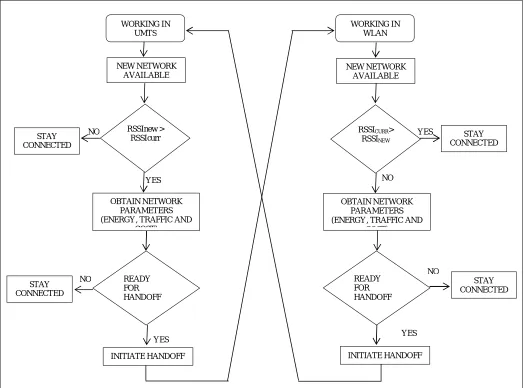
The fuzzy rule based mechanism that gives the decision regarding the best network to be selected is shown in Fig 4. It considers the parameter values of the network as input and handoff score is evaluated. Suppose a mobile terminal is connected to UMTS network and detects a new WLAN network. It starts handoff initiation process and decides whether the mobile terminal should handoff to WLAN or not. The input parameters used are energy, traffic and cost of the target WLAN network. RSSI indicates that WLAN network is available. The crisp values of the input parameters are then given to the fuzzification module which transforms them into fuzzy sets via membership functions. These fuzzy sets are then fed to fuzzy inference engine where a set of IF-THEN rules is applied to obtain decision sets. With the use of defuzzification process, these decision sets are converted to crisp values which determine whether handoff is necessary.
Each input parameters is assigned to one of three fuzzy sets; for example, the fuzzy set values for energy consist of the linguistic terms: Low, Medium, and High. These sets are mapped to corresponding triangular Membership Functions. The fuzzy IF-THEN rules can be:
IF energy is low, and traffic is high, and cost is high, THEN handoff factor is low.
IF energy is low, and traffic is medium, and cost is high, THEN handoff factor is low.
IF energy is high, and traffic is low, and cost is low, THEN handoff factor is high.
ISSN(Online): 2320-9801
ISSN (Print): 2320-9798
I
nternational
J
ournal of
I
nnovative
R
esearch in
C
omputer
and
C
ommunication
E
ngineering
(An ISO 3297: 2007 Certified Organization)
Vol. 3, Issue 5, May 2015
Fig 4. Fuzzy rule based handoff decision mechanism.
B. HANDOFF BETWEEN WLAN TO UMTS
As WLAN has limited coverage area, when a mobile terminal is moving out of the coverage area, it needs to have accurate and timely handoff decision to maintain the connection before the loss of WLAN access network. The input parameters used are energy, traffic and cost of the current WLAN network. RSSI indicates that WLAN network is available. The design of fuzzy inference engine for handoff between WLAN to UMTS is same as that of UMTS to WLAN. The only difference is the set of IF-THEN rules applied.
The fuzzy IF-THEN rules can be:
IF energy is low, and traffic is high, and cost is high, THEN handoff factor is high.
IF energy is high, and traffic is low, and cost is low, THEN handoff factor is low.
IF energy is medium, and traffic is low, and cost is low, THEN handoff factor is low.
V. CONCLUSION
In this paper, based on the UMTS-WLAN radio heterogeneous network model, fuzzy rule based decision algorithm is proposed. This algorithm employs the multi-criteria decision function of the fuzzy logic. The criteria of energy, traffic and cost is chosen to be the input to the fuzzy logic system which using membership functions calculates a crisp value to take a better decision for handoff. This algorithm can also be applied to the other heterogeneous networks. Since the
WORKING IN UMTS NEW NETWORK AVAILABLE RSSInew > RSSIcurr OBTAIN NETWORK PARAMETERS (ENERGY, TRAFFIC AND
COST) READY FOR HANDOFF INITIATE HANDOFF STAY CONNECTED STAY CONNECTED YES NO NO YES WORKING IN WLAN NEW NETWORK AVAILABLE
RSSICURR>
RSSINEW
OBTAIN NETWORK PARAMETERS (ENERGY, TRAFFIC AND
ISSN(Online): 2320-9801
ISSN (Print): 2320-9798
I
nternational
J
ournal of
I
nnovative
R
esearch in
C
omputer
and
C
ommunication
E
ngineering
(An ISO 3297: 2007 Certified Organization)
Vol. 3, Issue 5, May 2015
algorithm considers parameters like energy, traffic and cost it supports mobility and reduces unnecessary handoffs. The performance of the proposed algorithm can be improved by considering some more parameters also.
REFERENCES
1. KantubuktaVasu, SumitMaheshwari, SudiptaMahapatra and Cheruvu Siva Kumar.: “QoS-aware fuzzy rule-based vertical handoff decision algorithm incorporating a new evaluation model for wireless heterogeneous networks”. EURASIP Journal on Wireless Communications and
Networking,2012
2. SahanaBhosale, R.D. Daruwala.: “Experimental Analysis of Horizontal and Vertical Handovers in Wireless Access Networks using NS2”.
World Congress on Information and Communication Technologies, 2011
3. Enrique Stevens-Navarro, Vincent W.S. Wong, and Yuxia Lin Department of Electrical and Computer Engineering The University of British Columbia, Vancouver, Canada.: “A Vertical Handoff Decision Algorithm for Heterogeneous Wireless Networks”, IEEE Wireless
Communications and Networking Conference, 2007
4. Bo Liu, Jing Wang, Jun Li. : “A Joint Vertical Handover Technique for Heterogeneous Wireless Networks”,Proceedings of 2009 4th International Conference on Computer Science & Education.
5. Ram Kumar Singh, AmitAsthana, AkankshaBalyan, ShyamJi Gupta, Pradeep Kumar : “Vertical Handoffs in Fourth Generation Wireless Networks”, International Journal of Soft Computing and Engineering (IJSCE) ISSN: 2231-2307, Volume-2, Issue-2, May 2012
6. FarhanQamar , Asimshahzad and DrAdeelAkram : “Handover Control for Heterogeneous Wireless Access Systems”, International Journal of
Video & Image Processing and Network Security IJVIPNS-IJENS Vol:09 No:09
7. Li Ma, Fei Yu, And Victor C. M. Leung, “A new method to support UMTS/WLAN vertical handover using SCTP”, IEEE Wireless
Communications, August 2004
8. Navarro, E.S., Wong, V.W.S.: ‘Comparison between vertical handoff decision algorithms for heterogeneous wireless networks’. Proc. 63rd
IEEE Vehicular Technology Conf. (VTC ‘06), Melbourne, Victoria, Australia, vol. 2, pp. 947–951, May 2006
9. QiangGuo, Jie Zhu, XianghuaXu.: ‘An Adaptive Multi-criteria Vertical Handoff Decision Algorithm for Radio Heterogeneous Network’. IEEE
International Conference onCommunications, 2005.
10. A. Singhrova, N. Prakash.: ‘Vertical handoff decision algorithm for improved quality of service in heterogeneous wireless networks’. IET