Munich Personal RePEc Archive
The dynamics of exploitation in
ensembles of source and sink
Friedrich, T.
Humboldt - Universitaet zu Berlin
27 January 2012
Online at https://mpra.ub.uni-muenchen.de/39608/
The dynamics of exploitation in ensembles of source
and sink
Abstract
The ensemble is a new entity on a higher level of complexity composed of source and sink. When substrate is transferred from source to sink within the transfer space non-linearity is observed. Saturating production functions of source and sink in combination with linear cost functions generate superadditivity and subadditivity in the productivity of the ensemble.
In a reaction chain the source produces a product that will be used by the sink to produce a different product. The combined and interdependent productivity of the ensemble forms a surface similar to the Cobb-Douglas surface. Source and sink form a harmonic, synergistic ensemble.
When source and sink use the same substrate there will be competition. Both parties may have different saturating production functions, different linear cost functions and different amounts of substrates in their compartment. In an active ensemble substrate is transferred following the concentration gradient in harmony or through brute force or information (education) and superadditivity or subadditivity will appear. The surface within the transfer space in the active ensemble is in some regions above or below the surface of the inactive ensemble.
When substrate is repeatedly transferred from source to sink the actual productivity of the ensemble moves along the surface to a stable point or one party is lost and the ensemble is destroyed. This movement is the dynamic aspect of the ensemble. The benefit to cost ratio of source, sink and ensemble can be interpreted as three-dimensional, non-linear coordinates of the ensemble appearing within the transfer space.
Introduction
Biologic life and economy are characterized by consumption and production (metabolism). Both systems are open. Energy, substrates and products are taken from sources and transformed to products in sinks. Every bill has to be paid somehow by somebody (law of conservation of mass and energy). In biochemistry, the lowest level of complexity in life, there is only reaction kinetics. Substrates will flow from high concentration to low concentration or from low affinity to high affinity. At this level neither selfishness nor altruism is observable as a self - “the distinct individuality or identity of a person or thing” - as such does not jet exist. An enzyme will neither give nor take nor not give nor not take beyond the limits of reaction kinetics.
Organisms from single cells to societies of multicellular organism are ensembles of entities of a lower level. Cells are composed of many different types of molecules from water and ions to macromolecules like DNA and protein. Enzymes are a very important type of protein. They produce and consume substrates in a complex and branched reaction chain. The final product of single celled life is offspring produced by cellular division. The “parent” will be a complete part of the offspring. Multicellular organisms are composed of single cells. All phenomena of multicellular life can be completely explained from the lower level. No new laws of nature appear. Besides offspring a “body” is produced. At the end of life the body is recycled but certain components will be stable for many years. All this could be called a stable investment product. Starting at a certain body size the more investment is made into such long lasting products, the smaller the offspring number will be (Brown J.H., Marquet P.A. and Taper M.L.). This puzzles biologist as low fertility should not be a good propagation strategy on the first glance. In societies the multicellular organism is part of an even more complex entity. Again no new law of nature appears. All observed phenomena can be explainable by the behaviour of lower levels. Next to offspring the products of societies range from lime skeletons the size of mountains to cities and songs. Who pays these products and why are they reasonable?
General considerations:
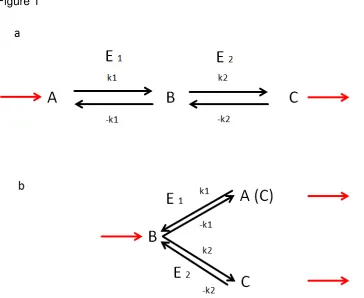
[image:4.595.72.436.230.528.2]Imagine two producing entities in close contact with a non-limiting connection between them. Both are united using either the same substrate or the substrate to the second entity is the product of the first entity.
Figure 1
I will mainly concentrate on the case where both use the same substrate in different compartments with the possibility of exchange between the compartments. Only if affinity to the substrate, substrate concentration, product, product affinity, product concentration and production activity and reaction conditions are identical in both entities no mass transfer will occur between them. If at least one of the properties will be different a transfer from higher to lower concentration or from lower affinity to higher affinity will occur.
The identity of the conditions is only achievable on the lowest level of complexity – in enzymes. Sequence and structural identical enzymes in a well-mixed vessel satisfy this condition. As soon as we go to more and more complex entities (composed of entities of the lower levels of complexity) it becomes more and more difficult to meet the properties of complete equality of internal and external conditions. Inequality will lead to the phenomenon of super- and subadditivity.
Ensemble:
Productivity:
Many definitions exist but they all consider productivity as a rate. A rate is “a quantity measured against another quantity or measure”. Usually the measure is time. The result of productivity is a product. This product could be called a benefit (b, “an advantage or profit gained from something”). The
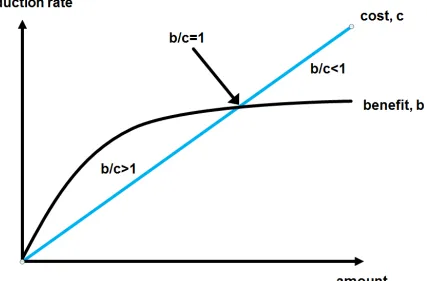
unit of productivity is amount per time (in enzymes: µmol/minute). This benefit comes at a cost (c, “an amount that has to be paid or spent to buy or obtain something”). In the characterized ensemble the benefit of one party comes at a cost to the other party. Although the mass transfer will be always from source to sink, the cost will not necessarily accumulate on the side of the source and the benefit will not always arise in the sink as I will prove later. This will be important to understand the structure of harmony and conflicts within ensembles. Productivity follows a saturating behaviour to the amount on all levels of complexity (figure 1). This has a simple physical reason, the Langmuir adsorption isotherm. Cost is usually considered of linear dependence to the amount.
Stability:
The benefit/cost ratio within the sink may be: b/c>1; b/c=1 and b/c<1. However, only ensembles with surplus will reasonably produce offspring.
[image:7.595.100.527.223.504.2]
Figure 2
Figure 2: Linear cost functions (blue) and saturating production functions (black) lead to three different benefit/cost ratios when the amount is increased.
substrate. The sink will take at b/c>1 but will not take at a ratio of b/c<1. Both parties will neither take nor give at b/c=1. This leads to table 1.
Table 1
source sink behaviour of the single party b/c ≥ 1 b/c >1 The source will not give.
The sink will take.
conflict
b/c < 1 b/c >1 The source will give. The sink will take.
harmony
b/c < 1 b/c ≤ 1 The source will give. The sink will not take.
conflict
b/c ≥ 1 b/c ≤ 1 The source will not give. The sink will not take.
no conflict
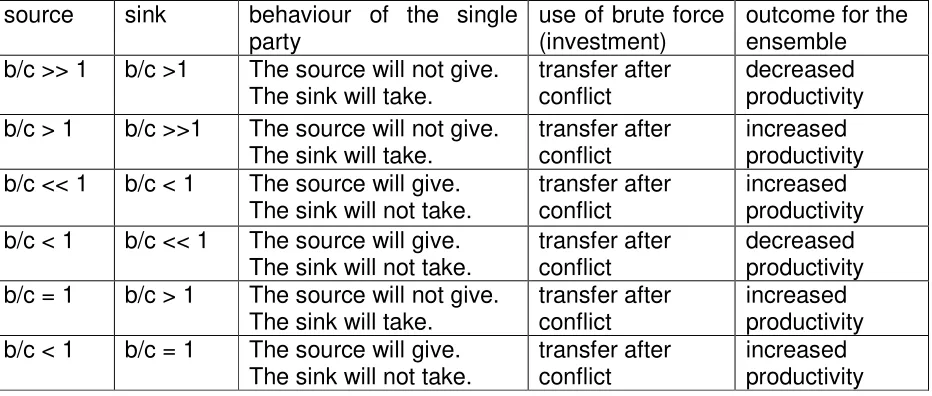
[image:8.595.67.533.465.663.2]Simple selfish behaviour will lead to “conflict”, “no conflict” and “harmony” within the ensemble. The picture becomes more complicate if we look at the consequences for the ensemble in the case of conflict. Here I assume for simplicity identical functions in source and sink and a small transfer.
Table 2
source sink behaviour of the single party
use of brute force (investment)
outcome for the ensemble b/c >> 1 b/c >1 The source will not give.
The sink will take.
transfer after conflict
decreased productivity b/c > 1 b/c >>1 The source will not give.
The sink will take.
transfer after conflict
increased productivity b/c << 1 b/c < 1 The source will give.
The sink will not take.
transfer after conflict
increased productivity b/c < 1 b/c << 1 The source will give.
The sink will not take.
transfer after conflict
decreased productivity b/c = 1 b/c > 1 The source will not give.
The sink will take.
transfer after conflict
increased productivity b/c < 1 b/c = 1 The source will give.
The sink will not take.
transfer after conflict
increased productivity
source by the sink or vice versa will be called productive wise if the increased productivity will pay the investment of brute force and education to realize a transfer in the case of conflicts. The only conflict free increase in productivity will be realized in the case of source: b/c<1 and sink: b/c>1. This condition is called symbiosis.
Figure 3
To judge the outcome for the ensemble (benefit/cost ratio, be/ce) will be even more difficult if we go to different (maybe even non-linear) cost functions, different production functions and different amounts of substrate. The production functions may differ in many ways. The maximal productivity, the steepness of the initial increase and even the shape (sigmoid behaviour, monotonous saturating) may be different. Therefore, a general mathematic understanding should be used to model the whole ensemble of source and sink. The benefit of the ensemble (be) is the productivity of the ensemble (Pe). The productivity of the ensemble is also a saturation function. Therefore, the benefit of the ensemble (be) will be the sum of the productivity and benefit of the single components (benefit of source, bso; benefit of sink, bsi).
= +
The cost to the ensemble is the sum of the cost to source (cso) and sink (csi).
= +
The benefit cost ratio of the ensemble is:
= +
Benefit b, productivity P and reaction velocity V will be used interchangeable in the following considerations.
Productivity within ensembles of enzymes:
Enzymes are basic to life and a good model for saturating productivity. The Michaelis-Menten kinetics is a simple model of productive behaviour in enzymes.
The reaction velocity V or productivity P is part of the maximal reaction velocity Vmax or maximal productivity Pmax.
The source has a reaction velocity (productivity) Vso with the substrate
concentration [S]so and the sink has a reaction velocity Vsi with a substrate
concentration [S]si. The Michaelis constant Km is the substrate
concentration at which the reaction rate is at half-maximal. It is an inverse measure of the substrate's affinity for the enzyme. According to Michaelis-Menten the reaction velocity in the source is:
=
+ ∗
The reaction velocity in the sink is:
=
+ ∗
If all reaction parameters are identical no transfer between the parties takes place. The ensemble (Ve) of both parties has the productivity.
Ve inact = Vso + Vsi
The ensemble is not active (Ve inact).
A single transfer:
In the active ensemble (Ve act) transfer of substrate [∆S] will be observable. Both parties become really source and sink. In the case of harmony (table 1) between the two parties the following equation is used:
= − ∆
+ − ∆ ∗ +
+ ∆
+ + ∆ ∗
= − ∆ − #
+ − ∆ − # ∗ +
+ ∆ − #
+ + ∆ − # ∗
The purpose of the investment brute force and education is that the cost function or the production function or both is re-evaluated by source and sink. The investment by the not saturated sink has the effect that the source is changed from not giving to giving. The counter force used by the source is aimed to move the sink from taking to not taking. A saturated source will use force to move the sink from not taking to taking. The counter force by the sink is used to change the behaviour of the source from giving to not giving. A different interpretation is that the whole transfer space is deformed. The use of education and counter-information has the same purpose. The size of the investment in comparison to the size of possible superadditivity after the transfer will be discussed in more detail later (wise exploitation).
Besides “harmony”, “no conflict” and “conflict” there are three outcomes for the ensemble:
1. consumptive transfer: Ve act < Vso(-∆S) + Vsi(+∆S) (table 2, decreased productivity)
2. productive transfer: Ve act > Vso(-∆S) + Vsi(+∆S) (table 2, increased productivity)
3. productive wise transfer: Ve act > Vso(-∆S) + Vsi(+∆S) - Iso - Isi
Wise refers here to the fact that the investment “I” (brute force or education) is overcompensated in the ensemble by the gain in productivity after the transfer from source to sink.
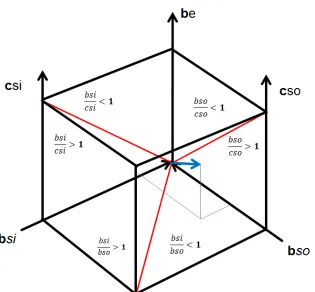
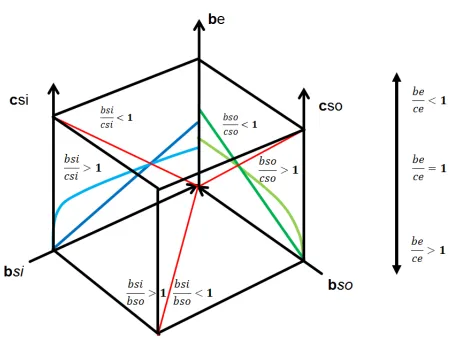
The transfer space (figure 4) represents on the surface of the cube source and sink and within the transfer space the ensemble. Harmony, conflict and no conflict depend on the shape of the production function, size of the cost (actual saturation with substrate) and size of the transferred amount of substrate.
[image:13.595.72.529.249.588.2]
Figure 4
Symmetric ensembles: If the ensemble is symmetric in all aspects nothing will happen. A transfer of substrate will start when the substrate concentration is different in source (high, b/c<1) and sink (low, b/c>1) or the affinity is different (source low, sink high); a first asymmetry.
[image:14.595.73.403.316.613.2]There are two types of harmonic ensembles. In the first type (figure 5a) the source will produce a product that is consumed by the sink to form a second product. Such behaviour is usually observed in (enzymatic) reaction chains (figure 1 a).
Figure 5a
The symmetric ensemble of figure 5b will use the same substrate in source and sink (branched reaction, 1b). Here we observe conflict, no conflict and harmony. Harmony here differs from harmony in ensemble of 5a. Harmony in the ensemble 5b occurs when the saturated source with a bso/cso ratio smaller than one will get rid of the costing substrate to a not saturated sink where the same substrate will be earning (bsi/csi>1). Substrate may be transferred freely from source to sink in the harmonic case or by means of brute force and education, which will be discussed later. The use of the same substrate will lead to superadditivity when the recipient can produce more from the substrate than the sender loses. In the case of subadditivity the recipient will produce even less from the substrate than the sender lost as productivity.
Figure 5b:
When the two following equation systems
$
= +
∗
+
+ ∆
+ + ∆ ∗
=
− ∆
+ − ∆ ∗
+
+ ∆
+ + ∆ ∗
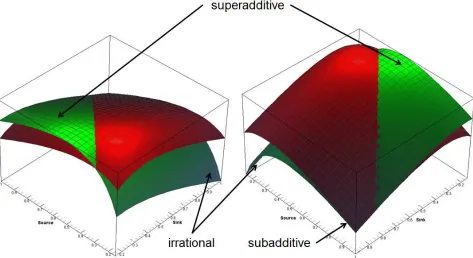
are used to model the behaviour of an active and harmonic ensemble (no use of brute force) two surfaces appear in the transfer space. The surface of the active ensemble is above the surface of the inactive ensemble when superadditivity is observed and below in the case of subadditivity. In some regions of the transfer space the active ensemble has a higher productivity while in other areas of the transfer space the inactive ensemble has a better productivity.
The coordinates of the space in figure 5c and 8 are the benefit/cost ratios of source, sink and ensemble of source and sink. This space could be named ensemble space. In superadditiv the active ensemble has a better productivity than the inactive ensemble in the same region. Under irrational conditions and in subadditivity it would be better not to transfer substrate from source to sink. Here the ensemble has a higher productivity when both parties stay separated (5c). The ensemble space (figure 8) is the inside of the transfer space. The surfaces represent all possible activities the parties may have at certain reaction parameters (Vmax, Km, already achieved saturation i.e. substrate cost, size of the exchange).
Figure 5c
Figure 5c. The surface of a specific symmetric ensemble (red inactive, green active) is depicted from two opposing viewpoints. The superadditiv (green surface above red surface), subadditive and irrational area (green surface below red surface) are clearly visible. Vmax for both is 5umol/min, Km is 0.25mmol and the linear cost is 3.5 times substrate. 0.15mmol substrate is transferred from source to sink. Therefore, substrate concentrations below 0.15mmol are not shown.
Figure 6
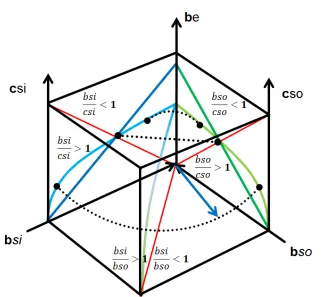
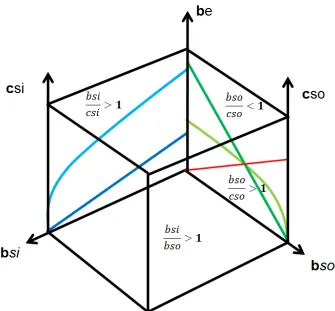
Figure 6: This asymmetric ensemble is productive, superadditive and harmonic at bso/cso<1. And the ensemble is productive and superadditive but with conflicts at bso/cso≥1 (on cost of the source). Continuing transfer of substrate from source to sink will increase the ensemble productivity and the productivity in the sink until the ensemble breaks down.
other. Under those conditions the source may start to suffer because bso/cso<1 (also the sink may suffer if forced to stand the condition of bsi/csi<1 in other cases).
The ensemble surface in figure 6 will no longer be symmetrically like in figure 5a. The surface will have a more concave shoulder on the side bsi/bso>1. In symbiosis both parties share the gain of superadditivity. In this neighbourhood we still observe a productive ensemble but the productivity is no longer owned by the ensemble. The productivity in figure 6 would be owned and controlled by the sink. We observe a type of wise exploitation (bso/cso>1). Brute force is used, paid by superadditivity and suffering in the source.
In figure 6 the sink could take the whole source in one bite. The sink is lost immediately and would have to be replaced by a new sink in the next round. In such a case we observe a predator-prey system.
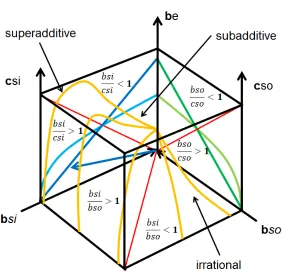
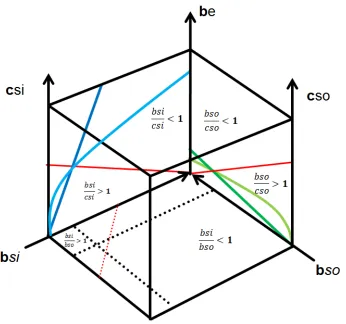
Wise exploitation: Only in asymmetric ensembles with superadditivity the ensemble can pay the investment brute force or education. In productive wise exploitation the investment brute force or education are overcompensated by the gain due to superadditivity. In the ensemble of figure 7a we again observe an asymmetric ensemble. This time the cost function in the source is very flat and very steep in the sink.
Figure 7a
Figure 7a. On the ground of this space we find three dotted lines. The black lines mark the position of bso/cso=1 and bsi/csi=1. The space is asymmetric. Left of the position of the dotted red line the bsi/bso ratio has become so big that the cost (investment I) of brute force or education (Iso, Isi) will be paid completely by superadditivity including a reward.
Equal distribution (mixing) of substrate will not result in optimal productivity in asymmetric ensembles. Substrate should be distributed according to the biggest productivity. If b/c=1 is no part of this solution all three sides (source sink and ensemble) may suffer.
Figure 7b
The regions v and w are cause of discussion and confusion. In this areas the investment of the source (v) or the sink (w) are not paid back. The investment is “not wise”. However this region is on the earning side of the line of strict equivalence. Here a win is produced but it is neither owned by the source nor by the sink. The gain is owned by the ensemble. We observe an integrated ensemble. However, the border to pure consumption is easily crossed.
The region y and x are often confused with (productive) wise exploitation type I and II. In x and y the investment of one side is overcompensated but on cost of the productivity of the ensemble (consumptive exploitation). The worst regions are the blue and orange areas where the ensemble loses productivity while the investment is not paid (no letters indicated).
In the food chain every ensemble has an external source and will be a source for a different ensemble. The primary source of energy is the sun. Productive ensembles will grow, consumptive ensembles will shrink.
Complex ensembles are composed of smaller ensembles. Resources within a complex ensemble may be redistributed between sub-ensembles so that an observed feature may look growing but on cost of a not observed ensemble. This may finally lead to a decline of the complex ensemble in case the not observed sub-ensemble is of importance.
The non-linear ensemble, the ensemble space: Depending on the distribution of substrates, cost functions and production functions in source and sink many different outcomes are possible. The ensemble as new entity appears within the transfer space and will be stable (be/ce=1) or growing (be/ce>1) or shrinking (be/ce<1) on cost of source and/or sink for the benefit of source and/or sink (figure 8).
Figure 8
Other production kinetics: Besides saturating Michaelis-Menten kinetics there are saturating logistic (sigmoid) shapes of the production observable. In enzymology we observe sigmoid behaviour when enzymes are oligomers of subunits each carrying a catalytic site. In addition, the different binding sites will influence each other in a way that the binding of the first substrate will increase the binding of a second substrate and so on. This type of enzyme is called allosteric. A simplified velocity equation for allosteric enzymes is the Hill Equation. Four binding sites with very high cooperativity between them results in the following equation:
=
%
& ' %
1 + & ' % %
This equation can be reduced to an equation similar to the Michaelis-Menten equation. K is a constant containing the interaction factors a, b and c and the intrinsic dissociation constant Ks.
= ) *
+, ) *∗ ( =
& ' %) ($ = 4)
The productivity of an active ensemble of source and sink with sigmoid production functions will be therefore:
= ( − ∆ )
0
+ ( − ∆ )0 ∗ +
( + ∆ )0 + ( + ∆ )0 ∗
=
− ∆
+ − ∆ ∗
+
+ ∆
+ + ∆ ∗
and in conflict with monotonous saturating productivity:
=
− ∆ − #
+ − ∆ − # ∗
+
+ ∆ − #
+ + ∆ − # ∗
in harmony with sigmoid saturating productivity:
=
( − ∆ )0 + ( − ∆ )0 ∗
+
( + ∆ )0 + ( + ∆ )0 ∗
and in conflict with sigmoid saturating productivity:
=
( − ∆ − # )0 + ( − ∆ − # )0 ∗
+
( + ∆ − # )0 + ( + ∆ − # )0 ∗
But source and sink may also differ in the shape of the production function like in the following harmonic behaviour (figure 9):
=
− ∆
+ − ∆ ∗
+
[image:26.595.69.526.174.549.2]( + ∆ )0 + ( + ∆ )0 ∗
Figure 9
Figure 9: The transfer space on the left side with different production functions and cost functions in source and sink. In the source there is a saturating production function (light green) and a linear cost function (dark green). The sigmoid production function in the sink (light blue) and a linear cost function (dark blue). The side of the sink has an additional red line separating bsi/csi<1 from bsi/csi>1. On the right side the ensemble surface within the ensemble space (be/ce; bso/cso; bsi/csi) is shown.
Repeated transfers and dynamics:
If the transfer [∆S] for example in wise exploitation is repeated because one side does not stop to take or give the source or the sink may sooner or later be exhausted and the ensemble will fall apart in case no stable point is in reach or one side can not stop to give or to take.
The Lotka-Volterra equation is a model for an autocatalytic ensemble.
1 + 23456 22
2 + 853'6 29
8 + :3&56 ; + :
A is an endless external source for the source within the ensemble. B is an endless external sink for the ensemble internal sink. A and B are considered constant. A enters the ensemble and is transformed to X; Y leaves the ensemble being transformed to E with the help of B.
<
< = =412 − =' 9
<9
< = =' 9 − =&:8
This system is well understood and a good model for cyclic population behaviour in predator-prey and parasite-host systems (Prigogine, I.). Let us take it as an orientation.
Case 1:
The source obtains the substrate S at a certain rate k1 from the endless external source A.
13456
< /< = =1 ∗
+ =1 ∗ ∗
The sink has also the basic source A where the substrate S is produced from at a rate k2:
13'56
The productivity change of the sink is:
< /< = =2 ∗
+ =2 ∗ ∗
The productivity change of the inactive ensemble would be:
dVe inact/dt = <Vso/dt + dVsi/dt
As soon as the ensemble becomes active substrate is transferred from source to sink. But this time the transfer would be repeated over and over again at a certain rate k3 (amount of substrate within a time interval). The
view of the source is 3&56 − ∆ and the view of the sink is
3&
56 + ∆ . Substrate is lost or gained at a rate of k3.
< /< = =1 ∗ − =3 ∗ ∆
+ =1 ∗ − =3 ∗ ∆ ∗
+ =2 ∗ + =3 ∗ ∆
+ =2 ∗ + =3 ∗ ∆ ∗
It is clear that if k1>k3 the ensemble is viable and if k1<k3 the ensemble will end because the source becomes exhausted.
Case 2
13456
From the substrate A the source will have the productivity change:
< /< = =1 ∗
+ =1 ∗ ∗
This time the sink obtains the used substrate completely from the source.
A =
The sink has a basic given saturation BS witch will not be used if a source is present. The productivity of the sink alone is:
= : + : ∗
The productivity of the inactive ensemble would be again:
dVe inact/dt = <Vso/dt + Vsi
The ensemble becomes active when substrate is transferred from source to sink. But this time the transfer must be repeated over and over again at a
certain rate k2. The view of the source is: 3'56 − ∆ , and the
view of the sink is: 3'56 ∆ . Substrate is lost or gained at a rate of k2.
< /< = =1 ∗ − =2 ∗ ∆
+ =1 ∗ − =2 ∗ ∆ ∗
+ : + =2 ∗ ∆
+ : + =2 ∗ ∆ )∗
It is clear that if k1>k2 the ensemble is viable and if k1<k2 the ensemble will end because the source becomes exhausted.
The ensemble vector will move with every ∆S to a new location at a certain velocity along the surface within the transfer space. This will result in a path from start of the transfer to the equilibrium of source and sink or to the end of the ensemble. The velocity v depends on the frequency of the transfer of small substrate portions from source to sink.
B = < ∆ <
But the velocity of development of the ensemble is also the change of ensemble productivity Ve over time.
B = < <
As the space is non-linear
< ∆ < ~
< <
In case the change of Ve does not take place in harmony, there will be force and counterforce of source and sink. To move the vector a force is necessary. Force and counterforce could be interpreted as viscosity of the transfer space.
D = μ1<F <9
Discussion:
Live is based on the DNA/RNA/Protein complex including other groups of organic and inorganic molecules. All components of life are important but enzymes and enzyme complexes contribute basically and directly to productivity. Organisms compete for similar substrates like carbohydrates, amino acids, lipids, light, water, oxygen, carbon dioxide and many other building blocks of live. Most of the conflicts are handled with brute force within and between species. The romantic game theory suggests that the best solution for conflicts is “cooperation” because this has the highest productivity and long term stability. The transfer space can better explain on all levels of complexity (from enzymes to societies) the behaviour of living entities and in which way unexpected dynamics will arise. Superadditivity has been observed in experiments solely designed to investigate ideas develop in game theory ((Turner, P.E. and Chao, L.; 1999). What is generally regarded as cooperation is either wise exploitation where on side stops at b/c=1 or harmony of giving and taking in symbiosis. Source and sink may be tied together by accident falling in all generations into the same pit or by brute force and education which makes a process of recognition for the gaining party necessary. To be source and sink may be a fixed fate but may also depend on the point of view. Especially in wise exploitation the sink may become a source for the exploited primary source like in breeding and farming. Therefore, the idea of “reciprocity” of classic game theory seems to be naïve as is the idea of “altruism”. There is only selfishness in all actions of source and sink. We no longer need to explain the development of altruism with “haystacks” in “group selection” as there is no altruism. Master and servant strategies are superior behaviours as recently demonstrated (Rogers et al.). A prerequisite for stability is the sufficient regeneration of the servant. An energy source is needed.
Depending on the effectiveness and productivity additional substrate is used where it will have the biggest impact on productivity. The mechanism to decide what has the biggest impact is “survival of the fittest”. Productivity is an important part of fitness. Fitness means in some species more offspring (quantity) and in other species higher quality offspring. The quality increase is due to low saturation and high productivity during growth in comparison to the saturated parents with low productivity and shorter residual lifetime.
The high economic productivity in modern industrial societies is accompanied by a sharp decrease in offspring (Myrskylä, M. et al). The transfer space is able to explain this also. The productivity of the source is transformed into consume and production of goods while reproduction suffers. To be rich in children is synonymous for being poor in material goods on the average from individuals to societies (conservation law of mass and energy). If the data of Myrskylä, M. et al would have been not been linearized with a hitherto unknown method it would be easy to see that the system follows an indifference curve where less (of a costing good) is better. This is in contrast to usual indifference curves in economics where “more is better”. Both shapes are part of the transfer space (figure 5a).
Summary:
Literature
Brown J.H., Marquet P.A. and Taper M.L. Evolution of body size: consequences of an energetic definition of fitness; The American Naturalist; Vol. 142, No. 4, Oct., 1993:573-584
Friedrich, T. (2010): MPRA, The transfer space.
Myrskylä, M., Kohler, H.-P. and Billari, F.C.; Advances in development reverse fertility declines; Nature 460 (2002) 741-743
Prigogine, I., Self-Organization in Nonequilibrium Systems (Wiley-Interscience, New York, 1977)
Rogers, A., Dash, R. K., Ramchurn, S. D., Vytelingum, P. and Jennings, N. R.; Coordinating Team Players within a Noisy Iterated Prisoner’s Dilemma Tournament. Theoretical Computer Science (2007) 377 (1-3) pp. 243-259
Solt, F. (2011) Diversionary Nationalism: Economic Inequality and the Formation of National Pride; The Journal of Politics, 73:821-830