Certificate Validation in Secure Computation
and Its Use in Verifiable Linear Programming
Sebastiaan de Hoogh1, Berry Schoenmakers2, and Meilof Veeningen1
1
Philips Research 2
Eindhoven University of Technology
Abstract. For many applications of secure multiparty computation it is natural to demand that the output of the protocol is verifiable. Verifi-ability should ensure that incorrect outputs are always rejected, even if all parties executing the secure computation collude. Since the inputs to a secure computation are private, and potentially the outputs are private as well, adding verifiability is in general hard and costly.
In this paper we focus on privacy-preserving linear programming as a typical and practically relevant case for verifiable secure multiparty com-putation. We introduce certificate validation as an effective technique for achieving verifiable linear programming. Rather than verifying the com-putation proper, which involves many iterations of the simplex algorithm, we extend the output of the secure computation with a certificate. The certificate allows for efficient and direct validation of the correctness of the output. The overhead incurred by the computation of the certificate is marginal. For the validation of a certificate we design particularly effi-cient distributed-prover zero-knowledge proofs, fully exploiting the fact that we can use ElGamal encryption for this purpose, hence avoiding the use of more elaborate cryptosystems such as Paillier encryption. We also formulate appropriate security definitions for our approach, and prove security for our protocols in this model, paying special attention to ensuring properties such as input independence. By means of sev-eral experiments performed in a real multi-cloud-provider environment, we show that the overall performance for verifiable linear programming is very competitive, incurring minimal overhead compared to protocols providing no correctness guarantees at all.
1
Introduction
When outsourcing a computation to the cloud, we want to be sure that the result is correct. But if the computation involves confidential inputs, e.g., of multiple mutually distrusting inputters, we also want to guarantee the privacy of the inputs. For instance, solving linear programs is useful for optimising global profits in supply chains [CdH10] or financial benchmarking [DDN+15]; confidentiality is important because the inputs are sensitive information from multiple companies but correctness is important because the outcome represents financial value.
this only protects against uncorrelated failure); or by relying on the use of trusted hardware by the worker [SZJVD04]. Alternatively, correctness can be achieved without assuming uncorrelated failure or trusted hardware, by instead producing cryptographic proofs of correctness (e.g., [PHGR13]).
Achieving privacy is hard when outsourcing to a single cloud worker, but feasible if the computation is distributed between several workers. Indeed, having a single worker perform arbitrary computations on encryptions requires fully homomorphic encryption, a cryptographic primitive that is still impractical for realistic applications. But distributing computations between multiple workers in a privacy-preserving way is possible, and getting more and more practical, using multiparty computation protocols (e.g., [BD09, DKL+13]). Such protocols guarantee privacy and correctness up to a certain threshold of corrupted workers. The inputters can pick workers run at different cloud providers, thereby reducing the risk that too many of them collude or are compromised.
Unfortunately, using such techniques has a major drawback: apart from in-putters having to trust the choice of workers for privacy, also recipients have to trust the choice of workers for correctness of their result. However, requiring this trust by the recipients is undesirable: it means recipients (potentially anybody, if the computation result is public) need to be involved in assessing the trust-worthiness of workers; and the result may simply have too much value to allow the possibility of incorrectness.
In theory, privacy and correctness can be achieved by producing crypto-graphic proofs of correctness in a multi-party way. Indeed, this is the basic idea behind recentuniversally verifiable [SV15] (orpublicly auditable [BDO14]) mul-tiparty computation protocols. (Correctness holds regardless of the workers, but privacy only holds up to a certain maximum of corruptions: we cannot hope to circumvent this in outsourcing scenarios without resorting to fully homomorphic encryption.) However, producing correctness proofs in a multi-party way is too expensive for realistic computations such as linear programming, requiring zero-knowledge proofs involving threshold Paillier encryptions [SV15] or somewhat homomorphic encryptions [BDO14]. Moreover, existing approaches need secure distributed set-up of these threshold cryptosystem, which is hard in practice.
1.1 Our Contribution
using elliptic curves). We show how to enforce inputters to choose their inputs independently, and we prove security in a rigorous security model.
Concretely, our instantiation is withn= 3 workers (but can be easily gener-alised ton= 2t+ 1 workers). We distribute the computation between all three workers using protocols that guarantee privacy if they do not collude or act ma-liciously (i.e., deviate from the protocol). Then, two (in general, t+ 1) of the workers perform certificate validation to guarantee to anybody that the found solution is correct. Hence, we reach a compromise between passive and active security. One the one hand, we provide more security than passively secure mul-tiparty computation because we guarantee correctness (in the sense that the solution is valid with respect to the certificate) regardless of corruptions. On the other hand, we provide less security than actively secure multiparty computation because we do not guarantee privacy if workers collude or act maliciously.
With our new protocol, we are able to demonstrate, for the first time, that certificate validation leads to practically feasible performance. We have imple-mented our protocol and tested its performance in a linear programming case study, performed in a real multi-cloud-provider environment. As mentioned, our security is in between passive and active; our experiments show that our per-formance is in fact much closer to passive, adding only little overhead in cases where using active security would be much slower.
1.2 Related Work
Verifiable computation, i.e., the question of how to verify correctness of com-putations performed by untrusted parties (without privacy) has a long history in the literature (e.g., [DFK+92, AS98, GKR08]). Recently, major practical im-provements in efficiency (e.g., [PHGR13]) have shown that in some cases it is possible in practice to verify a computation faster than performing it.
Combining verifiability with privacy has traditionally only been considered for particular applications such as e-voting [CF85,SK95], but recent works [dH12, BDO14, SV15] have also started studying the problem of verifiability for general multiparty computation. In essence (like in our work) the correctness proofs of these works rely on zero-knowledge proofs of correct multiplication and de-cryption: of Paillier encryptions in [dH12,SV15], and of somewhat homomorphic encryptions in [BDO14]. Compared to these works, this work proposes a private multiplier approach that enables the use of the much more efficient ElGamal encryption scheme (besides introducing the approach of certificate validation).
Another recent line of work has combined verifiability and privacy when out-sourcing computations to a single worker. However, known constructions in this line of work are unfortunately inpractical due to their use of costly primitives, e.g., fully homomorphic encryption and verifiable computation [LTV12, FGP14]; or functional encryption and garbled circuits [GKP+13]. Indeed, because such constructions require a single party to compute on encrypted data, even without offering verifiability they are inherently much heavier than our approach.
I/P/R inputters/workers/recipients party/ies P doS party/iesP concurrently performS
Encpk(x;r) ElGamal encryption ofxwith public keypk, randomnessr
Decsk(x) ElGamal decryption with key (share)sk
p prime order for ElGamal
⊕,⊗ homomorphic addition/multiplication of ElGamal ciphertexts
send(v;P);recv(P) send/receivevover secure, private channel (noPmeansP1/P2)
bcast(v) sharevon bulletin board
ZkVer(Σ;v;π;a) Fiat-Shamir proof verification (p. 6) a∈RS sampleauniformly random fromS
[x],[x0] own/other party’s additive share ofx(for two workers)
H cryptographic hash function
Fig. 1.Notation in algorithms and protocols
workers collude. This is the case for normal multiparty computation protocols ap-plied in an outsourcing setting (e.g., [JNO14, DDN+15]), but also for specialised outsourcing protocols like [KMR11, ACG+14]. Compared to these works, wedo offer correctness if all workers collude (without relying on a trusted set-up).
Finally, using short certificates to prove correctness of a larger operation has been proposed before. For instance, it was used to prove the correct execution of graph algorithms in [ZPK14]; see also [TT10] and its references. As far as we know, we are the first to propose the use of certificates for verifiability of multiparty computation. The certificates mentioned in these works may be useful for achieving verifiability of these computations in a privacy-preserving setting.
Outline. We first present a protocol for proving and verifying that a set of encryptions satisfies some given polynomial relations (Section 2). We then show how to combine this protocol with fast, non-verifiable multiparty computation (Section 3). We show with experiments that this gives rise to practical verifiable secure linear programming (Section 4). We finish with a discussion of related and future work (Section 5). Figure 1 shows notation used in this paper.
2
Proving Relations on ElGamal Encryptions
The main idea of our approach is compute a function using multiparty compu-tation; and then prove correctness of the result by proving that the input and result satisfy a number of polynomial relations with a private multiplier-based protocol on ElGamal encryptions. Suppose that in the computation, a collection
X1, . . . , Xn of ElGamal encryptions has been produced representing the inputs
the workers will together prove in zero knowledge that the encryptions satisfy certain relations, without learning any information about the encrypted values. The overall approach for producing this proof is the following. For each poly-nomial relation r(x1, . . . , xn) = 0 in values x1, . . . , xn, the workers produce an
encryptionRof the left-hand side value. This requires additions, multiplications by a constant, and multiplications of two encryptions. The first two can be com-puted locally using homomorphic properties of ElGamal. Multiplications of an encryption Y by an encryption Xi of a shared plaintext xi can be performed
verifiably by letting the workers verifiably multiply their shares, and combining correctness proofs on the shares into an overall correctness proof using the mul-tiparty Fiat-Shamir transform [SV15]. Finally, a proof that R decrypts to zero is made by homomorphically combining decryption proofs using shares [s]i.
In the remainder of this section, we review the threshold homomorphic ElGa-mal cryptosystem and associated proofs of correct multiplication and decryption, and the multiparty variants from [SV15]. We then discuss how to use these mul-tiplication and decryption proofs to obtain an overall proof that the polynomial relations hold. In Appendix A, we give an explicit two-party protocol.
2.1 Threshold ElGamal and Zero-Knowledge Proofs
First, recall the additively homomorphic ElGamal cryptosystem [El 85]. Given a generator g of a discrete logarithm group of size p (p prime), public keys are group elements h such that s = loggh is unknown; the private key is s;
encryption of m ∈ Zp with randomness r ∈ Zp is (gr, gmhr); and decryption
of (a, b) is gm=ba−s. This cryptosystem is indeed additively homomorphic: if
(a, b) encrypts m and (a0, b0) encrypts m0, then (a·a0, b·b0), denoted (a, b)⊕
(a0, b0), encryptsm+m0. Moreover, if (a, b) encrypts m, then (aα, bα), denoted
(a, b)⊗α, encryptsmα; and (aαgr, bαhr) is a random encryption ofmα. Because
ElGamal decrypts togmand not tom, it is only possible to decrypt small values
for which the discrete logarithm problem with respect to g is feasible. Suitable discrete logarithm groups include groups of points on elliptic curves, e.g., [Nat99]. ElGamal is turned into a threshold cryptosystem [Ped91] in which two parties together can perform decryption, by sharing the private key s as s =s1+s2: parties can publish their decryptionsD1=ba−s1,D2=ba−s2, from which the overall decryption is computed as gm = b(b−1D1)(b−1D2).3 Public key shares
hi=gsi are published that are used to prove correctness of decryption shares.
The correctness of decryption shares and multiplications can be proven us-ing Σ-protocols [CDS94]. Recall that a Σ-protocol for a binary relationR is a three-move protocol in which a potentially malicious prover convinces a hon-est verifier that he knows a witness w for statement v such that (v, w) ∈ R. First, the prover sends an announcement to the verifier; the verifier responds with a uniformly random challenge; and the prover sends his response, which the verifier verifies. For our purposes, we need three standardΣ-protocols: proof
3
Of course, parties can alternatively sharea−s1,a−s2; we prefer our description
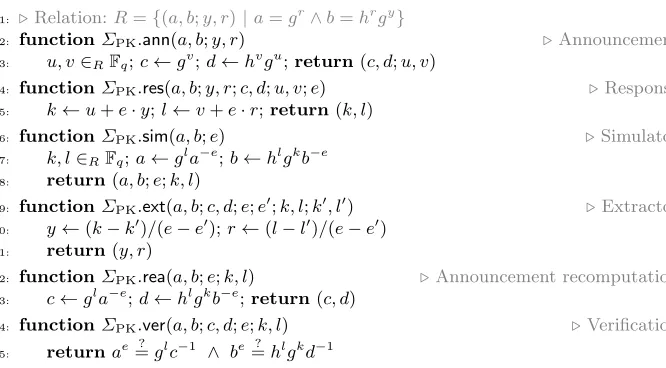
of plaintext knowledge ΣPK, proof of correct multiplication ΣCM, and proof of correct decryptionΣCD. ΣPK proves knowledge of plaintexty and randomness
r used in the statement (a, b) = (gr, hrgy). Σ
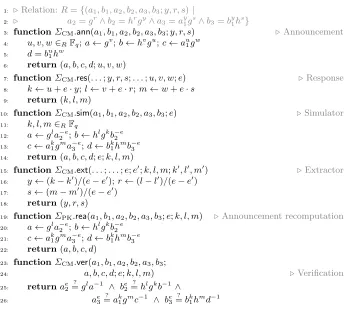
CM proves the following: given a statement consisting of encryptions (a1, b1), (a2, b2), and (a3, b3), the prover knows (y, r, s) such that a2=gr andb2=hrgy (i.e., (a2, b2) encrypts plaintext
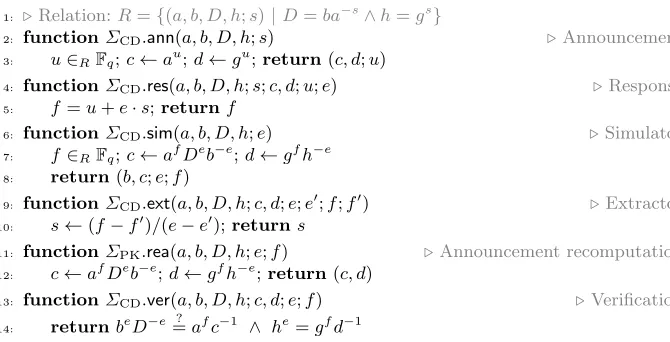
y with randomness r); anda3 =ay1gs and b3 =by1hs (i.e., (a3, b3) encrypts the product encryption, randomised withs). ForΣCD, recall that the decryption of plaintext (a, b) with private key (share) s isD =ba−s. Correctness ofD with
respect to public key (share) h is proven by proving knowledge of the value s
such thath=gs andb=Da−s using a standard equality proof.
Σ-protocols can be used to obtain non-interactive zero-knowledge proofs us-ing the well-knownFiat-Shamir heuristic[FS86]. Namely, a party proves knowl-edge of a witness for statement v by generating announcement a; setting chal-lenge c = H(v||a||aux) with some auxiliary information aux; and using this to computing response r. The proof (a, c, r) can be verified by checking that (a, c, r) verify, and H(v||a||aux) gives c. If a follows from c and r, then the proof can be shortened to (c, r), which is accept ifZkVer(Σ;v;c, r;aux) holds,
where ZkVer(Σ;v;c, r;aux) := (H(v||Σ.rea(v;c;r)||aux) =? c). Security is in the random oracle model, an idealised model of hash functions. To prove multi-ple statementsvi, the same challenge can be used for all the proofs by computing
announcementsai and settingc=H(v1||a1||v2||a2||. . .||aux).
For ourΣ-protocolsΣPK,ΣCDandΣCM,homomorphisms[SV15] exist that allow provers to combine proofs for different statements into one single proof. Suppose we have an encryptionXand a series of encryptionsYi, Zisuch thatZi
is an encryption of the product of the plaintexts ofX andYi. Then separate
in-stances ofΣCMcan be used to prove that theZiare indeed product encryptions.
However, if the transcripts (ai, c, ri) of these proofs all share the same challenge,
then these transcript can be “homomorphically combined” into one transcript that proves that⊕Ziis the product encryption ofX and⊕Yi. The combination
function simply takes the product of all elements of the announcement, and the sum of all elements of the response. If a verifier is just interested inX,⊕Yi and
⊕Zithen the verifier no longer needs to verify the individual proofs. Similarly, a
homomorphism forΣPK combines proofs of plaintext knowledge for (ai, bi) into
a proof of knowledge for (Q
ai,Qbi). That is, it combines proofs of knowledge
of the plaintexts ofXiinto one proof of (collective) knowledge of the plaintext of
⊕Xi. A homomorphism forΣCDcombines proofs of correct decryption of (a, b) to shares Di with respect to public key shares hi into a proof of correct
de-cryption of (a, b) tobQ(b−1d
i) with respect to public keyh=Qhi. Also these
homomorphisms also take the announcements’ product and the responses’ sum. Using the above homomorphisms, it is possible to obtain non-interactive zero-knowledge proofs of combined statements. Suppose parties with statements
v1, . . . , vt want to produce a series of proofs for combined statement v. They
exchange announcements a1, . . . , at for their shares v1, . . . , vt; compute
com-bined announcementa; take challengeh=H(v||a||aux); and exchange responses
witness corresponding to statement v. For security reasons, parties should not not be able to chooseaibased those of others. To ensure this, before exchanging aithe parties should first exchange commitments to these values. As above, it is
possible to use the same challenge for multiple combined proofs. [SV15] proves the desirable notions of soundness and zero knowledge.
2.2 Proving and Verifying Polynomial Relations
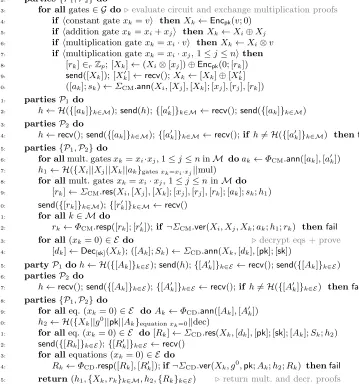
We now present an overview of ourPolyProveprotocol for producing a proof that ElGamal encryptionsX1, . . . , Xnsatisfy a given set of polynomial relations.
PolyProveE,G(pk; [pk]; [sk];X1, . . . , Xn; [x1], . . . ,[xn]; [r1], . . . ,[rn]) has two sets
of inputs. First, the ElGamal public keypkand secret-shares [pk], [sk] of this key and the corresponding private key. Second, encryptionsX1, . . . , Xn, and
secret-shares of the respective plaintexts [xi] and randomness [ri]. The set of relations
to be proven is formalised by structuresE and G.E is a set of equationsxj = 0
(1 ≤j ≤N for some N ≥n). G is an arithmetic circuit to compute values xj
for j > n. Specifically, G consists of gates xk =v, xk = xi+xj, xk = xi·v,
and xk =xi·xj (v any constant). For multiplication xk = xi·xj, we require
1≤j≤n: for these encryptions the workers have shared the randomness, which we will need to produce the proof. (Clearly, any set of polynomial relations can be described by suchE andG.) The protocol proceeds in the following steps:
– The first step of the protocol is to evaluate the circuit to obtain encryptions
Xn+1, . . . , XN. All gates except xk = xi·xj can be evaluated locally; for xk =xi·xj, the parties use their additive shares of the plaintext ofXj to
obtain shares ofXk, randomised using randomness [sk]. The parties exchange
these shares so that, at the end of this step, all parties know all encryptions
X1, . . . , XN.
– Then, the parties use the multiparty Fiat-Shamir transform to produce com-bined proofs of correctness of the multiplications in the arithmetic circuitG
forXn+1, . . . , XN.
– After verifying the correctness of all multiplication proofs, the parties can now safely decrypt encryptionsXj for all equations xj = 0: first, they
pro-duce decryption shares with associated proofs of correctness, and then they use the multiparty Fiat-Shamir transform to produce a proof that the combi-nation of the decryption shares produces zero. (Note that it is not necessary to exchange the decryption shares since the result is zero by assumption.)
We remark that in the case of two parties, a slight optimization to the mul-tiparty Fiat-Shamir transform is possible. Namely, instead of each party having to commit to each announcement before opening it, it is sufficient for the first worker to commit to its announcement; the second party to provide its announce-ment; and the first party to open its commitment. In Appendix A we explicitly give the abovePolyProvealgorithm which includes this optimization.
The corresponding algorithm PolyVerE,G(pk;X1, . . . , Xn;π) checks if the
the public keypk, encryptionsX1, . . . , Xn, and proof πas above. First, it
com-putes missing encryptions in{Xn+1, . . . , XN}, i.e., of gates that are not inputs
or multiplication results, using the homomorphic properties of ElGamal. Then, it verifies all multiplication and decryption proofs. Using the above techniques, this check corresponds to recomputing the announcements and checking if every-thing hashes to the correct multiplication proof and decryption proof challenges. Details appear in Appendix A.
3
Combining Computation and Validation
We now present our main protocol for privacy-preserving outsourcing with cor-rectness guarantees. We compute a solution and a so-called “certificate” using normal multiparty computation, and then produce a proof that the solution is valid with respect to the certificate using the above ElGamal-based proofs.
3.1 Certificates and Validating Functions
To efficiently validate a computation result, we use certificates. In complexity theory, a certificate is a proof that a value lies in a certain set, that can be verified in polynomial time (see [Hro01]):
Definition 1. Let S1,S2 be sets and X ⊆ S1. A polynomial time computable predicateφ⊆ S1× S2 is called a validating functionforX ifX ={w∈ S1| ∃c∈
S2 : φ(w, c)}. If φ(w, c), thenc is a certificateof the fact thatw∈ X.
E.g., letS1={x∈N| ∃y∈Z : y2=x}be the squares, thenφ(x, y) :=x=? y2
is a validating function, and,±2 are certificates of the fact that 4∈ S1.
In our case, a computation is given by a computation function (a,r) =f(x) and a validating function φ(x,a,r). Here, on input x, function f computes function outputrand certificatea; validating functionφchecks thatris a valid output with respect toxanda. We require that if (a,r) =f(x), thenφ(x,a,r), but we do not demand the converse: the outcome of the computation might not be unique, and φ might merely check that some correct solution was found, not that it was produced according to algorithmf. (For instance, a square root finder may return the positive square root while negative square root is also valid.) In our case study, we use that the optimality of a solution to a linear program can be efficiently validated using a certificate, but this concept is more generally applicable: for instance, see [TT10, ZPK14] and references therein.
3.2 Security Properties
We now provide a high-level overview of our setting and the relevant secu-rity properties. We consider a setting in which m inputters I1, . . . ,Im want
to perform a computation on their respective inputsx=x1, . . . , xm. As above,
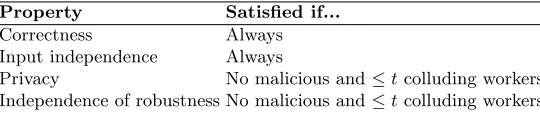
Table 1.Security properties and conditions on workers
Property Satisfied if...
Correctness Always
Input independence Always
Privacy No malicious and≤tcolluding workers Independence of robustness No malicious and≤tcolluding workers
φ(x,a,r), wherer is the outcome of the computation and a is the certificate. We assume that φ is given as a set of polynomial relations. The computation is distributed among n workers P1, . . . ,Pn, using (t, n) Shamir sharing with n= 2t+ 1. One single recipient Robtains the result (we later discuss changes when multiple parties need to get the result).
We will guarantee different security properties in different situations. We require correctness of the computation result, in the sense that it satisfies φ, regardless of which parties are corrupted.4 Privacy means that nobody learns information about the honest parties’ inputs (apart from the recipient learning the function result); we guarantee it if the workers are non-malicious (i.e., they do not deviate from the protocol) and do not collude with each other (they may col-lude with inputters or the recipient).Input independence means that corrupted inputters cannot choose their input depending on honest inputs (note that this is not implied by privacy as we also want to prevent corrupted inputters from copying honest inputs); we guarantee this property regardless of which parties are corrupted. A final property often considered in this setting isrobustness, i.e., the guarantee that parties cannot stop the computation from reaching a result; we do not aim for this property, and in fact, any inputter can make the com-putation break down by providing incorrect inputs. However, we do guarantee independence of robustness in the sense that parties cannot decide to make the computation break down depending on the inputs of honest inputters, if none of the workers collude or act maliciously.
Our security guarantees indeed (as said before) lie strictly between active and passive security for multiparty computation. Indeed, passively secure pro-tocols do not guarantee correctness or input independence if there are malicious workers (which we do); but actively secure protocols guarantee correctness, pri-vacy, and independence of robustness also with malicious workers (which we do not). We summarise our security properties, and the conditions on the workers under which they are satisfied, in Table 1. In Section 3.4, we will formalise these properties and state a security theorem for our protocol.
3.3 The VerMPC Protocol
We now present ourVerMPCprotocol providing the above security guarantees. To compute (a,r) =f(x), we use passively secure multiparty computation protocols based on (t, n)-Shamir sharing with n = 2t+ 1. In these protocols,
4
([a],[r])=f([x]) make A,R, π: φ(X, A, R)=1
5. 4. 3.
publish X share [x] check [x]=X
1.
2.
2.
6. 7.
send A,π
reconstruct [r]
bulle�n board
inpu�ers recipient
1. 2.
3. 4. 5.
4. 4.
6.
6. 7.
worker 1
worker 3
worker 2
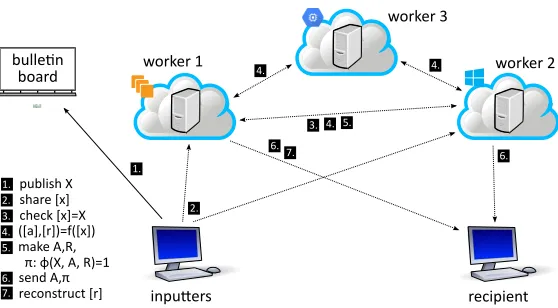
Fig. 2.VerMPCprotocol with three workers (dotted lines are private, secure channels)
private values are information-theoretically shared between the n parties such that t+ 1 parties are needed to recover the value. Protocols exist to, e.g., mul-tiply, bit-decompose, compare, and open these shared values (see [dH12] for an overview); these protocols are secure against passively corrupted, non-colluding workers. Note that the computation of f involves n parties and uses Shamir shares, whereasPolyProveinvolvest+ 1 parties and uses additive shares. It is easy to switch between the two:t+ 1 parties holding additive shares can Shamir-share them among all n; and t+ 1 of the n parties holding Shamir shares can locally convert them to additive shares by Lagrange interpolation.
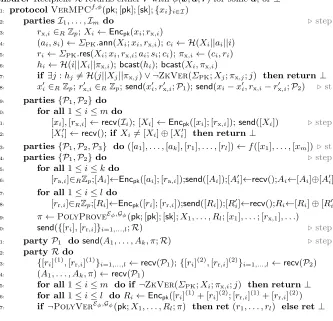
Given a multiparty computation protocol to compute ([a1], . . . ,[r1], . . . ,[rl])← f([x1], . . . ,[xm]) and the protocol PolyProveEφ,Gφ(X1, . . .; [x1], . . .; [rx,1], . . .) to prove that this result is correct, the question is how to combine them in a se-cure way. Figures 2, 3 show ourVerMPCprotocol, for concreteness instantiated with three workers (t= 1, n= 3). It consists of the following steps:
Step 1. First, the inputters announce their inputs. Each inputter encrypts its input (line 3), and makes a proof of knowledge of the corresponding plaintext (lines 4). These encryptions and proofs are posted on a bulletin board. To prevent corrupted inputters from adaptively choosing their input based on the inputs of others, this happens in two rounds: first, each inputter provides a hash as com-mitment to its input; having received the comcom-mitments of the other inputters, it then reveals the actual encrypted input and proof (line 6). If anybody provides an incorrect input or proof, the protocol is terminated (line 7).
Step 2.Next, the inputters provide additive secret shares of the plaintextxand randomnesssof the encryption to thet+ 1 workers who will later perform the PolyProveprotocol (line 8).
Require: pk/skElGamal public/private keys shared byP1,P2;x=x1, . . . , xminputs Ensure: RecipientRreturns eitherr withφ(x,a,r) for somea, or⊥
1: protocolVerMPCf,φ(pk; [pk]; [sk];{xi}i∈I)
2: partiesI1, . . . ,Im do .step 1
3: rx,i∈RZp;Xi←Encpk(xi;rx,i)
4: (ai, si)←ΣPK.ann(Xi;xi, rx,i);ci← H(Xi||ai||i)
5: ri←ΣPK.res(Xi;xi, rx,i;ai;si;ci);πx,i←(ci, ri)
6: hi← H(i||Xi||πx,i);bcast(hi);bcast(Xi, πx,i)
7: if ∃j:hj6=H(j||Xj||πx,j)∨ ¬ZkVer(ΣPK;Xj;πx,j;j) then return⊥
8: x0i∈RZp;rx0,i∈RZp;send(x0i, r
0
x,i;P1);send(xi−x
0
i, rx,i−r0x,i;P2) .st 2
9: parties{P1,P2}do 10: for all1≤i≤mdo
11: [xi],[rx,i]←recv(Ii); [Xi]←Encpk([xi]; [rx,i]);send([Xi]) .step 3
12: [Xi0]←recv();if Xi6= [Xi]⊕[X
0
i] then return⊥
13: parties{P1,P2,P3} do([a1], . . . ,[ak],[r1], . . . ,[rl])←f([x1], . . . ,[xm]) .st 4
14: parties{P1,P2}do .step 5
15: for all1≤i≤k do
16: [ra,i]∈RZp;[Ai]←Encpk([ai]; [ra,i]);send([Ai]);[A0i]←recv();Ai←[Ai]⊕[A0i]
17: for all1≤i≤ldo
18: [rr,i]∈RZp;[Ri]←Encpk([ri]; [rr,i]);send([Ri]);[R0i]←recv();Ri←[Ri]⊕[R0i]
19: π←PolyProveEφ,Gφ(pk; [pk]; [sk];X1, . . . , Rl; [x1], . . .; [rx,1], . . .)
20: send({[ri],[rr,i]}i=1,...,l;R) .step 6
21: partyP1 dosend(A1, . . . , Ak, π;R) .step 7
22: partyRdo
23: {[ri](1),[rr,i](1)}i=1,...,l←recv(P1);{[ri](2),[rr,i](2)}i=1,...,l←recv(P2)
24: (A1, . . . , Ak, π)←recv(P1)
25: for all1≤i≤m do if ¬ZkVer(ΣPK;Xi;πx,i;j) then return⊥
26: for all1≤i≤l doRi←Encpk([ri](1)+ [ri](2); [rr,i](1)+ [rr,i](2))
27: if ¬PolyVerEφ,Gφ(pk;X1, . . . , Rl;π) then ret(r1, . . . , rl) else ret⊥
Fig. 3.VerMPCprotocol with three workers
encrypting their shares of the inputs using their shares of the randomness; ex-changing the result; and checking correctness using the homomorphic property of the cryptosystem (lines 11–12). (Note that this works because ElGamal is not only homomorphic in the plaintext but also in the randomness.)
Step 4.Then, the actual computation takes place (line 13). This is the only step that involves the additional workers. Thet+ 1 workers holding additive shares of the input Shamir-share them between allnworkers; then the computation is performed between thenworkers; and finally,P1, . . . ,Pt+1 locally convert their Shamir shares to additive shares [ai],[ri].
1: functionIVerMPCf,φ
2: for allhonest inputtersIi dogetxi from partyIi .input phase
3: for allcorrupted inputtersIi doget xi from adversaryS
4: if < tpassively corrupted workersthen .computation phase 5: compute result, certificater;a←f(x)
6: else if ≥tpassively corrupted workersthen 7: send honest inputs{xi}i∈I\C to adversaryS
8: compute result, certificater;a←f(x)
9: if active inputter,S sends⊥ thenr← ⊥, . . . ,⊥ 10: else.actively corrupted workers
11: send honest inputs{xi}i∈I\C to adversaryS
12: get result, certificater;afrom adversaryS
13: if anyxiis⊥orφ(x;a;r) does not hold thenset resultr← ⊥, . . . ,⊥
14: send resultr to recipientR .result phase
Fig. 4.Security guarantees captured by ideal-world trusted party
right-hand side of a multiplication: because the workers prove knowledge of these right-hand sides, this guarantees that they know the corresponding plaintexts. Step 6.The workers send their additive shares of the result and the randomness of their encryption shares [Ri] to the recipient (line 20).
Step 7. One worker sends the encryptions of the certificate and proof of cor-rectness (line 21). The recipient checks the proofs of knowledge provided by the inputters (read from the bulletin board) (line 25); computes the encrypted re-sultR1, . . . , Rlfrom its shares (line 26); and callsPolyVerto verify correctness
(line 27): if the proof verifies, plaintextr1, . . . , rl is the computation outcome.
3.4 Formal Security Model and Theorem
To formally state and prove the security of our protocol, we use the standard for-malism used for multiparty computation: the ideal/real world paradigm [Can98]. We demand that the outputs of the recipient and the adversary in a protocol execution are distributed similarly to those outputs in an ideal world where the function is computed by an incorruptible trusted party. Because we provide dif-ferent security guarantees under difdif-ferent conditions (Table 1), depending on the number and type of corruptions, the trusted party gives the adversary the chance to learn inputs or manipulate outputs (cf. [SV15, BDO14]). In the ideal world, the adversary has no chances to break privacy or correctness apart from those explicitly given to it by the trusted party. If for every real-world adversary
Athere is an ideal-world adversarySAsuch that the real-world outputs are dis-tributed the same as in the ideal world, then also real-world adversaries cannot learn or influence more than allowed by the ideal-world trusted party.
corrupted inputters (line 3). In particular, regardless of corruptions, corrupted inputters cannot choose their inputs depending on those of honest inputters: this captures input independence. (However, they can provide ⊥in which case the whole computation will fail, capturing that we do not guarantee robustness.)
In thecomputation phase, we distinguish three different cases. The first, sim-plest case is when there are fewer than t passively corrupted workers: in this case, the trusted party simply evaluates the function f (line 5), capturing cor-rectness. In the second case, if there are at least t corrupted workers but they are all passive, then we can no longer guarantee privacy, so the trusted party sends the inputs to the adversary (line 7). The trusted party then computes f
(line 8). If there are any actively corrupted inputters, then we do not guarantee independence of robustness. Namely, the≥tcorrupted workers learn the honest inputs before the corrupted inputters provide their input shares, so the corrupted inputters can stop participating (but not change their inputs) depending on the honest inputs. We capture this by letting the trusted party ask S whether it wants to send⊥, in which case it sets all inputs to⊥(line 9). In the third case, if there are actively corrupted workers, then the passively secure protocols we use guarantee neither privacy nor correctness, so the trusted party provides the inputs to the adversary (line 11) and asks it to provide the computation result (line 12). Finally, in the result phase, the trusted party checks if the computa-tion result satisfiesφ, and otherwise sets the result to ⊥, capturing correctness (line 13). The result is then sent toR(line 14).
We now precisely define the real-world and ideal-world execution models. Let
C be a set of corrupted parties, of which Aare actively corrupted. Let k be a security parameter. Let adversaryAbe a probabilistic polynomial time Turing machine. Define real-world execution
RealC,AVerMPCf,φ,A(k;x1, . . . , xm)
as the distribution consisting of the output of the recipientRand the adversary
Ain a protocol run. This run consists of a secure set-up of the threshold ElGamal cryptosystem, returning public key pk shared as threshold public/private keys [pk],[sk]; followed by an execution of the protocolVerMPCf,φ(pk; [pk]; [sk];{xi}i∈I) with adversaryA. We assume the communication model of [Can98], i.e., a fully connected, synchronous network with rushing; parties can use private chan-nels and a bulletin board, and all communication is ideally authenticated (see [Can98, SV15] for details).
Similarly, the ideal-world execution given setCof corrupted parties of which
Aactive, adversaryS, security parameterk, and inputsx1, . . . , xm is called
IdealC,AIVerMPCf,φ,S(k;x1, . . . , xm);
it is defined as the distribution consisting of the outputs of the recipient R
honest recipient gets its output fromT; and the adversaryScan send arbitrary messages toT and return an arbitrary value.
Definition 2. ProtocolΠ is at-passively secure multiparty computation proto-col with certificate validationif, for all probabilistic polynomial time adversaries corrupting set C of parties and actively corrupting A⊆C, there exists a proba-bilistic polynomial time adversaryS such that for all possible inputsx:
RealC,AΠ,A(k;x)≈Ideal
C,A
IVerMPCf,φ,S(k;x),
where≈denotes computational indistinguishability in security parameter k.
Theorem 1. ProtocolVerMPCis a2-passively secure multiparty computation protocol with certificate validation in the random oracle model assuming the de-cisional Diffie-Hellman problem in the group used for ElGamal encryption is hard.
We prove this theorem in Appendix B.
Because we use the Fiat-Shamir heuristic for non-interactive zero-knowledge proofs, our construction is only secure in the random oracle model. In this model, evaluations of the hash functionHare modelled as queries to a “random oracle”
Othat evaluates a perfectly random function. Although security in the random oracle model does not generally imply security in the standard model, the model is commonly used to devise simple and efficient protocols, and no security prob-lems due to its use are known. In particular, our variant of the model [SV15] assumes that the random oracle has not been used before the protocol starts: in practice, it should be instantiated with a keyed hash function, with every computation using a fresh random key.
3.5 Extensions
Input range checking.The multiparty computation protocols used to compute
f may only guarantee correctness and privacy if their inputs x are bounded, e.g.,−2k≤x≤2k. To guarantee that the inputs of corrupted parties lie in this
range, it is possible to use statistically secure additive shares over the integers in line 8 of the protocol, i.e., by choosingx0iat random from [−2k−1, . . . ,2k−1]. The workers check if the shares they receive in line 11 lie in this range. Privacy of honest inputs is guaranteed if they are smaller than 2k−1by a statistical security parameter.
Multiple recipients and universal verifiability. In our model, only one party learns the result. If multiple parties need to learn the result, then the encrypted outputs R1, . . . , Rl should be posted on a bulletin board to ensure
consistency. Note that we cannot guarantee fairness as the workers can always choose to send their shares of the result to some recipients but not others.
are correct. In effect, this protocol achieves what is known as “universal” verifi-ability [dH12, SV15], although some small changes are needed to obtain security in a [SV15]-like model.
Basing it on Commitments. Verifiability by certificate validation can be based on Pedersen commitments instead of ElGamal encryptions. This requires a few changes; in particular, to prove that a commitments is zero, one needs to know the randomness, hence the randomness of product commitments needs to be computed in a multiparty way. Using Pedersen commitments likely leads to smaller proofs and quicker verification. Also, it is no longer needed to dis-tribute decryption keys to the workers, hence a computation can be outsourced to anybody without preparation. On the other hand, when using Pedersen com-mitments, whoever knows the trapdoor loggh used to set up the commitment
scheme, can produce correctness proofs of incorrect computation results. (In the present construction, knowing the trapdoor breaks privacy but not correctness.) Load Balancing of the 2PC.In the present protocol, two of the three workers produce the proof in line 19 while the third worker does nothing. If it is important to balance the computation load, then it is possible to let the three pairs of workers each produce one third of this proof.
Reducing Memory Load with Less Batching.In the present setup, all mul-tiplication proofs and all decryption proofs share the same challenge. Although this gives the smallest proofs and fastest computation, it also means that the announcements for all those proofs need to be in memory at the same time. Memory usage can be reduced at the expense of a slight increase in proof and computation time by splitting the set of all equations into “blocks” and executing PolyProveandPolyVerfor each block.
4
Secure and Verifiable Linear Programming
To demonstrate the feasibility of our approach, we apply it to linear program-ming. Linear programming is a broad class of optimisation problems occurring in many applications; for instance, it can be used for optimising global profits in supply chains [CdH10] or balancing risks in financial portfolios. Precisely, the problem is to minimise the output of a linear function, subject to linear con-straints on its variables. One instance of this problem is called a linear program (LP); it is given by a matrixAand vectorsbandc. The vectorc= (c1, . . . , cn)
gives the linear functionc·x=c1·x1+. . .+cn·xnin variablesx= (x1, . . . , xn)
that needs to be minimised. The matrix A and vector b give the constraints A·x ≤ b that need to be satisfied. A has n columns, and A and b have m
rows, wheremis the number of constraints. In addition to these constraints, we require /xi ≥0. For instance, the LP
/A=
1 2 1 1−1 2
,b=
2 1
,c=
−10 3
−4
To find the optimal solution of a linear program, typically an iterative algo-rithm called thesimplex algorithm is used. Each iteration involves several com-parisons and a Gaussian elimination step, making it quite heavy for multiparty computation. For relatively small instances, passively secure linear programming is feasible [BD09, CdH10]; but actively secure MPC much less so when includ-ing preprocessinclud-ing (as we discuss later). Fortunately, given a solutionxto an LP, there is an easy way to prove that it is optimal using the optimal solutionpof the so-calleddual LP“maximiseb·psuch thatA·p≤c,p≤0”. Namely, it is well known that solutions (x1
q , . . . , xn
q ) and ( p1
q, . . . , pm
q ) (x∈ Z n,p ∈
Zm, q ∈N+)
are both optimal if the following conditions hold:
q≥1; p·b=c·x; A·x≤q·b; x≥0;
AT ·p≤q·c; p≤0.
Also, the simplex algorithm for findingxturns out to also directly givep. To turn the above criterion into a set of polynomial equations, we define the certificate to consist of bit decompositions of (q·b−A·x)i,xi, (q·c−AT ·p)i, and−pi,
and prove that each bit decomposition b0, b1, . . . sums up to the correct value
v (with equation v = b0+ 2·b1+. . .) and contains only bits (with equations
bi·(1−bi) = 0).
4.1 Cloud Experiments
To assess the performance of our solution, we have performed experiments in a realistic cloud outsourcing setting. Our experiments used a specially developed prototype implementation of our protocols. We took the simplex implementation from the TUeVIFF distribution of VIFF5, and modified it to produce the certifi-cate of correctness, i.e., the dual solution and required bit decompositions. We implemented the VerMPCprotocol from Section 3.3 using SCAPI [EFLL12]. SCAPI is a high-level cryptographic library that supports ElGamal encryp-tion, Σ-protocols ΣPK and ΣCD, and the Fiat-Shamir heuristic; to implement VerMPC, we needed to add threshold decryption,ΣCM, and thePolyProve andPolyVerprotocols from Section 2.2. For ElGamal we use the NIST P-224 elliptic curve, supported in SCAPI through the MIRACL library.
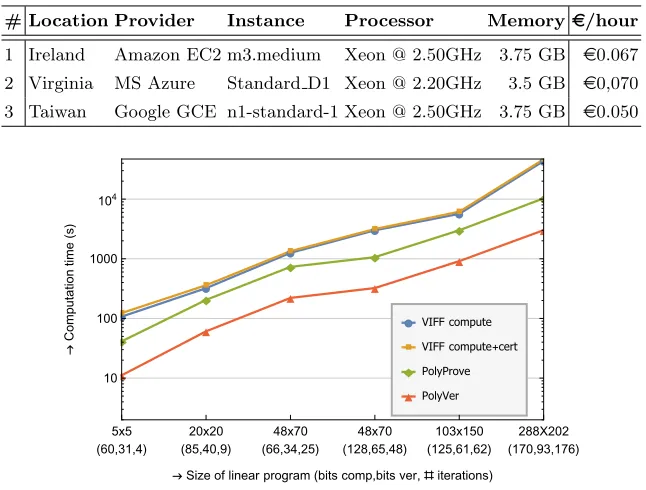
To obtain a realistic outsourcing setting, we have deployed the three workers on three different cloud instances from different providers on different continents. See Table 2 for their specifications. In this setup, the inputters and recipient do not have to rely on any single cloud provider or jurisdiction for their privacy: they simply have to assume that the different instances do not collude. All machines ran Ubuntu 14.04.2 LTS. The recipient ran Windows 7 on an Intel i5-5300 (2.30 GHz). The VIFF part of the computation (i.e., step 4) requires authenticated and private channels; these were implemented using SSL. We did not implement steps 1–3 as they contribute minimally to the overall performance of the protocol.
5
Table 2.Specifications of the workers used in our cloud experiments
# Location Provider Instance Processor Memorye/hour
1 Ireland Amazon EC2 m3.medium Xeon @ 2.50GHz 3.75 GB e0.067
2 Virginia MS Azure Standard D1 Xeon @ 2.20GHz 3.5 GB e0,070
3 Taiwan Google GCE n1-standard-1 Xeon @ 2.50GHz 3.75 GB e0.050
● ● ● ● ● ● ■ ■ ■ ■ ■ ■ ◆ ◆ ◆ ◆ ◆ ◆ ▲ ▲ ▲ ▲ ▲ ▲
● VIFF compute
■ VIFF compute+cert
◆PolyProve ▲ PolyVer
5x5
(60,31,4)
20x20
(85,40,9)
48x70
(66,34,25)
48x70
(128,65,48)
103x150
(125,61,62)
288X202
(170,93,176)
10 100 1000 104
→Size of linear program(bits comp,bits ver,#iterations)
→ Computation time ( s )
Fig. 5.Computation times ofVerMPCon various LPs (thex-axis shows the LP size, bit length for VIFF, bit length for the certificate, and number of iterations)
We ran our experiments on several LPs: randomly-generated small LPs and larger LPs based on Netlib test programs6. We measured the time for VIFF to solve the LP and to compute the certificate (this depends on the LP size, number of iterations needed, and the bit length for internal computations); the time for PolyProveto produce a proof; and forPolyVerto verify it (this depends on the LP size and bit length for the proof).7
Figure 5 shows the performance numbers of our experiments. For the LPs in our experiments, we find that producing a proof adds little overhead to comput-ing the solution, and that verifycomput-ing the proof is much faster than participatcomput-ing in the computation. As a consequence, for the recipient, outsourcing both guar-antees correctness and saves time compared to participating in the computation. Already in a party with three inputters/recipients, privacy-preserving outsourc-ing makes sense; with more inputters/recipients, this performance effect is even bigger because computation scales linearly in the number of parties involved.
6
http://www.netlib.org/lp/data/; coefficients rounded for performance
7 We took the minimal bitlengths needed for correctness. In practice, these are not
In general, one expects the difference between computing the solution and proving its correctness to be more pronounced for larger problems: indeed, both the computation and the correctness verification scale in the size of the LP; but computation additionally scales in the number of iterations needed to reach the optimal solution. This number of iterations typically grows with the LP size. However, we only found this for the biggest linear program, where proving is over four times faster than computing; for the other programs, this factor was around two. An explanation for this is that also the bitlength of solutions (which influences proving time) typically grows with the number of iterations.
4.2 Certificate Validation versus Active Security
As discussed, the security guarantees of our model lie in between passive secu-rity (that does not guarantee correctness in case of active attacks) and active security (that also guarantees privacy in this case). Above we showed that the overhead of our approach compared to passive security is small; we now compare our performance to that of active security. To get an idea of the performance difference between our approach and active security, we have solved several of our LP instances with an LP solver based on the state-of-the-art SPDZ pro-tocols [DKL+13]. SPDZ combines a slow preprocessing phase, in which many random values are shared between workers, with a fast on-line phase with com-plexity comparable to passively secure protocols. Hence, after preprocessing has been performed, SPDZ can perform a computation with full privacy and correct-ness guarantees in about the same time as VIFF (in fact, due to a more efficient implementation, the tested implementation is even faster).
However, preprocessing is slow. No public implementation of the preprocess-ing phase is available, but it is possible to estimate the time it takes by measurpreprocess-ing the amount of randomness needed for the on-line phase and combining this with available preprocessing performance figures [DKL+13]. Even with estimates that are very generous to SPDZ, one finds that the SPDZ preprocessing time is at least 15 times more than the VIFF computation time. For instance, for the first 48-by-70 linear program, we estimate that preprocessing for an actively secure computation takes at least 13 hours; conversely, for out implementation, com-putation and proving time is close to 35 minutes and verification time is 3.7 minutes. Also, note that the SPDZ timings from [DKL+13] were on a local net-work whereas our net-workers are spread over the world; and that the SPDZ timings were for two parties and SPDZ preprocessing scales linearly with the number of parties involved, including all inputters and recipients (whereas our performance does not depend on the number of inputters and recipients). Clearly, outsourcing with certificate validation has favourable performance compared to using SPDZ.
5
Concluding Remarks
effi-ciently instantiate this idea by combining passively secure three-party computa-tion with ElGamal-based proofs. For linear programming, verifying results takes much less time than participating in an actively secure computation; in fact, it even takes less time than participating in a passively secure computation with-out any correctness guarantees. Hence, for computations on inputs of mutually distrusting parties, privacy-preserving outsourcing with correctness guarantees provides a compelling combination of correctness (always) and privacy (against semi-honest, non-collaborating cloud workers) guarantees.
We see several directions for improvement of our work. We have used pas-sively secure protocols for computation; using protocols that guarantee privacy (but not correctness) also against active attacks would offer stronger protection, possibly at a low performance cost. Our implementation can be optimised, and our alternative construction using Pedersen commitment should have smaller proofs and faster verification. Much bigger speed-ups, however, (especially for linear programming) would come from using efficient zero-knowledge proofs for specific tasks, e.g., for showing that certain values are positive. In particular, range proofs are much faster to verify than our bit-wise proofs; the work of Keller et al. [KMR12] suggests ways of distributing these proofs that could be adapted to our setting. Alternatively, it may be possible to achieve even faster certificate validation by combining verifiable outsourcing techniques with the privacy guarantees of multiparty computation.
References
[ACG+14] P. Ananth, N. Chandran, V. Goyal, B. Kanukurthi, and R. Ostrovsky. Achieving Privacy in Verifiable Computation with Multiple Servers - With-out FHE and withWith-out Pre-processing. InProceedings of PKC ’14, 2014. [AS98] S. Arora and S. Safra. Probabilistic checking of proofs: A new
characteri-zation of NP. J. ACM, 45(1):70–122, 1998.
[BD09] P. Bogetoft and Dan Lund Christensen, et al. Secure Multiparty Compu-tation Goes Live. InProceedings of Financial Crypto ’09, 2009.
[BDO14] C. Baum, I. Damg˚ard, and C. Orlandi. Publicly Auditable Secure Multi-Party Computation. InProceedings of SCN ’14, 2014.
[Can98] R. Canetti. Security and Composition of Multi-party Cryptographic Pro-tocols. Journal of Cryptology, 13:2000, 1998.
[CdH10] O. Catrina and S. de Hoogh. Secure multiparty linear programming using fixed-point arithmetic. InProc. of ESORICS ’10, pages 134–150, 2010. [CDS94] R. Cramer, I. Damg˚ard, and B. Schoenmakers. Proofs of partial
knowl-edge and simplified design of witness hiding protocols. In Proceedings of
CRYPTO ’94, 1994.
[CF85] J. Cohen and M. Fischer. A Robust and Verifiable Cryptographically Secure Election Scheme. InProceedings of FOCS ’85, pages 372–382. IEEE, 1985. [CL02] M. Castro and B. Liskov. Practical Byzantine fault tolerance and proactive recovery. ACM Transactions on Computer Systems, 20(4):398–461, 2002. [DDN+15] I. Damg˚ard, K. Damg˚ard, K. Nielsen, P. S. Nordholt, and T. Toft.
[DFK+92] C. Dwork, U. Feige, J. Kilian, M. Naor, and S. Safra. Low communication 2-prover zero-knowledge proofs for NP. In Proceedings of CRYPTO ’92, pages 215–227, 1992.
[dH12] S. de Hoogh. Design of large scale applications of secure multiparty com-putation: secure linear programming. PhD thesis, Eindhoven University of Technology, 2012.
[DKL+13] I. Damg˚ard, M. Keller, E. Larraia, V. Pastro, P. Scholl, and N. P. Smart. Practical Covertly Secure MPC for Dishonest Majority - Or: Breaking the SPDZ Limits. InProceedings of ESORICS ’13, 2013.
[EFLL12] Y. Ejgenberg, M. Farbstein, M. Levy, and Y. Lindell. SCAPI: The Se-cure Computation Application Programming Interface. Cryptology ePrint Archive, Report 2012/629, 2012:629, 2012.
[El 85] T. El Gamal. A public key cryptosystem and a signature scheme based on discrete logarithms.IEEE Transactions on Information Theory, 31(4):469– 472, 1985.
[FGP14] D. Fiore, R. Gennaro, and V. Pastro. Efficiently Verifiable Computation on Encrypted Data. InProceedings of CCS ’14, 2014.
[FS86] A. Fiat and A. Shamir. How to Prove Yourself: Practical Solutions to Identification and Signature Problems. InProc. of CRYPTO ’86, 1986. [GKP+13] S. Goldwasser, Y. T. Kalai, R. A. Popa, V. Vaikuntanathan, and N.
Zel-dovich. Reusable garbled circuits and succinct functional encryption. In
Proc. of STOC ’13, 2013.
[GKR08] S. Goldwasser, Y. T. Kalai, and G. N. Rothblum. Delegating computation: interactive proofs for muggles. InProc. of STOC ’08, pages 113–122, 2008. [Hro01] J. Hromkovic. Algorithmics for hard problems - introduction to combinato-rial optimization, randomization, approximation, and heuristics. Springer, 2001.
[JNO14] T. P. Jakobsen, J. B. Nielsen, and C. Orlandi. A framework for outsourcing of secure computation. InProceedings of CCSW ’14, pages 81–92, 2014. [KMR11] S. Kamara, P. Mohassel, and M. Raykova. Outsourcing multi-party
com-putation. IACR Cryptology ePrint Archive, 2011:272, 2011.
[KMR12] M. Keller, G. L. Mikkelsen, and A. Rupp. Efficient Threshold Zero-Knowledge with Applications to User-Centric Protocols. In Proceedings of ICITS ’12, 2012.
[LTV12] A. L´opez-Alt, E. Tromer, and V. Vaikuntanathan. On-the-fly multiparty computation on the cloud via multikey fully homomorphic encryption. In
Proceedings of STOC ’12, pages 1219–1234, 2012.
[Nat99] National Institute of Standards and Technology. Recommended elliptic curves for federal government use, 1999. Available at http://csrc.nist.
gov/encryption.
[Ped91] T. P. Pedersen. A Threshold Cryptosystem without a Trusted Party (Ex-tended Abstract). InProceedings of EUROCRYPT ’91, 1991.
[PHGR13] B. Parno, J. Howell, C. Gentry, and M. Raykova. Pinocchio: Nearly Prac-tical Verifiable Computation. InProceedings of S&P ’13, 2013.
[SK95] K. Sako and J. Kilian. Receipt-Free Mix-Type Voting Scheme—A Practical Solution to the Implementation of a Voting Booth. In Proceedings of
EU-ROCRYPT ’95, volume 921 of Lecture Notes in Computer Science, pages
393–403. Springer, 1995.
1: .Relation:R={(a, b;y, r)|a=gr∧b=hrgy}
2: functionΣPK.ann(a, b;y, r) .Announcement
3: u, v∈RFq;c←gv;d←hvgu;return(c, d;u, v)
4: functionΣPK.res(a, b;y, r;c, d;u, v;e) .Response
5: k←u+e·y;l←v+e·r;return(k, l)
6: functionΣPK.sim(a, b;e) .Simulator
7: k, l∈RFq;a←gla−e;b←hlgkb−e
8: return(a, b;e;k, l)
9: functionΣPK.ext(a, b;c, d;e;e0;k, l;k0, l0) .Extractor
10: y←(k−k0)/(e−e0);r←(l−l0)/(e−e0) 11: return(y, r)
12: functionΣPK.rea(a, b;e;k, l) .Announcement recomputation
13: c←gla−e;d←hlgkb−e;return(c, d)
14: functionΣPK.ver(a, b;c, d;e;k, l) .Verification
15: returnae=? glc−1 ∧ be=? hlgkd−1
Fig. 6.ΣPK: Proof of plaintext knowledge
[SZJVD04] R. Sailer, X. Zhang, T. Jaeger, and L. Van Doorn. Design and Implemen-tation of a TCG-based Integrity Measurement Architecture. InProceedings of Usenix Security ’04, 2004.
[TT10] R. Tamassia and N. Triandopoulos. Certification and authentication of data structures. InProceedings of AMW ’10, 2010.
[ZPK14] Y. Zhang, C. Papamanthou, and J. Katz. ALITHEIA: towards practical verifiable graph processing. InProceedings of CCS ’14, pages 856–867, 2014.
A
Details of the PolyProve Protocol
In this Appendix, we present the details of the protocols presented in Section 2.2, specifically in the two-party setting that we have implemented.
A.1 Preliminaries
A Σ-protocol for a binary relation R is a three-move protocol in which a po-tentially malicious prover convinces a honest verifier that he knows awitness w
forstatement v such that (v, w)∈R. First, the prover sends anannouncement (computed using algorithm Σ.ann) to the verifier; the verifier responds with a uniformly randomchallenge; and the prover sends hisresponse (computed using algorithmΣ.res), which the verifier verifies (using predicateΣ.ver).
Definition 3. Let R ⊂V ×W be a binary relation with language LR ={v ∈ V | ∃w∈W : (v, w)∈R}. LetΣ be a collection of probabilistic polynomial time algorithmsΣ.ann,Σ.res,Σ.sim,Σ.ext, and polynomial time predicateΣ.ver. Let
1: .Relation:R={(a1, b1, a2, b2, a3, b3;y, r, s)|
2: . a2=gr∧b2=hrgy∧a3=ay1gs∧b3=by1hs}
3: functionΣCM.ann(a1, b1, a2, b2, a3, b3;y, r, s) .Announcement
4: u, v, w∈RFq;a←gv;b←hvgu;c←au1gw
5: d=bu1hw
6: return(a, b, c, d;u, v, w)
7: functionΣCM.res(. . .;y, r, s;. . .;u, v, w;e) .Response
8: k←u+e·y;l←v+e·r;m←w+e·s 9: return(k, l, m)
10: functionΣCM.sim(a1, b1, a2, b2, a3, b3;e) .Simulator
11: k, l, m∈RFq
12: a←gla−2e;b←hlgkb−2e 13: c←ak1gma
−e 3 ;d←b
k 1hmb
−e 3
14: return(a, b, c, d;e;k, l, m)
15: functionΣCM.ext(. . .;. . .;e;e0;k, l, m;k0, l0, m0) .Extractor
16: y←(k−k0)/(e−e0);r←(l−l0)/(e−e0) 17: s←(m−m0)/(e−e0)
18: return(y, r, s)
19: functionΣPK.rea(a1, b1, a2, b2, a3, b3;e;k, l, m) .Announcement recomputation
20: a←gla−2e;b←hlgkb−2e 21: c←ak1gma
−e 3 ;d←b
k 1hmb
−e 3
22: return(a, b, c, d)
23: functionΣCM.ver(a1, b1, a2, b2, a3, b3;
24: a, b, c, d;e;k, l, m) .Verification
25: returnae2 ?
=gla−1 ∧ be2 ?
=hlgkb−1 ∧
26: ae3 =? ak1gmc−1 ∧ be3=? bk1hmd−1
Fig. 7.ΣCM: Proof of correct multiplication
Completeness If (a, s) ← Σ.ann(v;w), c ∈ C, and r ← Σ.res(v;w;a;s;c), thenΣ.ver(v;a;c;r).
Special soundness If v ∈V,c=6 c0, andΣ.ver(v;a;c;r)andΣ.ver(v;a;c0;r0) both hold, thenw←Σ.ext(v;a;c;c0;r;r0)satisfies (v, w)∈R.
Special honest-verifier zero-knowledge If v ∈ LR, c ∈ C, then (a, r) ← Σ.sim(v;c)has the same probability distribution as(a, r)obtained by(a, s)←
Σ.ann(v;w), r ← Σ.res(v;w;a;s;c). If v /∈ LR, then (a, r) ← Σ.sim(v;c)
satisfiesΣ.ver(v;a;c;r).
1: .Relation:R={(a, b, D, h;s)|D=ba−s∧h=gs}
2: functionΣCD.ann(a, b, D, h;s) .Announcement
3: u∈RFq;c←au;d←gu;return(c, d;u)
4: functionΣCD.res(a, b, D, h;s;c, d;u;e) .Response
5: f=u+e·s;returnf
6: functionΣCD.sim(a, b, D, h;e) .Simulator
7: f∈RFq;c←afDeb−e;d←gfh−e
8: return(b, c;e;f)
9: functionΣCD.ext(a, b, D, h;c, d;e;e0;f;f0) .Extractor
10: s←(f−f0)/(e−e0);returns
11: functionΣPK.rea(a, b, D, h;e;f) .Announcement recomputation
12: c←afDeb−e;d←gfh−e;return(c, d)
13: functionΣCD.ver(a, b, D, h;c, d;e;f) .Verification
14: returnbeD−e
?
=afc−1 ∧ he=gfd−1
Fig. 8.ΣCD: Proof of correct decryption (share)
For our purposes, we need three Σ-protocols: proof of plaintext knowledge
ΣPK, proof of correct multiplicationΣCM, and proof of correct decryptionΣCD. These protocols are standard; we give them here for completeness. ΣPK (Fig-ure 6) proves knowledge of plaintext y and randomness r used in encryption (a, b) = (gr, hrgy). Σ
CM (Figure 7) proves the following: given encryptions (a1, b1), (a2, b2), and (a3, b3), the prover knows (y, r, s) such thata2 = gr and
b2=hrgy (i.e., (a2, b2) encrypts plaintexty with randomnessr); anda3=a
y
1gs and b3 =b
y
1hs (i.e., (a3, b3) encrypts the product encryption, randomised with
s). ForΣCD, recall that the decryption of plaintext (a, b) with private key (share)
sis D=ba−s. Correctness ofD with respect to public key (share)his proven
by proving knowledge of the value s such that h = gs and b = Da−s using a
standard equality proof (Figure 8).
We say thatΣCMhas ahomomorphism[SV15]ΦCMconsisting of a statement combining function ΦCM.stmt({(X, Yi, Zi)}) = (X,⊕Yi,⊕Zi)), an
announce-ment combining function ΦCM.ann({(ai, bi, ci, di)}) = (Qai,Qbi,Qci,Qdi),
and a response combining functionΦCM.resp({(ki, li, mi)}) = (Pki,Pli,Pmi).
Similarly, a homomorphismΦPKforΣPKcombines proofs of plaintext knowledge for (ai, bi) into a proof of knowledge for (Qai,Qbi). That is, it combines proofs
of knowledge of the plaintexts ofXi into one proof of (collective) knowledge of
the plaintext of⊕Xi. HomomorphismΦCD forΣCDcombines proofs of correct decryption of (a, b) to sharesDiwith respect to public key shareshi into a proof
of correct decryption of (a, b) tobQ
(b−1di) with respect to public keyh=Qhi.
Like ΦCM, these homomorphisms also take the product of the announcements and the sum of the responses. (Homomorphisms need to satisfy two technical properties discussed in [SV15]; we mention without proof that these properties hold for the homomorphisms in this paper.)
knowl-edge of a witness for statement v by generating announcementa using Σ.ann; setting challenge c = H(v||a||aux) with some auxiliary information aux; and computing responserwithΣ.res. The proof (a, c, r) can be verified by checking that
H(v||a||aux)=? c∧Σ.ver(v;a;c;r).
If Σ.rea is defined, then the proof can be shortened to (c, r), which a verifier accepts ifZkVer(Σ;v;c, r;aux) holds, where
ZkVer(Σ;v;c, r;aux) := (H(v||Σ.rea(v;c;r)||aux)=? c).
Security holds in the random oracle model, an idealised model of hash functions. If a party needs to prove multiple statements vi at the same time, then it is
possible to use the same challenge for all the proofs by computing announcements
ai and settingc=H(v1||a1||v2||a2||. . .||aux).
The above homomorphisms can be exploited to obtain non-interactive zero-knowledge proofs of combined statements. Suppose two parties want to produce a series of proofs for statementsvi =Φ.stmt({vi0, vi00}). They exchange
announce-ments a0i, a00i for their shares vi0, v00i of vi; compute ai = Φ.ann({a0i, a00i}); take
challengeh=H(v1||a1||v2||a2||. . .||aux); and exchange responsesr0i, r00i. Taking ri = Φ.resp({r0i, r00i}), the challenge h and responsesri prove collective
knowl-edge of witnesses corresponding to statementsvi. For security reasons, the second
party should not be able to choosea00i based ona0i. To ensure this, the first party can first provide a hash of its announcements; the second party then provides its announcements, after which the first party opens the hash. This construction satisfies the desirable notions of soundness and zero knowledge [SV15].
A.2 Details of PolyProve and PolyVer
Figure 9 shows ourPolyProve protocol for producing a proof that ElGamal encryptions X1, . . . , Xn satisfy a given set of polynomial relations in the
two-party setting. The protocol has two sets of inputs. First, the ElGamal public keypkand secret-shares [pk], [sk] of this key and the corresponding private key. Second, encryptions X1, . . . , Xn, and secret-shares of the respective plaintexts
[xi] and randomness [ri]. The set of relations to be proven is formalised by
structuresE andG.E is a set of equationsxj= 0 (1≤j≤N for someN ≥n).
Gis an arithmetic circuit to compute valuesxj forj > n. Specifically,Gconsists
of gates xk = v, xk =xi+xj, xk =xi·v, and xk =xi·xj (v any constant).
For multiplicationxk =xi·xj, we require 1≤j≤n: for these encryptions the
workers have shared the randomness, which we will need to produce the proof. (Clearly, any set of polynomial relations can be described by suchE andG.)
The first step of the protocol is to evaluate the circuit (lines 3–10) to obtain encryptions Xn+1, . . . , XN. All gates except xk =xi·xj can be evaluated
lo-cally; for xk =xi·xj, the parties use their additive shares of the plaintext of Xj to obtain shares ofXk, randomised using randomness [sk]. Then, the
Require: pk/sk ElGamal public/private keys shared between parties P1, P2; Xi =
Encpk(xi;ri) a set of ElGamal encryptions;Gan arithmetic circuit forxn+1, . . . , xN with multiplication gatesM ⊂ G;E a set of equationsxk= 0
Ensure: return proof that equationsE hold forX1, . . . , XN computed according toG
1: protocolPolyProveE,G(pk; [pk]; [sk];X1, . . . , Xn; [x1], . . . ,[xn]; [r1], . . . ,[rn])
2: parties{P1,P2}do
3: for allgates∈ G do.evaluate circuit and exchange multiplication proofs 4: if hconstant gatexk=vi thenXk←Encpk(v; 0)
5: if haddition gatexk=xi+xji thenXk←Xi⊕Xj 6: if hmultiplication gatexk=xi·vi thenXk←Xi⊗v 7: if hmultiplication gatexk=xi·xj, 1≤j≤nithen 8: [rk]∈rZp; [Xk]←(Xi⊗[xj])⊕Encpk(0; [rk]) 9: send([Xk]); [Xk0]←recv();Xk←[Xk]⊕[Xk0] 10: ([ak];sk)←ΣCM.ann(Xi,[Xj],[Xk]; [xj],[rj],[rk])
11: partiesP1 do
12: h← H({[ak]}k∈M);send(h);{[ak0]}k∈M←recv();send({[ak]}k∈M)
13: partiesP2 do
14: h←recv();send({[ak]}k∈M);{[a0k]}k∈M←recv();if h6=H({[a0k]}k∈M) thenfail
15: parties{P1,P2}do
16: for allmult. gatesxk=xi·xj, 1≤j≤ninM doak←ΦCM.ann([ak],[a0k])
17: h1← H({Xi||Xj||Xk||ak}gatesxk=xi·xj||mul) 18: for allmult. gatesxk=xi·xj, 1≤j≤ninMdo 19: [rk]←ΣCM.res(Xi,[Xj],[Xk]; [xj],[rj],[rk]; [ak];sk;h1)
20: send({[rk]}k∈M);{[r0k]}k∈M←recv() 21: for allk∈ Mdo
22: rk←ΦCM.resp([rk]; [r0k]);if ¬ΣCM.ver(Xi, Xj, Xk;ak;h1;rk) thenfail
23: for all(xk= 0)∈ E do .decrypt eqs + prove
24: [dk]←Dec[sk](Xk); ([Ak];Sk)←ΣCD.ann(Xk,[dk],[pk]; [sk])
25: partyP1doh← H({[Ak]}k∈E);send(h);{[A0k]}k∈E ←recv();send({[Ak]}k∈E) 26: partiesP2 do
27: h←recv();send({[Ak]}k∈E);{[A0k]}k∈E ←recv();if h6=H({[A0k]}k∈E) thenfail
28: parties{P1,P2}do
29: for alleq. (xk= 0)∈ E doAk←ΦCD.ann([Ak],[A0k])
30: h2← H({Xk||g0||pk||Ak}equationxk=0||dec)
31: for alleq. (xk= 0)∈ E do[Rk]←ΣCD.res(Xk,[dk],[pk]; [sk]; [Ak];Sk;h2)
32: send({[Rk]}k∈E);{[R0k]}k∈E ←recv() 33: for allequations (xk= 0)∈ E do
34: Rk←ΦCD.resp([Rk],[R0k]);if¬ΣCD.ver(Xk, g0,pk;Ak;h2;Rk) thenfail
35: return(h1,{Xk, rk}k∈M, h2,{Rk}k∈E) .return mult. and decr. proofs
Fig. 9.PolyProve: Prove polynomial equations over ElGamal ciphertexts
Require: Gis an arithmetic circuit forxn+1, . . . , xN;M ⊂ Gare multiplication gates; E is a set of equationsxk= 0
Ensure: all equations inE hold forX1, . . . , XN
1: functionPolyVerE,G(pk;X1, . . . , Xn;π)
2: (h1,{Xk, rk}k∈M, h2,{Rk}k∈E)←π .unpack 3: for allgates∈ Gdo .determine encrypted gates 4: if hconstant gatexk=vi thenXk←Encpk(c; 0)
5: if haddition gatexk=xi+xji thenXk←Xi⊕Xj 6: if hmultiplication gatexk=xi·vi thenXk←Xi⊗v
7: for allmultiplicationsxk=xi·xjinM doak←ΣCM.rea(Xi, Xj, Xk;h1;rk)
8: for allequationsxk= 0 inE doAk←ΣCD.rea(Xk, g0,pk;h2;Rk)
9: returnH({Xi||Xj||Xk||ak}xk=xi·xj||mul)
?
=h1∧ H({Xk||g0||pk||Ak}xk=0||dec) ? =h2
Fig. 10.PolyVer: Verify polynomial equations over ElGamal ciphertexts
The second step is to prove that, for each equation xj = 0, Xj is an
en-cryption of zero. The parties compute deen-cryption shares [dk] (line 23) and
pro-duce a combined proof that decryption is to zero. These proofs are propro-duced similarly to the multiplication proofs. (Note that the multiplication and de-cryption proofs cannot use the same challenge: for security, values Xk can be
decrypted only after the multiplication proofs have been verified.) The overall proof π= (h1,{Xk, rk}, h2,{Rk}) consists of the encrypted productsXk,
chal-lengeh1, h2, and responsesrk, Rk.
AlgorithmPolyVershown in Figure 10 shows how to check if the proofπ
produced by PolyProve is correct. Specifically, the algorithm takes as argu-ments the public key pk, encryptions X1, . . . , Xn, and proofπ as above. First,
it computes missing encryptions ∈ {Xn+1, . . . , XN}, i.e., of gates that are not
inputs or multiplication results (line 3–6). Then, it computes the announcements for all multiplication (line 7) and decryption (line 8) proofs. The overall proofπ
is correct when these announcements with their respective statements hash to challengesh1,h2 (line 9).
B
Security Proof
We now prove Theorem 1. As discussed, security is defined by demanding the existence, for every adversaryAfor the real protocol, of an adversarySA, called thesimulator, for the ideal-world execution. ThisSA should have the property that running the real protocol withAgives output of the recipient and adversary that are indistinguishable from performing the ideal-world execution with SA. In the ideal world, we control the information that SA gets to work with and we control the output for the recipient. Hence, if these are the same in the real world, then privacy, correctness and other modelled security requirements must hold.