Bootstrapping for Approximate
Homomorphic Encryption
Jung Hee Cheon1, Kyoohyung Han1, Andrey Kim1, Miran Kim2, and Yongsoo Song1,2
1
Seoul National University, Seoul, Republic of Korea
{jhcheon, satanigh, kimandrik, lucius05}@snu.ac.kr
2
University of California, San Diego, United States
{mrkim, yongsoosong}@ucsd.edu
Abstract. This paper extends the leveled homomorphic encryption scheme for an approximate arithmetic of Cheon et al. (ASIACRYPT 2017) to a fully homomorphic encryption, i.e., we propose a new technique to refresh low-level ciphertexts based on Gentry’s bootstrapping pro-cedure.
The modular reduction operation is the main bottleneck in the homomorphic evaluation of the decryption circuit. We exploit a scaled sine function as an approximation of the modular reduction operation and present an efficient evaluation strategy. Our method requires only one homomorphic multiplication for each of iterations and so the total computation cost grows linearly with the depth of the decryption circuit.
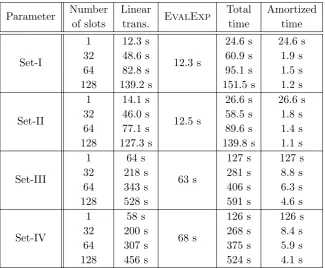
We also show how to recrypt packed ciphertexts on the RLWE construction with an open-source implementation. For example, it takes 139.8 seconds to refresh a ciphertext that encrypts 128 numbers with 12 bits of precision, yielding an amortized rate of 1.1 seconds per slot. Keywords.Homomorphic encryption, approximate arithmetic, bootstrapping
1 Introduction
Homomorphic encryption (HE) is a cryptographic scheme that allows us to evaluate an arbitrary arithmetic circuit on encrypted data without decryption. There have been a number of studies [22, 8, 9, 6, 7, 25, 30, 11, 5, 31, 19, 16] to improve the efficiency of HE cryptosystem after Gentry’s blueprint [26]. This cryptographic primitive has a number of prospective real-world applications based on the secure outsourcing of computation in public clouds. For example, HE can be a solution to performing the computation of various algorithms on financial, medical, or genomic data without any information leakage [39, 38, 15, 41, 36].
Unfortunately, most of existing HE schemes support the exact arithmetic operations over some discrete spaces (e.g. finite field), so that they are not suitable for many real-world applications which require a floating point operation or real number arithmetic. To be specific,bitwise encryption schemes [24, 17] can evaluate a boolean gate with bootstrapping in much shorter time, but it is necessary to evaluate a deep circuit with a number of gates to perform a single arithmetic operation (e.g. addition or multiplication) between high-precision numbers. Moreover, a huge expansion rate of ciphertexts is another issue that stands in the way of the practical use of bitwise encryptions. On the other hand, word encryption
schemes [7, 30, 6, 25] can encrypt multiple high-precision numbers in a single ciphertext but the rounding operation is difficult to be evaluated since it is not expressed as a small-degree polynomial. Therefore, they require either a plaintext space with an exponentially large bit size on the depth of a circuit, or an expensive computation such as rounding operation and extraction of the most significant bits.
a secret key sk, the decryption algorithm [hct,ski]q outputs an approximate value m+e of the original message with a small error e. The main advantage of HEAAN comes from the
rescaling procedure for managing the magnitude of plaintexts. It truncates a ciphertext into a smaller modulus, which leads to an approximate rounding of the encrypted plaintext. As a result, it achieved the first linear growth of the ciphertext modulus on the depth of the circuit being evaluated, against the exponential growth in previous word encryption schemes. In addition, the RLWE-basedHEAANscheme has its own packing strategy to encrypt multiple complex numbers in a single ciphertext and perform a parallel computation. However,HEAAN
is a leveled HE scheme which can only evaluate a circuit of fixed depth. As homomorphic operations progresses, the ciphertext modulus decreases and finally becomes too small to carry out more computations.
In previous literature, Gentry’s bootstrapping is the only known method to construct a fully homomorphic encryption (FHE) scheme which allows us to evaluate an arbitrary circuit. Technically, the bootstrapping method can be understood as a homomorphic evaluation of the decryption circuit to refresh a ciphertext for more computations. TheHEAANscheme does not support the modular arithmetic, however, its decryption circuit [hct,ski]q requires the modular reduction operation, which makes its bootstrapping much harder. Therefore, the bootstrapping ofHEAANcan be reduced to a problem that represents the modular reduction function F(t) = [t]q as a polynomial over the integers (or, complex numbers). One may use the polynomial interpolation of this function over the domain of t = hct,ski, but it is a limiting factor for practical implementation due to a huge computational cost of an evaluation.
Our contributions.We present a methodology to refresh ciphertexts ofHEAANand make it bootstrappable for the evaluation of an arbitrary circuit. We take advantage of its intrinsic characteristic - approximate computation on encrypted data. Our bootstrapping procedure aims to evaluate the decryption formula approximately and obtain an encryption of the original message in a large ciphertext modulus. Hence, we find an approximation of the modular reduction function that can be evaluated efficiently using arithmetic operations of
HEAAN. The approximation error should be small enough to maintain the precision of an input plaintext.
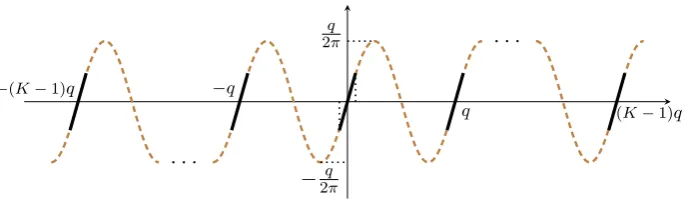
We first note that the modular reduction function F(t) = [t]q is the identity nearby zero and periodic with period q. If t = hct,ski is close to a multiple of the ciphertext modulus q (or equivalently, if the encrypted plaintext m = [t]q is small compared to q), then a trigonometric function can be a good approximation to the modular reduction. Namely, the decryption formula ofHEAANcan be represented using the following scaled sine function as
[hct,ski]q= q 2π ·sin
2π
q · hct,ski
+O(3·q),
when |[hct,ski]q| ≤ ·q. Hence we may use this analytic function instead of the modular reduction in the decryption formula.
Now our goal is to homomorphically evaluate the trigonometric function 2qπ·sin2qπ ·t
. . .
. . .
q
2π
−2qπ
q
−q
(K−1)q
−(K−1)q
Fig. 1.Modular reduction and scaled sine functions
We suggest an evaluation strategy of the trigonometric function to reduce its computation cost by exploiting the following double-angle formulas:
(
cos(2θ) = cos2θ−sin2θ, sin(2θ) = 2 cosθ·sinθ,
which means that we can obtain some approximate values of cos(2θ) and sin(2θ) from approximate values of cosθ and sinθ. In our bootstrapping process, we first compute the Taylor expansions of cos
2π
q · t
2r
and sin
2π q ·
t
2r
of a small degree d0 = O(1) for some
r=O(log(Kq)). Then we use the doubling-angle formulasr times recursively to get an
ap-proximate value of sin
2π q ·t
. In the case of the RLWE-based construction, this evaluation can be even more simplified by encrypting the complex exponentiation exp(iθ) = cosθ+i·sinθ and adapting the identity exp(i·2θ) = (exp(i·θ))2.
Results.Our bootstrapping technique forHEAAN is a new cryptographic primitive for FHE mechanisms, which yields the first word encryption scheme for approximate arithmetic. For a ciphertextctwith a modulusq, our bootstrapping procedure generates a ciphertext ct0 with a larger ciphertext modulus Qq, satisfying the condition [hct0,ski]Q≈[hct,ski]q while an error is kept small enough not to destroy the significant digits of a plaintext. The output ciphertext will have a sufficiently large modulus compared to a plaintext, thereby enabling further computation on the ciphertext. In addition, our approximation to a trigonometric function and efficient evaluation strategy reduce the complexity of the evaluation down to O(L) homomorphic multiplications for the depth L=O(logq) of the decryption circuit.
We also give an open-source implementation [12] to demonstrate the performance of our bootstrapping method. It contains some optimization techniques including the linear transformation method of [33] for the recryption over the packed ciphertexts. When we want to preserve 12 bits of precision, our bootstrapping on a single-slot ciphertext takes about 26.6 seconds. We also optimize the linear transforms for sparsely packed ciphertexts and it takes about 139.8 seconds to recrypt a ciphertext that encrypts 128 complex numbers in plaintext slots, yielding an amortized rate of 1.1 seconds per slot.
Implications of our bootstrapping method.The main feature of approximate arithmetic is that every number contains an error of which could increase during computation. The precision of a number is reduced by approximately one bit after multiplication and finally we may not extract any meaningful information from the computation result if the depth of a circuit is larger than the bit precision of the input data. On the other hand, our bootstrapping procedure is to refresh ciphertexts and then perform further computation on encrypted data. This concept of anunlimited computation may seem a contradiction to the property of finite precision in the approximate arithmetic.
mechanism of physical and computational components. A computational element commutes with the sensors and every signal contains a small error. One can guarantee the correctness of CPS only when it is stable because an error is reduced by negative feedback to the input. Another example is the gradient descent method, which is the most widely used algorithm to perform optimization. It has a number of applications in machine learning such as logistic regression and neural networks. It computes the gradient of a point and moves it closer to an optimal point, which reduces the effects of perturbations in the output.
As in the examples above, we do not have to worry about the precision of numbers when the overall system is stable. In fact, there are some proof-of-concept implementations about the secure control of CPS [35] and secure logistic regression using biomedical data [37]. We expect that our bootstrapping process can be applied to these real-world applications.
Related works. There have been several attempts to carry out an approximate arithmetic using HE. Downlin et al. [23] (see also [21, 4]) described a method to transform a real number into a polynomial with small and sparse coefficients to reduce the required size of a plaintext modulus. Costache et al. [20] suggested a similar encoding method with [14] to evaluate the discrete Fourier transformation efficiently, but a ciphertext could encrypt only one value. Chen et al. [10] uses a technique of [34] to encrypt a single high-precision number. However, they still have some problems: (1) the coefficients and the degree of encoded polynomial grow exponentially with the depth of a circuit and (2) there is no known result to achieve an FHE scheme because a polynomial should be re-encoded to be represented with a smaller degree and coefficients for more computations and the bootstrapping method of [33] is not enough for this functionality.
The original Gentry’s bootstrapping technique was implemented by Gentry and Halevi [27], which took a half hour to recrypt a single bit ciphertext. Gentry et al. [28] represented the decryption circuit of RLWE-based HE with a lower depth circuit using a special modulus space. The Halevi-Shoup FHE implementation [33] reported a recryption time of approx-imately six minutes per slot. Meanwhile, Ducas and Micciancio [24] proposed the FHEW scheme that bootstraps a single-bit encryption in less than a second based on the frame-work of [2]. Chillotti et al. [17] obtained a speed up to less than 0.1 seconds. The following works [18, 3] improved the performance by using the evaluation of a look-up table before bootstrapping. However, the size of an input plaintext of bootstrapping is very limited since it is related to the ring dimension of an intermediate Ring GSW scheme. In addition, a huge expansion rate of ciphertexts is still an open problem in bitwise encryption schemes.
The previous FHE schemes evaluate the exact decryption circuit using the structure of a finite field or a polynomial ring in bootstrapping algorithm. The evaluation of an arbi-trary polynomial of degree d requires O(√d) homomorphic multiplications, but Halevi and Shoup [33] used a polynomial with the lifting property to reduce the computational cost of bootstrapping. They used a recursive algorithm to extract some digits in an encrypted state, so the number of homomorphic multiplications for bootstrapping was reduced down toO(log2d). Contrary to the work of Halevi and Shoup, we find an approximate decryption circuit using a trigonometric function and suggest an even simpler recursive algorithm. As a result, our algorithm only requiresO(logd) number of homomorphic multiplications, which results in an enhanced performance.
2 Preliminaries
The binary logarithm will be simply denoted by log(·). We denote vectors in bold, e.g. a, and every vector in this paper is a column vector. For a n1 ×m matrix A1 and a n2 ×m
matrix A2, (A1;A2) denotes the (n1+n2)×m matrix obtained by concatenating matrices
A1 andA2 in a vertical direction.
We denote byh·,·ithe usual dot product of two vectors. For a real numberr,bredenotes the nearest integer to r, rounding upwards in case of a tie. For an integer q, we identify
Z∩(−q/2, q/2] as a representative ofZqand use [z]qto denote the reduction of the integerz moduloq into that interval. We use x←Dto denote the samplingx according to distribu-tionD. The uniform distribution over a finite setS is denoted byU(S). We letλdenote the security parameter throughout the paper: all known valid attacks against the cryptographic scheme under scope should takeΩ(2λ) bit operations.
2.1 Cyclotomic Ring
For a positive integerM, letΦM(X) be theM-th cyclotomic polynomial of degreeN =φ(M). LetR=Z[X]/(ΦM(X)) be the ring of integers of a number fieldQ[X]/(ΦM(X)). We write Rq = R/qR for the residue ring of R modulo an integer q. An arbitrary element of the set P =R[X]/(ΦM(X)) will be represented as a polynomial a(X) =PNj=0−1ajXj of degree strictly less than N and identified with its coefficients vectora = (a0, . . . , aN−1)∈RN. We
definekak∞ and kak1 by the relevant norms on the coefficients vector a.
Write Z∗M = {x ∈ ZM : gcd(x, M) = 1} for the multiplicative group of units in ZM. Recall that the canonical embedding of a(X) ∈ Q[X]/(ΦM(X)) into CN is the vector of
evaluations of a(X) at theM-th primitive roots of unity. We use its natural extension σ to P, defined by σ(a) = (a(ζj))j∈Z∗
M for ζ = exp (2πi/M). Its `∞-norm is called the canonical
embedding norm, denoted by kakcan
∞ =kσ(a)k∞.
2.2 Homomorphic Encryption for Arithmetic of Approximate Numbers
HE is one of the prospective cryptographic primitives for secure outsourcing computation without information leakage. However, an inefficiency of real number computation is one of the main obstacles to apply HE schemes in real-world applications. Recently Cheon et al. [14] proposed a method to construct the HE scheme for approximate arithmetic, called HEAAN. Their scheme supports an efficient rounding operation of encrypted plaintext as well as basic arithmetic operations. This subsection gives a concrete description of the RLWE-basedHEAAN
scheme.
For a real σ >0,DG(σ2) denotes a distribution overZN which samples its components
independently from the discrete Gaussian distribution of varianceσ2. For an positive integer h, HWT(h) denotes a uniform distribution over the set of signed binary vectors in {±1}N whose Hamming weight is exactlyh. For a real 0≤ρ≤1, the distributionZO(ρ) draws each entry in the vector from{0,±1}, with probabilityρ/2 for each of−1 and +1, and probability being zero 1−ρ.
• KeyGen(1λ).
- For a basepand an integerL, letq` =p`for`= 1, . . . , L. Given the security parameter λ, choose a power-of-twoM, an integerh, an integer P, and a real numberσ >0 for an RLWE problem that achievesλ-bit of security level.
- Samples← HWT(h),a←U(RqL) ande← DG(σ2). Set the secret key assk←(1, s) and the public key aspk←(b, a)∈ R2
• KSGensk(s0). For s0∈ R, samplea0 ←U(RP·qL) ande
0 ← DG(σ2). Output the switching
key as swk←(b0, a0)∈ R2
P·qL where b0← −a0s+e0+P s0 (modP ·qL). - Set the evaluation key asevk←KSGensk(s2).
• Encpk(m). For m∈ R, sample v ← ZO(0.5) and e0, e1 ← DG(σ2). Output v·pk+ (m+
e0, e1) (mod qL).
• Decsk(ct). For ct= (c0, c1)∈ R2q`, outputm=c0+c1·s (modq`). • Add(ct1,ct2). For ct1,ct2∈ Rq2`, output ctadd ←ct1+ct2 (modq`).
• Multevk(ct1,ct2). For ct1 = (b1, a1),ct2 = (b2, a2) ∈ R2q`, let (d0, d1, d2) = (b1b2, a1b2+
a2b1, a1a2) (mod q`). Outputctmult←(d0, d1) +bP−1·d2·evke (modq`). • RS`→`0(ct). For a ciphertext ct ∈ R2q
` at level `, output ct
0 ← bp`0−`
·cte (modq`0). We will omit the subscript (`→`0) when `0=`−1.
The native plaintext space of HEAAN can be understood as the set of polynomialsm(X) inZ[X]/(ΦM(X)) such that kmkcan∞ < q/2. For convenience, we allow an arbitrary element
of P = R[X]/(ΦM(X)) as a plaintext polynomial, so that a ciphertext ct = (c0, c1) ∈ R2q` at level ` will be called an encryption of m(X) ∈ P with an error bound B if it satisfies hct,ski = m+e (modq`) for some polynomial e(X) ∈ P satisfying kekcan∞ ≤ B. The set
P =R[X]/(ΦM(X)) can be identified with the complex coordinate spaceCN/2 using a ring
isomorphism. This decoding map allows us to encrypt at most (N/2) numbers in a single ciphertext and carry out parallel operations in a Single Instruction Multiple Data (SIMD) manner. A simple description of the packing method will be described in Section 4.1.
We will make the use of the following lemmas from [14] for noise estimation. We adapt some notations from [14], defining the constantsBks and Brs.
Lemma 1 ([14, Lem. 1]). Let ct←Encpk(m) be an encryption ofm∈ R. Thenhct,ski=
m+e (modqL) for some e∈ R satisfying kekcan∞ ≤Bclean for Bclean = 8
√
2σN + 6σ√N+ 16σ√hN.
Lemma 2 ([14, Lem. 2]). Let ct0 ←RS`→`0(ct) for a ciphertext ct∈ R2q
`. Thenhct
0,ski=
q`0
q`hct,ski+e (modq`0) for some e∈ P satisfying kek
can
∞ ≤Brs for Brs= p
N/3·(3 + 8√h). Lemma 3 ([14, Lem. 3]). Let ctmult ←Multevk(ct1,ct2) for two ciphertexts ct1,ct2 ∈ R2q`.
Thenhctmult,ski=hct1,ski · hct2,ski+emult (modq`) for somee∈ R satisfying kemultkcan∞ ≤
Bmult(`) for Bks = 8σN/
√
3 and Bmult(`) =P−1·q`·Bks+Brs.
A rescaling (rounding) error is the smallest error type of homomorphic operations. The least digits of a plaintext is destroyed by some error after multiplication or rescaling, so its significand should be placed in higher digits not to lose the precision of the resulting plaintext.
3 Decryption Formula over the Integers
The goal of bootstrapping is to refresh a ciphertext and keep computing on encrypted data. Recall thatHEAANsupports arithmetic operations on a characteristic zero plaintext space such as C However, its decryption formula consists of two steps: the inner product t = hct,ski
3.1 Approximation of the Modular Reduction Function
Letct be a ciphertext relative to a secret key sk and a modulusq. Since sk is sampled from a small distribution, the size of its decryption structure t = hct,ski is bounded by Kq for some fixed constant K. So we can say that the decryption formula of HEAAN is defined on the setZ∩(−Kq, Kq) and it maps an arbitrary integert∈Z∩(−Kq, Kq) to the reduction
modularq.
It is infeasible to find a good approximation of the modular reduction function since it is not continuous. We first assume that a messagemof an input ciphertext is still much smaller than a ciphertext modulusq, so thatt=hct,skican be expressed as qI+m for some I and m such that|I|< K and |m| q. This assumption is reasonable because one can start the bootstrapping procedure on a ciphertext before its modulus becomes too small. Then the modular reduction F(t) = [t]q on a restricted domain becomes a piecewise linear function (see Fig. 1). We point out that this function is the identity near zero and periodic, so it looks like a part of the scaled sine
S(t) = q 2πsin
2πt
q
.
Note that it gives a good approximation to the piecewise linear function when an input value t=qI+mis close to a multiple ofq. Specifically, an error betweenF(t) andS(t) is bounded by
|F(t)−S(t)|= q 2π
2πm q −sin
2πm
q
≤ q
2π · 1 3!
2π|m|
q
3 =O
q·|m|
3
q3
,
which is equivalentlyO(1) whenm=O(q2/3).
3.2 Homomorphic Evaluation of the Complex Exponential Function
As discussed before, the scaled sine functionS(t) is a good approximation of the reduction modulo q. However, this function cannot be evaluated directly using HE since it is not a polynomial function. The goal of this subsection is to explain how to approximately and efficiently evaluate this trigonometric function based on HEAAN.
We may consider the Taylor polynomial 2qπ Pd−1 j=0
(−1)j
(2j+1)!
2πt q
2j+1
of S(t). The size of
error converges to zero very rapidly as the degree grows, i.e., an error betweenS(t) and its Taylor polynomial of degree 2d is bounded by 2qπ · 1
(2d+1)!(2πK)
2d+1 when |t|< Kq, and it
becomes small enough when the degree of the Taylor polynomial isO(Kq). However, despite its high precision, this naive method has an ineffective problem in practice. The complexity grows exponentially with the depth of a circuit, e.g.O(√d) using the Paterson-Stockmeyer algorithm [40] for an evaluation of a degree-dpolynomial.
Instead, we can reduce the computational cost by exploiting the following double-angle formulas: cos(2θ) = cos2θ−sin2θ and sin(2θ) = 2 cosθ·sinθ. From approximate values of
trigonometric functions in a small domain, we extend to find good approximations of the sign function on a wider (doubled) range. In particular, the RLWE-basedHEAANscheme can encrypt the complex numbers, so that the evaluation algorithm can be more simplified using the complex exponential function. Specifically, we use the identities
(
exp(iθ) = cosθ+i·sinθ,
exp(2iθ) = (exp(iθ))2,
We take the Taylor polynomial of a small degreed0≥1 as a high-precision approximation
of the complex exponential function within a small range. Then we perform the squaring operation repeatedly to get an approximation of the complex exponential function over the desirable domain. Note that we multiply a scale factor of∆to prevent the precision loss and divide the intermediate ciphertexts by a constant∆using the rescaling procedure ofHEAAN. The use of the complex exponential function has another advantage in error analysis. When we consider the RLWE-basedHEAANscheme, smallcomplex errors are added to plain-text slots during encryption, evaluation, rescaling and slot permutation. Therefore, we have only one constraint such that a decryption formula should be tolerant of small complex er-rors. Another advantage of our method comes from the fact that the complex exponential function is analytic with a bounded derivative over the whole complex plane, and therefore an error does not blow up by the decryption formula. The whole procedure is explicitly described as follows.
A valuet∈(−Kq, Kq) is given as an input of the decryption formula.
1. Consider the complex exponential function of exp22πitr·q
and compute its (scaled) Taylor expansion as
P0(t) =∆·
d0 X
k=0
1 k!
2πit 2r·q
k
of degree d0 ≥1.
2. For j= 0,1, . . . , r−1, repeat the squaring Pj+1(t)←∆−1·(Pj(t))2.
3. Return Pr(t).
The degreed0 of the initial Taylor polynomial, the scaling factor of∆, and the numberr
of the iterations (squaring) are determined by the following noise analysis. Since the size of the initial input (2πt)/(2r·q) of the complex exponential function has a small upper bound (2πK/2r), even the Taylor polynomial of a small degreed0 can be a good approximation to
the complex exponential function exp22πitr·q
. From the above observation, the outputPr(t)
is a polynomial of degree dr =d0·2r and it is an approximation of E(t) := ∆·exp
2πit q
on a wide intervalt∈(−Kq, Kq). After the evaluation of the complex exponential function, we can extract the imaginary (sine) part by conjugation operation (i.e., 2 sinθ= exp(iθ)− exp(−iθ)), which will be described in the next section.
For the estimation of noise, we start from an initial error betweenP0(t) and∆·exp
2πit
2r·q
,
which is bounded by (d∆
0+1)! 2πK2r
d0+1
from the Taylor remainder theorem. As described above, the error bound is almost doubled after each squaring. Therefore, we get a bound from an approximation as follows:
|Pr(t)−E(t)| ≤ ∆·2 r
(d0+ 1)!
2πK 2r
d0+1
≤ ∆·2
r
p
2π(d0+ 1)
eπK 2r−1(d
0+ 1) d0+1
from Stirling’s formula. Asymptotically the choice of parametersd0=O(1) andr=O(log(Kq))
4 Linear Transformation on Packed Ciphertexts
In this section, we explain how to homomorphically evaluate the linear transformations over the vector of plaintext slots. We first present a simple description of the packing method of
HEAAN. We then explain how to compute the rotation and the complex conjugation over the plaintext slots using the key-switching technique. These functionalities can be applied to the evaluation of a linear transformation over plaintext slots.
4.1 Packing Method
The packing technique of HE schemes allows us to encrypt multiple messages in a single ciphertext and enables a parallel computation in a SIMD manner. Cheon et al. [14] proposed a method to identify a cyclotomic polynomial with real coefficients to a vector of complex numbers. We clarify this encoding method and give a simpler description using the structure of a cyclotomic ring with a power-of-two dimension.
Recall that for a power-of-two integerM >4, we haveN =M/2 andΦM(X) =XN+ 1. The integer 5 has the order of (N/2) moduloM and spansZ∗M with the integer “−1”. Hence {ζj, ζj : 0 ≤ j < N/2} forms the set of the primitive M-th roots of unity for ζj := ζ5
j
and 0 ≤ j < N/2. We use the notation τ : P = R[X]/(XN + 1) → CN/2 to denote a
variant of the complex canonical embedding map defined by τ :m(X) 7→ z = (zj)0≤j<N/2
such that zj = m(ζj). Note that τ is an isometric ring homomorphism between metric spaces (P,k·kcan
∞ ) and (CN/2,k·k∞). We use this isomorphism τ as the decoding function
for packing of (N/2) complex numbers in a single polynomial. By identifying a polynomial m(X) = PN−1
i=0 miXi ∈ P with the vector of its coefficients m = (m0, . . . , mN−1), the
decoding algorithm τ can be understood as a linear transformation from RN to CN/2. Its
matrix representation is given by
U =
1 ζ0 ζ02 . . . ζN −1 0
1 ζ1 ζ12 . . . ζN −1 1
..
. ... ... . .. ... 1ζN
2−1 ζ 2
N
2−1
. . . ζNN−1
2−1
which is the (N/2)×N Vandermonde matrix generated by {ζj : 0≤j < N/2}.
In order to compute the encoding function, which is the inverse of τ, we first note that the relation z =U ·m is obtained from z = U ·m by taking the conjugation. If we write CRT = (U;U) as the CRT matrix generated by the set {ζj, ζj : 0 ≤ j < N/2} of M-th primitive roots of unity, we have the identities (z;z) =CRT·mandCRT−1 = N1CRTT. This implies that the inverse ofτ can be computed by
m= 1 N(U
T
·z+UT ·z).
Throughout this paper, we will identify two spacesP andCN/2 via the mapτ, and hence a
ci-phertext will be called an encryption ofz∈CN/2if it encrypts the corresponding polynomial
m(X) =τ−1(z).
4.2 Rotation and Conjugation
The purpose of the key-switching operation is to convert a ciphertext under a secrets0 into a ciphertext of the same message with respect to another secret keysk= (1, s). The switching key swk can be generated by the procedure of KSGensk(s0). Given a ciphertextct = (c0, c1)
• KSswk(ct). Output the ciphertextct0 ←(c0,0) +bP−1·c1·swke (modq`).
The following lemma shows the correctness of key-switching procedure and estimates a noise bound. It has a similar noise bound P−1·q·Bks+Brs≈Brs with the rescaling process.
Lemma 4 (Key-switching).Let ct= (c0, c1)∈ R2q be a ciphertext with respect to a secret
key sk0 = (1, s0) and let swk ← KSGensk(s0). Then ct0 ← KSswk(ct) satisfies hct0,ski =
hct,sk0i+eks (modq) for some eks∈ R withkekskcan∞ ≤P−1·q·Bks+Brs.
Proof. Lete0=hswk,ski −P·s0 (mod P·qL) be the inserted error of the switching keyswk. It was shown in [14, Lem. 3] that the ciphertextct0 contains an additional error e00=c1·e0
in the modulus P ·q from the key-switching operation. The key-switching error is the sum ofP−1·e00 and a rounding errorers of P−1·c1·swk, so its size is bounded by
kekskcan
∞ ≤P−1· ke00kcan∞ +kerskcan∞ ≤P−1·q·Bks+Brs,
as desired. ut
For an integerkco-prime with M, letκk:m(X)7→m(Xk) (mod ΦM(X)) be a mapping defined on the set P. As noted in [29], this transformation can be used to provide more functionalities on plaintext slots. In some more details, given a ciphertext ct of a message m with sk = (1, s), we denote κk(ct) the ciphertext which is obtained by applying κk to each entry ofct. Then κk(ct) is a valid encryption of κk(m) with the secret key κk(s). The key-switching technique can be applied to the ciphertext κk(ct) to get an encryption of the same message κk(m) with respect to the original secret keysk.
Rotation. Suppose that ct is an encryption of a message m(X) with the corresponding plaintext vectorz = (zj)0≤j<N
2
∈CN/2. For any 0≤i, j < N/2, there is a mappingκ
k which sends an element in the slot of index i to an element in the slot of index j. Let us define k= 5i−j (modM) and ˜m=κk(m). Denoting ˜z = (˜zj)0≤j<N2 as the corresponding plaintext vector of ˜m, we have
˜
zj = ˜m(ζj) =m(ζ5 i−j
j ) =m(ζi) =zi,
so the j-th slot of τ( ˜m) and the i-th entry of τ(m) have the same value. In general, we may get a ciphertext κ5r(ct) encrypting ρ(z;r) := (zr, . . . , zN
2−1, z0, . . . , zr−1), which is the
vector obtained fromzby rotation. Below, we describe the rotation procedure including the key-switching operation.
• Generate the rotation key rkr ←KSGensk(κ5r(s)). • Rot(ct;r). Output the ciphertextKSrkr(κ5r(ct)).
Conjugation.We see thatκ−1(ct) is a valid encryption of the plaintext vectorz = (zj)0≤j<N/2
with the secret keyκ−1(s). It follows from that fact that
zj =m(ζj) =m(ζj) =m(ζj−1).
Then the homomorphic evaluation of the conjugation operation over plaintext slots consists of two procedures:
• Generate the conjugation key ck←KSGensk(κ−1(s)).
4.3 Linear Transformations
In general, an arbitrary linear transformation over the vector of plaintext slots inCN/2 can
be represented asz 7→A·z+B·z for some complex matricesA, B∈CN/2×N/2. As discussed
in [32], it can be efficiently done by handling the matrix in a diagonal order and making use of SIMD computation. Specifically, letuj = (A0,j, A1,j+1, . . . , AN
2−j−1,
N
2−1, A
N
2−j,0, . . . , A
N
2−1,j−1)
∈
CN/2 denote the shifted diagonal vector ofA for 0≤j < N/2. Then we have
A·z= X
0≤j<N/2
(ujρ(z;j)) (1)
wheredenotes the Hadamard (component-wise) multiplication between vectors. Therefore, if the matrix A is given in plaintext and ct is given as an encryption of the vector z, the matrix-vector multiplicationA·z is expressed as combination of rotations and scalar multi-plications. The vector rotation ρ(z;j) can be homomorphically computed by Rot(ct;j) and the Hadamard (component wise) scalar multiplication is done by multiplying the polynomial τ−1(uj). See Algorithm 1 for an explicit description of the homomorphic matrix multipli-cation. Similarly, the second termB·z can be obtained by multiplying the matrix B after applying the slot-wise conjugation on z.
Algorithm 1 Homomorphic evaluation of matrix multiplication
1: procedureMatMult(ct∈ R2q, A∈CN/2×N/2)
2: ct0 ← bτ−1(u0)e ·ct (modq) 3: for j= 1 to N/2−1do
4: ctj ← bτ−1(uj)e ·Rot(ct;j) (mod q)
5: ct0 ←Add(ct0,ctj) (mod q)
6: end for 7: return ct0
8: end procedure
Algorithm 1 requires (N/2−1) rotations and N multiplications with scalar polynomials but the complexity can be reduced down using the idea of Baby-Step Giant-Step algorithm. Let N1 = O(
√
N) be a divisor of N/2 and denote N2 = N/2N1. It follows from [33] that
Equation (1) can be expressed as
A·z= X
0≤j<N2 X
0≤i<N1
(uN1·j+iρ(z;N1·j+i))
= X
0≤j<N2
ρ
X
0≤i<N1
ρ(uN1·j+i;−N1·j)ρ(z;i);N1·j
.
For the homomorphic evaluation of the arithmetic circuit, we first compute the ciphertexts of ρ(z;k) fori= 1, . . . , N1−1. For each index j, we performN1 scalar multiplications and
aggregate the resulting ciphertexts. In total, the matrix multiplication can be homomorphi-cally evaluated with (N1−1) + (N2−1) = O(
√
N) rotations and N1·N2 = O(N) scalar
multiplications.
rotation error can be controlled by placing the significand of an input ciphertext in higher digits. Therefore, the modulus of an output ciphertext is reduced after the evaluation of a linear transformation if we use a scaling factor to get a better precision of plaintexts.
4.4 Sparsely Packed Ciphertext
The packing method described in Section 4.1 allows us to encrypt (N/2) complex numbers in a single ciphertext. However, it is sufficient to deal with a small number of slots in some applications of HE. In this section, we explain how to encode a sparse plaintext vector and describe the relation with the ordinary packing method. This idea will be applied to our bootstrapping method and provide a trade-off between the latency time and the amortized time of bootstrapping procedure.
Letn≥2 be a divisor ofN and letY =XN/n. The native plaintext space ofHEAANis the set of small polynomials inZ[X]/(XN + 1), and it has a subring Z[Y]/(Yn+ 1). Note that Z[Y]/(Yn+ 1) can be identified with the complex coordinate space Cn/2 by adapting the
idea of ordinary packing method in Section 4.1. Specifically, a polynomial m(Y) is mapped to the vectorw= (wj)0≤j<n/2 wherewj =m(ξj),ξ= exp(−2πi/n) =ζN/n, andξj =ξ5
j for 0≤j < n/2. If we consider a plaintext polynomial m(Y)∈Z[Y]/(Yn+ 1) as a polynomial
˜
m(X) =m(XN/n) in X, then the image of ˜m through the ordinary decoding functionτ is obtained byτ( ˜m) = (zj)0≤j<N/2 where
zj = ˜m(ζjN/n) =m(ξ5 j
) =wj (modn/2)
for 0≤j < N/2. Hencez = (zj)0≤j<N/2 can be understood as the vector obtained from w
by concatenating itself (N/n) times.
An encryption of a plaintext polynomial m(Y)∈Z[Y]/(Yn+ 1) with respect to a secret
key sk= (1, s) will be pairs as ct∈ R2
q satisfying hct,ski=m(Y) +e(X) (mod q) for some small polynomiale(X)∈ R. We may employ key-switching technique to get the functional-ities of rotation, conjugation, and linear transformation on sparsely packed slots. The main advantage of this method is that it reduces the complexity of an arbitrary linear transfor-mation: the total complexity on (n/2)-sparsely packed ciphertexts is bounded by O(√n) rotations andO(n) scalar multiplications.
5 Bootstrapping for HEAAN
5.1 Overview of the Recryption Procedure
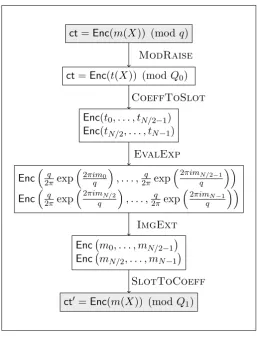
This section gives a high level structure of the bootstrapping process for the HEAANscheme. We employ the ciphertext packing method and combine it with our efficient evaluation strat-egy to achieve a better performance in terms of memory and computation cost. Below we describe all the parts of the recryption procedure in more details. We denote the following five steps byModRaise,CoeffToSlot,EvalExp,ImgExtandSlotToCoeff, respectively.
See Fig. 2 for an illustration.
Modulus raising. Let ct be an input ciphertext of the bootstrapping procedure with a ciphertext modulus q satisfying m(X) = [hct,ski]q. We start with the point that its inner product t(X) = hct,ski (modXN + 1) is of the form t = qI +m for some small I(X) ∈ R with a bound kIk∞ < K. Thus ct itself can be viewed as an encryption of t(X) =
t0 +t1X +· · ·+tN−1XN−1 in a large modulus Q0 q due to [hct,ski]Q0 = t(X). Our
ct=Enc(m(X)) (modq)
ModRaise
ct=Enc(t(X)) (modQ0)
Enc(t0, . . . , tN/2−1)
Enc(tN/2, . . . , tN−1)
CoeffToSlot
Enc
q
2πexp
2πim0
q
, . . . ,2qπexp 2πim
N/2−1
q
Enc
q
2πexp 2πim
N/2
q
, . . . ,2qπ exp 2πim
N−1
q
EvalExp
Enc m0, . . . , mN/2−1
Enc mN/2, . . . , mN−1
ImgExt
ct0=Enc(m(X)) (modQ1)
SlotToCoeff
Fig. 2.Pipeline of our bootstrapping process
Putting polynomial coefficients in plaintext slots.Given the input ciphertextct∈ R2
Q0
with a decryption structuret(X) =hct,ski, this step aims to put the coefficientst0, . . . , tN−1
in plaintext slots in order to evaluate the modular reduction functionF(t) coefficient-wisely. Letz0 =τ(t)∈CN/2be the corresponding vector of plaintext slots of the ciphertextct. Since
each ciphertext can store at most N/2 plaintext values, we will generate two ciphertexts encrypting the vectorsz00= (t0, . . . , tN
2−1) andz 0 1 = (tN
2, . . . , tN−1), respectively.
As mentioned in Section 4.1, recall the linear relation between the coefficient vector of a polynomial and its corresponding vector of plaintext slots. If we divide the matrix U into two square matrices
U0=
1 ζ0 . . . ζ
N
2−1 0
1 ζ1 . . . ζ
N
2−1 1
..
. ... . .. ...
1ζN
2−1 . . . ζ
N 2−1 N 2−1
and U1 = ζ N 2 0 ζ N 2+1 0 . . . ζ
N−1 0 ζ N 2 1 ζ N 2+1 1 . . . ζN
−1 1 .. . ... . .. ... ζ N 2 N 2−1 ζ N 2+1 N 2−1
. . . ζNN−1
2−1 ,
then we get an identity z0k= N1(Uk T
·z0+UkT ·z0) fork= 0,1. Therefore, we can generate encryptions of z00 and z01 using the linear transformations on the plaintext vector z0. One can apply our general method in Section 4.3 to this step.
Evaluation of the complex exponential function. This step takes the results of the previous step and homomorphically computes the reduction mod q function F(t) = [t]q
of F(t) and adapt the optimized evaluation strategy for the complex exponential function E(t) := 2qπexp2πitq .
Since the plaintext slots of the input ciphertexts contain the coefficients tj =qIj+mj
for 0≤ j < N, the output ciphertexts will encrypt 2qπexp 2πitj
q
= 2qπexp 2πimj
q
in the corresponding plaintext slots.
Extraction of the imaginary part. We take two input ciphertexts encrypting the values q
2πexp 2πimj
q
in their plaintext slots for 0 ≤j < N. We extract their imaginary parts as
q
2πsin 2πmj
q
≈mj by using the relation
sin
2πmj q
= 1
2
exp
2πimj q
−exp
−
2πimj q
and applying the evaluation method of slot-wise conjugation described in Section 4.2.
Switching back to the coefficient representation. The final step is to pack all the coefficients mj in the plaintext slots of two ciphertexts back in a single ciphertext. This procedure is exactly the inverse of theCoeffToSlottransformation. That is, when given
two ciphertexts that encrypt the vectors z0 = (m0, . . . , mN
2−1) andz1 = (m
N
2, . . . , mN−1),
we aim to generate an encryption of m(X). Since the plaintext vector z = τ(m) of m(X) satisfies the identityz=U ·m=U0·z0+U1·z1, this transformation is also represented as
a linear transformation over the plaintext vectors.
Our bootstrapping process returns an encryption of m(X) with a ciphertext modulus Q1 < Q0, which is much larger enough than the initial modulus q to allow us to perform
further homomorphic operations on the ciphertext.
We can perform the final two steps together by pre-computing the composition of linear transformations. The (inverse) linear transformation step consumes only one level for scalar multiplications but requires a number of slot rotations. On the other hand, EvalExp
per-forms homomorphic evaluation of the polynomial Pr(·), which is the most levels consuming part of the recryption but requires relatively small computational cost from our recursive evaluation strategy: linear with the depth.
5.2 Recryption with Sparsely Packed Ciphertexts
As mentioned in Section 4.4, the use of sparsely packed ciphertexts has an advantage in some applications, in that it reduces the complexity of linear transformation steps. How-ever, the recryption of sparsely packed ciphertexts requires an additional step before the
CoeffToSlotstep.
Let n ≥ 2 be a divisor of N and let Y = XN/n as in Section 4.4. Assume that we are given an encryptionctofm(Y)∈Z[Y]/(Yn+ 1) such thathct,ski ≈q·I(X) +m(Y) for some
I(X) =I0+I1·X+· · ·+IN−1·XN−1 ∈ R. Then theModRaisestep returns an encryption
of q·I(X) +m(Y) which is not a polynomial of Y. We aim to generate an encryption of q·I˜(Y) +m(Y) for some ˜I(Y) ∈ Z[Y]/(Yn+ 1) before the next
CoeffToSlot step. It
proceeds as described in Algorithm 2.
Note that the monomial Xk vanishes by the homomorphismX7→X−Xn+1+X2n+1− · · ·−XN−n+1 ifkis not divisible by (N/n); otherwise, it is multiplied by the constant (N/n).
Henceq·I(X) +m(Y) is mapped to (N/n)·(q·I˜(Y) +m(Y)) by this homomorphism where ˜
I(Y) =I0+IN/n·Y+· · ·+IN−(N/n)·Yn−1. For an efficient evaluation of this homomorphism,
Algorithm 2 Homomorphic evaluation of the partial-sum procedure
1: procedurePartialSum(ct∈ R2q, n|N, n≥2)
2: ct0 ←ct (mod q)
3: for j= 0 to log(N/n)−1 do
4: ctj ←Rot(ct0; 2j·(n/2)) (modq)
5: ct0 ←Add(ct0,ctj) (mod q)
6: end for 7: return ct0
8: end procedure
As mentioned before, the main advantage of sparsely packed ciphertexts is that the
CoeffToSlotstep can be represented as relatively small matrices multiplications with only
a single encryption of the coefficients vector oft(Y) =q·I˜(Y)+m(Y) while fully-packed slots need two ciphertexts for the CoeffToSlot step. In some more details, for the plaintext
vector w∈ Cn/2 of t(Y), the desired ciphertext can be computed by 1
n(U0 T
·w+U0T ·w) where
U0 =
1 ξ0 ξ20 . . . ξn −1 0
1 ξ1 ξ21 . . . ξ
n−1 1
..
. ... ... . .. ... 1ξn
2−1 ξ 2
n
2−1. . . ξ
n−1
n
2−1
,
as in Section 4.1. We can either generate two ciphertexts encrypting two plaintext vectors (w0, . . . , wn/2−1) and (wn/2, . . . , wn−1) by separatingU0 into two square matrices, or compute
a single encryption of (w0, . . . , wn−1) withn plaintext slots whenn < N. In the latter case,
EvalExpandImgExtperform the same operations as in the fulled-packed ciphertexts, but
the memory and the computational cost are reduced by half since we can work on a single ciphertext. The final SlotToCoeff step is also expressed as a linear transformation over
n-dimensional vector.
5.3 Noise Estimation of Recryption
In this section, we describe each step of recryption procedure with a noise analysis. We start with an upper bound K of kIk∞. Since each coefficient of a ciphertext ct = (c0, c1) is an
element of Zq and the signed binary secret key s has exactly h nonzero coefficients, each coefficient of hct,ski =c0+c1scan be considered to be the sum of (h+ 1) elements in Zq, which is bounded by q2(h+ 1). Hence all the coefficient of I(X) = b1qhct,skie is bounded by 12(h+ 1) ≈ 1
2ksk1. In practice, the coefficients of ci look like a random variable over
the interval Zq and a coefficient of 1qhct,ski behaves as the sum of (h+ 1)-numbers of i.i.d. uniform random variables over the interval (−1
2, 1
2). This heuristic assumption gives us a
smaller bound asK=O(√h) for kIk∞.
P. During matrix multiplication, key-switching errors are multiplied with diagonal vectors of matrix. Since infinite norms of diagonal vectors of N1U0 and N1U1 are exactly one, the total
error of second type is bounded byO(Brs).
In the EvalExp step, we take two ciphertexts to be homomorphically evaluated by the
approximate polynomialPr(·) of the complex exponential polynomial. Each component of the corresponding plaintext slots containstj+ej for some small error ej such that|ej| ≤O(Brs).
Hence, the error between the desired value E(tj) and the resulting plaintext of EvalExp
can be measured by
|E(tj)−Pr(tj+ej)| ≤ |E(tj)−E(tj +ej)|+|E(tj+ej)−Pr(tj+ej)|
≤ ∆·2π q |ej|+
∆·2r p
2π(d0+ 1)
eπK 2r−1(d
0+ 1) d0+1
,
since E(·) is analytic and |E0(·)| ≤ ∆·2π/q. The second term can be bounded by O(1)
and so it is negligible when d0 =O(1) and r =O(log(qK)) as described in Section 3.2. By
combining the error bound as|ej| ≤O(Brs) of the previous step, we deduce that the output
ciphertexts ofEvalExp encrypt E(tj) =∆·exp 2πitj
q
in their plaintext slots with errors bounded byO(Brs).
The imaginary part of E(t) is ∆·2qπS(t) = ∆·sin
2πt q
, which is an approximation
of ∆·2qπm with an error bounded by Oq·|mq3|3
for m = [t]q. We set a small bound on
an input plaintext (e.g. |m| ≤ q2/3) so that an approximation error does not destroy the
significant digits of the plaintext. Hence theImgExt step does not change the magnitude of
bootstrapping error.
Finally, in the SlotToCoeff step, the plaintext vectors are multiplied with the
ma-trices U0 and U1, and their diagonal vectors have the size of one. The size of error in the
resulting plaintext is bounded byO(N·Brs) since it is the sum ofN errors of sizeO(Brs). In
practice, under the heuristic assumption that these errors behaves as independent Gaussian distributions, we get a reduced error bound as O(√N·Brs).
In summary, for an input ciphertext ct ∈ R2
q satisfying hct,ski =m (mod q), our boot-strapping process returns a ciphertextct0 such thathct0,ski=m+e (modQ1) for a modulus
Q1 q and some error e with kekcan∞ ≤ O(
√
N ·Brs). It consists of the initial/final linear
transformations and the evaluation of the complex exponential function, so the total depth (number of levels consumed) for bootstrapping is O(log(Kq)) =O(logλ). The linear trans-formations require and O(√N) rotations, while the evaluation of the exponential function needs r = O(log(Kq)) = O(logλ) homomorphic multiplications, which is linear with the depth of the decryption formula. As described above, the total complexity can be signif-icantly reduced when we handle a sparsely packed ciphertext with (n/2) slots: the linear transformations require O(√n) rotations and the evaluation complexity of the exponential function is reduced by half.
6 Implementation
6.1 Parameter Selection
We adapt the estimator of Albrecht at el. [1] to guarantee the concrete security of the proposed parameters. All the parameter sets achieve at least 80-bit security level against the known attacks of the LWE problem.
The key-switching keys have the largest modulus in the HEAANscheme and the modulus Q0 (after ModRaise) has half the bit size of the modulus. We use the discrete Gaussian
distribution of standard deviation σ = 3.2 to sample error polynomials and set the Ham-ming weight h = 64 of the secret key s(X). The parameters d0 = O(1) and r = O(logq)
were chosen asymptotically in the above sections, but in practice, we set the parameter ex-perimentally based on the bootstrapping error. We take the degree 7 Taylor expansion as an initial approximation of the exponential function and choose a sufficiently large number of iterations r to maintain the precision of output plaintexts.
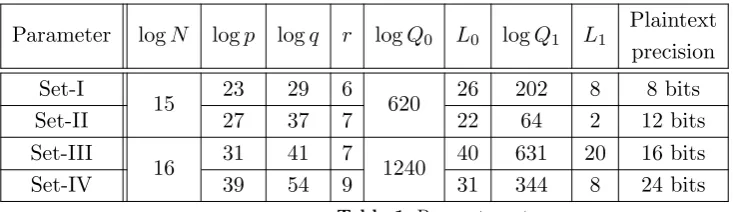
The parameter logp is the bit size of plaintexts and the plaintext precision denotes the number of significant bits of plaintexts after bootstrapping. The before and after levelsL0, L1
are obtained by dividing logQ0 and logQ1 by logp, respectively. The whole parameter sets
are described in Table 1.
Parameter logN logp logq r logQ0 L0 logQ1 L1
Plaintext precision
Set-I
15 23 29 6 620 26 202 8 8 bits
Set-II 27 37 7 22 64 2 12 bits
Set-III
16 31 41 7 1240 40 631 20 16 bits
Set-IV 39 54 9 31 344 8 24 bits
Table 1.Parameter sets
We present some specific examples of input and output plaintexts. For simplicity, we show the real parts of the plaintext values in four slots. All the values are divided by a factor ofp for a clear interpretation.
Before bootstrapping : [0.777898 0.541580 0.603675 0.822638]
After bootstrapping : [0.777435 0.541021 0.603023 0.822321]
It shows that the error vectors is bounded by 2−11·p, i.e., the bootstrapping procedure with the parameter set I outputs a ciphertext of 10 bits of precision.
Before bootstrapping : [0.516015 0.772621 0.939175 0.345987]
After bootstrapping : [0.516027 0.772614 0.939172 0.346001]
Similarly, the second example shows that the bootstrapping error with the parameter set II is bounded by 2−16·p and the output plaintext has 15 bits of precision.
6.2 Experimental Results
Parameter Number Linear EvalExp Total Amortized
of slots trans. time time
Set-I
1 12.3 s
12.3 s
24.6 s 24.6 s
32 48.6 s 60.9 s 1.9 s
64 82.8 s 95.1 s 1.5 s
128 139.2 s 151.5 s 1.2 s
Set-II
1 14.1 s
12.5 s
26.6 s 26.6 s
32 46.0 s 58.5 s 1.8 s
64 77.1 s 89.6 s 1.4 s
128 127.3 s 139.8 s 1.1 s
Set-III
1 64 s
63 s
127 s 127 s
32 218 s 281 s 8.8 s
64 343 s 406 s 6.3 s
128 528 s 591 s 4.6 s
Set-IV
1 58 s
68 s
126 s 126 s
32 200 s 268 s 8.4 s
64 307 s 375 s 5.9 s
128 456 s 524 s 4.1 s
Table 2.Bootstrapping timings with parameter sets I to IV
The amortized time is obtained by dividing the total bootstrapping time by the number of plaintext slots.
The linear transformations take a longer time as the number of plaintext slots grows while the complexity of theEvalExp step remains stable. Therefore, we can make a
trade-off between the latency time and the amortized time by changing the number of slots. Fig. 3 illustrates the trend of evaluation timings for each of the bootstrapping phases (parameter set I).
0 1 2 3 4 5 6 7
0 40 80 120 160
log number of slots (Set-I)
Time
in
seconds
PartialSum CoeffToSlot
EvalExp SlotToCoeff
Total
0 1 2 3 4 5 6 7
0 10 20 30
log number of slots (Set-I)
Time
in
seconds
Amortized
7 Conclusion
In this paper, we suggested a method to recrypt a ciphertext of theHEAANscheme. The per-formance of our bootstrapping procedure was significantly improved by adapting a trigono-metric approximation of the modular reduction function. The linear transformation turns out to be the most time-consuming part, but we used almost the same method as in [28, 33]. It would be an interesting open problem to find an efficient algorithm to evaluate the linear transformations approximately.
References
1. M. R. Albrecht, R. Player, and S. Scott. On the concrete hardness of learning with errors. Journal of Mathematical Cryptology, 9(3):169–203, 2015.
2. J. Alperin-Sheriff and C. Peikert. Faster bootstrapping with polynomial error. InAdvances in Cryptology– CRYPTO 2014, pages 297–314. Springer, 2014.
3. G. Bonnoron, L. Ducas, and M. Fillinger. Large fhe gates from tensored homomorphic accumulator. Cryptology ePrint Archive, Report 2017/996, 2017. https://eprint.iacr.org/2017/996.
4. C. Bonte, C. Bootland, J. W. Bos, W. Castryck, I. Iliashenko, and F. Vercauteren. Faster homomorphic function evaluation using non-integral base encoding. In International Conference on Cryptographic Hardware and Embedded Systems, pages 579–600. Springer, 2017.
5. J. W. Bos, K. Lauter, J. Loftus, and M. Naehrig. Improved security for a ring-based fully homomorphic encryption scheme. InCryptography and Coding, pages 45–64. Springer, 2013.
6. Z. Brakerski. Fully homomorphic encryption without modulus switching from classical GapSVP. In
Advances in Cryptology–CRYPTO 2012, pages 868–886. Springer, 2012.
7. Z. Brakerski, C. Gentry, and V. Vaikuntanathan. (Leveled) fully homomorphic encryption without boot-strapping. InProc. of ITCS, pages 309–325. ACM, 2012.
8. Z. Brakerski and V. Vaikuntanathan. Efficient fully homomorphic encryption from (standard) LWE. In
Proceedings of the 2011 IEEE 52nd Annual Symposium on Foundations of Computer Science, FOCS’11, pages 97–106. IEEE Computer Society, 2011.
9. Z. Brakerski and V. Vaikuntanathan. Fully homomorphic encryption from Ring-LWE and security for key dependent messages. InAdvances in Cryptology–CRYPTO 2011, pages 505–524. Springer, 2011. 10. H. Chen, K. Laine, R. Player, and Y. Xia. High-precision arithmetic in homomorphic encryption.
Cryp-tology ePrint Archive, Report 2017/809, 2017. https://eprint.iacr.org/2017/809.
11. J. H. Cheon, J.-S. Coron, J. Kim, M. S. Lee, T. Lepoint, M. Tibouchi, and A. Yun. Batch fully ho-momorphic encryption over the integers. InAdvances in Cryptology–EUROCRYPT, volume 7881, pages 315–335. Springer, 2013.
12. J. H. Cheon, K. Han, A. Kim, M. Kim, and Y. Song. Implementation of boostrapping for HEAAN, 2017.
https://github.com/kimandrik/HEAANBOOT.
13. J. H. Cheon, A. Kim, M. Kim, and Y. Song. Implementation of HEAAN, 2016. https://github.com/ kimandrik/HEAAN.
14. J. H. Cheon, A. Kim, M. Kim, and Y. Song. Homomorphic encryption for arithmetic of approximate numbers. InAdvances in Cryptology–ASIACRYPT 2017: 23rd International Conference on the Theory and Application of Cryptology and Information Security, pages 409–437. Springer, 2017.
15. J. H. Cheon, M. Kim, and K. Lauter. Homomorphic computation of edit distance. In International Conference on Financial Cryptography and Data Security, pages 194–212. Springer, 2015.
16. J. H. Cheon and D. Stehl´e. Fully homomophic encryption over the integers revisited. InAdvances in Cryptology–EUROCRYPT 2015, pages 513–536. Springer, 2015.
17. I. Chillotti, N. Gama, M. Georgieva, and M. Izabach`ene. Faster fully homomorphic encryption: Boot-strapping in less than 0.1 seconds. InAdvances in Cryptology–ASIACRYPT 2016: 22nd International Conference on the Theory and Application of Cryptology and Information Security, pages 3–33. Springer, 2016.
18. I. Chillotti, N. Gama, M. Georgieva, and M. Izabach`ene. Faster packed homomorphic operations and efficient circuit bootstrapping for tfhe. In Advances in Cryptology–ASIACRYPT 2017: 23rd Interna-tional Conference on the Theory and Application of Cryptology and Information Security, pages 377–408. Springer, 2017.
19. J.-S. Coron, T. Lepoint, and M. Tibouchi. Scale-invariant fully homomorphic encryption over the integers. InPublic-Key Cryptography–PKC 2014, pages 311–328. Springer, 2014.
20. A. Costache, N. P. Smart, and S. Vivek. Faster homomorphic evaluation of discrete fourier transforms. In
International Conference on Financial Cryptography and Data Security, pages 517–529. Springer, 2017. 21. A. Costache, N. P. Smart, S. Vivek, and A. Waller. Fixed-point arithmetic in she schemes. InInternational
Conference on Selected Areas in Cryptography, pages 401–422. Springer, 2016.
22. M. v. Dijk, C. Gentry, S. Halevi, and V. Vaikuntanathan. Fully homomorphic encryption over the integers. InAdvances in Cryptology–EUROCRYPT 2010, pages 24–43. Springer, 2010.
23. N. Dowlin, R. Gilad-Bachrach, K. Laine, K. Lauter, M. Naehrig, and J. Wernsing. Manual for using homomorphic encryption for bioinformatics. Proceedings of the IEEE, 105(3):552–567, 2017.
24. L. Ducas and D. Micciancio. FHEW: Bootstrapping homomorphic encryption in less than a second. In
Advances in Cryptology–EUROCRYPT 2015, pages 617–640. Springer, 2015.
25. J. Fan and F. Vercauteren. Somewhat practical fully homomorphic encryption.IACR Cryptology ePrint Archive, 2012:144, 2012.
27. C. Gentry and S. Halevi. Implementing Gentry’s fully-homomorphic encryption scheme. InAdvances in Cryptology–EUROCRYPT 2011, pages 129–148. Springer, 2011.
28. C. Gentry, S. Halevi, and N. P. Smart. Better bootstrapping in fully homomorphic encryption. InPublic Key Cryptography–PKC 2012, pages 1–16. Springer, 2012.
29. C. Gentry, S. Halevi, and N. P. Smart. Fully homomorphic encryption with polylog overhead. InAnnual International Conference on the Theory and Applications of Cryptographic Techniques, pages 465–482. Springer, 2012.
30. C. Gentry, S. Halevi, and N. P. Smart. Homomorphic evaluation of the AES circuit. In Advances in Cryptology–CRYPTO 2012, pages 850–867. Springer, 2012.
31. C. Gentry, A. Sahai, and B. Waters. Homomorphic encryption from learning with errors: Conceptually-simpler, asymptotically-faster, attribute-based. InAdvances in Cryptology–CRYPTO 2013, pages 75–92. Springer, 2013.
32. S. Halevi and V. Shoup. Algorithms in HElib. InAdvances in Cryptology–CRYPTO 2014, pages 554–571. Springer, 2014.
33. S. Halevi and V. Shoup. Bootstrapping for HElib. InAdvances in Cryptology–EUROCRYPT 2015, pages 641–670. Springer, 2015.
34. J. Hoffstein and J. Silverman. Optimizations for ntru. Public-Key Cryptography and Computational Number Theory, Warsaw, pages 77–88, 2001.
35. J. Kim, C. Lee, H. Shim, J. H. Cheon, A. Kim, M. Kim, and Y. Song. Encrypting controller using fully homomorphic encryption for security of cyber-physical systems. IFAC-PapersOnLine, 49(22):175–180, 2016.
36. M. Kim, Y. Song, and J. H. Cheon. Secure searching of biomarkers through hybrid homomorphic en-cryption scheme. BMC medical genomics, 10(2):42, 2017.
37. M. Kim, Y. Song, S. Wang, Y. Xia, and X. Jiang. Secure logistic regression based on homomorphic encryption. To appear in JMIR medical informatics, 2018.
38. K. Lauter, A. L´opez-Alt, and M. Naehrig. Private computation on encrypted genomic data. In Inter-national Conference on Cryptology and Information Security in Latin America, pages 3–27. Springer, 2014.
39. M. Naehrig, K. Lauter, and V. Vaikuntanathan. Can homomorphic encryption be practical? In Proceed-ings of the 3rd ACM workshop on Cloud computing security workshop, pages 113–124. ACM, 2011. 40. M. S. Paterson and L. J. Stockmeyer. On the number of nonscalar multiplications necessary to evaluate
polynomials. SIAM Journal on Computing, 2(1):60–66, 1973.