International Journal of Research (IJR)
e-ISSN: 2348-6848, p- ISSN: 2348-795X Volume 2, Issue 07, July 2015Available at http://internationaljournalofresearch.org
Adaptive MIMO-OFDM Channel Estimation of Super
Resolution Approach Utilizing Spatial and Temporal
Correlation and TTOP
𝐌𝐚𝐝𝐡𝐢𝐫𝐚 𝐄𝐬𝐰𝐚𝐫 𝐊𝐮𝐦𝐚𝐫
𝟏& 𝐊 . 𝐒. 𝐑𝐚𝐣𝐚𝐬𝐞𝐤𝐡𝐚𝐫
𝟐1.
Madhira Eswar Kumar
AcharyaNagarjuna University, Andhra Pradesh, India.
E-mail: [email protected]
2.
K.S. Raj Sekhar ,
Assistant Professor in University College of Engineering & Technology,
Acharya Nagarjuna University, Andhra Pradesh, , India.
E-mail: [email protected]
Abstract-
This paper provide adaptive technique for the
channel
estimation
of
MIMO-OFDM.
Generally there are a lot of methods for
channel estimation of OFDM as well as
MIMO OFDM. In this paper I first described
about the latest MIMO OFDM channel
estimation which is super resolution
approach that explores spatial and temporal
correlation of MIMO-OFDM. I then designed
conventional Time domain training based
orthogonal pilot (TTOP). I then compared
the performance of two channel estimation
schemes i.e. 2 D graph between the SNR vs.
BER.I generated the performance graphs for
different MIMO OFDM antenna pairs for
above two. And finally I propose the
combination of two techniques which is used
in Adaptive way given much better results
than previous channel estimation techniques
and it will better utilize resources much
efficiently.
Keywords-
Adaptive Channel Estimation;
Super sparse Resolution; MIMO OFDM
channel estimation; TTOP
1. INTRODUCTION
MULTIPLE Input Multiple Output (MIMO)
– OFDM is key technology for future
wireless communication due to its High
spectral efficiency and superior robustness to
multipath fading channels.[2].
For MIMO-OFDM systems, better channel
estimation
is
essential
for
system
performance [3]. Generally, there are two
categories of channel estimation schemes for
MIMO-OFDM systems. The first one is
nonparametric approach, which utilizes
orthogonal frequency domain pilots or time
domain training sequence to convert the
channel estimation in MIMO-OFDM system
to single antennasystem[3].In this paper I
proposed Time domain training based
orthogonal pilot (TTOP) for example of this
channel estimation approach.
However these sort schemes suffers from
high pilot overhead [4][5].when number of
transmit antennas increases. The second
approach is parametric channel estimation. It
utilizes sparsity of wireless channels to
reduce the pilot overhead.This is much useful
for future advancement since it can achieve
better higher spectral efficiency.
International Journal of Research (IJR)
e-ISSN: 2348-6848, p- ISSN: 2348-795X Volume 2, Issue 07, July 2015Available at http://internationaljournalofresearch.org
sparse wireless MOMO channelsis proposed
to deal with arbitrary path delays.
The proposed scheme can achieve
super-resolution estimates of arbitrary path delays,
Which is more suitable for wireless channels
in practice.
Due to the small scale of the transmit and
receive antenna arrays compared to long
signal transmission distance in typical
MIMO antenna geometry, channel impulse
responses (CIR) of different transmit receive
antenna pairs share common path delays
,which can be translated to as a common
sparse pattern of CIRs due to spatial
correlation of MIMO channels.
Due to temporal correlation of such common
sparse pattern doesn’t change along several
adjacent OFDM symbols Previously the
MIMO channel estimation schemes were
proposed such that they exploit spatial
correlation or temporal correlation.
But by exploiting both correlations the
estimation accuracy will be increases. In this
method we reduce pilot overhead by utilizing
Finite Rate Innovation (FRI) theory. This
technique can recover the antilog sparse
signal with very low sampling rate, as a result
channel scarcity level will decide average
pilot overhead length per antenna instead of
channel length.
2 .SPARSE MIMO CHANNEL MODEL
The MIMO channel is shown in Fig.1 ,its
characteristics are
1)Channel Sparsity:
In typical outdoor
communication scenarios ,due to several
significant characteristics CIR is intrinsically
sparse..
For an
𝑁
𝑡X
𝑁
𝑟MIMO system , the CIR
(𝑖,𝑗 )(t) between the
i
th transmit antenna and
j
th receive antenna can be modelled as [1]
(𝑖,𝑗 )(t) =
𝑃𝑝=1𝛼
𝑝 𝑖,𝑗𝛿(𝑡 −
𝜏
𝑝(𝑖,𝑗 )), 1 ≤
i
≤
𝑁
𝑡,
1 ≤
j
≤
𝑁
𝑟(1)
Where δ( • ) is the Dirac function, P is the
total number of resolvable propagation paths
, and
𝜏
𝑝(𝑖,𝑗 )and
𝛼
𝑝(𝑖,𝑗 )denote the path delay
and path gain of pth path respectively.
2) Spatial Correlation:
Because transmitter and receiver antenna
array is small compared with the transmitting
distance very similar scattering happens in
channels
of
different
transmit-receive
antenna pairs. Path delays delay difference
from the similar scatters is far less than
sampling period for most communication
systems. Even though the path gains are
different CIRs of different transmit-receive
antenna pairs share common sparse
pattern[6].
3) Temporal Correlation
:
For wireless
channels , the path delays are not as fast
varying as the path gains. And path gains
vary continuously. Thus , the channel sparse
pattern is nearly unchanged during several
adjacent 0FDM symbols, and the path gains
are also correlated[8].
3. TTOP CHANNEL ESTIMATION
Based on the assumptions such as perfect
synchronization and block fading, a
MIMO-OFDM system is design. In training based
channel estimation algorithms, training
symbols or pilot tones that are known to the
receiver, are multiplexed along with the data
stream for channel estimation.
The idea behind these methods is to develop
knowledge of transmitted pilot symbols at the
receiver to estimate the channel.
For a block fading channel, where the
channel is constant over a few OFDM
symbols, the pilots are transmitted on all
subcarriers in periodic intervals of OFDM
blocks. The channel estimates from the pilot
subcarriers are interpolated to estimate the
channel at the data subcarrierThis type of
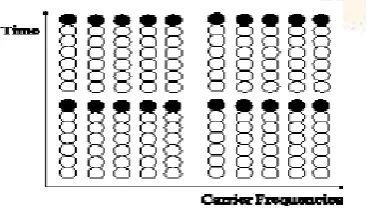
pilot arrangement, given in Fig.1 is called the
block type arrangement
International Journal of Research (IJR)
e-ISSN: 2348-6848, p- ISSN: 2348-795X Volume 2, Issue 07, July 2015Available at http://internationaljournalofresearch.org
channel is constant during the block, there
will be no channel estimation error since the
pilots are sent at all carriers.
Fig 1 BLOCK TYPE
4. SPARSE MIMO-OFDM CHANNEL
ESTIMATION
In this section, the widely used pilot pattern is
briefly introduced first, based on which a
super-resolution sparse MIMO –OFDM channel
estimation method is then applied. Finally, the
required number of pilots is discussed under the
framework of the FRI theory.
A. pilot Pattern
The pilot pattern widely used in common MIMO
–OFDM system is illustrated in Fig 3.
Fig 2. Spatial and temporal correlations of MIMO OFDM channels
Fig.3 Pilot pattern. Note that the specific 𝑁𝑡 =2 , D =4 , 𝑁𝑃 =4, and 𝑁p_total =8are
used for illustration purpose.
In frequency domain
𝑁
𝑃pilots are uniformly
spaced with pilot interval D (e.g.
D = 4 in Fig. 3 Meanwhile, every pilot is
allocated with a pilot index l for 0 ≤ l ≤
𝑁
𝑃−1,
which is ascending with the increase of the
subcarrier index. Each transmit antenna uses
A Aubcarrier index to distingush MIMO channels
associated with them.which has initial phase
θ
𝑖for 1 ≤ i ≤
𝑁
𝑡and (
𝑁
𝑡−1)
𝑁
𝑃zero subcarriers to
ensure the orthogonality of pilot.Therefore for ith
transmit antenna , the subcarrier index of the lth
pilot is
𝐼
𝑝𝑖𝑙𝑜𝑡𝑖(l) =
θ
𝑖+ lD , 0 ≤ l ≤
𝑁
𝑃−1 ( 2 )
Consequently , the total overhead per transmit
antenna is
𝑁
p_total=
𝑁
𝑡𝑁
𝑃, and thus ,
𝑁
𝑃can
be also referred as the average pilot overhead per
transmit antenna in the letter.
B Super – Resolution Chnnel Estimation
The eqivalent baseband channel frequency
response (CFR) H(f) can be expressed at
receiver as
H (
f
) =
𝑝=1𝑃𝛼
𝑝𝑒
−𝑗 2П𝑓𝜏𝑝, -
𝑓
𝑠/2≤ f ≤
𝑓
𝑠/2
( 3 )
Where superscript i and j in (1) are omitted for
convienience
𝑓
𝑠=1/
𝑇
𝑠is the system bandwidth,
and Ts is the sampling period. Meanwhile, the
N-point discrete Fourier transform (DFT) of the
time-domain equivalent baseband channel can be
expressed as [5], i.e.,
H[k] = H (
𝑘𝑓𝑠International Journal of Research (IJR)
e-ISSN: 2348-6848, p- ISSN: 2348-795X Volume 2, Issue 07, July 2015Available at http://internationaljournalofresearch.org
Therfore for ( i , j )th transmit-receive antenna
pair , according to (2)-(4) , the estimated CFRs
over pilots can be written as
Ĥ
(𝑖,𝑗 )[l] = H [
𝐼
𝑝𝑖𝑙𝑜𝑡𝑖
(l) ]
= H(
θ𝑖 + lD 𝑁)
=
𝑃𝛼
𝑝 𝑖,𝑗𝑒
−𝑗 2П 𝑝=1(θ𝑖 + lD )𝜏𝑝(𝑖,𝑗 ) 𝑁
+
𝑊
(𝐼,𝐽 )
(l)
( 5 )
where
Ĥ
(𝑖,𝑗 )[l] for 0 ≤ l ≤
𝑁
𝑃
−1 can be obtained
by using the conventional minimum mean square
error (MMSE) or least square (LS) method,
and
𝑊
(𝐼,𝐽 )(l) is the additive white Gaussian noise
(AWGN).
Eq. (5) can be also written in a vector form as
Ĥ
(𝑖,𝑗 )[l] =
(𝑉
𝑖,𝑗[𝑙])
𝑇𝑎
(𝑖,𝑗 )+
𝑊
(𝐼,𝐽 )(l) ( 6 )
Where
𝑉
𝑖,𝑗[𝑙]
= [
ϓ
𝑙𝐷𝜏1 (𝑖,𝑗 ),
ϓ
𝑙𝐷𝜏2 (𝑖,𝑗 )…
ϓ
𝑙𝐷𝜏𝑃 (𝑖,𝑗 )]
𝑎
(𝑖,𝑗 )= [
𝛼
𝑝 𝑖,𝑗ϓ
θ𝑖𝜏1 (𝑖,𝑗 ),
𝛼
𝑝 𝑖,𝑗ϓ
θ𝑖𝜏2 (𝑖,𝑗 )…….
𝛼
𝑝 𝑖,𝑗ϓ
θ𝑖𝜏𝑃 (𝑖,𝑗 )] and ϓ =
𝑒
−𝑗 2П(𝑓𝑠𝑁).
Because the wireless channel is inherently sparse
and
the
smallscaleofmultipletransmitorreceiveantennasisn
egligible compared to the long signal
transmission distance, CIRs of different
transmit-receive antenna pairs share common path delays,
which is equivalently translated as common
sparse patter of CIRs due to the spatial
correlation of MIMOchannels i.e. ,
𝜏
𝑝(𝑖,𝑗 )=
𝜏
𝑝𝑉
𝑖,𝑗[𝑙]
= v[l] for 1 ≤ p ≤ P, ), 1 ≤
i
𝑁
𝑃, 1 ≤
j
≤
𝑁
𝑟.Hence , by exploiting such spatially
common sparse pattern shared among different
receive antennas associated with the ith transmit
antenna ,we have
Ĥ
𝑖= V
𝐴
𝑖+
𝑊
𝐼, 1 ≤
i
≤
𝑁
𝑡
( 7 )
where
𝑁
𝑃𝑥 𝑁
𝑟measurement matrix
Ĥ
𝑖is
V = [v 0 , v 1 , v 2 , , v 𝑁𝑃− 1 ]𝑇 is a
vandermonde matrix of size 𝑁𝑃 𝑥 𝑁𝑟 ,𝐴𝑖 = [𝑎(𝑖,1) , 𝑎(𝑖,2) , … . . 𝑎(𝑖,𝑁𝑡)] 𝑜𝑓 𝑠𝑖𝑧𝑒 𝑁
𝑃 𝑥 𝑁𝑟 and 𝑊𝐼 is an 𝑁𝑃 𝑥 𝑁𝑟 matrix with 𝑊(𝐼,𝐽 )(l) in its jth column and
the (l+1)th row.
When all 𝑁𝑡 transmit antennas are considered
based on (7), wehave
Ĥ = VA + W ( 8 )
Where Ĥ = [ Ĥ1 , Ĥ2 , ……,Ĥ𝑁𝑡 ] of size 𝑁
𝑃 𝑥 𝑁𝑡𝑁𝑟
, A = [ 𝐴1 , 𝐴2,……….𝐴𝑁𝑡 ], and W =[ 𝑊1 , 𝑊2,……….𝑊𝑁𝑡 ] .
By Comparing the formulated problem and the classical direction-of-arrival (DOA) problem , I find out that they are mathematically equivalent. Traditional DOA problem is to estimate the DOAs of the P sources from a set of time-domain measurements, which are obtained from the 𝑁𝑃 sensors outputs at 𝑁𝑡𝑁𝑟distinct time instants
(time-domain samples).
In this case, we try to estimate the path delays of P multipaths from a set of frequency-domain measurements, which are acquired from 𝑁𝑃 pilotsof 𝑁𝑡𝑁𝑟distinctantennapairs(antenna-domain samples).To
efficiently estimate path delays with arbitrary valuesit has been verified by the total least square estimating signal parameters via rotational invariance techniques (TLS-ESPRIT) algorithm can be applied to (8). we can obtain superresolution estimates of path delays, i.e., 𝜏𝑝 for1 ≤ p ≤ P, by using the TLS-ESPRIT
algorithmand thus, 𝑉 can be obtained accordingly. Then, path gains can be acquired by the LS method , i.e.,
For certain entry of  , i.e.(𝛼𝑝 (𝑖,𝑗 ))^
ϓθ𝑖𝜏𝑝, because θ 𝑖
is known at the receiver and 𝜏𝑝 has been estimated
after applying the TLS-ESPRIT algorithm ,we can easily obtain the estimation of the path gain.(𝛼𝑝
(𝑖,𝑗 )
)^ for 1 ≤ p ≤ P, 1 ≤ i ≤ 𝑁𝑡, 1 ≤ j ≤ 𝑁𝑟 Finally, the
complete CFR estimation over all OFDM subcarriers can be obtained based on (3) and (4).
Furthermore,to improve the accuracy of the channel estimation we can also exploit the temporal correlation of wireless channels. First, path delays of CIRs during several adjacent OFDM symbols are nearly unchanged which is equivalently referred as a common sparse pattern of CIRs due to the temporal correlation of MIMO channels.
International Journal of Research (IJR)
e-ISSN: 2348-6848, p- ISSN: 2348-795X Volume 2, Issue 07, July 2015Available at http://internationaljournalofresearch.org
symbol, we can jointly exploitĤs of several adjacent OFDM symbols based on (8) ,i.e.,
Ĥ𝜌 𝑞 +𝑅 𝑃 =𝑞−𝑅
2𝑟+1
=
𝑉
𝑞𝐴𝜌 𝑞 +𝑅 𝑃 =𝑞−𝑅
2𝑟+1
+
𝑊𝜌 𝑞+𝑅 𝑃 =𝑞−𝑅
2𝑟+1
where the subscript ρ is used to denote the index of the OFDM symbol, and the common sparse pattern of CIRs is assumed in 2R +1adjacent OFDM symbols, Hence effective noise can be reduced, so the improved channel estimation accuracy is expected.
Ourproposedschemeexploitsthesparsityas well as the spatial and temporal correlations of wireless MIMO channels to first acquire estimations of channel parameters,
including path delays and gains, and then obtain the estimation of CFR, which is contrast to non
parametric schemes which
estimatesthechannelbyinterpolatingorpredictingbasedo nCFRs over pilots ,
C. Discussion on Pilot Overhead
Compared with the model of the multiple filters bank based on the FRI theory , it can be found out that CIRs
of 𝑁𝑡𝑁𝑟
transmit-receiveantennapairsareequivalenttothe 𝑁𝑡𝑁𝑟
semiperiod sparse subspaces, and the Np pilots are equivalent to the Np multichannel filters. Therefore, by using the FRI theory, the smallest required number of pilots for each transmit antenna is Np =2P in a noiseless scenario. For practical channels with the maximum delay spread𝜏𝑚𝑎𝑥, although the normalized
channel length L =𝜏𝑚𝑎𝑥/𝑇𝑠 is usually very large, the
sparsity level P is small, i.e., P <<L
Consequently, in contrast to the nonparametric channel estimation method where the required number of pilots heavily depends on L, our proposed parametric scheme only needs 2P pilots in theory. Note that the number of pilots in practice is larger than 2P to improve the accuracy of the channel estimation due to AWGN.
5. SIMMULATION RESULTS
In this we first kept Number of subcarriers (𝑁𝑠𝑐) as 64 and we kept cyclic prefix length (𝑁𝑔) as
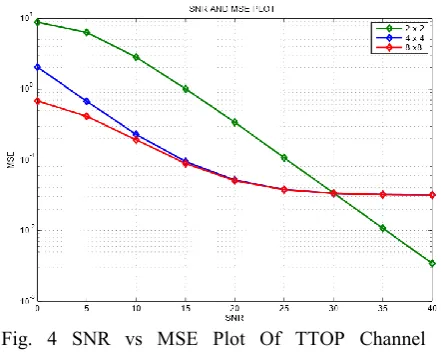
16 and delay spread as 5 and we took different SNR values ranges from 0 to 40 and we perform the channel estimation of MIMO – OFDM by using MMSE channel estimation technique . In this we adopt FFT for performing channel estimation.
We get the channel response as below
Fig. 4 SNR vs MSE Plot Of TTOP Channel Estimation
We also performed the channel estimation of MIMO - OFDM for static channel for different techniques and we get channel response as below From this response it is clear that for static channels proposed scheme and TTOP channel estimation gives same behaviour compared to other parametric and non parametric approaches.
Fig. 5 SNR vs MSE Plot Of Static Proposed Channel
Estimation
We also performed the channel estimation for
time varying channel was done and we obtain
channel responses for different parametric and
non parametric approaches as below
International Journal of Research (IJR)
e-ISSN: 2348-6848, p- ISSN: 2348-795X Volume 2, Issue 07, July 2015Available at http://internationaljournalofresearch.org
We also performed channel estimation of MIMO-OFDM with different transmit receive antenna pairs i. e .( 4 x 4, 8 x 8, 12 x 12) and obtain channel responses as below.
Fig. 7 SNR vs MSE Plot For Different Antenna Pairs
In this channel estimation techniques we use spatial and temporal correlations of hannel which results in better results of this technique even in time varying channels.
The tabular representation of the channel performance of static channel estimation of Time domain Training based Orthogonal Pilot is as below by using MMSE channel estimation
SNR(dB)\MSE 2 X 2 4 X 4 8 X 8
2 9 2
5x10⁻¹
5 6
6x10⁻¹ 3x10⁻¹
10 2 3x10⁻¹
2x10⁻¹
15 1 1x10⁻¹
1x10⁻¹
20 3x10⁻¹
5x10⁻² 4x10⁻²
25 1x10⁻¹ 4x10⁻² 3x10⁻²
In similar fashion the static channel estimation channel performance of proposed scheme in tabulation is as below
SNR(dB)\MSE 2 X 2 4 X 4 8 X 8
2 5x10⁻¹
3x10⁻¹ 3x10⁻¹
5 4x10⁻¹ 2x10⁻¹ 2x10⁻¹
10 3x10⁻¹ 1x10⁻¹ 9x10⁻²
15 2x10⁻¹ 8x10⁻² 7x10⁻²
20 1x10⁻¹ 3x10⁻² 5x10⁻²
25 7x10⁻² 2x10⁻² 4x10⁻²
6. CONCLUSION
In this paper we first proposed basic MIMO –
OFDM channel model and basic approach to
estimate the channel. We also proposed the Time
domain Training based Orthogonal Pilot (TTOP)
channel estimation technique. We also presented
brief overview of the super sparse resolution
MIMO OFDM channel estimation by using
spatial and temporal correlation. We performed
the channel estimation of TTOP by using
Minimum Mean Square Error (MMSE) channel
estimation technique and we obtain the SNR vs
MSE plot for this .In similar way we performed
the proposed channel estimation and we obtain
performance plot for static and time varying
channels.
At last we tabulate static channel estimation of
proposed scheme and TTOP for comparison.
From that table we came to conclusion that static
channel estimation of TTOP scheme gives almost
same performance of proposed scheme. Hence
we conclude that if we utilize TTOP estimation
for static MIMO OFDM requirements then we
can get better results with least resource. Hence
we propose adaptive MIMO OFDM channel
estimation which uses TTOP for static channels
and proposed scheme for time varying channels
will give better results with maximum utilization
of resources.
TTOP Channel Estimation For Static Channel
International Journal of Research (IJR)
e-ISSN: 2348-6848, p- ISSN: 2348-795X Volume 2, Issue 07, July 2015Available at http://internationaljournalofresearch.org