Full Terms & Conditions of access and use can be found at
http://www.tandfonline.com/action/journalInformation?journalCode=caeh20
Assessment & Evaluation in Higher Education
ISSN: 0260-2938 (Print) 1469-297X (Online) Journal homepage: http://www.tandfonline.com/loi/caeh20
Student attitudes to blogs: a case study of
reflective and collaborative learning
Beverley Jackling, Riccardo Natoli, Salina Siddique & Nick Sciulli
To cite this article: Beverley Jackling, Riccardo Natoli, Salina Siddique & Nick Sciulli (2015) Student attitudes to blogs: a case study of reflective and collaborative learning, Assessment & Evaluation in Higher Education, 40:4, 542-556, DOI: 10.1080/02602938.2014.931926
To link to this article: https://doi.org/10.1080/02602938.2014.931926
Published online: 02 Jul 2014.
Submit your article to this journal
Article views: 831
View related articles
View Crossmark data
Student attitudes to blogs: a case study of re
fl
ective and
collaborative learning
Beverley Jackling*, Riccardo Natoli, Salina Siddique and Nick Sciulli
College of Business, Victoria University, Melbourne, Australia
The aim of this study is to evaluate the capacity of an e-learning tool (blog) to facilitate reflection among students as part of collaborative group learning. The paper provides insights into student attitudes towards blogs as an interactive and reflective learning tool. Additionally, the study highlights the differences between domestic and international student attitudes towards reflection as part of collaborative learning in groups. The results indicate that international students consistently viewed the use of e-learning tools more positively than domestic students. For educators, the results provide direction in terms of enhancements to assessment tasks incorporating e-learning, including the professional develop-ment of staff to address the rapidly changing learning environdevelop-ment.
Keywords:e-learning; cultural diversity; group work; blogs
Introduction
Over the last two decades, research has shown that group work tends to improve the overall quality of student learning (e.g. Gatfield 1999; Barfield 2003; Seethamraju and Borman2009). Further, group work has increasingly been utilised by academics to improve the employability skills of students, especially team skills (Summers and Volet 2008). Simultaneously, revolutionary developments in technology have led to the emergence of e-learning as a tool of increasing importance to the higher educa-tion sector (Hourigan and Murray2010).
The prominence of group work and e-learning technologies has pervaded all aspects of course development, including production, delivery, quality assurance, assessment and validation (Sumsion and Goodfellow2004). In addition to the need to develop appropriate e-learning activities, academics in many parts of the world have faced the complexities of increasingly diverse student cohorts. In the past two decades, there has been a substantial growth in the international education market, with the international student population expanding to nearly 3.6 million worldwide by 2010 (Choudaha, Chang, and Kono 2013). In particular, English-language nations such as Australia, Canada, New Zealand, UK and USA have become major exporters of higher education (Australian Council for Educational Research2011).
This study focuses on a‘situated case study’in Australia. The growth of interna-tional education in discipline areas such as accounting in Australia has been substan-tial, due to the lure of permanent residency which has been offered to attract recently qualified international accounting graduates to fill a skill shortage in the profession (Jackling 2007). According to Hannon and D’Netto (2007), the presence
*Corresponding author. Email:[email protected]
© 2014 Taylor & Francis
of a culturally diverse student body in the higher education sector has meant that the need for a culturally inclusive curriculum design has become a central educational issue.
Empirical research suggests that, despite the rising popularity of e-learning, its innovative potential is yet to be systematically exploited by many universities (Garrison 2011). One of the e-learning tools that has attracted attention is blogs, as they provide opportunities for self-reflection and collaborative learning (Dippold 2009).
The aim of this study, therefore, is to evaluate the capacity of an e-learning tool (blog) to facilitate reflection between students as part of collaborative group learn-ing. The significance of the study is that it provides an insight into student attitudes toward an assessment activity using blogs as an interactive and reflective learning tool. Additionally, the study highlights the differences between domestic and interna-tional student attitudes towards reflection as part of collaborative learning in groups.
Literature review
E-learning
The role of e-learning includes, but is not limited to, information transfer (including cross-pollination of ideas among students), helping students with understanding and developing concepts, decreasing the focus on teacher-centred learning and develop-ing student understanddevelop-ing through engagement with online resources (González 2009). Furthermore, research indicates that the use of e-learning has the potential to address the needs of increasingly heterogeneous groups of students (O’Neill, Sing, and O’Donoghue2004). Of the many e-learning tools, it is blogs that have garnered significant use by many higher education institutions (Hourigan and Murray 2010; Jain, Kothari, and Thakurta 2012). Other e-learning tools used in higher education include twitter and wikis. Wikis, like blogs, require moderate understanding to com-mence recording entries (Caple and Bogle2013).
The use of blogs as a teaching and learning tool is consistent with constructivist educational theory (e.g. Vygotsky1978). Cameron (2012), in outlining the pedagogi-cal value of blogs, states that they promote interactive learning experiences that are discursive and conducive to knowledge construction and higher order thinking. Blogs provide students with an opportunity to ‘learn by doing’and create meaning through interaction with the online environment. They also provide opportunities to contextualise theory and to build on prior subject knowledge (Jonassen and Rohrer-Murphy1999).
Previous studies demonstrate that blogs are effective in providing a suitable social networking interface for effective collaboration and evaluation. For instance, Munday (2010) showed that blogs help students to take responsibility for reflecting on, and documenting, their own learning. They also enable students to showcase their development and create a potentially favourable impression on various stake-holders, including employers. Prior studies have demonstrated that blogs have enabled students to improve assignment strategies and enhance learning outcomes, particularly in collaborative learning situations (Clark and Hardham2010).
reflection. As outlined by Strampel and Oliver (2008), the stages of cognitive processes are closely linked to the levels of reflection. It is the structuring of the learning environment in particular that promotes reflection (Moon 1999). Further, Moon (2005) also points out that, at the highest level of reflective writing, students should be able to appreciate that there will be different frames of reference and points of view that go beyond description of events. Thus, the educational benefit of blogs have been described as a learning resource that has the potential to develop deep learning, especially by encouraging students to confront their own opinions and contemplate how their views might be interpreted (Oravec2002).
Fostering collaboration
Blogs encourage personal reflections and also the sharing of links to resources and up-to-date information in an educational context as a means of encouraging collabo-ration (Williams and Jacobs 2004; Tekinarslan 2008). Collaborative learning is defined in the broadest term as ‘a situation in which two or more people learn or attempt to learn something together’ (Dillenbourg 1999, 1). Thus, a collaborative learning situation is a form of social contract between peers (Rogoff 1998). Blogs designed for an educational setting have the potential for the student to develop views and contemplate how these views might be interpreted and reflected upon by others in a group collaborative learning environment (Lamshed, Berry, and Armstrong2002).
Despite the pedagogical advantages claimed for blogs, it is argued that such advantages are not necessarily inherent. Concerns related to engagement with e-learning have specifically addressed issues with reflective practice related to blogs. In some instances, blogs have been viewed as just another technological tool for teaching and learning. In particular, blogs have presented problems for the less tech-nologically savvy, and in a collaborative environment are sometimes viewed as an impersonal means of fostering discussion (Hossain and Quinn2012).
Cultural background and collaborative learning
Factors such as cultural background, language barriers and previous learning experi-ences can affect students’ ability to obtain an optimal result from collaborative assessment tasks (Wang, Harding, and Mai 2011). In particular, it has been found that students oftenfind online reflective writing to be an annoying, time-consuming interruption to their learning (Ajeneye 2005). Meredith (2010) found that interna-tional business students had difficulty with reflective writing and critical thinking tasks, mainly because they were not familiar with such processes given their previ-ous educational experiences in their home countries. The study also reported that domestic students were impatient and reluctant to collaborate with international stu-dents whose first language was not English. Although these issues have been acknowledged in the education literature, further research aimed at expanding and developing educators’ understanding of the pedagogical potential of blogs in a cul-turally diverse learning environment is warranted.
international students commence their studies at the second-year undergraduate level, having arrived via a designated pathway from an educational partner institu-tion offshore (e.g. China, Malaysia). Consequently, these students are less familiar with university group work requirements because they do not undertake the first year of their degree programme in Australia. Additional factors limiting intercultural interactions in academic settings include poor intercultural relational skills and fear of diminished grades by local students committed to group work with international students (De Vita2002).
Informed by the literature review, this study examines students’attitudes towards the use of blogs as a means of facilitating reflection as part of their collaborative skill development in a group work assessment task. The study focuses on accounting students enrolled in Australian universities. This study also investigates whether there are differences between domestic and international students’ perceptions of blogs as a tool for collaborative learning and a means for reflection. Consequently, the paper examines two main research questions:
RQ1. Does the use of e-learning (blogs) in an assessment task facilitate reflection as part of collaborative learning?
RQ2. Are there differences in attitudes of domestic and international students in the use of blogs as a means of facilitating reflection as part of collaborative learning?
Research approach
Details of the group assignment
The assessment task that features in this study was designed for use in a second-year corporate accounting unit (in a 24-unit undergraduate degree in accounting), under-taken at a university in Australia. The cohort of students typically consisted of an approximate even mix of local and international students. In order to enhance the level of collaboration between group members, the approach recommended by Dillenbourg (1999) was adopted.
Group formation
Students self-selected into groups of two to complete the assignment. Although the issue of group formation has been addressed widely in the literature, there is a lack of clarity as to the benefits of self-selection as opposed to pre-determined group allo-cation (Strauss, U-Mackey, and Young2011).
The intrinsic nature of the assessment task
The assignment was based on the topic of Impairment of Assets and the specific case of the fall in the financial value of the public company Fosters Group Ltd. The topic required both individual knowledge of the accounting construct, Impairment of Assets, as well as some background knowledge of the activities of Fosters Group Ltd. Since accounting for impairment involved professional judgement by the senior managers of Fosters, debate regarding the validity and reliability of thefinancial per-formance of Fosters was a feature of the assignment.
In designing the pedagogical aspects of the assignment, including introduction to the use of blogs, the accounting academics liaised with various educational support personnel at the university to enhance the e-learning aspects of the assessment task. To complete the assessment task, students were required to apply and further develop not only their accounting knowledge, but their reflective learning in com-pleting a collaborative task using blogs.
Assessment tasks
The assignment represented 20% of the unit’s total assessment and was assessed on a group basis consisting of two parts: a written component (15%) and a series of four blog entries to be posted fortnightly over eight weeks (5%). The blog entries were each to be reflections on the experience of the collaboration and were designed to reinforce the ongoing exercise of interaction between the group members. Once the blog accounts were set-up, each group was required to post at least four refl ec-tive blog entries in thefirst eight weeks of the 12-week semester.
Efforts to encourage reflective learning included the use of prompts for writing the blog such as web links (e.g. A Guide to Reflective Writing and Blog Rubric). An activity sheet also provided students with a structured approach to the use of the blog including prompts to guide their writing. Students were encouraged to develop a mind map to graphically represent elements of the assessment task, identifying relationships between elements to assist with the reflective writing task.
Monitoring collaboration
The blog accounts of the students were made available to the tutors to assist with monitoring the collaborative learning. Tutors provided feedback on each fortnight’s entries posted by the students in their blogs, as well as monitoring the timeliness of blog entries. The steps outlined were developed to increase the likelihood of collab-oration between the students in preparing the reflective accounts of their learning using the blog.
Research design and data collection
To evaluate students’ attitudes towards using blogs, a questionnaire was distributed to students at the completion of the assessment task. The questionnaire was com-pleted by 121 students from a population of 343, and was adapted from the work of Garvin et al. (1995), Mills (2003), and Ballantine and McCourt Larres (2007). The questionnaire included seven items about student attitudes to group assessment using blogs. The items related to aspects of communication, reflective learning, deterrence of free riders and independence in learning. The questionnaire also collected back-ground information relating to gender, language spoken at home and country of per-manent residence. The questionnaire was distributed and completed in the week the assignment was due in class (week 8 of a 12-week semester). The timing of the completion of the questionnaire meant that the assignment was ‘fresh’ in the mind of students, so responses would more accurately reflect experiences.
Descriptive statistics
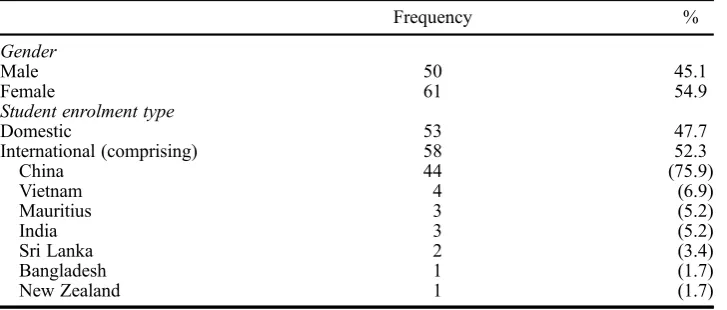
Of the 121 responses received, 111 were usable. Ten students did not identify them-selves on the demographic section in the questionnaire (questions 7–11), and their responses were excluded from further analysis. Overall this result represented a response rate of 35% based on the number of students who sat thefinal examination. According to Sekaran (2010) and Zikmund (2010), this is an acceptable response rate. Table 1 provides details of the sample characteristics. A comparison of the demographics of the sample with the population showed the following: (i) women comprised 55% of the sample study and 56% of the population; and (ii) internation-ally enrolled students were 52% of the sample and 55% of the population. Thus, the sample closely resembled the population of students studying second-year account-ing at the university.
Results and discussion
Group learning experience–blogs
In addressing Research Question 1, concerning students’ attitudes towards using blogs to facilitate reflection as part of collaborative learning was assessed via seven
Table 1. Descriptive statistics.
Frequency %
Gender
Male 50 45.1
Female 61 54.9
Student enrolment type
Domestic 53 47.7
International (comprising) 58 52.3
China 44 (75.9)
Vietnam 4 (6.9)
Mauritius 3 (5.2)
India 3 (5.2)
Sri Lanka 2 (3.4)
Bangladesh 1 (1.7)
New Zealand 1 (1.7)
items, using a five-point Likert scale where rankings ranged from ‘strongly dis-agree’= 1 to ‘strongly agree’= 5. Table 2 shows the attitudes of students as to whether the use of e-learning (blogs) in an assessment task facilitates reflection as part of collaborative learning.
The results indicate that for five of the seven items a median score of three (nei-ther disagreeing nor agreeing) was recorded. For the o(nei-ther two items ‘the blog enabled me to reflect on my own contribution to the group assignment’ and ‘the blog enhanced my responsibility for my own learning’, a median score of four was produced. Furthermore, four items produced mode scores of four, suggesting that the group learning experience valued most was the blog’s facilitation of reflective learning. The results are not dissimilar to those of Ballantine and McCourt Larres (2007); although they distinguished between ‘more able’ and ‘less able’ student groups, they attributed low scores to the possibility that students were disappointed with the use of the group learning log as a means of reflecting on the interaction of group members and its capacity to deal with free riders.
In both the present study and that of Ballantine and McCourt Larres (2007), marks were allocated for the group activity. This may, in part, explain the relative neutral scores for the items addressing attitudes to the blog as a tool in collaborative learning. However, the neutrality of the results might also be explained by a lack of group engagement as the ongoing online dialogue in maintaining the blog was not assessed. As Ballantine and McCourt Larres (2007) indicate, it is unlikely that stu-dents value educational approaches that are not subsequently assessed by the instruc-tor. Furthermore, given the novel characteristics of the blog, there may be a case to be made for ongoing assessment of blogs by academics, rather than assessment at the completion of all four blogs. A further factor that may explain a lack of engage-ment with the blogs was the percentage mark that was awarded for the group assess-ment component of the assignassess-ment (5%). Students may have perceived this percentage mark allocation as too low to justify a high level of commitment.
Research Question 2, regarding differences in the attitudes towards the use of blogs as a means of facilitating reflection as part of collaborative learning by the two enrolment groups (domestic and international), was assessed using the Mann– Whitney test. The non-parametric Mann–Whitney test is applicable for tests of inde-pendence between two independent samples. It is specifically suited to ordinal scaled data (i.e. Likert scales) as collected in this study (Field2009). Consistent with
Table 2. Using blogs to facilitate reflection and collaborative learning–all students.
Statement N Median Mode
The blog was a useful communication device between the members of the group
111 3 3 The blog was useful as a means of reflecting on the interaction of the
group members
111 3 4 The blog is an effective deterrent against free riders 111 3 3 The blog is a valuable part of the group assessment 111 3 3 The blog enabled me to reflect on my involvement in the group
learning process
111 3 4 The blog enabled me to reflect on my contribution to the group
assignment
the education literature, any estimated variable that is statistically significant at least at the 5% level is considered to have a significant effect. The results of the test are shown in Table3.
The results showed that the two student groups held different attitudes regarding the use of blogs as a means of facilitating reflection as part of collaborative learning. Across all seven items, international students attained higher mean rank scores than the domestic student group. The Mann–Whitney test results demonstrated that sig-nificant differences exist acrossfive of the seven items. Specifically, significant dif-ferences occurred with international students perceiving that the blog was ‘a useful communication tool’(U= 1165.000,z=−2.295,p= 0.022),‘a valuable part of group assessment’(U= 1086.000,z=−2.757,p= 0.006), to‘better reflect on their involve-ment in the group learning process’ (U= 993.500,z=−3.353, p= 0.001), to ‘better reflect on their own contribution to the group assignment’(U= 949.500,z=−3.619, p= 0.000), and the blog was‘more able to enhance their responsibility for their own learning’(U= 914.500,z=−3.842, p= 0.000) compared with students from domes-tic backgrounds. The findings support the view that international students are more likely than domestic students to have positive attitudes about the blog as a means to reflect on their learning and to contribute to collaborative group work.
Although there was no significant difference regarding blogs ‘as a means of reflecting on the interaction of the group members’ (U= 1236.500, z=−1.861, p= 0.063) and being ‘an effective deterrent against free riders’ (U= 1266.000, z=−1.666, p= 0.096), the international student mean rank score was greater than the domestic students. This result suggests that the international student cohort felt the blog was more effective in combating the free rider issue. More importantly, the result shows that domestic students–who typically are most aggrieved with the free rider issue (see Pieterse and Thompson2010)–did not believe that the use of blogs addressed this major ongoing concern linked with group work.
Table 3. Attitude towards blogs to facilitate reflection as part of collaborative learning: dif-ferences between international and domestic cohorts.
Statement
Cultural back-ground N
Mean rank The blog was a useful communication device between the
members of the group
International 58 62.41** Domestic 53 48.98 The blog was useful as a means of reflecting on the
interaction of the group members
International 58 61.18 Domestic 53 50.33 The blog is an effective deterrent against free riders International 58 60.67 Domestic 53 50.89 The blog is a valuable part of the group assessment International 58 63.78*
Domestic 53 47.49 The blog enabled me to reflect on my involvement in the
group learning process
International 58 65.37* Domestic 53 45.75 The blog enabled me to reflect on my contribution to the
group assignment
International 58 66.13* Domestic 53 44.92 The blog enhanced my responsibility for my own learning International 58 66.73*
Domestic 53 44.25
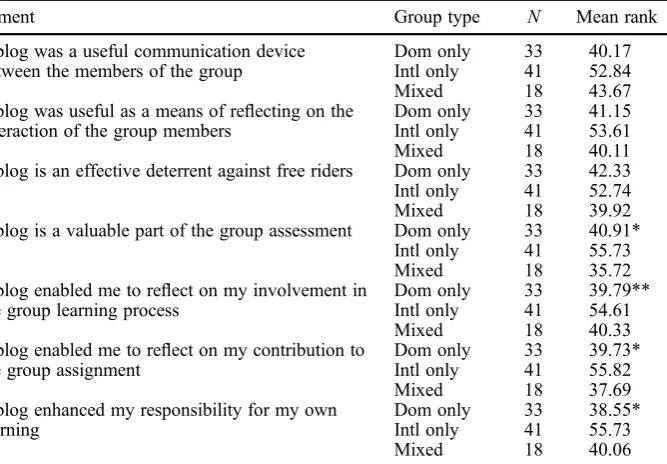
The self-selection of groups in the present study led to the formation of mixed groups (i.e. groups comprising one domestic student and one international student). Hence, further tests were undertaken to assess if these mixed group types perceived the benefits of blogs differently to non-mixed groups (i.e. groups comprising either international students or domestic students only). Statistical tests were conducted to assess differences in the attitudes towards the blogs based on the three group types: international only, domestic only and mixed, using the Kruskal–Wallis test. The non-parametric Kruskall–Wallis test is specifically suited to ordinal scaled data (i.e. Likert scales) as collected in this study (Field 2009). The results of the test are shown in Table4.
The results showed a significant difference among the three types of groups with respect to their perceptions of their learning experiences with the blog in relation to: (a) its usefulness as a valuable part of the group assessment; (b) enabling individual reflection on their involvement in the group learning process; (c) enabling individual reflection on their own contribution to the group; and (d) enhancing their responsi-bility for their own learning. To determine which of the groups differed from each other, post hoc tests were conducted. Given the three pairs were unequal in size, Mann–Whitneypost hoctests were conducted along with a Bonferroni correction to avoid Type I error. The Bonferroni correction method adjusts the p-value for n paired comparisons (Abdi 2007). Under a Bonferroni correction for three pairs, any
Table 4. Attitude towards blogs to facilitate reflection as part of collaborative learning: dif-ferences between different group types.
Statement Group type N Mean rank The blog was a useful communication device
between the members of the group
Dom only 33 40.17 Intl only 41 52.84 Mixed 18 43.67 The blog was useful as a means of reflecting on the
interaction of the group members
Dom only 33 41.15 Intl only 41 53.61 Mixed 18 40.11 The blog is an effective deterrent against free riders Dom only 33 42.33 Intl only 41 52.74 Mixed 18 39.92 The blog is a valuable part of the group assessment Dom only 33 40.91*
Intl only 41 55.73 Mixed 18 35.72 The blog enabled me to reflect on my involvement in
the group learning process
Dom only 33 39.79** Intl only 41 54.61 Mixed 18 40.33 The blog enabled me to reflect on my contribution to
the group assignment
Dom only 33 39.73* Intl only 41 55.82 Mixed 18 37.69 The blog enhanced my responsibility for my own
learning
Dom only 33 38.55* Intl only 41 55.73 Mixed 18 40.06
Notes:n= 92 (19 of the 111 students did not provide their student identification hence their group type could not be identified).
Dom only = Groups comprising domestic enrolled students only; Intl only = Groups comprising interna-tional enrolled students only; Mixed = Groups comprising domestic and internainterna-tional enrolled students. *Differences between groups significant at 1% level (p< 0.01).
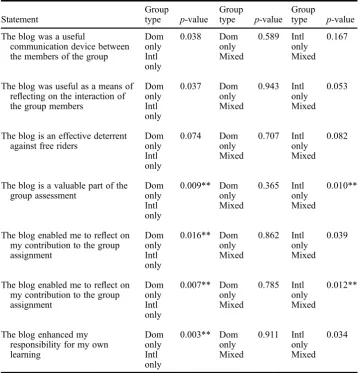
paired testing has to achieve a significance value of 0.017 or smaller to be signifi -cant at the 0.05 level. The results of the test are shown in Table5.
Table 5 shows that there were significant differences between the domestic- and international-only groups, demonstrating that differences in perceptions of learning experiences were amplified when analysed on this basis. The findings in Table5 – when combined with the mean rank results in Table 4–support the view that inter-national students are significantly more likely to view the blog as a vehicle for reflection of their involvement and contribution to group work, as well as a valuable tool for taking greater ownership for their own learning. In addition, international
Table 5. Attitude towards blogs to facilitate reflection as part of collaborative learning:post hoctests between different group types.
Statement
Group
type p-value
Group
type p-value Group
type p-value The blog was a useful
communication device between the members of the group
Dom only 0.038 Dom only 0.589 Intl only 0.167 Intl only Mixed Mixed
The blog was useful as a means of reflecting on the interaction of the group members
Dom only 0.037 Dom only 0.943 Intl only 0.053 Intl only Mixed Mixed
The blog is an effective deterrent against free riders
Dom only 0.074 Dom only 0.707 Intl only 0.082 Intl only Mixed Mixed
The blog is a valuable part of the group assessment Dom only 0.009** Dom only 0.365 Intl only 0.010** Intl only Mixed Mixed
The blog enabled me to reflect on my contribution to the group assignment Dom only 0.016** Dom only 0.862 Intl only 0.039 Intl only Mixed Mixed
The blog enabled me to reflect on my contribution to the group assignment Dom only 0.007** Dom only 0.785 Intl only 0.012** Intl only Mixed Mixed
The blog enhanced my responsibility for my own learning Dom only 0.003** Dom only 0.911 Intl only 0.034 Intl only Mixed Mixed
Note: Dom only = Groups comprising domestic enrolled students only; Intl only = Groups comprising international enrolled students only; Mixed = Groups comprising domestic and international enrolled students.
student and mixed student groups significantly differed on two items: (a) the blog as a vehicle for reflection of their own contribution to group work; and (b) the blog as a valuable part of the assessment. Finally, no significant differences in perceptions of the group learning experience were identified for mixed and domestic-only groups. Thus, international students in mixed groups were more likely to share simi-lar attitudes towards the blog as domestic-only groups (also supported by mean rank results in Table4).
Conclusions and future directions
This study explored accounting students’attitudes towards a group assessment activ-ity that utilised an e-learning tool to facilitate reflection as part of collaborative learning. The study aimed to identify whether: the use of e-learning (blogs) in an assessment task facilitated reflection as part of collaborative learning (Research Question 1), and whether there were differences in attitudes of domestic and interna-tional students in relation to the use of blogs as a means of facilitating reflection as part of collaborative learning (Research Question 2). Further tests were also carried out to determine whether group composition impacted on attitudes to the use of the blog in the assessment task. The findings related to Research Question 1 indicate that, overall, attitudes towards blogs were mixed. Various factors could explain the inconclusive result, including the variation in commitment given the small percent-age of marks allocated to the collaborative activity using the blog as an assessment task.
The findings related to Research Question 2 showed international students as being significantly more likely to view the blog as a vehicle for facilitating reflection as part of collaborative learning. An interesting implication of this research for edu-cators arises from the result which demonstrated that international students in mixed groups were more likely to share similar attitudes towards the blog as domestic-only groups. This would suggest that the composition of a group has a significant effect on eventual perception of the group work activity.
The findings from this study have implications for educators encountering the challenges of a similar cultural mix of students. In designing group tasks, there is a need to not only consider group size, self-selection or structured formation of the groups, but also the cultural mix. As Turner (2009) indicated, casual approaches to cultural integration in teaching and learning environments may restrict participation and intercultural engagement. Cuseo (1992) argues that educational groups should be formed on the basis of a number of background characteristics, including ethnic or racial backgrounds to more readily represent a real-world situation where one cannot choose their working group.
include offering a podcast of the initial instruction session conducted by support staff. Such a podcast would enable students to review the step-by-step operation of the blog. Another possible strategy would be to consistently provide reinforcement of the benefits of blogs to reduce the ‘content disconnect’ experienced by some students.
The incorporation of blogs in the curriculum provides a useful way of building evidence of the acquisition of a range of student capabilities, including portfolios presented to prospective employers after graduation. Employers, in particular, have expressed the view that they expect accounting graduates to have a global mindset: i.e. be able to work in diverse teams and interact with people from different cultural backgrounds (Bouyer 2011; Graduate Careers Australia 2011). The challenge for educators is to appreciate the change in learning dynamics created by technology and ensure that students are provided with opportunities to promote their skill acqui-sition. Blogs are one component of e-learning that provides this opportunity. Greater awareness of technology, as well as resourcing of technological support as a form of continuing professional development, would enable educators to more readily address the rapidly changing learning environment.
It is acknowledged that this study has a number of limitations. First, the out-comes may be partially attributable to the specific context in which the study was undertaken, including the student population and assessment processes. Additionally, it is acknowledged that the conclusions drawn about the group structure (groups of two) are not necessarily generalisable to larger group structures. Furthermore, no claims can be made regarding the homogeneity of the cultural groups, and it is acknowledged that ethnicity was not addressed. Nevertheless, there is the potential for others to learn from this study in developing e-learning activities, given the increasingly diverse cultural educational environment. Furthermore, although this study investigated the attitudes of students in using blogs to facilitate collaboration, it is acknowledged that no content analysis was undertaken of the blog entries (work samples) used by students to verify perceptions reported. A useful extension of the study would be to undertake a content analysis of the reflective learning comments used in the preparation of blog entries.
Notes on contributors
Beverley Jackling is an accounting professor and director of the Financial Education Research Unit in the College of Business at Victoria University leading research in areas of
financial services education. Her research has focussed on the educational aspects of business education including employment outcomes for accounting and business graduates in Australia including a focus on the learning and employment outcomes of international students. She has an extensive publication record and has been the recipient of a number of research grants from professional and employer bodies nationally and internationally, as well as government. Riccardo Natoli works as a senior lecturer in the Discipline of Finance at Victoria University, Melbourne. His research interests include financial literacy, financial education, corporate governance and economic development.
Nick Sciulli, associate professor, is currently a Discipline Leader – Financial Accounting within the College of Business at Victoria University, Melbourne, Australia. He has over 20 years’experience in higher education, as a lecturer, researcher and academic administrator in Australia and in Italy. His research interests include public sector accounting and manage-ment, sustainability accounting and accounting education. He has published research papers in several highly ranked journals and seeks to collaborate with international partners to dem-onstrate how management issues have a global context.
References
Abdi, H. 2007.“Bonferroni andŠidák Corrections for Multiple Comparisons.”In Encyclope-dia of Measurement and Statistics, edited by N. J. Salkind, 103–107. Thousand Oaks, CA: Sage.
Australian Council for Educational Research. 2011. “International Students Snapshot: A Global Picture.”Joining the Dots1 (8): 1–10.
Ajeneye, F. 2005.“Reflective Practice: A Biomedical Scientist’s Perspective.”The Biomedi-cal Scientist49: 573–574.
Ballantine, J., and P. McCourt Larres. 2007.“Final Year Accounting Undergraduates’ Atti-tudes to Group Assessment and the Role of Learning Logs.” Accounting Education 16 (2): 163–183. doi:10.1080/09639280701234419.
Barfield, R. 2003. “Students’ Perceptions of and Satisfaction with Group Grades and the Group Experience in the College Classroom.” Assessment & Evaluation in Higher Education28 (4): 355–370. doi:10.1080/0260293032000066191.
Bold, C. 2008. “Peer Support Groups: Fostering a Deeper Approach to Learning through Critical Reflection on Practice.” Reflective Practice 9 (3): 257–267. doi:10.1080/ 14623940802207022.
Bouyer, K. 2011. “Firm Panel: How are Students Transitioning.” Paper Read at Fourth Annual Conference on Teaching and Learning in Accounting, American Accounting Association, Denver, USA, August.
Cameron, M. 2012. “‘Economics with Training Wheels’: Using Blogs in Teaching and Assessing Introductory Economics.” The Journal of Economic Education 43 (4): 397–407. doi:10.1080/00220485.2012.714316.
Caple, H., and M. Bogle. 2013. “Making Group Assessment Transparent: What Wikis can Contribute to Collaborative Projects.”Assessment & Evaluation in Higher Education 38 (2): 198–210.
Chen, N.-S., W. Chun-Wang, W. Kuen-Ting, and L. Uden. 2009. “Effects of High Level Prompts and Peer Assessment on Online Learners’ Reflection Levels.” Computers & Education52 (2): 283–291.http://dx.doi.org/10.1016/j.compedu.2008.08.007.
Choudaha, R., L. Chang, and Y. Kono. 2013.“International Student Mobility Trends 2013: Towards Responsive Recruitment Strategies (April 28, 2014).”World Education News & Reviews26 (2). Available at SSRN:http://ssrn.com/abstract=2275946.
Clark, L., and G. Hardham. 2010. “Eportfolios – Reflecting on the Evidence.” InEffective Use of PebblePad: A Collection of Case Studies from PebbleBash 2010, edited by A. Poot. Telford: Pebble Learning.
Cuseo, J. 1992.“Cooperative Learning vs. Small-group Discussions and Group Projects: The Critical Differences.”Cooperative Learning and College Teaching2 (3): 5–10.
De Vita, G. 2002.“Does Assessed Multicultural Group Work Really Pull Uk Students’ Aver-age down?” Assessment & Evaluation in Higher Education 27 (2): 153–161. doi:10.1080/02602930220128724.
Dewey, J. 1933.How we Think: A Restatement of the Relation of Reflective Thinking to the Educative Process. Revised ed. Boston, MA: D. C. Heath & Co.
Dillenbourg, P. 1999. “What do you Mean by Collaborative Learning?” In Collaborative-learning: Cognitive and Computational Approaches, edited by P. Dillenbourg, 1–19. Oxford: Elsevier.
Dippold, D. 2009. “Peer Feedback through Blogs: Student and Teacher Perceptions in an Advanced German Class.”ReCALL21 (1): 18–36.
Field, A. 2009.Discovering Statistics using Spss for Windows: Advanced Techniques for the Beginner. 3rd ed. London: Sage.
Garrison, D. 2011.E-learning in the 21st Century: A Framework for Research and Practice. 2nd ed. New York: Routledge.
Garvin, J. W., A. C. Butcher, L. A. J. Stefani, V. N. Tariq, M. H. R. Lewis, N. L. Blumson, R. N. Govier, and J. A. Hill. 1995.“Group Projects for First-year University Students: An Evaluation.” Assessment & Evaluation in Higher Education 20 (3): 273–288. doi:10.1080/0260293950200304.
Gatfield, T. 1999. “Examining Student Satisfaction with Group Projects and Peer Assess-ment.” Assessment & Evaluation in Higher Education 24 (4): 365–377. doi:10.1080/ 0260293990240401.
González, C. 2009. “What do University Teachers Think Elearning is Good for in their Teaching?” Studies in Higher Education 35 (1): 61–78. doi:10.1080/ 03075070902874632.
Graduate Careers Australia. 2011.Graduate Outlook 2011: The Report of the Graduate Out-look Survey. Melbourne: Graduate Careers Australia.
Hannon, J., and B. D’Netto. 2007. “Cultural Diversity Online: Student Engagement with Learning Technologies.” International Journal of Educational Management 21 (5): 418–432.
Hossain, M. M., and R. J. Quinn. 2012.“Advantages and Disadvantages of using a Blogging Actaivity in a College Euclidean Geometry Course.”International Journal of Computer Technology and Electronics Engineering2 (6): 1–8.
Hourigan, T., and L. Murray. 2010.“Investigating the Emerging Generic Features of the Blog Writing Task across Three Discrete Learner Groups at a Higher Education Institution.”
Educational Media International47 (2): 83–101. doi:10.1080/09523987.2010.492674. Jackling, B. 2007.“The Lure of Permanent Residency and the Aspirations and Expectations
of International Students Studying Accounting in Australia.” People and Place 15 (3): 31–41.
Jain, P., P. Kothari, and A. Thakurta. 2012.“Differentially Private Online Learning.”Journal of Machine Learning Research: Workshop and Conference Proceedings23: 1–34. Jonassen, D., and L. Rohrer-Murphy. 1999.“Activity Theory as a Framework for Designing
Constructivist Learning Environments.”Educational Technology Research and Develop-ment47 (1): 61–79. doi:10.2307/30220230.
Lamshed, R., M. Berry, and L. Armstrong. 2002.“Blogs: Personal e-learning Spaces.”http:// www.binaryblue.com.au/docs/blogs.pdf.
Meredith, C. 2010. “Teaching Reflective Skills and Pdp to International Students: How Effective is the Use of Pebblepad?” Brookes eJournal of Learning and Teaching 2 (5).
http://bejlt.brookes.ac.uk/articles/teaching_reflective_skills_and_pdp_to_international_stu dents_how_effective_/.
Mills, P. 2003. “Group Project Work with Undergraduate Veterinary Science Students.”
Assessment & Evaluation in Higher Education 28 (5): 527–538. doi:10.1080/ 02602930301676.
Moon, J. A. 1999.Reflection in Learning and Professional Development: Theory and Prac-tice. London: Kogan Page.
Moon, J. 2005. “Progression in Higher Education: A Study of Learning as Represented in Level Descriptors.” InEnhancing Teaching in Higher Education: New Approaches for Improving Student Learning, edited by P. Hartley, A. Woods, and M. Pill, 111–120. London: Routledge, Taylor & Francis Group.
Munday, J. 2010.“Embedding Eportfolios into an Undergraduate Degree Program.”In Effec-tive Use of PebblePad: A Collection of Case Studies from PebbleBash 2010, edited by A. Poot. Telford: Pebble Learning.
O’Neill, K., G. Sing, and J. O’Donoghue. 2004. “Implementing Elearning Programmes for Higher Education: A Review of the Literature.” Journal of Information Technology Education3: 313–323.
Pieterse, V., and L. Thompson. 2010. “Academic Alignment to Reduce the Presence of
‘Social Loafers’and‘Diligent Isolates’in Student Teams.”Teaching in Higher Education
15 (4): 355–367. doi:10.1080/13562517.2010.493346.
Rogoff, B. 1998.“Cognition as a Collaborative Process.”InHandbook of Child Psychology, edited in chief W. Damon edited by D. Kuhn and R. Siegler, 5th ed. (Vol. 2, 679–744). New York: Wiley.
Seethamraju, R., and M. Borman. 2009. “Influence of Group Formation Choices on Aca-demic Performance.” Assessment & Evaluation in Higher Education 34 (1): 31–40. doi:10.1080/02602930801895679.
Sekaran, U. 2010.Research Methods for Business: A Skill-building Approach. 5th ed. Chich-ester: Wiley.
Strauss, P., A. U-Mackey, and S. Young. 2011.“‘I Know the Type of People I Work Well With’: Student Anxiety in Multicultural Group Projects.”Studies in Higher Education36 (7): 815–829. doi:10.1080/03075079.2010.488720.
Strampel, K., and R. Oliver. 2008.“We’ve Thrown Away the Pens, but are they Learning? Using Blogs in Higher Education.” Proceedings of ASCILITE, 992–1001. Melbourne: ASCILITE.http://ro.ecu.edu.au/ecuworks/933.
Summers, M., and S. Volet. 2008.“Students’Attitudes towards Culturally Mixed Groups on International Campuses: Impact of Participation in Diverse and Non-diverse Groups.”
Studies in Higher Education33 (4): 357–370. doi:10.1080/03075070802211430.
Sumsion, J., and J. Goodfellow. 2004.“Identifying Generic Skills through Curriculum Map-ping: A Critical Evaluation.” Higher Education Research & Development 23 (3): 329–346. doi:10.1080/0729436042000235436.
Tekinarslan, E. 2008.“Blogs: A Qualitataive Investigation into an Instructor and Undergradu-ate Students’ Experiences.” Australasian Journal of Educational Technology 24 (4): 402–412.
Thomas, T. A. 2014.“Developing Team Skills through a Collaborative Writing Assignment.”
Assessment & Evaluation in Higher Education39 (4): 479–495.
Turner, Y. 2009. “‘Knowing Me, Knowing You’, Is there Nothing we can do?: Pedagogic Challenges in Using Group Work to Create an Intercultural Learning Space.”Journal of Studies in International Education13 (2): 240–255.
Vygotsky, L. S. 1978.Mind in Society: The Development of Higher Psychological Processes, edited by Michael Cole. Cambridge, MA: Harvard University Press.
Wang, Y., R. Harding, and L.-W. Mai. 2011.“Impact of Cultural Exposure on Young Chinese Students’ Adaptation in a UK Business School.” Studies in Higher Education 37 (5): 621–639. doi:10.1080/03075079.2010.536528.
Williams, J. B., and J. Jacobs. 2004.“Exploring the Use of Blogs as Learning Spaces in the Higher Education Sector.” Australasian Journal of Educational Technology 20 (2): 232–247.