2016 International Congress on Computation Algorithms in Engineering (ICCAE 2016) ISBN: 978-1-60595-386-1
1 INTRODUCTION
All kinds of hard and soft materials such as metal, marble, glass and rubber can be machined by the high pressure abrasive water jet (AWJ) technology. When the machining time is short, there is no poisonous gas, machining heat effect and deformation [1]. As the new type of non-traditional machining technology, cutting is the major machining method studying high pressure abrasive water cut because the diameter of machining flow is small (which is in the range of 0.8–1.8mm) [2]. In order to cut high-strength and high-hardness mate-rial, it can replace the traditional plasma cutting, laser cutting, wire-electrode cutting and metal saw blade milling processing. What’s more, this technology is more and more widely applied.
Super-strength aluminium alloy which is heat-treatable and reinforced is mainly dominated by
Al-Zn-Mg-Cu series (for short of 7xxx series). Its advantages include high strength and hardness, good heat machinability and welding performance, better corrosion resistance and higher tenacity, and it is used for structural material with big bearing [3]. In the su-per-strength aluminium alloy, 7050 aluminium alloy developed by America ALCOA Company has the performance of very high strength, spalling corrosion resistance and stress corrosion cracking resistance. Meanwhile, owing to the advantages of low density and good breaking tenacity, it is widely used in the field of aerospace and shipbuilding and, it is suitable for manufacturing structural parts [4, 5]. The mechani-cal property of 7050 aluminium alloy is shown in Table 1 [6]. High-pressure abrasive water jet is used for conducting cutting experiment on 7050 aluminium alloy, analyzing the influences on the cutting depth by the target distance and the pressure of the abrasive
Controlled Experiment on the Cutting Depth of 7050 Aluminium
Alloy Machined by High-pressure Abrasive Water Jet
and Process Study
Xiaoming Geng1* & Zhen Li2
1
Anhui Vocational College of Electricity & Information Technology, Bengbu, Anhui, China 2
School of Mechanical Engineering & Automation, Beihang University; Beijing Engineering Technological Research Center of High-efficient & Green CNC Machining Process and Equipment Center, Beijing, China
ABSTRACT: As the new type of cutting technology, high pressure abrasive water jet (AWJ) has been used in more fields at present. The article aims at ultralumin material of 7050 aluminium alloy, takes advantage of the existing experiment equipment and adopts the high pressure abrasive water jet technology to conduct cutting experiment. On the basis of experimental data, the cutting experiment model is established; the pressure of jet has influences on the cutting depth of 7050 aluminium alloy material; the target distance and feeding speed of nozzle movement under different cutting conditions are obtained by adopting the method of orthogonal experiment; the prediction model of cutting depth (H) is established by adopting Matlab language and multiple regression analy-sis method when 7050 aluminium alloy material is machined by high pressure abrasive water jet. Finally, the analytical result of the cutting depth range has shown that the pressure of water jet has the most obvious influ-ence on the cutting depth of aluminium alloy material, while the influinflu-ence by the feeding speed of water jet ranks the second.
Keywords: high pressure abrasive water jet; cutting; 7050 aluminium alloy; the depth of cutting; orthogonal experiment; process study
water jet and feeding speed and proposing reasonable technology for cutting to provide theory and
[image:2.516.51.254.110.144.2]experi-ment basis for engineering application.
Table 1. Mechanical property of 7050 aluminium alloy. Strength of
exten-sion σb/MPa
Yield limit σ0.2/MPa
Ductility δ/%
Hardness (HB)
≥572 ≥503 12 150
2 EXPERIMENT ON 7050 ALUMINIUM ALLOY
VERTICALLY CUT BY HIGH PRESSURE ABRASIVE WATER JET
2.1 Formation of aluminium alloy scraps
In the process of high pressure abrasive water jet cut-ting, the flow velocity flowing through the nozzle is two to three times of velocity of sound [7], thereby strong impact force can produce. Meanwhile, abrasive is brought in cutting head mixing chamber through conveying system, and ejected from the abrasive water nozzle after speeding up through high pressure water. Because there are certain corner angles on the abrasive, the abrasive can be used as impact pressure head, and the big impact F is produced on the surface of alu-minium alloy by the abrasive which is driven by high speed water. The central crack and the transverse crack are produced at the front end of the abrasive pressure head. Under continuous impact of abrasive water, , scraps drop from the surface of aluminium alloy when crack continuously expands to the surface of workpiece, and plasticity crack is produced on the cutting surface as well as brittle fracture, so the modes of scraps include plasticity and brittleness.
2.2 Experiment condition
In the process of high-pressure abrasive water jet cut-ting, there are more than 20 technological parameters influencing machining quality [8, 9]. After analysis, the parameters can be divided into different types. One type is intrinsic parameter, such as the radius of water jet nozzle, the length and the radius of sand mixing tube, movement precision of nozzle and abrasive. The parameter is generally different owing to the equip-ment and basically not changes when cutting material. The second type is setup parameter, such as the target distance and feeding speed of water jet cutting. The parameter is set according to material before cutting. The third type is variable parameter which changes along with the changes of setting parameter, such as the changes of the pressure of abrasive water jet. Be-cause the diameter of the water nozzle does not change, the abrasive flow and water flow rate of the water jet nozzle will change accordingly, and the ma-chine tool water jet cutting system usually adjusts by itself [10, 11].
By using five-axis intelligent water jet cutter
[image:2.516.267.461.233.350.2]LTJ1613-5A machine tool manufactured from Shanghai Lionstek science and technology Co., Ltd , premixed abrasive water jet is adopted, and garnet sand is used as abrasive to conduct vertical cutting. Because the shorter the target distance is, the smaller the water column diffusion of water jet is, the cutting force on workpiece is more concentrated, and the tar-get distance is 1–6mm at the time of experiment. Owing to limitation of experiment condition, part of the technological parameters is adjusted and tested at the time of experiment. Technological parameters ensured on the experiment are shown in Table 2:
Table 2. Perpendicular cutting technological parameter of high pressure abrasive water jet.
Performance Parameter
Adjustment range of cutting pressure 0~420Mpa
Positional accuracy ±0.04mm/m
The maximum water discharge 3.7L/min
Diameter of water nozzle 0.33mm
Material of of water nozzle Sapphire
Diameter of abrasive nozzle 0.889mm
Particle size of abrasive 80μm
Flow of abrasive 0.5kg/min
2.3 Experimental result
In the process of experiment, because of not consider-ing the factor of machinconsider-ing quality, the test cuttconsider-ing depth is the maximum actual cutting depth, the length of incision in the cut aluminium alloy is 30mm, and the depth is measured by probe and vernier caliper. 2.3.1 Influence on the cutting depth by the pressure
of abrasive water jet
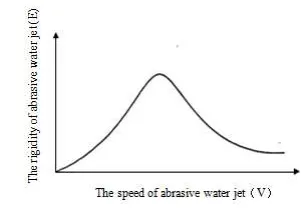
Figure 1. Relationship between the speed of water jet and rigidity.
[image:2.516.282.433.468.575.2]declines rapidly, the rigidity of the abrasive water jet diminishes on the contrary, and the elastic model is
2
)
(
c
v
E
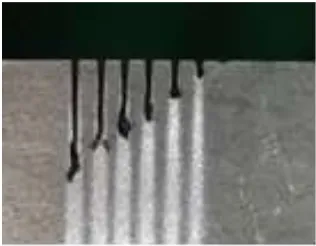
(in this formula, E is the rigidity of the jet, ρ is the density of water jet, c is propagation velocity of elastic waves in liquid, and υ is the ejected speed after abrasive is added in water jet). The chang-es of rigidity are shown in Figure 1, which is, when abrasive water jet reaches the certain speed value, the rigidity of the abrasive water jet is bigger, and the abrasive water jet can effectively cut material [12]. [image:3.516.270.444.56.199.2]In the experiment, the movement feeding speed V is 500mm/min, and the target distance S is 1mm. By changing the pressure of jet, the speed of abrasive water jet changes, and the cutting depth experiment are conducted on aluminium alloy material. The ex-perimental results are shown in Figure 2 and Figure 3. When 7050 aluminium alloy material is vertically cut by high pressure abrasive water jet, the higher the pressure of jet is, the cutting action force of jet im-pacting and kinetic energy of abrasive will increase, and the cut degree of material obviously deepens. When the pressure reaches to the certain value, the pressure continuously increases, collision among abrasive will increase, the effective cutting action force cancels each other out, and the depth of cutting process increases slightly.
Figure 2. Influences on the depth of cutting by the pressure of water jet.
Figure 3. Cutting depth drawing of changing the pressure of water jet.
[image:3.516.77.229.339.423.2]2.3.2 Influence on the cutting depth by the pressure of abrasive water jet
Figure 4. Influences on the depth of cutting by feeding movement speed.
In the process of high pressure abrasive water jet cut-ting, feeding speed directly influences the action time of aluminium alloy material, especially the impact effect of abrasive on the same position of material, and the influences on the cutting depth is great. In the experiment, the jet pressure P is 350Mpa, the target distance S is 1mm, and the feeding speed is changed [13]
. The test result of the cutting depth of aluminium alloy material is shown in Figure 4 and Figure 5. And it shows that the lower the movement feeding speed of nozzle is, the longer the action time of repeatedly impacting material by abrasive is, and the more mate-rial removes, the deeper the cutting depth is.
Figure 5. Cutting depth drawing of changing feeding movement speed.
2.3.3 Influence on the cutting depth by the target distance
[image:3.516.317.409.372.442.2] [image:3.516.73.231.462.585.2]Figure 6. Influences on the depth of cutting by the target distance.
Figure 7. Cutting depth drawing of changing the target distance.
3 PROCESS STUDY ON 7050 ALUMINIUM
ALLOY VERTICALLY CUT BY HIGH PRESSURE ABRASIVE WATER JET
3.1 Optimal experiment design of cutting parameter of high pressure abrasive water jet
As the processing method for cutting new materials, the applied range of abrasive water jet cutting is very wide. In the process of cutting through abrasive water jet, there are many factors influencing cutting process quality, wherein, the major controlled technological parameters such as jet pressure, the target distance and movement speed of nozzle directly decide the depth of machining and analysis of micro-abrasive water jet [14]. On the premise of allowable experiment and by adopting the orthogonal experiment method, the cut-ting depth is the optimal for objective function, the influences on the cutting depth of 7050 aluminium alloy material by the above three parameters are selec-tively analyzed, then the cutting parameter is opti-mized. Moreover, the cutting efficiency is improved on the premise of guaranteeing the cutting quality. 3.1.1 Establishing related data for experiment
In order to complete the orthogonal experiment, four major factors, including jet pressure, movement speed of nozzle, target distance and cutting depth, are ana-lyzed on the experiment [15]. Level factor set of each major machining technology parameter is shown in Table 3:
3.1.2 Establishing orthogonal table of technological parameter optimization
The experiment selects three influence factors, and three level values are selected from each factor.
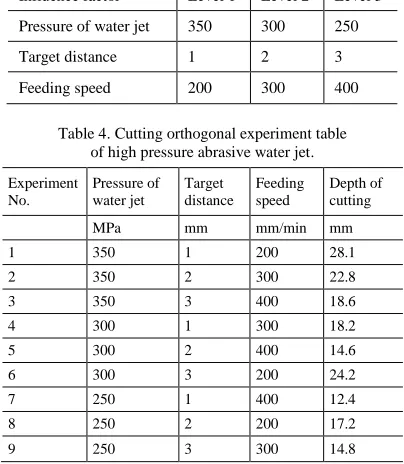
Ac-cording to the characteristic of orthogonal experiment, related experiments shall be conducted for 9 times and denoted by L9(33). The detailed cutting orthogonal experiment table is shown in Table 4.
Table 3. Factors table of cutting level experiment of high pressure abrasive water jet.
Influence factor Level 1 Level 2 Level 3
Pressure of water jet 350 300 250
Target distance 1 2 3
[image:4.516.263.462.139.384.2]Feeding speed 200 300 400
Table 4. Cutting orthogonal experiment table of high pressure abrasive water jet.
Experiment No.
Pressure of water jet
Target distance
Feeding speed
Depth of cutting
MPa mm mm/min mm
1 350 1 200 28.1
2 350 2 300 22.8
3 350 3 400 18.6
4 300 1 300 18.2
5 300 2 400 14.6
6 300 3 200 24.2
7 250 1 400 12.4
8 250 2 200 17.2
9 250 3 300 14.8
3.1.3 Optimization results and range analysis
The experiment data is calculated in the mode of range analysis to obtain the size of influences on cutting depth by each factor and ensure the optimal level combination of each factor. The cutting depth range analysis table of cutting process depth is shown in Table 5:
Table 5. Range analysis table of cutting process depth.
K1 69.5 58.7 69.5
170.9
K2 57 54.6 55.8
K3 44.4 57.6 45.6
k1 23.2 19.6 23.2
k2 19 18.2 18.6
k3 14.8 19.2 15.2
Optimization level P1 S1 V1
Rj 8.4 0.4 8
[image:4.516.262.464.150.382.2]level V1 are selected. The obtained optimal level com-bination through comprehensive selection is: the pressure of water jet P1=350MPa, the target distance S1=1mm and the movement speed of nozzle V1=200mm/min.
3.1.4 General model analysis of high pressure abra-sive water jet cutting depth
According to experiment data, when 7050 almunium alloy material is cut by high pressure abrasive water jet, the related factors of the prediction model for cut-ting depth mainly include cutcut-ting depth H (mm), jet pressure P (Mpa), feeding movement speed of nozzle
V (mm/min), and the target distance S (mm). And the mathematical expression of the cutting depth is shown as follows:
3 2
1 x x
x
V
S
KP
H
(1) Wherein K is the correlation coefficient related to abrasive and 7050 almunium alloy material; x1, x2 and x3 are undetermined coefficients.3.1.5 Regression model of high pressure abrasive water jet cutting depth
Taking the logarithm for two sides of formula (1), we can obtain:
V
x
S
x
P
x
K
H
ln
ln
ln
ln
ln
1
2
3 (2)Enable XlnH , A lnK
0 , Aixi , B1lnP ,
S
B2ln and B3lnV. Then formula (2) is trans-formed to: 3 3 2 2 11 1
0 AB AB AB
A
X (3) Thereby we obtain a multiple linear regression equation set as follows:
9 39 3 29 2 19 1 0 9 2 32 3 22 2 12 1 0 2 1 31 3 21 2 11 1 0 1
B
A
B
A
B
A
A
X
B
A
B
A
B
A
A
X
B
A
B
A
B
A
A
X
(4)Wherein,
i is random vector (i
1
,
2
,
3
9
), whereinE()0.Enable: , , , 9 2 1 3 2 1 0 9 2 1 A A A A A X X X X 39 19 32 12 31 11 1 1 1 B B B B B B B
Then we obtain:
BA
X
(5) Estimating according to least square method, then we can obtain experience regression formula as fol-lows:X B B B
A T 1 T
) ( ˆ
(6) Substituting it into formula (1) to obtain the cutting model of 7050 aluminium alloy cut by high pressure water jet, the orthogonal experimental data is analyzed in the mode of multivariate regression by Matlab lan-guage to obtain prediction model equation as follows:
3 2 1 x x
x
V
S
KP
H
594243 . 0 008042 . 0 315803 . 129553
.
0
P
S
V
(7)3.1.6 Error analysis of the cutting equation of high pressure abrasive water jet
In order to verify the error of the regression equation for cutting aluminium alloy by high pressure abrasive water jet, the equation calculation result is contrasted with the measuring result of cutting experiment, and the error is shown in Table 6.
Through calculation, the maximum relative error is 7.48%, and the minimum relative error is 0.46%. There are many reasons influencing the error, includ-ing material uniformity, experiment equipment, ex-periment time and measuring method. The primary causes of the model to produce error are machine tool system error, measuring error and so on. According to the data of Table 6, the average relative error of the cutting depth H is shown as follows:
% 96 . 2 % 100 9 9 2 1
9
r r r r
(8)
Table 6. Comparison between the predicated value and measured value of the cutting depth.
Experiment No. True value mm Predicated value mm Absolute error mm Relative error %
1 28.1 28.23 0.13 0.46%
2 18.6 18.86 0.26 1.4%
3 22.8 22.31 0.49 2.15%
4 23.8 23.09 0.71 2.98%
5 18.2 18.11 0.09 0.5%
6 14.6 15.35 0.75 5.14%
7 17.2 18.23 1.03 5.99%
8 15.1 14.25 0.85 0.56%
9 13.1 12.12 1.78 7.48%
4 EPILOGUE
re-gression model equation is obtained through calcula-tion and analysis by Matlab language to draw a con-clusion. When 7050 aluminium alloy material is cut by high pressure abrasive water jet, the influences on the cutting depth H by cutting jet pressure P are the most obvious, and the influences by the movement feeding speed V of nozzle and the target distance S are the second. In addition, the cutting depth of 7050 alu-minium alloy machined by high pressure abrasive water jet is analyzed in the mode of error, and the error is relatively small within the controllable range. For the convenience of practical operation, the optimal control of water jet cutting system can be achieved by optimizing the cutting speed on the premise of guar-anteeing the cutting depth. The expert database of speed corresponding to the cutting time is established, and the corresponding cutting speed is optimized.
ACKNOWLEDGEMENTS
This work was supported by National High Technol-ogy Research and Development Program of China (863 Program) (2013AA040105) and Basic Scientific Research Program of China.
REFERENCES
[1] C. Y. Wang, M. D. Chen & P. X. Yang, el al. 2009. Hole machining of glass by micro abrasive suspension Jets. Key Eng Mater, 389-390: 381-386.
[2] Yuli Wang. 2009. Analysis of flow characteristics and cutting performance of ultrahigh pressure multi-phase jet. Zhenjiang: Jiangsu University.
[3] TaoWang & Zhimin Yin. 2006. Rare Metals, 30(2): 197-202.
[4] Dursun T, & Soutis C. 2014. Recent developments in advanced aircraft aluminium alloys. Materials & Design, 56: 862-871.
[5] Bagheriasl R. 2012. Formability of aluminum alloy sheet at elevated temperature. Canada: University of Waterloo, [6] Wang Y L, Pan Q L & Wei L L, et al. 2014. Effect of retrogression and reaging treatment on the microstruc-ture and fatigue crack, Materials & Design, 55: 857-863. [7] Wenying Zhao. Weijia Shi & Xinqiang Hu. 2007. De-velopment and creative of mechanical and electrical products, 20 (4):11–13.
[8] C. K. Huang, S. Chiovelli & P. Minev, et a1. 2008. A comprehensive phenomenological model for erosion of materials in jet flow, 187: 273-279.
[9] M. A. Azmir, A. K. Ahsan & A. Rahmah. 2009. Effect of abrasive water jet machining parameters on aramid fibre reinforced plastics composite. The International Journal of Material Forming, 2: 37-44.
[10] D. K. Shanmugam, T. Nguyen, & J. Wang. 2008. A study of delamination on graphite/epoxycomposites in abrasive waterjet machining, Part A 39: 923-929. [11] M. A. Azmir & A. K. Ahsan. 2009. A study of abrasive
water jet machining process on glass/epoxy composite laminate. Journal of Materials Processing Technology, 209: 6168-6173.
[12] Fluid additives for improving high velocity jet cutting. NC Franz. Proceedings 1st Symposium on Jet Cutting Technology, Conventry 1972, pp: 93-105.
[13] A. Hascalik, U. Caydas & H. Gürün. 2007. Effect of traverse speed on abrasive waterjet machining of Ti-6Al-4V alloy. Materials and Design, 28: 1953-1957. [14] Yuyong Lei, Qingyang Song & Guilin Yang, et al. 2007.
Machine tool and hydraulic pressure, 35(4): 51-53. [15] Mallat S & Zhong Z. 1993. Matching pursuits with