DOI: 10.1534/genetics.105.052563
A Versatile and Efficient Gene-Targeting System for
Aspergillus nidulans
Tania Nayak,* Edyta Szewczyk,* C. Elizabeth Oakley,* Aysha Osmani,* Leena Ukil,*
Sandra L. Murray,
†Michael J. Hynes,
†Stephen A. Osmani* and Berl R. Oakley*
,1*Department of Molecular Genetics, The Ohio State University, Columbus, Ohio 43210 and†Department of Genetics, The University of Melbourne, Parkville, Victoria 3010, Australia
Manuscript received October 17, 2005 Accepted for publication December 23, 2005
ABSTRACT
Aspergillus nidulansis an important experimental organism, and it is a model organism for the genus Aspergillus that includes serious pathogens as well as commercially important organisms. Gene targeting by homologous recombination during transformation is possible inA. nidulans, but the frequency of cor-rect gene targeting is variable and often low. We have identified theA. nidulanshomolog (nkuA) of the human KU70 gene that is essential for nonhomologous end joining of DNA in double-strand break repair. Deletion ofnkuA(nkuAD) greatly reduces the frequency of nonhomologous integration of transforming DNA fragments, leading to dramatically improved gene targeting. We have also developed heterologous markers that are selectable in A. nidulans but do not direct integration at any site in the A. nidulans
genome. In combination,nkuADand the heterologous selectable markers make up a very efficient gene-targeting system. In experiments involving scores of genes, 90% or more of the transformants carried a single insertion of the transforming DNA at the correct site. The system works with linear and circular transforming molecules and it works for tagging genes with fluorescent moieties, replacing genes, and replacing promoters. This system is efficient enough to make genomewide gene-targeting projects feasible.
G
ENE targeting, which involves integration of trans-forming sequences into a genome by homolo-gous recombination, is an enormously useful technique. It can be used to delete genes entirely, to replace one allele of a gene with another, to replace a gene’s normal promoter with a regulatable promoter, and to tag genes with epitope tags or fluorescent proteins. These ap-proaches have been facilitated by the development of fusion PCR (Kuwayamaet al. 2002; Yanget al.2004; Yu et al.2004). Fusion PCR allows transforming fragments to be created with no ligation and if the genome of the organism of interest has been sequenced, the gene to be targeted does not need to be cloned. DNA frag-ments required for targeting can be amplified from genomic DNA using PCR primers based on the geno-mic sequence.The filamentous fungusAspergillus nidulansis an im-portant experimental organism. Significant findings in a number of areas have resulted from work with A. nidulans, and it serves as an important model organism for the genus Aspergillus, which includes commercially important fermentation organisms as well as serious pathogens. Gene targeting is possible inA. nidulans, but homologous recombination during transformation is not particularly efficient. Substantial stretches of ho-mologous DNA are required to obtain useful
frequen-cies of homologous integration and, even then, the majority of transforming sequences integrate heterolo-gously. For example, in the study of Yuet al.(2004), gene targeting with 29 different fusion PCR products with flanking sequences ranging from 480 bp to 4.3 kb re-sulted in correct gene-targeting frequencies ranging from 0 to 40% (20% or less in 24/29 cases). In addition, integration into multiple sites often occurs and trans-forming linear DNA fragments may circularize before integration. As a result, in most cases many transform-ants must be analyzed to identify one carrying a correct, single homologous targeting event. TheA. nidulans ge-nome has now been sequenced (Galaganet al.2005) and the development of a more efficient gene-targeting system not only would facilitate current research with
A. nidulans, but also would make possible genomewide gene-targeting projects (e.g., genomewide gene tagging or deletion).
We now report the development of a very efficient gene-targeting system for A. nidulans. Our approach is based on the results of Ninomiya et al. (2004) who found that the deletion of genes required for non-homologous end joining DNA repair (homologs of the human KU70 and KU80 genes) increases the frequency of gene replacement in Neurospora crassa. We have identified and deleted theA. nidulansKU70 homolog. This deletion has little or no effect on growth or sensitivity to mutagens, but it dramatically improves gene targeting. We have developed heterologous select-able markers that can be used for gene targeting in 1Corresponding author:Department of Molecular Genetics, The Ohio
State University, 484 W. 12th Ave., Columbus, OH 43210. E-mail: [email protected]
A. nidulans, and we have used our system for gene tagging; gene replacement, including replacement of essential genes (gene replacement/heterokaryon rescue); pro-moter replacement; and targeted integration of circular molecules. In all cases, the great majority of transform-ants carried a single correct integration. The system is efficient enough to allow genomewide gene-targeting projects. Our data in combination with the data of Ninomiyaet al.(2004) suggest that deletion of Ku ho-mologs may be a generally useful strategy for improving gene targeting.
MATERIALS AND METHODS
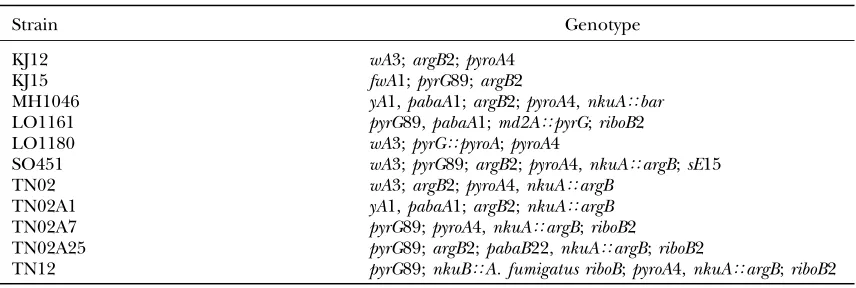
Strains: A. nidulansstrains used in this study are listed in Table 1. Strains have been deposited at the Fungal Genetics Stock Center (http://www.fgsc.net/).
Media: The inducing medium for the alcApromoter was solid minimal medium [6 g/liter NaNO3, 0.52 g/liter KCl, 0.52
g/liter MgSO47H2O, 1.52 g/liter KH2PO4, 9 g/liter fructose,
1 ml/liter trace element solution (Cove1966), 15 g/liter agar,
pH adjusted to 6.5 with NaOH before autoclaving] supple-mented with 1 mg/ml (8.9 mm) uracil, 2.442 mg/ml (10 mm)
uridine, 2.5 mg/ml riboflavin, 1mg/ml para-aminobenzoic acid, and 0.5 mg/ml pyridoxine with 6.25 mm threonine
added as an inducer. YAG (5 g/liter yeast extract, 20 g/liter
d-glucose, 15 g/liter agar) supplemented with 1 mg/ml uracil,
2.442 mg/ml (10 mm) uridine, and 2.5mg/ml riboflavin was
used as a repressing medium.
Methyl methanesulfonate (MMS) sensitivity tests were car-ried out on solid minimal medium with 10 mg/mld-glucose
as a carbon source and appropriate nutritional supplements ½1.0 mg/ml uracil, 2.442 mg/ml (10 mm) uridine, 2.5mg/ml
riboflavin, 1mg/ml para-aminobenzoic acid, 0.5 mg/ml pyri-doxine, 0.5 mg/mll-arginine. MMS was obtained from
Sigma-Aldrich.
The bar gene and selection: The source of the bar cas-sette was Mogens Trier Hansen (Novozymes A/S, Bagsvaerd, Denmark). Thebargene encoding glufosinate resistance was taken from the plasmid pBP1T (Straubingeret al.1992). The
bargene was then placed between theamdSpromoter [con-taining the I9 and the I66 mutations that give increased ex-pression (see Hynesand Davis2004)] and theAspergillus niger
glucoamylase terminator.
Glufosinate was prepared by chloroform extraction of the commercial herbicide Basta (Hoechst Schering AgrEvo GmbH), which contains 200 g/liter glufosinate–ammonium. The yellowish aqueous phase separated from the chloroform layer containing the blue dye added to this preparation by the manufacturers was taken for use. The aqueous phase was stored in the cold until used and was added at 25ml/ml of 1% glucose minimal medium with 10 mmammonium tartrate as
sole nitrogen source.
Polymerase chain reaction: Several polymerase chain re-action (PCR) polymerases and PCR procedures were used in the participating laboratories. All polymerase chain reactions were performed according to manufacturer’s instructions. In some cases PCR was carried out as described by Yanget al
(2004). In other cases AccuPrime Pfx DNA Polymerase (Invitrogen, Carlsbad, CA) was used to amplify shorter DNA fragments. AccuPrime Taq DNA Polymerase High Fidelity (Invitrogen, San Diego) was then used in the fusion PCR to obtain the final products. In other cases, Pfu DNA polymerase (Promega, Madison, WI) was used for amplification of short fragments and Pfu Turbo DNA polymerase (Stratagene, La Jolla, CA) was used for long fragments.
Transformation ofA. nidulans:Transformation was carried out as described previously (Andrianopoulos and Hynes
1998; Junget al. 2000; Yanget al. 2004).
Southern hybridizations:A. nidulansgenomic DNA was iso-lated as described by Oakleyet al. (1987) or Leeand Taylor
(1990). Southern hybridization was performed in dried agarose gels (Oakleyet al. 1987) or as described by Yanget al. (2004) or
on Hybond N1membranes (Amersham, Buckinghamshire, UK) after alkaline capillary transfer with 0.4mNaOH.
Microscopy: Images were taken using a 1.3 numerical aperture planfluor objective on an Olympus IX71 inverted microscope equipped with a mercury light source as well as a Uniblitz electronic shutter, a Priorz-axis drive, and a Hama-matsu Orca ER cooled CCD camera controlled by Slidebook software (Intelligent Imaging Innovations, Denver) on an Apple PowerMac G4 computer. Cells were grown and observed using four-chamber Lab-Tek chambered coverglasses (Nalge Nunc International, Naperville, IL). Imaging was through the coverslips at the bottom of the chambers as described pre-viously (Horioand Oakley2005).
RESULTS
Identification and deletion of theA. nidulans homo-log of KU70: We identified the A. nidulans KU70 TABLE 1
A. nidulansstrains used in this study
Strain Genotype
KJ12 wA3;argB2;pyroA4
KJ15 fwA1;pyrG89;argB2
MH1046 yA1,pabaA1;argB2;pyroA4,nkuATbar
LO1161 pyrG89,pabaA1;md2ATpyrG;riboB2
LO1180 wA3;pyrGTpyroA;pyroA4
SO451 wA3;pyrG89;argB2;pyroA4,nkuATargB;sE15
TN02 wA3;argB2;pyroA4,nkuATargB
TN02A1 yA1,pabaA1;argB2;nkuATargB
TN02A7 pyrG89;pyroA4,nkuATargB;riboB2
TN02A25 pyrG89;argB2;pabaB22,nkuATargB;riboB2
homolog by carrying out a blast search of theA. nidulans
genome database (http://www.broad.mit.edu/annotation/ fungi/aspergillus/) with the human KU70 cDNA se-quence. The search revealed a single KU70 homolog (AN7753.2 in the A. nidulans genome database, blast value 1e-52). We have designated this genenkuA.
We deletednkuAby replacing it with theA. nidulans argBgene (Upshallet al.1986). We created, by fusion PCR, a fragment in whichargBwas flanked on each side by 2000 bp of the sequence that flanks nkuA in the genome (Figure 1). This fragment was transformed into strain KJ12. TenargB1transformants were screened by Southern hybridizations and two showed a pattern diag-nostic for the replacement ofnkuAbyargB(Figure 1). We will use the abbreviation nkuAD for this replace-ment, which is more completely designatednkuATargB.
Since KU70 is involved in nonhomologous end-joining repair of double-strand breaks in phylogeneti-cally diverse organisms (reviewed by Hopfner et al. 2002; Lisbyand Rothstein2004) and in telomere main-tenance in some organisms (reviewed by Hande2004), we examined nkuAD strains for growth defects and increased sensitivity to mutagens. Growth and conidia-tion appeared normal in the initial nkuAD
transform-ants and in segregtransform-ants of crosses that carried nkuAD
(Figure 1).NkuADstrains crossed readily to other strains and, thus, apparently are not defective in meiosis.
In N. crassa, deletion of the KU70 homologmus-51
results in increased sensitivity to the mutagens MMS, ethyl methanesulfonate (EMS), and bleomycin (Ninomiya et al.2004). The increased sensitivity to MMS and EMS was somewhat surprising in that these are point muta-gens that do not cause double-strand breaks. We tested an nkuAD strain for growth sensitivity to MMS over a range from 0.01 to 0.16% and found no difference in growth of thenkuADstrain relative to thenkuA1control (Figure 1). Similarly, we found no inhibition of annkuAD
strain relative to annkuA1control on 0.5, 1.0, and 2.0
mg/ml bleomycin. This was somewhat surprising be-cause although bleomycin has a complex mechanism of action (Hecht 2000), it does cause double-strand breaks (Povirket al.1977). We also tested growth of an nkuADstrain on 15 mmhydroxyurea, a DNA replication inhibitor, and found no inhibition. Finally, we tested the growth of annkuADstrain on 25mg/ml camptothe-cin, a topoisomerase I inhibitor that can cause DNA breakage during replication (Hsianget al.1985). The nkuADstrain showed no inhibition of growth relative to Figure 1.—Deletion and initial
characteriza-tion ofnkuA, the KU70 homolog ofA. nidulans. (A) Deletion strategy. PCR was used to amplify re-gions flankingnkuAas well as theargBgene from genomic DNA. The PCR primers were synthe-sized with ‘‘tails’’ such that thenkuAflanking frag-ments anneal to theargBfragment during fusion PCR. Fusion PCR creates a fragment containing
nkuAflanking sequences surrounding argB and transformation with this fragment can lead to re-placement ofnkuAwithargB. (B) Verification of the replacement ofnkuAwithargBby Southern hybridization. The positions of DNA size stan-dards (in kilobases) are at the left. The probe con-sists of nkuA flanking sequences surrounding
argB. In wild-type DNA cut with PstI (lane 1), the probe hybridizes to bands of 2.6 and 4.7 kb at thenkuAlocus (as shown in the diagram be-low) as well as an 8.8-kb fragment containing the wild-typeargBgene. Lanes 2 and 3 show mini-prep DNA from two putative nkuAreplacement transformants. Homologous recombination re-placingnkuAwithargBconverts the two fragments at thenkuAlocus to a single 6.9-kb fragment as shown in the diagram. Since the mutantargB al-lele (argB2) is not a deletion, the probe also rec-ognizes theargBgene in the transformants. DNA produced by this miniprep procedure usually has slightly reduced mobility compared to the CsCl purified wild-type DNA, presumably due to con-taminating materials not removed by the miniprep procedure (Oakleyet al.1987). (C) Growth of
strains carrying replacements of nkuA or nkuA
andnkuBrelative to a wild-type control. Growth rates are similar in all strains. The wild-type strain is KJ12, the nkuADstrain is TN02, and the nkuAD, nkuBDstrain is TN12. ThenkuAD,nkuBDdouble mutant appears smaller than the other strains because of the darker spore color but the colony di-ameter is actually about the same. (D) Growth rates on MMS of strains carrying replacements ofnkuAornkuAandnkuBas well as a
a wild-type control, but a positive control strain carrying a deletion ofuvsB[a kinase with a central role in DNA repair (De Souza et al. 1999; Hofmann and Harris 2000)] showed, as expected, a significant reduction of growth relative to the nkuAD and wild-type control strains. The fact thatnkuADdoes not enhance the sen-sitivity to compounds that cause double-strand breaks indicates thatA. nidulanshas an efficient break repair system independent ofnkuA.
Cloning of selectable markers from Aspergillus fumigatus: Selectable markers from A. nidulanshave a disadvantage in gene-targeting experiments in that ho-mologous recombination (or gene conversion in the case of point mutations in selectable marker genes) can occur at the chromosomal copy of the selectable marker as well as at the targeted locus. Initial experiments in-dicated that this was a concern when targeting genes in
nkuAD strains (A. Osmani and S. A. Osmani, unpub-lished data). To eliminate this concern, we have cloned the A. fumigatus homologs of the A. nidulans riboB
andpyroAgenes to use as selectable markers. We have also used the previously clonedA. fumigatus pyrGgene (Weidneret al.1998) and we have constructed a vector that confers resistance to glufosinate (phosphinothricin). We partially sequenced the A. nidulans riboB gene that has previously been cloned (Oakleyet al. 1987), searched theA. nidulansdatabase, and found that the
riboBgene corresponds to AN0670.2. We then carried out a blast search of theA. fumigatusgenome (http:// tigrblast.tigr.org/er-blast/index.cgi?project¼afu1) and identified theriboBhomolog (Afu1g13300, blast value 5.1 e-106). We used the sequence information to design PCR primers to amplify the gene from A. fumigatus
genomic DNA and cloned the fragment into pBlue-Script SK1, creating plasmid pTN2. Similarly, we identified Afu5g08090 as theA. fumigatus pyroA homo-log through a blast search with the published pyroA
sequence (Osmani et al. 1999) (blast value 1.2 e-87), amplified the gene by PCR, and cloned the amplified fragment into pBlueScript SK1, creating plasmid pTN1. TheA. fumigatusgenes complementA. nidulans riboB2and pyroA4 mutations but in numerous experi-ments (discussed subsequently and in our unpublished data) have not directed integration at these loci.
When plasmids pTN1 and pTN2 carrying the A. fumigatus pyroA and riboB genes (and no A. nidulans
sequences) were used to transformnkuADstrains, only small, abortive colonies were obtained. These did not continue to grow when subcultured onto selective medium. When annkuADstrain was transformed with a plasmid carrying A. fumigatus pyrG, larger, nearly normal colonies were obtained. Conidia from these colonies did not grow, however, to form colonies on selective medium. Stable transformants thus were not obtained with any of the three plasmids. Our interpre-tation is thatnkuADprevents heterologous integration into the genome such that the transforming plasmids
are eventually lost. The fact that the colonies obtained with the plasmid carrying A. fumigatus pyrGare much larger than the colonies obtained with the other plas-mids is interesting and merits further study.
We have also used a vector (pMT1612) conferring glufosinate resistance, in which the bar (glufosinate resistance) gene of Streptomyces hygroscopicusfrom plas-mid pBP1T (Straubingeret al. 1992) is downstream of theA. nidulans amdSpromoter [containing the I9 and I66 mutations that give increased expression (Hynesand Davis2004)] and upstream of theA. nigerglucoamylase terminator (M. T. Hansen, personal communication).
Using this plasmid (or other circular plasmids con-taining thisbarcassette as the selectable marker) results in strong resistant transformants observable on a back-ground of ‘‘abortive’’ weaker resistant transformants that do not form stable resistant colonies when picked to new selective media. Thus transient expression of the
bargene from nonintegrated plasmids would seem to be sufficient to give glufosinate resistance initially. Un-stable transformants are not seen with linear fragments containingbar.
NkuAD dramatically improves the frequency of correct gene targeting: We initially tested the effects of nkuAD on gene targeting using a linear DNA frag-ment generated by fusion PCR to create a C-terminal histone H1-monomeric red fluorescent protein (mRFP) (Campbell et al. 2002; Toewset al. 2004) fusion. We chose this test system because histone H1-mRFP fusions are easily scored by fluorescence microscopy. The strategy and results are shown in Figure 2. We initially trans-formed a controlnkuA1strain (LO 1180) and annkuAD
strain (TN02A7) with a fusion PCR product consisting of the mRFP andA. fumigatus pyrGflanked on each side by 2000 bp of DNA from the histone H1 gene and from the histone H1 39untranslated region. The fusion PCR product was purified from an agarose gel. In the
nkuA1strain, we obtained 15 transformants, 10 of which had red fluorescent nuclei, indicating that they have a correct histone H1 mRFP fusion. This is an unusually high frequency of homologous integration, among the highest frequencies that we have obtained in annkuA1 strain. One of the transformants grew poorly and was not used in subsequent experiments. We examined the re-maining 9 histone H1 mRFP-positive transformants by Southern hybridizations and found that 7 had extra bands of hybridization in addition to the bands expected for a single correct homologous integration. Thus, only 2 of 15 transformants had a correct single integration.
In the nkuAD strain, 54 of 60 transformants tested (90%) were histone H1 mRFP-positive (Figure 2). We carried out Southern hybridizations on 12 positive trans-formants and each carried a single correct integration (Figure 2).NkuADthus increased the frequency of the desired targeting event from13 to90%.
nkuA strain, we wanted to determine if targeting is efficient with smaller flanking sequences. There are two advantages in being able to use small flanking regions. First, the fusion PCR is more efficient because the fragment is shorter. Second, because the flanks are shorter, there is less chance of PCR creating a mutation in the gene to be targeted or a nearby gene that overlaps with the 39 flanking region. We consequently tested the efficiency of gene targeting in an nkuAD strain (TN02A7) using fusion PCR products with 1000- and 500-bp flanking regions. These products were not band purified from gels but were simply purified with Amicon YM30 filters to remove primers, nucleotides, etc. In both cases, 90% of the transformants were histone H1 mRFP positive (Figure 2). To determine if the trans-formants carried a single correct integration, we carried out Southern hybridizations on DNA from 10 trans-formants obtained with the fusion PCR product with 500-bp flanking regions. All transformants had a single correct homologous integration. In a transformation of an nkuA1 control (LO1180) with the fusion PCR product with 500-bp flanking regions, 19 of 50 trans-formants were histone H1 mRFP positive. Southern
hybridizations were carried out on 12 of the histone H1 mRFP-positive transformants and 6 of them showed a single correct gene replacement. These data indicate that nkuAD dramatically decreases the frequency of nonhomologous integrations, resulting in much more efficient gene targeting. They also indicate that 500-bp flanking regions are large enough to allow efficient gene targeting in annkuADstrain. It is worth noting that the histone H1-mRFP,nkuADstrains grew robustly, at a rate indistinguishable from controls, and that the his-tone H1 allowed visualization of chromatin and chro-mosomes through the cell cycle.
Although gene targeting was efficient with 500-bp flanking regions, fewer transformants were obtained than with 2000- and 1000-bp flanking regions. We also attempted to GFP tagAn-nsp1, theA. nidulanshomolog of the Saccharomyces cerevisiae NSP1 nucleoporin (De Souza et al. 2004), with a fragment containing 30-bp flanking regions. The advantage of such small flanking regions is that they can be synthesized as part of the PCR primer and this eliminates the need for fusion PCR. Few transformants were obtained and none carried a GFP-taggedAn-nsp1. The picture that emerges is thatnkuAD Figure2.—mRFP tagging of histone H1. (A)
greatly facilitates gene targeting by decreasing the frequency of nonhomologous integration during trans-formation. Transformation is less efficient with smaller homologous flanking sequences, but 500 bp of flanking DNA is adequate to give acceptable numbers and fre-quencies of correct targeting events
An obvious question is whether nkuAD is useful for targeting other loci. We have now attempted to GFP tag the C termini of 28 genes of diverse functions in strains carryingnkuAD. In 24 cases, tagging was successful and in 4 cases it was unsuccessful. The unsuccessful cases are probably due to lethality of the fusion protein. We have used fusion PCR fragments with500-bp flanks in 12 of the 28 cases. In 10 cases, the tagging was successful and in the 2 other cases the C-terminal GFP fusion was apparently lethal. Fusion PCR products with 500-bp flanks thus are effective for targeting a variety of genes, although it is often advantageous to use larger flanking sequences because they give higher transformation fre-quencies. Interestingly, even in instances in which the fusion proteins are lethal,nkuADis advantageous in that many of the transformants are balanced heterokaryons (see below) and this can be a useful indication that the fusion is lethal. While we have not carried out a detailed analysis of each targeted gene, 114 transformants from 20 tagging experiments were examined by diagnostic PCR and 107 carried correct integration events (94%). We further examined 20An-nsp1-GFP transformants by Southern hybridizations. All transformants examined carried a single correct integration event. (However, one transformant was not selected for further analysis because it grew poorly and thus might have carried an incorrect integration event.) We have also attempted to S tag (reviewed by Terpe 2003) the C termini of 14 proteins and were successful in each case. Forty-one transformants were examined by diagnostic PCR and 38 carried correct integrations (93%).NkuADthus seems to be of great value in tagging a wide variety of genes.
NkuAD allows efficient gene targeting with sub-optimal fusion PCR products: Although fusion PCR is a remarkably useful technique, production of the correct, full-length product is often inefficient. In addition to the large, complete fusion PCR product, smaller incomplete products are present. In this case, the correct band must be purified from a gel or time and effort must be spent in optimizing PCR conditions for the particular fragment being amplified. We reasoned that if nonhomologous integration were reduced by
nkuAD, the smaller fragments might not be a significant problem. They would integrate homologously, simply replacing chromosomal sequences with identical se-quences generated by PCR.
To mRFP tag the C terminus ofg-tubulin, we generated a fusion PCR product that contained an mRFP/A. fumigatus pyrGcassette flanked by 500-bp sequences from theg-tubulin gene and its 39 untranslated region. The PCR fusion product also contained a prominent lower
band and several additional bands in addition to the desired band (Figure 3). We transformed with this PCR product and examined transformants by fluorescence microscopy to determine if they carried a g-tubulin mRFP fusion (easily scored because g-tubulin localizes to the spindle pole body). Of 20 transformants tested, 13 contained ag-tubulin mRFP fusion. These were analyzed by Southern hybridizations; 12 of the 13 contained a single correct integration and 1 contained a correct in-tegration plus an additional band of hybridization. All
g-tubulin mRFP fusion strains grew indistinguishably from the wild type. These data demonstrate thatnkuAD
allows reasonably efficient targeting with suboptimal fusion PCR products. This can be a considerable practical advantage in that it can save the time required to opti-mize fusion PCR or purify the desired fragment.
NkuAD facilitates promoter replacements, gene replacements, and heterokaryon gene replacements: Encouraged by the results with C-terminal mRFP, GFP, and S tagging, we examined the utility ofnkuADstrains for other types of gene targeting. It is often useful to reg-ulate the expression of genes, and thealcApromoter of
A. nidulansis highly regulatable, allowing gene expres-sion to be turned down to very low levels or up to very high levels (Adamset al. 1988; Waringet al.1989; Kennedy and Turner1996). We tested the efficacy of fusion PCR andnkuADfor replacement of the promoter of theA. nidulansMAD2 homolog,md2A, with thealcApromoter. We used theA. fumigatus riboBgene as a selectable marker and 500-bp flanking sequences. The fusion PCR product was not band purified before transformation.
To test transformants for promoter replacements, we used the fact that deletion or underexpression of MAD2 Figure3.—mRFP tagging of theg-tubulin gene with a
homologs in many organisms causes hypersensitivity to antimicrotubule agents such as benomyl, and this is the case with a deletion ofmd2AinA. nidulans(Prigozhina et al. 2004). We tested 10 transformants for benomyl sensitivity on YAG medium, which represses the alcA
promoter (Figure 4), and on a minimal medium con-taining threonine as an alcA inducer. In instances in which the md2A promoter was replaced by the alcA
promotor, the transformant should be benomyl hyper-sensitive on repressing medium but not on inducing medium. We found that this was the case with 10 of 11 transformants tested (Figure 4). We carried out South-ern blots on the 10 positive transformants and found that all 10 had a single correct replacement of themd2A
promoter by thealcApromoter.
To further test the value ofnkuADfor gene replace-ments, we targeted two A. nidulans genes, AN5843.2 and AN2667.2. For these experiments, we used the
bar (glufosinate resistance) cassette as the selectable marker and transformed strain TN02. The transforming fragments in these cases were constructed by normal recombinant DNA techniques rather than by fusion PCR. For AN5843.2, we used 1967 bp of 59flanking DNA and 1127 bp of 39 flanking DNA. Five transformants were screened by Southern hybridizations and all carried a correct gene replacement. For AN2667.2, we used 1152 bp of 59 flanking DNA and 1721 bp of 39 flanking DNA. Eight transformants were screened by Southern hybridizations and all carried the correct gene replacement. None of these targeted deletions resulted in an observable phenotype. Targeted deletion there-fore is highly efficient in an nkuAD strain even when screening for an observable phenotype is not possible.
Another extremely useful technique inA. nidulansis gene replacement/heterokaryon rescue (Osmaniet al.
1988; Oakleyet al.1990; Martinet al.1997; Junget al. 2000). Replacement of essential genes with selectable markers during transformation is normally lethal, but balanced heterokaryons forming during transforma-tion carry nuclei with the gene replacement as well as untransformed nuclei. These heterokaryons grow on the selection medium because the untransformed nuclei carry a functional copy of the targeted gene, while the transformed nuclei carry the selectable marker (replacing the targeted gene). Since conidia (asexual spores) are uninucleate, the conidia produced by a gene replacement heterokaryon will not grow to form colonies on selective medium. The phenotypes of the lethal gene disruptions or replacements can be determined, moreover, in the conidia produced by the heterokaryon. Gene replacement/heterokaryon rescue is not normally an efficient technique because two events must occur together—correct gene replacement and heterokaryon formation. On the other hand, if a transforming fragment integrates heterologously and does not disrupt an essential gene, the transformant can grow without heterokaryon formation. Thus there is a partial selection for heterologous integration.
To determine if heterokaryon gene replacement is facilitated by nkuAD, we transformed annkuADstrain with a fusion PCR fragment consisting of the A. fumi-gatus pyrGgene surrounded on each side by 1000 bp of
mipAflanking DNA. In two experiments, 54 of 93 trans-formants tested (58%) were balanced heterokaryons.
The efficiency of gene targeting in nkuAD strains allows one to determine easily and rapidly if a gene is essential or not. If it is not essential, very few trans-formants will be heterokaryons. If it is essential, a sub-stantial fraction of the transformants will be balanced heterokaryons in which the hyphae are able to grow on Figure 4.—Replacement of the md2A
pro-moter with the alcApromoter. (A) Fusion PCR was used to create a linear molecule containing sequences upstream from the md2A promoter, the A. fumigatus riboB gene, the alcApromoter, and a portion of themd2Acoding region. Correct integration of this fragment places themd2A cod-ing region under control of thealcApromoter. (B) Benomyl sensitivity caused by repression of
md2A expression. The top two rows of colonies (outlined by a rectangle on plate 2) are trans-formants in which themd2Apromoter has been correctly replaced with the alcA promoter. A 13th transformant (arrow on plate 2) does not carry the correct promoter replacement. The two colonies at the bottom of plate 2 are a wild-type control and a strain in which the
md2Agene has been deleted. Plates 1 and 2 con-tain YAG medium that represses thealcApromoter. Plate 1 contains no benomyl and growth of all strains is normal. Plate 2 con-tains 0.3mg/ml benomyl. As shown previously (Prigozhinaet al. 2004), themd2A deletion causes benomyl supersensitivity.
selective medium, but the conidia produced from the hyphae will not be able to grow on selective medium. We have used this approach in an ongoing project to exam-ine the function of genes involved in nuclear transport. To date we have relatively complete data on 30 genes. In 18 cases, transformation with fusion PCR products designed to delete target genes produced high frequen-cies of balanced heterokaryons and were determined by diagnostic PCR to have deletions of the desired genes. These 18 target genes thus are essential. In 12 additional cases, heterokaryons were not produced and diagnostic PCR revealed that the target genes had been deleted. These genes thus are not essential. An added benefit of this approach is that the phenotype of lethal genes can be observed by germinating spores from the balanced heterokaryons.
Finally, we have found that cotransformation of two different transforming molecules (plasmid/linear, lin-ear/linear) occurs in nkuAD strains. However, nkuAD
does not improve the frequency of cotransformation (results not shown).
Gene targeting with circular plasmids:Although fusion PCR is a powerful technique, it is sometimes advantageous to target plasmids for integration at particular sites in the genome. To determine ifnkuAD facilitates homologous integration of plasmids, we transformed strain TN02A25 with a plasmid carrying thebargene flanked by flanking sequences for theacuE(malate synthase) gene (AN6653.2) (1313 bp of the 59flank and 1123 bp of the 39flank). Five transformants were screened by Southern hybridization. All five showed homologous recombination at theacuE
locus. In four cases, the plasmid integrated by homolo-gous recombination in the 59flanking region, and in one case, crossing over in the 59 and 39 regions resulted in replacement of the acuE gene by bar. NkuAD, thus, as expected, facilitates targeting of circular molecules.
We have used this technique to create a strain in whichnkuA is replaced by bar. Strain TN02A1, which carries a replacement ofnkuAby theA. nidulans argB, was transformed with a plasmid carrying thebarcassette flanked by 2288 bp ofnkuA59flanking DNA and 2030 bp ofnkuA39flanking DNA. One transformant carried a replacement of nkuATargB bynkuATbar. In addition,
transformation of this strain with a linear fragment also generated nkuATbar replacements and two of these
were confirmed by Southern blot analysis (Figure 5). This strain (MH1046) is useful because thenkuAdeletion can be followed in crosses by scoring for glufosinate resistance, eliminating the need for havingargB2 in the strains to which thenkuADstrain is crossed.
Identification and deletion of the A. nidulans ho-molog of KU80: We identified the A. nidulans KU80 homolog by carrying out a blast search of theA. nidulans
genome database with a human KU80 cDNA sequence (NCBI NP_066964). The search revealed a single KU80 homolog (AN4552.2, blast value 1e-32). We have desig-nated this genenkuB.
We deletednkuBby replacing it with theA. fumigatus riboB gene. We created, by fusion PCR, a fragment in which A. fumigatus riboB was flanked on each side by 1000 bp of the sequence that flanks nkuB in the genome. This fragment was transformed into the
nkuAD strain TN02A7. Transformants in which nkuB
was replaced by riboB were identified by Southern Figure5.—Construction of annkuAdeletion with thebar
marker. (A) Strategy for replacement of thenkuTargB dele-tion withnkuATbar. Thebarcassette was inserted to replace the region between190 and12296 bp of thenkuAgene. A linear fragment was transformed into thenkuATargBstrain. TN02A1 and four glufosinate-resistant plasmids that had si-multaneously become argB1 were recovered. (B) Southern
blot analysis of two nkuATbar transformants. DNA was di-gested withSalI orBglII as indicated and the blot hybridized with a probe corresponding to thenkuAgene with 2470 and 2344 bp of flanking DNA as shown in A. Lane 1 contains wild-type (nkuA1) genomic DNA, lane 2 contains TN02A1 (nkuA
T
argB) DNA, and lanes 3 and 4 contain DNA from twonkuAT
hybridizations. For brevity, we will refer to this replace-ment as nkuBD. A more complete, but cumbersome, designation isnkuBTA. fumigatus riboB.
ThenkuAD,nkuBDdouble mutant grew at the same rate as thenkuAsingle-mutant strain and the parental strain (Figure 1). As with thenkuADmutant, thenkuAD,
nkuBD mutant did not show enhanced sensitivity to MMS (Figure 1).
To determine if gene targeting is enhanced in the
nkuAD, nkuBD double mutant relative to the nkuAD
single mutant, we transformed the double mutant with a fusion PCR product consisting of the mRFP and A. fumigatus pyrGflanked on each side by 2000 bp of DNA from the histone H1 gene and from the histone H1 39 untranslated region (the same linear construct that we used to transform the nkuAD single mutant). Of 100 transformants, 87 were positive for histone H1 mRFP. This value is very similar to the value obtained with the
nkuADsingle mutant (Figure 2) and gene targeting thus does not appear to be enhanced in the double mutant relative to the single mutant.
DISCUSSION
We have developed a highly efficient gene targeting for A. nidulans that uses nkuAD, a deletion of a gene required for nonhomologous end joining, in combina-tion with heterologous selectable markers. In numerous targeting experiments involving many different genes, 90% of transformants have been correctly targeted. This is true of GFP tagging, mRFP tagging, promoter replacement, and replacement of nonessential genes. It does not seem to be dependent on the transformation procedure since good results were obtained with three somewhat different transformation procedures. Re-placement of essential genes rescued by the formation of balanced heterokaryons is somewhat less efficient, but is much more efficient than has been possible pre-viously. Even transformation with crude PCR products containing multiple bands gives a majority of trans-formants with correct gene-targeting events. As impor-tantly, integration events in additional to the correct targeting event are very rare. We have carried out South-ern hybrizations on 83 transformants innkuADstrains to date. Only one carried transforming DNA sequences in addition to the correct targeting event and this trans-formant was from a transformation with a crude fusion PCR preparation. While there will certainly be variations among organisms, our data, in combination with the data of Ninomiyaet al. (2004), suggest that deletion of KU homologs may be a generally useful strategy for improving gene targeting.
ThenkuADstrains transform well and grow robustly. In experiments to date, we have seen no evidence for interactions ofnkuADwith tagged, deleted, or promoter replaced versions of a variety of genes involved in mitosis,
nuclear transport, or cell cycle regulation. One would anticipate thatnkuADwould interact with mutations in genes involved in DNA repair, of course, and if one is concerned thatnkuADwill affect a process under study, it can be removed by a simple cross.
The gene-targeting system that we have developed is efficient enough that only a few transformants need to be obtained to be certain of having at least one with the correct targeting event. Assuming 90% to be the proba-bility that each transformant carries a single correct targeting event, if one obtains even five transformants, then the probability that at least one will carry the desired targeting event is 0.9999. Since one need obtain only a few transformants to be certain of obtaining one with the correct integration, one can transform with a reduced number of protoplasts and a reduced amount of DNA. More usefully, it is quite practical to target 10 or more genes in a single transformation experiment with a pro-toplast preparation no larger than one usually uses to target a single gene in an nkuA1 strain. Fusion PCR, moreover, allows 10 or more transforming fragments to be generated quite quickly. The efficiency of gene targeting in thenkuADstrains also allows one to determine quickly if a targeting event is lethal. For example, if a particular GFP fusion is lethal, a large fraction of transformants will be balanced heterokaryons (discussed below).
The rapidity of fusion PCR, coupled with the effi-ciency of gene targeting in nkuAD strains, makes ge-nomewide gene-targeting projects quite feasible. Indeed, if one can target 20 genes/day, one could target every gene in theA. nidulansgenome in,500 working days. This should make genomewide gene tagging, promoter replacement, and gene knockout experiments feasible. While the function of many genes in theA. nidulans
genome can be guessed from sequence similarities, the functions of the majority of the genes are unknown. The combination of fusion PCR and nkuAD provide a powerful system for knocking out these genes. A. nidulans has particular advantages, moreover, with re-spect to gene knockouts. The presence of a high fre-quency of balanced heterokaryons (the conidia of which do not grow to form colonies on selective medium) among gene knockout transformants is a strong in-dication that a gene is essential. In addition, one can usually determine the phenotype of the knockout by observing the germination and growth of spores pro-duced by the heterokaryon. Likewise, the existence of excellent regulatable promoters inA. nidulans(Adams et al. 1988; Waringet al.1989; Kennedy and Turner 1996; Pachlingeret al.2005) makes it possible, in prin-ciple, to repress or overexpress essentially every gene in the genome.
We thank Morgens Trier Hansen for pMT1612 and David Askew (University of Cincinnati College of Medicine) for theA. fumigatus
Note added in proof: After the online-ahead-of-print publication of this manuscript, two articles were published that indicate that dele-tion of KU homologs also improves the frequency of gene targeting inAspergillus fumigatus(M. E.daSilva Ferreira, M. R. Kress, M.
Savoldi, M. H. Goldman, A. Hartlet al., 2006, The akuB(KU80)
mutant deficient for nonhomologous end joining is a powerful tool for analyzing pathogenicity inAspergillus fumigatus. Eukaryot. Cell5:
207–211; S. Krappmann, C. Sasseand G. H. Braus, 2006, Gene
target-ing inAspergillus fumigatusby homologous recombination is facili-tated in a nonhomologous end-joining-deficient genetic background. Eukaryot. Cell5:212–215).
LITERATURE CITED
Adams, T. H., M. T. Boylanand W. E. Timberlake, 1988 brlAis
necessary and sufficient to direct conidiophore development in
Aspergillus nidulans.Cell54:353–362.
Andrianopoulos, A., and M. J. Hynes, 1988 Cloning and analysis
of the positively acting regulatory gene amdR from Aspergillus nidulans.Mol. Cell. Biol.8:3532–3541.
Campbell, R. E., O. Tour, A. E. Palmer, P. A. Steinbach, G. S. Baird
et al., 2002 A monomeric red fluorescent protein. Proc. Natl. Acad. Sci. USA99:7877–7882.
Cove, D. J., 1966 The induction and repression of nitrate reductase
in the fungusAspergillus nidulans.Biochim. Biophys. Acta113:51– 56.
DeSouza, C. P. C., X. S. Yeand S. A. Osmani, 1999 Checkpoint
defects leading to premature mitosis also cause endoredupli-cation of DNA inAspergillus nidulans.Mol. Biol. Cell10:3661– 3674.
De Souza, C. P. C., A. H. Osmani, S. Hashmi and S. A. Osmani,
2004 Partial nuclear pore complex disassembly during closed mitosis inAspergillus nidulans.Curr. Biol.14:1973–1984. Galagan, J. E., S. E. Calvo, C. Cuomo, L.-J. Ma, J. Wortmanet al.,
2005 Sequencing and comparative analysis ofAspergillus nidu-lans.Nature438:1105–1115.
Hande, M. P., 2004 DNA repair factors and telomere-chromosome
integrity in mammalian cells. Cytogenet. Genome Res.104:116– 122.
Hecht, S. M., 2000 Bleomycin: new perspectives on the mechanism
of action. J. Nat. Prod.63:158–168.
Hofmann, A. F., and S. D. Harris, 2000 TheAspergillus nidulans
uvsB gene encodes an A M-related kinase required for mul-tiple facets of the DNA damage response. Genetics154:1577– 1586.
Hopfner, K.-P., C. D. Putnamand J. A. Tainer, 2002 DNA
double-strand break repair from head to tail. Curr. Opin. Struct. Biol.12:
115–122.
Horio, T., and B. R. Oakley, 2005 The role of microtubules in
rapid hyphal tip growth of Aspergillus nidulans.Mol. Biol. Cell
16:918–926.
Hsiang, Y. H., R. Hertzberg, S. Hechtand L. F. Liu, 1985
Cam-ptothecin induces protein-linked DNA breaks via mammalian DNA topoisomerase I. J. Biol. Chem.260:14873–14878. Hynes, M. J., and M. A. Davis, 2004 Regulation of theamdSgene in
Aspergillus nidulans, pp. 421–435 inThe Mycota, Vol. 3: Biochemistry and Molecular Biology, edited by R. Brambland G. A. Marzluf.
Springer-Verlag, Berlin and Heidelberg.
Jung, M. K., Y. Ovechkina, N. Prigozhina, C. E. Oakleyand B. R.
Oakley, 2000 The use of beta-D-glucanase as a substitute for
Novozym 234 in immunofluorescence and protoplasting. Fungal Genet. Newsl.47:65–66.
Kennedy, J., and G. Turner, 1996 d-(L-a
-aminoadipyl)-L-cysteinyl-D-valine synthetase is a rate limiting enzyme for penicillin pro-duction inAspergillus nidulans.Mol. Gen. Genet.253:189–197. Kuwayama, H., S. Obara, T. Morio, M. Katoh, H. Urushihara
et al., 2002 PCR-mediated generation of a gene disruption con-struct without the use of DNA ligase and plasmid vectors. Nucleic Acids Res.30:e2.
Lee, S. B., and J. W. Taylor, 1990 Isolation of DNA from fungal
my-celia and single spores, pp. 282–287 inPCR Protocols: A Guide to Methods and Applications, edited by M. A. Innis, D. H. Gelfand,
J. J. Sninskyand T. J. White. Academic Press, San Diego/New
York/Berkeley,CA/ Boston/London/Sydney/Tokyo/Toronto. Lisby, M., and R. Rothstein, 2004 DNA damage checkpoint and
repair centers. Curr. Opin. Cell Biol.16:328–334.
Martin, M. A., S. A. Osmaniand B. R. Oakley, 1997 The role of
g-tubulin in mitotic spindle formation and cell cycle progression inAspergillus nidulans.J. Cell Sci.110:623–633.
Ninomiya, Y., K. Suzuki, C. Ishiiand H. Inoue, 2004 Highly
effi-cient gene replacements inNeurosporastrains deficient for non-homologous end-joining. Proc. Natl. Acad. Sci. USA101:12248– 12253.
Oakley, B. R., C. E. Oakley, Y. Yoonand M. K. Jung, 1990 Gamma
tubulin is a component of the spindle-pole-body that is essential for microtubule function inAspergillus nidulans.Cell61:1289– 1301.
Oakley, C. E., C. F. Weil, P. L. Kretzand B. R. Oakley, 1987 Cloning
of the riboB locus ofAspergillus nidulans.Gene53:293–298. Osmani, S. A., D. B. Engle, J. H. Doonan and N. R. Morris,
1988 Spindle formation and chromatin condensation in cells blocked at interphase by mutation of a negative cell cycle control gene. Cell52:241–251.
Osmani, A. H., G. S. Mayand S. A. Osmani, 1999 The extremely
conservedpyroAgene ofAspergillus nidulansis required for pyri-doxine synthesis and is required indirectly for resistance to pho-tosensitizers. J. Biol. Chem.274:23565–23569.
Pachlinger, R., R. Mitterbauer, G. Adam and J. Strauss,
2005 Metabolically independent and accurately adjustable
Aspergillussp. expression system. Appl. Environ. Microbiol.71:
671–678.
Povirk, L. F., W. Wubker, W. Kohnlein and F. Hutchinson,
1977 DNA double-strand breaks and alkali-labile bonds pro-duced by bleomycin. Nucleic Acids Res.4:3573–3580. Prigozhina, N. L., C. E. Oakley, A. M. Lewis, T. Nayak, S. A. Osmani
et al., 2004 g-Tubulin plays an essential role in the coordination of mitotic events. Mol. Biol. Cell15:1374–1386.
Straubinger, B., E. Straubinger, S. Wirsel, G. Turgeon and
O. Yoder, 1992 Versatile fungal transformation vectors carrying
the selectable bar gene ofStreptomyces hygroscopicus.Fungal Genet. Newsl.39:82–83.
Terpe, K., 2003 Overview of tag protein fusions: from molecular and
biochemical fundamentals to commercial systems. Appl. Micro-biol. Biotechnol.60:523–533.
Toews, M. W., J. Warmbold, S. Konzack, P. Rischitor, D. Veith
et al., 2004 Establishment of mRFP1 as a fluorescent marker in Aspergillus nidulansand construction of expression vectors for high-throughput protein tagging using recombination in vitro (Gateway). Curr. Genet.45:383–389.
Upshall, A., 1986 Genetic and molecular characterization of
argB1 transformants of Aspergillus nidulans. Curr. Genet. 10:
593–599.
Waring, R. B., G. S. Mayand N. R. Morris, 1989 Characterization
of an inducible expression system inAspergillus nidulansusing
alcAand tubulin-coding genes. Gene79:119–130.
Weidner, G., C.d’Enfert, A. Koch, P. C. Moland A. A. Brakhage,
1998 Development of a homologous transformation system for the human pathogenic fungusAspergillus fumigatusbased on the
pyrGgene encoding orotidine 59-monophosphate decarboxylase. Curr. Genet.33:378–385.
Yang, L., L. Ukil, A. Osmani, F. Nahm, J. Davieset al., 2004 Rapid
production of gene replacement constructs and generation of a green fluorescent protein-tagged centromeric marker in Aspergil-lus nidulans.Eukaryot. Cell3:1359–1362.
Yu, J.-H., Z. Hamari, K.-H. Han, J.-A. Seo, Y. Reyes-Dominguezet al.,
2004 Double-joint PCR: a PCR-based molecular tool for gene manipulations in filamentous fungi. Fungal Genet. Biol.41:973– 981.