End Game Algorithm Based Scalable
Inverters and Its Application in Microgrid
Saranya.S 1, Venkatesh.S 2
P.G. Student, Department of Electrical and Electronics Engineering, Kingston Engineering College, Vellore,
Tamil Nadu, India1
Ph.D Scholar , Department of Electrical and Electronics Engineering, VIT University, Vellore, Tamil Nadu, India2
ABSTRACT: Scalable inverters (SI) are prime components of distributed generation systems and micro-grid, because they are used to integrate the renewable energy resources to the utility grid. Recently these kinds of inverters have captivated more and more attention for their aid on ancillary services on power quality enrichment in micro-grids. The main objective is to compensate the harmonic and reactive current. In this paper, the excellent control objectives of scalable inverters are presented based on end game algorithm by means of Comprehensive Power Quality Index (CPQI) and Analytical Hierarchy Process (AHP).
KEYWORDS: micro-grid, end game algorithm, scalable inverter, Comprehensive Power Quality Index, Analytic Hierarchy Process.
I. INTRODUCTION
A micro-grid is a combination of loads and micro-sources operating as a single controllable system that affords power to its local area. To the utility, the micro-grid can be thought as a single controllable load that can respond in seconds to meet the urge of the transmission system. Whereas to the customer, the micro-grid can meet their special requirements such as enhancing local reliability, reducing feeder losses, supporting local voltages, providing increased efficiency through the use of waste heat, voltage sag correction or providing uninterrupted power supply. Radically, a micro-grid is considered as a power resource to minimize the power fluctuation of Renewable Energy Resources (RES). The micro-grid provides active and reactive power to the utility in order to enhance the stability of the system. Moreover, due to its flexibility of operating modes in both grid connected and islanding modes, the micro-grid can enhance the operation and control of the utility. Power quality issue is a major concern in a micro-grid due to the distinct non-linear and reactive loads. The harmonic resonance induces some cascading failure in the system. The harmonic and reactive current flow give rise to power loss and also end with noise and vibrations in transformers and electrical machines. The poor on-grid price in electricity market is due to poor power quality. Scalable inverter can greatly save capital investment and system space, because the various functionalities of multiple devices such as active power filter, static var compensators etc. are implemented in the same equipment. In general, the overall capacity of scalable inverter is greater than that of installed photo voltaic arrays and wind turbines. Thus the excess capacity of scalable inverter is utilized to enrich the power quality, in such condition additional power quality conditioner need is bypassed.
II. THE PICTURE OF A MICRO-GRID AND THE SCALABLE INVERTER
A) OUTLINE OF THE MICRO-GRID
“It is particularly a portion of an electric power distribution system located downstream of the distribution substation. “ as in [1].
wind turbines, PV, micro-turbines. The available energy storage technologies batteries, fly-wheels and super capacitors are more applicable for micro-grid type of setup Most of the emerging (DER) technologies require an inverter interface in order to convert the energy into grid compatible ac power.” as in [1].
Solar energy is considered one of the most encouraging energy sources due its immense power. The word photo voltaic means direct conversion of sunlight into electricity by means of solar cells. A photovoltaic cell is a semiconductor device that converts light to electrical energy by photovoltaic effect.
Fig.1. Photovoltaic cells, modules, panels & array.
If the energy of photon of light is greater than the band gap then the electron is emitted and the flow of electrons creates current. However a photovoltaic cell is different from photodiode. In photodiode light falls on channel of the semiconductor junction and gets converted into current or voltage signal but a photovoltaic cell is always forward biased. Fig.1.photovoltaic cells, modules, panels and array, as in [8].
A PV array consists of several photovoltaic cells in series and parallel connections. Series connections are responsible for increasing the voltage of module whereas the parallel connection is responsible for increasing the current in the array.
Wind energy is converted into useful form of energy using wind turbines is called wind power. Wind is abundant almost in any part of the world. The cost of wind power is cheaper compared to the cost of generating electricity using coal and oil. The most important factors that contribute to the efficiency of wind turbine are wind speed and rotor blade. The key factor for the successful operation of wind farm is the ability to regulate voltage at the point of common coupling, as in [9].
B) OUTLINE OF THE SCALABLE INVERTER
Fig.2. Topology of scalable inverter.
From Fig.2 it can be seen that scalable inverter samples its output current iabc and the grid current igabc. In order to calculate the reference current iuabcend game algorithm is used.
III.OPTIMALCOMPENSATIONOFSCALABLEINVERTER
C) COMPREHENSIVE POWER QUALITY INDEX
In conventional power quality conditioners, the harmonic and reactive current is compensated by providing equal weight. Where as in scalable inverter, the harmonic and reactive current is distinguished using different contributing weights, based on comprehensive power quality index.
There are different methods available to calculate the weights of power quality indices. However for enhanced analysis, subjective fuzzy method is used because this method is simple, accurate and less time consuming. Two different power quality indices are taken and related with one another. The priority matrix is developed based on “Satty’s1-9 scale” as in [4]. In this paper, harmonic issue has given more importance compared to reactive current issue.
With reference to the AHP based comprehensive power quality index model, the power factor and harmonic has different contributing weights a1 and a2, as in [2].The order of priority matrix is 2. Eigen value and eigen vectors are calculated for priority matrix whose maximum eigen value is 2. The weight of two power quality indices is a=(a1,a2)=(0.75,0.25).
Based on AHP theory consistency index (CI) has to be zero, as in [4],[2]
Fig.3. CPQI evaluation of power quality issues.
Fig.3. is the representation of power quality issues based on CPQI technique, as in [2]. Fig.2. implies the topology and overview control strategy of scalable inverter along with DGs and loads.
D) CONTROL STRATEGY OF SCALABLE INVERTER
the output voltage. To avoid the failure of decoupling control in synchronous rotating dq frame, the current tracking is performed inabc frame using PR controller..
Fig. 4. Flow chart of optimal compensation.
E) END GAME ALGORITHM TO GENERATE THE REFERENCE CURRENT.
The reference current has two parts. One is used to interface renewable energy resources into utility and the other is used to compensate the power quality issues especially harmonic and reactive current in the micro-grid. The implementation of algorithm on a DSP control board is easy when we generate reference current in non-phase locked loop.
Initially grid voltage, grid current and output current is measured and converted into dq frame from abc frame. This conversion is made to make the analysis simple. The converted voltage and current measurements are deployed into active and reactive components. The observed reactive and harmonic equivalents is multiplied by the optimal compensation coefficient, namely alpha1,alpha2 is added to the reference active and reactive power of renewable energy resources. Then the resultant current is again converted back to abcframe .
According to the analysis, flowchart to obtain the optimal compensation is shown in Fig.4, as in [2]. Here Bho,Bqo are the initial harmonic and reactive coefficients before compensation. Based on PQ standards consider the value of C as zero, because smaller C gives better power quality. Sg is calculated based on initial harmonic, reactive component and their weightage.
F) SIMULATION RESULTS
As current generated from CCVSI can be controlled independently from AC voltage, the active and reactive power controls are decoupled. Not only is that, due to PR control technique unity power factor achieved.
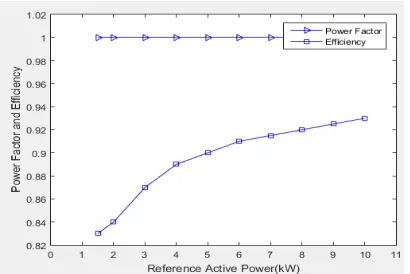
Unity power factor is maintained by fixed phase delay with respect to grid voltage. Fig.5. indicates the power factor in the system.
Fig.5, 6 shows the enhancement of power quality issue especially the total harmonic distortion and power factor.
Fig.6. performance of scalabe inverter in power quality enhancement.
Fig.7. shows the performance of the system with respect to end game algorithm based scalable inverter, before compensation and after compensation.
Fig.7. Response of the scalable inverter to the harmonic distortion.
Fig.8. shows the end game algorithm based compensation of the scalable inverter and their alpha values .
Fig.8. Optimal compensation of scalable inverter.
The compensation is based on CPQI technique which is simple and easy to carry out the power quality issues in the system.
IV. CONCLUSION
The scalable inverter is used to compensate the power quality issues efficiently compared to the conventional inverters. Generally, inverters are used to interface the renewable energy resources into utility. The excess capacity of the inverter is used here to compensate some power quality issues as an ancillary service
In conventional power quality conditioners, the harmonic and reactive current is compensated by providing equal weight. Where as in scalable inverter, the harmonic and reactive current is distinguished using different contributing weights, based on comprehensive power quality index.
These type of inverters save the capital investment and system space. It also improves the stability of utility by injecting the proper active and reactive power.
REFERENCES
[1] N.W.A. Lidula and A.D.Rajapakse,”Microgrids research: A review of experimental microgrids and test systems,” Renew.Sust.Energy Rev., vol15, no. 1, pp. 186-202, Jan. 2011.
[2] ZhengZeng,HuanYang,”Objective –oriented power quality compensation of multi-functional grid tied inverters and its application in microgrid,”IEEE transaction, 2013.
[3] Z.Zeng, R.Zhao, H.Yang, and C.Cheng, “Topologies and control strategies of multi-functional grid-connected inverters for power quality enhancement: A comprehensive review, “ Renew. Sust Energy Rev., vol.24,p p. 223-270, Aug. 2013.
[4] SurbhiSingh,TilakThakur,”Comprehensive analysis of power quality indices,” Volume2, Issue5, Pages 743-752,2014.
[5] Z.Zeng, R.X.Zhao and H.Yang,”Coordinated control of multi-functional grid tied inverters using conductance and susceptancelimitation,”IET Power Electron., vol. PP,p. 1-1, 2014.
[6] Bhushan, Navneet; KanwalRai, Strategic decision making: Applying the analytic hierarchy process, London: Springer-Verlag, 2004. [7] Muhammad H. Rashid, Power Electronics: Circuits, Devices, and Applications. Pearson Education, 2004.