Non-Orthogonal Multiple Access Techniques
for 5G Technology
Sai Tejaswi Badida1, Ch.Santhi Rani2, Syam Sunitha Goriparthi3, Naga Lakshmi Susmitha Batchu4, Uma Sri Sai Keerthi Gudiwada5, Sudha Rani Burre6
U.G. Student, Department of Electronics and Communication Engineering, DMS SVH College of Engineering,
Machiliptnam, India1,3,4,5,6
Professor and Head, Department of Electronics and Communication Engineering, DMS SVH College of Engineering,
Machiliptnam, India2
ABSTRACT: Present day world is an era of communication where the data traffic and the number of users connecting
to a single network are rapidly increasing. This work deals with Non-Orthogonal Multiple Access (NOMA), a 5G multiple access technique. The main focus is on how the Bit Error Rate is varying with different Doppler Shifts and Transmit Antenna Diversity ignoring the Successive Interference Cancellation (SIC) at the receiving end. The key idea of NOMA is to use power domain for multiple access along with code domain multiplexing. NOMA can handle data traffic 100 times more efficiently than the present 4G Long Term Evolution (LTE). In the current work comparison of two users at their maximum Doppler Shift for several SNR values varying from 0 dB to 12 dB and their BERs are presented in downlink. At SNR of 12dB, for user1 the low Bit Error Rate (BER) of 0.2704 is obtained for Pedestrians and BER of 0.2763 for Urban user. For user 2 with two transmitting antennas and SNR of 12 dB the BER for Pedestrians is 0.4323 and for Urban user is 0.4315. Without considering the SIC at the receiver end, the performance for User 1 is more commendable than User 2 as it has less BER. However the BER for user 1 may vary for different classes due to various fading effects.
KEYWORDS: Non-Orthogonal Multiple Access (NOMA), Bit Error Rate (BER), Successive Interference
Cancellation (SIC), Doppler Shift, Transmit Diversity.
I. INTRODUCTION
From the previous generation of communications it is observed that multiple access techniques form the base. In the same way Non-Orthogonal Multiple Access technique is the backbone for 5G technology. 5G is the 5th generation wireless broadband technology based on the IEEE 802.11ac standard. 802.11ac is also known as Gigabit Wi-Fi operating in 5GHz band. There is high requirement of communication techniques which can use spectrum efficiently, handle data traffic and connectivity of more number of devices as the data traffic is going to increase 1000 times by 2020[1].
This article consists of VI sections, where introduction is given in the I section and Literature Survey is given in the II section. The key features of NOMA and the block diagram are discussed in the III section. A note on Antenna Diversity and simulation results are given in IV and V sections respectively. Finally the conclusion and future scope are presented in VI section.
II. RELATEDWORK
In [1] the main emphasis is the comparison of different major NOMA schemes in aspect of basic principles, key features, receiver complexity, engineering feasibility which helped in the basic study of the work. In [2] the authors concluded that Successive Interference Cancellation (SIC) is not that promising tool to improve the throughput of the wireless network, expect in some unreliable conditions such as the SNR of the strongest signal must be very low. This provoked to study the results when the Successive Interference Cancellation (SIC) is not considered at the receiver end. In [3] the basic concept of how power is allocated for different users using the suboptimal and optimal methods such as iterative water filling power allocation algorithm is discussed. So this work deals with comparing BER of 2 users ignoring SIC at receiver by varying Doppler Shift and number of transmitting antennas with different SNR values varying from 0dB to 12dB.
III.PROPOSED SYSTEM
overcoming the effect of Fading, Outages and circuit failures. The amount of received signal in transmit diversity depends on the fading characteristics of the signal. In Transmit Diversity multiple antennas transmit delayed version of the signal where frequency selective fading is used for equalization at the receiver to provide density gain.
V. EXPERIMENTAL RESULTS
We compared two users based on their BER at their maximum Doppler Shift by varying SNR values from 0dB to 12dB and verified the effect of Doppler effect and Transmit Diversity.
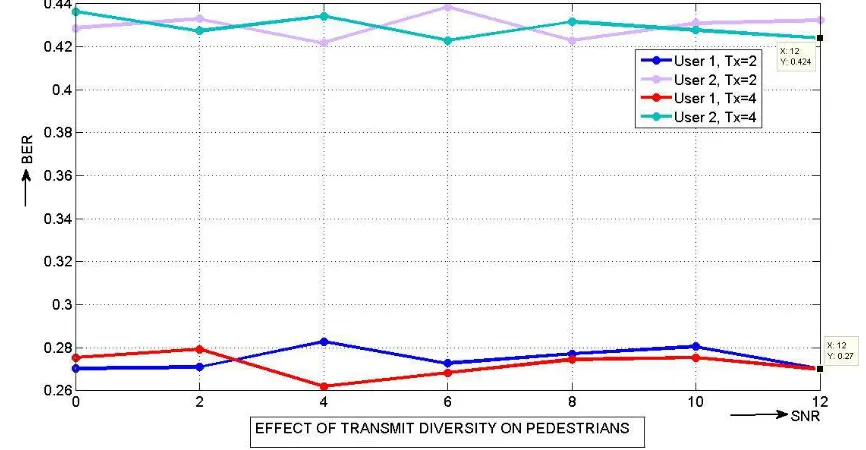
Fig 2: Comparison of BER for 2 pedestrian users with 2 and 4 transmitting antennas.
Fig.2 shows the BER of two pedestrian users when 2 and 4 transmitting antennas are considered. At SNR of 12dB user 1 has lowest BER of 0.2700 when 4 transmitting antennas are taken. And user 2 has the lowest BER of 0.4240 when 4
Fig 3: Comparison of BER for 2 vehicular users with 2 and 4 transmitting antennas.
From the simulation results in fig.3 it is observed that at SNR of 12dB the BER of user 1 is 0.2754 and 0.2748 with 2 and 4 transmitting antennas respectively. And for user 2 at SNR of 12dB the BER is 0.4242 and 0.4385 for 2 and 4 transmitting antennas respectively.
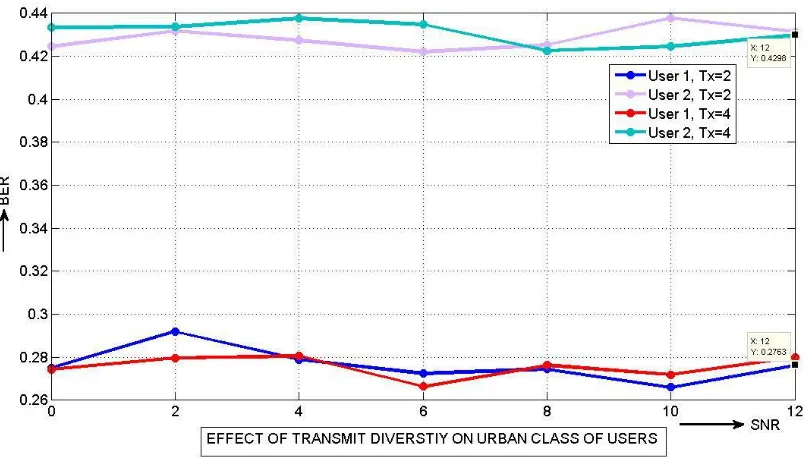
Fig.4 states that the BER at SNR of 12dB for user 1 with 2 and 4 transmitting antennas is 0.2763 and 0.2800 respectively. And for user 2 at SNR=12dB the BERs with 2 and 4 transmitting antennas are 0.4315 and 0.4298 respectively. For user2 the BER decreases as number of transmitting antennas increases.
Fig. 5: Comparison of BER for different Doppler Shifts with 2 Transmitting Antennas.
In fig.5 for user1 at SNR of 12dB the BER of 0.2704 occurs fd of 5Hz. For user 2 at SNR of 12dB the BER is 0.4323
at fd of 5Hz. Here for user1 the BER increases as fd increases.
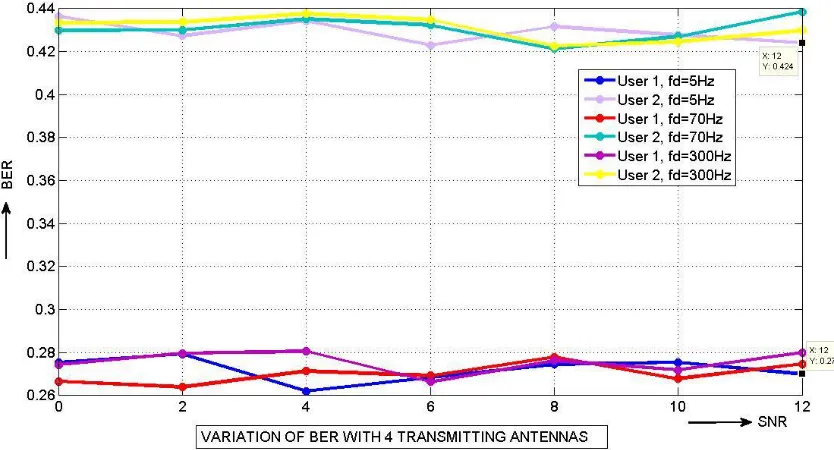
The BER for both user 1 and user 2 from the fig.6 is least when fd of 5Hz at SNR of 12dB. The values are 0.2700 and
0.4240 for user 1 and user 2 respectively. The observation is the BER is less when Doppler Shift is low.
VI.CONCLUSION AND FUTURE SCOPE
From the simulation results we can conclude that in most of the cases the BER decreases with increase in the number of transmitting antennas. And considering the Doppler effect the BER is least for fd of 5Hz. However the BER depends
also on the fading effects of different channels and the different channel gains. In future, studies can be made on the variation on BER in NOMA in accordance with different fading channels such as Rayleigh Fading channel, Rician Fading channel without SIC and observe the results.
REFERENCES
[1] Linglong Dai, Baichai Wang, Yifei Yuan, Shuangfeng Han, Chih-Lin I, and Zhaocheng Wang, “Non-Orthogonal Multiple Access for 5G: Solutions, Challenges, Opportunities, and Future Research Trends,” IEEE Communications Magazine, September 2015.
[2] Souvik Sen, Naveen Santhapuri, Romit Roy Choudhury, Srihari Nelakuditi, “Successive Interference Cancellation: A Back-of-the-Envelope Perspective,” Hotnets’10, October 2010.
[3] Xin Su and HaiFeng Yu, “Non-Orthogonal Multiple Access with Practical Interference Cancellation for MIMO Systems,” IT CoNvergence PRActice (INPRA), volume:3, number:4, pp. 34-40, December 2015.
[4] Y. Saito et al, “Non-Orthogonal Multiple Access (NOMA) for Future Radio Access,” Proc. IEEE VTC, Spring’13, pp.1-5, June 2013. [5] Daniel Halperin, Thomas Anderson, David Wetherall, “ Taking the Sting out of Carrier Sense: Interference Cancellation for Wireless LANs,”
MobiCom’08, September 2008.
[6] Pulin Patel and Jack Holtzman, “Analysis of a Simple Successive Interference Cancellation Scheme in a DS/CDMA system,” in Fourth WINLAB Workshop, October 1993.
[7] S.M. Riazul Islam, Nurilla Avazov, Octavia A. Dobre, and Kyung-Sup Kwak, “Power-Domain Non-Orthogonal Multiple Access(NOMA) in 5G systems:Potentials and Challenges.”
[8] Md Shipon Ali, Hina Tabassum, and Ekram Hossain, “Dynamic User Clustering and Power Allocation for Uplink and Downlink Non-Orthogonal Multiple Access(NOMA) Systems,” supported by a Discovery Grant from the Natural Sciences and Engineering Research Council of Canada (NSERC).
[9] Jose Armando Oviedo and Hamid R Sadjadpour, “A New NOMA Approach for Fair Power Allocation,” arXiv, May 2016.