DOI: 10.1534/genetics.107.078980
Sex-Specific Splicing of the Honeybee
doublesex
Gene Reveals 300 Million
Years of Evolution at the Bottom of the Insect Sex-Determination Pathway
Soochin Cho,* Zachary Y. Huang
†and Jianzhi Zhang*
,1*Department of Ecology and Evolutionary Biology, University of Michigan, Ann Arbor, Michigan 48109 and †Department of Entomology, Michigan State University, East Lansing, Michigan 48824
Manuscript received July 17, 2007 Accepted for publication September 5, 2007
ABSTRACT
Sex-determination mechanisms vary greatly among taxa. It has been proposed that genetic sex-deter-mination pathways evolve in reverse order from the final step in the pathway to the first step. Consistent with this hypothesis, doublesex (dsx), the most downstream gene in the Drosophila sex-determination cascade that determines most sexual phenotypes also determines sex in other dipterans and the silk moth, while the upstream genes vary among these species. However, it is unknown whendsxwas recruited to the sex-determination pathway during insect evolution. Furthermore, sex-specific splicing ofdsx, by whichdsx determines sex, is different in pattern and mechanism between the moth and the fly, raising an interesting question of how these insects have kept the executor of sex determination while allowing flexibility in the means of execution. To address these questions, here we study thedsxgene of the honeybeeApis mellifera, a member of the most basal lineage of holometabolous insects. We report that honeybee dsx is sex-specifically spliced and that it produces both the fly-type and moth-type splicing forms, indicating that the use of different splicing forms of Dsx in controlling sexual differentiation was present in the common ancestor of holometabolous insects. Our data suggest that in ancestral holometabolous insects the female Dsx form is the default and the male form is generated by suppressing the splicing of the female form. Thus, it is likely that thedsxsplicing activator system in flies, where the male form is the default, arose during early dipteran evolution.
T
HE genetic basis underlying sex-determination evo-lution is a fascinating topic because sex-determina-tion mechanisms vary greatly across different species (Bull1983; Marinand Baker1998). It was postulated a decade
ago that genetic sex-determination pathways evolve in reverse order from the final step in the hierarchy up to the first (Wilkins 1995). This hypothesis has reaped
sup-porting evidence from studies of multiple model organ-isms, including invertebrate and vertebrate animals. One of the most fruitful areas is the sex-determination path-way of the fruit flyDrosophila melanogasterand its related dipteran species (Graham et al. 2003; Pomiankowski
et al.2004). In Drosophila, the ratio between the number of X chromosomes and autosomal sets (X:A) serves as the initial determinant of sex. In females, the X:A ratio of 1 activates theSex lethal(Sxl) gene that encodes a splicing regulator. Sxl protein then activates the female-specific splicing of its downstream genetransformer(tra), giving rise to functional Tra protein. Tra, together with Tra2, activates the female-specific splicing of its downstream gene doublesex (dsx), generating the female-type Dsx protein (DsxF), which regulates its downstream genes for
the female development to proceed. In males, the X:A ratio of 0.5 preventsSxlfrom being produced, leading to the male-specific splicing oftra, rendering its encoded product nonfunctional due to a premature stop codon. In the absence of Tra activity, DsxMis produced by the
default male-type splicing of dsx, which regulates its downstream genes for male development (Cline and
Meyer1996).
Interestingly, in non-Drosophila insects, Sxl is ex-pressed in both sexes equally, suggesting that the sex-determining role ofSxlis limited to Drosophila (Meise
et al.1998; Sacconeet al.1998; Sievertet al.2000; Lagos
et al.2005; Niimiet al.2006). In line with this observation,
it was found thatSxlwas duplicated in the brachyceran dipteran (fly) lineage after its separation from nemato-ceran dipterans (mosquitoes, gnats, and midgets), which may have contributed to the adoption of Sxlto the sex-determination pathway in Drosophila (Traut
et al. 2006). In the olive fruit fly (Bactrocera oleae) and Mediterranean fruit fly (Ceratitis capitata), two non-Drosophila flies, trawas found to activate the female-specific splicing of dsxas in Drosophila, but the TRA activity in the female is maintained by an autoregulatory loop, unlike in Drosophila where it is regulated bySxl (Paneet al.2002, 2005; Lagoset al.2007).
Dsx, the most downstream component of the Dro-sophila sex-determination pathway that controls most
Sequence data from this article have been deposited with the EMBL/ GenBank Data Libraries under accession nos. EU137057–EU137060.
1Corresponding author:Department of Ecology and Evolutionary Biology,
University of Michigan, 1075 Natural Science Bldg., 830 North University Ave., Ann Arbor, MI 48109. E-mail: [email protected]
sex-specific phenotypes, is a transcriptional factor with a zinc-finger DNA-binding domain known as the DM domain. Several DM-domain-containing proteins are known to participate in sex determination in a diverse array of animals. These genes includemab-3, the male somatic sex-determining gene in nematodes (Raymond
et al. 1998); DMY, the master regulator of male de-velopment in medaka fish (Matsudaet al.2002; Nanda
et al.2002; Zhang2004); and Dmrt1, the gene required
for mammalian testis differentiation (Raymond et al.
2000). However, unlikedsx, these genes do not use sex-specific splicing to determine sex, and their sequence similarity with dsx is limited to the DM domain, in-dicating that they may not be orthologous to dsx. Orthologs of D. melanogaster dsx have been identified and studied in a number of dipterans (Shearmanand
Frommer1998; Kuhnet al.2000; Hedigeret al.2004;
Lagoset al.2005; Ruizet al.2005; Scaliet al.2005). In all
these species, the gene structure and the sex-specific splicing pattern ofdsxare generally conserved. Further-more, as inD. melanogaster(Inoueet al.1992), it appears
that the Tra/Tra2 complex binds to thecis-regulatory element (dsxRE) within the female-specific exon, acti-vating the weak 39splicing site preceding the exon to give rise to the female-typedsxmRNA. Outside the order Diptera, relatively detailed studies of dsx have been conducted in the silk mothBombyx mori (Ohbayashi
et al.2001; Suzukiet al. 2001, 2003, 2005; Funaguma
et al.2005). Interestingly, the female splicing pattern of dsxin Bombyx is different from that in Drosophila at the 39-end of the mRNA. In Bombyx, the 39 splicing site preceding the upstream female-specific exon does not appear to be weak and dsxRE has not been found within the female-specific exons. In addition,in vitrosplicing experiments showed that, unlike in Drosophila, the female-type splicing in Bombyx is the default, suggesting that a different molecular mechanism involving splicing repressors, rather than activators, is used to generate sex-specific variants of silk mothdsx mRNA (Suzuki et al.
2001), although this interpretation needs further scru-tiny because the in vitro splicing experiment for the mothdsxwas conducted in HeLa cell extract, which may be different from the insect cellular environment. The disparity between the fly and moth systems raises an intriguing evolutionary question of which system is ancestral and which is derived. It is also unknown whether the use ofdsxin sex determination is conserved outside the dipterans and lepidopterans.
The honeybeeApis melliferais an ideal organism for addressing the above questions because of its phylo-genetic position within holometabolous insects, which are insects that undergo a complete cycle of metamor-phism. Recent studies aided by the completion of the honeybee genome sequencing revealed that the order Hymenoptera, which includes the honeybee, is the most basal lineage in the phylogeny of holometabolous insects (superorder Endopterygota), being an outgroup
to Diptera, Lepidoptera, and Coleoptera (Honeybee
Genome Sequencing Consortium 2006; Savard et al.
2006). Understanding the sex-determination mecha-nism in honeybees will thus shed light on the evolution ofdsxin holometabolous insects and help to further verify Wilkins’s hypothesis on the evolution of sex-determina-tion pathways. Honeybees, as well as.100,000 species in the insect order of Hymenoptera, are haplodiploids (Cook1993). Fertilized eggs of honeybees become diploid
females (workers and queens) and unfertilized eggs parthenogenically develop as haploid males (drones). More specifically, honeybee sex is controlled by the allelic composition of a locus known as csd (c omple-mentarysexdetermination). Diploid individuals carry-ing two differentcsdalleles (heterozygotes) develop as females, while haploid individuals become males. Dip-loid embryos homozygous forcsdbecome sterile males. As expected,csdis subject to balancing selection and is highly polymorphic (Hasselmannand Beye2004; Cho
et al.2006). Thecsdgene encodes a member of the SR protein family, whose members are involved in splicing regulation of various mRNAs; however, the genes that are regulated by Csd are unknown (Beyeet al.2003). On
the basis of protein sequence comparison, Csd appears to be homologous toD. melanogasterTra protein (Beye
et al.2003), which plays a role in sex determination by regulating sex-specific splicing of its downstream gene dsx. Therefore, one of the potential targets of Csd isdsx. Very recently, Cristino et al. 2006 identified a dsx
homolog in the honeybee genome sequence using computer-based prediction and demonstrated that a pair of primers designed from their gene prediction could amplify a part ofdsxcDNA only from males, but not from females, suggesting that the honeybeedsx is sex-specifically spliced. However, they did not obtain full-lengthdsxmRNA sequences from the two sexes and thus the crucial information on the sex-specific splicing pattern and mechanism is missing. In this study, we identify four different splicing variants ofdsxmRNA in honeybees: two female specific, one male specific, and one ubiquitous. We also determine the full-length mRNA sequences and the complete gene structure. Our com-parative analysis suggests that (1) sexual differentiation regulated by sex-specific splicing ofdsxwas present in the common ancestor of holometabolous insects and that (2) the defaultdsxsplicing form switched from female in ancestral holometabolous insects to male in dipter-ans, with the alternative splicing mechanism changing from repressing the default to activating the alternative form.
MATERIALS AND METHODS
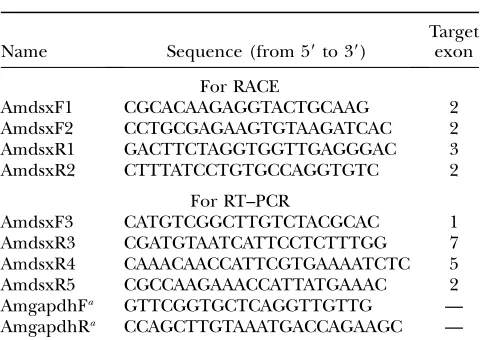
colonies located at East Lansing, Michigan. The samples were immediately frozen in a dry-ice chamber and stored in a 70° freezer until used. Total RNA was purified from each bee sample using TRIZOL reagent (Invitrogen, Carlsbad, CA). To determine the entire sequences of the Am-dsx transcripts contained in the total RNA samples, 59and 39rapid amplifi-cation of cDNA ends (RACE) was performed using the FirstChoice RLM-RACE kit (Ambion, Austin, TX). Gene-specific primers for RACE reactions were designed referring to a partial cDNA sequence available from GenBank (acces-sion no. AY375535) (Table 1). All RACE products were cloned into pCR2.1 vector (Invitrogen) before being sequenced by the conventional dideoxy method at the University of Mich-igan DNA Sequencing Core.
Reverse transcription polymerase chain reaction and gel electrophoresis:Total RNA samples were reverse transcribed using the RETROscript kit (Ambion), and PCR was performed for each cDNA sample using PlatinumTaqDNA polymerase (Invitrogen) with the gene-specific primers listed in Table 1. The PCR cycles used were 95° for 2 min, then 35 cycles of 30 sec at 95°, 30 sec at 58°, and 2 min at 72°, followed by final synthesis at 72° for 7 min. PCR amplicons were anal-yzed by 1% agarose gel electrophoresis and verified by DNA sequencing.
Sequence analysis:The exon–intron boundaries of honey-beedsxwere determined by comparing the cDNA sequences from this study and the genomic DNA sequence (accession no. NW_001253366) generated by the honeybee genome project (http://www.ncbi.nlm.nih.gov/genome/guide/bee/). The mRNA sequences of thedsxgenes inD. melanogaster( Dm-dsx), the mosquitoAnopheles gambiae(Ag-dsx), and the silk moth B. mori (Bm-dsx) were obtained from GenBank and their accession numbers are listed in Table 2. We used the UCSC Genome Bioinformatics site (http://genome.ucsc.edu/) to obtain the genomic sequences corresponding to these mRNA sequences to determine their gene structures. ForA. gambiae dsx, two independent groups submitted their sequences to GenBank: AY903307 (Ag-dsxM) and AY903308 (Ag-dsxF) and
DQ137801 (Ag-dsxM) and DQ137802 (Ag-dsxF). We used the
former pair in this study because (1) we found that the latter pair had a large number of mismatches in the coding region compared with the completed genome sequence and (2) the
59and 39untranslated regions (UTRs) in the latter pair were not alignable with the genome sequence. Protein and nucle-otide sequences were aligned by Clustal X (Thompsonet al.
1997) with manual adjustments.
RESULTS
Molecular cloning of full-lengthAm-dsxcDNAs from
males and females:To determine the full-length coding
and 59- and 39-UTR sequences of the honeybeedsxgene, we performed RACE using total RNA samples purified from four different developmental stages of female workers and male drones: eggs, young larvae, old larvae, and pupae. Gene-specific primers for both 59 and 39
RACE experiments were designed to target the exon that harbors the conserved DNA-binding domain and the predicted start codon. From our 59RACE in both sexes, we identified another exon of1.2 kb upstream from this predicted exon. Because no open reading frame of significant length was identified within the new exon, we regarded it as noncoding. From our 39RACE, we detected four variant transcripts: two female specific, one male specific, and one from both sexes (Figure 1A). The longer female-specific variant (dsxF1, 3359
nucleo-tides) contains seven exons, and the shorter (dsxF2, 2337
nucleotides) contains five. The difference betweendsxF1
anddsxF2rests entirely in the 39-UTR, owing to
alterna-tive transcription termination sites. As a result,dsxF1and
dsxF2encode the same protein (DsxF) of 277 amino acids.
The sole male-specific transcript (dsxM, 2504
nucleoti-des) has six exons, skipping the fifth exon of dsxFby
alternative splicing. Consequently,dsxMencodes a
pro-tein product (DsxM) of 336 amino acids that is identical
to DsxFat its N-terminal 250 amino acids but different at
the C-terminal part (Figure 1A; supplemental Figure 1 at http://www.genetics.org/supplemental/). Finally, a fourth variant (dsxB, 1992 nucleotides) detected from
both sexes shares its first exon with the other variants, TABLE 1
Primers used in this study
Name Sequence (from 59to 39)
Target exon
For RACE
AmdsxF1 CGCACAAGAGGTACTGCAAG 2 AmdsxF2 CCTGCGAGAAGTGTAAGATCAC 2 AmdsxR1 GACTTCTAGGTGGTTGAGGGAC 3 AmdsxR2 CTTTATCCTGTGCCAGGTGTC 2
For RT–PCR
AmdsxF3 CATGTCGGCTTGTCTACGCAC 1 AmdsxR3 CGATGTAATCATTCCTCTTTGG 7 AmdsxR4 CAAACAACCATTCGTGAAAATCTC 5 AmdsxR5 CGCCAAGAAACCATTATGAAAC 2 AmgapdhFa GTTCGGTGCTCAGGTTGTTG —
AmgapdhRa CCAGCTTGTAAATGACCAGAAGC —
aThese primers amplify the glyceraldehyde 3 phosphate
de-hydrogenase 1 gene used as the positive control.
TABLE 2
Holometabolous insectdsxgene sequences used in this study
Species Order Sex
GenBank accession no.
D. melanogaster (fruit fly)
Diptera Female NM_169203 Male NM_169202 A. gambiae
(mosquito)
Diptera Female AY903308 Male AY903307 B. mori
(silk moth)
Lepidoptera Female AB048543 Male AB048544 A. mellifera
(honeybee)
Hymenoptera Female EU137059, EU137060 (this study) Male EU137057
but its second exon is extended by 217 nucleotides to the 39-end compared with the other variants, overlooking the 59splicing site at the end of the second exon (Figure 1A). This shortest variant encodes a protein of 130 amino acids (DsxB), whose last six amino acids are different
from DsxFand DsxM(Figure 1A; supplemental Figure 1
at http://www.genetics.org/supplemental/).
Sex-specific expression patterns of Am-dsx mRNA
variants:We performed reverse transcription
polymer-ase chain reaction (RT–PCR) to determine the expres-sion patterns of these four variants using one specific forward primer (F) and three reverse primers (R1, R2, and R3) (Figure 1B). Primers F and R1 amplifieddsxF1
anddsxMfrom female and male samples, respectively, in a
sex-specific manner (Figure 1C). WhiledsxMis expressed
throughout the male developmental stages tested here, dsxF1is not expressed in female eggs. Primers F and R2
amplified dsxF1 and dsxF2 from female samples at all
stages, but these primers also detected relatively weak expressions of these female variants in males, particu-larly during the egg stage, suggesting that the female variants are present in male tissues at a low level (Figure 1D). By contrast, the male-specific variantdsxMwas not
detected in female samples even at a low level (Figure 1C). We confirmed that primers F and R3 specifically ampli-fieddsxBin both sexes (Figure 1E). As a positive control,
we used the glyceraldehyde 3-phosphate dehydrogenase 1 gene (GenBank accession no. XM_623046), which showed a constitutive expression throughout all devel-opmental stages in both sexes (Figure 1F).
Figure1.—Gene structure and expression
pat-tern of the four splicing variants of honeybeedsx. (A) Structures of the four splicing variants. Boxes represent exons and lines are introns. Only exons are drawn to scale. Shaded boxes are untrans-lated regions and open boxes are coding regions. Within coding regions, diagonally hatched boxes mark oligomerization domain 1/DNA-binding domain and cross-checked boxes mark oligomer-ization domain 2. ‘‘A(n)’’ represents the polyade-nylated tail. (B) The locations of the primers used for RT–PCR experiments are shown as ar-rows. Open boxes are exons and lines are introns. They are drawn in alignment with the gene struc-tures in A. The only forward primer (F) was de-signed to anneal to the first exon, which is shared by all four variants. R1 anneals to dsxF1
and dsxM, R2 to dsxF1and dsxF2, and R3 to only
dsxB. (C–F) RT–PCR amplicons from total RNA
samples of four different developmental stages of both sexes are analyzed by 1% agarose gel elec-trophoresis. E, embryos; SL, small larvae; LL, large larvae; P, pupae. See materials and methods
The C-terminal part of the second oligomerization
domain is not conserved inAm-Dsx:InD. melanogaster,
the Dsx protein has two domains (OD1 and OD2) known to be important for oligomerization (An et al.
1996). OD1 also encompasses the zinc-finger DNA-binding domain (DBD), which is necessary for DNA-binding to its target sequences for transcriptional regulation (Erdman and Burtis 1993). The N-terminal part of
OD2 is shared by Dm-DsxM and Dm-DsxF, but the
C-terminal 15 amino acids are encoded by a female-specific exon and are absent in Dm-DsxM (An et al.
1996). Previous studies demonstrated that OD1/DBD and OD2 domains are evolutionarily well conserved among all Dsx homologs found in dipterans and the silk moth (Shearmanand Frommer1998; Kuhnet al.2000;
Suzukiet al.2001; Hedigeret al.2004; Lagoset al.2005;
Ruizet al.2005; Scaliet al.2005). InAm-Dsx, OD1/DBD
is conserved with all of the six amino acid residues im-portant for its zinc-finger function unchanged (Erdman
and Burtis1993) (Figure 2A). The N-terminal part of
OD2 shared by Am-DsxF andAm-DsxMis also relatively
well conserved in evolution (Figure 2A). However, the C-terminal part of OD2 specific to DsxFis not conserved
in Am-DsxF, with only 1 of the 15 amino acids in the
region identical toDm-DsxF(Figure 2B). It is known that
the level of sequence identity in the male-specific part of DsxMdeclines rapidly whenDm-DsxMis compared with
other species beyond the genus level (Shearman and
Frommer1998; Kuhnet al.2000; Hediger et al.2004;
Lagoset al.2005). As expected, this region ofAm-DsxM
does not show any significant sequence similarity to the DsxMproteins in other insects (Figure 2C).
Variation ofdsxsplicing patterns in holometabolous
insects:We compared the sex-specific splicing patterns
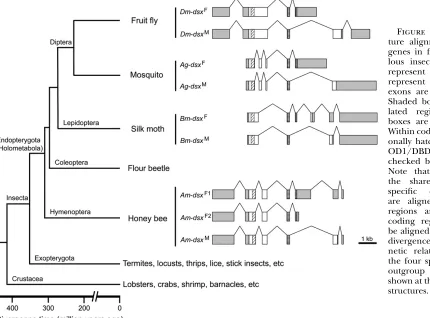
ofdsx amongD. melanogaster, the mosquitoA. gambiae, the mothB. mori, andA. melliferain the context of the insect phylogeny (Figure 3). InD. melanogaster, the male-specificdsxmRNA connects exons 1, 2, 3, 5, and 6, while the female-specific exon 4 is adjoined after exons 1, 2, and 3 in females (Burtisand Baker1989). Thus, the
male and female variants do not share the final exon. The same splicing pattern is observed in A. gambiae (Figure 3). However,B. mori dsxhas a different splicing pattern: two female-specific exons are skipped in the male variant (Bm-dsxM) such that the final two exons are
shared by both sexes (Suzukiet al.2001). InA. mellifera,
the single female-specific exon inAm-dsxF1is skipped in
the male variant (Am-dsxM), resulting in the final two
exons being shared between Am-dsxF1 and Am-dsxM, a
situation similar to that observed inB. mori. However, Am-dsxF2andAm-dsxMdiffer by alternatively splicing to
sex-specific exons at the 39-end and they thus do not share the 39 exon, reminiscent of the two dipteran species,D. melanogasterandA. gambiae(Figure 3). On the basis of the parsimony principle, one may infer from the above observations that (1) the common ancestor of holometabolous insects had both the dipteran-type and
lepidopteran-type sex-specificdsxsplicing patterns, (2) hymenopterans retain both ancestral patterns, and (3) dipterans and lepidopterans each lost one of the an-cestral patterns. However, it should be noted that no significant sequence conservation is detected around the 39-end of the female-specific exon among these in-sect species. This is not unexpected because in all these species the 39-end of the female-specific exon is located in untranslated regions, which are usually evolutionarily unconserved.
DISCUSSION
In this study, we identified four alternatively spliced full-length cDNA sequences of the honeybeedsxgene. The presence of fourdsxsplicing variants is unexpected because only two or three have been identified in other species. Among the four honeybeedsxsplicing variants, one (dsxB) is expressed in both sexes, one (dsxM) is
ex-pressed in males, and two (dsxF1anddsxF2) are expressed
in females. Because the two female splicing variants are identical to each other in protein sequence, each sex produces one sex-specific Dsx protein as in other species. The function of DsxB is enigmatic, because it
has only one, instead of two, oligomerization domains, in addition to the DNA-binding domain (supplemental Figure 1 at http://www.genetics.org/supplemental/). Furthermore, DsxB is unlikely to be involved in sex
determination because of its expression in both sexes. What is the molecular mechanism of the sex-specific splicing of honeybeedsx? InD. melanogaster, the default splicing is the male form, connecting exons 1, 2, 3, 5, and 6. The 39splice site preceding the female-specific exon (exon 4) contains a sequence of purine nucleotides, which make it a weak splicing acceptor that is overlooked by the spliceosomal machinery in males. In females, the Tra/Tra2 complex binds to several 13-nucleotide splic-ing enhancer elements (dsxREs) and the purine-rich elements (PREs) present within the female-specific exon to activate the 39splice site and produce female-specific mRNA connecting exons 1, 2, 3, and 4 (Inoueet al.1992;
Lynchand Maniatis1995). InA. gambiae, the same
sex-specific splicing pattern is observed (Figure 3), and dsxRE and PRE are also detected in the female-specific exon, suggesting that a similar molecular mechanism is used to generate sex-specific variants in this species (supplemental Figure 2 at http://www.genetics.org/ supplemental/). However, Suzukiet al.(2001) showed
experiments with HeLa cell extract showed that the female type is generated as the default inB. mori(Suzuki
et al.2001). Furthermore, no dsxRE or PRE are found in the female-specific exons, and the 39splice site of the intron preceding the female-specific exons does not appear to be weak (Suzukiet al.2001). Together, Suzuki
et al.’s findings suggest that splicing repressors, rather than activators, are turned on in males to suppress the female-specific splicing to generate the male-specific splicing variant. Unlike other insects, honeybees have two female-specific splicing variants that differ in the choice of transcription termination sites (Figure 1A and
Figure2.—Amino acid sequence alignment of Dsx proteins ofD. melanogaster(Dm),A. gambiae(Ag),B. mori(Bm), andA. mellifera(Am).
Figure 3). Interestingly, one of the seven exons ofAm -dsxF1is skipped in the male-specific variant (Am-dsxM),
which is reminiscent ofBm-dsx. Nonetheless, the other female-specific variant (Am-dsxF2) is different fromAm-dsxM
at the 39-end, similar to the situation in D. melanogaster andA. gambiae. Is the molecular mechanism underlying the honeybee sex-specific splicing ofdsxmore similar to that ofD. melanogasteror to that ofB. mori? We believe that it is more likely to be similar to that ofB. mori, although the other possibility cannot be excluded completely, as discussed below.
The allelic composition of thecsdgene is the master controller of sex differentiation in honeybees;csd het-erozygotes develop into females, while homozygotes and hemizygotes develop into males. If honeybees have a fly-typedsxsplicing mechanism, the male-specific splic-ing should be the default and the functional Csd in females directly or indirectly activates the 39splice site of the female-specific exon to generateAm-dsxF1orAm-dsxF2
(Figure 4A). Alternatively, honeybees could have a moth--type splicing mechanism. That is, the female-specific splicing is the default and Csd suppresses splicing re-pressors in females. In males, the lack of functional Csd leads to the activation of the splicing repressors, which causes the skip of the female-specific exons in splicing and the production ofAm-dsxM(Figure 4B). We favor the
second scenario for three reasons. First, as is the case of
Bm-dsx, no dsxRE or PRE is found in the female-specific exon ofAm-dsxF1orAm-dsxF2. Second, the 39splice site
preceding the female-specific exon (59-. . . ctttattctctag-39) has only a few purine nucleotides and thus does not appear to be weakened. Third, our RT–PCR experi-ments detected a low level of female-typedsxexpression in male samples but no male type in any female samples, suggesting that the female-type splicing is more likely to be the default (Figure 1, C and D). However, it is still possible that honeybees employ a splicing activator sys-tem that is very different from that of D. melanogaster. Experimental investigation, such as in vitrosplicing, is required to resolve the two scenarios. If the second scenario involving the repressor system is true, it would be most parsimonious to hypothesize that the common ancestor of all holometabolous insects used a repressor system and the switch to an activator system occurred during dipteran evolution in the common ancestor of fruit flies and mosquitoes. Studies ondsxin other holo-metabolous insects, such as Tribolium castaneum (order Coleoptera), could further test this idea.
Despite the differences in certain details of the pat-tern and mechanism, the general similarity in sex-specific splicing ofdsxbetween the honeybee and those insects (Drosophila and Bombyx) where the role ofdsx in sex determination has been well established strongly supports the hypothesis thatdsxis involved in honeybee
Figure 3.—Gene
sex determination. The final proof of this hypothesis requires showing relevant phenotypes in honeybees where dsx is nonfunctional, which may be possible by RNA interference experiments. If the above hypothesis is correct, as is very likely, our results suggest that the use of alternative splicing of dsx in regulating insect sex differentiation was already present in the common an-cestor of holometabolous insects, which existed300 million years ago (Savardet al.2006). In contrast todsx,
which is at the bottom of the sex-determination path-way, a diverse array of upstream genes and signals in the sex-determination cascade is used in D. melanogaster (X:A ratio),B. mori(a dominant feminizing factor on W), andA. mellifera(complementary allelic composition of a gene). These findings are in strong support of the postulation that genetic sex-determination pathways evolve in reverse order from the final step in the hierarchy up to the first (Wilkins1995). In the future,
it would be interesting to study how sex-specific splicing of honeybeedsxis regulated by upstream genes, such as csd; how differentiation of honeybee sexual traits, in both morphology and behavior, are controlled by the sex-specific Dsx proteins; and whetherdsxis also part of the sex-determination pathway in nonholometabolous insects.
We thank Wendy Grus, Wenfeng Qian, and Xiaoxia Wang for valuable comments. This work was supported by a grant from the Office of Vice President for Research at the University of Michigan and by grants from the National Institutes of Health to J.Z.
LITERATURE CITED
An, W., S. Cho, H. Ishiiand P. C. Wensink, 1996 Sex-specific and
non-sex-specific oligomerization domains in both of the double-sex transcription factors from Drosophila melanogaster. Mol. Cell. Biol.16:3106–3111.
Beye, M., M. Hasselmann, M. Fondrk, R. Pageand S. Omholt,
2003 The genecsdis the primary signal for sexual development in the honeybee and encodes an SR-type protein. Cell114:419– 429.
Bull, J. J., 1983 Evolution of Sex Determining Mechanisms.
Benjamin-Cummings, Menlo Park, CA.
Burtis, K. C., and B. S. Baker, 1989 Drosophila doublesex gene
controls somatic sexual differentiation by producing alternatively spliced mRNAs encoding related sex-specific polypeptides. Cell
56:997–1010.
Cho, S., Z. Y. Huang, D. R. Green, D. R. Smith and J. Zhang,
2006 Evolution of the complementary sex-determination gene of honeybees: balancing selection and trans-species polymor-phisms. Genome Res.16:1366–1375.
Cline, T. W., and B. J. Meyer, 1996 Vive la difference: males vs
fe-males in flies vs worms. Annu. Rev. Genet.30:637–702. Cook, J., 1993 Sex determination in the Hymenoptera: a review of
models and evidence. Heredity71:421–435.
Cristino, A. S., A. M. Nascimento, F. CostaLdaand Z. L. Simoes,
2006 A comparative analysis of highly conserved sex-determin-ing genes between Apis mellifera and Drosophila melanogaster. Genet. Mol. Res.5:154–168.
Erdman, S. E., and K. C. Burtis, 1993 The Drosophila doublesex
proteins share a novel zinc finger related DNA binding domain. EMBO J.12:527–535.
Funaguma, S., M. G. Suzuki, T. Tamuraand T. Shimada, 2005 The
Bmdsx transgene including trimmed introns is sex-specifically spliced in tissues of the silkworm, Bombyx mori. J. Insect Sci.
5:17.
Graham, P., J. K. Pennand P. Schedl, 2003 Masters change, slaves
remain. BioEssays25:1–4.
Hasselmann, M., and M. Beye, 2004 Signatures of selection among
sex-determining alleles of the honeybee. Proc. Natl. Acad. Sci. USA101:4888–4893.
Hediger, M., G. Burghardt, C. Siegenthaler, N. Buser, D.
Hilfiker-Kleineret al., 2004 Sex determination in Drosophila
melanogaster and Musca domestica converges at the level of the terminal regulator doublesex. Dev. Genes Evol.214:29–42. HoneybeeGenomeSequencingConsortium, 2006 Insights into
social insects from the genome of the honeybee Apis mellifera. Nature443:931–949.
Inoue, K., K. Hoshijima, I. Higuchi, H. Sakamotoand Y. Shimura,
1992 Binding of the Drosophila transformer and transformer-2 proteins to the regulatory elements of doublesex primary tran-script for sex-specific RNA processing. Proc. Natl. Acad. Sci. USA89:8092–8096.
Kuhn, S., V. Sievertand W. Traut, 2000 The sex-determining gene
doublesex in the fly Megaselia scalaris: conserved structure and sex-specific splicing. Genome43:1011–1020.
Lagos, D., M. F. Ruiz, L. Sanchez and K. Komitopoulou,
2005 Isolation and characterization of the Bactrocera oleae genes orthologous to the sex determining Sex-lethal and double-sex genes of Drosophila melanogaster. Gene348:111–121. Lagos, D., M. Koukidou, C. Savakis and K. Komitopoulou,
2007 The transformer gene in Bactrocera oleae: the genetic switch that determines its sex fate. Insect Mol. Biol.16:221–230. Lynch, K. W., and T. Maniatis, 1995 Synergistic interactions
be-tween two distinct elements of a regulated splicing enhancer. Genes Dev.9:284–293.
Marin, I., and B. S. Baker, 1998 The evolutionary dynamics of sex
determination. Science281:1990–1994.
Matsuda, M., Y. Nagahama, A. Shinomiya, T. Sato, C. Matsuda et al., 2002 DMY is a Y-specific DM-domain gene required for male development in the medaka fish. Nature417:559–563. Meise, M., D. Hilfiker-Kleiner, A. Dubendorfer, C. Brunner, R.
Nothigeret al., 1998 Sex-lethal, the master sex-determining
gene in Drosophila, is not sex-specifically regulated in Musca do-mestica. Development125:1487–1494.
Nanda, I., M. Kondo, U. Hornung, S. Asakawa, C. Winkleret al.,
2002 A duplicated copy of DMRT1 in the sex-determining
Figure4.—Two models of the genetic regulation of
honey-beedsxsplicing. Arrows represent activation and lines with a bar indicate suppression. Active genes and interactions are in black whereas inactive ones are in gray. (A) The activator model, where the male form ofdsx splicing is the default. In females, functional Csd either directly or indirectly acti-vates the female-specific splicing to give rise toAm-dsxF1or
Am-dsxF2. (B) The repressor model. In females, functional
region of the Y chromosome of the medaka, Oryzias latipes. Proc. Natl. Acad. Sci. USA99:11778–11783.
Niimi, T., K. Sahara, H. Oshima, Y. Yasukochi, K. Ikeo et al.,
2006 Molecular cloning and chromosomal localization of the Bombyx Sex-lethal gene. Genome49:263–268.
Ohbayashi, F., M. G. Suzuki, K. Mita, K. Okano and T. Shimada,
2001 A homologue of the Drosophila doublesex gene is tran-scribed into sex-specific mRNA isoforms in the silkworm, Bombyx mori. Comp. Biochem. Physiol. B Biochem. Mol. Biol.128:145–158. Pomiankowski, A., R. Nothigerand A. Wilkins, 2004 The
evolu-tion of the Drosophila sex-determinaevolu-tion pathway. Genetics166:
1761–1773.
Pane, A., M. Salvemini, P. DelliBovi, C. Politoand G. Saccone,
2002 The transformer gene in Ceratitis capitata provides a ge-netic basis for selecting and remembering the sexual fate. Devel-opment129:3715–3725.
Pane, A., A. DeSimone, G. Sacconeand C. Polito, 2005 Evolutionary
conservation of Ceratitis capitata transformer gene function. Genetics171:615–624.
Raymond, C. S., C. E. Shamu, M. M. Shen, K. J. Seifert, B. Hirsch et al., 1998 Evidence for evolutionary conservation of sex-deter-mining genes. Nature391:691–695.
Raymond, C. S., M. W. Murphy, M. G. O’Sullivan, V. J. Bardwell
and D. Zarkower, 2000 Dmrt1, a gene related to worm and fly
sexual regulators, is required for mammalian testis differentia-tion. Genes Dev.14:2587–2595.
Ruiz, M. F., R. N. Stefani, R. O. Mascarenhas, A. L. Perondini, D.
Selivonet al., 2005 The gene doublesex of the fruit fly Anastre-pha obliqua(Diptera, Tephritidae). Genetics171:849–854. Saccone, G., I. Peluso, D. Artiaco, E. Giordano, D. Bopp et al.,
1998 The Ceratitis capitata homologue of the Drosophila sex-determining gene sex-lethal is structurally conserved, but not sex-specifically regulated. Development125:1495–1500. Savard, J., D. Tautz, S. Richards, G. M. Weinstock, R. A. Gibbs
et al., 2006 Phylogenomic analysis reveals bees and wasps
(Hymenoptera) at the base of the radiation of Holometabolous insects. Genome Res.16:1334–1338.
Scali, C., F. Catteruccia, Q. Liand A. Crisanti, 2005 Identification
of sex-specific transcripts of the Anopheles gambiae doublesex gene. J. Exp. Biol.208:3701–3709.
Shearman, D. C., and M. Frommer, 1998 The Bactrocera tryoni
ho-mologue of the Drosophila melanogaster sex-determination gene doublesex. Insect Mol. Biol.7:355–366.
Sievert, V., S. Kuhn, A. Paululatand W. Traut, 2000 Sequence
conservation and expression of the sex-lethal homologue in the fly Megaselia scalaris. Genome43:382–390.
Suzuki, M. G., F. Ohbayashi, K. Mitaand T. Shimada, 2001 The
mechanism of sex-specific splicing at the doublesex gene is dif-ferent between Drosophila melanogaster and Bombyx mori. In-sect Biochem. Mol. Biol.31:1201–1211.
Suzuki, M. G., S. Funaguma, T. Kanda, T. Tamuraand T. Shimada,
2003 Analysis of the biological functions of a doublesex homo-logue in Bombyx mori. Dev. Genes Evol.213:345–354. Suzuki, M. G., S. Funaguma, T. Kanda, T. Tamuraand T. Shimada,
2005 Role of the male BmDSX protein in the sexual differen-tiation of Bombyx mori. Evol. Dev.7:58–68.
Thompson, J. D., T. J. Gibson, F. Plewniak, F. Jeanmouginand D. G.
Higgins, 1997 The CLUSTAL_X windows interface: flexible
strategies for multiple sequence alignment aided by quality anal-ysis tools. Nucleic Acids Res.25:4876–4882.
Traut, W., T. Niimi, K. Ikeoand K. Sahara, 2006 Phylogeny of
the sex-determining gene Sex-lethal in insects. Genome 49:
254–262.
Wilkins, A. S., 1995 Moving up the hierarchy: a hypothesis on the
evolution of a genetic sex determination pathway. BioEssays17:
71–77.
Zhang, J., 2004 Evolution of DMY, a newly emergent male
sex-deter-mination gene of medaka fish. Genetics166:1887–1895.