The Contribution of TRIZ Integration with
Others Design Tools In the Engineering
Design Process
Solomani Coulibaly
Assistant Professor, Department of Industrial Engineering, National School of Engineering.– Abderhamane Baba Touré (ENI-ABT), Bamako, Mali
ABSTRACT: Since its introduction in the beginning of1990s in the western countries,TRIZ is considered as a very effective tool in the early design process.Consequently, it is no stop growing; developing new approaches (e.g. Ideation-TRIZ, OSTM-TRIZ, TRIZ+, etc.) testifies that. In parallel to the new approaches, researchers find that TRIZ is very complementary to others design tools and methods. That is why many authors proposed an integrated form of TRIZ with others design tools and methods in the engineering design process.The present article carried out a survey in order to disclose an updated situation of TRIZ integration with others design tools and methods. For that, more than hundred relevant articles published in the last seven years (2010-2016) in TRIZ journal, ETRIA TRIZ Future Conference, inderscience and springerhave been collected.The goal is to disclose how TRIZ contributes, by its integration, to the effectiveness of design tools and methods in the engineering design process. The findings of this study show that more 17 articles, that integrate TRIZ and others design tools and methods, were published per year.More than twenty tools or methods were integrated with TRIZ, but only five (QFD, AD, DFSS, AHP and TOC) are the most used. Only two (Matrix of Contradiction and The 40 Inventive Principles) of TRIZ tools are most preferred by authors. Then, manufacturing is the favorite field of application. And finally, steps three and four are the steps where TRIZ integration contributes the more.
KEYWORDS: TRIZ, TRIZ integration, design tools and methods, engineering design process
I. INTRODUCTION
The present paper explores the implementations and practices of TRIZ integration with others design tools, methods and philosophies in the organizations. A survey was carried out, from database of the last seven years in order to examine how TRIZ integration with others problem solving tools and methods can contribute to make effective the engineering design process. The findingsof this researchrevealed some amazing results,even if some where ourunderstanding of TRIZ integration with others problem solving toolsimplementation were strengthen.
II. RELATEDWORK
In the early years which followed its growing, there was a true passion for the researchers to make help TRIZ(or vice versa) by other design problem-solving tools throughout the design process of their product or service. The literature review done by Hua et al [8] about TRIZ and its integration with others design tools shows how much practitioners were excited by this tool. But in these last five yearsthe batch of tool which arouses the interest for TRIZintegration is decreasing. This new trend identified five design tools and methods that have been frequently integrated with TRIZ.These five tools are: Axiomatic Design (AD), Analytic Hierarchy Process (AHP), Design for Six Sigma (DSS), Quality Function Deployment (QFD) and Theory of Constraints (TOC).
A. TRIZ IN BRIEF
TRIZ is the Russian acronym of Theory of Inventive Problems Solving. It is a theory resulting from the researches completed by G. S.Altshuller, a patent expertise in Russian navy. It is an experimental science based on the analysis of over millions of invention patents classified in 5 categories(table 1), from the apparent solution to the discovery one, according to the levels of inventiveness[9] and [10].Table 1explains that, an invention can be as well a minor improvement of an existing product that required only little time to be found, as a discovery resulting from very long research. TRIZ is consideredto be a powerful tool for obtaining inventions located between levels 2 and 4 of this classification.
Table 1: Levels of inventiveness
Level Degree of
inventiveness
% of solutions Source of knowledge Approximate of solutions to consider
1 Apparent solution 32% Personal knowledge 10 2 Minor improvement 45% Knowledge within company 100 3 Major improvement 18% Knowledge within the industry 1,000 4 New concept 4% Knowledge outside the
industry
100,000 5 Discovery 1% All that is knowable 1,000,000 Three main findings emerged from his analysis:
Problems and solutions were repeated across industries and sciences
Patterns of technical evolution were repeated across industries and sciences
Innovations used scientific effects outside the field where they were developed From these findings a structured methodology have been developed aiming to help designers to:
develop new generation products,
resolve difficult problems, and
identify and treat failures of products.
The development of TRIZ leads to many tools and concepts that designers can use, according to their problems, throughout the design process. Among the tools there are: Contradictions matrix, Su-Field analysis and Standard solutions, Scientific and Technical Effects, Trends of evolution of technological systems, Algorithm for Inventive Problem Solving (ARIZ), etc.
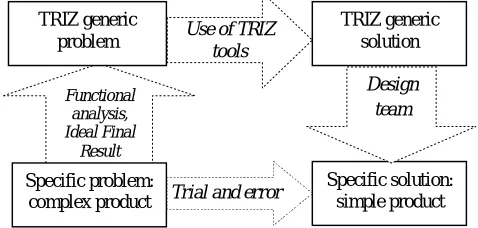
different innovations in the past. Figure 1 shows that most of the problem-solving methods are based on trial and error approach. Yet, TRIZ proposes that,to solve a given problem, designers have always to find a generic problem, then use a TRIZ appropriate tool to generate the generic solutions, and finally interpret these generic solutions to choose and develop the specific one [11].
B. AXIOMATIC DESIGN (AD)
Axiomatic Design (AD) is a design approach proposed by Professor Nam P. Suh in the end-1970s. He defines an axiom as obviousness or fundamental truth for which, there is neither any counterexample nor exception. Axiomatic Design is based on three main concepts: design as process of mapping; laws of design in the form of axioms and the matrix of design representing the functional dependences.According to Suh, design follows an iterative and sequential advance between "what one seeks to achieve" and "How to achieve it"[12]. Design process is divided into four fields: the customer field, the functional field, the physical field and the field of the process. The transition from a field to another one is called process of mapping.
Two design axioms have been identified.Independence axiommaintains the independence of the function requirements and information axiomminimizes the information content of the design. Some of the corollaries and theorems resulting from these axioms are very comparable of TRIZ principles.
C. ANALYTIC HIERARCHY PROCESS (AHP)
AHP was developed by Thomas Saaty[13] at the beginning of 1970’s. It is one of the most powerful analysis methods to solve complex problems. AHP method represents a problem of decision by a hierarchical structure reflecting the interactions between different elements of the problem, then compares byduos elements of the hierarchy, and finally determines the priorities of the actions.As to fill a gap, AHP appears on the list of tools accompanying TRIZ only these last years. Nevertheless, both tools are very suitable, insofar as TRIZ is known for its wealth for new ideas generation, while AHP is very strong in hierarchizing the collected ideas.
D. DESIGN FOR SIX SIGMA (DFSS)
Developed by Motorola in the mid-1980s,DFSS methodology offers techniques and tools to drastically improve business processes while reducing both the conceptual and operational types of vulnerabilities of designed entities[14].Process production-orientedat the beginning; the method seeks the absolute regularity. Indeed,variability causes customer’sdissatisfaction. Customersare expecting a certain quality, according to a specific standard,in each product. Not be able to guarantee the totality of the production by respecting this standard is particularly expensive for companies.To face this challenge DFSS proposes to release these entities at the Six Sigma quality levels in all their requirements, that is, to does not authorize more than 3.4 defects per million for designed entities.
E. QUALITY FUNCTION DEPLOYMENT (QFD)
Quality function deployment (QFD) was firstly introduced by Japanese Professors Shigeru Mizuno and YojiAkao in the end-1960s. In a total quality approach, they sought to make sure that the “Voice of Customer” was deployed
Use of TRIZ tools
Functional analysis, Ideal Final
Result TRIZ generic
problem
Specific solution: simple product Specific problem:
complex product
TRIZ generic solution
Design team
Trial and error
throughout the full process of designed entities.According to Akao[15], QFD is a method for developing a design quality aimed at satisfying the consumer and then translating the consumers’ demands into design targets and major quality assurance points to be used throughout the production stage. They also see QFD as converting consumers’ demands into “quality characteristics” and developing a design quality for the finished product, by systematically deploying the relationships between the demands and the characteristics, starting with the quality of each functional component and extending the deployment to the quality of each part and process.
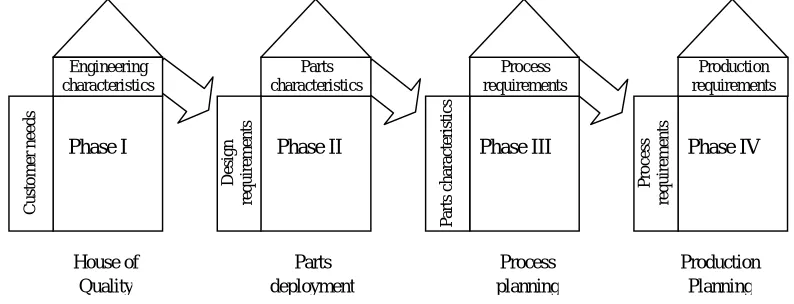
The most common approach, promoted in U.S.A., is the so-called American Supplier Institute Four Phase Model [16] (figure 2). This figure shows the steps of quality deployment along the engineering design process. It uses three series of coupled matrices and a chart for planning production requirements to translate customer needs through several stages into manufacturing equipment settings.
Figure 2: QFD Four Phase Model
F. THEORY OF CONSTRAINTS (TOC)
Theory of constraints (TOC) was developed by Goldratt[17]in 1984. Often described as a continuous improvement methodology, often as management philosophy, TOC seeks to help managers achieving a goal by identifying the constraints that prevent or limit the achievement of this goal. In an organization, managers can accomplish a fixed goal through analyzing of the underlying cause and effect dependency and variation of the system in question.
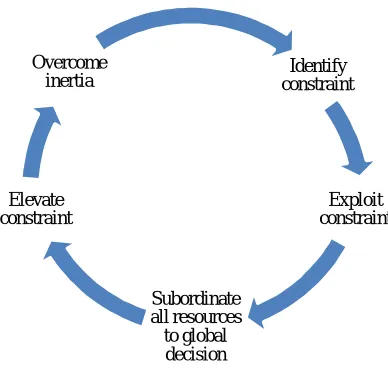
TOC is composed of two main components. The first one is a philosophy, which supports TOC working principles. It is composed of five steps for on-going improvement (figure 3), the drum-buffer-rope (DBR) scheduling methodology, and the buffer management information system. This philosophy suggests that the main constraint in most organizations may not be physical, but in fact managerial-policy related. To address the policy constraints and effectively implement the process of on-going improvement, Goldrattdeveloped a generic approach called the Thinking Process (TP). This is the second component of TOC. The TP prescribes a set of five tools in the form of cause-and-effect diagrams. It starts to identify core problems by using a tool called Current Reality Tree (CRT). Dettmer [18] defined a CRT as a logical structure that depicts the state of reality as it currently exists in a given system. Once a core problem has been identified, the next step is therefore to search for a plausible solution to the core problem. This requires other tools such as Contradiction Resolution Diagram (CRD) also known as Evaporating Cloud (EC) and Future Reality Tree (FRT).Experts believe that it is the TP which will ultimately have the most lasting impact on business.
Phase I Phase II Phase III Phase IV
Figure 3: TOC process of on-going improvement
III. MATERIAL AND METHODS
TRIZ, since its emergence,is always growing. Consequently, new approaches are developing (e.g. Ideation-TRIZ, OSTM-TRIZ, TRIZ+, etc.). In spite of this growth, the tendency is rather to integrate it into other design tools.In order to disclose an updated situation of TRIZ integration with others design tools and methods, the present study was carried out. It is a survey oriented and based on how TRIZ contributes, by its integration, to the evolution of design tools and methods. For that, more than hundred relevant articles published in the last seven years (2010-2016) in TRIZ journal, ETRIA TRIZ Future Conference, inderscience and springerhave been collected. The collected articles were compiled, analyzed to determine what is the contribution of TRIZ in the practice of designed entities, which fields are the most used, what are the most used tools, what are the tools that need more TRIZ.
IV. RESULTS
A. DISTRIBUTION OF PUBLISHED PAPERS IN THE TIME
To conduct this study we have collected 117 relevant articles that proposed an integration of TRIZ with other design tools or methods. La majority of the published articles put forward the synergies between TRIZ and just one tool, while some authors proposed it with two or more, such as [19].The figure 4 shows how many papers have been published per year, from 2010 to 2016.A first analysis of this figure shows that an average of 17 articles, which treat the possibility of integrating TRIZ with other tools, was published per year. Without taking accountTRIZ single papers, this number illustrates how much time this tool interests the researchers.
Identify constraint
Exploit constraint
Subordinate all resources to global decision Elevate
constraint Overcome
Figure 4: Distribution of published papers in the time
B. THE MAINS TOOLS INTEGRATED WITH TRIZ
Figure 5: TRIZ integration with others design tools
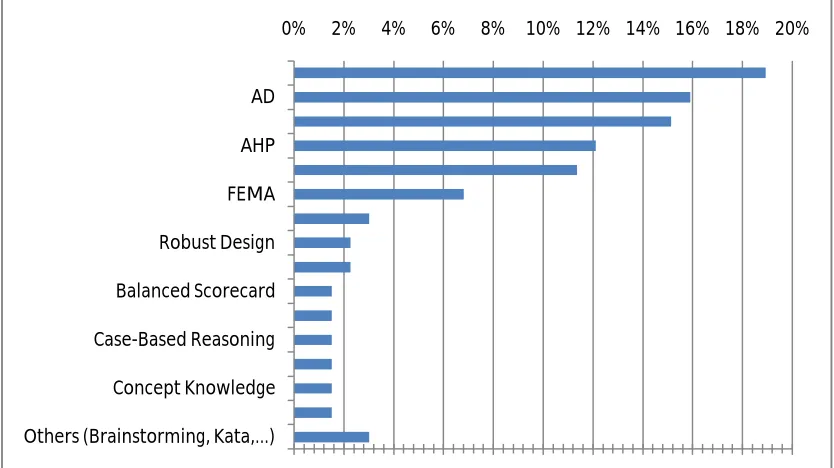
Since its introduction, TRIZ has much especially inspired the researchers for its capacity to help others tools to be more efficient. It is besides this passion which explains the high number of publication which proposes its integration with others design tools and methods. Figure 5 shows the percentages of the different tools or methods that have been integrated with TRIZ among the selected articles. It indicatesthe mains preferred tools that are suitable for TRIZ. One of the remarkable facts is the appearance of AHP (Analytic Hierarchy Process) in the top four while such was not the
0 2 4 6 8 10 12 14 16 18 20
0% 2% 4% 6% 8% 10% 12% 14% 16% 18% 20%
case in the similar studies like [20] or [21].More than twenty tools or methods that were integrated with TRIZ are indexed in the literature. The present study shows that only five of them are preferred by the researchers: they are QFD, AD, DFSS, AHP and FEMA that were introduced at the beginning of this article. The top five cumulates more than 73% of published articles. Among the top five, around 19% of the published articles put forward QFD with TRIZ, what is corresponding to the same tendency released by similar studies previously made, such as [20] or [21].
C. THE PREFERRED TOOLS OF TRIZ
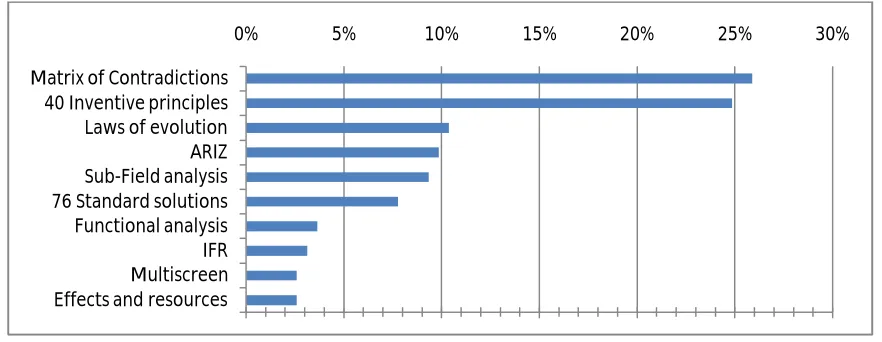
During its integration with others design tools or methods; authors have to make a choice between several tools of TRIZ. Each tool has a certain advantage and some favorite fields. The analysis of the different TRIZ tools used by the authors in the articlesallowed us to sketch the figure 6. It indicates the percentages of TRIZ tools used throughout the collected papers. The results show that two of the several tools are more preferred by authors: they are Matrix of Contradiction and The 40 Inventive Principles. More than 50% of the examined articles used these two tools. The opposite would have been astonishing knowing that TRIZ holds its notoriety by the effectiveness of these two tools to help engineers solving their design process problems.
Figure 6: TRIZ tools contribution with others tools
D. MAINS APPLICATIONS FIELDS
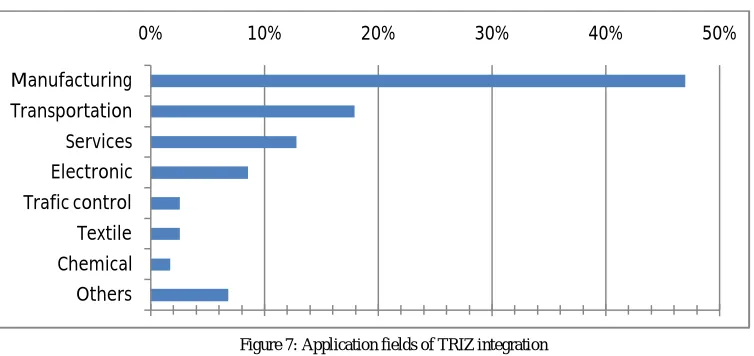
The selected articles cover technical fields as multiple as varied.A meticulous analysis allowed us to identify, classify and sketch the Figure 7.It indicates the percentages of the mains applications fields of TRIZ integration with others design tools and methods. Even if the selected one is partial, we think that the chosen sample is highly representative. By considering the different technical fields covered by the collected articles we note that 78% of studies are made in the field of manufacturing product, transportation and services. From the top three fields manufacturing covers 47%. This reinforces our understanding of TRIZ key practices and how it helps engineers in their design process.
0% 5% 10% 15% 20% 25% 30%
Figure 7: Application fields of TRIZ integration
E. THE CONTRIBUTION OF TRIZ INTEGRATION IN THE DESIGN PROCESS
The stages of engineering design process differ according to authors, but the following steps are common in most of the proposed processes.
Step 1: Identify the need or problem
Step 2 : Research the need or problem
Step 3: Develop possible solution
Step 4: Choose the best solution possible
Step 5: Construct a prototype
Step 6: Test and evaluate the solution(s)
Step 7: Communicate the solution(s
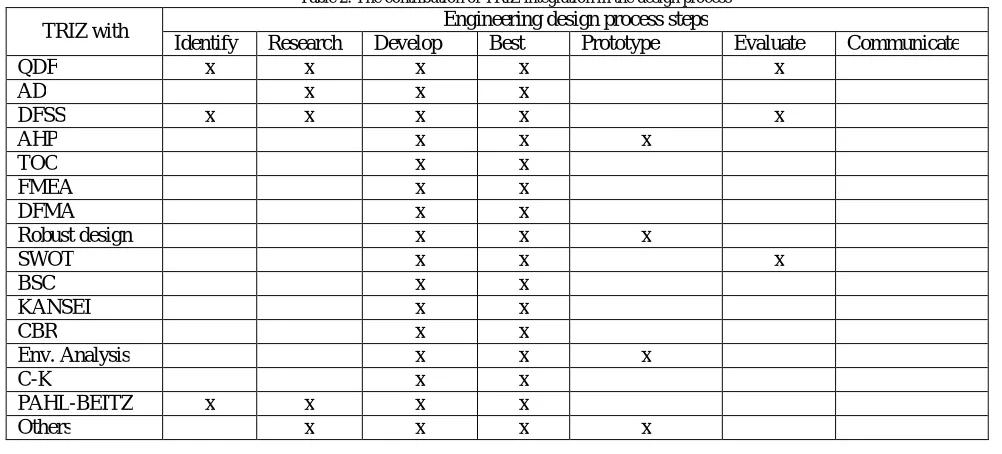
The table2summarizes all the reviewed articles in which TRIZ has been integrated with others tools or methods. By observing this table, we can see that QFD and DFSS are the two tools which better integrate TRIZ. Globally, itshows how much TRIZ integration contributes to make the others design tools efficient throughout the engineering design process, especially in the steps four and five.Here, we can see that QDF and DFSS are the two tools the more adapted Each tool taken individually has its strengths and weaknesses, but it remains obvious that TRIZ integration basically reinforces the assets of these design tools and methods in their favorite fields.
V. DISCUSSION
A. DISCUSSION
Even if we think that the sample used is validly representative, the present work remains that remains a survey. It is the photography of the state of the art represented at a given time. Consequently, the results are susceptible to be discussed if method is changed. Moreover, we found in the literature that some of the proposed approaches are so complicated, like the one of Yang and Chen [22] that they need a high background for new comer to be implemented. Is it necessary to have so trained humans’ resources to perform a well-structured engineering design process? We don’t think so.
0% 10% 20% 30% 40% 50%
Table 2: The contribution of TRIZ integration in the design process
TRIZ with Engineering design process steps
Identify Research Develop Best Prototype Evaluate Communicate
QDF x x x x x
AD x x x
DFSS x x x x x
AHP x x x
TOC x x
FMEA x x
DFMA x x
Robust design x x x
SWOT x x x
BSC x x
KANSEI x x
CBR x x
Env. Analysis x x x
C-K x x
PAHL-BEITZ x x x x
Others x x x x
B. LIMITATIONS
The mains limitations of this work are considered in two ways. Firstly, the examined papers have been limited from 2010 to 2016, so that we fail to take account those published before. Even if we think that the sample is validly representative, it would allow more robust results if the overall published integration was considered. Secondly, non-English papers have not been included. It is sure that the integrations of TRIZ with others design tools and methods have been published in others languages.
VI. CONCLUSIONS
The present study examined more than hundred papers which put forward TRIZ integration with others design tools and methods. We have classified them according to many criteria, in order to show how TRIZ integration can helps engineers in their design entities processes. We particularly focused on the way to detect: what are the most popular tools or methods that are suitable for TRIZ, what are the most preferred tools by authors, what are the favorite fields of TRIZ integration and what is the contribution of TRIZ integrated in the engineering design process. The findings of this study are in the same alignment to those previously made, but with different approaches. However, the AHP approach makes its appearance in the top five tools preferred by authors, which was not the case in preceding studies.
In order to improving the present study, future development regarding others aspect that have not been taking account in this workcan be explored, by considering database of others websites. We believe that this would give more robust results.
REFERENCES
[1] DeboisF., GroffA. and ChenevierE.,“La Boîte à outils de la créativité”, Dunod- 2èmeédition, 2016. [2] AltshullerG.S., “And Suddenly the Inventor Appeared”,Worcester, MA: Technical Innovation Center, 1996.
[3] BoldriniJ.-C., “L’accompagnement méthodologique des projets d’innovation en PMI. Le cas de TRIZ”, XIVème Conférence de l’Association Internationale de Management Stratégique, Pays de la Loire, Angers, 6-9 juin 2005.
[4] LiuH. T, ChengH. S, “An improved grey quality function deployment approach using the grey TRIZ technique”, Computers & Industrial Engineering, Vol. 92, pp. 57-71, 2016
[6] WangF. K., YehC.T. and ChuT. P., “Using the design for Six Sigma approach with TRIZ for new product development”, Computers & Industrial Engineering, Vol. 98, pp. 522-530, 2016.
[7] Huang, S., Liu, X. and Ai, H. “Research on application of process model for product concept creative design based on TRIZ and TOC”, International Journal on Interactive Design and Manufacturing, pp.1-10, 2016.
[8] HuaZ. S., YangJ., CoulibalyS. and ZhangB., “Integration TRIZ with problem-solving tools: a literature review from 1995 to 2006”, Int. J. Business Innovation and Research, Vol. 1, Nos. 1/2, 2006.
[9] Altshuller G.S., “Creativity as an exact science”, Gordon and Breach, New York, 1988.
[10] Altshuller G.S., “The innovation algorithm: TRIZ, systematic innovation, and technical creativity”, Worchester, Massachusetts, 1999. [11] Coulibaly, S., “Setting up a successful TRIZ project”, Engineering Management Journal, vol. 15, no. 2, p. 14, 2005.
[12] SuhN. P., “Axiomatic Design: Advances and Applications”, Oxford University Press, New York, 2001. [13] Saaty T.L. “The Analytic Hierarchy Process”, New York, McGraw-Hill, 1980.
[14] Yang K. and El-HaikB., “Design for Six Sigma, New York, McGraw-Hill, 2003.
[15] Akao Y., “Quality Function Deployment: Integrating Customer Requirements into Product Design”, Productivity Press, Cambridge, MA, 1990.
[16] Hauser J.R.; and Clausing D. (), “The house of quality”, Harvard Business Review, Vol. 66, Issue 3, pp. 63–73, 1988. [17] Goldratt E.M. and Cox, J., “The Goal: An Ongoing Improvement Process”, Gower, Aldershot, 1984.
[18] Dettmer H.W., “Goldratt’s Theory of Constraints: A System Approach to Continuous Improvement”. ASQC Quality Press, 1997.
[19] 18S. Vinodh, V. Kamala, K. Jayakrishna, “Integration of ECQFD, TRIZ, and AHP for innovative and sustainable product development”, Applied Mathematical Modelling, Vol. 38, Issues 11–12, pp 2758-2770, 2014.
[20] SpreafiC. and RussoD., “TRIZ industrial case studies: a critical survey”, Procedia CIRP 39,pp. 51 – 56.2016 [21] CavallucciD., “World Wide status of TRIZ perceptions and uses a survey of results,” 2009.