DOI: 10.1534/genetics.106.069393
Epigenetic Mechanisms for Breakdown of Self-Incompatibility
in Interspecific Hybrids
June B. Nasrallah,*
,1Pei Liu,* Susan Sherman-Broyles,* Renate Schmidt
†and Mikhail E. Nasrallah*
*Department of Plant Biology, Cornell University, Ithaca, New York 14853 and†Leibniz Institute of Plant Genetics and Crop Plant Research (IPK), D-06466 Gatersleben, Germany
Manuscript received December 9, 2006 Accepted for publication January 13, 2007
ABSTRACT
As a major agent of rapid speciation, interspecific hybridization has played an important role in plant evolution. When hybridization involves species that exhibit self-incompatibility (SI), this prezygotic barrier to self-fertilization must be overcome or lost to allow selfing. How SI, a normally dominant trait, is lost in nascent hybrids is not known, however. Here we demonstrate that hybrid self-fertility can result from epigenetic changes in expression of theS-locus genes that determine specificity in the SI response. We analyzed loss of SI in synthetic hybrids produced by crossing self-fertile and self-incompatible species in each of two crucifer genera. We show that SI is lost in the stigmas ofA. thaliana–lyratahybrids and their neo-allotetraploid derivatives and in the pollen of C. rubella–grandiflora hybrids and their homoploid progenies. Aberrant processing of S-locus receptor kinase gene transcripts as detected in Arabidopsis hybrids and suppression of theS-locus cysteine-rich protein gene as observed in Capsella hybrids are two reversible mechanisms by which SI might break down upon interspecific hybridization to generate self-fertile hybrids in nature.
T
HE origin of many plant species may be traced to sexual hybridization between more or less di-verged species (Stebbins1959; Rieseberg1997, 2001). Stable self-fertile diploid (homoploid) hybrids are sometimes produced by hybridization between closely related species that have similar genomes and chro-mosome complements (Gross and Rieseberg 2005). More frequently, however, several barriers to gene flow between species must be overcome before fertile inter-specific hybrids are generated. Most commonly dis-cussed are postzygotic barriers that lead to sterility in F1 hybrids (Bushell et al. 2003), often resulting from aberrant meiotic pairing between highly divergent pa-rental genomes. In these cases, chromosome doubling restores normal meiosis and generates fertile allopoly-ploids, a process that is thought to underlie at least 4% of speciation events in flowering plants (Rieseberg2001). Neither homoploid nor allopolyploid hybrids can form, however, unless prezygotic barriers to hybridization are overcome, including pollination barriers that prevent pollen tubes from forming at the stigma surface, growing within the pistil, and reaching the ovules. A major prez-ygotic pollination barrier is genetic self-incompatibility(SI), which, although primarily known as an intraspecific barrier to self-fertilization in many obligate outcrossing plants, is also important in the context of interspecific hybridization. Indeed, when interspecific hybridization involves self-incompatible species, the generation of self-fertile hybrids, whether homoploid or allopoly-ploid, is dependent on the breakdown of SI.
The crucifer (Brassicaceae) family, which includes pre-dominantly self-fertilizing species and self-incompatible species, provides several examples of self-fertile inter-specific hybrids that occurred spontaneously or were produced artificially in breeding programs. Self-fertile allopolyploids are particularly common. Examples of allotetraploids include Brassica napus, derived by hy-bridization betweenB. oleraceaandB. campestris(syn.B. rapa), andArabidopsis suecica, derived by hybridization between self-fertileA. thalianaand self-incompatibleA. arenosa(Mummenhoffand Hurka1995; O’Kaneet al. 1996). In addition, self-fertile homoploid F1 hybrids occur in this family. For example, crosses between self-incompatibleCapsella grandifloraand self-fertileC. rubella
produce self-fertile diploid F1hybrids that can be selfed to establish F2populations (Riley1934; Acarkanet al. 2000; Kochand Kiefer2005).
The crucifer family is particularly well suited for investigating the breakdown of SI in interspecific hybrid progenies of self-incompatible species, not only because of the prevalence of interspecific hybridization events in this family, but also because the crucifer SI system is
Sequence data from this article have been deposited with the EMBL/ GenBank Data Libraries under accession nos. EF530735 and EF530736.
1Corresponding author:Department of Plant Biology, 228 Plant Science
Bldg., Cornell University, Ithaca, NY 14853. E-mail: [email protected]
well characterized. SI specificity has been shown to be determined by the highly polymorphic protein prod-ucts of two genes that are tightly linked within the
S-locus complex (Nasrallah 2005; Takayama and Isogai 2005). Allele-specific interaction between two proteins, the stigma-expressedS-locus receptor kinase (SRK) and its pollen ligand, the S-locus cysteine-rich protein (SCR, also known as SP11; Takayamaand Isogai 2005), triggers a signaling cascade within the stigma epidermis that leads to pollen inhibition. Importantly, these two proteins have also been shown to be the primary determinants of the outcrossing mating system in the family as demonstrated by the successful transfer of the SI trait into self-fertileA. thalianaby transformation with an SRK–SCR gene pair from self-incompatible A. lyrata(Nasrallahet al.2002, 2004).
To understand the molecular basis of breakdown of SI in interspecific hybrids, we focused on interspecific hybrids of Arabidopsis and Capsella. Previous studies had shown that crosses betweenA. thalianaandA. lyrata, on the one hand, and betweenC. rubellaandC. grandiflora, on the other hand, produced interspecific hybrids in controlled pollinations (Acarkanet al.2000; Nasrallah
et al.2000). Here, we document the behavior of pollen tubes in the hybrids upon self-pollinations and reciprocal crosses to the parental species. We also report on the isolation ofS-locus genes fromC. grandifloraand the use of these genes and of previously isolatedA. lyrata SRKand
SCRgenes for a molecular analysis of interspecific hybrids. We demonstrate that bothA. thaliana–lyrataandC. rubella– grandiflorahybrids exhibit a loss of SI, on the stigma side in the first case and on the pollen side in the second case. The expression patterns ofS-locus genes in these hybrids suggest at least two different mechanisms by which SI might break down to generate fertile interspecific hybrids in nature.
MATERIALS AND METHODS
Plant materials and generation of interspecific hybrids:For interspecific hybridization of Arabidopsis species, we usedA. thalianaaccession Col-0 and self-incompatible A. lyrata SaSb plants (described by Kusaba et al. 2001), which were
de-scended from accessions collected in Michigan (kindly pro-vided by Charles Langley, University of California at Davis). The generation of A. thaliana–lyrata hybrids by pollinating A. thaliana stigmas with pollen from A. lyrata, followed by ovule rescue, was described previously (Nasrallah et al.
2000). TheC. rubella and C. grandiflorastrains used in this analysis were described previously (Acarkanet al.2000) and
C. rubella–grandiflorahybrids were generated by manual cross-pollinations, which produced seed that could be germinated directly in soil.
Pollination analyses and determination of SI phenotype: Stigmas were examined for absence of contaminating pollen under a stereoscope, and appropriate pollen was manually applied to their surface. Two hours after pollination, flowers were fixed for 30 min in a 3:1 mixture of ethanol and acetic acid, softened for 30 min in 1mNaOH at 65°, washed for
30 min in water, stained in decolorized aniline blue, and mounted on slides for examination by epifluorescence mi-croscopy (Khoand Baer1968). Under these conditions, an
incompatible response is typically manifested by,10 pollen tubes per stigma while compatible pollinations exhibit nu-merous pollen tubes per stigma.
Construction and screening of genomic libraries: For genomic library construction, C. grandiflora S7S8 DNA was partially digested with Sau3A1, and a fraction containing fragments of 9–20 kb was cloned into theBamHI site of the
lDASHII vector (Stratagene, LaJolla, CA). The library was screened with a 32P-labeled probe containing a mixture of
fragments derived from the first exons of theA. lyrata SRKa andSRKbgenes (Kusabaet al.2001).
DNA gel-blot analysis: DNA was isolated from leaves according to Murrayand Thompson(1980). Digested DNA
(3mg) was run on 0.8% (w/v) agarose gels, transferred to GeneScreen Plus membrane (DuPont-New England Nuclear, Boston) using an alkaline transfer method. The blots were prehybridized and hybridized at 65° in 10% (w/v) dextran sulfate, 330 mmsodium phosphate, pH 7.0, 10 mmEDTA, and
5% (w/v) SDS. Probes were labeled with32P using the Random
Priming kit (Roche, Indianapolis). After washing in a solution containing 0.23 SSC (13SSC is 0.15 mNaCl and 0.015 m
sodium citrate) and 0.1% (w/v) SDS at 65°, the blots were exposed to phosphor screens and developed using a Molec-ular Dynamics (Sunnyvale, CA) PhosphorImager.
RNA analysis: SRKtranscripts were detected in poly(A)1 RNA isolated from stigmas as previously described (Kusaba
et al.2001), whileSCRtranscripts were detected in total RNA isolated from anthers using the TRIZOL reagent (Invitrogen, San Diego). RNA gel blot analysis was performed as previously described (Kusabaet al.2001) by subjecting the RNA [1mg
of poly(A) RNA forSRKdetection and15mg of total RNA for SCR detection] to denaturing electrophoresis on 1% (w/v) agarose, transfer to GeneScreen Plus membrane (DuPont-New England Nuclear, MA), and hybridization with32P-labeled
SRKorSCRprobes as described above. Quantitation ofSRK and SCR signal intensity was performed with a Molecular Dynamics PhosphorImager using the ImageQuant software package and normalization of hybridization signals was performed using an actin probe.
For reverse transcription–polymerase chain reaction (RT– PCR) analysis ofSRKatranscripts, stigma RNA was treated with DNase I to eliminate contaminating genomic DNA, reverse transcribed, and amplified using the SuperScript one-step RT–PCR kit (Invitrogen) and SRKa-specific intron-flanking primers. The effectiveness of DNase digestion was verified by RT–PCR using actin intron-flanking primers, and only samples lacking contaminating DNA were used for RT–PCR ofSRKa.
Sequence analysis and database searches:DNA sequencing was performed at the Cornell University BioResource Center using an Applied Biosystems (Foster City, CA) automated sequencer. Sequences were manipulated and aligned using DNASTAR Lasergene software (DNASTAR, Madison, WI). BLAST searches were performed on the National Center for Biotechnology Information website (http://www.ncbi.nih.gov).
RESULTS
2001) designated S0, and an A. lyrata SaSb plant (Nasrallahet al.2000). On the basis of gel-blot analysis of genomic DNA, the two hybrids were determined to have inherited the A. lyrata Sa haplotype (data not shown) and were therefore designated SaS0. These hybrids failed to produce pollen and were male sterile, consistent with the divergent chromosome number and genome organization of the two parental species (Kuittinenet al.2004; Yogeeswaranet al.2005). While male sterility precluded analysis of pollen from these
SaS0hybrids, hybrid stigmas were functional, allowing assays of cross-incompatibility responses by manual pollination with A. lyrata SaSa and SbSb pollen. Both pollinations resulted in equally prolific pollen tube growth (Table 1), demonstrating that the stigmas of
A. thaliana–lyrata SaS0hybrids failed to recognize and rejectSapollen. Interestingly, backcrossing of these hy-brids toA. lyratarestored the stigma SI response within one generation (Table 1).
Loss of SI was also exhibited by a neo-allotetraploid that arose spontaneously on oneA. thaliana–lyrata SaS0
hybrid (Nasrallah et al. 2000). This allotetraploid, which was shown by cytological analysis to have 26 chromosomes (or double the chromosome number of theA. thaliana–lyrataF1hybrids) (Nasrallahet al.2000), produced functional pollen due to restoration of normal meiosis upon chromosome doubling. Selfing of this plant generated self-fertile allotetraploid prog-eny (Nasrallahet al.2000). Reciprocal pollinations to
A. lyrata SaSa plants demonstrated that the pollen of the allotetraploid and its progeny retained Sa speci-ficity while its stigmas allowed confluentSapollen tube growth (Table 1). This pollination phenotype was stable and persisted over four allotetraploid generations ana-lyzed. Thus, loss of SI in allotetraploids—and, by in-ference, in the original A. thaliana–lyrata hybrid—was stigma specific.
Molecular basis of SI breakdown in A. thaliana–lyrata hybrids:To investigate the molecular basis of breakdown
in hybrid stigmas, we compared expression of theSRKa
gene in each of the two A. thaliana–lyrata SaS0hybrids and inA. lyrataby gel-blot analysis of stigma poly(A)1 RNA using an SRKa-specific probe derived from the
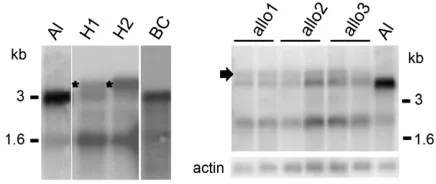
SRKa first exon. Self-incompatible A. lyrata Sastigmas exhibit anSRK transcript profile (Kusaba et al.2001) consisting of a fully spliced 3-kb SRKa transcript that encodes the full-length SRKa receptor and a 10-fold less abundant 1.6-kb alternative transcript derived from the first exon of the gene, which results from the use of an alternative poly(A) addition site within the first intron of SRK and encodes a soluble form of the SRK ecto-domain. The stigmas ofA. thaliana–lyrata SaS0hybrids and allotetraploids differed from those of A. lyrata Sa
stigmas in two respects (Figure 1). They exhibited an additional 4-kb transcript species (Figure 1), at least some of which correspond to unsplicedSRKatranscripts (expected size: 3.920 kb) on the basis of RT–PCR using TABLE 1
Pollination analysis of Arabidopsis species hybrids and parental species
#A. thaliana–lyrata
#A. lyrata SaSa #A. lyrata SbSb F1b AllotetraploidSaSaS0S0
$A. lyrata SaSa ,10a 111 MS ,10
$A. lyrata SbSb 111 ,10 MS 111
$A. thaliana–lyrata
F1b 111 111 MS ND
BCc ,10 111 MS ND
Allotetraploid SaSaS0S0 111 111 MS 111
a
The number of pollen tubes per pollinated stigma:,10, incompatible pollination;111, compatible pol-lination; MS, male sterile; ND, not determined because previous generations were no longer available.
b
F1, interspecific hybrids from theA. thaliana3A. lyratacross.
c
BC, plants from a backcross ofA. thaliana–lyratahybrids toA. lyrata.
Figure1.—Association of aberrantSRKtranscript
process-ing with self-fertility inA. thaliana–lyratahybrids and allotetra-ploid derivatives. Gel blots of stigma poly(A)1 RNA were hybridized with a probe derived from exon 1 ofA. lyrata SRKa as previously described (Kusabaet al.2001). Al,A. lyrata; H1
and H2, first-generation hybrids; BC, a first-generation plant from a backcross of H2 to A. lyrata; allo1, allo2, and allo3, three consecutive allotetraploid generations. The 3- and 1.6-kb transcripts typically produced by SRKgenes are indi-cated. Note the 4-kb aberrantSRKatranscripts produced by stigmas of F1hybrids (asterisks) and allotetraploid derivatives
intron-flanking primers (data not shown). They also exhibited dramatically reduced levels of the fully spliced 3-kb transcripts, which at best equaled those of the alternative 1.6-kb transcripts (Figure 1). Importantly, these 3-kbSRKatranscripts accumulated to levels that were,10% (6.4%60.5) of those detected inA. lyrata Sa
stigmas.
To examine further the association of aberrant SRK
transcript profiles with loss of SI, we analyzed SRKa
expression in the stigmas of self-incompatible plants produced by backcrossing each of theA. thaliana–lyrata SaS0hybrids to the A. lyrataparent. Interestingly, the correctSRK transcript profile (Figure 1) was restored along with SI (Table 1) in first-generation backcross plants. These observations suggest that aberrant splic-ing ofSRKatranscripts, and in particular the dramatic reduction in correctly spliced full-length transcripts, is the cause of the breakdown of SI inA. thaliana–lyrata SaS0hybrids.
C. rubella–grandiflora interspecific hybrids: A cross between a C. rubella plant and a C. grandiflora plant produced fertile F1hybrids that set seed spontaneously, as previously described (Riley 1934; Acarkan et al. 2000; Kochand Kiefer2005). The fertility ofC. rubella–
grandiflora hybrids is not surprising, given that these plants have the same basic chromosome number (n¼8) and are very similar at the molecular level (Hurkaand Neuffer1997). Despite these similarities, however, C.
rubella and C. grandiflora are recognized as separate species (Hurkaand Neuffer1997). In this context, it should be noted that the concept of a strict biological species, which is defined by the ability of its members to produce viable and fertile progeny upon cross-hybridization, has not been recognized by plant biolo-gists as a useful species concept (Grant 1981), and hybridization between plants belonging to well-recog-nized species is common (Arnold1997).
Genetic analysis of SI in C. grandiflora, C. rubella, and interspecific hybrid populations: Prior to analysis of C.
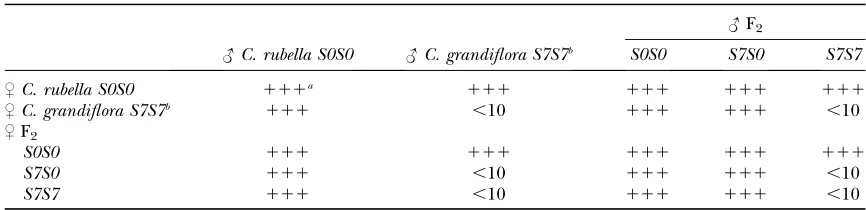
rubella–grandiflorainterspecific hybrids, it was necessary to perform a genetic analysis of the parental strains used in our interspecific cross. First, we generated aC. grandi-florapopulation of plants that segregated for SI specificity by forced self-pollination in young floral buds prior to the developmental onset of SI in stigmas. These plants were analyzed by microscopic examination of pollen tube growth in self-pollinations and reciprocal cross-pollina-tions among all siblings and with the parental plant. On the basis of these pollinations, we confirmed early reports (Bateman1955) that the SI system of Capsella, like that of other crucifers, is under single-locus sporophytic control, whereby the pollen SI phenotype is determined by the diploid genotype of its parent plant. We also determined that theC. grandifloraplant used in our interspecific cross carried two SI specificities, arbitrarily designatedS7andS8, withS7andS8exhibiting codominance in the stigma and
S7being dominant toS8in pollen (Table 2). Finally, we analyzed several progeny derived from the spontaneous selfing of theC. rubellaparent and confirmed that all of these plants were self-compatible, as expected (Table 2).
Genetic analysis was then carried out on theC. rubella3
C. grandifloracross. Starting with aC. rubella–grandiflora
F1hybrid, we produced an F2population of 74 plants that segregated for SI and self-compatibility (SC). Analysis of the F1 and F2 plants by self-pollinations, autonomous seed set, and reciprocal pollinations with
C. grandiflora S7S7 andS8S8tester plants showed that this population inherited the S7 allele and that SC segregated as a simple dominant trait (53 SC:21 SI, approximating a 3:1 ratio;x2¼0.45;P¼0.5) linked to
theSlocus (Table 2). Reciprocal pollinations of the self-incompatible F2 plants with tester C. grandiflora S7S7 and S8S8 homozygotes showed that pollinations with
S8S8 plants were compatible while those with S7S7
plants were incompatible, indicating that the plants ex-pressed S7 specificity in stigma and pollen (Table 2). The stigmas of 36 (or 2/3) of the self-compatible F2 plants inhibited pollen from the S7S7 tester, but the TABLE 2
Pollination analysis of Capsella species hybrids and parental species
#F2
#C. rubella S0S0 #C. grandiflora S7S7b S0S0 S7S0 S7S7
$C. rubella S0S0 111a 111 111 111 111
$C. grandiflora S7S7b 111 ,10 111 111 ,10
$F2
S0S0 111 111 111 111 111
S7S0 111 ,10 111 111 ,10
S7S7 111 ,10 111 111 ,10
a
The number of pollen tubes per pollinated stigma:,10, incompatible pollination;111, compatible pol-lination; MS, male sterile; ND, not determined because previous generations were no longer available.
b
C. grandiflora S7S7homozygotes were used because theC. rubella–grandifloraF2population segregated for
pollen of these plants germinated and produced pollen tubes onS7S7stigmas (Table 2). The remaining 17 (or 1/3) of the self-compatible F2plants were reciprocally cross-compatible with bothS8S8andS7S7plants (Table 2). The data, confirmed by seed counts and self-pollinations in 106 additional F2plants, are consistent with the following interpretation. The self-fertile C. rubella parent is homozygous for a nonfunctional S
haplotype, designated S0, and crossing it to the C. grandiflora S7S8plant produces an S7S0 F1 hybrid. In the F2 generation, S7S7 plants are self-incompatible,
S0S0plants are self-compatible, andS7S0plants express
S7specificity in the stigma (their stigmas inhibit pollen from S7S7 plants) but are self-compatible due to the breakdown of SI in pollen (their pollen germinates and produces tubes onS7S7stigmas).
Molecular cloning of S-locus genes from C. grandiflora:
The availability ofSRKandSCRgenes is essential for a molecular analysis of SI and its breakdown. To isolate
SRKand SCR genes from the C. grandiflora S7 haplo-type, aC. grandifloragenomic library constructed from anS7S8plant was screened with a probe derived from the first exons of the A. lyrata SRKa and SRKb genes (Kusabaet al. 2001). Sequence analysis of a subset of positive clones revealed them to contain an SRK-like gene in close proximity to anSCR-like gene. DNA gel-blot analysis with probes from these genes confirmed that they were derived from theS7haplotype. A probe corresponding to exon 1 of theC. grandiflora SRK-like gene hybridized most strongly with plants previously classified by pollination analysis as carrying the S7
haplotype, and it detected a restriction fragment length polymorphism that cosegregated with theS7haplotype inC. grandifloraF2plants segregating for theS8andS7
haplotypes (data not shown). In the C. rubella 3 C. grandiflora F2 population, the SRK and SCR probes hybridized only to plants carrying the S7 haplotype (Figure 2B) but not to plants predicted to be homozy-gous for theC. rubella-derivedS0haplotype. This lack of hybridization, even with the SRK probe, suggests that the nonfunctionalS0 haplotype carries either deleted or highly diverged SI genes.
Our molecular cloning of S-locus genes from C. grandiflora confirmed the expectation that SI in this genus has the same molecular basis as other crucifers. The C. grandiflora SRK7 and SCR7 genes (hereafter designatedCgSRK7 andCgSCR7), which represent the first SRK–SCR gene pair identified in the Capsella species, contain all sequence motifs characteristic of
SRK andSCRgenes (Figure 3). TheCgSRK7sequence represents a new allele distinct from the partial C. grandiflora SRK sequences that have been reported recently (Paetsch et al. 2006). BLAST searches show
CgSRK7andCgSCR7to be most similar to theSRKaand
SCRagenes ofA. lyrata(Kusabaet al.2001). The exons of CgSRK7, on average, share 84% nucleotide and 86% amino-acid sequence identity with the corre-sponding exons ofAlSRKa, whileCgSCR7exons 1 and 2 are85% and74% identical toAlSCRaexons 1 and 2 in nucleotide and amino-acid sequence, respectively. Interestingly, the C. grandiflora S7 haplotype is also similar to the A. lyrata Sa haplotype in the position and spacing of theSRKandSCRgenes relative to each other (Kusabaet al.2001). In bothShaplotypes, the two genes are arranged tail to tail and are separated by a relatively small intergenic region (1006 bp inC. grandi-flora S7 and 1500 bp inA. lyrata Sa). However, neither the region betweenCgSRK7andCgSCR7nor the introns Figure 2.—Molecular analysis of
self-incompatibility and self-fertility in Capsella spe-cies hybrids. (A and B) DNA gel blots ofC. rubella (Cr),C. grandiflora(Cg), and two populations of C. rubella–grandiflora F2 plants probed with the
CgSRK7 exon 1 probe (A) and CgSCR7 (B). Only F2plants indicated with asterisks were
self-incompatible and genotypicallyS7S7on the basis of pollination assays. All other F2plants were
self-compatible and could be grouped into two clas-ses on the basis of pollination analysis: self-fertile F2 plants that hybridized with the probes were
S7S0 while those that did not hybridize were S0S0, as withC. rubella.The small differences in electrophoretic mobility of the hybridizing frag-ments observed between some of the lanes are due to irregular migration of DNA fragments, which is often associated with the use of relatively impure DNA obtained by mini-preparation meth-ods. (C) Stigma-specific expression of the 3.0-and 1.6-kbCgSRK7transcripts detected by gel-blot analysis of poly(A)1RNA from leaf tissue (lf), floral buds with pistils removed (fb), and stigmas (st) ofC. grandiflora S7S7.The cross-hybridizing band (circle) common to the three samples represents tran-scripts from anSRK-related gene. (D) Gel-blot analysis ofCgSCR7in total RNA fromC. grandiflora(S7S7) andC. rubella(S0S0) whole floral buds (left, lanes 1 and 2) and anthers (left, lanes 3 and 4) and in the anthers of a representative sample ofC. rubella– grandifloraF2plants (right). Note the lack of hybridization signal inS0S0plants and the drastic reduction in the steady-state levels
of the two genes, which are similar in size and placement (Figure 3), share appreciable sequence identity accord-ing to pairwise BLAST alignments (data not shown).
Molecular basis of SI breakdown in C. rubella–grandiflora hybrids: The molecular cloning ofCgSRK7andCgSCR7
allowed us to compare their expression in self-incompatible and self-compatible plants. In self-incompatible plants, these genes exhibited hybridization patterns characteristic of other SRK and SCR genes. CgSRK7 transcripts were detected in the pistils, but not in the leaves or anthers, of plants carrying theS7haplotype (Figure 2C), irrespec-tive of whether the plants were self-incompatible (i.e.,
S7S7) or self-compatible (i.e.,S7S0).CgSCR7transcripts were detected in anthers or young floral buds of C. grandiflora S7S7 plants and self-incompatible S7S7 C. rubella–grandifloraF2plants (Figure 2D). In contrast, all 4S0S0 F2plants analyzed failed to hybridize with the
CgSCR7 probe and all 10 S7S0 F2 plants analyzed
produced only a weak hybridization signal that was 10-to 12-fold lower in self-compatibleS7S0plants relative to their self-incompatibleS7S7sibs (Figure 2D).
DISCUSSION
We investigated two cases of breakdown of SI upon interspecific hybridization in Arabidopsis and Capsella. In both cases, loss of SI was due to reversible changes in expression of theS-locus recognition genes,SRKorSCR. In A. thaliana–lyrata SaS0 hybrids and their allotetra-ploid derivatives, stigmas exhibited aberrant SRKa
transcript profiles. In particular, the levels of the fully spliced 3.0-kbSRKatranscripts were reduced to6% of the levels detected inA. lyrata Sastigmas, while the levels of the 1.6-kb transcripts were slightly enhanced. The role of the soluble forms of the extracellular domain of SRK (designated eSRK) that are encoded by the 1.6-kb Figure 3.—Alignment of the predicted SRK (A) and SCR (B) amino-acid sequences from theC. grandiflora S7haplotype
(CgSRK7 and CgSCR7; accession nos. 892031 and 894476) and theA. lyrata Sahaplotype (Kusabaet al.2001) [AlSRKa (accession
transcripts is not understood. However, there is no evidence that they have a negative effect on SRK function; rather, they might contribute to the stabilization of the full-length SRK receptor, as previously suggested for the Brassica S-locus glycoprotein SLG, which shares a high degree of sequence similarity with the extracellular domain of SRK (Dixitet al.2000). Thus, any increased accumulation of eSRKa that might result from the slight increase in 1.6-kb transcript levels observed inA. thaliana– lyrata SaS0hybrid stigmas is not expected to cause loss of SI through dominant-negative effects. In contrast, the 94% reduction in the levels of fully spliced 3.0-kbSRKa
transcripts, which is much greater than the 75% re-duction that was previously shown to cause loss of SI in Brassica (Conner et al. 1997), is expected to result in absence or suboptimal accumulation of SRKa protein and, consequently, in the breakdown of SI in the stigmas ofA. thaliana–lyratahybrids and their neo-allotetraploid derivatives. Strong support for this conclusion is provided by the observation that reestablishment of SI in the first-generation backcross ofA. thaliana–lyrata SaS0hybrids to
A. lyratawas accompanied by restoration of normalSRKa
transcript profiles.
Species-specific differences in pre-mRNA splicing have been reported (Laverdiereet al.2000; Panet al. 2005), but their consequences for gene expression in interspecific hybrids had not been previously explored. The production of some 3-kb SRKa transcripts in A. thaliana–lyratahybrids indicates that the correct SRKa
initiation, termination, and splice sites are utilized, al-beit inefficiently, by the transcription and processing machinery of hybrid stigmas. Similarly, the production of 1.6-kbSRKatranscripts indicates that this machinery recognizes and utilizes the alternative poly(A) addition site within the SRKa first intron that generates this transcript species. At present, the cause of aberrant
SRKatranscript processing is unclear. It cannot be due to global defects in transcript synthesis and processing in all tissues ofA. thaliana–lyratahybrids, because these hybrids do not exhibit major developmental or physio-logical abnormalities. Nor can it be ascribed to dilution of theA. lyrata-derived machinery byA. thalianafactors that cannot process A. lyrata SRK transcripts, because theSRKbtransgene is processed correctly inA. thaliana
stigmas (Nasrallahet al. 2002). Although analysis of additionalA. lyrata SRKalleles and their processing inA. thaliana–lyratahybrids is required, it is possible that this phenomenon reflects incompatibilities between the
A. thaliana and A. lyrata RNA processing machineries resulting from independent changes that accumulated in the two species since their divergence from a common ancestor5 million years ago (Kochet al.2000).
While breakdown of SI occurred in the stigmas ofA. thaliana–lyrata hybrids, it occurred in pollen of C. rubella–grandiflora hybrids in correlation with a 10- to 15-fold reduction inCgSCR7 gene expression in S7S0
anthers. This suppression ofCgSCR7is similar to, albeit
not as complete as, the silencing of SCR alleles from pollen-recessive S haplotypes observed in intraspecific heterozygotes (Kusaba et al. 2002; Shiba et al. 2002, 2006; Fujimoto et al.2006). Notably, a functionalSCR allele has been reported in Brassica, which is silenced in the presence of a nonfunctionalSCRallele (Fujimoto
et al.2006), similar to the situation described here. Why particular combinations of SCR alleles cause silencing while others do not is not understood. In any case, it is evident that pollen recessiveness based onSCR suppres-sion, which allows an Shaplotype to evadeSRK surveil-lance in intraspecific pollinations, can also cause loss of SI upon interspecific hybridization.
Interestingly, the sequences of CgSRK7 andCgSCR7
are most similar to theSRKandSCRgenes of theA. lyrata Sa haplotype, which also exhibits pollen recessiveness resulting from silencing of itsSCRagene, at least inSaSb
heterozygotes (Kusabaet al.2001). In previous studies, comparison ofS haplotypes from Brassica and Rapha-nus identified several cases of trans-geRapha-nus polymor-phisms, whereby pairs of S haplotypes were found to determine the same recognition specificity (Satoet al. 2004). In one of these intergeneric pairs, theSRKsand
SCRsexhibited88% and70% amino-acid sequence identity, respectively (Sato et al. 2004). CgSRK7 and
CgSCR7exhibit similarly high 86 and 74% amino-acid sequence identity to theA. lyrata SRKaandSCRagenes, respectively. On the basis of this extensive sequence identity and on the basis of a similar genomic organi-zation of SRK and SCR genes, it is possible that the
C. grandiflora S7andA. lyrata Sahaplotypes may be de-scended from one ancestral haplotype that existed before the divergence of Capsella and Arabidopsis species10 million years ago (Kochet al.2000).
The 3:1 ratio of self-compatible to self-incompatible progeny observed in the C. rubella–grandiflora F2 pop-ulation is noteworthy for two reasons. First, the domi-nance of SC over SI inferred from this ratio is unusual for a loss-of-function trait and it also violates the general, albeit not absolute, rule of dominance of SI over SC inferred from intraspecific crosses (Nasrallah 1974; Nasrallah et al. 1992, 2004). Second, the 3:1 ratio, although clearly consistent with the segregation of self-fertility as a singleS-locus-linked trait, is not a simple case of dominance of one allele over another. Rather, this ratio has a more complex basis, with two different phenomena contributing to the majority self-fertile class: homozygosity for the nonfunctionalC. rubella S0
locus, on the one hand, and suppression of the SCR7
lyrata(Nasrallahet al.2004). Whether other strains of
C. rubella, like other accessions ofA. thaliana(Nasrallah
et al.2002, 2004), have accumulated additional mutations at SI modifier loci remains to be determined.
In summary, our analysis has revealed two mecha-nisms for loss of SI upon interspecific hybridization in crucifers. While the well-documented changes in ge-nome structure and gene expression (Songet al.1995; Soltisand Soltis1999; Wendel2000; Ranzet al.2004; Lai et al. 2006; Wang et al. 2006) that occur upon merging of divergent genomes have been reasonably proposed to underlie phenotypic variability in interspe-cific hybrids and their allopolyploid derivatives, our results provide a concrete case in whichde novochanges in expression of specific genes are correlated directly with a specific and adaptive change in phenotype. Although analysis of additional interspecific hybrids generated by crossing plants carrying differentS hap-lotypes is required, it is unlikely that the aberrantSRK
RNA processing in hybrid stigmas and downregulation ofSCRin hybrid anthers that we observed are restricted to the AlSRKa and CgSCR7 alleles analyzed in this study. Indeed,C. rubella–grandiflora S8S0heterozygotes also exhibit breakdown of SI in pollen, suggesting that the CgSCR8allele might also be silenced in heterozy-gous anthers. However, confirming this hypothesis will require the isolation of theCgSCR8allele, which has not been accomplished as yet. Because of the extensive polymorphisms of SRK and SCR, the behavior of in-dividualShaplotypes in interspecific hybrids will have to be determined empirically on a case-by-case basis.
The two mechanisms underlying breakdown of SI described here do not result from changes in DNA se-quence, and they are reversible and therefore epigenetic in nature. These mechanisms can allow establishment of stable self-fertile hybrid genotypes, promote their re-productive isolation from parental species, and thus facilitate hybrid speciation in nature. Unlike mutation or deletion of S-locus recognition genes, which cause irreversible evolutionary switches from SI to self-fertility, these epigenetic processes can cause reversible loss of SI. In addition to allowing self-fertile interspecific hybrids to act as bridges for transfer of functional S haplotypes between species, this reversibility would provide nascent interspecific hybrids with flexibility in their selection of mating system, possibly contributing to reproductive success in the face of uncertain ecological conditions.
This material is based upon work supported by the National Science Foundation under grant no. 0414521 to M.E.N. and J.B.N.
LITERATURE CITED
Acarkan, A., M. Rossberg, M. Koch and R. Schmidt,
2000 Comparative genome analysis reveals extensive conserva-tion of genome organizaconserva-tion forArabidopsis thalianaandCapsella rubella.Plant J.23:55–62.
Arnold, M. L., 1997 Natural Hybridization and Evolution. Oxford
University Press, London/New York/Oxford.
Bateman, A.J., 1955 Self-incompatibility systems in angiosperms.
III. Cruciferae. Heredity9:53–68.
Bushell, C., M. Spielmanand R. J. Scott, 2003 The basis of
nat-ural and artificial postzygotic hybridization barriers in Arabidop-sis species. Plant Cell15:1430–1442.
Conner, J. A., T. Tantikanjana, J. C. Stein, M. K. Kandasamy, J. B.
Nasrallahet al., 1997 Transgene-induced silencing of S-locus
genes and related genes inBrassica.Plant J.11:809–823. Dixit, R., M. E. Nasrallah and J. B. Nasrallah, 2000
Post-transcriptional maturation of the S receptor kinase ofBrassica
correlates with co-expression of the S-locus glycoprotein in the stigmas of twoBrassicastrains and in transgenic tobacco plants. Plant Physiol.124:297–311.
Fujimoto, R., T. Sugimura, E. Fukai and T. Nishio,
2006 Suppression of gene expression of a recessiveSP11/SCR
allele by an untranscribed SP11/SCR allele in Brassica self-incompatibility. Plant Mol. Biol.61:577–587.
Grant, V., 1981 Plant Speciation.Columbia University Press, New
York.
Gross, B. L., and L. H. Rieseberg, 2005 The ecological genetics of
homoploid hybrid speciation. J. Hered.96:241–252.
Hurka, H., and B. Neuffer, 1997 Evolutionary processes in the
genusCapsella(Brassicaceae). Plant Syst. Evol.206:295–316. Kho, Y. O., and J. Baer, 1968 Observing pollen tubes by means of
fluorescence. Euphytica17:298–302.
Koch, M., and M. Kiefer, 2005 Genome evolution among
crucifer-ous plants—a lecture from the comparison of the genetic maps of three diploid species: Capsella rubella, Arabidopsis lyratassp.
petraeaandArabidopsis thaliana. Am. J. Bot.92:761–767. Koch, M., B. Hauboldand T. Mitchell-Olds, 2000 Comparative
evolutionary analysis of chalcone synthase and alcohol dehydro-genase loci inArabidopsis,Arabis, and related genera (Brassica-ceae). Mol. Biol. Evol.17:1483–1498.
Kuittinen, H., A. A.deHaan, C. Vogl, S. Oikarinen, J. Leppala
et al., 2004 Comparing the linkage maps of the close relatives Arabidopsis lyrata and A. thaliana. Genetics 168:
1575–1584.
Kusaba, M., K. D. Dwyer, J. Hendershot, J. Vrebalov, J. B. Nasrallah
et al., 2001 Self-incompatibility in the genus Arabidopsis: charac-terization of theSlocus in the outcrossingA. lyrataand its autoga-mous relativeA. thaliana.Plant Cell13:627–643.
Kusaba, M., C.-W. Tung, M. E. Nasrallahand J. B. Nasrallah,
2002 Monoallelic expression and dominance interactions in anthers of self-incompatible Arabidopsis lyrata. Plant Physiol.
128:17–20.
Lai, Z., B. L. Gross, Y. Zou, J. Andrews and L. H. Rieseberg,
2006 Microarray analysis reveals differential gene expression in hybrid sunflower species. Mol. Ecol.15:1213–1227. Laverdiere, M., J. Beaudoin and A. Lavigneur, 2000
Species-specific regulation of alternative splicing in the C-terminal region of the p53 tumor suppressor gene. Nucleic Acids Res.28:1489– 1497.
Mummenhoff, K., and H. Hurka, 1995 Allopolyploid origin of
Arabidopsis suecica (Fries) Norrlin: evidence from chloroplast and nuclear genome markers. Bot. Acta108:449–456. Murray, M. G., and W. F. Thompson, 1980 Rapid isolation of high
molecular weight plant DNA. Nucleic Acids Res.8:4321–4325. Nasrallah, J. B., 2005 Recognition and rejection of self in plant
self-incompatibility: comparisons to animal histocompatibility. Trends Immunol.26:412–418.
Nasrallah, M. E., 1974 Genetic control of quantitative variation in
self-incompatibility proteins detected by immunodiffusion. Genetics76:45–50.
Nasrallah, M. E., M. K. Kandasamyand J. B. Nasrallah, 1992 A
genetically defined trans-acting locus regulates S-locus function inBrassica.Plant J.2:497–506.
Nasrallah, M. E., K. Yogeeswaran, S. Snyderand J. B. Nasrallah,
2000 Arabidopsisspecies hybrids in the study of species differen-ces and evolution of amphiploidy in plants. Plant Physiol.124:
1605–1614.
Nasrallah, M. E., P. Liuand J. B. Nasrallah, 2002 Generation of
self-incompatibleArabidopsis thalianaby transfer of twoS-locus genes fromA. lyrata.Science297:247–249.
Nasrallah, M. E., P. Liu, S. Sherman-Brolyes, N. A. Boggs
self-incompatibility inArabidopsis thaliana: implications for the evolution of selfing. Proc. Natl. Acad. Sci. USA101:16070–16074. O’Kane, S. L., Jr., B. A. Schaaland I. Al-Shehbaz, 1996 The
ori-gins ofArabidopsis suecica(Brassicaceae), as indicated by nuclear rDNA. Syst. Bot.21:559–566.
Paetsch, M., S. Mayland-Quellhorst and B. Neuffer,
2006 Evolution of the self-incompatibility system in the Brassi-caceae: identification of S-locus receptor kinase (SRK) in self-incompatibleCapsella grandiflora.Heredity97:283–290. Pan, Q., M. A. Bakowski, Q. Morris, W. Zhang, B. J. Freyet al.,
2005 Alternative splicing of conserved exons is frequently species-specific in human and mouse. Trends Genet.21:73–77. Ranz, J. M., K. Namgyal, G. Gibsonand D. L. Hartl, 2004 Anomalies
in the expression profile of interspecific hybrids ofDrosophila mela-nogasterandDrosophila simulans.Genome Res.14:373–379. Rieseberg, L. H., 1997 Hybrid origins of plant species. Annu. Rev.
Ecol. Syst.28:359–389.
Rieseberg, L. H., 2001 Polyploid evolution: keeping the peace at
genomic reunions. Curr. Biol.11:R925–R928.
Riley, H. P., 1934 A further test showing the dominance of
self-fertility to self-sterility in shepherd’s purse. Am. Nat.68:60–64. Sato, Y., S. Okamotoand T. Nishio, 2004 Diversification and
alter-ation of recognition specificity of the pollen ligand SP11/SCR in self-incompatibility ofBrassicaandRaphanus.Plant Cell16:3230– 3241.
Shiba, H., M. Iwano, T. Entani, K. Ishimoto, H. Shimosatoet al.,
2002 The dominance of alleles controlling self-incompatibility
in Brassica pollen is regulated at the RNA level. Plant Cell14:
491–504.
Shiba, H., T. Kakizaki, M. Iwano, Y. Tarutani, M. Watanabeet al.,
2006 Dominance relationships between self-incompatibility al-leles controlled by DNA methylation. Nat. Genet.38:297–299. Soltis, D. E., and P. S. Soltis, 1999 Polyploidy: recurrent
formation and genome evolution. Trends Ecol. Evol. 14:348– 352.
Song, K., P. Lu, K. Tangand T. C. Osborn, 1995 Rapid genome
change in synthetic polyploids of Brassicaand its implications for polyploidy evolution. Proc. Natl. Acad. Sci. USA 92:7719– 7723.
Stebbins, G.L., 1959 The role of hybridization in evolution. Proc.
Am. Philos. Soc.103:231–251.
Takayama, S., and A. Isogai, 2005 Self-incompatibility in plants.
Annu. Rev. Plant Biol.56:467–489.
Wang, J., L. Tian, H. S. Lee, N. E. Wei, H. Jiang et al.,
2006 Genomewide nonadditive gene regulation in Arabidopsis allotetraploids. Genetics172:507–517.
Wendel, J. F., 2000 Genome evolution in polyploids. Plant Mol.
Biol.42:225–249.
Yogeeswaran, K., A. Frary, T. L. York, A. Amenta, A. H. Lesseret al.,
2005 Comparative genome analyses of Arabidopsis spp.: infer-ring chromosomal rearrangement events in the evolutionary his-tory ofA. thaliana.Genome Res.15:505–515.