DOI: 10.1534/genetics.105.053983
Functional Implication of an Arg307Gly Substitution in
Corticosteroid-Binding Globulin, a Candidate Gene
for a Quantitative Trait Locus Associated With
Cortisol Variability and Obesity in Pig
Ve´ronique Guyonnet-Dupe´rat,* Nicoline Geverink,* Graham S. Plastow,
†Gary Evans,
†Olga Ousova,* Christian Croisetie`re,* Aline Foury,* Elodie Richard,*
Pierre Morme`de* and Marie-Pierre Moisan*
,1*Laboratoire de Neuroge´ne´tique et Stress, INRA UMR1243—Universite´ Victor Se´galen Bordeaux 2, 33077 Bordeaux, France and †PIC, Oxfordshire, OX13 5FE, United Kingdom
Manuscript received November 30, 2005 Accepted for publication May 9, 2006
ABSTRACT
We previously reported that corticosteroid-binding globulin gene (Cbg) may be the causal gene of a quantitative trait locus associated with cortisol levels, fat deposition, and muscle content in a pig intercross. Sequence analysis of parental animals allowed us to identify four amino-acid substitutions. Here we have examined if any of these single amino acid substitutions could be responsible for the difference in CBG binding and affinity for cortisol between the parental breeds, usingin vitroassays ofCbgvariants after transfection of mammalian cells. Additionally, theCbgcoding region was analyzed in samples from a synthetic pig line to study association between polymorphism and CBG biochemical properties, carcass composition, and meat quality. Both in vitrotransfection assays and the association studies suggest a role of the Arg307Gly mutation in increasing CBG capacity (by .70%) and decreasing CBG affinity for cortisol (by 30%). The Ile265Val substitution may also have an effect on decreasing CBG affinity for cortisol by 25%. The mutations Ser15Ile and Thr257Met do not seem to have an effect on CBG parameters. The Arg307Gly substitution was the only muta-tion associated with a parameter of meat quality and no mutamuta-tion was linked to carcass composimuta-tion.
C
ORTICOSTEROID-BINDING globulin (CBG) is the major plasma transport protein for natural glucocorticoids (cortisol in man and pig, corticosterone in rodents) (Rosner1990; Hammond 1995; Breunerand Orchinick2002). CBG is synthesized essentially in
the liver and then secreted in blood. However, CBG mRNA expression has also been reported in kidney, testis, lung, spleen, and ovary of various species. CBG is characterized as a 50- to 60-kDa monomeric glycoprotein with a single binding site for glucocorticoids. Gluco-corticoids circulate in plasma in both free and CBG-bound forms with the free form being biologically active. Thereby CBG functions as a cortisol pool and CBG levels regulate plasma cortisol bioavailability and clear-ance (Bright 1995; Bright and Darmaun 1995).
From its structure, CBG belongs to the serine prote-ase inhibitors and substrate superfamily of proteins (Hammondet al.1987). Indeed, CBG is a substrate of
the serine protease elastase that cleaves CBG in its C-terminal part resulting in the dissociation of the CBG-glucocorticoid complex and the local release of glucocorticoid at sites of inflammation (Pemberton
et al.1988; Hammondet al.1990). A larger spectrum of
action of CBG is suggested by several studies reporting the presence of CBG membrane receptors in extra-vascular sites (Hryb et al. 1986; Strel’chyonok and
Avvakumov1991; Maitraet al.1993) and the fact that
68% of CBG remains in a cortisol-free state under physiological conditions (Gayrard et al.1996).
Recently, CBG involvement in the obesity pheno-type has been suggested by several reports. In humans, CBG levels are negatively correlated with body mass index, waist-to-hip ratio, insulin resistance, and blood pressure, all parameters defining the metabolic syn-drome (Fernandez-Real et al. 2002). Total or partial
deficiency of CBG detected in some patients is associ-ated with obesity and leads to a compensatory response of the hypothalamus-pituitary-adrenal axis to balance plasma free-cortisol concentrations (Emptoz-Bonneton
et al. 2000; Torpyet al.2001). However, this feedback
control does not compensate for the lack of CBG at the tissue level, especially in adipose tissue, as preadipocytes from CBG-deficient patients display increased prolifer-ation and enhanced differentiprolifer-ation compared to con-trol cells ( Joyner et al. 2003). Excess CBG leading to
elevated total and free cortisol levels may also induce increased adiposity as reported in our previous study. We have proposed that corticosteroid-binding globulin
1Corresponding author:Institut Francxois Magendie, Universite´ Bordeaux
2, 146 rue Leo Saignat, 33077 Bordeaux Cedex, France. E-mail: [email protected]
gene (Cbg) may be the causal gene of a quantitative trait locus (QTL) associated with cortisol levels, fat deposi-tion, and muscle content in a pig intercross (Ousova
et al.2004).
In Ousovaet al.(2004) we reported that CBG binding
capacity was three times higher in Meishan (MS) com-pared to Large White (LW) parental breeds and that the dissociation constant (Kd) was 40% higher in the MS breed. Also, a preliminary assay detected a sevenfold difference in CBG mRNA expression between animals of the two breeds chosen for their extreme CBG bind-ing capacity. Haplotype analysis of six LW and six MS parental animals allowed us to identify five CBG pro-tein variants containing one or a combination of the four amino acid substitutions (Ser15Ile, Thr257Met, Ile265Val, Arg307Gly). We have shown that none of these substitutions in isolation could explain the differ-ence in CBG capacity between the two pig breeds.
The difference in CBG levels between the two breeds may be due to a difference in the rate of secretion of the protein, which can be modulated by an amino acid sub-stitution. The Ser15Ile change located in the signal pep-tide could influence the secretion of CBG. However, we did not find any effect of this mutation in a firstin vitro
experiment (Ousova et al.2004). CBG level variations
may also be explained by a difference in the rate of transcription of theCbggene, due to changes located in the promoter or in the transcriptional regulatory regions. Finally, another alternative may lie in the impact of a sin-gle nucleotide polymorphism (SNP) onCbgmRNA stabil-ity. A combination of these mechanisms could explain the difference in CBG capacity between LW and MS pigs.
In this study, we have investigated if one of the amino acid substitutions identified previously between the two pig breeds could be responsible for the reduced steroid binding affinity and for the higher CBG binding ca-pacity observed in the MS breed. This article describes
in vitroassays of the individualCbgvariants, which were
generated byin vitromutagenesis, after transfection of mammalian cells with expression vectors containing these variants to determine the impact of amino acid substitution on CBG binding capacity and its affinity for cortisol. Additionally, an association analysis was per-formed on an MS3 LW synthetic pig breed. TheCbg
gene was sequenced in samples of animals from this breed to detect molecular polymorphisms and to study the association between these polymorphisms, CBG biochemical properties, carcass composition, and meat quality measurements. Overall, the data accumulated in this study point to theCbg gene and particularly the Arg307Gly substitution as an important regulator of CBG binding capacity and some aspects of meat quality.
MATERIALS AND METHODS
Animals:Animals were 100 female pigs from PIC (Oxford, UK), a Meishan3Large White advanced intercross
popula-tion (MS 3 LW). The gilts were reared under the same environment and product regime in a farm in southwestern France. At140 days of age they were transported for 10 hr in batches of25 to overnight lairage at a research abattoir in Spain (IRTA Monells). The gilts were slaughtered according to normal commercial practices after weighing and CO2 stun-ning. Details for meat quality measurement can be found in Geverinket al. (2006)
DNA isolation and genotyping: For all MS 3 LW pigs, genomic DNA was isolated from whole blood using the Wizard genomic DNA purification kit (Promega, Madison, WI). Sequencing of 92 MS3LW gilts across exons 2–5, and intron 3 was performed to determine the genotypes of 18 SNPs reported by Ousovaet al.(2004) and using the primers as
described therein, with an M13F tag added to the forward primer sequence and an M13R tag added to the reverse primer sequence. After the PCR, the fragments were cleaned up using ExoSapIT and sequenced using the M13 primers. All the reactions were carried out using the ABI big dye sequencing kit, using the recommended conditions, and run on an ABI 3700.
Real-time RT–PCR:Liver total RNA from pigs of each breed (20 LW and 17 MS) was extracted with the Trizol kit (Life Technologies, Cergy-Pontoise, France) according to the man-ufacturer’s protocol. Real time quantitative RT–PCR was per-formed using a Rotor-Gene 2000 (Corbett Research, Sydney) with primers already described in Ousovaet al. (2004). CBG
mRNA expression was normalized using the expression of three housekeeping genes (RPL19,b-microglobulin,b-actin) as the normalizing factor.
Synthesis of CBG cDNA: CbgcDNA was obtained by RT– PCR from total RNA isolated from LW pig liver by Trizol reagent (Life Technologies) using M-MLV reverse transcrip-tase (Promega, Charbonnie`res, France). PCR with primer 59 -ACAATGCTGCTCACCCTGTA-39containing the ATG codon and with primer 59-TCAGATGAGCTGTGGTTCCTA-39 lo-cated a few bases after the stop codon allowed a 1257-bp cDNA fragment containing the entire coding sequence to be obtained.
Construction of CBG cDNA expression vectors and site-directed mutagenesis: The 1257-bp cDNA PCR product was inserted into pTarget mammalian expression vector by liga-tion (Promega). Then codons for Ser15 (AGC / ATC), Thr257 (ACG/ATG), Ile265 (ATC/GTC), and Arg307 (AGA / GGA) were mutated using a mutagenesis kit (GeneEditorin vitroSite-Directed Mutagenesis System, Prom-ega), according to instructions provided by Promega. The primers used for site-directed mutagenesis were mutT133 (59 -TCGACCATCGGGCTCTG-39), mutT859 (59-GCTGGAATAC ATGGGCAATGAGACGG-39), mutG882 (59-CCTTCTTCGTC CTCCCG-39), and mutG1008 (59-GGTCTCCATCTCCGGAGC CTATGACC-39), respectively. The resulting cDNAs encoding Ile15-CBG, Met257-CBG, Val265-CBG, and Gly307-CBG were checked by sequencing to confirm that no inappropriate mutations had occurred.
Expression of CBG cDNA in cell cultures: The pTarget expression vectors corresponding to various variants and unmodified LW CBG cDNA (WT-CBG) were transfected into human embryonic kidney (HEK-293T) cells using FuGENE 6 transfection reagent (Roche Diagnostics, Meylan, France) according to the manufacturer’s protocol. In brief, exponen-tially growing 293T cells (23105cells) were incubated 20 hr
vector. Each assay included 6, 9, or 12 replicates of transfection using plasmids that were independently purified at least twice. For each transfection, replicate means were calculated for CBG binding capacity (Bmax) andKdvalues. In all assaysCbg var-iants (Ile15-CBG, Met257-CBG, Val265-CBG, or Gly307-CBG) were analyzed in comparison with wild-type Cbg (WT-CBG). Significance of differences between variants and WT-CBG data (P,0.05) was obtained using Student’st-test within each trans-fection. Finally, results ofBmaxandKdare given in mean per-centage compared with wild-type CBG values. Results are presented as mean6SEM.
CBG binding assay: The binding capacity of CBG and its affinity for cortisol were measured at 4° by a solid phase binding assay using Concanavalin A-Sepharose as described in Ousovaet al. (2004). The CBG binding assay was performed
with 400ml of medium collected from transfected 293T cells or 300ml of plasma sample. The binding capacity of CBG for cortisol was calculated by nonlinear regression, using bound as the quantity of cortisol specifically bound to the glycoproteins adsorbed to the gel and free as the concentration of cortisol in the aqueous phase.
Statistics:The effect of Cbg gene haplotype on CBGBmax, Kd, and cortisol in MS3LW pigs was estimated using a mixed linear model. One variable was included for each haplotype, with values 0, 1, and 2 corresponding to the animal having 0, 1, or 2 copies of the haplotype in question. Batch was assumed to have a random effect. Regression coefficients were obtained for all haplotypes and contrasts tested for significance. Finally, for MS3LW pigs the effect ofCbggene haplotypes on meat quality variables was studied in a mixed linear model, in-cluding the microsatellite marker Sw1856 alleles as covariates with a fixed effect and batch as a factor with a random effect. All calculations were performed with SAS version 8 (SAS Institute, Cary, NC).
RESULTS
CBG mRNA expression in LW and MS breeds:In a previous study (Ousovaet al. 2004) we demonstrated
that the maximal binding capacity was on average three times higher in MS compared to LW pigs. A preliminary analysis by real time quantitative RT–PCR, realized from only three CBGBmax extreme animals of each breed, had shown a high difference in Cbg liver mRNA expression. To investigate this further we performed the same analysis from a higher number of animals of each breed. As depicted in Figure 1, normalized Cbg
mRNA expression was twofold higher in MS (5.35 6
0.33) than in LW liver (2.66 6 0.69), P , 0.0005. Additionally, we observed a high correlation between Cbg mRNA level and CBGBmaxfor individual animals in both breeds: for LW pigs,r¼0.63,P¼0.0028; MS pigs,
r¼0.70,P¼0.0023.
CBG cDNA sequence:TheCbgcDNA was synthesized by RT–PCR using total RNA isolated from an LW pig liver. The sequence of this cDNA showed that this animal displays the major haplotype found in pure LW pigs (Ousovaet al. 2004), although some nucleotide
changes were observed compared to the previously published sequences (Heo et al. 2003; Ousova et al.
2004). One SNP already described by Heoet al.(2003)
(1133G/A) and four new SNPs (499G/A, 551T/
C, 704G/A, and 1160G/A) were identified. Among these four SNPs, only the first one (499G/A) induces an amino acid change in the sequence (Glu137/Gly). This cDNA was cloned into a mammalian expression vector and was transfected into 293Tcells to serve as con-trol vector (called WT-CBG) for the functional analysis ofCbgvariants.
CBG binding analysis of normal and variant CBG expressed in 293T cells: We used site-directed muta-genesis to prepareCbgvariants from WT-CBG. FourCbg
variants were constructed: Ile15-CBG containing Ile15, Met257-CBG containing Met257, Val265-CBG contain-ing Val265, and Gly307-CBG containcontain-ing Gly307. CBG
BmaxandKdwere determined by Scatchard plot analysis. We present here the mean of results emerging from different assays as described in the materials and methods. Results ofBmaxandKdfor cortisol are given
in mean percentage variation compared to WT-CBG (Figures 2 and 3). No significant difference was found in
Bmaxand inKdvalues between Ile15-CBG and WT-CBG. However, compared to WT-CBG, a significant diminu-tion inBmaxvalue (from47% to14% depending on the assay, P , 0.05) was observed with Met257-CBG
Figure1.—Cbg mRNA expression in liver of LW and MS
breeds. Real time RT–PCR of CBG mRNA expression in liver of LW and MS breeds.CbgmRNA expression was normalized using the expression of three housekeeping genes as normal-ized factor.
Figure 2.—CBG binding capacity of CBG variants
variant and an increase of 25–41% (depending on the assay,P,0.05) inBmaxvalue was observed for Val265-CBG. However, no significant difference was observed inKdvalue for these two last variants. For Gly307-CBG variant, CBG parameters were highly increased com-pared to WT-CBG values (Bmax: 65–111%,P,5.106;Kd:
25–69%,P,0.05).
CBG Kdvalues obtained in an in vitroassay for WT-CBG (n¼36; meanKd6SEM: 0.6260.019 nm) were
very similar to those obtained in the LW pigs having residue Arg307 (n¼21, meanKd6SEM: 0.7860.112 nm). Similarly Gly307-CBG variant (n ¼ 36, meanKd:
0.8560.029 nm) showed a similarKdvalue to MS pigs
(n¼31, meanKd: 1.0260.064 nm). Consequently, the
difference inKdmeans between LW and MS is similar to that between WT-CBG and Gly307-CBG variant (i.e., 37vs.31%).
Sequence analysis of the CBG gene and association with CBG Bmax and Kd in an MS 3 LW breed: To
evaluate the impact of amino acid substitutionsin vivo,
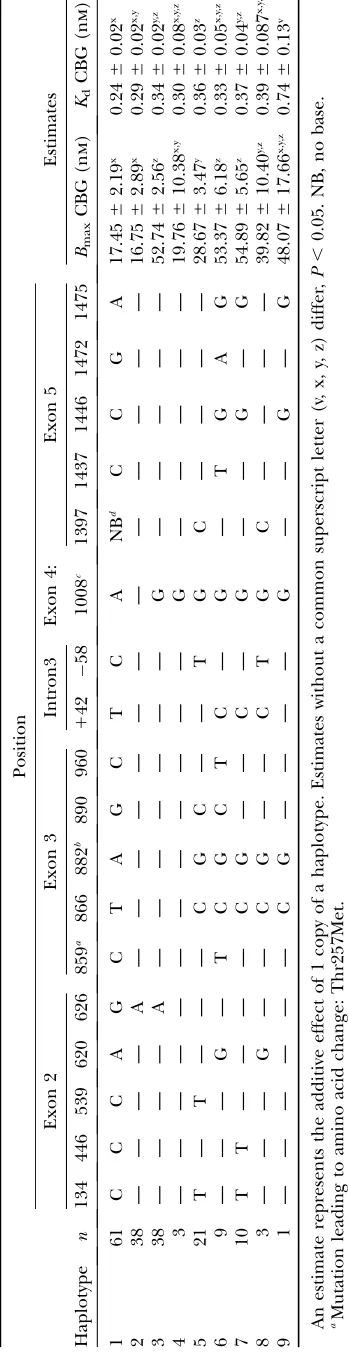
we studied at the molecular level a synthetic pig line corresponding to an MS 3 LW advanced intercross. Sequencing 92 MS 3 LW gilts across exons 2–5 and intron 3 for 18 polymorphisms enabled us to define nine haplotypes. Within this synthetic pig line, the haplotypes differed with respect to CBG Bmax (P ,
0.0001, Table 1). The lowest levels of CBGBmax were associated with the presence of Ile in position 265 (SNP882) and Arg in position 307 (SNP1008) as judged from haplotypes 1 and 2, except for the three animals of haplotype 4 with Gly in position 307. Conversely, the highest levels of CBGBmaxwere found in haplotypes 6–9 harboring a Val in position 265 and a Gly in position 307 and haplotype 3 that displays an Ile in position 265 and a Gly in position 307. Haplotype 5 is associated with an intermediary CBGBmaxvalue although it harbors a Val265 and a Gly307. The presence of Met in position 257 seems to have no effect as judged by comparison of haplotype 6 with the haplotypes 7–9. These results led us to explore further the effect of SNP882 and SNP1008
Figure3.—CBG dissociation constant (Kd) of CBG variants
transfected in 293T cells. Results ofKdare given in percentage compared with wild-type CBG capacity. Significance of differ-ences in data (**P,0.05) was determined using Student’s
(corresponding to mutation Ile265Val and Arg307Gly, respectively) on CBGBmaxandKd. As shown in Table 2, the SNP882 polymorphism has no effect on CBGBmax
but influences CBGKd. For SNP1008 leading to Arg307-Gly mutation, a clear effect is found on both CBGBmax
andKd.
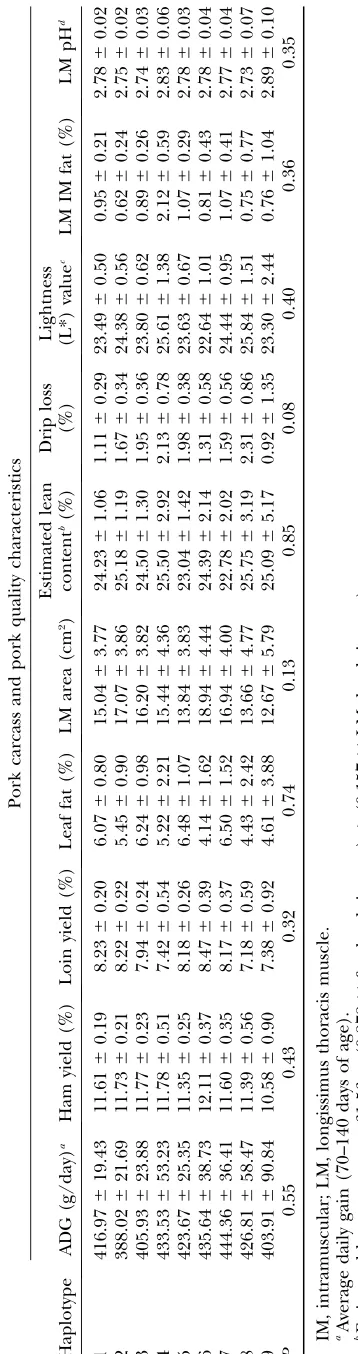
Carcass composition and meat quality in relation to CBG Arg307Gly polymorphism: Because in our pre-vious studies (Ousovaet al.2004; Geverinket al. 2006)
we found an association between CBG (gene polymor-phism and Bmax) and carcass composition and meat quality, we decided to evaluate the specific effect of each haplotype on these traits (Table 3). As no significant effect was found we evaluated the specific effect of SNP1008 on these traits in our new population. No effect was found on fatness or muscle content parame-ters. However, a meat quality parameter, the percentage of drip loss, is influenced by this polymorphism. Leastsquares means of drip loss percentage for the three genotypes at this marker are: 2.5960.28 (animals A/A,n¼27), 2.6560.24 (animals A/G,n¼41), and 3.5560.34 (animals G/G,n¼18),P,0.05.
DISCUSSION
The results ofCbg mRNA expression analysis in the liver of the two pig breeds show twice as much expres-sion for the MS as for the LW. A high correlation was observed betweenCbgmRNA andBmax, suggesting that the CBGBmaxdifference comes in large part (r2¼40%
in LW and r2 ¼ 50% in MS) from a difference in Cbg
mRNA levels and consequently a difference in protein synthesis. In other words, this result implies that the difference in CBG binding between the two breeds is in large part a result of a difference at the level of the tran-scriptional regulation ofCbgor inCbgmRNA stability.
The in vitro assays confirmed that the substitution
Ser15Ile located in the signal peptide of CBG protein does not have any effect on the secretion and affinity of CBG (as measured by binding activity). As to Thr257Met and Ile265Val substitutions, both produce small changes on CBG Bmax. However, the Arg307Gly substitution in-creases CBGBmaxconsiderably in cultured cells. Thus, it may be that this single nucleotide change induces greater mRNA stability and/or three-dimensional structural dif-ferences resulting in a more efficient secretion of CBG protein. This Arg307Gly substitution also increases the CBG dissociation constant, with a difference equivalent to that observed between MS and LW breeds. Thus, the Arg307Gly substitution identified essentially in the MS breed probably accounts for most of the reduction in steroid binding affinity.
To evaluate thein vivoimpact of ourin vitroresults, we have studiedCbggene polymorphisms in a population of MS3LW intercross pigs at the molecular level. In a previous study (Geverink et al. 2006) we have shown
that CBGBmaxwas high in this line compared to four other European lines and that in this line and in the LW breed, CBG Bmax was correlated to plasma cortisol. Furthermore, CBGBmaxhad an effect on meat quality particularly in the MS 3 LW line, on fat content, and meat drip loss percentages. Here, sequence analysis of 184 chromosomes from the MS3LW line allowed us to refine the in vitro analysis. Comparison of haplotype 6 with haplotypes 7–9 led us to conclude that the Thr257Met mutation has no effect on CBG Bmax
because there are no significant differences in CBG
Bmaxmean among these haplotypes that are very similar except for the Thr257Met substitution and because CBG Bmax mean is homogeneous despite the small number of animals observed (n ¼9). Similarly, com-parison of haplotype 3 with haplotypes 6–9 led us to
TABLE 2
Effect of SNP 882 and SNP 1008
Genotype
A/A A/G G/G
Bmax(nm) n Bmax(nm) n Bmax(nm) n
A. On CBGBmax(nm)
SNP882 56.1363.75 57 67.2064.86 34 64.13612.66 5
SNP1008 33.6763.85x 30 67.3463.08y 47 85.7764.84z 19
SNP882
A/A A/G G/G
Kd(nm) n Kd(nm) n Kd(nm) n
B. On CBGKd(nm)
SNP882 0.5860.02x 57 0.6560.03y 34 0.7360.07y,z 5
SNP1008 0.5360.03x 30 0.6460.02y 47 0.6760.03y,z 19
conclude that Ile265Val mutation has probably no effect on CBGBmaxbecause there is no significant difference in CBGBmaxmean among these haplotypes. Conversely, the Arg307Gly mutation is associated with the haplo-types showing high or intermediary CBGBmaxvalues— except haplotype 4—but only three animals contain this haplotype. The analysis of Ile265Val mutation (SNP882) and Arg307Gly mutation (SNP1008) on CBGBmaxandKdconfirmed that the Arg307Gly muta-tion has a significant effect on Bmax but that the Ile265Val mutation does not. However, both mutations influence CBGKd.
Overall, thein vivodata fit rather well with thein vitro
results, highlighting the importance of the Arg307Gly mutation on CBGBmaxandKdbut not confirming the small influence of Thr257Met and Ile265Val mutations on CBGBmax. The Ile265Val substitution has a signifi-cant effect on CBGKdin the MS3LW population but this effect was not significant in thein vitroassays if we average the data from all transfections. However, this effect was significant in two of three transfection assays. Genetic variants of CBG have been reported in rat (Smith and Hammond1991), in mouse (Orava et al.
1994), and in humans (VanBaelenet al.1982; Smith
et al.1992; Emptoz-Bonnetonet al.2000; Brunneret al.
2003). The alignment of pig and rat amino acid se-quences shows that the pig Arg307 amino acid is located at two residues of the substitution Met276Ile in the rat that is implicated in reduced steroid binding affinity of the BioBreeding rat (Smithand Hammond 1991).
According to the deduced tertiary structure of CBG (Deyand Roychowdhury2003), amino acids Gln232,
Asn238, Ile263, and Trp266 seem involved in ligand bind-ing in humans and are well conserved across species. In our pig model, Thr257Met and Ile265Val are very close to these important amino acids and within the b-barrel, which has been involved in steroid binding (Dey and
Roychowdhury2003).
The association analysis shows a 155% increase in CBG Bmax between animals homozygous Arg307/ Arg307 and animals Gly307/Gly307, whereas in vitro
the mean difference was 77%. Concerning CBGKdand the Arg307Gly mutation, thein vivo data show a 26% increase for animals Gly307/Gly307 compared with a 37% differencein vitro, whereas for Ile265Val mutation
bothin vitroandin vivodata display a 25% change inKd
between Ile265/Ile265 and Val265/Val265 genotypes. For obvious reasons, these differences betweenin vitro
andin vivodata may be due to technical reasons linked
to CBG expression in culture cells through transfection of cDNA. This is supported by the fact that CBGBmax
varies but Kd is not very different. Alternatively, the
in vivo highest difference for Arg307Gly mutation on
CBG Bmax may be due to other mutations in the Cbg
gene that would additively influence CBGBmax. There are other lines of evidence suggesting that other as yet unknown mutations influence CBGBmax. In this study
we found that haplotype 5 harboring Gly307 is associ-ated with an intermediate CBGBmaxvalue, significantly lower than CBG Bmax from haplotypes 3, 6, and 7. Moreover, in our previous study (Ousovaet al. 2004)
the highest genetic linkage with cortisol values and CBG
Bmax traits was found in the progeny of the F1 sire
910045, meaning that this animal must be heterozygous at the causal mutation. However, this F1sire is
homozy-gous Gly307/Gly307, demonstrating that other muta-tion(s) remain to be discovered. Additionally, the F1sire
910081 was heterozygous for Arg307/Gly307 mutation but no contrast was found for cortisol values in its progeny. Finally, CBGBmaxwas found to influence fat deposition in two independent studies (Ousovaet al.
2004; Geverink et al. 2006), but this finding was not
replicated in this analysis. This latter result suggests that the mutations examined in this study are not the cause of the major difference in body composition between LW and MS breeds. However, this hypothesis should be moderated by the fact that the population analyzed in the original study is different in type [F2(LW3MS)vs.
F10(LW3MS)] and size (.600vs.100 pigs).
In conclusion, we have provided good evidence, supported byin vitroandin vivodata, that the Arg307Gly mutation influences CBGBmaxandKd. Additionally, the Ile265Val mutation may have an influence on CBGKd. These findings do not explain all CBGBmaxvariations observed and their associated effect on fat deposition. Other mutations probably remain to be identified in noncoding regions of the Cbg gene, probably in regions regulating the level of Cbg mRNA transcription. How-ever, the impact of the Arg307Gly mutation on CBG
Bmax and on meat drip loss percentage found in this study should be taken into account in pig selection schemes if replicated in separate and larger popula-tions. More generally, this study further suggests that naturally occurringCbggene polymorphisms may have an impact on CBG protein function and regulation of the hypothalamic-pituitary-adrenal axis.
The authors thank the Quality Pork Genes project (http://www. qualityporkgenes.com), supported by European Community FP5 QLK5-CT-2001-01888, for providing the LW3MS samples. We thank Andy Day for his contribution to the sequencing work and Nathalie Iannuccelli for the genotyping.
LITERATURE CITED
Breuner, C. W., and M. Orchinik, 2002 Plasma binding proteins as
mediators of corticosteroid action in vertebrates. J. Endocrinol.
175:99–112.
Bright, G. M., 1995 Corticosteroid-binding globulin influences
kinetic parameters of plasma cortisol transport and clearance. J. Clin. Endocrinol. Metab.80:770–775.
Bright, G. M., and D. Darmaun, 1995 Corticosteroid-binding
glob-ulin modulates cortisol concentration responses to a given pro-duction rate. J. Clin. Endocrinol. Metab.80:764–769.
Brunner, E., J. Baima, T. C. Vieira, J. G. Vieiraand J. Abucham,
2003 Hereditary corticosteroid-binding globulin deficiency due to a missense mutation (Asp367Asn, CBG Lyon) in a Brazil-ian kindred. Clin. Endocrinol.58:756–762.
Dey, R., and P. Roychowdhury, 2003 Homology model of human
corticosteroid binding globulin: a study of its steroid binding ability and a plausible mechanism of steroid hormone release at the site of inflammation. J. Mol. Model.9:183–189. Emptoz-Bonneton, A., P. Cousin, K. Seguchi, G. V. Avvakumov,
C. Bullyet al., 2000 Novel human corticosteroid-binding
glob-ulin variant with low cortisol-binding affinity. J. Clin. Endocrinol. Metab.85:361–367.
Fernandez-Real, J. M., M. Pugeat, M. Grasa, M. Broch, J.
Vendrellet al., 2002 Serum corticosteroid-binding globulin
concentration and insulin resistance syndrome: a population study. J. Clin. Endocrinol. Metab.87:4686–4690.
Geverink, N. A., A. Foury, G. S. Plastow, M. Gil, M. Gispertet al.
2006 Cortisol-binding globulin and meat quality in five Euro-pean lines of pigs. J. Anim. Sci. 84: 204–211
Gayrard, V., M. Alvinerieand P. L. Toutain, 1996 Interspecies
var-iations of corticosteroid-binding globulin parameters. Domest. Anim. Endocrinol.13:35–45.
Hammond, G. L., 1995 Potential functions of plasma
steroid-binding proteins. Trends Endocrinol. Metab.6:298–304. Hammond, G. L., C. L. Smith, I. S. Goping, D. A. Underhill, M. J.
Harleyet al., 1987 Primary structure of human corticosteroid
binding globulin, deduced from hepatic and pulmonary cDNAs, exhibits homology with serine protease inhibitors. Proc. Natl. Acad. Sci. USA84:5153–5157.
Hammond, G. L., C. L. Smith, N. A. Patersonand W. J. Sibbald,
1990 A role for corticosteroid-binding globulin in delivery of cor-tisol to activated neutrophils. J. Clin. Endocrinol. Metab.71:34–39. Heo, J., H. G. Kattesh, R. L. Matteri, J. D. Grizzleand J. D. Godkin,
2003 Partial nucleotide sequence of the porcine corticosteroid-binding globulin (CBG) cDNA and specification of CBG expres-sion sites in postnatal pigs. Domest. Anim. Endocrinol.24:257–264. Hryb, D. J., M. S. Khan, N. A. Romasand W. Rosner, 1986 Specific
binding of human corticosteroid-binding globulin to cell mem-branes. Proc. Natl. Acad. Sci. USA83:3253–3256.
Joyner, J. M., L. J. Hutley, A. W. Bachmann, D. J. Torpyand J. B.
Prins, 2003 Greater replication and differentiation of
preadi-pocytes in inherited corticosteroid-binding globulin deficiency. Am. J. Physiol. Endocrinol. Metab.284:E1049–E1054. Maitra, U. S., M. S. Khanand W. Rosner, 1993
Corticosteroid-binding globulin receptor of the rat hepatic membrane: solubi-lization, partial characterization, and the effect of steroids on binding. Endocrinology133:1817–1822.
Orava, M., X. F. Zhao, E. Leiterand G. L. Hammond, 1994
Struc-ture and chromosomal location of the gene encoding mouse corticosteroid-binding globulin: strain differences in coding se-quence and steroid-binding activity. Gene144:259–264. Ousova, O., V. Guyonnet-Duperat, N. Iannuccelli, J. P. Bidanel,
D. Milanet al., 2004 Corticosteroid binding globulin: A new
tar-get for cortisol driven obesity. Mol. Endocrinol.18:1687–1696. Pemberton, P. A., P. E. Stein, M. B. Pepys, J. M. Potterand R. W.
Carrell, 1988 Hormone binding globulins undergo serpin
conformational change in inflammation. Nature336:257–258. Rosner, W., 1990 The functions of corticosteroid-binding globulin
and sex hormone-binding globulin: recent advances. Endocr. Rev.11:80–91.
Smith, C. L., and G. L. Hammond, 1991 An amino acid substitution
in biobreeding rat corticosteroid binding globulin results in re-duced steroid binding affinity. J. Biol. Chem.266:18555–18559. Smith, C. L., S. G. Powerand G. L. Hammond, 1992 A Leu-His
sub-stitution at residue 93 in human corticosteroid binding globulin results in reduced affinity for cortisol. J. Steroid Biochem. Mol. Biol.42:671–676.
Strel’chyonok, O. A., and G. V. Avvakumov, 1991 Interaction of
human CBG with cell membranes. J. Steroid Biochem. Mol. Biol.
40:795–803.
Torpy, D. J., A. W. Bachmann, J. E. Grice, S. P. Fitzgerald, P. J. Phillips
et al., 2001 Familial corticosteroid-binding globulin deficiency
due to a novel null mutation: association with fatigue and relative hypotension. J. Clin. Endocrinol. Metab.86:3692–3700. VanBaelen, H., R. Brepoelsand P. DeMoor, 1982 Transcortin
Leuven: a variant of human corticosteroid-binding globulin with decreased cortisol-binding affinity. J. Biol. Chem.257:3397–3400.