ABSTRACT
THOMAS, WALTER EDWARD. Physiological evaluations of translocation of glyphosate in glyphosate resistant crops including interaction with cotton growth regulators. (Under the direction of Dr. John W. Wilcut.)
Field studies were conducted in 2004 to evaluate corn tolerance, weed control, grain
yield, and net returns in transgenic and non-transgenic corn with various herbicide
systems. No significant differences between hybrid systems were observed for weed
control. Grain yield was variable between hybrids and locations due to environmental
differences. Consequently, net returns for each hybrid system within a location were also
variable.
Studies were conducted at three locations in North Carolina in 2004 to evaluate
density-dependent effects of glyphosate-resistant (GR) corn on GR cotton growth and lint
yield. The examined GR corn densities had a significant effect on cotton yield, but not as
significant as many other problematic grass and broadleaf weeds.
Two studies were conducted to investigate the influence of corn growth stage on the
absorption and translocation of glyphosate in glyphosate-resistant (GR) corn. Regardless
of corn growth stage, the leaves above the treated leaf and roots were the greatest sinks for
14
C-glyphosate. These data suggest that reproductive tissues such as the tassel and ear
shoots can accumulate 14C-glyphosate at higher concentrations that other tissues, especially when the herbicide treatment is applied postemergence after the V6 stage.
Studies were conduc ted to evaluate absorption and translocation of 14C-glyphosate in both commercial glyphosate-resistant (GR) cotton events [GR event 1, released 1997
(GRE1) and GR event 2, released 2006 (GRE2)] were evaluated at the 4- leaf (L) and 8-L
8-L cotton, glyphosate absorption was not different between events. Glyphosate
translocation patterns were not different between events or harvest timings and exhibited a
source-sink relationship. Based on the percentage of 14C exported out of the treated leaf, glyphosate and sucrose translocation patterns were similar, indicating that glyphosate may
be used as a photoassimilate model in GRE2 cotton.
Studies examined various morphological characteristics and 14C-glyphosate
translocation in cotton as influenced by 14C-treatment timing and mepiquat chloride (MC). No significant differences in plant height, leaf area, and specific leaf weight were observed
for any treatment. Dry weight of first position fruits on nodes 1, 2, and 3 of MC treated
plants accumulated greater biomass compared to fruits on non-treated plants. No
significant observations were found for 14C-glyphosate translocation. These data support previous research that showed increased fruit weight and provides insight into the potential
for MC treatment to alter source to sink relationship in cotton.
Studies examined various morphological characteristics and 14C-glyphosate
translocation in cotton as influenced by cotton plant growth regulator regimes and source
leaf. MC and MP reduced cotton height and the number of nodes per plant. Total fruit
retention and first position fruit retention were not influenced by any treatment. Based on
these data, MC and MP do not influence 14C-glyphosate translocation.
Greenhouse studies were conducted to evaluate the rain- free requirement for mepiquat
chloride and mepiquat chloride plus cyclanilide with and without surfactant and to evaluate
absorption and translocation of cyclanilide. Based on these data, a rain- free period of 8
hours is needed to maximize efficacy, regardless of plant growth regulator or the use of
respectively. Averaged over harvest intervals, 18% of the applied cyclanilide remained in
the treated leaf while 1.7 and 6.5% of the applied cyclanilide was found in the above and
PHYSIOLOGICAL EVALUATIONS OF TRANSLOCATION OF GLYPHOSATE IN GLYPHOSATE RESISTANT CROPS INCLUDING INTERACTION WITH
COTTON GROWTH REGULATORS
By
WALTER EDWARD THOMAS
A dissertation submitted to the Graduate Faculty of North Carolina State University
in partial fulfillment of the requirements for the Degree of
Doctor of Philosophy
Crop Science
Raleigh
2006
APPROVED BY:
_____________________________ _____________________________
Dr. Candace H. Haigler Dr. Alan C. York
_____________________________ _____________________________
Dr. David W. Monks Dr. John W. Wilcut
BIOGRAPHY
Walter E. Thomas was born in Sanford, North Carolina on June 12, 1979 to Neill B.
Thomas, Jr. and Frances G. Thomas. He was raised in Lillington, North Carolina, a small
rural town. He graduated in 1997 from Western Harnett High School as a North Carolina
Scholar and Honor Student. Following graduation, he enrolled at North Carolina State
University where he earned a bachelor of science degree in Agronomy with a
concentration in Turfgrass Management. In October 2000, he earned the American FFA
degree, the highest degree bestowed upon FFA members. He graduated sum cum laude, a
College of Agriculture and Life Sciences Honor Student, and a University Scholar. Walter
earned a Master of Science in Crop Science and a minor in Entomology from North
Carolina State University in December of 2003. Following graduation, he pursued a
doctor of philosophy in Crop Science at North Carolina State University.
While pursuing his degrees, Walter has won awards in the graduate student poster
contests at the Southern Weed Science Society and Weed Science Society of North
Carolina and graduate student oral presentation contests at the Beltwide Cotton
Conference. He was also awarded the Deere & Co. Graduate Fellowship from the
American Society of Agronomy. He was a participant and award winner in weed contests
conducted by the Northeastern and Southern Weed Science Societies. In 2005, he was a
member of the first place team at the Northeastern Weed Science Society Weed Contest in
ACKNOWLEDGEMENTS
I would like to sincerely thank Dr. John Wilcut, my major advisor, for his guidance,
patience, and friendship. I also extend appreciation to my committee members, Drs.
Candace Haigler, Clifford Koger, David Monks, Dale Shaner, and Alan York. I would
also like to thank Shawn Askew, Whitnee Barker, Ian Burke, Scott Clewis, Wesley
Everman, Wendy Pline, Bridget Robinson, and Shawn Troxler for their friendship, advice,
and encouragement. I greatly appreciate the many hours of laboratory and greenhouse
assistance provided by Carianne Grubb, Joey Hope, Abigail Mayhew, Cassandra Mayhew,
Diana Thomas, Jared Wilcut, and Caitlyn Wilcut. I would also like to thank Dr. Fred
Corbin for his advice and wonderful life stories and Bonnie Sheldon for her friendship and
willingness to help with any task.
I am greatful for the unending support, encouragement, and love provided by wife,
Tracy. I sincerely appreciate the encouragement from my parents, Baxley and Frances,
siblings, Neill and Diana, and many other family members who have supported me along
TABLE OF CONTENTS
LIST OF TABLES ... vi
LIST OF FIGURES ... ix
INTRODUCTION AND LITERATURE REVIEW ...1
INTRODUCTION...1
LITERATURE CITED ...11
RESISTANT CORN INTERFERENCE IN GLYPHOSATE-RESISTANT COTTON...17
ABSTRACT...17
INTRODUCTION...18
MATERIALS AND METHODS ...19
RESULTS AND DISCUSSION ...22
LITERATURE CITED ...27
INFLUENCE OF CORN GROWTH STAGE ON ABSORP TION AND TRANSLOCATION OF GLYPHOSATE IN GLYPHOSATE-RESISTANT CORN ...40
ABSTRACT...41
INTRODUCTION...42
MATERIALS AND METHODS ...43
RESULTS AND DISCUSSION ...45
LITERATURE CITED ...52
ABSORPTION AND TRANSLOCATION OF GLYPHOSATE AND SUCROSE IN GLYPHOSATE-RESISTANT COTTON ...63
ABSTRACT...63
INTRODUCTION...64
MATERIALS AND METHODS ...67
RESULTS AND DISCUSSION ...69
LITERATURE CITED ...76
TRANSLOCATION OF SPOT APPLICATIONS OF GLYPHOSATE AS INFLUENCED BY MEPIQUAT CHLORIDE APPLICATIONS IN COTTON...86
ABSTRACT...87
INTRODUCTION...88
MATERIALS AND METHODS ...91
RESULTS AND DISCUSSION ...93
TRANSLOCATION OF 14C-GLYPHOSATE AS INFLUENCED BY VARIOUS PLANT
GROWTH REGULATORS IN COTTON...119
ABSTRACT...120
INTRODUCTION...121
MATERIALS AND METHODS ...123
RESULTS AND DISCUSSION ...125
LITERATURE CITED ...133
RAIN-FREE REQUIREMENT AND PHYSIOLOGICAL PROPERTIES OF COTTON PLANT GROWTH REGULATORS ...144
ABSTRACT...145
INTRODUCTION...145
MATERIALS AND METHODS ...147
RESULTS AND DISCUSSION ...149
CONCLUSIONS...152
LIST OF TABLES
RESISTANT CORN INTERFERENCE IN GLYPHOSATE-RESISTANT COTTON
Table 1. Regression parameters (H = a e-be-Kt) describing the relationship between cotton height and time in days after crop planting at various densities of corn interference where H, a, e, and t are based on the plant height in cm, the upper asymptote for late-season plant height, the base of natural logarithm, and the time in days after planting, respectively,
while b and k are constants. Values in parenthesis are standard errors. ...31
Table 2. Economic thresholds for glyphosate-resistant corn in glyphosate-resistant
cotton. ...33
INFLUENCE OF CORN GROWTH STAGE ON ABSORP TION AND TRANSLOCATION OF GLYPHOSATE IN GLYPHOSATE-RESISTANT CORN
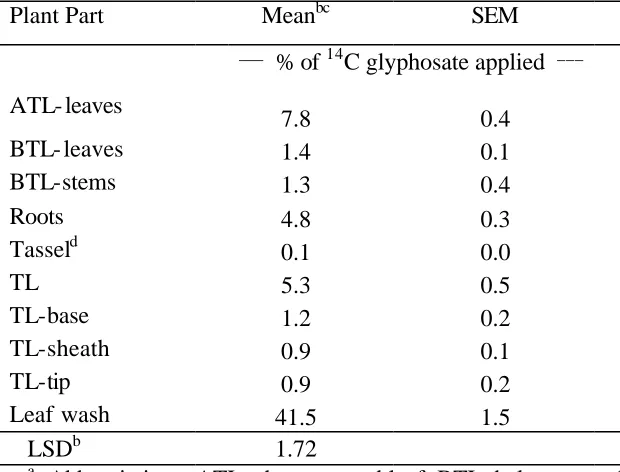
Table 1. Distribution of 14C-glyphosate in glyphosate-resistant corn, averaged over trials, treatment timings (V4, V6, and V8), and harvests timings (3 and 7 d after treatment). ...57
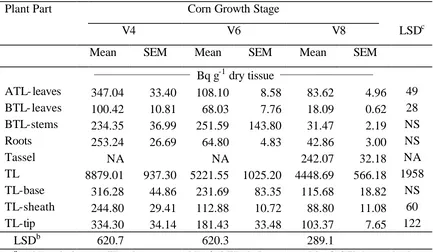
Table 2. Concentration of 14C-glyphosate in glyphosate-resistant corn treated at V4, V6, or V8, averaged over trials and harvests (3 and 7 d after treatment). ...58
Table 3. Distribution of foliar-applied 14C-glyphosate in glyphosate-resistant corn treated at V4, V6, or V8 and harvested at various vegetative and reproductive growth stages,
averaged over trials ...59
Table 4. Distribution of foliar-applied 14C-glyphosate in glyphosate-resistant corn treated at V4, V6, or V8 and harvested at various vegetative and reproductive growth stages,
averaged over trials ...61
ABSORPTION AND TRANSLOCATION OF GLYPHOSATE AND SUCROSE IN GLYPHOSATE-RESISTANT COTTON
Table 1. Translocation of 14C-glyphosate in cotton. Translocation values are a percentage of absorbed 14C-glyphosate, averaged over glyphosate-resistant event and harvest
timing ...81
Table 3. Translocation of 14C compounds (glyphosate and sucrose) in 5- and 10-leaf cotton as a percentage of exported 14C from the treated leaf, averaged over runs and harvest timings ...84
TRANSLOCATION OF SPOT APPLICATIONS OF GLYPHOSATE AS INFLUENCED BY MEPIQUAT CHLORIDE APPLICATIONS IN COTTON
Table 1. Interaction of 14C-glyphosate timing and mepiquat chloride on the total plant height at harvest, treated leaf node, and absorption of 14C-glyphosate, averaged
over trials. ...106
Table 2. 14C-glyphosate timing main effect on total fruit retention and first position fruit retention, averaged over trials and mepiquat chloride regime...107
Table 3. Interaction of nodal position and leaf position within sympodia on leaf area,
averaged over trials, 14C-glyphosate timing, and mepiquat chloride...108
Table 4. Interaction of mepiquat chloride and sympodial position for fresh weight of the various cotton parts within each position on nodes A, C and D, averaged over trials and
14
C-glyphosate timing. For nodes B and E, fresh weight is presented by the various cotton parts within sympodial position, averaged over trials, 14C-glyphosate timing, and mepiquat chloride. ...109
Table 5. Interaction of mepiquat chloride and sympodial position for dry weight of the various cotton parts within each position on nodes A, B, C, and D, averaged over trials and
14
C-glyphosate timing. For node E, dry weight is presented by the various cotton parts within sympodial position, averaged over trials, 14C-glyphosate timing, and mepiquat
chloride ...111
Table 6. The levels of significant difference for the main effects and their interactions on
14
C-glyphosate concentration in cotton for each node...113
Table 7. Interaction of parts within each position and sympodial position for 14 C-glyphosate concentration, averaged over trials, 14C-glyphosate timing, and mepiquat
chloride ...114
Table 8. Interaction of mepiquat chloride and sympodial position for 14C-glyphosate concentration in the various cotton parts within each position for node A, averaged over trials ...115
TRANSLOCATION OF 14C-GLYPHOSATE AS INFLUENCED BY VARIOUS PLANT GROWTH REGULATORS IN COTTON
Table 1. Cotton height as influenced by cotton plant growth regulator regimes, averaged over trials and 14C-glyphosate placement. ...137
Table 2. Leaf area as influenced by plant position and cotton plant growth regulator
regimes, averaged over trials and 14C-glyphosate placement ...138
Table 3. Dry weight of plant parts as influenced by plant position and cotton plant growth regulator regimes, averaged over trials and 14C-glyphosate placement ...139
Table 4. Translocation of 14C-glyphosate as influenced by plant position, averaged over trials, 14C-glyphosate placement, and cotton plant growth regulator regimes. Data are from the node containing the treated leaf...142
Table 5. Translocation of 14C-glyphosate as influenced by plant position, averaged over trials, 14C-glyphosate placement, and cotton plant growth regulator regimes. Data are from one node above the treated leaf node...143
RAIN-FREE REQUIREMENT AND PHYSIOLOGICAL PROPERTIES OF COTTON PLANT GROWTH REGULATORS
Table 1. Parameters (standard error) for regression analysis [y = -a ln(time) + b] on the change in cotton height in response to various simulated rainfall timings. . ...157
Table 2. F-values and probabilities of the main effects and interactions evaluated for
translocation data ...159
LIST OF FIGURES
RESISTANT CORN INTERFERENCE IN GLYPHOSATE-RESISTANT COTTON
Figure 1. Glyphosate-resistant corn height, glyphosate-resistant cotton height with no weed interference, and glyphosate-resistant cotton height with 5.25 corn plant per m of cotton row are shown. Bars represent standard error of the mean. Regression parameters and corresponding R2 values are shown in Table 1. ...34
Figure 2. Effect of glyphosate-resistant corn density at the last measuring timing at each location (104, 95, and 101 d after planting at Clayton, Lewiston-Woodville, and Rocky
Mount, respectively). Bars represent standard error of the mean...35
Figure 3. Effect of glyphosate-resistant corn density on late-season glyphosate-resistant corn biomass per plant shown by location. Bars represent standard error of the mean. A linear response was not observed at Lewiston-Woodville and Rocky Mount ...36
Figure 4. Effect of glyphosate-resistant corn density on late-season glyphosate-resistant corn seed weight per plant shown by location. Bars represent standard error of the mean. A linear response was not observed at Lewiston-Woodville and Rocky Mount...37
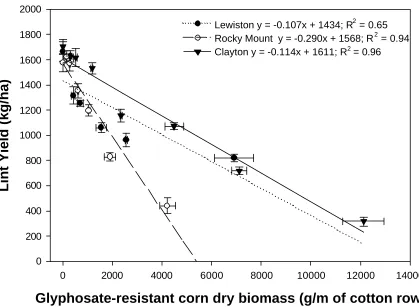
Figure 5. Effect of glyphosate-resistant corn biomass per m crop row on cotton lint yield shown by location. Bars represent standard error of the mean...38
Figure 6. Cotton lint yield loss associated with season- long glyphosate-resistant corn
interference. Bars represent standard error of the mean...39
ABSORPTION AND TRANSLOCATION OF GLYPHOSATE AND SUCROSE IN GLYPHOSATE-RESISTANT COTTON
Figure 1. Absorption of glyphosate in 4-lf and 8- lf cotton is shown as a percentage of applied, averaged trials. In 8- lf cotton, absorption is also averaged over trials and
glyphosate resistance events ...85
RAIN-FREE REQUIREMENT AND PHYSIOLOGICAL PROPERTIES OF COTTON PLANT GROWTH REGULATORS
Figure 1. The change in total plant height from 0 to 7 and 7 to 14 d after treatment for no surfactant and surfactant studies, averaged over runs and cotton plant growth regulators. Data modeled using y = -a ln(time) + b. Parameters for equations are shown in table 1. ....161
INTRODUCTION
Objective 1. Herbicide-resistant (HR) crops are becoming increasingly prevalent in the southeastern United States. Herbicide-resistant corn hectarage has steadily increased from
7% in 2000 to 26% in 2005 (USDA-NASS 2000, 2005). The use of HR cotton has been
more widespread with 46 and 61% planted in 2000 and 2005, respectively (USDA-NASS
2000, 2005). In North Carolina, 78% of the planted cotton in 2005 contained a
herbicide-resistant trait (USDA-NASS 2005). In addition to the wide-spread use of
glyphosate-resistant (GR) corn and cotton, many of the weed management systems within each
cropping system utilize only glyphosate. Additional herbicidal options like metolachlor
and pendimethalin included in some cotton weed management systems are also registered
in corn and are unlikely to control volunteer corn. The combination of continuous use of
GR cropping systems with the inclusion of only glyphosate allows for growth and
subsequent competition of GR volunteers (York et al. 2004, 2005).
Since the registration of GR cotton, less than 50% of the NC hectarage receives any
residual preemergence treatment (A. C. York, personal communication). A vast majority
of this hectarage is only treated with glyphosate or glyphosate plus S-metolachlor for the
first 4 to 5 wks after crop emergence. In addition, weather conditions like hurricanes
commonly destroy corn. Therefore, GR corn volunteers are often left uncontrolled. Since
interference between GR corn and GR cotton has not been investigated, studies were
conducted to determine effects of a range of GR corn densities on GR cotton growth and
yield and to evaluate growth of GR corn as affected by plant density (Chapter 1, pp. 17 -
GR corn was taller than GR cotton as early as 25 d after planting, depending on
location. A GR corn density of 5.25 plant/m of crop row reduced late-season cotton height
by 49, 24, and 28% at Clayton, Lewiston-Woodville, and Rocky Mount, respectively,
compared to weed- free cotton height. Using the rectangular hyperbola model with the
asymptote (a) constrained to 100% maximum yield loss, the estimated coefficient i (yield
loss per unit density as density approaches zero) was 9, 5, and 5 at Clayton,
Lewiston-Woodville, and Rocky Mount, respectively. The examined GR corn densities had a
significant effect on cotton yield, but not as significant as many other problematic grass
and broadleaf weeds.
Objective 2. Glyphosate has been shown to negatively influence various reproductive characteristics in GR corn and cotton (Pline et al. 2002a; Thomas et al. 2004).
Investigations concluded that yield reductions in GR cotton were due to lower
CP4-5-enolpyruvylshikimate-3-phosphate synthase (EPSPS) expression in male reproductive
portions of flowers compared to vegetative tissues (Pline et al. 2002a). In addition to
lower EPSPS levels, pollen viability was reduced and stigma length was increased
following glyphosate treatments (Pline et al. 2002a, 2002b, 2002c; Yasour et al. 2000). In
GR corn, pollen viability reductions were evident with glyphosate treatments after the V6
stage, however, no yield reductions were observed with any glyphosate treatment
combination (Thomas et al. 2004). The combination of tassel initiation [as early as two
wks after corn emergence (Kiesselbach 1992)] and the source-to-sink translocation of
glyphosate (Gougler and Geiger 1981; Hetherington et al. 1999; McAllister and Haderlie
1985; Pline et al. 2001; Sandberg et al. 1980; Wyrill and Burnside 1976; Viator et al. 2003)
on this hypothesis, our objectives were to evaluate absorption and translocation of
glyphosate applied at the V4, V6, or V8 stage using various harvest timings. The first
study evaluated the immediate effects (3 and 7 DAT) on absorption and translocation of
glyphosate. A second study evaluated the distribution of foliar-applied glyphosate (V4,
V6, and V8) by harvesting at four vegetative and reproductive stages (V8, V12, V16, and
R1) (Chapter 2, pp. 40 - 62).
In the second study, 42 to 60% of the applied 14C-glyphosate remained in the corn tissues at anthesis. The leaves above the treated leaf and roots accumulated the greatest
amounts of 14C-glyphosate, regardless of corn growth stages. When plants were treated at V4, V6, and V8 stages, the concentration of 14C-glyphosate in the tassel at the V12 harvest timing was 184, 431, and 921 Bq g-1 dry tissue, respectively. Likewise, increasing levels of 14C-glyphosate concentrations between corn growth stages were also observed in ear shoots. These data suggest that reproductive tissues such as the tassel and ear shoots can
accumulate 14C-glyphosate at higher concentrations than other tissues, especially when the herbicide is applied POST after the V6 stage.
Objective 3. In addition to laboratory analyses of CP4-EPSPS expression levels (Pline et al. 2002a), determination of shikimic acid levels (which accumulates following inhibition
of EPSPS) (Pline et al. 2002b; Viator et al. 2003), and floral morphology assessments
(Pline et al. 2002b), several researchers have reported abscission of first position bolls
(Jones and Snipes 1999; Viator et al. 2003, 2004), which in some years resulted in delayed
maturity. Depending on year, Viator et al. (2004) reported an 8% yield reduction
following applications of glyphosate POST at 0.84 kg ae/ha followed by glyphosate
glyphosate. The lack of glyphosate tolerance in reproductive tissues of
glyphosate-resistant event 1 (GRE1) lead to the development of a new generation of GR cotton.
The new generatio n, glyphosate-resistant event 2 (GRE2) cotton, uses an identical
resistance gene but different promoters as compared to the original resistance technology
(Anonymous 2005). The use of alternate promoters has increased the tolerance in
reproductive portions of the plant while maintaining tolerance levels in vegetative parts
(Anonymous 2005). Consequently, glyphosate can be applied POST up to 7 days before
harvest. Multiple researchers have investigated the physiological behavior of 14
C-glyphosate in GRE1 cotton (Pline et al. 2001, 2002a; Viator et al. 2003), however limited
research investigating similar responses to glyphosate in GRE2 cotton has been reported.
Thus, our objective was to evaluate absorption and translocation of glyphosate in these two
events at different cotton growth stages (Chapter 3, pp. 63 - 85).
Glyphosate absorption, as a percentage of applied, increased over time with 29 and
36% absorption at 7 DAT in GRE1 and GRE2 cotton at the 4- lf growth stage, respectively.
In 8- lf cotton, glyphosate absorption (33% at 7 DAT) was not different between events.
Glyphosate translocation patterns were not different between events or harvest timings and
exhibited a source-to-sink relationship. Observed translocation differences between cotton
growth stages were probably due to reduced glyphosate export from the treated leaf of 8-lf
cotton.
Objective 4. Previous photoassimilate movement research in cotton used radiolabeled substrates including CO2 and sucrose (Ashley 1972; Benedict and Kohel 1975; Benedict et
al. 1973; Horrocks et al. 1978). However, these substrates are metabolized into multiple
is not readily metabolized in plants (Duke 1988; Sandberg et al. 1980) and shares similar
translocation patterns to sucrose (Dewey and Appleby 1983; Tardif and Leroux 1993), may
offer an additional tool in photoassimilate research. Glyphosate-resistant event 2 cotton in
combination with glyphosate may provide tools to study photoassimilate translocation in
cotton in the absence of glyphosate toxicity (Feng and Chiu 2005). Even though several
researchers observed similar glyphosate and sucrose translocation patterns in a number of
weed species (Dewey and Appleby 1983; Shieh et al. 1993; Tardif and Leroux 1993), a
comparison of glyphosate and sucrose translocation in GR cotton or other GR crops has
not been conducted. Thus, our objective was to compare glyphosate and sucrose
translocation patterns in GRE2 cotton as influenced by cotton growth stage (Chapter 3, pp.
63 - 85).
Averaged over trials, 14C compounds, and growth stages, cotton absorbed 28% of the applied dose at 14 d after treatment. Based on the percentage of 14C exported out of the treated leaf, glyphosate and sucrose translocation patterns were similar, indicating that
glyphosate may be used as a photoassimilate model in GRE2 cotton.
Objectives 5 and 6. Development and retention of cotton fruits are influenced by supply and demand of plant photoassimilates. The complex balance of these source-to-sink
relationships varies by plant position and age (Ashley 1972; Benedict and Kohel 1975) as
well as environmental conditions (Guinn 1982). Multiple researchers have investigated
photoassimilate patterns in cotton with 14CO2 (Ashley1972; Benedict and Kohel 1975;
Horrocks et al. 1978) and 14C-glyphosate (Feng and Chiu 2005). Ashley (1972) and Horrocks et al. (1978) showed that the subtending leaf of a fruit was the primary
Glyphosate, a commonly used systemic herbicide, is symplastic in nature and is
translocated in the phloem following a source-to-sink relationship (Dewey and Appleby
1983; Sandberg et al. 1980; Tardif and Leroux 1993). Due to these properties, similar
patterns of glyp hosate and sucrose translocation have been reported in Canada thistle
[Cirsium arvense (L.) Scop.], cotton, quackgrass [Elyrigia repens (L.) Nevski], and tall
morningglory [Ipomoea purpurea (L.) Roth.] (Dewey and Appleby 1983; Harker and
Dekker 1988; Klevorn and Wyse 1984; McAllister and Haderlie 1985; Shieh et al. 1993;
Tardif and Leroux 1993; Thomas et al. 2006).
Many cotton production systems include the use of plant growth regulators (PGRs) to
manage vegetative cotton growth. Mepiquat chloride and mepiquat pentaborate, two
onium- type growth regulators commonly used in these systems, inhibit gibberillic acid
synthesis by stopping the conversion of geranylgeranyl diphosphate to ent-kaurene,
consequently reducing cell enlargement and the rate of cell division (Rademacher 2000;
Srivastava 1993). The visual effects of these PGRs include reduced stem and leaf
expansion and cotton reaching maturity earlier than cotton not treated with PGRs (Reddy
et al. 1990, 1996; York 1983a, 1983b). However, cotton yield responses were variable
(Kerby 1985). Since PGRs have been shown to alter cotton canopy architecture and fruit
maturity, photoassimilate translocation patterns are presumably altered by these
applications. Even though research has not confirmed differences in photoassimilate
translocation in response to MC treatment using 14CO2 technology (Zhao and Oosterhuis
2000), glyphosate and glyphosate-resistant technology offer new tools for investigating
Since glyphosate movement has been correlated with sucrose movement in cotton
(Thomas et al. 2006) and multiple weed species (Dewey and Appleby 1983; Harker and
Dekker 1988; Klevorn and Wyse 1984; McAllister and Haderlie 1985; Shieh et al. 1993;
Tardif and Leroux 1993), our objectives were to evaluate translocation of 14C-glyphosate at different timings relative to a single MC treatment (Chapter 4, pp. 86 - 118) and to
evaluate translocation of 14C-glyphosate from various source leaves as influenced by multiple cotton PGR regimes (Chapter 5, pp. 119 - 143).
Due to the large number of plant parts, data for a five- node section of each plant was
recorded for each parameter (the mainstem leaf on node B received the 14C-glyphosate treatment). No significant differences in plant height, leaf area, and specific leaf weight
were observed for any 14C-glyphosate timing or MC combination. At the time of MC treatment and 21 DMC, total fruit retention was 85 and 70%, respectively. Even though all
plants retained at least 86% of all first position fruits, a significant decline was observed
from the day of MC treatment to 21 DMC (92 and 86%, respectively). Fresh and dry
weight data showed similar responses with multiple first position fruits of MC-treated
plants accumulating more biomass compared to first position fruits of non-treated plants.
For dry weight of plants parts, first position fruits on nodes A, B, and C of MC-treated
plants accumulated 30, 35, and 45% greater biomass, respectively, compared to first
position fruits of non-treated plants. Absorption of 14C-glyphosate was not influenced by either 14C-glyphosate timing or MC treatment. Even though no significant observations were found on node A, several numerical observations offer support for reduced leaf
expansion and increased biomass accumulation in response to MC treatment. In node A,
tissue than second position fruits of non-treated plants. In addition, numerical increases in
14
C-glyphosate concentration in the leaf and stem of the second position of node A in
MC-treated plants were observed compared to the same parts of non-MC-treated plants. On node D,
first position fruits of MC-treated plant contained nearly 6 and 7 times the 14C-glyphosate concentration at 0 and 21 DMC treatment compared to the respective timing for
non-treated plants. In addition, all other comparisons with first position fruit were numerically
greater with MC treatment. These data support previous research that showed increased
fruit weight and provides insight into the potential for MC treatment to alter the
source-to-sink relationship in reproductive cotton.
Studies examined various morphological characteristics and 14C-glyphosate translocation in cotton as influenced by cotton plant growth regulator regimes [none,
mepiquat chloride (MC), mepiquat pentaborate (MP)] and source leaf (14C-glyphosate was applied to mainstem and sympodial leaves). Mepiquat chloride and MP reduced cotton
height by 13 and 20%, respectively, compared to non-treated plants. Mepiquat chloride
and MP reduced the number of mainstem nodes by 1.4 and 1.9 nodes plant-1, respectively, compared to non-treated plants. Total fruit retention, first position fruit retention, low
sympodial fruit retention (nodes 6-10), high sympodial fruit retention (nodes 11-15), and
the location of the first sympodial branch were not influenced by either 14C-glyphosate treatment or cotton PGR regime. On node 19, MC and MP reduced the leaf area of the
mainstem leaf by 59 and 73%, compared to the mainstem leaf of non-treated plants. This
observed reduction may be partially influenced by the reduction in cotton height and the
number of nodes. Leaf area at other positions was only influenced by node and position
placement or cotton PGR regime. Based on these data, MC and MP do not influence 14 C-glyphosate translocation, which presumably indicates no direct influence on
photoassimilate translocation.
Objective 7. In 2006, a prepackaged mixture of mepiquat chloride and cyclanilide, which inhibits gibberellic acid synthesis and auxin transport, respectively, was registered for use
in cotton. Compared to known polar auxin transport inhibitors (1-N-naphthylphthalamic
acid and 2, 3, 4-triiodobenzoic acid) [12], Pederson [13] reported similar levels of
inhibition of auxin transport with 10 µm of cyclanilide in etiolated coleoptiles of corn (Zea
mays). Due to limited basipetal transport of auxin in cyclanilide treated plants, apical
dominance is not maintained, allowing for increased lateral shoot growth [13-17].
Since the prepackaged mixture of mepiquat chloride plus cyclanilide has recently been
registered, limited data are available with regard to rain- free requirements and distribution
within cotton. Therefore, our objectives were (1) to determine the rain- free interval for
mepiquat chloride and mepiquat chloride plus cyclanilide alone or in combination with a
non- ionic surfactant and (2) to evaluate absorption and translocation of cyclanilide in
cotton (Chapter 6, pp. 144 - 162).
No significant differences in the number of nodes, leaf area, and plant part fresh and
dry weight were observed with any PGR treatment and rainfall simulation combination.
Both plant growth regulators responded similarly to rainfall interval. As rain- free period
increased, cotton height was reduced. Based on these data, a rain- free period of 8 hours is
needed to maximize efficacy, regardless of the use of surfactant. Absorption of cyclanilide
18% of the applied cyclanilide remained in the treated leaf while 1.7 and 6.5% of the
Literature Cited
Anonymous. 2000. Acreage 2000. Available at
http://usda.mannlib.cornell.edu/reports/nassr/field/pcp-bba/acrg2000.pdf (version
October 9, 2005). USDA-NASS, Washington, DC.
Anonymous. 2005a.
http://usda.mannlib.cornell.edu/reports/nassr/field/pcp-bba/acrg0605.pdf. Accessed: March 13, 2006.
Anonymous. 2005.
http://www.monsanto.com/monsanto/content/investor-/financial/presentations/2004/MON_062504c.pdf. Accessed: March 13, 2006.
Ashley, D. A. 1972. 14C-labelled photosynthate translocation and utilization in cotton plants. Crop Sci. 12:69-74.
Banks, J. C., S. Osborne, L. Bull, and K. Coggeshall. 2004. Evaluation of an experimental
growth regulator – TADS 15338. In 2004 Annual Report: Extension Cotton Research
and Demonstrations in Oklahoma. Oklahoma State University: Stillwater, OK. p.
48-49. online: http://osu.altus.ok.us/2004%20Annual%20Report.pdf.
Benedict, C. R., R. H. Smith, and R. J. Kohel. 1973. Incorporation of 14C-photoassimilate into developing cotton bolls, Gossypium hirsutum L. Crop Sci. 13:88-91.
Benedict, C. R. and R. J. Kohel. 1975. Export of 14C-assimilates in cotton leaves. Crop Sci. 15:367-372.
Clausen, M., H. Lüthen, and M. Bötiger. 1996. Inside or outside? Localization of the
Dewey, S. A. and A. P. Appleby. 1983. A comparison between glyphosate and assimilate
translocation patterns in tall morningglory (Ipomoea purpurea). Weed Sci.
31:308-314.
Duke, S. O. 1988. Glyphosate. In P. C. Kearney, D. D. Kaufman eds., Herbicides:
Chemistry, Degradation and Mode of Action. Marcel Dekker, New York, pp. 1-70.
Elfving, D. C. and D.B. Visser. 2005. Cyclanilide induces lateral branching in apple trees.
HortSci. 40:119-122.
Faircloth, J. C., D. N. Horton, G. U. White, N. O’Berry, and M. Weeks. 2005. TADS
15338/PGR effects. In 2005 Peanut and Cotton Research Evaluations in Plant Growth
Regulators, Weed Science, Varieties, and Defoliants # 424-202. Virginia Polytechnic
Institute and State University: Blacksburg, VA. online:
http://www.ext.vt.edu/pubs/cotton/424-202-05/424-202-05.html.
Feng, P.C.C. and T. Chiu. 2005. Distribution of [14C]glyphosate in mature glyphosate-resistant cotton from application to a single leaf or over-the-top spray. Pest. Biochem.
Physiol. 82:36-45.
Gougler, J. A. and D. R. Geiger. 1981. Uptake and distribution of
N-phosphonomethylglycine in sugarbeet plants. Plant Physiol. 68:668-672.
Guinn, G. 1982. Causes of square and boll shedding in cotton. USDA Tech. Bull. 1672.
U.S. Government Printing Office, Washington, D.C. pp. 1-22.
Harker, K. N. and J. Dekker. 1988. Effects of phenology on translocation patterns of
Hetherington, P.R, T. L. Reynolds, G. Marshall, and R. C. Kirkwood. 1999. The
absorption, translocation and distribution of the herbicide glyphosate in maize
expressing the CP-4 transgene. J. Exper. Bot. 50:1567-1576.
Horrocks, R. D., T. A. Kerby, and D. R. Buxton. 1978. Carbon source for developing
bolls in normal and superokra leaf cotton. New Phytol. 80:335-340.
Jones, M. A. and C. E. Snipes. 1999. Tolerance of transgenic cotton to topical
applications of glyphosate. J. Cotton Sci. 3:19-26.
Kerby, T. A. 1985. Cotton response to mepiquat chloride. Agron. J. 77:515-518.
Kiesselbach, T. A. 1992. In The Structure and Reproduction of Corn. Cold Spring Harbor
Laboratory Press, Cold Spring Harbor, NY. pp. 38-50.
Klevorn, T. B. and D. L. Wyse. 1984. Effect of soil temperature and moisture on
glyphosate and photoassimilate distribution in quackgrass (Agropyron repens). Weed
Sci. 32:402-407.
McAllister, R. S. and L. C. Haderlie. 1985. Translocation of 14C-glyphosate and 14CO2
-labeled photoassimilates in Canada thistle (Cirsium arvense). Weed Sci. 33:153-159.
Pedersen, M. K. 1998. The mechanism of action of cyclanilide, an ethephon synergist
[dissertation]. North Carolina State University: Raleigh, NC. pp. 23-77.
Pline, W. A., A. J. Price, J. W. Wilcut, K. L. Edmisten, and R. Wells. 2001. Absorption
and translocation of glyphosate in glyphosate-resistant cotton as influenced by
application method and growth stage. Weed Sci. 49:460-467.
Pline, W. A., J. W. Wilcut, S. O. Duke, K. L. Edmisten, and R. Wells. 2002a. Tolerance
glyphosate-resistant and nonglyphosate-resistant cotton (Gossypium hirsutum L.). J.
Agric. Food Chem. 50:506-512.
Pline, W. A., R. Viator, J. W. Wilcut, K. L. Edmisten, J. Thomas, and R. Wells. 2002b.
Reproductive abnormalities in glyphosate-resistant cotton caused by lower CP4-EPSPS
levels in the male reproductive tissue. Weed Sci. 50:438-447.
Rademacher, W. 2000. Growth retardants: effects on gibberellin biosynthesis and other
metabolic pathways. Ann. Rev. Plant Physiol. Mole. Biol. 51:501-531.
Reddy, V. R, D. N. Baker, and H. F. Hodges. 1990. Temperature and mepiquat chloride
effects on cotton canopy architecture. Agron. J. 82:190-195.
Reddy, A. R., K. R. Reddy, and H. F. Hodges. 1996. Mepiquat chloride (PIX)- induced
changes in photosynthesis and growth of cotton. Plant Growth Regul. 20:179-183.
Sandberg, C. L., W. F. Meggitt, and D. Penner. 1980. Absorption, translocation, and
metabolism of 14C-glyphosate in several weed species. Weed Res. 20:195-200. Shieh, W., D. R. Geiger, and S. R. Buczynski. 1993. Distribution of imported glyphosate
in quackgrass (Elytrigia repens) rhizomes in relation to assimilate accumulation.
Weed Sci. 41:7-11.
Srivastava, L. M. 2002a. Gibberellins. In Plant Growth and Development. Academic
Press: New York. pp. 172-181.
Srivastava, L. M. 2002b. Auxins. In: Plant Growth and Development. Academic Press:
New York. pp. 155-156.
Srivastava, L. M. 2002c. Uptake and transport of hormones. In: Plant Growth and
Tamas, I. A. 1995. Hormonal regulation of apical dominance. In: P. J. Davies ed., Plant
Hormones: Physiology, Biochemistry, and Molecular Biology, 2nd edition. Kluwer Academic Publishers: Norwell, MA. pp. 572-597.
Tardif, F. J. and G. D. Leroux. 1993. Translocation of glyphosate, quizalofol, and sucrose
in quackgrass (Elytrigia repens) biotypes. 41:341-346
Thomas, W. E.,W. A. Pline, J. F. Thomas, K. L. Edmisten, R. Wells, and J. W. Wilcut.
2004. Glyphosate negatively affects pollen viability but not pollination and seed set in
glyphosate-resistant corn. Weed Sci. 52:725-734.
Viator, R. P., S. A. Senseman, and J. T. Cothren. 2003. Boll abscission responses of
glyphosate-resistant cotton (Gossypium hirsutum) to glyphosate. Weed Technol.
17:571-575.
Viator, R. P., P. H. Jost, S. A. Senseman, and J. T. Cothren. 2004. Effect of glyphosate
application timings and methods on glyphosate-resistant cotton. Weed Sci.
52:147-151.
Wyrill, J. B. and O. C. Burnside. 1976. Absorption, translocation, and metabolism of
2,4-D and glyphosate in common milkweed and hemp dogbane. Weed Sci. 24:557-566.
Yasuor, H., M., Sibony, B. Rubin, I. Flash, and E. Gat. 2000. Influence of glyphosate
(Roundup Ultra) rate and time of application on weed control and performance of DP
5415RR cotton in Israel: Field and laboratory experiments. Proc. Beltwide Cotton
Conf. pp. 1480-1483.
York, A. C. 1983a. Cotton cultivar response to mepiqua t chloride. Agron. J. 75:
York, A. C. 1983b. Response of cotton to mepiquat chloride with varying levels N rates
and plant populations. Agron. J. 75:667-672.
York, A. C., A. M. Stewart, P. R. Vidrine, and A. S. Culpepper. 2004. Control of
volunteer glyphosate-resistant cotton in glyphosate-resistant soybean. Weed Technol.
18:532-539.
York, A. C., J. B. Beam, and A. S. Culpepper. 2005. Control of volunteer
glyphosate-resistant soybean in cotton. J. Cotton Sci. 9:102-109.
Zhao D. and D. M. Oosterhuis. 2000. Pix Plus and mepiquat chloride effects on
physiology, growth, and yield of field- grown cotton. J. Plant Growth Regul.
Glyphosate-Resistant Corn Interference in Glyphosate-Resistant Cotton1
WALTER E. THOMAS, WESLEY J. EVERMAN, SCOTT B. CLEWIS, and JOHN W.
WILCUT2
Abstract: Studies were conducted at three locations in North Carolina in 2004 to evaluate density-dependent effects of glyphosate-resistant (GR) corn on GR cotton growth and lint
yield. GR corn was taller than GR cotton as early as 25 d after planting, depending on
location. A GR corn density of 5.25 plant/m of crop row reduced late-season cotton height
by 49, 24, and 28% at Clayton, Lewiston-Woodville, and Rocky Mount, respectively,
compared to weed- free cotton height. At Clayton, GR corn dry biomass per m crop row
and GR corn seed biomass per m of crop row decreased linearly. The relationship between
GR corn and GR cotton yield loss was described by the rectangular hyperbola model with
the asymptote (a) constrained to 100% maximum yield loss. The estimated coefficient i
(yield loss per unit density as density approaches zero) was 9, 5, and 5 at Clayton,
Lewiston-Woodville, and Rocky Mount, respectively. The examined GR corn densities
had a significant effect on cotton yield, but not as significant as many other problematic
grass and broadleaf weeds.
1 Received for publication and in revised form.
2 Graduate Research Assistant, Graduate Research Assistant, Agricultural Research Technician, and Professor, North Carolina State University, Box 7620 Raleigh, NC
Nomenclature: Glyphosate, corn, Zea mays L., ZEAMX, ‘DKC 69-71RR; cotton, Gossypium hirsutum L., ‘FM 989RR’, ST 4892RR’.
Keywords: Competition, economic threshold, models, weed biomass, weed density, plant height.
INTRODUCTION
Herbicide-resistant crops are becoming increasingly prevalent in the southeastern
United States. Herbicide-resistant corn hectarage has steadily increased from 7% in 2000
to 26% in 2005 (USDA-NASS 2000, 2005). The use of herbicide-resistant cotton has been
more widespread with 46 and 61% planted in 2000 and 2005, respectively (USDA-NASS
2000, 2005). In North Carolina, 78% of the planted cotton in 2005 contained a
herbicide-resistant trait (USDA-NASS 2005). In addition to the wide-spread use of
glyphosate-resistant (GR) corn and cotton, many of the weed management systems within each
cropping system utilize only glyphosate. Additional herbicidal options like metolachlor
and pendimethalin included in some cotton weed management systems are also registered
in corn and are unlikely to control volunteer corn. Many graminicides are registered for
use in cotton to control annual and perennial grasses and may be needed to control
volunteer GR corn. The combination of continuous use of GR cropping systems with the
inclusion of only glyphosate allows for growth and subsequent competition of GR
volunteers (York et al. 2004, 2005).
Since the registration of GR cotton, less than 50% of the North Carolina hectarage
vast majority of this hectarage is only treated with glyphosate or glyphosate plus S
-metolachlor for the first 4 to 5 wks after crop emergence. In addition, weather conditions
like hurricanes commonly destroy corn. Therefore, GR corn volunteers are often left
uncontrolled. If an economic threshold is to be realized, data on weed interference must be
collected for yield- loss prediction models (Coble and Byrd 1992). Since interference
between GR corn and GR cotton has not been investigated, studies were conducted to
determine effects of a range of GR corn densities on GR cotton growth and yield and to
evaluate growth of GR corn as affected by plant density.
MATERIALS AND METHODS
Field experiments were conducted at the Central Crops Research Station near Clayton,
NC, the Upper Coastal Plain Research Station near Rocky Mount, NC, and the Peanut Belt
Research Station near Lewiston-Woodville, NC in 2004. Soil at these locations was a
Norfolk loamy sand (fine- loamy, siliceous, thermic Typic Paleudults) having 0.9 to 1.1%
organic matter and pH 5.8 to 6.0. All sites were disked and smoothed with a field
cultivator, and pendimethalin at 0.84 kg ai/ha was applied preemergence (PRE). Cotton
cultivars were ‘FM 989RR’ at Clayton and Lewiston-Woodville and ‘ST 4892RR’ at
Rocky Mount. Seed were planted on conventional seedbeds at 15 seeds per m of cotton
row on May 6, May 13, and May 11 at Clayton, Lewiston-Woodville, and Rocky Mount,
respectively. Plots were 6 m long and four 91-cm rows at Lewiston-Woodville and Rocky
Mount with four 97-cm rows at Clayton. Fertilization and pest management practices were
standard for cotton production in North Carolina. Glyphosate at 0.84 kg ae/ha was applied
emerged weeds. After the four- leaf stage, glyphosate was applied postemergence-directed
to limit contact with cotton foliage. After the eight- leaf stage, weeds were removed by
hand. The experimental design was a randomized complete block with treatments
replicated three times.
On the day of cotton planting at each location, GR corn ‘DKC 69-71RR’ was planted
at desired densities 15 cm from the crop row and evenly spaced along crop rows. Corn
densities were 0, 1, 2, 4, 8, 16, and 32 plants per 6.1 m of row in the center two rows of
each plot, which is equivalent to 0, 0.16, 0.33, 0.65, 1.31, 2.62, and 5.25 plants per m of
row. The outer two rows of each plot were left as weed- free borders.
Corn and cotton heights were measured at 11, 20, 34, 49, 66, 81, and 104 d after
planting (DAP) at Clayton, 20, 24, 31, 37, 46, 58, 72, and 95 DAP at Lewiston-Woodville,
and 23, 36, 44, 52, 63, 79, and 101 DAP at Rocky Mount. Up to four randomly selected
GR corn plants from each plot were measured from soil surface to top of the plant. Four
randomly selected cotton plants from the center two rows of each plot were measured for
height from the soil surface to the apical meristem. At the end of the growing season, up
to four GR corn plants were randomly selected from each plot to measure above- ground
dry biomass and kernel set. The remaining GR corn plants were cut at ground level and
removed from plots to facilitate cotton harvest. The center two rows of each plot were
harvested once with a spindle picker modified for small-plot research.
Statistical Analyses. Data were tested for homogeneity of variance prior to statistical analysis by plotting residuals. Analysis of variance (ANOVA) was performed on GR corn
quadratic, and higher-order polynomial effects of GR corn density were tested by
partitioning sums of squares (Draper and Smith 1981). Weed density main effects were
tested by error associated with appropriate location by weed density interactions (McIntosh
1983). If significant GR corn density effects were observed, regression analysis was
performed. Nonlinear models were used if ANOVA indicated higher-order polynomial
effects of GR corn density were more significant than linear effects. Iterations were
performed to determine parameter estimates with least sums of squares for all nonlinear
models using the Gauss-Newton method via PROC NLIN in SAS (SAS 1998).
The Gompertz equation was fit to plant heights of each species in each plot (Askew
and Wilcut 2001; Draper and Smith 1981; Rawlings et al. 1998). Variables in the
Gompertz equation are H, a, e, and T, which are based on plant height in cm, the upper
asymptote for late-season plant height, the base of natural logarithm, and the time in days
after planting, respectively, while b and k are constants. Multivariate analysis of variance
(PROC MANOVA; SAS 1998) was conducted on the three estimated parameters for each
fitted curve to test for location, weed density, and location by weed density effects.
The rectangular hyperbola (Askew and Wilcut 2001; Cousens 1988) was used to
describe density-dependent effects of GR corn on cotton yield loss. Variables in the
rectangular hyperbola are Y, a, D, and i, which are based on a percent reduction of
weed-free yield, the asymptote for percentage yield loss, the weed density per m crop row, and
the yield loss per weed as weed density approaches zero, respectively. Coefficients of
RESULTS AND DISCUSSION
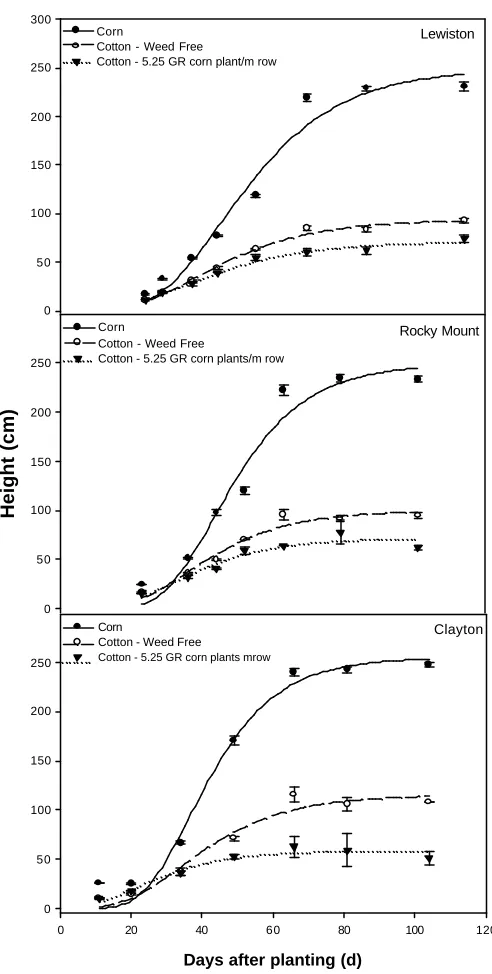
GR Corn and Cotton Height. GR corn and GR cotton heights were significantly
different at each location, thus data are presented by location. Heights of GR corn and GR
cotton plotted against time fit the Gompertz growth model well (Figure 1). Average
late-season height of GR corn was 248, 231, and 234 cm at Clayton, Lewiston-Woodville, and
Rocky Mount, respectively. GR corn began to grow taller than GR cotton as early as 25
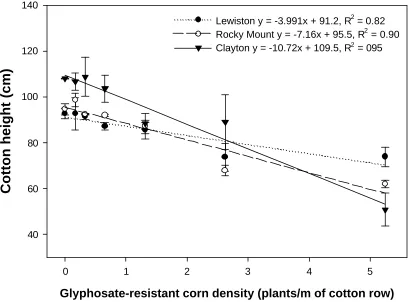
DAP, depending on location. In addition, cotton height decreased with increasing GR
corn density (Figure 2). When grown in competition with 5.25 GR corn plants per m of
row, cotton height was reduced by 49, 24, and 28% at Clayton, Lewiston-Woodville, and
Rocky Mount, respectively, compared to weed- free cotton (Figure 1). Weeds that grow
above crop canopies often intercept light and are more competitive. In addition to direct
influences on competition, tall weeds that canopy over cotton may interfere with
agrichemical deposition onto cotton foliage. Consequently, yield reduction could be
magnified due to indirect influences of weeds that grow taller than cotton like GR corn.
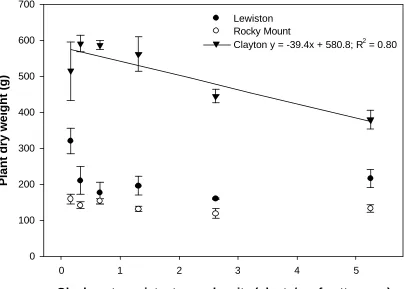
GR Corn Above-Ground Dry Biomass and Seed Production. The effect of GR corn density on GR corn dry biomass was significantly affected by location. Thus data are
shown by locations (Figure 3). Glyphosate-resistant corn above- ground dry biomass
decreased linearly with increasing weed density at Clayton. At Clayton, GR corn dry
biomass decreased from 515 g per plant at 0.16 plants/m of row to 379 g per plant at 5.5
plants/mof row. Buffalobur (Solanum rostratum Dunal.) (Rushing et al. 1985a), tropic
tumble pigweed (Amaranthus albus L.) (Rushing et al. 1985b), and velvetleaf (Abutilon
theophrasti Medicus) (Bailey et al. 2003)produced 325, 154, 268, and 177 g dry biomass
per plant, respectively at 0.2 plants/m density. Density-dependent decline in weed dry biomass per plant is indicative of intraspecific competition (Bridges and Chandler 1987;
Rushing et al. 1985a, 1985b; Snipes et al. 1982). However, at Lewiston-Woodville and
Rocky Mount, GR corn above- ground biomass was not linearly influenced. The use of
hybrid corn may have contributed to the lack of response of corn dry biomass to planting
density. Planting densities for corn production generally range from 4.9 to 6.9 plants per
m of corn row in North Carolina, depending on row spacing and water holding capacity
(Heiniger et al. 2005).
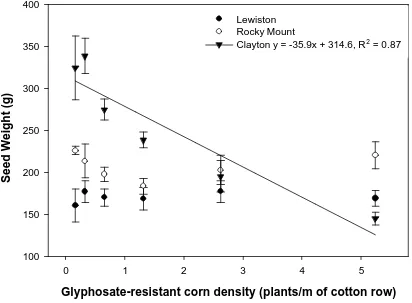
The effect of GR corn density on GR corn kernel production was affected by location,
thus data were shown by locations (Figure 4). There was an inverse relationship between
GR corn kernel bio mass and weed density at Clayton. At Clayton, GR corn kernel
biomass decreased from 324 g per plant at 0.16 plants/m of row to 145 g per plant at 5.5
plants/mof row. Similarly to GR corn above-ground dry biomass, the lack of response for
seed production at Lewiston-Woodville and Rocky Mount may be explained by the use of
hybrid corn and its corresponding recommended planting density.
Cotton Yield Loss. As GR corn dry biomass/m of crop row increased, cotton lint yield decreased (Figure 5). The relatio nship of dry biomass and lint yield varied between
locations. Cotton lint yield decreased 57, 54, and 145 kg/ha at Clayton,
Lewiston-Woodville, and Rocky Mount, respectively, with each 500 g increase in weed biomass/m
of crop row (Figure 4). At Rocky Mount, GR corn dry biomass remained relatively
in biomass production. Jimsonweed (Datura stramonium L.) (Scott et al. 2000),
ladysthumb (Polygonum persicaria var. persicaria L.) (Askew and Wilcut 2002a), Palmer
amaranth (Amaranthus palmeri L.) (Rowland et al. 1999), Pennsylvania smartweed
(Polygonum pensylvanicum var. laevigatum Fern.) (Askew and Wilcut 2002b), tropic
croton (Askew and Wilcut 2001), unicorn-plant [Proboscidea louisianica (Mill.) Thellung]
(Riffle et al. 1989), and velvetleaf (Smith et al. 1990) also exhibited an inverse relationship
of plant biomass to cotton lint yield.
Although i values varied from 5 to 9 among locations (Figure 6), concomitant changes
in a values were such that predicted lint yield losses at GR corn densities below two plants
per m of row were relatively stable. For example, one GR corn plant/m of crop row
decreased lint yield 8, 5, and 5% in Clayton, Lewiston-Woodville, and Rocky Mount,
respectively. Prediction accuracy at the lower end of weed density ranges is more
important than at higher weed densities since economic thresholds often occur at weed
densities below one weed/m of crop row (White and Coble 1997). Lee et al. (2005)
evaluated GR soybean as a weed in GR cotton with i values ranging from 1.7 to 2.8,
depending on location. Byrd and Coble (1991) reported between 1 and 6% lint yield loss,
depending upon year, with 0.33 large crabgrass plants per m of crop row. One
johnsongrass [Sorghum halepense (L.) Pers.] plant per m of cotton row reduced lint yield
by 56 and 86% in 1996 and 1997, respectively, when harvested with a spindle picker
(Wood et al. 2002). Bridges and Chandler (1987) reported yield losses of 14 and 40% with
johnsongrass densities of 0.4 and 0.8 plant per m, respectively. Brown et al. (1985)
investigated the influence of bermudagrass [Cynodon dactylon (L.) Pers.] interference
observed in the initial season with moisture stress during the cotton fruiting period (Brown
et al. 1985). However, in subsequent years, yield was negatively affected. For example,
one plant per 7.5 m of cotton row reduced yield at least 25% at all locations (Brown et al.
1985). Even though limited data are available for annual grass weed interference,
interference of numerous broadleaf weeds in cotton has been investigated. Cotton lint
yield losses ranged from 22 to 69% from a weed density of 1 plant/m of row for ivyleaf
morningglory, jimsonweed, ladysthumb, pale smartweed, Palmer amaranth, Pennsylvania
smartweed, tropic croton, and velvetleaf (Askew and Wilcut 2002a, 2002b, 2002c; Bailey
et al. 2003; Morgan et al. 2001; Rogers et al. 1996; Rowland et al. 1999; Scott et al. 2000;
Wood et al. 1999). Yield losses associated with GR corn were less than with many grass
and broadleaf weeds common in cotton but still significant due to value of the cotton crop.
Furthermore, these yield loss estimates may be overestimated due to the use of hybrid
corn. Jugenheimer (1976) discussed several characteristics of hybrid vigor. When hybrids
are open pollinated, hybrid vigor is reduced (Jugenheimer 1976). In normal field situations
with volunteer GR corn, these volunteers would display reduced vigor compared to
commercial hybrids.
Numerous graminicides, including clethodim, fluazifop, quizalofop, and sethoxydim,
are registered for POST treatment of GR corn control in GR cotton (York and Culpeper
2005). Herbicide costs as listed in HADSS3 plus a $10/ha application fee are shown (Table 2). Economic threshold was based on a support price of $1.32/kg for cotton lint
3 HADSS, Herbicide Application Decision Support System-North Carolina version,
(Askew and Wilcut 2001) and weed-free yield potential of 1,704, 1,668, and 1,577 kg/haat
Clayton, Lewiston-Woodville, and Rocky Mount, respectively. The economic threshold
for the various graminicides ranged from 2 to 8 GR corn plant per 100 m of crop row
(Table 2), depending on herbicide selection and weed- free yield potential. However, these
calculations assume that other cotton cultivars will respond similarly to GR corn
interference, that graminicides are equally efficacious, that similar weed- free yields are
attainable, and a selling price of $1.32/kg for cotton lint.
GR corn is less competitive than many grass and broadleaf weeds of cotton. In
addition to direct yield losses, GR corn may limit light interception, interfere with
agrichemical applications, and reduce harvest efficiency. Due to known differences
in hybrid vigor between commercial hybrids and open-pollinated hybrids
(Jugenheimer 1976), these data may overestimate the potential for corn to cause
yield losses due to the use of hybrid corn in this study.
ACKNOWLEDGEMENTS
The authors thank the excellent staff of the Central Crops Research, Peanut Belt
Research, and Upper Coastal Plain Research Stations for assistance and the North Carolina
Cotton Quality Improvement Committee and Cotton Incorporated for partial funding of
this research. We also thank Dr. Cavell Brownie for her review of statistical analyses.
Appreciation is also extended to Ian Burke, Jared Wilcut, and Caitlyn Wilcut for technical
LITERATURE CITED
Anonymous. 2005. Roundup WeatherMAX label. Monsanto Co., St. Louis. MO.
Askew, S. D. and J. W. Wilcut. 2001. Tropic croton interference in cotton. Weed Sci.
49:184-189.
Askew, S. D. and J. W. Wilcut. 2002a. Ladysthumb interference and seed production in
cotton. Weed Sci. 50:326-332.
Askew, S. D. and J. W. Wilcut. 2002b. Pennsylvania smartweed interference and achene
production in cotton. Weed Sci. 50:350-356.
Askew, S. D. and J. W. Wilcut. 2002c. Pale smartweed interference and achene
production in cotton. Weed Sci. 50:357-363.
Bailey, W. A., S. D. Askew, S. Dorai- Raj, and J. W. Wilcut. 2003. Velvetleaf (Abutilon
theophrasti) interference and seed production dynamics in cotton. Weed Sci.
51:94-101.
Bridges, D. C. and J. M. Chandler. 1987. Influence of johnsongrass (Sorghumhalepense)
density and period of competition on cotton yield. Weed Sci. 35:63-67.
Brown, S. M., T. Whitwell, and J. E. Street. 1985. Common bermudagrass (Cynodon
dactylon) competition in cotton (Gossypium hirsutum). Weed Sci. 33:503-506.
Byrd, J. D., Jr. and H. D. Coble. 1991. Interference of selected weeds in cotton
(Gossypium hirsutum). Weed Technol. 5:263-269.
Coble, H. D. and J. D. Byrd, Jr. 1992. Interference of weeds with cotton. In Weeds of
Cotton: Characteristics and Control. The Cotton Foundation, Memphis, TN. pp.
Cousens, R. 1988. Misinterpretations of results in weed research through inappropriate
use of statistics. Weed Res. 28:281-289.
Draper, N. R. and H. Smith. 1981. Applied Regression Analysis. J. Wiley, New York,
NY. pp. 33-42 and 511.
Heiniger, R. W., J. F. Spears, D. T. Bowman, and E. J. Dunphy. 2005. Crop management.
In North Carolina Corn Production Guide. North Carolina Cooperative Extension
Service, Raleigh, NC. online: http://www.ces.ncsu.edu/plymouth/cropsci/cornguide/.
Jasieniuk, M., B. D. Maxwell, R. L. Anderson, J. O. Evans, D. J. Lyon, S. D. Miller, D. W.
Morishita, A. G. Ogg, Jr., S. Seefeldt, P. W. Stahlman, F. E. Northam, P. Westra, Z.
Kebede, and G. A. Wicks. 1999. Site-to-site and year-to-year variation in Triticum
aestivum-Aegilops cylindrica interference relationships. Weed Sci. 47:529-537.
Jugenheimer, R. W. 1976. Heterosis. In Corn: Improvement, Seed Production, and Uses.
John Wiley & Sons: New York. pp. 55-60.
Lee, D. R., D. K. Miller, M. Matthews, J. W. Wilcut, I. C. Burke, and C. M. Wilcut. 2005.
When crops become weeds: effects of full season interference from Roundup Ready
cotton or soybean. Proc. Beltwide Cotton Conf. p. 2948.
McIntosh, M. S. 1983. Analysis of combined experiments. Agron. J. 75:153-155.
Morgan, G. D., P. A. Bauman, and J. M. Chandler. 2001. Competitive impact of Palmer
amaranth (Amaranthus palmeri) on cotton (Gossypium hirsutum) development and
yield. Weed Technol. 15:408-412.
Rawlings, J. O., S. G. Pantula, and D. A. Dickey. 1998. Applied regression analysis – A
Riffle, M. S., D. S. Murray, L. M. Verhalen, and D. L. Weeks. 1989. Duration and
intensity of unicorn-plant (Proboscidea louisianica) interference with cotton
(Gossypium hirsutum). Weed Technol. 3:313-316.
Rogers, J. B., D. S. Murray, L. M. Verhalen, and P. L. Claypool. 1996. Ivyleaf
morningglory (Ipomoea hederacea) interference with cotton (Gossypium hirsutum).
Weed Technol. 10:107-114.
Rowland, M. W., D. S. Murray, and L. M. Verhalen. 1999. Full-season Palmer amaranth
(Amaranthus palmeri) interference with cotton (Gossypium hirsutum). Weed Sci.
47:305-309.
Rushing, D. W., D. S. Murray, and L. M. Verhalen. 1985a. Weed interference with cotton
(Gossypiumhirsutum). I. buffalobur (Solanum rostratum). Weed Sci. 33:810-814.
Rushing, D. W., D. S. Murray, and L. M. Verhalen. 1985b. Weed interference with cotton
(Gossypiumhirsutum). II. tumble pigweed (Amaranthusalbus). Weed Sci.
33:815-818.
[SAS] Statistical Analysis Systems. 1998. SAS/STAT® User's Guide. Release 7.00.
Cary, NC: Statistical Analysis Systems Institute. 1028 p.
Scott, G. H., S. D. Askew, J. W. Wilcut, and C. Brownie. 2000. Datura stramonium
interference and seed rain in Gossypium hirsutum. Weed Sci. 48:613-617.
Smith, B. S., D. S. Murray, and D. L. Weeks. 1990. Velvetleaf (Abutilon theophrasti)
interference with cotton (Gossypium hirsutum). Weed Technol. 4:799-803.
Snipes, C. E., G. A. Buchanan, J. E. Street, and J. A. McGuire. 1982. Competition of
common cocklebur (Xanthium pensylvanicum) with cotton (Gossypium hirsutum).
USDA-NASS. 2000. Acreage 2000. Available at
http://usda.mannlib.cornell.edu/reports/nassr/field/pcp-bba/acrg2000.pdf (version
October 9, 2005). USDA-NASS, Washington, DC.
USDA-NASS. 2005. Acreage 2005. Available at
http://usda.mannlib.cornell.edu/reports/nassr/field/pcp-bba/acrg0605.pdf (version
October 9, 2005). USDA-NASS, Washington, DC.
White, A. D. and H. D. Coble. 1997. Validation of HERB for use in peanut (Arachis
hypogaea). Weed Technol. 11:573-579.
Wood, M. L., D. S. Murray, R. B. Westerman, L. M. Verhalen, and P. L. Claypool. 1999.
Full-season interference of Ipomoea hederacea with Gossypium hirsutum. Weed Sci.
47:693-696.
Wood, M. L., D. S. Murray, J. C. Banks, L. M. Verhalen, R. B. Westerma n, and K. B.
Anderson. 2002. Johnsongrass (Sorghum halepense) density effects on cotton
(Gossypium hirsutum) harvest and economic value. Weed Technol. 16:495-501.
York, A. C., A. M. Stewart, P. R. Vidrine, and A. S. Culpepper. 2004. Control of
volunteer glyphosate-resistant cotton in glyphosate-resistant soybean. Weed Technol.
18:532-539.
York, A. C., J. B. Beam, and A. S. Culpepper. 2005. Control of volunteer
glyphosate-resistant soybean in cotton. J. Cotton Sci. 9:102-109.
York, A. C. and A. S.Culpepper. 2005. Weed management in Cotton. In Cotton
Information AG 417. North Carolina Cooperative Extension Service, Raleigh, NC.
Table 1. Regression parameters (H = a e-be-Kt) describing the relationship between cotton height and time in days after crop planting at various densities of corn interference where
H, a, e, and t are based on the plant height in cm, the upper asymptote for late-season plant
height, the base of natural logarithm, and the time in days after planting, respectively,
while b and k are constants. Values in parenthesis are standard errors.
Location Interference
level
a b
K
R2
Cotton height (cm)
Lewiston- 0 93.9 (2.14) 8.55 0.067 0.99
Woodville 0.16 95.1 (3.67) 8.75 0.067 0.96
0.33 94.3 (1.95) 7.25 0.060 0.99
0.66 88.9 (3.42) 7.67 0.063 0.96
1.31 83.4 (3.92) 7.68 0.065 0.94
2.62 72.1 (2.98) 7.33 0.069 0.94
5.25 71.4 (2.81) 6.43 0.064 0.95
Rocky Mount 0 99.9 (4.02) 9.84 0.064 0.95
0.16 103.4 (3.45) 9.21 0.060 0.97
0.33 99.4 (3.39) 9.32 0.062 0.97
0.66 97.7 (3.19) 8.94 0.062 0.97
1.31 93.4 (4.06) 9.11 0.063 0.94
2.62 73.2 (4.86) 8.55 0.068 0.91
5.25 71.7 (4.86) 8.07 0.066 0.82
Clayton 0 115.4 (5.79) 8.30 0.062 0.95
0.16 118.7 (5.76) 9.58 0.064 0.95
0.33 115.7 (7.39) 6.32 0.053 0.93
0.66 113.1 (5.58) 5.42 0.050 0.96
Table 1 (continued)
2.62 91.3 (7.13) 4.18 0.048 0.89
5.25 58.6 (5.12) 4.81 0.073 0.71
Corn height (cm)
Lewiston-Woodville 249.2 (4.53) 12.26 0.066 0.96
Rocky Mount 249.5 (5.36) 20.6 0.070 0.93
Table 2. Economic thresholds for glyphosate-resistant corn in glyphosate-resistant cotton.
Herbicidea Cost
Clayton
Lewiston-Woodville
Rocky
Mount
Clayton
Lewiston-Woodville
Rocky
Mount
$/ha _ corn plants/100 m of row _ ______ plants/ha ______
Clethodim 35.37 5.05 5.26 2.92 523 546 318
Fluazifop 28.49 4.05 4.22 2.34 419 438 256
Quizalofop 50.04 7.19 7.52 4.15 745 777 453
Sethoxydim 28.15 4.00 4.18 2.31 415 433 253
Figure 1. Glyphosate-resistant corn height, glyphosate-resistant cotton height with no
weed interference, and glyphosate-resistant cotton height with 5.25 corn plant per m of
cotton row are shown. Bars represent standard error of the mean. Regression parameters
and corresponding R2 values are shown in Table 1.
0 50 100 150 200 250 300 Corn
Cotton - Weed Free
Cotton - 5.25 GR corn plant/m row
Height (cm) 0 50 100 150 200 250 Corn
Cotton - Weed Free
Cotton - 5.25 GR corn plants/m row
Days after planting (d)
0 20 40 60 80 100 120 0 50 100 150 200 250 Corn
Cotton - Weed Free
Cotton - 5.25 GR corn plants mrow
Lewiston
Rocky Mount
Figure 2. Effect of glyphosate-resistant corn density at the last measuring timing at each
location (104, 95, and 101 d after planting at Clayton, Lewiston-Woodville, and Rocky
Mount, respectively). Bars represent standard error of the mean.
Glyphosate-resistant corn density (plants/m of cotton row)
0 1 2 3 4 5
Cotton height (cm)
40 60 80 100 120 140
Figure 3. Effect of glyphosate-resistant corn density on late-season glyphosate-resistant
corn biomass per plant shown by location. Bars represent standard error of the mean. A
linear response was not observed at Lewiston-Woodville and Rocky Mount.
Glyphosate-resistant corn density (plants/m of cotton row)
0 1 2 3 4 5
Plant dry weight (g)
0 100 200 300 400 500 600 700
Lewiston Rocky Mount
Figure 4. Effect of glyphosate-resistant corn density on late-season glyphosate-resistant
corn seed weight per plant shown by location. Bars represent standard error of the mean.
A linear response was not observed at Lewiston-Woodville and Rocky Mount.
Glyphosate-resistant corn density (plants/m of cotton row)
0 1 2 3 4 5
Seed Weight (g)
100 150 200 250 300 350 400
Lewiston Rocky Mount