
Study Effect of Surface Porosity for Weight
Perforated Concrete Block Breakwater
Tamrin1
Dept. of Civil Engineer, Mulawarman University, Samarinda East Kalimantan 94779. Indonesia1
ABSTRACT: Perforated breakwater type is a type which rely on wave attenuation when reducing the wave height,
This type becoming the new type that can be developed for friendly breakwater. The efficiency of this breakwater can be measured by counting Transmission coefficient (KT).The greater of transmission coefficient, more affective the breakwater. According to the test results and some analysed non dimensional relation parameter obtained the fact that transmission coefficient from this Perforated Concrete Block Breakwater (PCBB) is very determined by holes diameter on the surface and the wave length is very influential to minimum weight requirement of perforated block breakwater.
KEYWORDS: Perforated concrete block breakwater, surface porosity , dimensionless parameter.
I. INTRODUCTION
Coastal damage usually caused by wave height through the beach, This is usually caused by the weather and destruction of coral reefs or mangrove which function as natural wave energy absorbers. Human effort to make a breakwater cannot be used to replace the coral reefs, or mangroves both technical and environmental aspects. So that the construction of breakwater frequently leaving sediment problem and moves the erosion somewhere, The effect of imbalance of longshore currents caused by obstruction of breakwater construction, so perforated concrete block structure will be a new alternative to solve this problem both of technical aspects , economic aspects and environmental aspects . This Perforated concrete blocks breakwater is a type of breakwater that using concrete block on surface and given holes evenly and through on the other side, so after the concrete block prepared then the holes connected from the front side until the back side , thus the incoming waves can be suppressed in all the holes of the concrete block .
Since Jarlan [3], had first suggested it, Perforated breakwater had been widely used to reduce the wave force that reached the front part of vertical wall breakwater. One of the important characteristics of a Perforated breakwater is that the wave energy will break if it hits the front part of the permeable and Perforated vertical wall breakwater. A research had also been done by Armono and Hall [2] for wave transmission in submerged breakwater that was made of artificial reefs/ hollow Hemispherical Shape Artificial Reefs (HSAR) in line with the result of the research done by Suh, et al. [4]. Then Wurjanto et al [1] had investigated the level of effectiveness perforated skirt breakwater (PSB) in the category of long wave and concluded that the higher the value of draft breakwater (s) the smaller the transmission coefficient could get (Kt) or the dissipation energy would be higher. Then Tamrin at al [8] had investigated about phenomena run up and run down at perforated concrete block breakwater (PSCBB) where run up and run down very small.
II. THEORY
1. Wave Mechanics
reflected and transmitted energy (Ht). The wave parameter according to Airy theory is the parameter based on the assumption of harmonic sinusoid [7], with few wave characteristics, those are the wave length (L), the complete description will be shown below.
Picture1. Wave Airy Theory Several used notations are:
d : distance between mean water level and sea floor ƞ (x,t) : fluctuation toward mean water level
a : wave amplitude H : wave height = 2 a L : wave length
T : wave period, time interval that’s needed by water particle to return to the same point similar to prior point C : wave velocity = L/T
k : wave index 2π/L σ : wave frequency 2π/T
The figure shows that the wave moves with the velocity of C in the water with depth of d. in this case, the moving element is just the water level form. Unlike the river basin in which the water (mass) particle moves in one closed orbit so that it doesn’t move forward. A buoy in the sea will only move up and down following the wave and does not move (in the wave direction) from its origin point. Position of particle every moment of the orbit moves is given by horizontal coordinate (ξ) and vertical (ε) towards central orbit. The vertical velocity is u and v, and water level elevation towards the still water (x axis) in every point is η.Water level profile is a function of space (x) and time (t) that has the following form
η(x,t)= H/2 cos(kx- σt) ………..(1)
Wave velocity(C) and wave length (L) is given in the following equation.
kd
gT
L
d
gT
C
tanh
2
2
tanh
2
………..………...…...(2)kd
gT
L
d
gT
L
tanh
2
2
tanh
2
2 2
………..………..…...(3)2. Wave energy
The total energy is the sum of kinetic energy and wave potential energy. Kinetic energy is the energy that caused by water particle velocity due to the motion of the waves. Potential energy is the energy that produced by displacement of water level due to the waves .Wave energy is the wave energy per unit time that propagates in the direction of wave propagation When a series of ocean waves moving in toward shore, then the wave will be deformation caused by the refraction and silting waves, diffraction, reflection, and wave breaking
Picture 2.Basic concept of waves energy equation
Equation of kinetic energy can be calculated is
2
2
1
dmV
dEk
2 2
2
1
v
u
dxdy
L
d
dydx
v
u
Ek
0 0
2 2
2
1
Completion of equations can write is
L
gH
Ek
216
1
... 4Equation of potential energy can write
2
16
1
gH
Ep
...5
Where Ek and Ep the same large, total energy wave energy
Ep
Ek
Ep
becomeL
gH
E
28
1
... 63. Wave reflection
Wave reflection is very important in planning breakwater where serenity shore waters after breaking wave due the breakwater. Breakwater structure it is good if the stricture can optimally absorb energy, with a little reflection.
Wave reflections expressed in terms of the reflection coefficient (Kr) which is defined as a match between the reflected wave height (Hr) against the coming wave height (Hi).
Hi
Hr
Kr
…….………..………7
With :
4. Wave Transmission
Transmission wave is a waves passing through the obstacles a building that parameter is expressed as the ratio between transmitted wave height ( Ht ) of the incoming wave height ( Hi ).
Hi
Ht
Kt
……….….8With :
Kt: transmission coefficient Hi : Incoming wave height Ht : Transmitted wave height
5. Modelling
The basic of the modelling used is concept with model scale to form back a phenomenon in a prototype in a smaller scale, so that the happening phenomenon in the model will be similar to the one exists in prototype. There are three criterions that’s required for the model according to the observed phenomenon characteristic, those are geometric similarity, kinematic similarity, and dynamic similarity. Geometric similarity is a similarity in which the form in the model is similar to the prototype but the size can be different. The comparison of the entire length of the model and the prototype is similar. In a perfect geometric similarity, the horizontal length scale and vertical length scale (is similar while in the distorted model, the length scale and height scale is not similar. Kinematic similarity is a similarity that fulfils the criterion of geometric similarity and the comparison between the velocity and current acceleration in two points in the model and prototype in the same direction is the same. Velocity scale is noted by nu, acceleration scale is noted by na, and time scale is nT. Dynamic similarity is a similarity that fulfils the criterion of geometric and kinematic similarity, and also the comparison between forces that work in the model and prototype for the entire current in the same direction is equal. All parameter in the coast must be adjusted with laboratory parameter, so the model have to made scale, the scale which done on this model is by using the principle of balance Froude[9] as in equation 6 , that can be written below
p m
m r m r
gL gL
F F
;
……….9
6. Method
In this model scale geometry adapted to the wave channel capability by comparing with the prototype. In coastal waters “Manggar Balikpapan”, the water depth that investigated is about 9 m and a maximum depth of the wave channel operated will be 30 cm so that made scale experiment 30: 900 or 1: 30, by using this scale of wave height at the study site of maximum 2.5 m so wave hight in the model is 250/30 = 8.3 cm, By using the Froude, the other parameter can be calculated including the scaling of time and heavy scaling. By using the timescale, Tp / Tm = 5:48, with T = 8 seconds then Tm = 8 / 5:48 = 1.45 sec, in this study used a period of 1.2 seconds, 1.45 seconds and 2 seconds so in this study can be modeled below:
(a) (b) (c)
Research scenario consists of 3 main parts
1.
Experiment with 3 different diameter variation of the hole by using a wavelength and different
wave height
2.
Experiment with varying the wave until the Perforated concrete block to shift or move
3.
The transmission coefficient ( KT) can be calculated with comparing the ratio between the
transmission wave height (Ht) , and the incoming wave height (Hi ).
The testing procedure can be seen in the following future:
7. Analysis of Dimension
To present the results of experimental be used the dimensional analysis method for connecting the
important parameters to obtain the relationship between the parameters that can be written as
follows
2 2 2
3
; ' ; ; ;
gT L H
A gT
B f
L L H
W
i a r
o r
……….………..10
III.DISCUSSION
Table 1. Result calculation of Hr and Ht
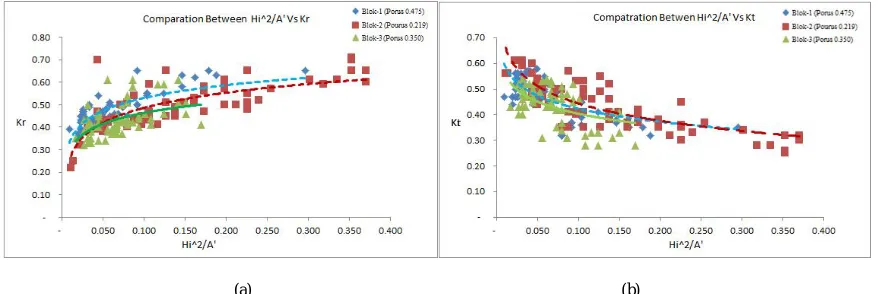
Table 1. shows incoming wave height is 1.9 cm with period 2 seconds, after passing the perforated concrete block obstacle with a diameter 2.8 cm with a width (B) is 15 cm capable of reducing a wave height until 63% it can be seen wave height after breakwater is 0.7 cm. this matter can be presented on a graph that connects between H^2 /A' VsKt and H^2/A' Vs Kr. As seen in the picture Non-dimensional relationships between these parameters can be presented as follows.
The wave height after passing through the breakwater becomes smaller because of wave energy attenuation that occurs due to a hole along the concrete block, it shows the effect of damping perforated concrete block breakwater depending on the porosity of the surface and attenuation length that traversed
(a) (b)
figure5(a). shows that the greater the surface porosity of the concrete blocks make more wave transmitted so that the value Kt is getting bigger, but the reflected wave is getting smaller as seen at the decline amount of value Kr it shown(b). Porosity at surface perforated concrete block affect the level of reduction breakwater, the smaller porosity would make wave height behind breakwater is getting low, but the reflection is getting enlarged and porosity that bigger make reduced damping ability breakwater.
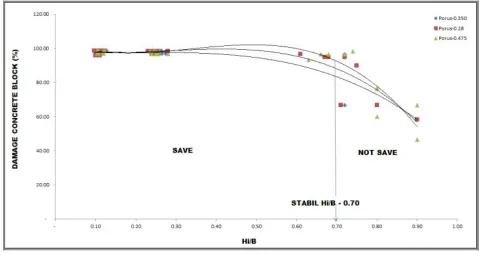
Picture 6.Concrete blocks damage % Vs Hi/B
Damage occurs in perforated concrete block which has a small width (B), width of the perforated concrete block arrangement greatly affect the stability of blocks, by taking the value Hi/B of 70% so relationship between porosity, wavelength and blocks heavy can be shown in Figure 7 below.
Picture 7. Relationship between Vs
Where :
W = Perforated concrete block weight
r
= Block densityA = Perforated Concrete block sectional area Luas A' = Hole width
Hi = Incident wave height Lo = Sea waves length
L = Wave length around breakwater area
= Surface porosity A'/Aa
= Water densityC = Perforated concrete blocks value 1.346
IV.CONCLUSION
1. Effect of hole diameter and porosity of the concrete block surfaces provide a very large effect on the value of Kt and Kr where The smaller the diameter of the Perforated concrete block will be smaller waves transitioned , the magnitude of the transmission is a logarithmic function of the ratio between the height of the wave at the surface porosity Size
2. Perforated concrete block weight proportional to the porosity of concrete block surface, wave length really take effect on minimum weight of concrete block
ANNOUNCEMENT
Department Civil of Engineer Hasanuddin University for facility to researched in Hydraulics and Coastal Engineering Laboratory
REFERENCES
1. AndojoWurjantodkk, “JurnalTeoretisdanTerapanBidangRekayasaSipil” PemodelanFisik 2-D untukMengukur Tingkat Efektivitas Perforated Skirt Breakwater padaKategoriGelombangPanjang”,Vol. 17 pp.211-2162010.
2. Armono, H.D., Hall, K.R.“Canadian Coastal Conference” , Wave Transmission On Submerged Breakwaters Made Of Hollow Hemispherical Shape Artificial Reefs,.2002
3. Jarlan, G. E. “National Research Council of Canada” The application of acoustic theory to the reflective properties of coastal engineering structure: DME/NAE Quarterly Bulletin, 1965
4. Suh, K.D., Choi, J.C., Kim, B.H., Park, W.S., and Lee, K.S., 2001, Reflection of Irregular Waves FromPerforated-Wall Caisson Breakwaters, Coastal Engineering 44, pp. 141–151.
5. CERC, “Shore Protection Manual”, Departement of The Army Waterway Experiment Station, Corps of Engineering Research Center, Fourth Edition, US Governtment Printing Office, Woshington.1984,
6. Dean.R.G., Dan Dalrymple. R.A, Water Wave Mechanics For Engineer and Scientist, Prentice Hall, Inc1984, 7. Triatmojo, B, “Teknikpantai”, Beta offset, Yogyakarta1999.
8. Tamrin, Salehpallu, Herman Parung, ArsyadThaha,“ARPNJournal of Engineering and Applied Sciences” The Reduction of Run-Up and Run Down With Perforated Concrete Block Breakwater, Vol 9 pp. 2022 – 2027, 2014
![Study of anthelmintic properties of 1 Nicotinoyl 4 aryl 3 methyl 3a,4 dihydropyrazolo[3,4c] pyrazoles and their inclusion complexes with β cyclodextrin](data:image/gif;base64,R0lGODlhAQABAIAAAP///wAAACH5BAEAAAAALAAAAAABAAEAAAICRAEAOw==)