Performance Evaluation of Beem
Based Protocol
Harpreet kaur
1, Amandeep kaur
2,
M.Tech Student, Department of ECE, Global Institutes of Management& Emerging Technologies, Batala Road, Asr, India1.
Head of Department of ECE, Global Institutes of Management & Emerging Technologies, Batala Road, Asr, India2.
ABSTRACT: Network lifetime is crucial in Wireless Sensor Network (WSN) systems since recharging or exchanging the sensors is difficult and expensive. In this paper, a novel algorithm Balanced Energy-Efficiency Multihop (BEEM) clustering algorithm has been improved. The improvement in the BEEM has been done by using the reactive principle i.e. hard and soft thresholding to reduce the number of communications between the sink and cluster heads. Also to improve the load balancing further the inter-cluster data aggregation criteria has also been used. In BEEM a node might not become cluster head for a long time so will result in load misbalancing so it has been removed by using the inter-cluster data aggregation. The effect of increase in the number of nodes will also be considered to evaluate the improvement of the reactive waiting based BEEM over existing BEEM.
KEYWORDS: Wireless Sensor Network (WSN), Balanced Energy-Efficiency Multihop (BEEM), EESCM,LEACH, HEED.
I. INTRODUCTION
Wireless sensor system is often a propagate Wireless band of cable connections which usually really is a collection regarding unbiased units including sensor nodes, routers, trip in which every sensor node possessing connection to be able to sensor. Facts is transmitted in a very tossed means coming from commencing to remove these types of nodes along with keeping track of with the physical or even environmental predicament is completed coming from rural spot. Your nodes are usually within an unexpected means and look after hint wirelessly. A wireless sensor network consists of a large amount of sensor nodes which can be densely deployed either inside the environmental surroundings or near it. The positioning of sensor nodes will not need to be engineered or predetermined. This permits random deployment in inaccessible hazardous environments. A number of the most crucial application areas of sensor networks include military, natural calamities, health, and home. In comparison with traditional ad hoc networks, probably the most noticeable point about sensor networks is that, they're limited in power, computational capacities, and memory.
Figure 1: Architecture of wireless sensor network
The Clustered Architecture is explained as below:
The clustering algorithms that are made is dependant on homogeneity and heterogeneity involving nodes. Among the original function advising this method in WSNs is actually LEACH (Low Power Adaptive Clustering Hierarchy). Just lately, we have seen all clustering strategies which are mostly versions involving LEACH process together with bit of a progress and different request scenarios. DEEC (Design of distributed energy-efficient clustering), EDACH (Energy-Driven Adaptive Clustering Hierarchy) and EEUC (An Energy-Efficient Unequal Clustering) are all clustering strategies proposed with the aim involving lessening vitality use, whilst extending system life.
Figure 2: WSN in Monsoon
The Objectives in clustering are Maximizing network Life-time and fault tolerance.In maximizing network lifetime,most of the sensor nodes include little energy resource. As a result, energy effectiveness will still be of growing concern all of which will continue being one of the many design and style goals of WSN. As a way to
BsNET/Runtime
Agent
Platform
Mons oon servic e
Agent Behav iour
Neighb or node scan
Try OS
Sensor Reading Comm. Control
Sensors Comm. hardware
Sensor Device
Internet Or Cellular
Monsoon Server
EAs DAs
Wireless Network Sensors Base
Station
Internet
Remote
ControllerUser
Sink
Sensor
overcome strength administration throughout WSN, clustering scheme has become pursued, to extend system life-time and aid alleviate the duty of each node transferring on to BALONEY as with regular practices like Primary Transmitting. Whenever some nodes that are acquiring a lesser amount of strength within the WSN and then the goal is usually to provide the strength to the next nodes previous to they will reported being thoroughly dead nodes.In Fault-tolerance, the clustering techniques are actually planned to deal with the challenge of node inability by utilizing proxy cluster-heads, in the case of inability in the 1st elected cluster-head or maybe possess little energy with regard to indication. A few other literatures possess used adaptive clustering scheme, to cope with node downfalls.In Load balancing,fill controlling technique may be one more design and style aim of clustering strategies. This can be essential to not more than burden the cluster-heads since this could wipe out the efforts quicker. Therefore, it is very important possess even submitting of nodes throughout each and every group.
II. RELATED WORK
existing state-of-the-art methodologies and algorithms intended for WMNs .Sohrabi et al. [23] System self-assembly and steady circle self-organization through the lifetime of this circle in the dependable, useful, and scalable approach are crucial intended for profitable deployment and operations connected with these kinds of networks.Gao et al. [24] received presented any system-level portrayal from the vitality ingestion intended for sensor circle application examples. Shanbehzadeh et al. [25] tried using get over the challenge of energy simply by optimizing this nodes' energy ingestion.Grams Daniel et al. [26] tried using to resolve the challenge connected with course-plotting scalability, this Hierarchical State Direction-finding system into a hierarchical multi layer environment continues to be expanded. Huang et al. [27] lengthen these disorders from the cluster-based course-plotting methodologies when it comes to common algorithm complexity connected with facts blend, common compressing percentage connected with facts blend, and circle area along with long distance corresponding these three common examination techniques to assess the vitality efficiency from the cluster-based course-plotting methodologies. Tashtarian et al. [28] looked at any clustering process intended for individual wireless sensor networks that will engages any cut-throat system intended for chaos head collection. EECS-M continues to be suggested that is the changed version for the renowned process EECS exactly where a few of the nodes come to be volunteers to become chaos heads by having an similar possibility. Ando et al. [29] Cluster enhancement and cluster head collection are essential difficulties in sensor circle apps and can greatly have an impact on this network's verbal exchanges vitality dissipation. To be able to manage this matter, a power reduction algorithm intended for sensor networks according to fuzzy common sense and variety of neighbor’s nodes continues to be suggested.
III. LIMITATIONS IN EARLIER TECHNIQUES
There are following gaps has been shown in the literature survey.
1. The use of the hard and soft thresholding has been ignored by the most of the existing researchers. 2. In BEEM a node might not become cluster head for a long time so will result in load misbalancing 3. The effect of the nodes scalability has been ignored in the BEEM.
IV. PROPOSED ALGORITHM
Following are the various steps required to successfully simulate the proposed algorithm.
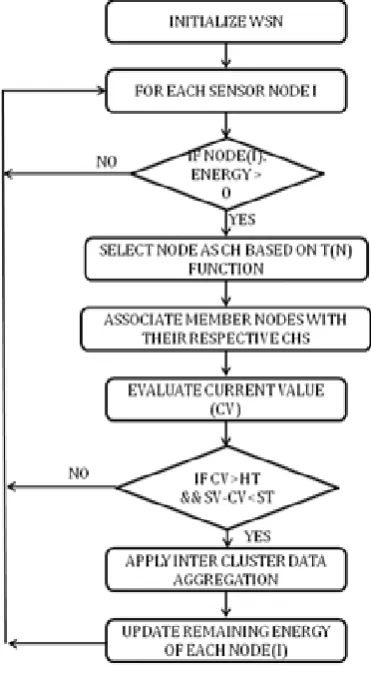
Step 1: First of all initialize WSN with their respective characteristics.
Step 2: For each node i repeats the following steps
Step 3: If given node has energy more than 0 that means it is alive node only then repeat upcoming steps else move back to step 2.
Step 4: Select node as a CH if it holds the properties of improved cluster head selection.
Step 5: Now association of the nodes will be done with their nearest CHs.
Step 6: Now evaluate the current value from the sensor field.
Step 7: If CV>HT and SV-CV <ST then inter-cluster data aggregation data communication will be required so move to step 8 else move to step 2.
Figure 3: Flowchart of the proposed technique
V. RESULTS AND DISCUSSION
The proposed algorithm is tested on various parameters. The algorithm is applied using various performance indices First Dead Nodes, Half Dead Nodes and Last Dead nodes.
In order to implement the proposed algorithm, design and implementation has been done in MATLAB processing toolbox. We are comparing proposed approach using some performance metrics. Result shows that our proposed approach gives better results than the existing technique.
First Dead Node
Table 5.1: First Dead Node
Figure 4. shows the comparison graph when first node dies in Existing and Proposed for the number of nodes from 100 to 280. Blue color in the graph represents the Existing and Red color represents the proposed algorithm. We can find that proposed algorithm performs much better than the Existing when first node dies as much later in Proposed than in Existing.
Figure 4: ComparisonGraph when first node is dead in Existing and Proposed Algorithm
Half Dead Nodes
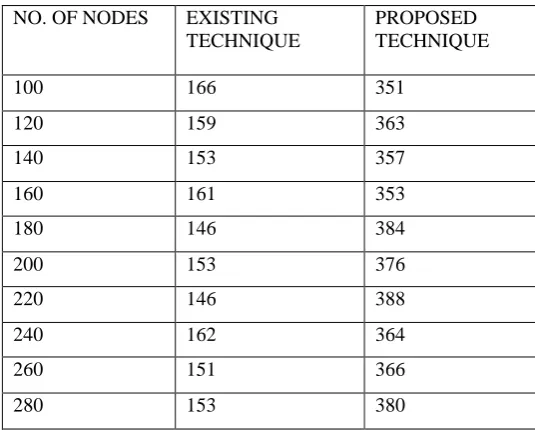
Table 5.2 is showing the comparative analysis of the half dead nodes. In the below table it represents the various numbers of nodes and according these nodes different values of existing and proposed technique respectively.
NO. OF NODES EXISTING TECHNIQUE
PROPOSED TECHNIQUE
100 166 351
120 159 363
140 153 357
160 161 353
180 146 384
200 153 376
220 146 388
240 162 364
260 151 366
Table 5.2: Half Dead Nodes
Figure5. shows the comparison graph when half node dies for Existing and Proposed for the number of nodes from 100 to 280. In the graph x-axis represents the number of nodes given and y-axis represents the number of rounds. Blue colour in the graph represents the Existing and red colour represents the Proposed.
Figure 5: ComparisonGraph when half nodes are dead in Existing and Proposed algorithm
Last Dead Nodes
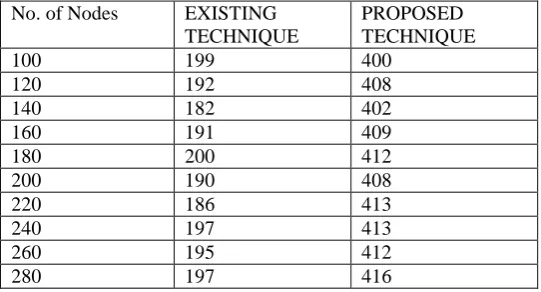
Table 5.3 is showing the quantized analysis of the Last Dead Nodes. In the below table it represents the various numbers of nodes and according these nodes different values of first dead nodes in existing and proposed technique respectively.
No. of Nodes EXISTING TECHNIQUE
PROPOSED TECHNIQUE
100 199 400
120 192 408
140 182 402
160 191 409
180 200 412
200 190 408
220 186 413
240 197 413
260 195 412
Table 5.3: Last Dead Nodes
No. of Nodes EXISTING TECHNIQUE
PROPOSED TECHNIQUE
100 462 507
120 457 517
140 475 532
160 457 499
180 481 508
200 493 550
220 524 515
240 460 528
260 481 517
280 492 541
Figure 6. shows the comparison graph when all nodes are dead for Existing and Proposed algorithm for the number of nodes from 100 to 280 and x-axis represents number of nodes given and y-axis represents the number of rounds. Blue color in the graph represents the Existing and red color represents the proposed algorithm.
Figure 6: ComparisonGraph when all nodes are dead in Existing and Proposed algorithm
VI. CONCLUSION
Wireless Sensor Network (WSN) systems since recharging or exchanging the sensors is difficult and expensive. In this paper, a novel algorithm Balanced Energy-Efficiency Multihop (BEEM) clustering algorithm has been improved. The improvement in the BEEM has been done by using the reactive principle i.e. hard and soft thresholding to reduce the number of communications between the sink and cluster heads. Also to improve the load balancing further the inter -cluster data aggregation criteria will also be used. In BEEM a node might not become -cluster head for a long time so will result in load misbalancing so it will be removed by using the inter-cluster data aggregation. The effect of increase in the number of nodes will also be considered to evaluate the improvement of the reactive waiting based BEEM over existing BEEM.
result in improve network lifetime. Therefore, in near future evolutionary optimization based node deployment algorithms will also be considered.
REFERENCES
1. Heinzelman, W., Chandrakasan, A., and Balakrishnan, H., “Energy-Efficient Communication Protocol for Wireless Microsensor Networks” IEEE Proceedings of the 33rd Hawaii International Conference on System Sciences, pp. 3005-3014, Jan 2000.
2. Smaragdakis, Georgios, Ibrahim Matta, and Azer Bestavros. “SEP: A stable election protocol for clustered heterogeneous wireless sensor networks”, Boston University Computer Science Department, 2004.
3. Guisheng Yin1, Guang Yang1,2, Wu Yang1,2, Bingyang Zhang1,2, Wenjin Jin1,2 “An Energy-Efficient Routing Algorithm for Wireless Sensor Networks”, International Conference on Internet Computing in Science and Engineering (IEEE) (2008),28-29 Jan; Harbin, pp.181-186.
4. Sun, J., Chen, W., Zhang, B., Liu, X. and GU, X., “Energy-efficient Clustering Routing Protocol Based on Weight”, IEEE International Conference on Wireless Communications & Signal Processing, pp. 1-5,November 2009.
5. Yuhua Liu Yongfeng Zhao Jingju Gao “A New Clustering Mechanism Based On LEACH Protocol”, International Joint Conference on Artificial Intelligence (IEEE) (2009), 25-26 April; Hainan, Island, pp.715-718.
6. Babaie, S., Agaalizadeh, S. and Golsorkhtabar, M. “The Novel Threshold Based Hierarchical Clustering Method for Wireless Sensor Network”, IEEE International Conference on Electronics and Information Engineering (ICEIE), pp. 191 – 195,august 2010.
7. Bakr, B. A. and Leszek, L., “Extending Wireless Sensor Network Lifetime in the LEACH-SM Protocol by Spare Selection”,IEEE 5th Conference on Innovative Mobile and Internet Services in Ubiquitous Computing, pp. 277-282, , July 2011.
8. Ma Chaw Mon Thein, ThandarThein “An Energy Efficient Cluster-Head Selection for Wireless Sensor Networks”, International Conference on Intelligent Systems, Modelling and Simulation (IEEE) (2010), 27-29 Jan ; Liverpool, pp.287-291.
9. Melese, D. G., Xiong, H., and Gao Q., “Consumed Energy as a Factor For Cluster Head Selection in Wireless Sensor Networks”, IEEE 6th International Conference onWireless Communications Networking and Mobile Computing (WiCOM), pp. 1-4.
10. Peng, J., Chengdong, W., Yunzhou, Z. and Fei, C., “A Low-Energy Adaptive Clustering Routing Protocol of Wireless Sensor Networks”, IEEE International Conference on Wireless Communications, Networking and Mobile Computing (WiCOM), pp. 1-4 September 2011.
11. VivekKatiyar, Narottam Chand, Gopal Chand Gautam,Anil Kumar “Improvement in LEACH Protocol for Large-scale Wireless Sensor Networks”, (IEEE), 23-24 March; Tamil Nadu, pp.1070-1075, 2011
12. ReetikaMunjal, Bhavneesh Malik “Approach for Improvement in LEACH Protocol for Wireless Sensor Network”, Second International Conference on Advanced Computing & Communication Technologies (IEEE) Rohtak, Haryana, pp.517-521, 2012.
13. Shuo Shi, Xinning Liu and XuemaiGu “An Energy-Efficiency Optimized LEACH-C forWireless Sensor Networks”, 7th International ICST Conference on Communications and Networking in China (CHINACOM) (IEEE) , kun Ming, pp.487-492. 2012
14. Thu Ngo Quynh1, Kieu-Ha Phung2,3, Hoan Vu Quoc1 “Improvement of Energy Consumption and Load Balance for LEACH in Wireless Sensors Networks”, (IEEE) 15-17 Oct; Jeju, Island, pp.583-588, 2012.
15. M M Islam1, M A Matin2, T K Mondol1 “Extended Stable Election Protocol (SEP) for ThreelevelHierarchical Clustered Heterogeneous WSN”, (IEEE) London, pp.1-4, 2012
16. Lu, Y., Zhang D., Chen1 Y., Liu, X. and Zong P., “Improvement of L EACH in Wireless Sensor Network Based on Balanced Energy Strategy” IEEE Proceeding of International Conference on Information and Automation Shenyang, China, June 2012 on p 111-115 in IEEE,2013.
17. Heinzelman, W., Anantha, P. and Balakrishnan, H. “An Application-Specific Protocol Architecture for Wireless Micro sensor Networks” IEEE Transactions on Wireless Communications, in IEEE Vol. 1,No 4, pp.661-670, 2002
18. Xu, Lina, G. M. P. O'Hare, and Rem Collier. "A Balanced Energy-Efficient Multihop clustering scheme for Wireless Sensor Networks." In Wireless and Mobile Networking Conference (WMNC), 2014 7th IFIP, pp. 1-8. IEEE, 2014.
19. Hussain, Sajid, Abdul W. Matin, and Obidul Islam. "Genetic algorithm for energy efficient clusters in wireless sensor networks." In null, pp. 147-154. IEEE, 2007.
20. Hussain, Sajid, and Abdul W. Matin. "Energy efficient hierarchical cluster-based routing for wireless sensor networks." Jodrey School of Computer Science Acadia University Wolfville, Nova Scotia, Canada, Technical Report, pp: 1-33,2005.
21. Nam, Choon Sung, Young Shin Han, and Dong Ryeol Shin. "Multi-hop routing-based optimization of the number of cluster-heads in wireless sensor networks." Sensors 11, no. 3 (2011): 2875-2884.
22. Akyildiz, Ian F., and Xudong Wang. "A survey on wireless mesh networks."Communications Magazine, IEEE 43, no. 9 (2005): S23-S30.
23. Sohrabi, Katayoun, William Merrill, Jeremy Elson, Lewis Girod, Fredric Newberg, and William Kaiser. "Methods for scalable self-assembly of ad hoc wireless sensor networks." Mobile Computing, IEEE Transactions on 3, no. 4 (2004): 317-331.
24. Gao, J. L. "Analysis of energy consumption for ad hoc wireless sensor networks using a bit-meter-per-joule metric." IPN Progress Report (2002): 42-150. 25. Shanbehzadeh, Jamshid, Saeed Mehrjoo, and Abdolhossein Sarrafzadeh. "An intelligent energy efficient clustering in wireless sensor networks."
InProceedings of the International Multiconference of Engineers and computer Scientists, vol. 1, pp. 16-18. 2011.
26. Gu, Daniel Lihui, Guangyu Pei, Henry Ly, Mario Gerla, and Xiaoyan Hong. "Hierarchical routing for multi-layer ad-hoc wireless networks with UAVs." InMILCOM 2000. 21st Century Military Communications Conference Proceedings, vol. 1, pp. 310-314. IEEE, 2000.
27. Huang, Guangyan, Xiaowei Li, and Jing He. "Energy-efficiency analysis of cluster-based routing protocols in wireless sensor networks." In Aerospace Conference, 2006 IEEE, pp. 8-pp. IEEE, 2006.
28. Tashtarian, Farzad, M. Tolou Honary, Majid Mazinani, A. T. Haghighat, and Jalil Chitizadeh. "A new level based clustering scheme for wireless sensor networks." In Computer Systems and Applications, 2008. AICCSA 2008. IEEE/ACS International Conference on, pp. 284-290. IEEE, 2008.