Equilibrium Studies of Methylene Blue from
Aqueous Solution Using Low Cost Adsorbent
B.Saritha
1,
K. Rajasekhar
2,
Khriezo Kiso
31,2,3 Department of Civil Engineering, Bharath Institute of Science and Technology, Bharath University, Selaiyur, Chennai,
India
ABSTRACT: In this study, adsorption of Methylene blue using low cost adsorbent corn cob has been investigated.
Removal of this dye from aqueous solution using corn cob has been investigated. Liquid phase adsorption experiments were conducted. Batch adsorption studies were carried out by observing the effect of pH, amount of adsorbent, contact time and initial concentration.The results generated by this work can be used for determination of optimum conditions for adsorption of dye in aqueous solutions. Dye is present in mixture form in various industrial effluents like Textile Industries, Sewage water, Water treatment plants. Adsorption increases with increase in pH. The adsorption of cationic dye is mainly influenced by the amount of negative charges in the solution which is actually influenced by the solution pH. At pH=2 there is net positive charge in the solution so adsorption is less whereas at pH=12 there is increase in negative charges increasing adsorption of Methylene blue. Maximum adsorption was found to take place at pH=12. Adsorption tends to increase with contact time. At first the increase in adsorption is very rapid as there are lots of free sites for the adsorption to take place. Adsorption decreases at later stages till saturation is reached due to saturation of active sites.
KEYWORDS:-Corn cob, Adsorption, Methylene blue.
I.INTRODUCTION
There are various ways to remove dyes from wastewater discharges like coagulation, electrochemical process, membrane separation process, chemical oxidation, reverse osmosis and aerobic and anaerobic microbial degradation. Many of these processes are not so popular due to their economic disadvantages and inefficiency. Coagulations and chemical and electrochemical oxidations have low feasibility on large scale plants. Adsorption is preferred over these processes and is widely used due to low cost and high performance. Common adsorbents are activated carbon, alumina silica and metal hydroxides. Economic advantages, performance efficiencies and environment are the main concerns when selecting an adsorbent, thus researchers generally goes for using low-cost adsorbents like char from agricultural wastes and others.
II.
MATERIALS AND METHODS
2.1 Preparation of adsorbent
Corn cob collected from local agricultural field and dried. Then the corn is grinded using grinder.Then the powder is sieved at a size of 150 µm. Then it is washed with distilled water. Then it is dried using hot air oven at 100oC for 5hrs. Now the corn cob absorbent is stored in vacuum desiccators.
2.2 Preparation of dye solution
Stock solution of Methylene blue was prepared by dissolved 500 mg of dye in 1L of distilled water to give concentration of 500mg/L.
2.3 Batch adsorption experiment
Batch mode experiment were carried out in orbital shaker at a constant speed of 120 rpm using 250ml conical flask containing 50 mg of adsorbent with 10 ml of dye solution after predetermined time intervals sample were withdrawn from the flask. The adsorbent were separated from the solution by centrifuge (REMI make) at 6000rpm for 5 min.The dye concentration was determined spectrophotometrically using Ellico make UV- Visible spectrophotometer.
III.
RESULT AND DISCUSSION
3.1. Effect of contact timeFigure 1. Effect of Contact Time on MB Adsorption by Corn Cob
3.2. Effect of pH
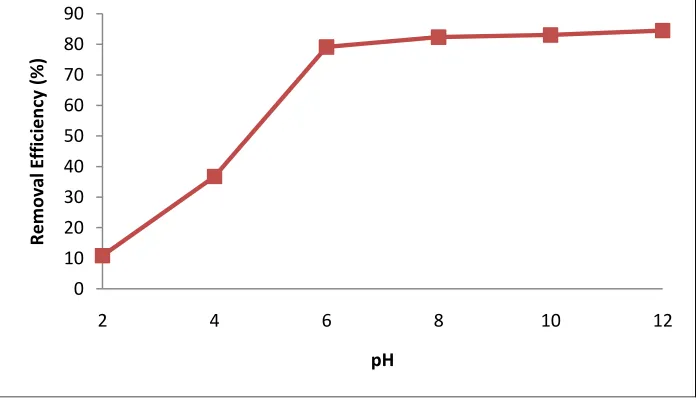
The effect of pH was investigated by employing initial concentration of dye 10mg/L. The initial pH values were adjusted with 0.1N H2SO4 and 0.1N NaOH to form a series of pH from 2 to 12. The result shows that there was significant change in the removal of dye over the entire pH range. This indicates that either H+ or OH- ions influence the dye adsorption onto adsorbent.
Figure 2. Effect of pH on MB Adsorption by Corn Cob 0
10 20 30 40 50 60 70 80 90
0 10 20 30 40 50 60 70 80 90 100
R
e
m
o
val
E
ff
ic
ie
n
cy
(%
)
Contact Time (minutes)
0 10 20 30 40 50 60 70 80 90
2 4 6 8 10 12
R
e
m
o
val
E
ff
ic
ie
n
cy
(%
)
3.3. Effect of initial concentration
The adsorption experiment was carried out. The initial concentration of dye was increased from 10mg/L to 100mg/L.It is because of the fact that at lower concentration the ratio of the initial number of dye molecules to the available surface area is low subsequently the fractional adsorption becomes independent of initial concentration. However at higher concentration the available sites of adsorption becomes fewer and hence the percentage removal of dye is dependent upon initial concentrations.
Figure 3. Effect of initial concentration on MB Adsorption by Corn Cob
3.4. Effect of adsorbent dosage
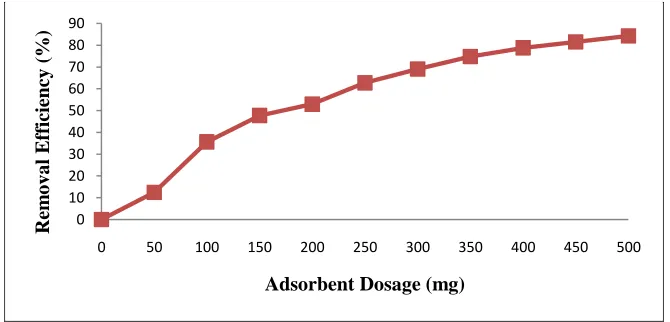
The effect of adsorbent dosage on removal of dye at constant concentration 10mg/L were investigated by agitating with different adsorbent dosage over the range 50 mg to 500mg. The study reveals that percentage of adsorption increases with increasing the adsorbent dosage. This attributes has increased corn cob powder surface area and availability of more adsorption sites.
Figure 4. Effect of adsorbent dosage on MB Adsorption by Corn Cob
0 10 20 30 40 50 60 70 80 90
10 20 30 40 50 60 70 80 90 100
Rem
o
v
a
l
E
ff
iciency
(
%)
Initial Concentration (mg/l)
0 10 20 30 40 50 60 70 80 90
0 50 100 150 200 250 300 350 400 450 500
Rem
o
v
a
l
E
ff
iciency
(
%)
3.5 Equilibrium isotherms
3.5.1 Langmuir isotherm
The linear form of Langmuir isotherm assumes monolayer adsorption onto a surface Containing a finite number of adsorption sites of uniform strategies of adsorption Without interaction between adsorbed molecules commonly expressed as (Uma et al., 2013; Hameed, 2009).
Ce/qe=1/bQo+Ce/Qo Where,
Qo is a constant related to adsorption capacity (mg/g) b is Langmuir constant related to energy of adsorption (mg/L) Ce is equilibrium constant of dye (mg/L)Qe is amount of dye adsorbed at equilibrium (mg/g)
The linear plot of Ce/qe versus Ce .the constant Qo and b can be calculated from slope and intercept of the plot. The shape of the Langmuir isotherm was investigated by the dimensionless constant separation term (RL) to determine high affinity adsorption and is expressed as RL=1/ (1+bC0). RL value indicates the nature of adsorption process as given below.
RL value Adsorption
RL>1 Unfavorable
RL=1 Linear
0<RL<1 Favorable
RL=0 Irreversible
b =22.93, C=1.99 RL
=1/1+b*C0 RL
=0.0214
y = 0.022x - 1.99 R² = 0.992
0 0.05 0.1 0.15 0.2 0.25
0 0.05 0.1 0.15 0.2 0.25
C
e/
qe(
g
\l)
Ce(mg\l)
In the present investigation the RL value is less than one which shows that the adsorption process was favorable.
3.5.2 Freundlich isotherm
The Freundlich isotherm is applicable to non-ideal adsorption on heterogeneous surfaces result of the assumption that the adsorption occurs and non-uniform distribution of the heat of adsorption over the adsorbent surface takes place (Freundlich, 1885). The linear form of the isotherm can be represented as: The Freundlich isotherm is based on multilayer adsorption on heterogeneous surface. Linear from of Freundlich equation islog qe=logkf+1/n log Ce
Where,
qe is dye concentration at equilibrium (mg/g)
Ce is dye concentration in solution at equilibrium (mg/L) Kf is measure of adsorption capacity (mg/g)
n is adsorption intensity
The values of 1/n and kf can be calculated from the slope and intercept respectively and the result are given below.When 1/n is >1.0, the change in adsorbed dye concentration is greater than the change in the concentration in the solution.
Slope =1/n= 0.353 Intercept = log kf =0.068
ISOTHERM CONSTANTS MODELS
Langmuir Qm(mg/g) b R2
isotherm 45.45 22.93 0.992
Freundlich
isotherm Kf ( mg/g) n R2
0.068 0.353 0.950
Removal of Methylene blue from aqueous solutions by adsorption with Corn Cob has been experimentally determined and the following observations were made. The percentage of colour removed increases with increasing adsorbent dosage.The adsorption rates decreases with increasing initial concentration. Optimum contact time for equilibrium is found to be 100 minutes. It is basically due to saturation of the active site which does not allow further adsorption to take place. For Methylene blue maximum adsorption is found to be at pH = 12.The adsorption of these positively charged dye groups on the adsorbent surface is primarily influenced by the surface charge on the adsorbent which in turn is influenced by the solution pH. The Langmuir equation assumes that there is no interaction between the adsorbate molecules and that the sorption is localized in a monolayer. It is then assumed that once a dye molecule occupies a site, no further adsorption can take place at that site. The Freundlich adsorption model assumes that adsorption takes place on heterogeneous surfaces. Adsorption increases with increase in pH. The Freundlich adsorption model assumes that adsorption takes place on heterogeneous surfaces. Adsorption increases with increase in pH. The adsorption of cationic dye is mainly influenced by the amount of negative charges in the solution which is actually influenced by the solution pH. At pH=2 there is net positive charge in the solution so adsorption is less whereas at pH=12 there is increase in negative charge increasing adsorption of Methylene blue. Maximum adsorption was found to take place at pH=12. Adsorption tends to increase with contact time. At first the increase in adsorption is very rapid as there are lot of free sites for the adsorption to take place. Adsorption decreases at later stages till saturation is reached due to saturation of active sites.
REFERENCES
[1] B.H. Hameed, A.T.M. Din, A.L. Ahmad (2006) Adsorption of methylene blue onto Bamboo-based activated carbon: Kinetics and equilibrium studies.
[2] Sathish Kumar M., Karrunakaran C.M., Vikram M., "Process facilitated enhancement of lipase production from germinated maize oil in Bacillus spp. using various feeding strategies", Australian Journal of Basic and Applied Sciences, ISSN : 1991-8178, 4(10) (2010) pp. 4958-4961. [3] C. Namasivayam*, D. Kavitha (2001) Removal of Congo Red from water by adsorption Onto activated carbon prepared from coir pith, an
agricultural solid waste, Dyes and Pigments 54 (2002) 47–58.
[4] Karthikeyan T., Subramaniam R.K., Johnson W.M.S., Prabhu K., 'Placental thickness & its correlation to gestational age & foetal growth parameters- a cross sectional ultrasonographic study", Journal of Clinical and Diagnostic Research, ISSN : 0973 - 709X, 6(10) (2012) pp.1732-1735.
[5] Emad N. El Qada∗, Stephen J. Allen, Gavin M. Walker (2006) Adsorption of Methylene Blue onto activated carbon produced from steam activated bituminous coal, Chemical Engineering Journal 124 (2006) 103–110.
[6] Ramakrishnan V., Srivatsa S.K., "Pitch control of wind turbine generator by using new mechanism", Journal of Electrical Systems, ISSN : 1112-5209, 6(1) (2010) pp.1-15.
[7] 4.Grabowska EwaLorenc, GryglewiczGra_zyna (2005) Adsorption characteristics of Congo red on coal-based mesoporous activated carbon, Dyes and Pigments 74 (2007)34-40.
[8] Shirley Gloria D.K., Immanuel B., Rangarajan K., "Parallel context-free string-token petri nets", International Journal of Pure and Applied Mathematics, ISSN : 1311-8080, 59(3) (2010) pp.275-289.
[9] I.A. Rahman, B. Saad, S. Shaidan, E.S. Sya Rizal (2005) Adsorption characteristics of Methylene blue on activated carbon derived from rice husks produced by chemical–Thermal process, Bioresource Technology 96 (2005) 1578–1583.activated carbon kinetic study and equilibrium isotherm analysis. Colloids and Surfaces, 264(2005) 17-28.
[10] Rekha C.V., Aranganna P., Shahed H., "Oral health status of children with autistic disorder in Chennai", European Archives of Paediatric Dentistry, ISSN : 1818-6300, 13(3) (2012) pp.126-131.
[11] Khan A. Tabrez, Imran Ali, Singh VedVati and Sharma Sangeeta (2009) Utilization of Fly ash as Low-Cost Adsorbent for the Removal of Methylene Blue, Methylene blue and Rhoda mine B Dyes from Textile Wastewater, journal of environmental protection science(2009), Vol. 3, pp.11 – 22.
[12] M. Hema and P. Martin Deva Prasath (2009) Adsorption of Methylene blue onto carbon Prepared from brasses bark, The Arabian Journal for Science and Engineering, Volume34, Number 2A, July 2009.
[13] Nagarethinam Kannan and MariappanMeenakshiSundaram (2001), Adsorption of Congo [14] Red on Various Activated Carbons -A Comparative Study
[17] V.K. Garg), MoirangthemAmita, Rakesh Kumar, Renuka Gupta (2004) Basic dye(Methylene blue) removal from simulated wastewater by adsorption using Indian Rosewood sawdust: a timber industry waste, Dyes and Pigments 63 (2004) 243e250.
[18] Y. Onal,C. Akmil-Basar, DidemEren, CigdemSarıcı-O zdemir, TolgaDepci(2006)Adsorption kinetics of Methylene blue onto activated carbon prepared from Tunc¸bilek lignite, Journal of Hazardous Materials B128 (2006) 150–157.
[19] YaminYasin, MohdZobir Hussein and FaujanHj Ahmad (2007) Adsorption of Methylene blue onto Treated Activated Carbon, The Malaysian Journal of Analytical sciences, Vol 11, No 11 (2007): 400 – 406.
[20] Bhattacharyya K.G. and Sharma A. (2005) Kinetics and mechanism of removal of methylene blue by adsorption on various carbons-a comparative study, Dyes and pigments, 51, 25-40.
[21] Choy K.K.H., McKay G. and Porter J.F. (1999) sorption of acid dyes from effluent using activated, Resour.Conserv. Recy, 27, 57-71.
[22] Chuah T.G., Jumasiah A., Azni I., Katayon S. and Thomas Choong S.Y. (2005) Rice husk as a potentially low-cost biosorbent for heavy metal and dye removal: an overview, Desalination, 175(3), 305-316.
[23] Daifullah A.A.M., Girgis B.S. and Gad H.M.H. (2003) Utilization of agro-residues (rice husk) in small Waste water treatment plans, Materials Letters, 75, 1723-1731.
[24] Eastoe J. and Dalton J.S. (2000) Dynamic surface tension and adsorption mechanisms of surfactants at the air water interface, Adv. Colloid Interface Sci., 85, 103–144.
[25] Freundlich H. (1906), Umber die adsorption in lösungen [Adsorption in solution] Z.Phys. Chem., 57,384–470.
[26] Gould J.M. (1984) alkaline peroxide delignification of agricultural residues to enhance, Biotechnologyand Bioengineering, 26, 46-52.
[27] GuptaM.P.andBhattacharya P.K. (1985) , Studies on color removal from bleach plant effluent of a craft pulp, Chem.TechnolBiotechnol, 35B, 23-28.
[28] Gupta S., Pal A., Ghosh P.K. and Bandyopadhyay M. (2003) Performance of waste activated carbon as a low-cost adsorbent for the removal of anionic surfactant from aquatic environment, J. Environ.Sci.Health, A38, 381-397.
[29] Hem L., Garg V.K. and Gupta R.K. (2007) Removal of a basic dye from aqueous solution by adsorption using partheniumhysterophorus: An agricultural waste, Dyes and Pigment, 74, 653-658.Ho Y.S. and McKay G. (1978) Sorption of dye from aqueous solution by peat, Chem. Eng. J., 70, 115– 124.
[25] Ikeuchi T., Azumaa M., Katoa J. and Ooshima H. (1999) Screening of microorganisms for Xylitol production and ferementation behavior in high concentrations of xylose, Biomass &Bioenergy,16(5),333-339.
[26] Joseph P.V., Rabello M.S., Mattoso L.H.C., Josef K. and Thomas S. (2002), Environmental effects on the degradation behavior of sisal fiber reinforced polypropylene composites, Compos. Sci.Technol. 62(10/11), 1357-1372.
[27] J.Arul Hency Sheela, GC-MS Studies of the Plant Clematis Gouriana , International Journal of Innovative Research in Science, Engineering and Technology , ISSN: 2319-8753 ,pp 13514-13519 ,Vol. 3, Issue 6, June 2014.
[28] Jemima Daniel,Usage of Language,International Journal of Innovative Research in Science, Engineering and Technology,ISSN: 2319-8753, pp 7073-7075,Vol. 2, Issue 12, December 2013.
[29] Jemima Daniel,The Duality of Human Nature,International Journal of Innovative Research in Science, Engineering and Technology,ISSN: 2319-8753,pp 511-512,Vol. 2, Issue 2, February 2013.
[30] Jemima Daniel,Impact of E-Mail communication,International Journal of Innovative Research in Science, Engineering and Technology,ISSN: 2319-8753,pp 527-528,Vol. 2, Issue 2, February 2013.
[31] Jemima Daniel,The Enchanting World In Karnas`S Plays,International Journal of Innovative Research in Science, Engineering and Technology,ISSN: 2319-8753,pp 757-758,Vol. 2, Issue 3, March 2013.