
ABSTRACT
VENKATAKRISHNAN, ROOPAK. Redundancy-Based Detection of Security Anomalies in Web-Server Environments. (Under the direction of Dr. Mladen A. Vouk.)
When developing software, the aim should be to make it secure. Failing that, detecting and preventing attacks before they compromise a system is a good alternative. Attacks and breaches can be detected using acceptance testing, redundancy-based mechanisms, and using external consistency checking such as watchdog processes. Acceptance testing typically works only in situations where we have some prior information about the attack patterns, categories, and models. Acceptance testing is used quite frequently in the security context. It comes in the form of virus identification patterns, white and black-lists, firewalls, and similar. When properly implemented, acceptance tests can detect certain types of zero-day attacks.
Redundancy-based mechanisms, on the other hand, are a step towards an oracle based on the expected behavior of a healthy system. That approach is also able to detect zero-day attacks. It is part of a technique where we use functionally equivalent, but in some way diverse components, and we compare their outputs and reactions for a given input vector. The full implementation involves voting followed by mitigation. Diversity, at the right level, provides an ability to avoid fault and failure correlation. It also helps detect unusual behaviors and inconsistencies not observed before, and through that detect attacks. A special case is back-to-back testing which is focused on anomaly detection only. Redundancy is not used often in the security context beyond diversification of code memory locations. In part this has to do with the potential cost, and another concern is the effectiveness of the approach.
© Copyright 2014 by Roopak Venkatakrishnan
Redundancy-Based Detection of Security Anomalies in Web-Server Environments
by
Roopak Venkatakrishnan
A thesis submitted to the Graduate Faculty of North Carolina State University
in partial fulfillment of the requirements for the Degree of
Master of Science
Computer Science
Raleigh, North Carolina
2014
APPROVED BY:
Dr. Laurie Williams Dr. William Enck
DEDICATION
BIOGRAPHY
Roopak Venkatakrishnan was born in India. He received his Bachelors degree in Computer Science from Anna University, Chennai in June 2012. He joined North Carolina State University for the masters program in computer science in Fall 2012. He is expected to be a Software Engineer at Twitter starting July 2014.
ACKNOWLEDGEMENTS
I would like to thank my advisor, Dr.Mladen Vouk for his guidance through my graduate program at NC state. Working with Dr.Vouk has always been both a fun and learning experience which I have enjoyed. I would like to thank Dr.Laurie Williams for introducing me to the world of Software Security with a memorable course and Dr. William Enck for graciously agreeing to be on my committee.
I would like to take this opportunity to thank my parents, my friends Vinayasree, Aparna, Sarah, Naren, Nikhil and Anant for their support and encouragement. I would also like to thank Ashwin Shashidharan for his guidance and inspiration when I was writing my thesis. I would especially like to thank Roshan George who took time to look through my thesis and gave me some valuable inputs.
TABLE OF CONTENTS
LIST OF TABLES . . . vii
LIST OF FIGURES . . . .viii
Chapter 1 Introduction . . . 1
1.1 Motivation . . . 1
1.2 Attacks . . . 1
1.3 Detecting Attacks . . . 2
1.4 Redundancy . . . 3
1.5 Web-Servers . . . 5
1.6 Classifying anomalies . . . 5
Chapter 2 Related Work . . . 9
2.1 Faults, Failures, Vulnerabilities and Exploits . . . 9
2.2 Fault Tolerance . . . 10
2.2.1 Redundancy . . . 11
2.3 Effectiveness of Redundancy . . . 14
2.3.1 Effectiveness . . . 15
2.3.2 Effectiveness - An experimental study . . . 18
2.3.3 Another look at theory . . . 19
2.3.4 Total Cost . . . 21
2.3.5 System Structure . . . 21
2.4 Detecting Security Anomalies in Web Browsers using Diversity . . . 23
2.4.1 The Algorithm . . . 24
Chapter 3 Case Studies . . . 25
3.1 Research Methodology . . . 25
3.2 Linux/Cdorked.A Attack 2013 . . . 26
3.2.1 What Happened? . . . 27
3.2.2 Could back-to-back testing have helped? . . . 27
3.2.3 Other Similar attacks . . . 28
3.3 An Nginx Vulnerability (CVE-2013-4547) . . . 28
3.3.1 What Happened? . . . 28
3.3.2 How a comparison based could have helped . . . 29
3.4 ColdFusion IIS Attack - (CVE-2013-0629) . . . 30
3.4.1 What Happened? . . . 30
3.4.2 How they got in? . . . 30
3.4.3 What did it do? . . . 31
3.4.4 Using back-to-back Comparisons to detect this malware . . . 32
3.5 Zencart Redirect - Feb 2014 . . . 32
3.5.1 How did it work . . . 32
3.5.2 How back-to-back Testing could have found this . . . 33
3.6.1 Understanding the Vulnerability . . . 34
3.6.2 Detecting the attack utilizing diversity . . . 35
3.7 The Heartbleed Vulnerability - CVE-2014-0160 . . . 35
3.7.1 Understanding the exploit . . . 35
3.7.2 Diversity in the use of detecting Heartbleed . . . 36
3.8 What still escapes? . . . 36
3.9 Attack Detection Times . . . 37
Chapter 4 Engineering. . . 40
4.1 Modeling the system . . . 40
4.1.1 The Diversity aspect . . . 40
4.1.2 System Overview . . . 44
4.1.3 Mitigation . . . 46
4.2 Costs . . . 48
Chapter 5 Conclusion and Future Work . . . 49
5.1 Summary . . . 49
5.2 Future Work . . . 50
References. . . 51
Appendix . . . 59
Appendix A Understanding the Nginx Vulnerability . . . 60
A.1 Directory Structure . . . 60
A.2 Permissions on directories . . . 61
LIST OF TABLES
Table 1.1 Number of web-servers of different types Nov 2013 - Source:Netcraft(http: //www.netcraft.com) . . . 6
LIST OF FIGURES
Figure 1.1 Web-Server Distribution (Nov 2013) - Source:Netcraft(http://www.netcraft.
com) . . . 5
Figure 1.2 Types of Anomalies . . . 6
Figure 1.3 Direct attacks to the web-server . . . 7
Figure 1.4 Lateral compromise of a Web-Server . . . 8
Figure 2.1 Errors, Faults, Defects, Failures and Anomalies - NCSU CSC547 class slides[59] 10 Figure 2.2 Log of Short Burst of Attacks - (logs analyzed using Loggly) . . . 16
Figure 2.3 Probability of detecting a failure with change in probability of common mode failure . . . 20
Figure 2.4 Structure of a simple voting system . . . 22
Figure 3.1 Voting could be used to detect the Nginx vulnerability and decide on the correct response. . . 29
Figure 3.2 CFML passed to Adobe ColdFusion to exploit a vulnerability . . . 31
Figure 3.3 An example of a redirect sent by the Zencart malware[62] . . . 33
Figure 3.4 Example of Multipart boundary in form post (as seen in Chrome debugger) . 34 Figure 3.5 Remote Code Execution on Struts 2 -https://www.mandiant.com. . . 36
Figure 4.1 General Architecture with replicated stack . . . 41
Figure 4.2 System Architecture with acceptance testing and watchdog software . . . 45
Figure 4.3 Real Time detection using Cloud based voting System . . . 47
Chapter 1
Introduction
1.1
Motivation
The number of web-based attacks has increased by over 30% from 2012 to 2013 [63] and this number continues to increase. In practice, security of a system before it is released can only be improved to a certain degree. After that, we have to work toward detecting attacks and intrusions and finding a way to mitigate and manage them (preferably pro-actively).
Most of the solutions in place today look for and identify threats which we already know or attacks that we can expect. Identifying zero day attacks (vulnerabilities that we haven’t seen before) is an open challenge. We believe that using a security-adapted “N-Version Pro-gramming” (or NVP) is one way of doing that. In “classical” software reliability engineering (SRE), NVP is a technique that uses redundancy to identify and mitigate potential run-time failures[42, 31, 32]. This thesis focuses on evaluation of its testing variant, back-to-back testing, as a security anomaly detection mechanism. The specific domain of interest is the security of web-server core.
1.2
Attacks
According to the Kaspersky Security Bulletin [28], the number of attacks which are web based (i.e. that use the web as a medium to propagate) increased to 1.7 billion in 2013, with over 90% of these trying to employ an attack embedded in the HTTP / HTTPS traffic. And this is only for the companies which participated in Kaspersky’s study. It is safe to say that the number of web based attacks is growing alarmingly every year.
to attacks and may have been compromised. Another thing to note is that the current methods of detection can be improved. In a number of recent situations, compromises took a long time to be detected. It is unfortunate that in many situations administrators were the last ones to find that their server had been compromised. As an administrator, being aware of the different attacks discovered all the time is not as easy monitoring a database. Attacks are discovered by various different security groups, most of whom maintain a blog where they post their findings. Usually one can be confident that almost all major attacks are reported to the CVE Mitre database. Staying up to date with this however is not as easy following a blog. Some well known blogs which report major breaches/attacks/vulnerabilities in the industry include ArsTechnica[4], Techcrunch[2], and it almost always comes up on HackerNews[73]. Finally staying up to date with the CVE top 25[39] and the OWASP top 10[44] is some thing all web admins should do.
This thesis focuses on detection of attacks on, and intrusions into, web-servers using the concepts of diversity and redundancy.
1.3
Detecting Attacks
There are essentially three ways of detection attacks and intrusions at run-time. They are appli-cation level acceptance testing based on prior knowledge (e.g., signatures, patterns), watching for anomalies from the outside(external consistency checking), and oracle tests not based on prior knowledge but on behavioral tests such as voting.
the unique values, we get a white-list which essentially contains inputs accepted by the system. The downside of dynamic profile generation is that one of the requests may hit a vulnerability and result in an exploit. Plus, there may be some rare legitimate requests that do not appear in such a list. A better, but more expensive, approach is to first create a draft coverage profile by traversing the web-site content tree, making sure all outputs are correct. This works well if the site is static. If the site changes, or has dynamic elements (e.g., a webapp using PHP or a CGI based application), some dynamic profile building may be needed. This operational coverage profile can now be used to reject requests not on the white-list before they reach the server. The false alarm rate may be an issue and needs to be monitored.
Acceptance testing will work quite well in catching requests that violate a white-list, or an attack explicitly covered in a black-list. Unfortunately, all too often a seemingly harmless request could cause problems. Knowing what to look for and what to put into the table is the problem. This means that this type of acceptance testing may not be able to detect zero-day vulnerabilities.
Consistency Checking - This technique uses not only the information available to the system but also some extra information which is usually not available to the system internally, at run-time. Such information may be obtainable during system testing (e.g., through fault or vulnerability injection, and checks to see if defensive mechanisms can detect it), or at run-time through external observation of behavior (e.g., is processing exceeding allowed time?). In practice run-time consistency checks are often not granular enough to be useful except in one situation : diversity based redundancy, or run-time back-to-back testing.
1.4
Redundancy
result in exposure, usage profiles that are unusual and can end up breaking the software (or lead to compromised security). Incorrect use of the software (use-error) can also result in a security problem (e.g., using too short a password).
We are always looking for ways to improve the security of systems we create. This can be done in three ways: through fault-avoidance (e.g., perfect design, program proofs, and simi-lar), fault-elimination (e.g., inspections, testing) and run-time fault-tolerance (techniques which recognize run-time error-states and then mitigate the situation through forward or backward recovery).
One such fault-tolerance approach is N-version programming. In N-version programming several versions of the software are developed in such as way that they are functionally equiva-lent. Under the hood these versions are desired to have diverse designs, perhaps diverse devel-opers, and diverse implementations. A good example are different web-servers. While differing is details and in capabilities, at the core (delivery of HTTP or HTTPS requested streams, pages, etc.) they are functionally equivalent and in principle, conform to WWW standards. The conceptual idea behind N-version programming is that the same input is given to multiple functionally-equivalent versions of the software they then process it to give an output. If the essence of the output is the same for all servers, we say that they agree. Our assumption is that the probability that multiple functionally equivalent but diverse versions have a similar vulnerability that results in an identical and wrong response is very low. This means that com-parison of the results obtained from such functionally equivalent but diverse software may be an excellent detector (through disagreement) of possible issues in one or more of the versions. Such comparisons are sometimes called back-to-back testing, and sometimes voting.
1.5
Web-Servers
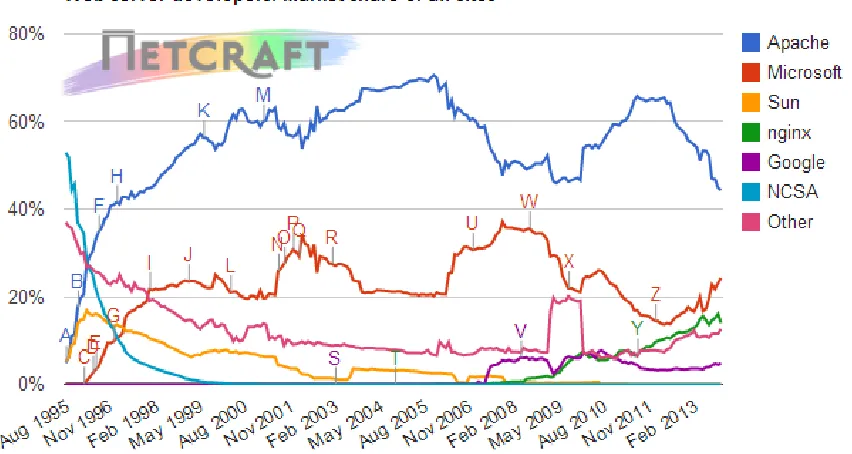
When focusing on servers it helps to understand the distribution of the various kinds of web-servers across the Internet. Over 80% of the websites in the world use either Apache, Nginx or a Microsoft (IIS) server[43]. Another web-server which powers a sizable percentage of websites is Google’s custom web-server. Figure 1.1 and table 1.1 show the web-server distribution according to Netcraft[43] as of Nov 2013. In practice, most of the attacks directed at web-servers will probably target one of the top 3 servers than target the lesser known ones.
Figure 1.1: Web-Server Distribution (Nov 2013) - Source:Netcraft(http://www.netcraft. com)
1.6
Classifying anomalies
Table 1.1: Number of web-servers of different types Nov 2013 - Source:Netcraft(http://www. netcraft.com)
Developer October 2013 Percent November 2013 Percent Change Apache 344,408,387 44.89% 348,159,702 44.33% -0.55 Microsoft 177,216,296 23.10% 190,451,702 24.25% 1.15 Nginx 123,114,800 16.05% 190,968,564 14.00% -2.04 Google 34,127,482 4.45% 37,748,743 4.81% 0.36
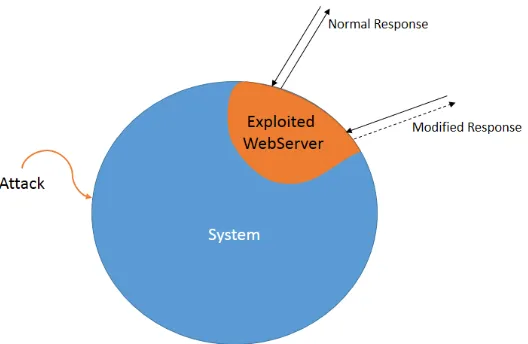
output, not its logs (although those can help if acceptance testing is added into the equation), and not its interactions with the host system or other applications. We also distinguish between a) webservers which may have already been compromised through other means than requests / attacks via its primary communication port (e.g., port 80) - lateral compromise, and b) those that are attacked through web requests and are compromised through a vulnerability in the server and via its primary communications port - direct compromise. In the latter category we also distinguish between vulnerabilities in the server core, and those in third-party “add-ons” (e.g., PHP, databases, etc.) or web applications.
While detection of a direct attack in real-time is important, so is reliable and timely detection of anomalies that may arise from successful indirect attacks on the webserver host system or a lateral compromise.
While we would like to detect all attacks as they come in, this may not be possible in practice. A fall-back is to improve the number we catch before they cause harm. Certain attacks are silent, and don’t manifest in a perceivable manner. In such cases we may find that the malware / worm / virus remains dormant (in most cases collecting data) waiting for the right time to “explode” causing havoc. There have been a number of such cases in the recent times, and unfortunately they were noticed or discovered more by chance than deliberate action. Attacks that crash a server or cause an obvious end-user visible anomaly are relatively easy to detect. However the newer breed of malware tries to be as stealthy as possible, all the while collecting information. In some of those cases unanticipated side-effects of the intrusion are discoverable through diversity-based comparisons.
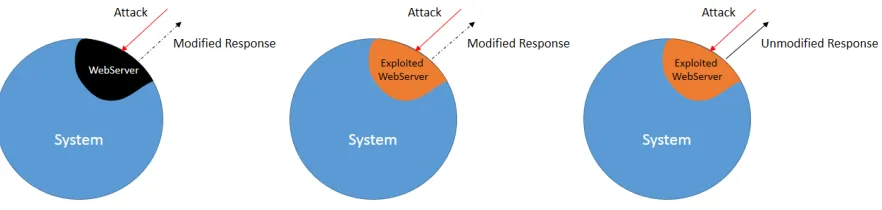
Figure 1.3 illustrates web-servers that are attacked directly. An attack can result in:
A modified response but not a breach
The server can be exploited and as the result of that its behavior on its primary principal communication channel is modified
Despite being compromised the server seems to respond normally
Figure 1.3: Direct attacks to the web-server
Figure 1.4: Lateral compromise of a Web-Server
When looking to use diversity as a means for detecting anomalies, we have to address how effective this solution could be. We must also account for the fact that diversity requires multiple functionally equivalent modules to exist or be developed(which would increase costs). Another concern is the impact of exploits in third party add-ons up the stack(e.g databases) or in the web applications. Finally, this will only be an attractive solution if it is cost effective and has a low false positive rate.
Chapter 2
Related Work
The idea of using redundancy to provide fault tolerance and detect problems has been around for some time[70, 8, 32]. Explicit investigations of the value of redundancy in tackling security issues and problems are relatively more recent[30]. However if vulnerabilities, or security faults, are considered a subset of the general class of faults, many aspects of the already developed body of fault tolerance science apply. There are many factors that have to be taken into consideration when considering an attack-tolerant system. One of the first things to understand are the differences between non-security faults and vulnerabilities, and the related assumptions. This section reviews the state-of-the-art in the diversity-based fault tolerance with a special focus on security.
2.1
Faults, Failures, Vulnerabilities and Exploits
As already mentioned non-security and security software problems have many similarities, but also some key differences. The latter include consequences of these problems turning into failures during field use, and the profile of the actions that lead to such failures - i.e., attacks. In turn, this dictates both pro-active and reactive processes and approaches that can be used to defend against such actions and consequences.
Error - An error is a mistake made by either human or machine. An error implies there is a difference between what is expected and what actually occurs. An error leads to a physical or policy fault.
Fault - Caused by an error, a fault propagates as a defect through the stages of software development, implementation and maintenance in a program.
Figure 2.1: Errors, Faults, Defects, Failures and Anomalies - NCSU CSC547 class slides[59]
Vulnerability - In terms of software security, CVE[41] defines a vulnerability as a mistake in a software that can be directly exploited by a hacker to gain access to a system. A mistake is a vulnerability if the hacker can use it to violate a security policy (excluding an open policy, where all users are trusted).
Failure - An error-state containing an observable anomaly results in a failure. If the failure is caused by a fault or defect which is a security vulnerability, the failure in that case implies a possible security breach brought about by an exploit..
Exploit - An exploit is a piece of code, or set of actions that can take advantage of an existing vulnerability in a system to gain extended access, privileges, or violate security policies.
2.2
Fault Tolerance
There are only two ways that guarantee that a software is completely free of faults, exhaustive testing and proof of correctness. In practice, neither is feasible for complex systems. Therefore the aim is to develop software which can work reliably despite lack of perfection.
involves a way of detecting that there is a problem, and then mitigating the problem. In pro-active fault tolerance failure is assumed and mitigation is always applied (e.g., error coding based forward recovery such as convolutional coding), in reactive fault tolerance mitigation is applied only if an actual failure is suspected (e.g., if memory checksum fails, some action is taken).
Classical fault tolerant software uses methods like acceptance testing, voting or external consistency checking to determine if the result produced is correct. As already mentioned, acceptance testing is an approach where the software compares its output against a set of known and valid output or internal consistency relationships. The acceptance conditions could be defined by simple tests, boundary conditions, or even a white-list. Acceptance tests are designed specifically for a system or purpose. Only information available to the program during run-time is used. Voting and back-to-back testing, on the other hand is a step towards a more environment independent “oracle” where behaviors of multiple functionally equivalent product versions are given the same input/request and are then compared to see if they arrive at the same answer, and if they do not some corrective action is taken. External Consistency checking is a method that checks information available not only from internal but also external sources to ascertain consistency of the computations, data, outputs or behaviors. Often such information is not available at run-time to individual components of a system, but may be provided through system overview functionality (e.g by watchdog software, an example are time-outs where it is assumed something is wrong if a component exceeds certain amount of time not communicating or not visibly progressing towards completion of its tasks), or only at verification and validation time where known conditions are created, faults are injected, etc.
When, at run time, software encounters a defect it may end up in an error state which may be perceived by the user as an anomaly. If the error state is identified, steps can be taken to recover.
Backward Recovery- In this mode, the state of the software is repeatedly saved. Each of these “save-points” is a recovery point. When a software has to recover from an error-state, it rolls back to the last recovery point, and then restarts from there.
Forward Recovery- In this case, software masks or compensates for an internal error-state by deliberately entering a new error-state in which it can operate, either in a degraded mode with less features(like a “safe-mode”), or in an error compensation mode which typically uses redundancy to find the correct answer or mask the error.
2.2.1 Redundancy
components in case one piece of hardware failed, is a sensible approach. This idea was extended to the software space[8, 9, 46],but the problem was that software faults are usually due to design flaws or implementation errors, so replication either does not guard against failures, or does so under special circumstances. For example separate groups of developers would develop functionally equivalent components[10, 48, 74]. When two groups of people are given identical specifications to come up with software it is assumed that they would not use the exact same design and implementation details and algorithms. It is also assumed that the faults left in these software components will not be the same, i.e., common-mode or correlated, meaning that the two versions would not fail on the same input and if the software failed, it would not fail with identical and wrong responses. Diversity is the key here. This means that everything from the language it is written in, to the operating system it runs on, to the run-time memory locations can be used to make its run time internals more diverse, and still keep its functional behavior the same. The idea is to make functionally equivalent software different in the right way, so that the probability that two pieces of functionally equivalent code the outputs of which will be compared fail in a correlated fashion is as close to zero as possible.
For fault tolerance that manages inherent faults that fail randomly during software operation has been studied in great detail over the years [33, 31, 32, 29], and it appears to work well so long as certain conditions (such as independence of failures) are satisfied. In fact, redundant functionally equivalent software is used today to fly aircraft [74], and guide trains [27, 37]. When we try to extend the idea of using fault tolerance to security, it is necessary to take into account that we have versions diverse enough to detect an attack. We want to make sure that an incoming attack is identified as an attack and noticed as soon as possible.
In both acceptance based algorithms and in redundancy based error-state detection algo-rithms one has to decide whether response(s) of a system is (are) acceptable. In the first case it is done against known patterns and behaviors, in the second case it is done against the behavior (or output) of the redundant versions. The algorithm that does the comparison and decides on this is known as an ‘adjudicator’. There are many algorithms that are used for this purpose right from simple acceptance tests (e.g., is the answer larger than X), to majority voting, to median selection, to more complex decision analysis. We distinguish between anomaly detection, and actions that may follow adjudication.
Adjudication Strategies based on Voting
In situations where one is not satisfied just with a finding that that there is a difference among the answers coming from several functionally equivalent versions that are given identical inputs, it may be necessary to decide which of the responses is the “correct” response. Voting is a common method of finding that there is an issue, and in the mitigation state what the most appropriate or correct response might be. For example, Lyu[33] and McAllister et al.[36] review some of the more commonly used methods. A point to note here is that, the output chosen by the voting-based adjudication method is only the agreed upon output. Also, an output could be a single number or character, a range of numbers or symbols, a vector with agreement measured through a distance between vectors, etc. It is not necessarily the correct output. Following are the adjudication strategies used in classical fault tolerance. Some of these could be used when working with security vulnerabilities.
Simple Majority Voting As the name suggests, this method looks at all the outputs and tries to pick the one with at least m out of the N outputs it received. Usually N has a value of 3, and in some cases is greater. andmis given byd(N+ 1)/2e. Hered erepresents the ceiling function.
Two-out-of-N voting Scott et al.[52] showed that given a reasonably large set out outputs it would not be necessary to ever have an m greater than 2. Thus with N outputs to choose from, any output having at least 2 similar outputs from a group of N can be chosen as the agreed output. This method may be particularly suitable in the context of cloud technologies where a large number of diverse functionally equivalent software may be available. In fact, in this context location diversity may be sufficient to detect issues since a only one location may be compromised.
Median Voting This technique works when the number of possible outputs is a range. It would also require that the outputs can be arranged in some order (i.e preferably they are numerical). The median voting algorithm picks the middle output from the set of outputs. The reason this may be better than an algorithm that calculates the average is that it wont be subject to a bias. Further in the case of discrete valued output a median voting algorithm will always succeed whereas the same cannot be said about the mean(or average).
Consensus Voting[36] It is a modified version of majority voting. The algorithm works as follows:
If there is a unique set ofm outputs which are all the same but,mis not half of the total outputs, this answer is chosen. Only ifm is the maximum number of agreeing outputs. If there are two outputs, each withmthen another decisions step is needed. If there are two or more sets of outputs which agree each withm outputs, then the
following is used to pick one.
– If consensus voting is used with N-Version Programming, any one of the groups is chosen using a random selection strategy.
– Else If consensus voting is used with recovery block mode[46, 47], an acceptance test is used to pick one of the outputs.
2.3
Effectiveness of Redundancy
In the context of this thesis, we will say that a method is more effective than another method if it achieves a goal, such as identification of attacks, with higher probability than another method. On the other hand a method is more efficient than another method if it achieves the same goal with less resources (or lower cost).
A development-phase variant of N-version programming[8], again possibly quite suitable for cloud environments, is known as back-to-back testing[70]. The various versions of the software are developed by different groups of people independently in order to avoid the same faults in all versions. These software versions are built to satisfy the same requirements and hence their output should be the same to some tolerance level for the same input. In the cloud context, it may mean testing software against cloud-based services that already are functionally equivalent. In the case of back-to-back testing one is interested in identification of issues (or disagree-ments) rather than automatic adjudication of correctness. This may be all that is needed in the case of security attacks - a warning bell. We now examine theoretical effectiveness of this approach.
There are several potential issues with back-to-back testing, and its run-time equivalent N-version programming. They include efficiency and costs since development of multiple N-versions can be expensive. However, now in the day of clouds and massive functional and resource redun-dancies, this may not be an issue anymore. They also include electiveness, the ability to detect issues, and as always the structure of architecture of the system. Again, as clouds proliferate, a side-benefit may well be automated back-to-back testing and pro-active redundancy-based run-time fault tolerance.
In this context, and for the purposes of this thesis we define the following terms
Efficiency - The ability of a system to be effective with minimal expenditure of resources (e.g., time, test cases, redundant versions) and meeting its other requirements and performance parameters.
Total cost - The cost incurred for a system to deliver effectiveness and efficiency. This includes accounting for hidden-costs, development costs, operational costs, etc. For example, a proprietary system may be effective and efficient, but the cost of licenses, hardware and operation may be so high that it is beyond the price-point affordable by an organization.
2.3.1 Effectiveness
How effective is N-version programming or back-to-back testing in detecting attacks and vulner-abilities. Since attacks are coming from the outside, and a security failure is a very undesirable event, the focus should be on detection of attack probes and attack cases or input vectors before they impact the combined services offered by the redundant systems. To do that, we follow the reasoning discussed in the back-to-back testing papers by Vouk[70, 71]. However, assumptions are modified to reflect attack profiles and vulnerability characteristics. In principle if we have enough versions all designed such that they are diverse and will never produce an identical and wrong response, we would be able to detect any attack the first time it comes in, this includes zero-day attacks. Obviously when trying to implement this we come across some road blocks.
So what is the difference between non-security faults and failures, and security faults and failures or vulnerabilities and exploits? To start with there are many more non-security faults than vulnerabilities. According to Anbalagan[1] and Subramani[60] security problems in open source software are between 0.02 and 5% of the total number of reported problems. Furthermore, only a fraction of known vulnerabilities (not more than a few percent) are actually exploited in the field[18, 7]. This means that security events tend to be rare events, although potentially very high-risk rare events [49, 66, 7, 56]. This also means that rare-event statistics may apply. The process of discovery of security problems or faults under normal operation does not ap-pear to differ too much from what is happening with non-security faults. This allows prediction of the security properties of a software under normal operating conditions[1, 60]. Under normal operation software has an operational profile and frequency of operations/requests/inputs that reflects its use by non-malicious everyday users[42].
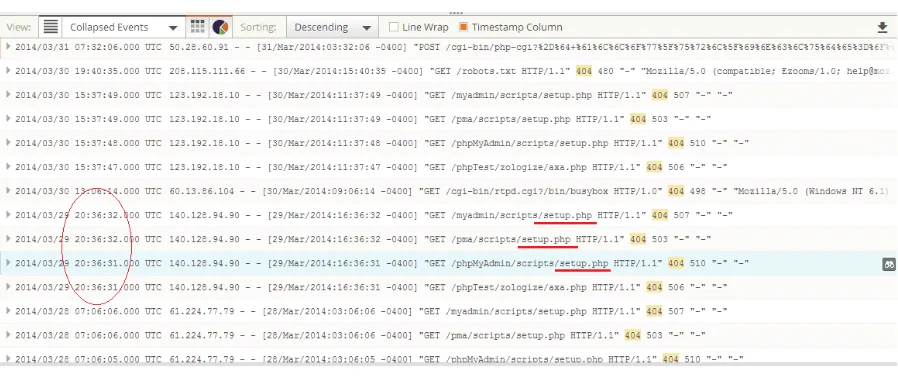
Figure 2.2: Log of Short Burst of Attacks - (logs analyzed using Loggly)
This burst is mixed in with normal input cases. On the average, for that particular server, such attacks are only about 5% of the overall request traffic. From the defensive perspective, it means that we need to be looking at detection (and mitigation) of anomalies that may be true attacks among the 5% of the traffic. While real attacks may come in bursts, on the average, for this server, an estimate of the probability of an attack (that includes probes, as well exploits) is 0.05 or less. In the case of this web-server example, none of the attacks have been successful so far. Only very few of the attacks were sophisticated enough to escape immediate detection based on the existence of the requested web-page or service (404 of 403 error codes) - the rate was about 2 or 3 in 100,000 requests.
How effective is multi-version software in discovering that? To understand that we make some explicit assumptions about the attack streams (or attack profiles), attack ranges (attack surface), the processes attacks follow, and the properties of the attacked software.
Let requirements be implemented in multiple versions V1, V2, . . . Vi, . . . VN , i= 1. . . N so
that operational software is functionally equivalent, but has some diversity property. LetTj be
thejth input vector (which may have a number of dimensions) that is received by all versions. Let there be n input vectors to a version (e.g., web requests to web-server). Let the probability that version Vi either fails (i.e., is compromised) or reacts to a security attack related probe in
an anomalous fashion be pAi(Tj). Let, for simplicity for all i, pAi(Tj) = p. Let’s also assume
that version failures or anomalous reactions are independent, i.e., P(version i fails |version k has failed) = P(version k fails|version i has failed) wherei6=k.
In this case the probability of a server giving a normal response would be 1 −p. The probability that all N versions respond as expected is then given by (1−p)N. Following from
probe or an anomaly after running n inputs is
PD(n) = 1−(1−p)N n (2.1)
This works, and will even detect zero-day attacks, so long as the output vectors from failed or flagged versions are not identical. Depending on what the output space looks like, this may happen more often than one would be comfortable with. For instance, if all failures result in error code 404 and only that code is used to make comparisons, than it would indeed be difficult to distinguish a security failure or anomaly just based on comparisons. Of course, in this simplistic example, the fact that the code is 404 is already a warning (acceptance test), makes detection of such an anomaly automatic. It is less clear what to do if the returned code by all versions is 200 (OK), but we actually have an issue. Therefore, it is important for the output vector used for comparisons to include more information about the output and through that increase the cardinality of the failure output space. Comparisons in the of web-service status code space only is in fact a problem akin to voting in small output space [35]. This problem has been recognized by Totel et al.[69] in the context of intrusion detection for web-servers, and they offer some suggestions on how to increase the cardinality of the output space in which comparisons are being made. We discuss this paper further later in this section.
The effect of failure dependence is illustrated using a system where a single identical vul-nerability is present in all N versions, i.e., the fault has span of N. Then, when one component fails, all fail. As the vulnerability has span N, for this vulnerability the effective behavior of the N-tuple is equivalent to that of a single version. If all versions fail with an identical answer, then this failure cannot be detected. If the answers are not identical, there is a finite probability that the failures stemming from this vulnerability or vulnerability probe will be detected. It can be shown [70] that in the first approximation, the probability that such a N-tuple detects such an attack is
PD = 1−[γNp+ (1−p)]n (2.2)
PD = 1−Γ1(N)P(one or more of the N versions fail coincidentally)
−P(all N versions return correct answer) (2.3)
where P(“. . .”) denotes the probability of the event “. . . ” . If Fu(N) represents the
exper-imental frequency of undetected failure events, and FD(N) the frequency of failures that have
been detected, then the ratio
Γ1(N) = Fu(N) FD(N) +F u(N)
(2.4)
is the fraction of failures not detected by comparisons, and it estimates the above conditional probability. Failure detection effectiveness of attack detection also depends on the number of output variables, or system states, that are monitored for agreement. Earlier work on non-security faults by Vouk confirms that[70].
2.3.2 Effectiveness - An experimental study
Section 2.3.1 looks at the theory of effectiveness of diversity. A study by Jin Han and others[21] from Singapore Management University consisted of classifying various Real-World vulnerabil-ities and looking as to what portion of them would be detectable using diversity.
The authors assumed that the chances of a common mode failure is low. This makes sense, as the chances of two different applications developed by two completely distinct groups with no shared modules failing on the same input vector in an identical manner is low. The paper tries to answer questions like,
If a software was vulnerable, did it have substitutes in the market?, and whether they could be exploited using the same attack
How diverse the software was? Were there substitutes which would run on different op-erating systems? If one ran on multiple opop-erating systems was it vulnerable to the same attack on different OSes?
If these questions were answered one could talk about how effective diversity could be as a mechanism for detecting attacks.The authors analyzed about 6000 vulnerabilities during the year of 2007 to find the answer to these questions.
Application Vulnerabilities
The authors concluded that 45.7% of vulnerable applications run on multiple operating systems, and in these 84.7% have the vulnerabilities across operating systems. When the vulnerability represents itself across and operating system there are at-least two factors like memory, or machine instructions etc, which make it hard for the exploit to happen on two OSes concurrently. This would mean a fairly decent amount of diversity just in terms of operating system diversity.
Web Script Vulnerabilities
Web script vulnerabilities are split up into cross-site scripting, SQL injection, remote file inclu-sion(RFI), directory traversal and others. The authors discuss each category and how it could potentially be identified using diversity. XSS can be caught by using diversity on the client side as the code is usually handled slightly differently by each web browser. SQL injection, can def-initely be caught using diversity, but masking the differences might be an overhead cost while developing the application or the setup. RFI is considered out of scope as this can be disabled completely at the server end. Directory traversal however can be caught when using different operating systems, e.g., unix based vs windows.
The authors finally conclude that more than 98.5% of the vulnerable applications have substitutes and that the chance of a common mode failure is extremely low.They also discuss that though the versions of the same software on different operating systems has about 80% chance of failing on the same vulnerability, the attack code for OS distributions is different. They finally talk about the drawbacks of their analysis which, is that a lot of manual work is required to categorize attacks and how some are not categorizable easily and involve human judgment. The conclusion is that diversity can be used effectively to a certain extent to detect attacks.
The work discussed in this thesis complements the work in[21] by investigating some recent difficult-to-detect web-server vulnerabilities and attacks, and discussing the ability of redun-dancy and diversity to detect these attacks and vulnerabilities.
2.3.3 Another look at theory
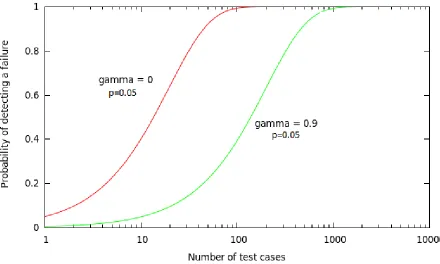
An analysis of one of the web-servers on campus here at NCSU showed that roughly 5% of the requests to a web-serer are attacks. By looking at statistics from reports like Imperva’s Web Application Attack Report[25] and WhiteHats report[54], we can speculate that this value varies between 2 to 10% depending on the type of website, its popularity, and what it is worth if breached. This is essentially the value p.
Figure 2.3: Probability of detecting a failure with change in probability of common mode failure
2.3.4 Total Cost
One of the major things to keep in mind when using redundancy, whether to find the correct answer or security flaws, is that multiple versions have to be developed, multiple versions have to be run for their results to be compared, one has to compare appropriate output vectors, etc. This definitely means higher costs, from developing multiple versions all the way to resources required to run such a system.
An analysis of the cost of redundancy can be found in the paper on back-to-back testing by Vouk[70]. Studies done in the context of “classical” software fault tolerance[33, 31, 32] show that developing redundant diverse software is not always a multiple of the number of components, but it may grow sub-linearly. In the case of using redundancy for security, we propose to use Components off the shelf (COTS). The idea is that for commercially used software like web-servers which we focus on, there are already multiple versions of the same software available in the market. They are almost readily available functionally equivalent components, because they are software developed to serve the same specification by independent groups. They satisfy the requirements of using them as versions for back-to-back testing or N-version programming. However where the standard or specification is not clear or is open, each of them may do what they assume is right. So some masking of their design differences has to be done before the output vectors can be compared directly.
One of the reasons that makes redundancy-based systems worth it is the fact that they can be used to catch zero-day vulnerabilities.
2.3.5 System Structure
A fault tolerant system can be constructed in several ways[36, 33, 32]. One of the methods is recovery block(RB). In this technique, the adjudication strategy is Acceptance Testing(AT). Initially the output of the first module is passed through the acceptance test, if it is not accept-able, it rolls back and tries it on the second module and continues serially trying all versions till it succeeds or fails. It is a reactive approach, that may not suitable in security situations. If the first version is compromised (and that is detectable and manageable), and the second is sound, then there may be some value in the approach, but the key here is an appropriate acceptance test - recognition of unusual behavior.
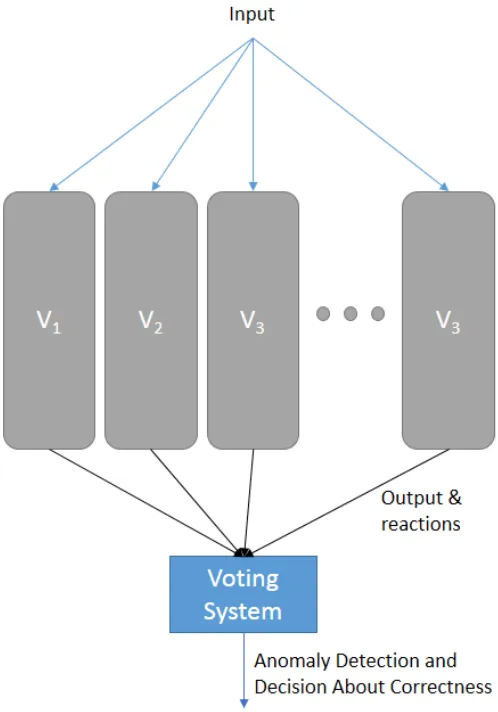
Another commonly used architecture is N-Version Programming. In this case the input is passed to all N versions of the software as shown in Figure 2.4. The outputs along with reactions are passed to a “voter” which looks at all the data it receives and predicts the “correct output”. However in our case it could be modified to help identify a security anomaly. This architecture has variations which are used for different purposes.
Figure 2.4: Structure of a simple voting system
Recovery Block. Here initially NVP is used and if that fails RB is used with the same N versions.
Acceptance voting - Here the normal N-version programming is modified such that the out-put of each version is first passed through an acceptance test and only those that pass the acceptance test are sent to the voting system. This technique will fail if none of the versions produce an output which passes the acceptance test.
N self-checking programming - Versions are grouped into pairs, and the output from each pair is compared, only if they agree is this passed on. This is repeated till the system either fails or produces an output.
get-ting compromised” first) and therefore a conservative and pro-active approach to detection and prevention of attacks is preferred to “classical” increased availability emphasis where a failure followed by a quick recovery is acceptable. Therefore some approaches such as the Consensus Recovery Block, might be less useful, while the other two methods could be potentially used. Acceptance voting may give us the best of both worlds.
2.4
Detecting Security Anomalies in Web Browsers using
Di-versity
A paper by Eric Totel et al.[69], talks about intrusion detection systems, and how design diversity can be used to detect anomalies. This paper focuses specifically on web-servers and how voting could be of use here. They recommend the use of COTS to provide redundancy. This thesis builds on the findings of the Totel et al paper by a) focusing on anomaly detection as it relates to some difficult-to-detect recent attacks, and b) examining engineering extensions needed to implement a redundant and diverse web-server solution.
Replicating web-services to balance load or provide fail-over in the case of random outages is a standard procedure. Using diversity and redundancy to combat cyber-attacks is far from routine yet. Achieving design diversity is expensive, as this would involve employing multiple groups to design the same software. This is where the idea of COTS is very beneficial. The authors point out that services available via the web have multiple components off the shelf that could be used. Hence using COTS could be a good idea from an economic perspective. However, the authors point out that there are bound to be differences where the specification is incomplete or open.
Their architecture has a proxy, an Intrusion Detection System(IDS) which is typically used to detect a successful attack on a system[50], and three or more web-servers. Every input to the system is received by the proxy and then forwarded to each of the web-servers. Similarly it also forwards the final response by the system to the client. The IDS compares the reactions of the web-servers to the given input and finalizes the output of the entire system. In the case the reactions of the web-servers vary, the IDS decides if any of the servers has been compromised, and correspondingly raises an alarm.
The web-servers are simple but diverse COTS, which could vary in terms of software, oper-ating systems and hardware too. This variation helps reduce correlated failures.
an attack.
The authors ran about one month’s requests (about 800,000) to their system. These requests had originally come in to one of their web-servers and a previous analysis showed that 1.4% of these were harmful requests(or attacks). Experiments showed that, when one months requests where passed to this system, it raised an alert for about 0.37% of the requests. Of these raised alerts about 22% of them were thought to be false positives(these include failed attack attempts) and hence the 22% false alarm rate appears to be very high. It is possible to do much better by running acceptance tests via white and black-list filters. Also, most of the web-sites today are not static. The authors recognize this limitation.
2.4.1 The Algorithm
Chapter 3
Case Studies
This thesis is focused on an assessment of security anomaly detection capabilities of what is sometimes known as back-to-back testing or comparison of responses from functionally equiv-alent software. We have seen that the problem has been studied to some extent before. In this Chapter we will examine some recent attacks on web-servers to establish whether back-to-back anomaly detection would have been able to recognize the attacks.
There are two kinds of anomalies that our system could help with. First is where it helps identify an oncoming attack. The second is the ability to identify an attack that has already taken place and has compromised a system. Identifying oncoming attacks is often done quite successfully by other methods such as acceptance tests either at the networking level, operating system or application level. However, acceptance tests do not work unless we have identified patterns or relationships that describe an observable characteristic of the attack case, or its behavioral impacts. The “front end” of acceptance testing usually means that we need to experience an attack before we can defend against it.
The problem of the detection of an existing compromise or hidden (perhaps already ex-ploited) vulnerability is a different one. One way is through comparative analysis of the system behavior.
3.1
Research Methodology
recent attacks published in various security blogs(e.g, FireEye, Sucuri, Symantec etc.) which included a vulnerability in the web-server or a lateral compromise affecting targeting web-server were also studied.
Each vulnerability was examined to see if a back-to-back testing based approach could be used to detect an exploit. This involved studying the details of the vulnerability and assessing how back-to-back testing could play a role in detecting this attack. In the case that a prelim-inary scan suggested that diversity could work, if the vulnerability was replicable, a manual comparison of the output vectors from diverse components including the vulnerable version was performed to verify that a diversity based approach would work. In certain cases, especially in the cases of lateral exploits, replicating the vulnerability or the exploit was not possible. In such a case the analysis of the vulnerability was a thought process which involved looking at the reports by various security experts and determining if back-to-back testing would have caught such an attack.
The manual tests performed involved trying to replicate an exploit in diverse environments. The aim was to see if the output vectors from the diverse components showed a difference which could be identified by monitoring the output of the web-server. The tests also aimed to identify if there were correlated problems, and if that was the case, whether increasing the cardinality of the output vector would help identify the exploit. Initially only the status codes were looked at, but as more use cases were studied it was found that observing at least three or more fields in the output vector(such as status code, response size, last modified etc) would reduce the chance of an exploit being passed as a correlated failure. These tests showed that for the use cases studied, diversity would potentially help catch difficult to detect attacks.
3.2
Linux/Cdorked.A Attack 2013
3.2.1 What Happened?
Intrusion to inject Cdorked.A not appear to leave any trace in the logs of the affected system. Of course, Cdorked.A has its code hidden in the system, and this extra code is detectable if one knows what one is looking for (or has a way of checking uncompromised installation logs). It always operates only on memory. Thus a simple restart destroys all evidence of its operation. Initially the speculation was that a flawed installation of add-ons from a compromised(fake) installer was allowed. The recently published Windingo report[18] states the actual method used by the attackers. A lateral compromise which successfully broke into openSSH gave the attackers access to deploy Cdorked.
What made things worse is that the attack was designed in a way that made it very hard to detect it by admins of the machines. The infected web-servers had a plugin / module which sent the user a URL redirect based on many conditions which included a random factor as well. Some of these conditions included a check to see if the URL was from an admin like page, and if it was to not, redirected the user. Since operation of the malware was limited to in-memory operation, detection of Cdorked.A was a challenge. Cdorked.A made sure that no information were stored in the logs.
3.2.2 Could back-to-back testing have helped?
Our analysis, shows that detection of this malware would have been much easier using back-to-back comparisons. The reason is that this particular malware affects only Apache, and a small number of Nginx server versions. This means that a functionally equivalent but diverse server such as IIS etc. remained unaffected.
A triply redundant diverse system based on the Apache, Nginx, and IIS could have identified the compromise automatically by comparing results of relatively simple system inputs and outputs. Unfortunately the attack has a random factor based on which the redirect was sent. This means that passing the same input query to multiple infected servers would not mean that all of them would generate the malicious redirect. Therefore even without the use of diverse (different) servers, redundancy would be effective in detecting unusual behavior. Use of different servers adds an additional advantage. Simple web-server status codes and response sizes could have been used to construct a back-to-back testing mechanism, and would have raised an alert provided a sufficient number of requests were given to the system.
idea of what exactly it was. ESET and Sucuri analyzed and wrote a script to detect this rogue module in early February 2013 when the attack gained momentum[18]. Several thousands of servers were infected even after this, as it was only on March 20th and later that anti-virus scanners added this to their databases.
This particular attack, affected both Apache and Nginx. There is a possibility that an attack could affect all the types of servers our diversity approach uses. A point to be noted here is that in such a case even the use of 3 compromised Apache and Nginx servers could potentially detect the attack. The trigger for redirection includes a random factor which gives us the chance of detecting this particular attack with even compromised servers so long as random events to not coincide.
3.2.3 Other Similar attacks
The Cdorked.A malware is an example of a whole category of “on-installation” malware that hides and when invoked operates in memory. There have been other attacks which are similar and could have been detected using back-to-back testing methods as described for Cdorked.A. They are listed in table 3.1.
One specific example is Effusion is a malware which is similar in many ways to Cdorked.A. It also could have been found using a very similar approach[12]. It resided on RAM, lived on the modules of both apache and Nginx. Attacking Apache and Nginx using modules seems to be a new trend when trying to exploit / break into web-servers. This particular malware is reportedly being sold for$2500 for one copy.
3.3
An Nginx Vulnerability (CVE-2013-4547)
In November 2013, an engineer from Google discovered a vulnerability in Nginx[15]. This vul-nerability could have allowed an attacker to bypass security restrictions among other things. This is a different category of security faults. It is a native fault in the software, and it is exploited through specially crafted server communication port requests. Again a comparison based system could help detect this attack as it happens.
3.3.1 What Happened?
location /protected/ {
deny all;
}
For example, if there exists a directory “folderone ” with a trailing space, a request like the following could be passed which ended up granting access to any file within “protected”, which should never be the case.
GET /folderone /../protected/secret_file.txt
This attack could only be exploited using tools like telnet which send the HTTP request as is without modifying or escaping characters.
3.3.2 How a comparison based could have helped
According to the error report, this flaw has existed since version 0.8.41, which released sometime in 2010. This is quite a while, considering that millions of web-servers through the world use Nginx. This particular vulnerability however may not have been exploitable too many times because of its pre-requisite requirements.
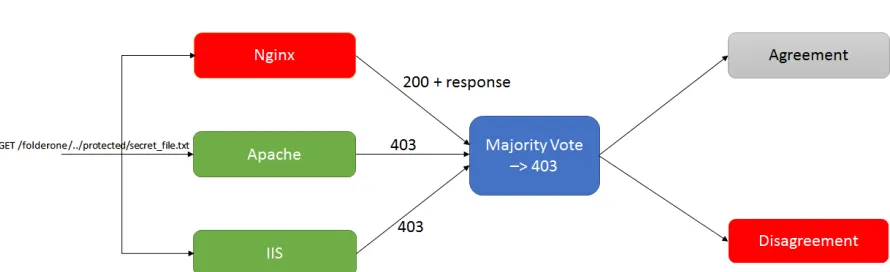
Having a real-time voting system in place could have detected this attack if it was tried. Consider a very simple voting system. This system makes decisions based on simple majority. Let us say this system has 3 web-servers. let one of these servers be Nginx, and that the other two be Apache, and IIS.
Figure 3.1: Voting could be used to detect the Nginx vulnerability and decide on the correct response.
case. The input to the system is the attack web request. All web-servers are passed the same request. In this case, only Nginx is vulnerable and it returns a 200 status code (OK) and the response itself. However, the other two servers return a 403 (Forbidden) as they should. Let us say we have a simple majority based voting system which looks only at the status codes. In this case Nginx automatically causes a disagreement, and hence an alert. The only problem with voting in this context is that typically one would like to accept the “correct” answer. Is majority rejection of an input the correct answer, or is the OK the correct answer?
So we can see that a comparison-based (back-to-back testing) based system could have identified this potential zero day vulnerability, which took a lot of time to identify otherwise, and might have gone unnoticed in many cases.
3.4
ColdFusion IIS Attack - (CVE-2013-0629)
In December 2013, there was an attack which utilized a vulnerability in ColdFusion to attack IIS[55]. The attack wasn’t widespread, however it started gaining a lot of popularity among hackers due to the fact that although Adobe released a patch, site administrators were slow to patch their site. This attack falls into the category request exploited native vulnerability.
3.4.1 What Happened?
The attackers used a vulnerability in ColdFusion to install some rogue DLLs on servers running IIS. The malware runs in “stealth mode”. The modified IIS Module silently looks through the POST data of all requests. This can be configured by the attacker to be just one specific set of URLs or more. All examined data is stored or recorded in log files as plain text. Encryption and decryption is not even a worry since the data is retrieved right from IIS itself.
Detecting this kind of attack is hard. This is mainly because there aren’t many symptoms. The attack just causes the server to perform certain actions which are seemingly harmless. For quite a while most anti-virus providers could not detect this module. However over time they were able to identify some characteristics of the module which included signatures of the rogue module.
3.4.2 How they got in?
Trustwave SpiderLabs, the people who caught the attack, also did an analysis of how the attackers got access to the system[57].
Figure 3.2 The attackers used this technique to pass a file with their own Cold Fusion Markup Language (CFML) which created a webshell back-door. They then used their file to upload their rogue IIS module.
Figure 3.2: CFML passed to Adobe ColdFusion to exploit a vulnerability
Once the module had been uploaded, the attackers used the CMD feature of the webshell back-door, to activate the malicious module.
The DLL could then be controlled by sending it commands using GET parameters which it was designed to look for.
3.4.3 What did it do?
Once the module was installed, it would listen for commands from the attacker on port 80 in the form of GET requests. During the installation process the attacker can specify the path for the DLL, the log, the name for the log file etc. After this has been done it looks for keywords in the QUERY STRING of requests that come in[56].
In general, once the list of URLs to listen for data from had been provided by the attacker, it took the plain text version of all post data that came in and inserted all of this into a log file. This means that plain text version of everything from credit-card info all the way to passwords of banking info could be recorded in the log. The attacker would typically let the log file collect as much of this info as he needed. He could then grab a copy of this log file from the server. The module had some keywords which had some basic actions associated with them. It specifically looked for the following keywords.
isn getlog return the contents of the isn.log file
isn logdel delete the isn.log file
The malware module was not widespread. However since its functionality is very dangerous and its detection rate is very low the threat caused by this module is pretty high.
3.4.4 Using back-to-back Comparisons to detect this malware
As mentioned before this kind of malware is hard to detect, and the only Spiderlabs came across it was based on heuristic guesses. However, if we were to use a back-to-back comparison system, this attack would not have gone undetected for such a long period of time. In fact as the attacker sends a request to download the log file, we would have seen that something unusual was going on. In our setup, a request is sent to at least 3 different servers which vote on the responses, one of which would be the compromised IIS server. This utilizes a very simple comparison system which looks at the size of the responses with which we should be able to notice that something was up with the IIS server.
One server, namely the infected IIS server alone, will return a log file of presumably large size which will be much more than the empty response sent by the remaining servers. This can be used to trigger an alert which needs to be looked at by an admin.
3.5
Zencart Redirect - Feb 2014
Another recent attack[61], reported by Sucuri, redirected some (a portion of) users to a malicious site. This particular attack went unnoticed for over 6 to 8 months because of the way it hides itself. This is again a case of an independently injected exploit. Zencart, the software in question had a malicious payload which was inserted in one of its source PHP files.
3.5.1 How did it work
The malware, affected only a portion of the visitors who visited the website. Initially it was deemed as only affecting the “www” users and not the “non-www” users. later it was found that this was not the case. It triggered only on certain User-Agents and Referrers. It is a conditional malware.
Figure 3.3: An example of a redirect sent by the Zencart malware[62]
Here is how the redirect worked.
1. On the first visit the site checks if the user is neither Chinese nor originating from Hong Kong.
2. The user should also come from either of Bing, Google, Facebook, or Yahoo
3. If the conditions were satisfied, the USERID field of the cookie was set as “shine-check” otherwise it was set to “twotime’”
4. On the next visit, the site looks at the cookie, and those with “twotime” are not redirected, while those with “shine-check” are. There is one other conditional eligibility test performed at this point. A user with “shine-check” is redirected with a 40% probability. If the user is not being redirected, the cookie value for USERID is changed to “twotime”. This means that a user who wasn’t redirected the first time will not be redirected again.
This particular malware, is hard to detect and current practices don’t allow for such malware to be caught easily.
3.5.2 How back-to-back Testing could have found this
Though our focus is on catching attacks aimed at the webserver. We can catch more than just that. In this case, the last factor determining whether the response should contain a redirect is conditional. Assuming we get a request which satisfies the first two conditions of not being from China and having one of the specific referrers, there is a 40% chance it will return a redirect. This means that if we forward an eligible request to 3 servers, irrespective of whether they have all been compromised or not, pretty soon we will notice a difference in their response just by looking at the status codes of their response.
3.6
Apache Tomcat Possible DoS Attack (CVE-2014-0050)
Early in February 2014, an internal email from the Apache Tomcat community was leaked[58]. This email detailed an attack which could take down websites served using certain versions of Apache Tomcat. This issue has since been been patched.
3.6.1 Understanding the Vulnerability
Figure 3.4: Example of Multipart boundary in form post (as seen in Chrome debugger)
starts using a high amount of CPU resources until the process is terminated. This results in a possibility of a DoS attack on web-servers running Apache Tomcat (versions 7.0-7.0.50 or 8.0-8.0.1) and using Apache Commons FileUplaod[58].
3.6.2 Detecting the attack utilizing diversity
Though such an attack can be detected by monitoring CPU usage of a web-server, utilizing a diversity based approach might trigger an alert earlier than usual. If a back-to-back testing system using different versions of Apache Tomcat were to be setup, and a watchdog process was to monitor the different web-server processes, we could very easily notice a higher CPU utilization on the vulnerable version of the server as compared to other versions. We could even use different web-servers (not just different versions of Tomcat) and compare the change in percentage of CPU utilization by each the servers. This would further improve the diversity in the system.
3.7
The Heartbleed Vulnerability - CVE-2014-0160
A vulnerability in OpenSSL was reported on April 7, 2014 by Neel Mehta at Google. This particular vulnerability had a huge amount of repercussions and is thought to have left two-thirds of the servers on the internet vulnerable[6]. Caused due to a simple coding error this particular bug leaves at least half a million servers exposed as of 04-10-2014(3 days after the exploit was disclosed), does not leave a trace of being exploited, and gives out information including private keys, or even user account passwords[5, 51].
3.7.1 Understanding the exploit
3.7.2 Diversity in the use of detecting Heartbleed
This is a case of an inherent attack, but a problem with a third party add-on and not directly with the web-server. Diversity could have been used to detect the if the heartbeat vulnerability if it was exploited. All the information exchange takes place along port 443 (or the primary port for communication of a web-server when using HTTPS). This being the case, if a diversity based setup were to inspect all the traffic along this port, and not just basic request and response (not just the GET and POST), this attack would be very simply caught. An improper implementation of SSL would return 64KB of data whereas any other implementation would fail without a response. In this case diversity would have to involve servers not using OpenSSL. Microsoft services utilize SChannel as opposed to openSSLand thus anything using a Microsoft based stack remains unaffected[75].
3.8
What still escapes?
When looking for attacks at the web-server level, anything which involves common vulnerabili-ties in the extensions and add-on application middle-ware such as the database or the scripting languages etc., will continue to slip through the cracks. Another exploit which will go unnoticed is inherent design flaws when using frameworks. Of course, if the output vector is not chosen appropriately, it may not be sensitive to changes in the behavior and thus will not display an anomaly that is detectable by comparison. However, the aim here is to detect attacks at the web-server core. The following is an example of attacks which cannot be detected using diversity based techniques at the level of the server core comparisons.
Figure 3.5: Remote Code Execution on Struts 2 - https://www.mandiant.com
of the requests passed to the web-server to execute a command on the server. Now the Struts framework is developed by Apache, and is deployed on Java based web-servers like Apache Tomcat, JBoss, Websphere etc. Though we achieve diversity with web-servers, the fault lies in the design of the struts framework, where there are no other equivalent versions developed by other groups. Hence all deployments of the vulnerable versions of Struts 2, irrespective of the web-server used will be compromised when a request in the form an attack is sent as an input. This is one of the scenario’s where diversity will not be of any help.
3.9
Attack Detection Times
A motivation for use of double or triple redundancy in the case of web-servers is the fact that many more sophisticated compromises otherwise remain undiscovered for many months, perhaps years. If that happens on a high-assurance site that manages / delivers sensitive information, damage may be irreparable. The cost of implementing and maintaining redundant system is in those situations far cheaper than the damage control and recovery that needs to happen after the fact.
Table 3.1 shows the time taken to detect the two attack / vulnerability categories we dis-cussed in the previous section a number of relatively recent similar attacks. In case of inherent vulnerabilities the time taken to detect is simply the time that an exploitable version has been out in the open without a patch available. All the vulnerabilities listed can be detected using back-to-back testing or diversity. An investigation of a number of “difficult-to-detect” web-server vulnerabilities and attacks disclosed over the last five years seems to indicate that on an average it takes about 3 and a half years to even detect such attacks. By the time they are found, a lot of harm can potentially be caused. Usually an attack is detected only when it starts to affect a large number of public machines, and its effects are noticed because of extensive exposure.
Table 3.1: Time taken to detect some recent web-server compromises.
Attack Type of
Anomaly
Time Taken to Detect
Start Date / Detected Impact (No.of Servers) Heartbleed Vulnerability (CVE-2014-0160) Inherent (Addon)
2 years and 1 months
Mar 2012 / Apr 2014 600,000+ servers[51] Apache httpd
(CVE-2014-0098)(malformed cookie)
Inherent 8 years and 3 months

![Figure 2.1:Errors, Faults, Defects, Failures and Anomalies - NCSU CSC547 class slides[59]](https://thumb-us.123doks.com/thumbv2/123dok_us/1671271.1210280/20.612.91.543.71.342/figure-errors-faults-defects-failures-anomalies-ncsu-slides.webp)
![Figure 3.3:An example of a redirect sent by the Zencart malware[62]](https://thumb-us.123doks.com/thumbv2/123dok_us/1671271.1210280/43.612.91.541.72.174/figure-example-redirect-sent-zencart-malware.webp)