Second Generation
Hybrid Image-coding Techniques
by
M. Reha Civanlar
Sarah A. Rajala
arid
Wonrae M. Lee
Center for Communication and Signal Processing
Department of Electrical and Computer Engineering
North Carolina State University
August 1986
cosr.
TR-86/1 9
Abstract
Recently, ways to obtain a new generation of image-coding techniques have been pro-posed. The incorporation of the human visual system (HVS) models and tools of the image analysis, such as segmentation, are two defining features of these techniques. In this paper, an appLication of the new approach to the classical linear predictive coding (LPC) of imaqes and an Hl/S based segmentation technique for the second generation coders will be discussed. In the case of LPG, the error image is encoded using an image decomposition approach and binary image coding. This improves the compression ratio keeping the qual-ity nearly the same. The new segmentation technique can be used in single frame imaqe coding applications to obtain acceptable images at extremely high compression rates.
Introduction
Until recently, image analysis and image coding have been considered to be two
unrelated fields of image processing.1, page 469 The aim of image analysis is to extract
cer-tain information from a picture, a process of eliminating the unrelated information while
enhancing the related information in a picture. That is, although their ultimate products
may be different, information lossy image coding and image analysis share very similar
goals. In certain applications, such as the LANDSAT, where the relevant information in a
picture differs from user to user, it is not allowed to alter the picture for coding purposes.
However, in other applications such as video teleconferencing or archival of human
pic-tures, where images with certain characteristics are to be viewed by human observers
under more or less well defined conditions, the pictures can be simplified by the removal
of irrelevant information. In such applications, the characteriatics of the human visual
system (HVS) can be used in determining the relevancy of information and an easily
cod-able image containing only the relevant information may be obtained using image
analysis tools. The coding methods based on this new approach are called second
genera-tion image-coding techniques.f
In this paper, two applications of the new technique will be presented. In the first
application, a classical image coding technique, linear predictive coding (LPC) is modified
using a second generation approach to improve its performance. This is made possible by
using a prominent property of the LPC error image which constitutes the major part of
the information to be transmitted. This application results in a hybrid technique in that,
although it uses tools from second generation techniques, it is based upon the classical
LPC and it uses mathematical distance measures for fidelity.
The second application is called HVS based segmentation for image coding and it is a
genuine example of the second generation approach. In this technique, the squared coding
error may be high, however, it is possible to obtain acceptable images at extremely high
compression ratios. The primary reason for this is the use of the HVS rnodel in
segment-ing the original image. The segmented image can be transmitted ussegment-ing a bandwidth much
smaller than that required for the original image. Determination of a fidelity measure for
this application is a continuing research area.
LPC with second generation techniques
The importance of the LPC error
The success of the LPC in speech coding has been the driving force for the efforts to
develop a two-dimensional (2D) version of the algorithm. In speech coding, the source, i.e.
the vocal tract, can be approximated by a causal linear system.
In
images, it is extremelydifficult to define a source model and the causality does not apply. However, in many
parts of a picture there is correlation between the neighboring pixels. The classical LPC of
images is based on estimating the intensity of a pixel using the intensities of the
"previ-ous" pixels which are inside the estimation window. The coefficients used in the linear
estimation process and the estimation error constitute the information to be encoded.
In contrary to LPC of speech, in LPC of images, the transmission of the LPC error is
much more important than transmission of the coefficients. The effective size of the
esti-mation window, i.e. the number of the neighboring pixels used in estimating the intensity
of a pixel, is picture dependent. However, using windows larger than 3 X 3, generally,
does not result in a significant improvernent.:' Especially in coarsely sampled images, even
the improvement obtained using a 3 X 3 window over a 2 X 2 (previous three pixels) does
not justify the increased computational complexity. For the 2 X 2 window, only three
coefficients per block have to be transmitted. On the other hand, using a common block
size of 16 X 16, the transmission of the LPC error involves encoding of 256 pixels per
block.
The reason for using blocks in LP(.) analysis is the spatially varying correlation pro-perties of images. While this variation is an important factor in the LPC of textured
suggested that a standard set of coefficients for the entire image be used." In such an
approach, the LPC error picture becomes the only information to be transmitted.
Properties of the LPC error
In
fig. 1 and 2 the original image and the LPC error image obtained by a coder witha fixed coefficient set and 2 X 2 estimation window is demonstrated. The LPC error
pic-ture is quantized using an eight level quantizer. As expected, the effective dynamic range
of the error image is less than the original. The classical approach to the problem is to
make use of th is reduction in the dynamic range by using appropriate quantizers for the
LPC error im a ge . Com p r ession rates as low as 0.7 bits per pixel (bpp) have been obtained
using adapti ve quant izers.i'
Th is is because it is impossible to predict an edge using the pixels located only on one side
of it. In fact, this property has been used ill edge detectors.5,6,7 In 7, it is reported that the
LPC error is particularly efficient in detecting those edges perpendicular to the direction
of recursion and the union of linear predictors starting from four corners of all image is
used to capture all of the edges. Clearly, in coding applications detection of all edges is
not required. Adaptive quantization can be considered as an indirect way of making use
of the localization of the LPC error. However, this property is so prominent that a direct
method of exploiting it can easily be developed.
A coder using the localization of LPC errors
Decomposition of the original image One way of improving the performance of
LPC is to decompose the original image into two images so that one of these contains the
abrupt intensity changes and the other one is easily codable with a LPC.
TIle
decomposi-tion requires segmenting the original image and transmitting the segmented image while
using the LPC for encoding the difference between the original and the segmented images.
If the segmentation algorithm is successful in removing all of the significant edges, the
difference picture will not contain any abrupt intensity transition and the LPC error on
the difference picture may be negligible. The main problem with this approach is the
edges which remain in the difference picture because of segmentation errors. It is possible
to improve the performance of the segmentation algorithm to eliminate suc h errors,
how-ever, the quality of the refined segmented picture is so high that transmission of the
difference picture becomes unnecessary. This approach will be discussed in the I-IVS
based segmentation section.
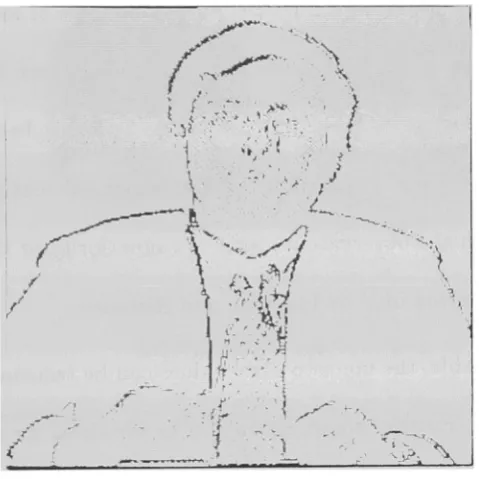
An encoder for the LPC error In the LPC error image of fig. 2, only 8% of the
pixels have non-zero intensities. These pixels are demonstrated in fig. 3 which is called an
LP C error mask.
Figure 3 - LPC error mask
Although , the majority of the significant errors are located around edges, tile picture in
fig. 2 is not suitable for contour coding. This is because of the lack of continuation and
varying intensity levels of the pixels located on the possible contours. The modification of
the intensities to obtain continuous and homogeneous contours causes st r ip artifacts in
the direction of recursion on the reconstructed image. On the other hand, if fig. 3 is
transmitted as a binary image and the pixel values inside the nonzero regions are
Although, the majority of the significant errors are located around edges, tile picture in
fig. 2 is not suitable for con t ou r coding. This is because of the lack of continuation and
varying intensity levels of the pixels located on the possible contours. The modification of
There are numerous techniques for encoding binary irnages.9 These are developed for
facsimile applications, however, most of them are applicable to encoding of the LPC error
mask. In this work, the modified READ code 10 and the arithmetic code 11 have been
tested. The modified READ code uses the similarity between the successive lines of a
binary image for data compression. Arithmetic coding makes use of local statistics and it
is very effective when the majority of the pixels have the same values. Mask pictures have
both of these properties. However, the arithmetic coder performs better because of the
existence of small isolated regions which cannot be encoded efficiently using the READ
code. This is consistent with the observation about the superiority of the arithmetic code
in facsimile applications reported in 11 by Langdon and Rissanen.
Once the mask is available, the nonzero pixel values can be transmitted in a specified
order, such as a raster scan. Further compression can be obtained by using a level plane
coding procedure for the single dimensional vector of nonzero pixel values. It has been
observed that, as low as eight quantization levels for the nonzero pixels are sufficient for
an acceptable reconstruction of the test image used in this paper.
Results
In fig. 4 the result obtained by using arithmetic code to transmit the LPC error mask
and a level-plane run-length code for the nonzero pixel values is demonstrated. In this
application the coding rate is 0.41 bpp. In order to cocle the same image using a
straight-forward quantization a coding rate of 3 bpp is required.
Figure 4 - Coded picture using the new technique
HVS based segmentation
Segmentation of images for coding purposes has been studied by many researchers.f
As stated in the previous section, it is possible to obtain very high compression rates using
this approach. The coding methods using segmentation vary in the criteria they use to
determine the homogeneity of the segments and the method they use to encode the
boun-daries and the insides of the segments. The homogeneity definition is particularly
impor-tant because it specifies the number of segments which determines the compression rate
and the qualit.y of the coded image. In the trivial case,where each pixel is considered to be
a segment, there is no compression and the coded image is the same with the original.
In image analysis, the main use of the segmentation is in automatic object
recogni-determine the homogeneity of the segments and the method they use to encode the
boun-daries and the insides of the segments. The homogeneity definition is particularly
impor-tant because it specifies the number of segments which determines the compression rate
coding applications, there is no need for such a correspondence and the visibility of the
intensity differences should be the main segmentation criterion.
If
theend
result isintended for a human observer, it is natural to use the characteristics of the HVS to
deter-mine the visibility. In this work, the incorporation of the HVS model in the segmentation
algorithm is accomplished in two steps: preprocessing the image and determining the
thresholds of the segmentation algorithm.
Preprocessing
Two fundamental properties of the HVS used in this application are Weber's law aud
the modulation transfer function (ivITF) of the eye.12 Weber's law states that the ratio of
the intensity difference between a visible region and its background to the intensity of the
background is a constant for medium intensity levels (Weber's region). For low and high
intensity levels, Weber's law does not hold, and the sensitivity of the human eye to
inten-sity differences reduces a great deal. This property is used in reducing the dynamic range
of the original image without loosing visible details for standard viewing conditions. The
determination of the Weber's range is accomplished by performing subjective experiments
on a set of test images. The upper and lower intensity bounds depend on the equipment
used.
The lvITF of the eye indicates that the eye has a bandpass response to the spatial
fre-quencies. That is, the visibility of very slow and very fast intensity transitions is low.
Dur-ing the preprocessDur-ing stage, this property together with the Weber's law is used in
remov-ing small regions which may increase the number of segments. The decision threshold in
removing of a region is based on its size and the intensity difference between the region
and its neighbors.
Segmentation
A variation of the centroid linkage region growing segmentation algorithm 13 is used
to segment the image. In this approach, the image is scanned using a conventional raster
scan. TIle value of each pixel is compared to the value of an already constructed neighbor
segment. If the intensity difference is less than the HVS based visibility threshold, which is
a function of the intensity of the neighboring segment, the pixel is joined to the existing
segment. If the intensity differences between the pixel and its neighbor segments are
larger than the corresponding thresholds, a new segment is started.
Experimentally determined thresholds based 011 HVS are published in varIOUS
sources.12 However, the display device and the viewing conditions make considerable
difference on the threshold values. Experiments with the display system are invaluable in
determining this extremely important function.
Results
In fig . .5, the HVS based segmentation result of the original image of fig. 1 is
demon-strated. This image has 20,5 segments, and using five bits to encode the intensity values
inside the segments and contour coding the boundaries, 0.15 bpp is a sufficient rate to
transmit this image. A problem with the segmentation approach is the visibility of the
segment boundaries in non-edge regions. Postprocessing can be performed to reduce this
artifact by rolling off the segment boundaries in such regions. The mathematical
difference between the coded image and the original is not small, however, most of the
important features of the original are preserved in the coding process.
Figure 5 - HVS based segmentation result
Conclusion
The results obtained using the image analysis approach to image coding are
encouragmg. However, in order to have a generally applicable codec based on such an
approach, there are many questions to be answered. Identification and encoding of the
textured areas, and extension of the techniques to make use of the previous frames in
image sequenc e transmission are two examples for these questions.
As in all other information lossy image coding techniques, the image analysis based
coders suffer from the lack of a meaningful fidelity cr iter io n .
A
possible way of comparingThe results obtained using the image analysis approach to image coding are
encouraging. However, in order to have a generally applicable codec based on such an
approach, there are many questions to be answered. Identification and encoding of the
References
[1] W. K. Pratt, Digital Image Processing, John vViley
&
Sons, New York 1978.[2] ~'L Kunt, A. Ikonomopoulos, M. Kocher, "Second-Generation Image-Coding Tech-niques," IEEE Proceedings, vol. 73, no. 4, pp. 549-,574, April 1985.
[3] P. A. Mar agos, R. 't-V.
Schafer,R.
M. Mersereau, "Two-Dimensional Linear Prediction and Its Application to Adaptive Predictive Coding of Images,If IEEE Transactions on.:lcotLstics Speech an.d Signal Processinq, vol. ASSP-32, no. 6, pp. 1213-1229, December 1984.
[4] D. Anast assiou, \\1. B. Pennebaker, J. L. Mitchell, "Gray-Scale Image Coding for Freeze-Frame Videoconferencing," IEEE Transactions on Communications, vol. CO~I-34, no. 4, pp. 382-394~April 1986.
[,5] T.F. Quatieri, "Object Detection by Two-Dimensional Linear Prediction," Proc. IEEE Inti. Coni...-1coustz"cs, Speech, and Signal Processing, Boston, April 1983.
[6] ivJ.D. Richard, C.W. Therrien,
J.S.
Lim, "Image Segmentation Using Spatial Linear Prediction." Proc. IEEE Inti. Con]. ~4coustics, Speech; and Signal Processing" pp. 32.3.1-32.3.4, San Diego, March 1984.[7] Y. Zhou. R. Challappa, \T. Venkateswar , "Edge Detection Using Zero Crossings of Direct ioual Derivatives of a Random Field Model." Proc, IEEE Inil. Coni. Acoustics, Speech, and Signal Processing, Tokyo, April 1986.
[8] J. C. Candy, :vl. .L~. Franke, B. G. Haskell, F. W. Mounts, "Transmitting Television as Clusters of Frame-to-Frame Differences,n The Bell System Technical .louriial, vol. 50, no. 6, pp. 1889-1917,1971.
[9]
v.
Yasuda, Y. Yamazaki, T. Kamae, K. Kobayashi, "Advances in Fxx,
n Proceedings oftheIEEE,
vol. 73, no. 4, pp. 706-'730, April 198,).[10] R. Hunter, A. H. Robinson, "International Digital Facsimile Coding Standards," Proceedings
0/
theIEEE,
vol. 68, no. 7, pp. 8.54-867~.July 1980.[11] G. G. Langdon,
J.
Rissanen, "Compression of Black-\Vhite Images with Arithmetic Codina.0 ,nIEEE
Transactions on Communications, vol. CO~1-29, no. 6~ pp. 8,58-867) June 1981.[12] J. G. Snodgrass, et al., Human Experimenial Psychology, Oxford Un iv. Press, 198.5. [13] R. M. Haralick, L. G. Shapiro, nImage Segmen tat ion Techniques." Computer Vision, Graphics, and Image Processing" vol. 29, pp. 100-132, 198.5.