ISSN: 2574 -1241
Comparison of Pathogenic Bacteria in Water and
Fecal-Source Samples in the Kathmandu Valley, Nepal,
Using High-Throughput DNA Microarray
Rajani Ghaju Shrestha
1,2, Kazuko Sawada
3, Daisuke Inoue
2, Hayato Yoshinaga
4, Bikash Malla
1,
Sarmila Tandukar
5, Dinesh Bhandari
6, Yasuhiro Tanaka
7, Kazunari Sei
3, Jeevan B Sherchand
6and Eiji
Haramoto
1*
1Interdisciplinary Center for River Basin Environment, University of Yamanashi, Japan
2Division of Sustainable Energy and Environmental Engineering, University of Yamanashi, Japan
3Department of Health Science, Kitasato University, Japan
4Environment and Medical Sciences Course, Kitasato University, Japan
5Department of Natural, Biotic and Social Environment Engineering, University of Yamanashi, Japan
6Institute of Medicine, Tribhuvan University, Nepal
7Department of Environmental Sciences, University of Yamanashi, Japan
*Corresponding author: Eiji Haramoto, Interdisciplinary Center for River Basin Environment, University of Yamanashi, Japan
DOI: 10.26717/BJSTR.2019.17.003060
Received: April 28, 2019 Published: May 08, 2019
Citation: R Ghaju Shrestha, K Sawada,
D Inoue, H Yoshinaga, B Malla, S Tan-dukar, D Bhandari, Y Tanaka, K Sei, J B Sherchand, E Haramoto. Comparison of Pathogenic Bacteria in Water and Fe-cal-Source Samples in the Kathmandu Valley, Nepal, Using High-Throughput DNA Microarray. Biomed J Sci & Tech Res 17(5)-2019. BJSTR. MS.ID.003060.
Keywords: DNA Microarray; Fecal
Con-tamination; Kathmandu Valley; Patho-genic Bacteria; Water Source
ARTICLE INFO abstract
Fecal contamination of water occurs from agricultural lands that use animal manure, runoff from urban surfaces, and direct discharge of untreated sewage. This study investi-gated and compared the presence of pathogenic bacteria using a DNA microarray targeting 941 pathogenic bacterial species/groups in water and fecal-source samples in the Kath-mandu Valley, Nepal. Sixteen water samples were collected from 13 shallow dug wells, a deep tube well, a spring, and a river, whereas a total of 16 composite fecal-source samples were collected from feces of chicken, dogs, ducks, pigs, ruminants, and human sewage. Nineteen pathogenic bacterial species/groups, including nine biosafety level (BSL) 2 and one BSL 3 bacteria, were detected in >70% of both the water and fecal-source samples.
Among the waterborne pathogenic bacteria identified, Helicobacter pylori, Klebsiella spp.,
Salmonella enterica serovars, Vibrio cholerae, and Yersinia enterocolitica were detected in both water and fecal-source samples, with detection ratios of >6% and >60%, respectively, suggesting that transmissions of these pathogenic bacteria in water might be from fecal sources. These results indicate that improper disposal of feces is occurring, causing fecal pollution in environmental waters and adversely affecting human and animal health.
Introduction
Rapid population growth and unplanned urbanization are
causing an insufficient drinking water supply, which is a major
problem in the Kathmandu Valley, Nepal. People are therefore using groundwater for drinking, cooking, bathing, and laundry purposes [1]. In previous studies conducted in the Valley, various types of pathogenic bacteria, viruses, and protozoa have been
near river banks [10,11]. A high demand for livestock products led to heavy discharge loads of feces into the environment [12]. Each gram of feces contains millions of bacterial cells, including diverse populations of bacteria [13,14]. Fecal pathogens, when discharged into the water environment, can survive for a long period, serving as a potential source and reservoir of waterborne diseases. Numerous outbreaks have been documented through waterborne transmission of fecal pathogens, resulting in mild gastrointestinal illness to even death [15-17].
In our previous study, numerous pathogenic bacteria were detected from water samples using next-generation sequencing [2]. Fecal-source samples contain many bacteria, which makes it time-consuming to identify all pathogens and a single assay cannot be
used. DNA microarray is a promising tool for the specific detection
of multiple genes simultaneously [5,14]. DNA microarray has been used for molecular community analyses and microbiological surveillance studies of environmental samples, fecal sources, and human waste; thus, DNA microarray is an important tool in molecular biology [18-21]. In this study, DNA microarray targeting 941 pathogenic bacterial species/groups was used to estimate the presence of pathogenic bacteria in water and fecal-source samples. Relationships between pathogenic bacteria detected from water sources and fecal-source samples were also determined.
Materials and Methods
Collection of Water Samples and Fecal-Source Samples
A total of 16 water samples were collected from 13 shallow dug wells, a spring, a deep tube well, and a river from the Kathmandu Valley in August 2015 [22]. The sample ID for water samples were labelled as KTM. In addition, 16 composite fecal-source samples were collected from feces of two chickens, three dogs, two ducks, three pigs, three ruminants, and three sewage samples from human in December 2015 [23]. For fecal-source samples, they were labelled from initial name based on type of fecal-source except for duck. A sterile spoon was used to collect the fecal-source sample, which was then stored in a 50-mL plastic tube. Each composite sample was mixed thoroughly, and 300-400 mg of the sample was mixed with autoclaved phosphate buffered saline to obtain a 1% fecal suspension.
Bacterial DNA Extraction
Bacterial DNA from the water samples was extracted using CicaGeneus DNA Extraction Reagent (Kanto Chemical, Tokyo, Japan) as previously described [2]. A similar procedure was followed for bacterial DNA extraction from the fecal-source samples by using 5 mL of the 1% fecal suspension.
DNA Microarray Analysis
DNA microarray targeting 16S rRNA genes of 941 pathogenic bacterial species/groups, including biosafety level (BSL) 2 and 3 pathogens and other opportunistic BSL 1 pathogens listed by the Japanese Society for Bacteriology, was used. The DNA microarray
used in this study was developed by Prof. Takayuki Ezaki at Gifu University, Japan, and was purchased from AMR Inc. (Gifu, Japan). The applicability of the microarray to environmental samples had
been assured by the developers and previously applied to landfill
leachets, river water samples, and shallow well groundwater [5,24,25]. In brief, Cy3-labeled polymerase chain reaction (PCR) products were prepared by using a PCR mixture (50 µL) containing 25 µL of SapphireAmp Fast PCR Master Mix (Takara Bio, Kusatsu, Japan), 0.25 µL each of 15 pmol/µL forward and reverse primers [5,26-28], 1 µL of DNA template, and 23.5 µL of ultrapure water. The thermal conditions were as follows: 94°C for 1 min, followed by 30 cycles of 98°C for 5 s, 55°C for 5 s, and 72°C for 10 s, and
finally 72°C for 10 s. Agarose gel electrophoresis was performed to confirm the amplification of Cy3-labeled PCR products, followed by purification of the products using a NucleoSpin Gel and PCR
Cleanup Kit (Macherey-Nagel, Bethlehem, USA).
DNA microarray hybridization and scanning were performed
as described previously [5]. Briefly, the hybridization mixture was
prepared by adding 5 µL of 10× Gene Expression Blocking Agent (Agilent, Waltham, USA) and 1 µL of 25× Fragmentation Buffer, which was mixed with 19 µL of Cy3-labeled PCR product solution. The tube was incubated at 60°C for 29 min and then cooled on ice
for 1 min. Twenty-five microliters of 2× Hybridization Buffer was
added to the tube and centrifuged at 15,300 × g for 1 min at 4°C. Then, the samples were hybridized with the pre-hybridized array at 55°C for 16 h. The microarray slides were washed and scanned with a GenePix 4000B (Molecular Devices, Sunnyvale, USA), and the scanned images were processed using GenePix Pro 7 software (Molecular Devices). Analysis of the scanned image data was performed as described previously [5].
Result and Discussion
Occurrence of Pathogenic Bacteria in Water Samples
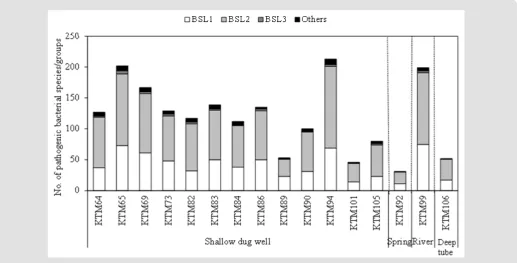
As shown in Figure 1, 31-213 pathogenic bacterial species/ groups were detected in each of the 16 water samples tested. The highest number of pathogen species/groups (213) was detected in KTM94, including 3 BSL 3 and 132 BSL 2 pathogens, followed by KTM 65 with 202 pathogen species/groups including 5 BSL 3 and 116 BSL 2 pathogens. BSL 3 pathogens were detected in 15 (94%) of the tested samples, with the highest number of 5 pathogen species/ groups in KTM65. Thirty BSL 2 pathogens and 1 BSL 3 pathogen were detected in >70% of the water samples tested. Among them, 9 BSL 2 and 1 BSL 3 pathogens were present in both water and fecal-source samples, with detection ratios of >70%, as shown in Table 1. In addition, Acinetobacter, Bartonella, Brevundimonas, Comamonas, Enterococcus, Erysipelothrix, Kingella, and Moraxella
study of groundwater and river water revealed 5 BSL 3 pathogens, of which the Anaplasma marginale/centrale group (39%) was detected most frequently [27]. In this study, 6 BSL 3 pathogens
were detected from different water samples, and the detection ratio of the A. marginale/centrale group (94%) was the highest (Table 1).
Figure 1: Numbers of pathogenic bacterial species/groups detected in water samples.
Table 1: Pathogenic bacterial species/groups present in >70% of both water and fecal-source samples.
Bacterial species/groups BSL No. of detected samples (% positive)
Water samples (n = 16) Fecal-source samples (n = 16)
Anaplasma marginale centrale 3 15 (94) 12 (75)
Bordetella avium group 2 14 (88) 12 (75)
Bordetella pertussis group 2 15 (94) 12 (75)
Chryseobacterium meningosepticum group 2 14 (88) 13 (81)
Chryseomonas luteola 2 15 (94) 12 (75)
Flavimonas oryzihabitans 2 15 (94) 12 (75)
Kluyvera cryocrescens 2 13 (81) 12 (75)
Legionella dumoffii 2 12 (75) 15 (94)
Pseudomonas aeruginosa 2 14 (88) 12 (75)
Sphingomonas parapaucimobilis 2 14 (88) 12 (75)
‘%’ indicates presence of bacteria in samples divided by total number of samples collected. A classification at the genus level revealed that 12 genera
(Acinetobacter, Agrobacterium, Anaplasma, Arthrobacter, Bordetella, Caulobacter, Flavimonas, Kingella, Legionella, Moraxella, Pseudomonas, and Xanthomonas) were present in 15 (94%) of the 16 samples tested. This result was comparable to that of a previous study, where genera such as Acinetobacter, Arthrobacter,
Brevibacterium, Legionella, and Pseudomonas, were detected in 82% (23/28) of water samples, which had been collected in 2014 [27]. Waterborne pathogenic bacteria that could be transmitted
through the fecal-oral route were identified, whereby Vibrio cholerae, Klebsiella spp., and Salmonella enterica serovars were
detected in 63%, 38%, and 31% of the water samples tested, respectively. Detection of various waterborne pathogenic bacteria in groundwater and river water samples indicates that there is a serious risk of pathogen infection through consumption of contaminated groundwater.
Occurrence of Pathogenic Bacteria in Fecal-Source
Sam-ples
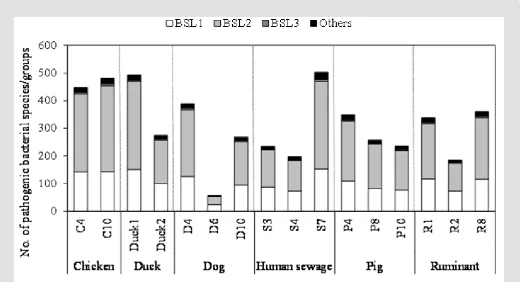
were present in at least one of the samples tested. The highest number of pathogenic bacterial species/groups (503) was found in the human sewage S7, followed by fecal-source samples of duck (Duck1, 493) and chicken (C10, 481). Out of 611 BSL 2 pathogens targeted, 317, 316, and 310 pathogens were detected in the samples Duck1, S7, and C10, respectively. Five BSL 2 pathogens (Borrelia re-currentis, Clostridium histolyticum, C. symbiosum, Helicobacter pylo-ri, and Suttonella indologenes) were detected in all the fecal-source samples tested. Of the total 14 BSL 3 pathogens targeted, at least one species/group was detected in all tested samples, with a
max-imum of 8 pathogens identified in a single sample (C10), followed
by 7 pathogens in the S7 sample, and 6 pathogens in the C4 and D4 samples. Waterborne pathogenic bacteria such as H. pylori, Klebsi-ella spp., S. enterica serovars, V. cholerae, and Yersinia enterocoliti-ca were detected in >60% of the fecal-source samples tested. Ac-cording to the World Health Organization (WHO), at least 2 billion people worldwide use fecal contaminated drinking water, and such use is estimated to cause 500,000 deaths due to diarrhea each year [29]. In Nepal, diarrhea and gastroenteritis are the leading causes of waterborne diseases (48%), followed by typhoid/paratyphoid fever (18%) [30]. Thus, preventive management approaches are re-quired to control the risks associated with human and animal feces.
Figure 2: Numbers of pathogenic bacterial species/groups detected in fecal-source samples.
Comparison of the Occurrence of Pathogenic Bacteria
Between Water and Fecal-Source Samples
Of the 941 pathogenic bacterial species/groups tested, 361 species/groups were present in common in at least one sample each from water and fecal-source samples. The number of pathogenic bacterial species/groups that were present in both the water sample and at least one of the fecal-source samples tested ranged from 19 to 121, as summarized in Table 2. The highest detection ratio of pathogenic bacterial species/groups present in both the water and fecal-source samples was 67% (31/46) in KTM101, followed by 65% (88/135) in KTM86 and 62% (33/53) in KTM89.
Table 2: Numbers of pathogenic bacterial species/groups detected in both a water sample and at least one of the fecal-source samples tested.
Source types Sample ID
No. of pathogenic bacterial species/groups detected
In the water sample In both a water sample and at least one of the fecal-source samples
Total (%) BSL 2 BSL 3
Shallow dug well
KTM64 127 61 (48) 36 1
KTM65 202 105 (52) 55 3
KTM69 167 98 (59) 54 2
KTM73 129 62 (48) 32 2
KTM82 117 56 (48) 36 2
KTM83 139 69 (50) 38 2
KTM84 112 56 (50) 32 1
KTM86 135 88 (65) 51 3
KTM89 53 33 (62) 18 1
KTM90 100 54 (54) 35 1
KTM94 213 120 (56) 68 3
KTM101 46 31 (67) 20 1
KTM105 80 41 (51) 24 1
Spring KTM92 31 19 (61) 9 0
River KTM99 199 121 (61) 68 3
Deep tube well KTM106 52 27 (52) 16 1
‘%’ indicates presence of pathogenic bacterial species/groups in both a water sample and at least one of the fecal-source samples to the total number of pathogenic bacterial species/groups present in the water sample.
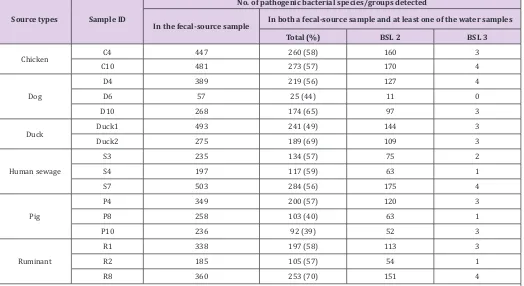
Table 3: Numbers of pathogenic bacterial species/groups detected in both a fecal-source sample and at least one of the water samples tested.
Source types Sample ID
No. of pathogenic bacterial species/groups detected
In the fecal-source sample In both a fecal-source sample and at least one of the water samples
Total (%) BSL 2 BSL 3
Chicken C4 447 260 (58) 160 3
C10 481 273 (57) 170 4
Dog
D4 389 219 (56) 127 4
D6 57 25 (44) 11 0
D10 268 174 (65) 97 3
Duck Duck1 493 241 (49) 144 3
Duck2 275 189 (69) 109 3
Human sewage
S3 235 134 (57) 75 2
S4 197 117 (59) 63 1
S7 503 284 (56) 175 4
Pig
P4 349 200 (57) 120 3
P8 258 103 (40) 63 1
P10 236 92 (39) 52 3
Ruminant
R1 338 197 (58) 113 3
R2 185 105 (57) 54 1
R8 360 253 (70) 151 4
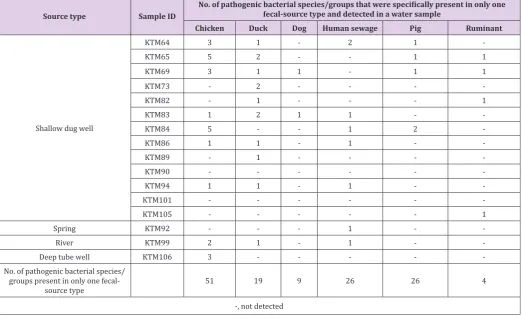
Table 4: Numbers of pathogenic bacterial species/groups detected in only one fecal-source type.
Source type Sample ID
No. of pathogenic bacterial species/groups that were specifically present in only one fecal-source type and detected in a water sample
Chicken Duck Dog Human sewage Pig Ruminant
Shallow dug well
KTM64 3 1 - 2 1
-KTM65 5 2 - - 1 1
KTM69 3 1 1 - 1 1
KTM73 - 2 - - -
-KTM82 - 1 - - - 1
KTM83 1 2 1 1 -
-KTM84 5 - - 1 2
-KTM86 1 1 - 1 -
-KTM89 - 1 - - -
-KTM90 - - -
-KTM94 1 1 - 1 -
-KTM101 - - -
-KTM105 - - - 1
Spring KTM92 - - - 1 -
-River KTM99 2 1 - 1 -
-Deep tube well KTM106 3 - - - -
-No. of pathogenic bacterial species/ groups present in only one
fecal-source type 51 19 9 26 26 4
-, not detected
As shown in Tables 2 & 3, the detection of same species/ groups of pathogenic bacteria in both fecal-source samples and water samples implies that these bacteria in fecal-source samples might be a source of fecal contamination in water samples. Water quality, human health, and fecal-source samples are interrelated, and pathogenic bacteria in water and fecal-source samples play an important role in these three parameters [31]. Although the adverse effects of pathogens depend on the risk of exposure, environmental interaction, host susceptibility, and pathogen virulence, the effect of pathogens would be reduced if any one of these determinants are lowered [32]. Therefore, it is necessary to identify and treat species/groups of pathogenic bacteria present in environmental samples, and therefore reduce their effects on humans and animals. The numbers of bacterial species/groups detected in only one fecal-source type were as follows: 51, 19, 9, 26, 26, and 4 for chickens, ducks, dogs, human sewage, pigs, and ruminants, respectively (Table 4). The highest number of water samples with bacterial species/groups that were present in only one fecal-source sample was obtained from duck fecal-source samples (10 water samples), followed by fecal-source samples from chicken (9 water samples), and human sewage (7 water samples). In KTM69, contamination
from 5 different fecal-source types was identified, whereas no fecal-source type specific contamination was found in KTM90 and
KTM101. In fecal-source samples, waterborne pathogenic bacteria with detection ratios of >60%, H. pylori, Klebsiella spp., S. enterica
serovars, V. cholerae, and Y. enterocolitica were also obtained
in water samples with detection ratios of 6%, 38%, 31%, 63%, and 19%, respectively. Even though there are limitations in the sensitivity of probe-based assays, DNA microarray can be useful for identifying one or many sources of fecal contamination in water samples [19,33,34]. The single or multiple detection of pathogens
present in both fecal-source and water samples could be efficiently
performed using DNA microarray, as bacterial species/groups
present only in specific fecal-source samples were also present in
water samples (Table 4).
Conclusion
In summary, diverse species/groups of pathogenic bacteria, in-cluding waterborne pathogenic bacteria, were detected from water and fecal-source samples. Overall, the detection of large numbers of pathogenic bacterial species/groups by DNA microarray could be a useful tool to demonstrate interrelationships of pathogenic bacterial species/groups between water and fecal-source samples.
The identification and treatment of pathogens, thus decreasing the
risk of exposure to them, might reduce adverse effects on humans and animals. Therefore, safe water and public health services for prompt action should be taken to ensure that sewage is managed and treated properly before discharging into the environment, which will therefore increase the safety and quality of water for hu-man use. Also, full sanitation is a good weapon against fecal patho-gens and the sanitation can be dry sanitation and animal manure
Acknowledgement
This study was supported by the Science and Technology Research Partnership for Sustainable Development (SATREPS) program of the Japan International Cooperation Agency (JICA) and the Japan Science and Technology Agency (JST), entitled “Hydro-microbiological Approach for Water Security in Kathmandu Valley, Nepal.” The authors thank Prof. Suresh Das Shrestha (Tribhuvan University, Nepal), Prof. Kei Nishida, and Dr. Takashi Nakamura (University of Yamanashi, Japan) for their continuous support in water sampling, Mr. Khadga Bahadur Shrestha (University of Yamanashi, Japan) for guidance, and Mr. Takahiro Yamada, Ms. Erina Miyata, Ms. Hitoha Moriyama, and Mr. Rui Osada (University of Yamanashi, Japan) for their invaluable support during laboratory analysis.
References
1. Shrestha S, Aihara Y, Bhattarai AP, Bista N, Rajbhandari S, et al. (2017) Dynamics of domestic water consumption in the urban area of the Kathmandu Valley: situation analysis pre and post 2015 Gorkha earthquake. Water 9(3): 222.
2. Ghaju Shrestha R, Tanaka Y, Malla B, Bhandari D, Tandukar S, et al. (2017) Next-generation sequencing identification of pathogenic bacterial genes and their relationship with fecal indicator bacteria in different water sources in the Kathmandu Valley, Nepal. Sci Total Environ 601-602: 278-284.
3. Haramoto E, Yamada K, Nishida K (2011) Prevalence of protozoa, viruses, coliphages and indicator bacteria in groundwater and river water in the Kathmandu Valley, Nepal. Trans R Soc Trop Med Hyg 105(12): 711-716. 4. Haramoto E (2018) Detection of waterborne protozoa, viruses, and
bacteria in groundwater and other water samples in the Kathmandu Valley, Nepal. IOP Conf Ser Earth Environ Sci 120(1): 012004.
5. Inoue D, Hinoura T, Suzuki N, Pang J, Malla R, et al. (2015) High-throughput DNA microarray detection of pathogenic bacteria in shallow well groundwater in the Kathmandu Valley, Nepal. Curr Microbiol 70(1): 43-50.
6. Prasai T, Lekhak B, Joshi DR, Baral MP (2007) Microbiological analysis of drinking water of Kathmandu Valley. Sci World 5: 112-114.
7. Shrestha S, Haramoto E, Shindo J (2017) Assessing the infection risk of enteropathogens from consumption of raw vegetables washed with contaminated water in Kathmandu Valley, Nepal. J Appl Microbiol 123(5): 1321-1334.
8. Tandukar S, Sherchand JB, Bhandari D, Sherchan SP, Malla B, et al. (2018) Presence of human enteric viruses, protozoa, and indicators of pathogens in the Bagmati River, Nepal. Pathogens 7(2): 38.
9. Tanaka Y, Nishida K, Nakamura T, Chapagain SK, Inoue D, et al. (2012) Characterization of microbial communities distributed in the groundwater pumped from deep tube wells in the Kathmandu Valley of Nepal. J Water Health 10(1):170-180.
10. Asian Development Bank (2013) Solid Waste Management in Nepal. Kathmandu, Nepal.
11. Li X, Harwood VJ, Nayak B, Staley C, Sadowsky MJ, et al. (2015) A novel microbial source tracking microarray for pathogen detection and fecal source identification in environmental systems. Environ Sci Technol 49(12): 7319-7329.
12. Thornton PK (2010) Livestock production: recent trends, future prospects. Philos Trans R Soc 365(1554): 2853-2867.
13. Lagier JC, Million M, Hugon P, Armougom F, Raoult D (2012) Human gut microbiota: repertoire and variations. Front Cell Infect Microbiol 2: 1-19. 14. Paliy O, Kenche H, Abernathy F, Michail S (2009) High-throughput
quantitative analysis of the human intestinal microbiota with a phylogenetic microarray. Appl Environ Microbiol 75(11): 3572-3579.
15. Bartram J (2012) Animal Waste, Water Quality and Human Health. In: Dufour A, Bartram J, Bos R, Gannon V (Eds.), (1st edn.). World Health
Organization, IWA Publishing, London, UK.
16. Effler E, Isaäcson M, Arntzen L, Heenan R, Canter P, et al. (2001) Factors contributing to the emergence of Escherichia coli O157 in Africa. Emerg Infect Dis 7(5): 812-819.
17. Wilson DJ, Gabriel E, Leatherbarrow AJH, Cheesbrough J, Gee S, et al. (2009) Rapid evolution and the importance of recombination to the gastroenteric pathogen Campylobacter jejuni. Mol Biol Evol 26(2): 385-397.
18. Call DR, Borucki MK, Loge FJ (2003) Detection of bacterial pathogens in environmental samples using DNA microarrays. J Microbiol Methods 53(2): 235-243.
19. Cao Y, Van De Werfhorst LC, Dubinsky EA, Badgley BD, et al. (2013) Evaluation of molecular community analysis methods for discerning fecal sources and human waste. Water Res 47(18): 6862-6872. 20. Gomes M, Vieira H, Vale FF (2015) Characterization, validation and
application of a DNA microarray for the detection of mandatory and other waterborne pathogens. J Biochem 158(5): 393-401.
21. Huyghe A, Francois P, Schrenzel J (2009) Characterization of microbial pathogens by DNA microarrays. Infect Genet Evol 9(5): 987-995. 22. Ghaju Shrestha R, Tanaka Y, Malla B, Tandukar S, Inoue D, et al. (2018)
Development of a broadly reactive quantitiative PCR assay for Arcobacter spp. and its application to environmental water samples. Microbes and Environ 33(3): 309-316.
23. Malla B, Ghaju Shrestha R, Tandukar S, Bhandari D, Inoue D, et al. (2018) Validation of host-specific Bacteroidales quantitative PCR assays and their application to microbial source tracking of drinking water sources in the Kathmandu Valley, Nepal. J Appl Microbiol 125(2): 609-619. 24. Inoue D, Inaba M, Upadhye RR, Sei K, Ike M (2009) Multiple detection
of occurrence of bacterial pathogens in two rivers in the Kinki district of Japan with a DNA microarray. Japanese J Wat Treat Biol 45(1): 31-43. 25. Upadhye RR, Inoue D, Inaba M, Sei K, Ike M (2008) DNA microarray
analysis of temporal and spatial variation of bacterial communities in Japanese rivers. Japanese J Wat Treat Biol 44(2): 109-120.
26. Tamaki H, Sekiguchi Y, Hanada S, Nomura N, Matsumura M, et al. (2005) Comparative analysis of bacterial diversity in freshwater sediment of a shallow eutrophic lake by molecular and improved cultivation-based techniques. Appl Environ Microbiol 71(4): 2162-2169.
27. Inoue D, Yoshinaga H, Malla B, Ghaju Shrestha R, Tandukar S, et al. (2018) Comprehensive detection of pathogenic bacteria in jar water, community well groundwater, and environmental water in the Kathmandu Valley, Nepal. Japanese J Water Treat Biol 54(2): 65-72.
28. Weisburg WG, Barns SM, Pelletier DA, Lane DJ (1991) 16S ribosomal DNA amplification for phylogenetic study. J Bacteriol 173(2): 697-703. 29. World Health Organization (2017) Fact sheet on drinking water. 30. Department of Health (2016) Annual report on Department of Health
Service. Ministry of Health, Kathmandu, Nepal.
31. Suresh GK, Toranzos GA, Fayer R, Nissaparton V, Olveda R, et al. (2012) Assessing the importance of zoonotic waterborne pathogens. In: Dufour A, Bartram J, Bos R, Gannon V (Eds.), (1st edn.). Animal Waste, Water
Quality and Human Health. World Health Organization, IWA Publishing: London, UK, pp: 17-72.
32. Robertson W, Yasvinski G (2012) Water Quality and Human Health. Animal Waste, World Health Organization, In: Dufour A, Bartram J, Bos R, Gannon V (1st edn.). IWA Publishing: London, UK, pp: 257-282.
33. Boehm AB, Van De Werfhorst LC, Griffith JF, Holden PA, et al. (2013) Performance of forty-one microbial source tracking methods: A twenty-seven lab evaluation study. Water Res 47(18): 6812-6828.
Submission Link: https://biomedres.us/submit-manuscript.php
Assets of Publishing with us
• Global archiving of articles
• Immediate, unrestricted online access • Rigorous Peer Review Process • Authors Retain Copyrights • Unique DOI for all articles
https://biomedres.us/
This work is licensed under Creative Commons Attribution 4.0 License ISSN: 2574-1241